
Home / Hayati Pro Max Plus Pods / Blue Frozen Hayati Pro Max Plus Pods
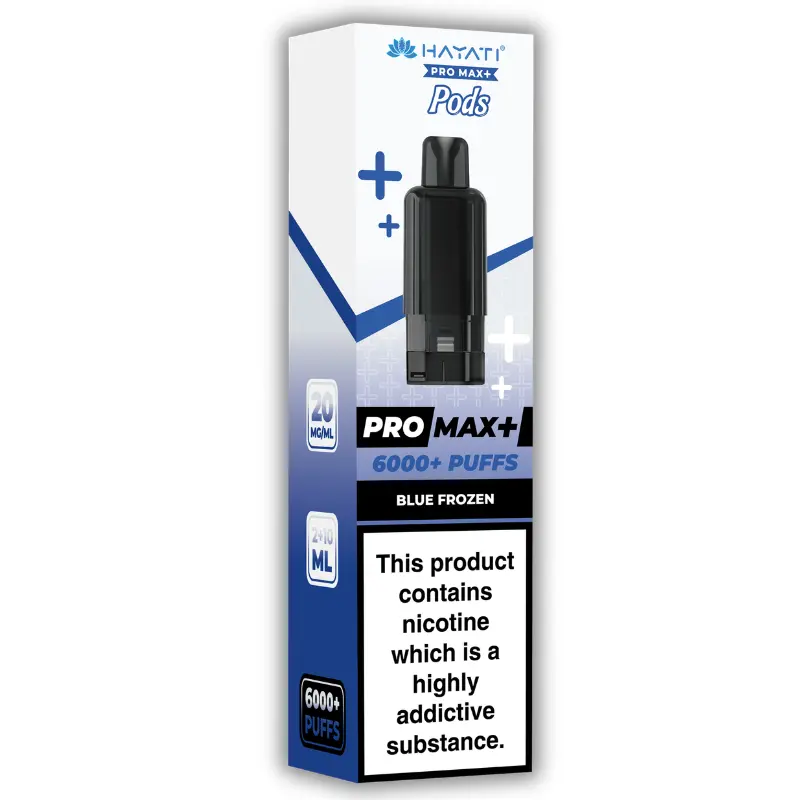
Hayati · Pro Max Plus
Blue Frozen Hayati Pro Max Plus Pods
£5.49
✔ In stock — ready to ship
Genuine Hayati
Free over £20
Same-day dispatch
Secure checkout
Blue Frozen is a sealed replacement pod for the Hayati Pro Max Plus, priced at £5.49, holding 12ml of 20mg nicotine salt liquid, sold without a device because you already own one. Sweet blue fruit of the blueberry and blue raspberry sort, carrying a lot of cold. That is the listing in a sentence, and if all you wanted was to know whether the pod is in stock and what it costs, you can stop here and buy it.
The interesting thing about this listing is the second word, and it is interesting for a reason that has nothing to do with how the liquid tastes. Hayati sell 492 listings across their range. Most of the cold ones say Ice. This one says Frozen. Two others say Cooler. Some say Mint, a handful say Menthol, one says Cold and one says Frosted. Six or seven different words for what a buyer experiences as one axis, and no published key anywhere explaining how they relate.
So the question that actually matters when you are standing in front of a shelf of cold pods is this: is Frozen colder than Ice? Is Cooler warmer than both? Is there a ladder here that a careful shopper could climb, or are these words interchangeable decoration attached to whichever flavour name sounded right on the day?
Nobody appears to have asked. It is answerable, though, not by tasting 121 pods but by counting them, because a naming convention leaves fingerprints in a catalogue whether or not anyone writes the convention down. A word used as a tier behaves differently from a word used as a label, and the difference shows up in how many products carry it, which platforms and flavour families it lands on, whether it ever combines with its neighbours, and whether the filing system behind the shop treats it as meaning anything.
This page counts all of that, reports what the numbers permit and what they do not, and then gives you the thing the count cannot: a method for establishing where this pod actually sits on your own palate, plus a short list of pods that make decent measuring sticks. The answer to the headline question is no, by the way. It is stated with the evidence in the section after next, rather than buried at the bottom.
Counting every cold word in the range
The raw material here is the product catalogue that drives this shop: 492 Hayati listings, each with a title, a set of shelf assignments, a set of tags and a block of flavour text. Everything below comes out of that file and nothing has been estimated. Where a number is a judgement rather than a match, it says so.
First, the simple census. How many listings carry each cold word in the title, and how many genuinely distinct flavour names does that represent once you stop counting the same flavour three times because it is sold as a bottle, a pod and a kit?
| Word in the title | Listings | Distinct flavour names |
| Ice | 90 | 21 |
| Mint (including Spearmint and Frosted Mint) | 19 | 7 |
| Menthol | 7 | 5 |
| Frozen | 3 | 1 |
| Cooler | 2 | 1 |
| Cold | 1 | 1 |
| Frost | 1 | 1 |
| Chill | 0 | 0 |
| Freeze | 0 | 0 |
| Cool, standing alone | 0 | 0 |
Across the whole range, 121 of 492 listings put a cold word in the title. A shade under a quarter. That is the population the rest of this section is about.
Two of these words name exactly one product each
Start with the number that settles most of the argument on its own. Frozen appears on three listings. All three are Blue Frozen: this pod at £5.49, the Blue Frozen Hayati Pro Max Plus 6000 Pod Kit at £7.99, and a 10ml bottle in the nic salt line at £2.49. One flavour, sold three ways.
Cooler appears on two listings. Both are Kiwi Cooler Hayati Pro Max Plus Pods and the matching kit. One flavour, sold two ways.
Take a moment with what that means, because it is easy to read past. A grading scale is a thing with rungs, and a rung with one occupant is not a rung, it is a name. If Frozen were the top of a Hayati cooling ladder you would expect to find Strawberry Frozen, Mango Frozen, Cola Frozen, the same fruit vocabulary that Ice is attached to, sorted into a colder tier. There is no such family. There is one product that happens to be called Blue Frozen, in the way that one product happens to be called Mad Blue and one happens to be called Black Mamba.
Ice is different in kind, not just in quantity. Its 90 listings resolve to 21 separate flavour names, nineteen of which follow one grammatical pattern: a fruit or a drink, then the word. Banana Ice, Blackberry Ice, Cherry Ice, Cola Ice, Grape Ice, Lychee Ice, Mango Ice, Pineapple Ice, Red Apple Ice, Watermelon Ice and the rest. A pattern with 21 members, applied across every platform Hayati make, is a productive convention. Somebody at the company can take a new fruit tomorrow, add the word, and everyone will understand what has been done. That is what a category looks like from the outside.
The other two members of the Ice group are the exceptions that prove the pattern is a pattern: Ice Pop and Ice Cold put the word at the front, where it is doing something else entirely. Ice Pop names a frozen confection. Ice Cold, which is a nicotine pouch rather than a vape, doubles the word for emphasis. Neither is a fruit with cooling bolted on.
Three of the words in the question do not exist
The premise handed to this page included Chill as one of Hayati's cooling words. It appears in zero of 492 titles. Not once, in any form, including Chilled. Freeze appears zero times. Cool, standing on its own as a modifier rather than inside Cooler, appears zero times.
This is worth flagging rather than quietly correcting, because the corpus of pages on this site has already made the mistake in print. Another listing for this same flavour, the Blue Frozen bottle in the nic salt line, states that Hayati use three cold words and names them as Ice, Frozen and Freeze. Two of those are real. The third is not in the data at all. Nobody was being careless in a way that matters much, and the surrounding argument on that page is sound, but it illustrates the failure mode precisely: cold vocabulary feels familiar, the trade does use Freeze widely, and a writer reaching for a third example supplied one from memory rather than from the file.
So treat every claim on this page as something you could check, including the ones that flatter the argument. The counts above come from matching whole words in the title field of the catalogue, and anyone with the file can reproduce them in a minute.
What a thirty-to-one split can and cannot tell you
Ninety listings against three is a big asymmetry and it is tempting to over-read it. Here is what it does support and what it does not.
It supports the conclusion that Ice is the default and everything else is an exception. When Hayati want to signal cold on a fruit, they write Ice, and they do it for 21 different fruits across every device family they sell. The exceptions are not a system operating alongside the default. They are two individual product names and a couple of pouches.
It does not support any conclusion about relative temperature, and this is the step where the reasoning would go wrong if you let it. Rarity is not intensity. A word used once could be marking the coldest thing in the range, or it could be marking a product whose flavour name needed a second word and Ice had already been used on a blue fruit somewhere else, or it could be a licensing artefact, or somebody's preference. One data point cannot distinguish between those, because you cannot establish a convention from a single instance. Whatever the Blue Frozen recipe turns out to be, it is not evidence about what Frozen means, because there is nothing else called Frozen to compare it with.
There is a second thing the numbers rule out, and it is the test that would have saved the whole hypothesis if it had gone the other way. If these words were dimensions rather than alternatives, you would expect them to stack. A recipe with menthol in it and a heavy coolant dose on top might reasonably be called Menthol Ice, or Frozen Mint. Across 492 listings, the number that combine a word from the ice family with a word from the mint family is zero. None. The only listings carrying two cold words at all are the twelve called Fresh Mint, where Fresh is an adjective attached to the herb rather than a separate signal, and the single Ice Cold pouch.
Words that never co-occur are alternatives to each other. They occupy the same slot in the name and the formulator picks one. That is the behaviour of synonyms in a naming grammar, not of graduated measurements.
The one family where the vocabulary genuinely is graded
Having spent several hundred words dismantling the scale, honesty requires the counterexample, because there is one and it is instructive about where the line falls.
Inside the mint and menthol group, Hayati's own flavour text does rank the products explicitly and consistently. Double Menthol Hayati Pro Max Plus Pods is described as menthol with the volume raised, sharp and bracing, with no fruit named to soften it. The Spearmint listing on the same shelf says the opposite in as many words: it cools without the bite of peppermint or menthol, and it sits at the relaxed end of the scale. The listing for Fresh Mint Hayati Pro Max Plus Pods places itself between the two and points readers who want something colder towards the menthol option by name.
Three products, ranked against each other in their own copy, with the ranking pointing the same direction every time. That is a scale. Note what makes it work: Menthol, Mint and Spearmint are ingredient names. They refer to substances with known characters, so the ordering has something real underneath it and Hayati can state it without inventing anything. Menthol is a specific compound that people recognise. Spearmint is a specific plant that tastes different from peppermint.
Ice, Frozen and Cooler are not ingredient names. They are descriptions of an effect, and an effect has no fixed strength attached to the word describing it. Nobody can say how cold Ice is in the way they can say what menthol is, and Hayati's copy never attempts a cross-family ranking. Not once in 492 listings does any flavour text compare an Ice product with a Frozen one, or place Cooler above or below either. The comparisons exist only inside the ingredient-named group.
Which gives a much sharper version of the answer than the one the question asked for. The vocabulary is graded where it names substances and ungraded where it names sensations, and the reason is not marketing laziness. It is that the first kind of word has a referent and the second kind does not.
Where the filing system disagrees with the names
Every listing in the catalogue carries tags and shelf assignments as well as a title, and these were applied by somebody at some point with an intention. If the cold words meant anything systematic, the filing would reflect it. It does not, and the way it fails is more informative than a clean result would have been.
There is an ice grouping in the data with 92 members. Eighty-seven of those have Ice in the title, which is the expected majority. Five do not, and the five are the whole story: the Blue Frozen bottle, both Kiwi Cooler listings, the Black Mamba bottle, and a Blackberry Raspberry bottle.
Read that list again. Frozen and Cooler are both filed as ice. Whoever tagged the catalogue treated those words as members of the same class rather than as tiers above or below it, which is direct evidence from inside the company's own system that the three words are alternatives. The tagging says synonym.
Then it immediately stops saying anything reliable, in two ways.
First, it is inconsistent across formats of one flavour. Blue Frozen exists three times. The bottle is tagged as ice. This pod and the kit are not tagged as ice at all. Same flavour name, same manufacturer, same cold billing, and two of the three listings are missing from the group that is supposed to collect them. Kiwi Cooler does the same thing with the menthol tag: the pod carries it, the kit does not. If you were to browse the ice grouping looking for cold pods, this listing would not appear in it, and you would conclude that Hayati sell no frozen pod. The grouping is not a reliable index of what is cold.
Second, and worse, it contains at least one listing whose own description denies the classification. The Blackberry Raspberry bottle is filed under ice, and its flavour text ends by recommending it to anyone who wants mixed berry without any cooling. It is in the cold group and it says it is not cold. Meanwhile Blackberry Raspberry Hayati Pro Max Plus Pods, the same flavour name in pod form, is not filed under ice, which is at least consistent with the description even if it is inconsistent with the bottle.
None of this is a scandal. Product catalogues at this scale are assembled by several people over several years and they drift. But it does dispose of the last route by which a buyer might have hoped to decode the vocabulary. The names do not encode intensity, and the filing behind the names does not encode it either, and in a few places the filing is simply wrong.
Cooling that the name does not mention
One more count, this one scoped tightly to the shelf you are shopping from, because it is the practical half of the finding.
The Hayati Pro Max Plus Pods shelf holds 89 listings. Sixteen of them put a cold word in the title: Banana Ice, Blackberry Ice, Blue Frozen, Cola Ice, Double Menthol, Fresh Mint, Ice Pop, Kiwi Cooler, Lychee Ice, Pineapple Ice, Red Apple Ice, Smooth Strawberry Ice, Spearmint, Strawberry Raspberry Ice, Vim Ice and Watermelon Ice.
At least six more are cooled and do not say so in the name. Blue Razz Mojito Hayati Pro Max Plus Pods describes a cool mint lift in its flavour text and tells readers who find straight menthol too much that this is the gentler route to the same thing. The Strawberry Raspberry Mojito pod names fresh mint as the first element of the blend. Four listings are sold under a nicotine strength rather than a flavour, including Hayati Pro Max Plus Prefilled Pods 10mg, and every one of them is filled with Banana Ice, so the cooling is in the pod and the title mentions neither the fruit nor the chill.
Then there is Black Mamba, which is the single best illustration of the whole problem on this shelf. The pod listing describes a mood, says the name hints at intensity rather than ingredients, and mentions no cooling whatsoever. The bottle of the same flavour in the nic salt line describes a cooling note that arrives late and sharpens the fruit, leaves the finish colder than the inhale suggested, and records the profile in a structured field as mixed berries with a cool finish. Same flavour name. One listing tells you it is cooled and the other does not.
So the name does not reliably tell you how much cooling a pod has, and it does not reliably tell you whether there is any. Twenty-two of 89 pods on this shelf are cooled on the available evidence and sixteen of them say so.
The verdict, stated without hedging
Hayati's cooling words are not a graded scale and a buyer cannot infer intensity from which one appears in a product name. Ice is the default label, applied to 21 flavours. Frozen and Cooler are individual product names, each attached to exactly one flavour, filed by Hayati's own tagging as ice rather than as anything above or below it. Chill and Freeze do not exist in the range. The words never combine with one another, which is how alternatives behave and not how dimensions behave. The only genuine ranking anywhere in the vocabulary is inside the mint and menthol group, where the words name substances instead of sensations, and it does not extend outwards to the ice family.
That is a useful thing to know because it removes a decision procedure most people are using without examining it. If you have ever picked one cold pod over another on the strength of which word was printed on it, you were reading a signal that is not being transmitted.
What is actually knowable about the cold in this pod
Everything above is evidence about naming. The step from naming to liquid is a different kind of claim and this corpus has a record of getting it wrong, so it gets marked clearly here rather than slid past.
What follows separates three things: what the listing states, what can be read off the range with moderate confidence, and what nobody is in a position to tell you.
On the record for this pod
The flavour text for this listing says the core is sweet blue fruit in the blueberry and blue raspberry style, that the chill is heavy, that the cooling is a substantial part of the experience rather than a finishing touch, and that the fruit stays sweet and identifiable underneath it. It says the pod suits vapers who like their flavours properly cold.
That is a more forthcoming description than most cold listings get. Compare the flavour text on Cola Ice Hayati Pro Max Plus Pods, which mentions an icy exhale and a crisp rather than syrupy result without ever indicating how much ice, or Blackberry Ice Hayati Pro Max Plus Pods, which says the chill complements the fruit rather than masking it. Both are useful sentences. Neither gives you a level. This listing at least commits to heavy, and to the cooling being structural rather than decorative.
So the cold-versus-warm question is settled for this pod by the description, not by the word Frozen. Had the same paragraph appeared under the name Blue Ice, you would know exactly as much.
The one extra fact the range supplies, and its limits
Fifteen listings out of 492 carry a structured profile field naming what is in the blend. All fifteen are bottles in the nic salt line, and one of them is Blue Frozen, where the field reads: blue raspberry and menthol.
That is the only place in the entire catalogue where a cooling word in a title is decoded into an ingredient. Look at what the same field does for the others and the contrast is sharp. Red Apple Ice is recorded as red apple and ice. Blackberry Ice as blackberry and ice. The field restates the title word and adds nothing. For Blue Frozen it names a substance instead, and menthol is a substance with a character, aromatic as well as cold, which is a different proposition from a bare coolant that chills without smelling of anything.
Now the limit, and it is a real one. That field belongs to the 10ml bottle at 10mg on a half-and-half base. This is a sealed 12ml pod at 20mg. They share a flavour name and a manufacturer and nothing else that is published. Hayati do not state that the two recipes are identical, and the range gives at least one worked example of a shared name covering differently described liquids, which is the Black Mamba case set out above. Reasoning from the bottle to the pod is exactly the move the naming analysis has just spent 2,000 words warning against, so it is offered as a probability and not as a fact.
Tagged by confidence
- Reasonably confident. This pod is heavily cooled, and the cooling is a lead component rather than a finish. The listing states it directly, in terms that distinguish it from the softer descriptions given to several Ice pods on the same shelf.
- Reasonably confident. The fruit is the manufactured blue confectionery profile rather than a garden blueberry, and it is pitched sweet. The listing says sweet twice and names both blueberry and blue raspberry.
- Probable. The coolant is menthol rather than an odourless cooling compound, on the strength of the structured field attached to the bottle of the same name. If that carries across, expect an aromatic minty edge alongside the cold sensation rather than cold on its own.
- Unknown. How this ranks against Double Menthol, or against any individual Ice pod on the shelf. No dose is published for any listing in the range, no two listings are ever ranked against each other outside the mint group, and the word in the title does not supply the answer.
- Unknown. Whether the pod recipe matches the bottle recipe at all.
- Unknown, and not knowable from any page. Where it will sit for you, which depends on what you have been vaping recently. Another listing on this site, the Smooth Strawberry Ice pod page, works through why a heavy cold user reads the same liquid as milder than a light one does, and that argument is not repeated here.
What this pod is not
- It is not a mint pod. There is cooling in quantity and probably menthol behind it, but the subject of the blend is sweet blue fruit. For mint as the subject, the shelf has Fresh Mint, Spearmint and Double Menthol.
- It is not sour. Nothing in the listing indicates acid, and the blue confectionery profile is not built around it. Blue Razz Lemonade Hayati Pro Max Plus Pods is where the tang lives among the blue options.
- It is not a blueberry pod in the fruit sense. The listing names blue raspberry alongside blueberry, and blue raspberry is a confectionery flavour rather than a fruit. Blueberry Pomegranate Hayati Pro Max Plus Pods puts actual berry character in front.
- It is not lightly cooled, and the listing goes out of its way to say so. If a hint of chill is what you want, this is the wrong pod and the shelf has gentler options.
- It is not the coldest thing Hayati sell, as far as anyone can establish. Double Menthol is described in stronger terms than this listing uses, which is the closest thing to a ranking the range provides.
The pod as an object
Short section, because the Pro Max Plus hardware has been documented across this site at length and none of it changes for a blue liquid.
What arrives is one sealed pod holding 12ml of liquid at 20mg, prefilled at the factory, with no battery, no charger and no packaging beyond what protects the pod. It fits a Pro Max Plus body you already own. Match the range name on your device to the range name in this title before ordering, because Hayati sell several pod formats that look broadly similar.
The specification that matters for this particular liquid is the nicotine strength, and not for the usual reason. Twenty milligrams per millilitre is the ceiling permitted for sale in the United Kingdom, so every standard pod on this shelf carries the same figure and it is not a choice you are making here. What is worth knowing is that heavy cooling and a high salt strength interact on the inhale. Cold raises the apparent sharpness of a draw at the back of the throat, so a strongly cooled pod at 20mg feels firmer on the inhale than an uncooled pod at the same number. If your usual pods are warm fruit, expect this one to read as more assertive even though nothing about the nicotine has changed. A slower, longer draw moderates it; a short sharp pull does the opposite.
Hayati rate the pod at up to 6,000 puffs. That figure comes out of test equipment running a fixed routine, and your own total will depend on how long you draw and how often, so treat it as a comparison between listings rather than a prediction about your week. The rest of the shelf, including the pods not mentioned on this page, sits on Hayati Prefilled Pods & Refills.
The numbers, and one row that is deliberately empty
Everything Hayati publish against this listing, with nothing added to fill a gap.
| Listing | Blue Frozen Hayati Pro Max Plus Pods |
| Cooling word used | Frozen, one of three listings in the range carrying it |
| Cooling dose | Not published, for this or any listing |
| Flavour as recorded | Blue Frozen |
| Liquid held | 12ml, prefilled and sealed |
| Nicotine | 20mg/ml, salt form |
| Manufacturer puff rating | Up to 6,000, a laboratory figure |
| Device | Not included, Pro Max Plus required |
| Price | £5.49 |
| Maker | Hayati |
The empty row is the point of putting a table here at all. A cooling dose is the single number that would answer every question this page has raised, and it is not published for this pod, for any Ice pod, or for Double Menthol. No manufacturer in the category publishes it. That absence is why the naming convention carries so much weight with buyers, and why it matters that the convention turns out not to be carrying any information.
On the other rows there is less to say than usual. Twelve millilitres in a sealed pod is a larger volume than most prefilled formats, which mainly affects how often you are buying rather than how the liquid behaves. The price sits level with the rest of the shelf, so choosing between flavours here costs nothing either way, and the kit is £2.50 more because it has a device in the box. Buying this pod rather than the kit is the correct move if and only if you already own the body.
Finding your own zero, and what to measure against
Since the label will not rank the pods for you, the alternative is to build a small reference set of your own. This takes about a fortnight of ordinary vaping and it is worth doing once, because after that every cold listing in the range becomes legible.
Establishing the ends before the middle
You cannot place something on a scale until you know where the ends are. Buy two pods that are not this one and vape them properly, not for a few draws.
For the cold end, Double Menthol is the reference. It is the only pod on this shelf whose own description claims maximum, it has no fruit named in it to complicate the reading, and that absence is what makes it useful: whatever you feel is the coolant and nothing else. Four or five draws in you will know what the top of the range does to the roof of your mouth and how long the sensation takes to clear.
For the warm end, pick something with no cooling anywhere in its description. Blackcurrant Juice Hayati Pro Max Plus Pods is a single dark fruit with no chill mentioned at all, and Juicy Peach Hayati Pro Max Plus Pods is a single stone fruit in the same position. Either gives you a floor. Having a genuine zero matters more than people expect, because after a run of cooled pods the absence of cold reads as a flavour in its own right and you need to recalibrate.
Reading a new pod in the first three minutes
With the ends established, four checks will place anything.
Where the cold lands. A light coolant shows up only on the exhale and only at the front of the mouth. A heavy one is present partway through the inhale and spreads to the roof of the mouth and the back of the throat. Note which of those is happening on the second draw, before you have adapted at all. The listing for this pod predicts the second pattern.
How long it stays. Exhale, then wait and count. A light chill is gone inside five seconds. A heavy one is still detectable at twenty and will make the next mouthful of room-temperature water feel colder than it is. This is the most reliable of the four, because duration is harder to fool yourself about than intensity.
What happens to the fruit. Under a heavy dose, fine aromatic detail flattens and a fruit reads as a broad shape rather than a specific thing. If you can still pick out edges and layers, the dose is moderate. On this pod the listing claims the fruit survives, which is a testable claim rather than a boast, and it is the first thing to check.
Whether there is a smell to it. Menthol carries an aroma and the odourless cooling compounds do not. Take one draw with your nose pinched shut and one without, and the size of the difference in minty character is the amount of genuine menthol in the pod. This bears on the probable claim above. If the pod reads as cold but not minty with the nose open, the bottle's profile field has not carried across to the pod, and you will know something the catalogue does not tell you.
Useful measuring sticks on this shelf
Once you have the ends, these are the pods worth having vaped, in ascending order of how much cold their own listings claim. The order is drawn from what Hayati write about each, not from any dose, so treat it as a ranking of descriptions.
Banana Ice Hayati Pro Max Plus Pods sits low: the flavour text calls the chill a breeze and says its job is to stop a soft fruit turning cloying. Kiwi Cooler is described in almost identical terms despite carrying a different word, which is itself a small demonstration of the argument above. Blackberry Ice is a step up, with the chill described as crisp and sharpening rather than merely finishing. Cola Ice puts the cold against a sweet drink base where it reads more prominently than the same dose would on a fruit. This pod claims more than any of them. Double Menthol claims more again.
Notice that the word Frozen appears exactly once in that sequence and that the sequence was assembled entirely from flavour text. That is the practical form of the finding: read the paragraph, ignore the noun.
Choosing between this and its neighbours
The blue-fruit group on this shelf is the largest single family Hayati sell in pod form, and this pod's position in it is unusual in a way that is worth stating precisely because it is the one rarity claim on this page that survives counting.
Nineteen listings on the Pro Max Plus Pods shelf are built on blue fruit. Blue Fusion, Blue Razz Blackcurrant, Blue Razz Cherry, Blue Razz Fruit Twist, Blue Razz GB, Blue Razz Lemonade, Blue Razz Mojito, Blue Razz Pineapple, Blue Sour Raspberry, Blueberry B'Gum, Blueberry Cherry Cranberry, Blueberry Pomegranate, Blueberry Raspberry, Blueberry Raspberry Cherry, Galaxy Aura, Mad Blue, Mr Blue, Strawberry Raspberry Blueberry and this one. Of those nineteen, exactly one carries a cooling word in its name, and you are reading its page. Blue Razz Mojito has mint in its flavour text, which makes two that are cooled, but only one that says so.
So the practical choice inside the blue family is unusually clean. If you want blue fruit and you want it cold, the options are this pod or the mojito, and they are not close to each other. The mojito is a lime-and-mint construction with the berry in support; this is a berry with heavy cold on top.
Against the sweeter blues, the difference is the presence or absence of the chill rather than any difference in the fruit. Blue Razz GB is described as the most confectionery of them, smooth and generous, with its own listing noting that it suits people who do not want cooling. Blue Fusion Hayati Pro Max Plus Pods layers blue raspberry tang over deeper blueberry for a jammy finish. Blue Razz Fruit Twist Hayati Pro Max Plus Pods softens the tang with mixed fruit. Any of those is the pod to choose if what you liked about this one was the fruit and what you disliked was the temperature.
Against the sharper blues, the comparison is more interesting because acid and cold do overlapping jobs. Both cut sweetness and both stop a sugary liquid becoming heavy over a long session. Blue Razz Blackcurrant Hayati Pro Max Plus Pods uses dark fruit tartness for that; Blue Razz Cherry Hayati Pro Max Plus Pods uses a slightly tart cherry finish. If you have been reaching for cold pods to stop sweet liquids cloying, one of those will do the same job by a different route and will leave your palate readable afterwards, which heavy cooling does not.
Against the mood-named blues, the difference is information rather than flavour. Galaxy Aura Hayati Pro Max Plus Pods and Mad Blue both decline to name their fruit, and the counting exercise above applies to them with greater force: if a title will not tell you reliably how much cooling is in a pod, it certainly will not tell you what fruit is in one. This listing at least states the fruit family and the cooling level in plain words.
Outside the blue family, three comparisons are worth making. Cola Ice is the other pod on the shelf where the cold is doing structural work rather than finishing, because a cola base wants to be cold and a warm cola reads as syrup. Cola Lime Hayati Pro Max Plus Pods is the same idea with citrus in place of chill, and running the two against each other is the cheapest way to feel what a coolant contributes that acid does not. And Berry Lemonade Hayati Pro Max Plus Pods is the uncooled pod that most people reach for when they want refreshment without cold, which is a real category that the ice vocabulary tends to swallow.
One final comparison, for people rotating rather than choosing. A heavily cooled pod is a difficult neighbour. It raises the threshold at which everything else registers, so a subtle pod vaped afterwards will read as muted for a while. The pods that survive that treatment are the loud ones: Blackcurrant Mango Hayati Pro Max Plus Pods with its two fruits trading places, or Cherry Peach Lemon Hayati Pro Max Plus Pods with three distinct arrivals in a single draw. Delicate single fruits are wasted in that slot.
Living with a cold pod
The general handling advice for prefilled pods is on every listing in the range. These four points are specific to a heavily cooled one and are the ones worth knowing.
The first hour is not representative. Cooling compounds are among the more volatile components in a liquid and they concentrate near the top of a pod that has been standing. The opening draws of a fresh cold pod often read colder than the pod's settled character, then the level drops slightly and holds. Do not form your judgement of this pod on draw one. Give it an hour, then decide, and use the four checks above rather than an impression.
Cold hides sweetness while it is happening and not afterwards. A chilled sweet liquid tastes less sweet in the mouth than the same liquid warm, because the cold signal competes for attention. The sugar is still there. It shows up as a coating late in a long session and it shows up on the coil, where sweeteners bake on and darken regardless of how cold the exhale felt. If the flavour on this pod goes dull well before the liquid runs low, sweetener on the coil is the likely cause and there is nothing to be done about it in a sealed pod other than to finish it.
The pod holds the memory of the cold. Menthol and its relatives soak into the plastics and seals of whatever they have been near. This matters less for a sealed pod than for a refillable one, because you are not putting a new liquid into the same chamber, but it matters for the device bay. Switch straight from this to something delicate and the first several draws of the new pod will carry a chill that is not in the new liquid. Wipe the bay, leave it a few minutes, and take the first draws of the replacement with that in mind. Judging a soft peach pod in the five minutes after a frozen one is how people convince themselves a good pod is faulty.
Storage matters slightly more here than elsewhere. Warmth accelerates the loss of the volatile fraction, which on this pod is the part you are buying. A spare kept in a jacket pocket through a hot fortnight will open flatter than one kept in a drawer. Somewhere dark, indoors and out of the reach of children and animals is all it needs. When the pod is finished it is a plastic shell with a coil and a residue inside it, so it belongs at an electrical take-back point rather than in a household bin.
Questions people actually ask
Is Frozen colder than Ice in this range?
There is no evidence that it is. Frozen appears on three listings and all three are this one flavour, so there is no second Frozen product to compare against and no convention to read. Hayati's own tagging files the Blue Frozen bottle in the same group as the Ice products rather than in a colder one. What tells you this pod is heavily cooled is the flavour text, which says so directly, not the word in the title.
How does it compare with Kiwi Cooler, since that word sounds milder?
The words are not doing the work you would expect. Kiwi Cooler's listing describes a cool, fresh finish on a green fruit, which is a moderate description. This listing describes a heavy chill that is a lead component. So the two do differ, but you learn that from the paragraphs rather than from Frozen outranking Cooler, and both products sit in the same ice grouping in Hayati's data.
Which pod on this shelf is actually the coldest?
On the descriptions, Double Menthol. Its listing uses the strongest language of any pod in the range and names no fruit to soften it, and two other mint listings point towards it by name as the colder option. No dose is published for any pod, so this is a ranking of what Hayati write rather than a measurement.
Is there menthol in this specifically, or an odourless coolant?
Probably menthol, and the evidence is indirect. The nic salt bottle of the same flavour records its profile as blue raspberry and menthol in a structured field, and that is the only place in the range where a cooling word gets decoded into an ingredient. Whether the pod recipe matches the bottle recipe is not published. You can settle it in one draw with your nose pinched shut: menthol has an aroma and the synthetic coolants largely do not.
Can I tell how cold a pod is from the shelf it is filed on?
Not reliably. The ice grouping in the catalogue has 92 members, and it both omits products that are clearly cooled and includes at least one whose own description says it has no cooling. This pod is not in it, despite being one of the coldest things on the shelf by its own listing. Read the flavour text on each listing instead.
Are there cooled pods whose names do not say so?
Yes, at least six on this shelf. Blue Razz Mojito describes a cool mint lift, the Strawberry Raspberry Mojito names fresh mint as a component, and the four listings sold by nicotine strength rather than flavour are all filled with Banana Ice. Black Mamba is the awkward case: the bottle version describes a cooling finish and the pod version mentions none.
What is the blue fruit here, exactly?
The listing names the blueberry and blue raspberry style without committing to a single fruit. Blue raspberry is a confectionery profile rather than something grown, so expect a broad sweet berry shape rather than a specific identifiable berry. That is normal for the blue group and it is not a criticism, but it does mean the fruit will not read as precisely as a single-fruit pod does.
Should I buy this or the kit?
The pod if you own a Pro Max Plus already, the kit if you do not. The kit is £7.99 and includes the device; this listing is £5.49 for the sealed pod on its own, with no battery in the pack. There is no flavour difference between them.
Will heavy cooling make this last longer or shorter?
Neither, as far as anything published shows. The pod holds 12ml at 20mg and Hayati rate it at up to 6,000 puffs, the same as the rest of the shelf. What cooling changes is how the pod feels late in its life: the chill tends to be the first thing to fade as a coil ages, so an old cold pod reads warmer and sweeter rather than simply weaker.
I found this less cold than I expected. Has something changed?
Possibly, but check the obvious things first. A pod that has been stored warm loses its volatile fraction. A coil late in its life delivers less chill and more sweetness. And if you have been vaping cooled pods continuously for weeks, your own baseline moves, which the Smooth Strawberry Ice pod listing on this site covers in detail. Handing the pod to somebody who has not been vaping cold liquids is the quickest test.
Does icing a sweet blue fruit make sense, or is it fighting itself?
It is a genuine pairing rather than a redundant one. Cold and acid both cut sweetness, and this fruit profile has very little acid in it, so the chill is doing a job nothing else in the recipe would do. That is a different situation from icing a fruit that already reads as cool and watery, which the Watermelon Ice listing on this site works through at length.
How many Hayati products are cooled in total?
A hundred and twenty-one of 492 listings put a cooling word in the title, which is just under a quarter of the range. Ninety of those say Ice, nineteen say Mint in some form, seven say Menthol, three say Frozen, two say Cooler, and one each say Cold and Frost. A number of further listings are cooled without the title mentioning it.
The short version
This is the 12ml replacement pod for Blue Frozen at £5.49, at 20mg, for a Pro Max Plus you already own, rated by Hayati at up to 6,000 puffs in laboratory conditions. Sweet manufactured blue fruit with heavy cooling over it, and the fruit staying audible underneath, on the listing's own account.
What this page adds is the answer to the question the name invites. Hayati's cooling words are not tiers. Ice is the house default with 21 flavours behind it; Frozen and Cooler are single product names, each attached to one flavour and filed by Hayati's own tagging as ice rather than above or below it; Chill and Freeze are not in the range at all despite one page on this site saying otherwise. The words never combine, which is how alternatives behave. The only real ranking sits inside the mint and menthol group, where the words name substances rather than sensations, and it does not reach the ice family.
So do not buy cold by the noun. Read the flavour paragraph, which on this listing is unusually candid and commits to heavy, and then establish your own scale with two reference pods at the ends and four checks in the first three minutes of anything new. That takes a fortnight once and then works for every cold listing in the range, which is more than the label will ever do for you.
Buy this pod if a strongly cooled sweet blue fruit is what you are after and you want the cold to be the thing you remember. Buy one of the uncooled blues if the fruit is the point. Buy Double Menthol if the cold is the whole point and the fruit is in the way. And if you have been choosing between cold pods on the strength of which word was printed on the front, the counting says you can stop, because the word was never carrying the message.
Strictly for adults aged 18 and over. Nicotine is an addictive substance.
You might also like


