
Home / Hayati Pro Ultra Plus Pods / Hayati Pro Ultra Plus Shisha 30000 Pods
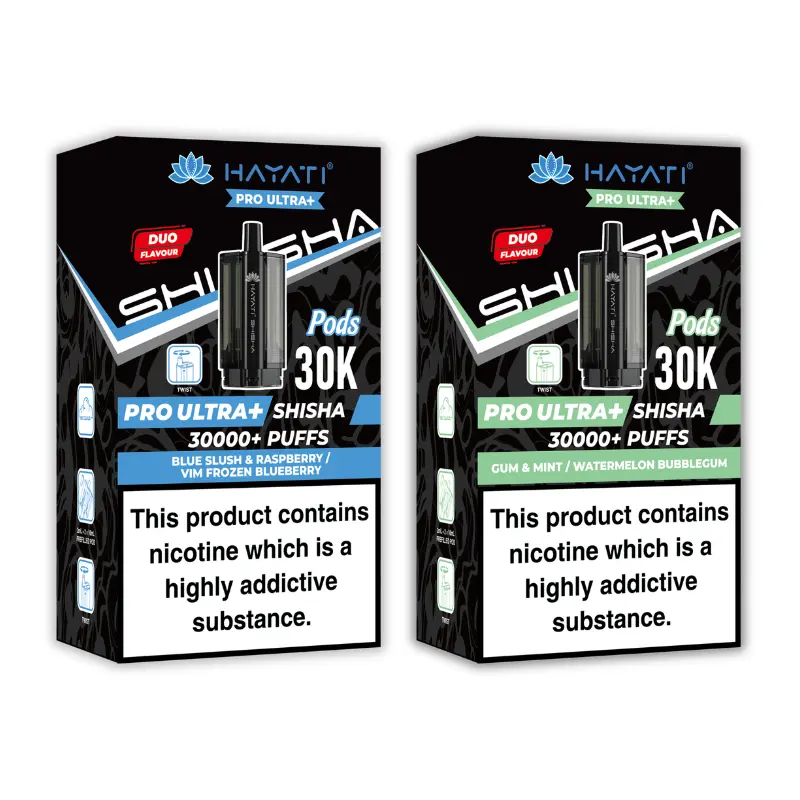
Hayati · Pro Ultra Plus
Hayati Pro Ultra Plus Shisha 30000 Pods
£7.99
✔ In stock — ready to ship
Genuine Hayati
Free over £20
Same-day dispatch
Secure checkout
Hayati Pro Ultra Plus Shisha 30000 Pods is a replacement pod for the Pro Ultra Plus body, priced at £7.99, holding 22ml of liquid divided into two reserves that a rotating mouthpiece selects between. One reserve carries Apple Mint Grape. The other carries Peach Grape Mint. No device comes in the box. The nicotine is 5mg, and the manufacturer rates the pod at up to 30,000 puffs, a figure produced on laboratory equipment rather than by anyone using it.
Everything in that paragraph is ordinary except two numbers and one word. The numbers are 5 and 30,000, and both of them are outliers on a shelf of 104 listings where almost nothing varies. The word is Shisha, and it is the only product title in this catalogue that names a way of consuming something instead of naming a fruit, a colour or a sweet. The flavour is published, but it is published further down the listing, in the specification field, not in the title. What the title gives you is a register.
That register is the interesting part, and it is interesting for a reason that has very little to do with tradition and a great deal to do with duration. The blends that gave this flavour family its name were built for a long, slow, shared occasion. A vape is short, solo and repeated. Those two shapes of use pull a recipe in opposite directions, and a profile engineered to survive the first one arrives in the second with a set of properties nobody asked it for. Some of them are useful. At least one of them is a liability. This page is mostly about working out which is which, because the answer decides whether this is an unusually durable all-day liquid or simply a quiet one.
Before any of that: this is a nicotine vape liquid and not a tobacco product, and the tradition the name borrows from is the origin of a flavour idea and nothing else. Nothing below describes, recommends or dresses up that tradition as a practice. It appears here because it explains why the recipe is shaped the way it is.
A title that names a room rather than an ingredient
Three listings in this catalogue of 492 carry Shisha in the product name. This pod, the matching Hayati Pro Ultra Plus Shisha 30000 Prefilled Pod Kit at £11.99, and a 10ml bottle in the Pro Max nic salt line. Count what they have in common and the picture is tight rather than loose. All three are built on Apple Mint Grape. Two of the three, the pod and the kit, add Peach Grape Mint as a second reserve. The bottle carries Apple Mint Grape alone. So Hayati's working definition of the register, stated in product data rather than inferred by anyone, is apple plus grape plus mint, with peach as the one permitted substitution.
That is a narrower reading than the word invites. The tradition the name points at is aromatic and wide, and a buyer who knows it might reasonably expect anise, rose, spice, something resinous. Hayati went to three fruits and a herb. A sibling page on this site, the Double Apple pod listing, worked through the etymology of a different borrowed term and concluded from Hayati's own naming that their reading of this register is mint-led rather than anise-led. That conclusion holds up against the data above and it is cited here rather than rebuilt, because it belongs to that page and the space is better spent elsewhere.
What is worth adding is the shape of the gap. A title that names a fruit makes a prediction you can test on the first draw. A title that names a register makes a prediction about how the blend will behave, which is slower to verify and harder to be wrong about in an obvious way. Hayati have hedged this by publishing the component fruits in the specification, so the information is there. It is simply not in the place a buyer scanning a shelf will look, and on a shelf where every neighbouring title leads with its fruit, a title that does not leads with an atmosphere instead.
The register, stated without romance
Strip the tradition out and what remains is a set of formulating constraints. A blend intended for a long occasion cannot lean on sugar, because sweetness is the first thing a palate stops registering and the first thing that turns unpleasant when it does not stop. It cannot lean on acid either, because acid is fatiguing in a different way and it accumulates. What it can lean on is aroma: volatile compounds that the nose keeps reading long after the tongue has given up, and that do not build a residue in the mouth. Herbs sit in that category. So do the darker, less bright fruits.
Look at Apple Mint Grape against that list and it stops looking arbitrary. Grape is a dark, low-acid, aromatic fruit whose sweetness reads as depth rather than as sugar. Mint is a volatile herb that works almost entirely through the nose and the trigeminal nerve rather than through the sweet receptors. Apple supplies just enough brightness to keep the thing from going heavy. Three components, only one of which is doing conventional fruit work, and the other two chosen for stamina. That is a coherent recipe, and it is not the recipe you would write if you were designing for a five-minute impression.
What a profile designed for endurance does inside a format designed for interruption
Here is the actual question this pod raises, and it is not a question about tradition. A recipe optimised for an hour of continuous, uninterrupted consumption has been decanted into a device used in bursts of twenty seconds, forty or eighty times a day, with gaps of minutes or hours between them. Those are different problems. Solving one well does not automatically solve the other, and in a couple of places the solutions are directly opposed.
Sweetness that works for five minutes and sweetness that works for sixty
The central design tension is sugar, and it is worth being concrete about why. A sweet note is enormously effective on first contact and it decays fast. Receptors adapt, saliva dilutes, and within a few minutes of continuous exposure the same concentration reads as roughly half what it did. A formulator building for a short impression exploits this: put the sugar high, let it land, and the decay never arrives because the occasion is over first. A formulator building for a long one cannot, because the decay arrives at minute four and everything after that is a liquid whose main structural element has stopped working, leaving whatever was underneath it exposed. If nothing was underneath it, the remaining fifty-six minutes are thin.
So the long-form answer is to put less sugar in and more structure under it. Aroma, bitterness, a cooling sensation, a herbal edge: things that do not adapt at the same rate. The result is a blend that is unimpressive at minute one and steady at minute thirty. That is the correct trade for the occasion it was built for.
Now move it into a pod. A vaper using this liquid is not at minute thirty. They are at minute one, repeatedly, all day. Every session is a first impression. The adaptation curve resets in the gaps, which means the property the recipe sacrificed, the big front-loaded sweet hit, is the property that would have been most valuable in this format, and the property it bought instead, resistance to fatigue over a long continuous run, is one this format rarely calls on.
Read pessimistically, that is the whole case against this pod. It has paid a real price for a benefit the hardware cannot collect.
Three reasons the pessimistic reading is not the end of it
The first is that the gaps are not as clean as the argument assumes. A vaper who uses one device as their only liquid is not resetting fully between sessions. Sessions separated by ten or fifteen minutes overlap on the slower-decaying part of the curve, and across a whole day of that the effective exposure looks less like eighty independent first impressions and more like a long, ragged, interrupted session. The closer someone's pattern is to continuous, the closer this liquid is to the conditions it was designed for.
The second is that the failure mode a long-form recipe is built to avoid is exactly the failure mode that ends most pods early. Very few pods are abandoned because the vaper stopped being able to taste them on a given afternoon. They are abandoned because after ten days the flavour has become tiring in a way that is hard to name, and the honest description of that is accumulated fatigue across sessions rather than within one. A recipe designed against fatigue has the right target, even if it was aiming at the wrong timescale. Twenty-two millilitres is a large volume to spend on a liquid that turns on you in week two.
The third is the most specific. Mint does not adapt the way sugar does. The cooling sensation is a trigeminal response rather than a taste, and it holds its intensity across a session far better than a sweet note holds its own. So the component this recipe leans on hardest is the one component whose behaviour is roughly the same in a long occasion and a short one. Whatever else does or does not transfer, the mint transfers intact.
What that adds up to as a prediction
Put it together and the prediction is fairly specific. This should be a liquid that reads quiet, even slightly underpowered, on the first pod of the first day, and that holds its position better than its shelf neighbours across weeks two and three. It should be poor at the thing an occasional vape is bought for, which is a distinct and memorable hit, and good at the thing an only-liquid is bought for, which is still being tolerable on day eighteen.
That is a real recommendation and it cuts both ways. Anyone buying one pod to see what a flavour is like is meeting this one at its weakest point, because a single trial draw is precisely the measurement condition it was not designed to win. Anyone buying 22ml because they intend to live inside it is meeting it at its strongest. The purchase pattern changes the verdict more than the liquid does, which is unusual and worth saying plainly.
Two honest caveats attach to all of this. It is reasoning from the published components and from how those components behave, not from a specification that states any of it, and Hayati make no claim of the kind. And a recipe can be built on the right principles and still be dull. Restraint and flatness produce similar-looking specifications and the difference between them is execution, which no listing discloses.
The liquid, component by component
The base both halves share
Grape and mint are common to both reserves, and only the third fruit changes. That is unusual construction for this platform. Of the 19 distinct dual-flavour pairings on the Pro Ultra Plus, three hold a two-word base constant and substitute a single element, and two of those three are swaps inside one berry family, where the substituted element changes very little. This is the only pairing that holds a base constant and substitutes across two genuinely different fruits, and the only one whose shared base includes a herb rather than only fruit.
The practical consequence is that the collar on this pod does less than the collar on most. Turn it on Sour Apple/Juicy Peach Hayati Pro Ultra Plus 25K Pods and the entire character of the liquid changes, from sharp to soft, from green to orange. Turn it here and roughly two thirds of what you were tasting stays where it was. You are adjusting one component of three, not switching liquids.
Whether that is a defect depends on what you wanted the collar for. As an escape hatch from a flavour that has become tiring, it is weak, because the tiring part is most likely the base and the base is on both sides. As a way of nudging a liquid you broadly like towards fresher or rounder depending on the hour, it is better than a large swing, because a large swing forces a decision and this does not.
Mint here is a component, not a topping
This is the part of the flavour analysis that generalises, and it is worth establishing with a count rather than an assertion. Nineteen listings in the catalogue carry mint in the title or the published flavour field. They fall into three groups, and the groups are not the same kind of thing.
- Mint as the entire product. Eleven listings named Fresh Mint across every format the site sells, plus Black Mint in the nic salt line and Frosted Mint in the pouch line. The herb is the subject. Fresh Mint Hayati Pro Ultra Plus Pods is the version of this on the same hardware.
- Mint paired with one other thing. Lemon Mint and Lemon and Mint across three listings, and Blue Razz Mint as half of Fresh Mint / Blue Razz Mint Hayati Pro Ultra Plus 25K Pods. Two components, the herb and a fruit, with the herb named second and doing the cooling.
- Mint as one element inside a three-part blend. Three listings, and they are the three Shisha ones. Nothing else in 492 products puts mint third in a construction where it is neither the subject nor the applied coolant.
That is the finding, and it is narrow enough to be true. A separate page on this site, the Blue Frozen pod listing, ran the broader census of Hayati's cooling vocabulary and established that Ice is the default by a very wide margin, that the terms are not graded, and that an ice-family word and a mint-family word never appear in the same title. Those counts are cited here rather than repeated. What they do not address is the question of role, and role is where this pod differs: in the ice listings the coolant is applied on top of a finished fruit, and here the herb is one of the three things the blend is made of.
You can taste the difference between those two arrangements. An applied coolant arrives late and sits on top, a separate sensation layered over a flavour that would be complete without it. An integrated herb arrives with everything else and changes the fruit it is mixed with, because mint's aromatic compounds interact with fruit esters rather than simply sitting beside them. Expect the cold here to feel woven rather than bolted on, and expect it to be moderate, because a component that has to share a blend with two fruits cannot be dosed the way a finishing coolant can.
A further page on this site, the Lemon and Mint pod listing, works through the separate question of whether Hayati's mint is the herb or a synthetic cooling agent wearing the word, and offers a method for settling it. That question applies here too and its answer is not published for this listing either. It is not re-argued below.
Apple Mint Grape across a draw
Taking the published components and the register together, the likely order of arrival on this side is apple first, grape underneath it, mint through the middle and continuing after both. Apple is the most volatile of the three and the most front-loaded, so it should read early and thin out quickly. Grape is slower and heavier and should still be there when the apple has gone. Mint is the longest of the three on the exhale and the only one that will still be detectable several seconds after the draw.
Hayati describe this side as the crisper and slightly sharper of the two. That is consistent with apple's role: not sour, because nothing in the description points at a green apple or an acid spike, but brighter at the top than a blend of grape and mint alone would be. The word to hold onto is fresher rather than sharper, because on the evidence published the sharpness here is a matter of aromatic lift rather than of acid.
What this side is likely to do badly is impress anyone on one draw. Apple is a weak headline fruit. It has no colour association, no confectionery register to fall back on, and it is easily buried. Placed first in a three-part name it is doing the work of an announcement, and it is not a fruit with much announcement in it.
Peach Grape Mint across a draw
Peach behaves almost oppositely to apple. It is heavier, rounder, lower in acid and slower to arrive, and it lingers rather than thinning. Substituting it for apple on the same grape and mint base should produce a liquid with a softer opening, more body in the middle and a longer fruit tail, at the cost of the lift that made the other side feel fresh.
The interaction with mint is the part worth predicting carefully, because peach and mint is a more demanding pairing than apple and mint. Peach carries lactone compounds that read as creamy, and cold tends to flatten creaminess and make it read as waxy instead. Whether that happens here depends entirely on the mint dose, which is not published. If the cooling is light, this side should be the more comfortable of the two for long use. If it is not light, peach is the fruit that suffers first.
Against the other peaches on this hardware the difference is mostly one of company. Mango Peach Pineapple Hayati Pro Ultra Plus 25K Pods puts peach in a tropical group where it is the softest of three bright fruits. Here it is the only bright thing in the blend and it is working against a herb. Same fruit, different job.
Sweetness, without flattery
On the published evidence this should be one of the less sweet pods on the shelf, and that is a statement about position rather than a compliment. Grape reads sweet without much sugar behind it, apple contributes very little, peach contributes some, and mint actively subtracts by occupying attention the sweet receptors would otherwise have. Set against a candyfloss blend such as Blueberry Cotton K / Raspberry Cotton K Hayati Pro Ultra Plus Pods or a bubblegum construction such as Blueberry H'Bubba / Watermelon H'Bubba Hayati Pro Ultra Plus Pods, it should sit a long way down.
Anyone whose current pod is one of those two and who reads restraint as an improvement should still expect the first day to feel like a loss. Dropping a confectionery blend for a herbal one is not a small adjustment, and the adjustment takes several days rather than several draws.
What it is not
- Not an Ice liquid. No ice-family word appears in the title or the flavour field, and Hayati are consistent about labelling cooled pods in the name. The cold here comes from a named herb inside the blend.
- Not sour. Nothing published points at acid. If sharpness is what you want, Blackcurrant Lemonade Hayati Pro Ultra Plus 25K Pods and the citrus pods are the honest destinations.
- Not aniseed, rose or spice. Three fruits and a herb are what the specification names. A register is not an ingredient list.
- Not two separate purchases. One 22ml budget covers both reserves, so liquid left in the side you use less is discarded with the pod.
- Not a large swing at the collar. Two of the three named components are the same on both sides.
Three axes on which this listing is not like its shelf
Most pods on this platform differ from each other in exactly one respect, the flavour, and are otherwise interchangeable down to the millilitre. This one differs in several, and the differences are easy to miss because they are all in fields buyers skim. Each is checkable and each was checked.
The puff rating, and what the arithmetic rules out
Of 104 Pro Ultra Plus listings, 102 are rated by the manufacturer at up to 25,000 puffs. Two are rated at up to 30,000, and they are this pod and its kit. Both figures are laboratory estimates generated by a machine drawing at a fixed length and interval until the liquid is gone, which makes them a way of comparing two products on paper and a poor guide to anything else.
The useful step is to divide. All 104 listings state the same 22ml capacity, without exception. Twenty-two millilitres across 25,000 rated puffs works out at about 0.88 microlitres of liquid per puff. The same 22ml across 30,000 comes to about 0.73. So the extra 5,000 puffs are not extra liquid. They are the same liquid, credited with lasting about 17 per cent further per draw.
A sibling page on this site, the Juicy Peach kit listing, notes the same anomaly and attributes it to the lower nicotine strength. The first half of that is right and worth keeping: it correctly rules out more liquid and better hardware. The causal half does not survive checking. Nicotine at 20mg/ml is about 2 per cent of the formulation by mass and at 5mg/ml about 0.5 per cent, and shifting 1.5 per cent of a mixture cannot make a coil vaporise 17 per cent less of it per draw. Something else explains the figure, most plausibly a different test protocol or a commercial decision about what number to print, and Hayati publish neither. The correction is offered as a count rather than as a complaint, and the rest of that page's reasoning is unaffected.
The nicotine figure, read as formulation
Two of the 104 Pro Ultra Plus listings state 5mg. The other 102 state 20mg, which is the maximum permitted at retail in the United Kingdom. In 22ml that is the difference between about 110mg of nicotine in the pod and about 440mg.
What follows from that is a formulation observation and nothing else. Nicotine is not a neutral carrier in a recipe. It contributes bitterness, it contributes a physical sensation in the throat, and both of those occupy perceptual space that would otherwise be available to the flavour. A page on this site covering the 5mg Pro Max Plus pod works through the mechanism at length, including which recipe types gain from the change and which lose their structure, and that analysis is not rebuilt here.
What is worth adding is how neatly the choice lines up with everything else on this listing. A recipe whose whole design premise is that it must stay pleasant over a long run has an obvious reason to reduce the component that contributes bitterness and throat sensation, because those accumulate. Of all the flavours on this shelf, the one built for endurance is the one where a lower nicotine concentration is most consistent with the rest of the recipe. That is an observation about why a formulator might choose it. It is not advice, and what strength anyone uses is not a question this page has any business answering.
One small correction while the counting is out. Another page on this site states that the sole exception to 20mg across this range is this pod. There are two: this pod and its kit, both at 5mg, out of 104. The point that page was making survives the correction intact.
The shelf it sits on, and the berry that is not in it
This listing appears on Blueberry Vapes, a shelf of 90 products. Neither Apple Mint Grape nor Peach Grape Mint contains a blueberry, or a berry of any description. The product's own tag data carries the word blueberry, which is presumably how it got there, and the tag is not supported by the published flavour.
Ten of those 75 have no blue-family word in the title or flavour field. Six are the Banana Ice strength-only listings, which sit on a lot of shelves as family defaults rather than as flavours in their own right. One is Mixed Berries, which is defensible. The remaining three are the three Shisha products. So on the one genuinely questionable shelf placement on that page, all three instances are this flavour.
The Apple Vapes shelf is the better-founded of the two, and it is instructive about how little apple this catalogue actually carries. Twenty-two listings: seven are Red Apple Ice in seven formats, three are Double Apple, four are Sour Apple pairings, three are these Shisha products, and five are Banana Ice strength defaults. Twenty-two listings and four real apple flavours, one of which is this one, where the apple is a third of one side of a two-sided pod.
None of this changes what the liquid tastes like. It changes how you find it, which matters on a catalogue this size, and it is a reason not to treat shelf membership as evidence about content.
The pod, briefly
What arrives is a single prefilled pod holding 22ml, split into two reserves that share one coil, one wick and one airflow path, with a rotating mouthpiece selecting which reserve feeds the coil. No device, no cable, no spare. The device is bought separately or as part of the Shisha kit, which is £4.00 more and includes the body.
Check the range name printed on your device against the range name in this title before ordering, because different Hayati ranges use different pods and a retail page is not the place to settle a cross-range fitment question.
The specification that bears on this particular liquid is the shared coil. Because both reserves feed one coil through one wick, the first two or three draws after turning the collar are a blend of the two sides rather than a clean read of the new one. On most dual pods that matters for tasting and little else. Here it matters less than usual, because the two sides already share their base, so the carryover is mostly of material that is present on both sides anyway. It is one of the few respects in which this pod's unusual construction works in its favour. Hayati publish what the collar selects and nothing about how the reserves are divided or held apart, so nothing below describes a mechanism. The rest of the platform is covered on the Pro Ultra Plus kits and pods shelf.
The specification, and what each line is doing
| Nicotine strength | 5mg, against 20mg on 102 of the 104 listings in this range |
| Reserve A | Apple Mint Grape |
| Reserve B | Peach Grape Mint |
| Total liquid | 22ml, shared across both reserves |
| Manufacturer puff rating | Up to 30,000, a laboratory estimate |
| Price | £7.99, which is about 36p per millilitre |
| Supplied as | Replacement pod, no device |
| Selection | Rotating mouthpiece, one shared coil |
| Coil resistance | Not published for this listing |
| VG/PG ratio | Not published for this listing |
| Preparation | Nicotine salt, the standard preparation for this format, though the listing does not state it |
Two of those rows say nothing, and it is worth being clear that they say nothing. Coil resistance and VG/PG are absent from the listing, and they are the two figures that would let anyone predict how this liquid behaves at the coil. Without them, the draw character is something you find out by using it.
The price line is the one that repays a second look, because it is identical to every other 22ml pod on this shelf at £7.99. That is worth noticing given everything above. The same money buys the same volume of liquid, with a quarter of the nicotine per millilitre and a rated figure 20 per cent higher. Nothing in the pricing reflects either difference, which suggests the two numbers are treated as product positioning rather than as cost inputs. That is a reasonable inference from the pricing and not something Hayati state.
The puff figure deserves its caveat stated once rather than repeatedly. It is a machine measurement taken under fixed conditions, and the conditions are not published. Its only defensible use is comparing one listing against another, and even there the comparison above showed that the two figures on this shelf are not measuring the same thing in any way that the arithmetic supports.
Choosing this over its neighbours
If the herb is what you came for
Fresh Mint Hayati Pro Ultra Plus Pods is the direct route and the better purchase if mint is the point rather than an element. It is the herb alone, undiluted by fruit, and it makes no demands on your patience. This pod puts mint third in a construction where two fruits are competing for the same attention, so anyone who wants the herb front and centre is buying a compromise here.
Fresh Mint / Blue Razz Mint Hayati Pro Ultra Plus 25K Pods is the middle option: one reserve of pure herb and one where the herb is attached to a single fruit. If you want the range from bare mint to fruited mint inside one pod, that is the pod with the range. Its kit version bundles a body for anyone who needs one.
If it is the grape you want rather than the register
Grape is the load-bearing component on both sides of this pod, and there are two ways to buy it uncomplicated. Grape GB / Blue Razz GB Hayati Pro Ultra Plus 25K Pods puts grape against blue raspberry in the gummy-sweet register, which is the opposite direction from this one: confectionery rather than herbal, and front-loaded rather than steady. Grape GB / Strawberry GB Hayati Pro Ultra Plus Pods keeps the same treatment and swaps the partner fruit. Both will read as considerably sweeter than this pod, and both will make a stronger first impression and a weaker fifteenth day, which is the trade this whole page has been about.
If you want the third fruit on its own terms
Sour Apple/Juicy Peach Hayati Pro Ultra Plus 25K Pods is the interesting comparison, because it contains both of this pod's variable fruits and neither of its constants. Apple and peach, with no grape and no mint, and the apple taken in the sour direction this listing avoids. If you read the two flavour names here and thought the apple and the peach were the point, that pod delivers them without the base, and it delivers them sharper.
Mango Peach Pineapple Hayati Pro Ultra Plus 25K Pods is peach in a bright tropical setting, which is peach used as a softener rather than as the lead. Fruit Twist Hayati Pro Ultra Plus 25K Pods is the general mixed-fruit option for anyone who wants breadth rather than a named construction.
If you want to know what the other duals do differently
The construction point made earlier is easier to see against examples. Blueberry Raspberry / Blueberry Raspberry Cherry Hayati Pro Ultra Plus 25K Pods is an additive pair, where one side is the other side plus one more fruit. Blue Razz Cherry/Blue Razz GB Hayati Pro Ultra Plus 25K Pods and Red Razz GB/Blue Razz GB Hayati Pro Ultra Plus 25K Pods are substitutions inside one family. Blueberry Raspberry/Mr Blue and Lemon Lime / Lemon Blueberry share one word and diverge on the rest. This pod shares two and diverges on one, which is the tightest pairing on the shelf.
If one flavour is enough
Several listings on this hardware are single-reserve and have no collar at all, which removes a decision rather than adding one. Blueberry Raspberry Hayati Pro Ultra Plus Pods, Mr Blue Hayati Pro Ultra Plus Pods, Blue Razz Cherry and Cherry Berry all commit to one profile for the whole 22ml. Given how little this pod's collar actually changes, a single-flavour pod is a more honest version of the same experience for anyone who would only have turned it twice.
If the platform itself is the question
Cheaper hardware runs a smaller pod and a shorter commitment. Blue Razz Fruit Twist Hayati Pro Max Plus Pods and Blue Fusion Hayati Pro Max Plus Pods sit at £5.49 on the Pro Max Plus body, which is a smaller outlay per pod and a smaller amount of liquid to be wrong about. Hayati Pro Max Plus Prefilled Pods Zero Nicotine (0mg) is the listing at the far end of the strength range on that platform, quoted here for the record rather than as a suggestion.
For browsing rather than deciding, Hayati Pro Ultra Plus Pods is the 52-listing shelf this pod belongs to, Hayati Prefilled Pods and Refills gathers every pod in the catalogue, Hayati Pods is the wider view, the New Products shelf is where recent additions land, and the full Hayati catalogue is everything at once.
Living with 22ml of a quiet liquid
The handling notes that matter here follow from the flavour rather than from the format, so they are different from the ones that would apply to a sweet pod.
Give it longer than you would normally give a pod. This is the practical consequence of the whole endurance argument. A liquid built to be steady rather than striking will be judged unfairly on day one, and day one is when most people decide. The fair measurement point is somewhere around the third or fourth day, once the comparison with whatever you were using before has faded. That is a large fraction of the pod to spend on a trial, which is an argument for buying it deliberately rather than curiously.
Mint is the component that will disappear first. Volatile aromatics are the part of any blend that a tiring coil stops carrying, and here the volatile aromatic is doing a structural job rather than a decorative one. When this pod starts to go, the symptom will not be a general dullness. It will be the cold thinning out while the grape stays roughly where it was, leaving something heavier and flatter than what you bought. That specific change is the signal to stop, and it will arrive before any burnt note does.
Apple goes before the mint does. On the Apple Mint Grape side there are two things that can fade and they fade in order. Apple is lighter and less persistent and will be the first thing missing. If that side starts reading as grape with cold on it, the apple has gone, and the pod is further through its life than the liquid level suggests.
The collar is not a fix for a tired pod. Because both sides share a coil and share their base, switching reserves when one side goes dull will not restore much. It is worth trying once as a diagnostic: if the other side is equally flat, the coil is the problem rather than the flavour.
Warmth is the enemy of this one more than most. Heat accelerates the loss of exactly the volatile compounds this blend is built on. A pod stored somewhere warm for a fortnight will lose more here than a heavily sweetened pod would, because a sweetened pod's main structural element is not volatile. Somewhere cool, dark and upright is the right place for a spare, and a spare bought well in advance is a spare that is quietly degrading.
Draw length is the only variable you control. With no published resistance figure and no airflow adjustment, the one input available is how long you pull. A longer draw favours the heavier end of the blend, which here means grape and peach. A shorter one favours the top, which means apple and the first part of the mint. Anyone finding this pod too heavy should shorten before concluding it is not for them.
When it is done, it is waste with a coil in it. A spent pod is a sealed plastic body containing a heating element and a residue of liquid, which puts it outside household recycling. It belongs at a retail take-back point or an electrical waste facility. The pod is not designed to be opened or refilled and there is nothing serviceable inside it.
Questions this listing keeps raising
Does this taste like shisha?
It tastes like the fruits and herb named in the specification, which are apple, grape and mint on one side and peach, grape and mint on the other. The word in the title describes a flavour register that Hayati have interpreted as those components, not a claim about replicating anything. Three listings in the catalogue carry the word and all three are built on the same apple, grape and mint base, which is the clearest statement available of what Hayati mean by it.
Why is the puff rating higher than every other pod on this shelf?
Hayati do not explain it. All 104 Pro Ultra Plus listings hold the same 22ml, so the extra 5,000 rated puffs are not extra liquid. Dividing the volume by the rating gives about 0.73 microlitres per puff here against about 0.88 elsewhere, which means the figure credits this pod with consuming roughly 17 per cent less liquid per draw. Both numbers are laboratory estimates taken under conditions that are not published.
Is the lower nicotine strength the reason for the higher rating?
Another page on this site suggests so, and the arithmetic does not support the causal part. Nicotine is roughly 2 per cent of a 20mg formulation by mass and 0.5 per cent of a 5mg one, and a 1.5 per cent change in composition cannot produce a 17 per cent change in how much liquid a coil turns to vapour per draw. What that page gets right is that the difference is not extra liquid and not different hardware.
How different are the two sides?
Less different than most dual pods. Grape and mint are common to both reserves and only the third fruit changes, so around two thirds of what you taste is the same whichever way the collar is turned. The change is from a fresher, brighter top on the apple side to a rounder, heavier one on the peach side. If you want a large swing, a pairing that shares nothing between its halves will give you one.
Is there ice or menthol in it?
No ice-family word appears in the title or in the published flavour, and Hayati are consistent about naming cooled pods in the title. The cooling here comes from mint, which is named as a component of both blends rather than applied as a finishing coolant. Whether that mint is the herb, a synthetic cooling compound, or both is not published for this listing.
Why does it appear on the Blueberry Vapes shelf?
Because the listing's tag data carries the word blueberry. Neither published flavour contains a blueberry or any other berry. Of the 75 products on that shelf, ten have no blue-family word in their flavour or title, and three of the ten are the Shisha listings. Treat shelf membership on a catalogue this size as navigation rather than as evidence about contents.
Does the device come with it?
No. This is a replacement pod on its own, for a Pro Ultra Plus body you already have. The kit version at £11.99 includes the device, which makes the body £4.00 on top of the pod price if you need one.
Can I keep the unused half for later?
Not as a separate item. One coil and one 22ml budget serve both reserves, and the pod is discarded whole, so anything left in the side you use less is thrown away with it. Coil wear is shared too, so both sides age at the same rate regardless of how you split your use between them.
What resistance is the coil?
Not published for this listing, and neither is the VG/PG ratio. Those are the two figures that would let anyone predict the draw before buying, and their absence is worth knowing about rather than filling with a guess from a sibling page.
Is this a good first pod to try on this platform?
It is a difficult one to evaluate quickly, which is a separate matter from whether it is good. A blend built to stay steady rather than to open strongly is at its least convincing on the first draw and its most convincing a fortnight in, so a short trial measures it at the point it was not designed to win. If you want a pod that declares itself immediately, a sweeter one will.
Why is it the same price as pods with four times the nicotine?
Every 22ml pod on this shelf is £7.99, which is about 36p per millilitre, and the pricing does not move with strength or with the rated puff figure. The reasonable reading is that both numbers function as positioning rather than as cost inputs, though Hayati do not comment on how the range is priced.
Is the nicotine a salt?
The listing does not specify the preparation. Salt is the standard preparation for prefilled pods of this kind and the rest of this catalogue is described on that basis, so it is stated here on the same footing. Nicotine is addictive at any concentration.
The short version
A 22ml replacement pod at £7.99, two reserves selected by a rotating collar, Apple Mint Grape on one side and Peach Grape Mint on the other, no device included. The base of grape and mint is shared and only the third fruit changes, which makes it the tightest pairing among the 19 dual flavours on this platform and means the collar adjusts rather than transforms.
Its interest lies in where the recipe came from. The register it is named after produced blends built to stay pleasant across a long, slow, continuous occasion, and the design choices that follow from that are low sugar, aromatic depth and a herb doing structural work. Put into a device used in short repeated bursts, that recipe gives up the strong opening the format rewards and keeps the resistance to fatigue the format rarely tests, except across weeks rather than hours, where it turns out to matter after all. So this is a poor pod to sample and a plausible one to live in, and which of those you are doing should decide the purchase more than the flavour notes do.
Three things on the listing are unlike its shelf and all three are checkable. It is one of two listings out of 104 rated at up to 30,000 puffs rather than 25,000, on identical liquid volume, with no published explanation for the difference. It is one of two out of 104 filled at 5mg rather than 20mg, which is a formulation fact and not a recommendation. And it sits on a berry shelf while containing no berry. None of that changes the taste. All of it changes how confidently you can read the listing, which on a catalogue of 492 near-identical products is most of what a page like this is for.
Strictly for adults aged 18 and over. Nicotine is an addictive substance.
You might also like


