
Home / Hayati Rubik Prefilled Pod Kit / Blueberry Raspberry Hayati Rubik Prefilled Pod Kit
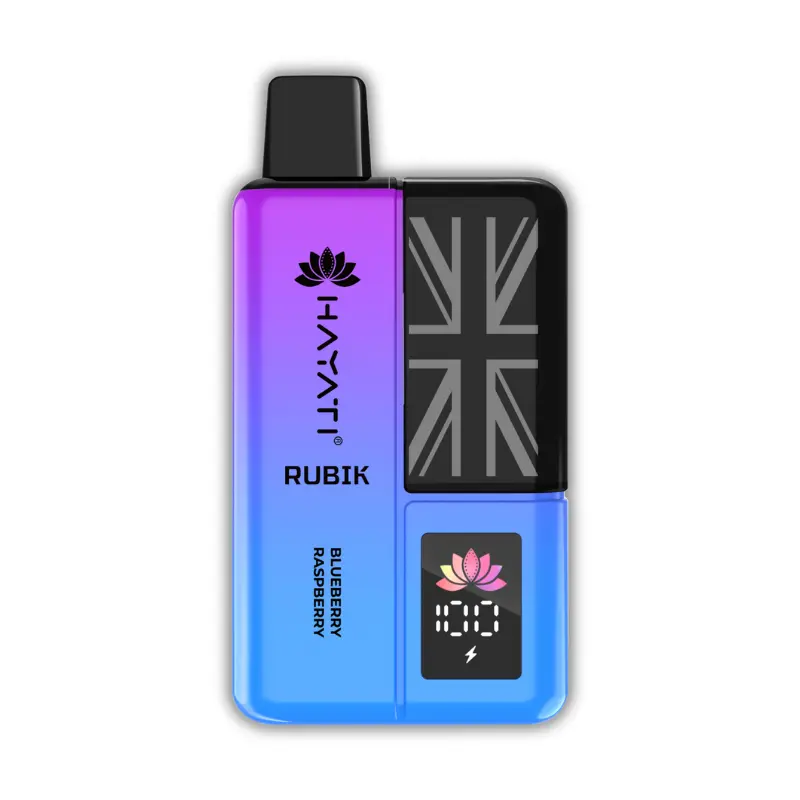
Hayati · Rubik
Blueberry Raspberry Hayati Rubik Prefilled Pod Kit
£5.99
✔ In stock — ready to ship
Genuine Hayati
Free over £20
Same-day dispatch
Secure checkout
Five pounds ninety-nine buys the whole thing here: a Hayati Rubik body with a filled pod already seated in it, twelve millilitres of liquid at 20mg nicotine salt, and an 850mAh cell underneath. Hayati's published figure for a full Rubik pod is up to 7,000 puffs, arrived at on test equipment drawing to a fixed schedule rather than by anybody carrying one around, so read it as a statement of how much work one sealed coil has been given and not as a quantity you have bought. No cooling word appears in the title and none is listed against the liquid, so the fruit runs warm from the first draw to the last.
That is the product. The reason this page runs to several thousand words is a different thing entirely, and it is the one fact about Blueberry Raspberry that nobody selling it puts on the label.
This is not a flavour. It is a base. Hayati build other flavours on top of it, they do it repeatedly, and they do it to this pairing more than to any other liquid recipe they sell. That sounds like a piece of trivia and it is not, because a base has different design requirements from a finished flavour, those requirements pull against each other, and the compromise between them is audible in the liquid. If you draw on this pod expecting a flavour with a hook in it and find something rounder and less pointed than you wanted, you have not been sold a weak version of something. You have been sold the thing the range was built to extend, working exactly as specified.
Most of the pages on this site argue about what a liquid tastes like. This one argues about what kind of object it is first, because that decides who should buy it and the tasting notes on their own do not. Below: the count, which settles whether the base claim is real or a nice line; what a base has to be and why those requirements fight; what the unextended draw is actually like, including the gap where the extension normally sits; where the three extensions go and what that tells you the base is felt to be short of; and why the cheapest platform in the range is the sensible place to keep a liquid you use as a default.
Count it before believing it
A claim of the form "the catalogue treats this as a base" is worth nothing unless somebody counts. Here is the count, taken from the flavour part of all 492 Hayati titles with the hardware wording stripped off.
Eleven listings carry the two-fruit name and nothing else
Eleven products are sold as Blueberry Raspberry with no third word. That figure has already been established on the Blueberry Raspberry Cherry Pro Max Plus kit's bare-pod sibling, which reached it by the same route and used it to argue that the base rather than the cherry version is what Hayati actually sell. It still holds. The eleven spread across seven kinds of hardware: this kit and its Rubik refill pod at £3.99, the Pro Max Plus kit and its bare pod, the Mini Ultra kit and its pod, the Pro Ultra Plus kit at 22ml and its pod, a 10ml nicotine salt, and two 120ml bottles at 0mg in different carrier ratios.
Seven hardware families is the whole prefilled range plus both bottled lines. Nothing else in the catalogue has that spread under one unmodified name. Whatever else is true, Hayati clearly regard this recipe as something every format ought to offer.
Eleven more carry the pairing plus something
Now the other side, which nobody has counted before and which is the reason this page exists. Take every listing whose flavour name contains Blueberry Raspberry alongside something else. There are also eleven of those. An even split, eleven to eleven, out of twenty-two listings in total that put the pairing in a title.
The eleven divide into two kinds, and the distinction matters more than the total.
Six are recipe extensions: one liquid, mixed before the pod was filled, whose name is the base plus one more word. Three distinct names account for the six. Blueberry Raspberry Cherry appears twice, as a Pro Max Plus pod and as its kit. Blueberry Raspberry Lemon appears three times, as a Pro Ultra Plus kit, as its bare pod and as a 10ml nicotine salt. Blueberry Raspberry Menthol appears once, as a Mini Ultra pod.
Five are pairings rather than extensions: divided pods where the base occupies one reserve and something else occupies the other, with a rotating mouthpiece selecting between them. Two of those put the base next to its own cherry version. Two put it next to Mr Blue, as the Blueberry Raspberry / Mr Blue kit and the same liquid as a bare replacement pod. The fifth is the Blueberry Straw' Menthol / Blueberry Raspberry Menthol Mini Ultra, where a cooled version of the base shares a pod with a cooled version of a near neighbour.
Six recipe extensions and five hardware pairings, against eleven listings of the base sold plain. On the raw listing count the range spends exactly as much shelf space on Blueberry Raspberry with something added as it does on Blueberry Raspberry by itself.
Testing the rarity claim, and narrowing it until it is true
The interesting version of the claim is stronger than a tally, and it is the version that needed checking hardest, because a page in this corpus already states it and a claim repeated without counting is not evidence of anything.
The claim is that Blueberry Raspberry is the only recipe Hayati take and modify by adding a word. Run the search properly and the first result is that it is not: strip the hardware off all 492 titles, look for flavour names that are another flavour name with exactly one word appended, and eleven such pairs turn up rather than four. Cola and Cola Ice. Cola and Cola Lime. Bubblegum and Bubblegum Ice. Blueberry and Blueberry Pomegranate. Blueberry and Blueberry Bgum. Blueberry and Blueberry Raspberry itself. Strawberry Watermelon and Strawberry Watermelon Bubblegum. One pair is not a flavour at all, being a hardware range name with a strength suffix on it. Plus the three that extend this base.
So the strong claim fails as written, and then survives a narrowing that turns out to be the right one. Check whether the base of each pair exists as a liquid, and most of them do not. There is no Cola e-liquid in this catalogue and no Bubblegum e-liquid; both names appear only on nicotine pouches, which is a different product with a different reason for its naming. The same is true of plain Blueberry, which confirms from a second direction something the Pro Max Plus kit page established by going through the eighteen blueberry-without-raspberry listings individually: Hayati do not sell blueberry as a liquid on its own, anywhere, in any format.
Take the pouches out and exactly four pairs remain, in which a liquid has been taken and had a word added to produce another liquid. Three of the four extend Blueberry Raspberry. The fourth is Strawberry Watermelon with a bubblegum treatment on it. That is the honest form of the claim, it matches the figure the Blueberry Raspberry Cherry pod page arrived at, and it is worth stating precisely: of every e-liquid recipe Hayati list, two have been used as a base for a modified version, and one of those two accounts for three of the four modifications.
The stem that ties it, and why the tie is the interesting part
One more count, because there is a flavour name with just as many derived names as this one and comparing them is what makes the base argument concrete rather than rhetorical.
Across the 192 distinct flavour names in the catalogue, thirty-four appear inside at least one other flavour name. Two reach seven derived names and no name reaches more. One is Blueberry Raspberry. The other is Blue Razz GB, which turns up inside Blue Razz GB / Lemon Lime, inside a grape pairing, inside a red razz pairing and inside a cherry pairing, across two hardware formats each.
Now look at the composition of the two sevens, because they are not the same kind of seven at all. Every one of Blue Razz GB's is a divided pod. Not one is a recipe: Hayati have never mixed anything into Blue Razz GB and sold the result as a single liquid. It is a pairing partner, a thing placed beside other things, and it sits in those pods completely unaltered, which you can hear for yourself by putting the Blue Razz GB Rubik kit against the Pro Max Plus version or the Mini Ultra one.
Blueberry Raspberry's seven runs both ways. Five pairings, which is the Blue Razz GB behaviour, and three recipe extensions, which is behaviour Blue Razz GB never shows. It is the only flavour in this catalogue that gets both treatments, and it is the only one that has been mixed into three times.
That is what "the catalogue treats it as a base" amounts to when you make it precise. Not that the liquid is popular, although eleven listings say it is. That Hayati have repeatedly opened the recipe up and put something else inside it, which is a thing they have done to one other liquid once.
What a base has to be, and why those three requirements fight
Grant the counting. The question that follows is what it does to the liquid, and the answer is not a matter of opinion once you set out what a base is being asked to do.
A flavour built to be extended has three requirements on it, and no formulator gets to satisfy all three cleanly.
It has to be broad. An addition has to land somewhere. If the base already occupies every register, from the front edge of the inhale to the last of the exhale, there is no unoccupied position for a third component to take and the addition either fights something or disappears. Breadth here means the opposite of what it usually means in flavour writing: not a full, crowded profile, but a profile with defined regions and space between them.
It has to be unobtrusive. Anything with a genuine hook in it, a sour layer, a coolant, a confectionery coating, an effervescent prickle, will still be the thing you notice after the addition goes in. A base with a strong identity produces extensions that all taste like the base with a garnish. For the extension to register as a change of flavour rather than a change of trim, the base has to be willing to recede.
It has to be complete. This is the requirement that ruins the other two, and it is not optional, because Hayati sell the unextended version eleven times over and nobody buys a deliberately incomplete liquid twelve millilitres at a time. It has to stand up as a purchase on its own, across a long pod, without the thing that was designed to go on top of it.
Read those three together and the tension is obvious. Broad and unobtrusive both push towards a liquid that gets out of the way. Complete pushes towards a liquid that does not. The resolution the trade reaches, and it is reached everywhere and not just here, is a profile that is finished in its own terms and deliberately short of an event. Everything that needs to be there is there. Nothing in it is trying to be the thing you remember.
That is a design decision with a real cost attached, and it would be dishonest to present it as pure upside. A liquid engineered to accept an addition is a liquid that is easy to stop noticing. The Blueberry Raspberry / Mr Blue pod page reaches the same place from a completely different argument, about which half of a divided pod gets used, and puts it in one line worth borrowing: predictability is enormously valuable at the moment you buy and steadily less valuable afterwards, because predictability is also what lets a flavour fade into the background fastest. On a four-millilitre pod that costs you a fortnight. On twelve millilitres it costs you rather more.
The draw, and the position nothing occupies
What follows describes the liquid you get when nothing has been added to it. The two fruits and what each contributes have been worked out at length elsewhere in this catalogue and there is no point rebuilding sound arguments, so those are cited and taken as settled, and the work here goes into the part they did not need: what the shape of the unextended draw actually is, and where the hole in it sits.
Taken as established
Raspberry is the edge and blueberry is the body. That much is agreed across four pages here and it is agreed for good reasons. Raspberry carries a real acid load that lands on the sides of the tongue in the first moment of an inhale, because acid works by direct contact and has no distance to travel, and it carries a perfumed, faintly violet aromatic top that is the single most identifiable thing in the pod for most people. Both are front-loaded and both thin out before the draw finishes. Blueberry brings almost no acid, a heavier and slower set of aromatic compounds that build through the middle and stay into the exhale, and a rounded sweetness with no edge on it at all.
The Blueberry Raspberry Cherry kit page then establishes the finding that changes how the pairing reads, and it is the most useful thing anybody in this corpus has written about these two fruits. A raw blueberry is close to aromatically mute. What everybody recognises as blueberry is the cooked one, the pie filling and the compote and the stain on the spoon, because heat and sugar break the skins and generate aromatic material the raw berry does not contain. Any blueberry flavouring therefore references a processed fruit whether or not anybody intended it to, and it arrives in a recipe already carrying an impression of having been heated and sugared. Two consequences follow that page's argument: the sweetness it supplies is matt rather than glossy, with a slight skin-derived drag that stops the sugar sliding away, and the whole liquid reads as a preserve rather than a drink. Raspberry's identifiable version is the fresh one. So the pairing is not sharp fruit over sweet fruit. It is fresh fruit over cooked fruit.
Both findings are reasoning about what these materials are, applied to a recipe whose proportions Hayati publish nowhere. Treat them as well-supported inference rather than as a specification, and treat any page that quotes you a percentage for this liquid as having made it up.
What eleven descriptions of one liquid agree about
There is a cheap way to test whether that account is a real property of the recipe or a habit of whoever writes the copy, and it is worth running because Hayati write fresh text for every listing rather than syndicating one description. Line up all eleven of the plain Blueberry Raspberry listings and read what each says the two fruits do.
Eleven out of eleven assign the same roles. Blueberry gets the sweetness, the body, the roundness, the depth, the floor; raspberry gets the tang, the brightness, the sharpness, the lift, the spark. Not one listing reverses the assignment. Across a set of independently written descriptions covering seven hardware families and three nicotine strengths, that is about as close to a fact as this catalogue ever gets, and it means the role division is a property of the liquid rather than a phrase somebody keeps reaching for.
One listing dissents, and only on order rather than on role. The 70/30 bottle, which is a high-VG shortfill at 0mg intended for sub-ohm use, puts the raspberry first and has the blueberry arriving underneath afterwards. Two readings are available and it would be wrong to pick one confidently. A thicker carrier at higher power genuinely does change which aromatic material reaches you first, so the description may be accurate for that format and not transferable to a low-power sealed pod. Or the writer simply described the draw from the other end. Nothing published settles it, and the one thing that would, the concentrate loading in each format, is not disclosed for any product in this range.
The shape, in the order it arrives
The inhale opens on the raspberry, and on a fresh pod it opens clearly. Tang at the front and sides of the tongue, a perfumed lift sitting above it, the whole thing arriving inside the first second and reading as brighter than the finished impression of the liquid will turn out to be. This is the most defined moment in the draw and it is the shortest.
The blueberry comes in underneath and behind, and it does not arrive at a point you can mark. It builds. By the middle of the inhale it is carrying most of the vapour, and what it supplies is weight and duration and that matt, slightly dry sweetness rather than an identifiable flavour event. Ask somebody mid-draw which fruit they are tasting and they will say raspberry, on a pod where the blueberry is doing the larger share of the work, because the palate reports edges and novelty and a low-acid sweetness occupying the middle registers as texture.
The exhale is blueberry with the raspberry gone from it. Warm, since no coolant is in the liquid and nothing cuts the sweetness off, so the finish decays gradually instead of stopping. The faint floral lift that comes in with the cooked reading sits somewhere in there and is the thing most likely to make a person say there is something else in this without being able to finish the sentence.
Run that together and you have a two-event draw. A bright arrival, a sweet body, and then a decay. Which is a complete shape, and it is a shape with one position in it that nothing occupies.
The gap, stated plainly
The unoccupied position is the top of the exhale, the moment after the raspberry's acid has thinned and before the blueberry's sweetness has finished. Nothing in this liquid happens there. The tang has gone and the body has not yet resolved, and what fills the space is the tail of one fruit running into the shoulder of the other.
That is not a formulation error. It is the space the extensions go into, and you can demonstrate it without taking anybody's word for it, because the range sells the liquid with that space filled three different ways and you can buy any of them. It is also, in my reading and marked as reading rather than reported fact, the single thing most responsible for how this pod is described by people who like it and by people who are bored by it, who are describing the same property and disagreeing about whether it is a virtue.
The practical form of the observation: this liquid gives you one thing to notice per draw, and it gives it to you at the start. Everything after that is texture. A person who wants a flavour to keep doing something across an inhale will register that as the pod going quiet halfway through. A person who wants a liquid they can draw on all day without it demanding a response will register it as the reason they can.
What it is not
No cooling of any kind. The question of whether Hayati grade their cold words has been counted properly on the Blue Frozen pods page, which went through the whole catalogue and found that they do not, and the only point that matters here is that no word from either the ice family or the mint family appears in this title, so there is no coolant in the pod and everything keeping it lively is fruit acid and volatile aroma.
Not sour. The raspberry brings fruit tang, which registers in the jaw and along the tongue and fades. That is a different thing from a dosed sour layer, and if a dosed sour layer is what you were after, the range sells one directly.
Not a confectionery build. The fruit reference here is a fruit reference. It is not the sugared blue-counter note that the blue-labelled listings are built on, and confusing the two is the commonest mistake made when shopping this part of the range by colour.
Not sweet to the confectionery end of the scale, but not restrained either. Both components are sweet fruits, nothing is holding either back, and there is no acid structure above the midpoint of the draw to pull the perceived level down. Call it clearly above the middle of what this range sells and short of the sweet-counter register.
Not, on a long pod, a liquid that fades to nothing. It fades to generic. The volatile material goes first and the volatile material is the raspberry's perfumed top, so a tiring coil takes the identifiable part and leaves the durable part, which is sweetness and weight, and sweetness and weight are common to a very large number of listings. A late pod on this flavour does not taste weak. It tastes like a dark berry liquid you could not name.
Where the three extensions went, and what that says about the base
Here is the test that makes the base argument do useful work rather than sit there being true. If the catalogue has modified this recipe three times, the direction each modification took is evidence about what the people formulating it thought was missing.
The hypothesis handed to me was that since blueberry supplies the body and raspberry supplies the edge, an extension would add sweetness or a third fruit rather than more acid, on the grounds that the acid position is already filled. It sounded right. It does not survive the count, and the way it fails is more interesting than the way it would have succeeded.
Cherry adds sweetness and depth, which fits the hypothesis. Its own listings describe a rich, dark sweetness rounding the blend off, and both pages written about that liquid conclude it lands in territory the blueberry already occupies. Two listings.
Lemon adds acid, which contradicts the hypothesis directly. Its listings describe a sharper, fresher edge and a zest that lifts the berries, and the Blueberry Raspberry Lemon kit and its bare pod both argue at length that the citrus is structural rather than decorative. Three listings, which makes lemon the most repeated of the three extensions.
Menthol adds cold, which fits neither side of the hypothesis, cold not being a flavour at all. One listing.
So the assigned claim is wrong as stated, and the most-used extension is the one that adds acid. What is true, and what the count does support, is narrower and considerably more revealing.
No extension adds another berry. No extension adds more raspberry, no extension adds a second red fruit in the raspberry position, and no extension adds a second body fruit to reinforce the blueberry. Every one of the three brings a register the base does not use at all: cherry brings a preserved, glacé sweetness that is chemically unlike anything in the base, lemon brings a citrus acid that is not the same material as berry tang and behaves nothing like it, menthol brings a receptor effect rather than an aroma. Three modifications, three new axes, zero reinforcement of an existing one.
Read that back and it says something quite specific about where the base is felt to be lacking, which is not where you would guess. Nobody thought it needed to be sweeter in kind, or sharper in kind. Both of those were available and neither was done. What was done, three times, was to put an event into a draw that has one event in it. The lemon case makes it clearest, because the lemon pod page works out exactly what the citrus does: it occupies the space between two fruits that overlap in the middle, and in doing so it gives the raspberry a ceiling and leaves the blueberry as the floor, so there are two audible things where there was one. That is not acid added to a liquid short of acid. That is structure added to a liquid short of structure.
The five divided pods say the same thing in hardware instead of chemistry. Put the base next to Mr Blue, or next to its own cherry version, and what you have bought is an interruption available on demand: a second thing to go to, without touching the recipe. Extension by mixing and extension by pairing are two answers to one question, and the question is what to do about a liquid that says its piece in the first half-second.
Which brings the argument round to the thing a buyer actually needs. Nothing above is a criticism, because the property being described is the specification rather than a shortfall against it. The base is short of an event on purpose. Three extensions and five pairings exist precisely because that is a useful thing for a liquid to be, and the eleven unextended listings exist because it is also a sellable thing for a liquid to be, to a particular person.
The verdict: who this is right for and who should walk past
This one is unusually clear-cut for a berry pod, and the clarity comes from the design analysis rather than from anything about how pleasant it is.
Buy it if you want a berry blend that does not demand attention. That description covers more people than it sounds like it does. If you vape while working and want the pod to stay out of the way of what you are thinking about, an unextended base is doing exactly the job. If you want one liquid you can draw on from morning to evening without it becoming tiring, the property that makes this pod forgettable in the first hour is the same property that stops it becoming hard work in the seventh. If you keep two devices on the go and want one of them to be the neutral one, this is what neutral tastes like. The Hayati Rubik shelf page, which sorts the range by how much cold is in each entry, independently lands on the same verdict from the other direction and nominates this as the flavour the line would pick as its all-day option.
Walk past it if you want a flavour with a hook. If the thing you enjoy about a pod is the moment something happens, a sour snap, a cold exhale, a prickle, a sweet-counter intensity, then this liquid has no such moment in it and no amount of paying attention will produce one. You will finish the first millilitre wondering whether it is supposed to do something else. It is not. Twelve millilitres is a long time to spend confirming that.
Four places to go instead, all of which put an event back in. Blue Sour Raspberry on this same shelf keeps the raspberry and doses the sour hard, which is the most direct answer to "the same fruit, but with something happening", and it is also the Rubik entry that holds up longest over twelve millilitres because the sour layer keeps resetting the palate. Blueberry Cherry Cranberry keeps the blueberry and hands the sharp job to cranberry, which brings acid without sugar and produces something drier and more astringent that stops the whole thing going jammy. Blue Razz Cherry abandons the fruit reading altogether for a confectionery one, with the tang up top and a darker cherry body underneath. And Banana Ice is the shelf's reminder that not every answer has to be another berry: mellow and rounded where the rest are bright, with the chill doing the work of stopping it feeling heavy.
One group in between deserves naming, because they get this decision wrong in both directions. If you have never settled on a daily flavour and are still working through the range, an unextended base is a poor thing to judge yourself against, since you will read its restraint as the pod being unremarkable and conclude you have chosen badly. Buy something with a landmark first, learn what you actually respond to, and come back to the base when you know whether quiet is what you want. The reverse mistake is commoner: people who already have a daily flavour with a hook in it, who buy a second one with a hook in it, and then find that two loud pods in a rotation cancel each other out. A rotation needs a quiet member, and this is the range's quiet member.
The Rubik, in the space it needs
Open the box and there is a body with a pod already in it and nothing else. No spare pod, no second flavour, no adaptor, nothing to fit or fill or prime. Peel the wrapper, draw, and the device fires on inhale with no button involved.
The one published figure that changes how this kit behaves is the pairing of twelve millilitres with an 850mAh cell, and the consequence is set out in full on the Rubik kits shelf, so this page takes it as read rather than restating the arithmetic. The short version is that the liquid outlasts the charge many times over, which inverts the rhythm anyone coming from a smaller sealed device is used to. Charging becomes routine upkeep and the pod change becomes a rare event. Rare events are the ones people are least prepared for, which is why the useful habit is buying the next pod when you open the current one rather than when you finish it.
There is a second consequence particular to this liquid rather than to the hardware, and it is the reason the section above spends so long on the shape of the draw. A twelve-millilitre pod is a long commitment to one profile, and the property that makes a base a base, that it is easy to stop noticing, compounds over that length in a way it would not over four millilitres. If a quiet liquid suits you, twelve millilitres of it is the most comfortable purchase on this shelf. If it does not, twelve millilitres is a fortnight of mild disappointment.
Beyond the cell and the capacity, Hayati publish very little about the Rubik. No coil resistance, no wattage, no carrier ratio, no airflow figure, no dimensions and no parts breakdown appear against this product or any other on the range, and nothing has been supplied from elsewhere for this page. On fitment, the rule that holds is the dull one: Rubik pods are listed against Rubik bodies, Hayati publish no cross-range fitment chart, and a hardware compatibility decision from a retail page is worth nothing. The rest of the format, both tiers together, sits on the Hayati Rubik shelf.
The figures, and the fields nobody fills in
The table runs from what the pod is, through what it costs to run, to what is simply absent from the record. That last group is larger than people expect on a prefilled device and it is the group most often filled in with guesswork by pages that ought to know better.
| Name on the listing | Blueberry Raspberry. Two fruits, no third word, no cooling word |
| What kind of object it is | A base. Three Hayati recipes and five divided pods are built on it |
| Events per draw | One, at the front. Body and decay after that |
| Cold | None of any description |
| Sweetness | Above the midpoint of the range, short of the sweet-counter builds |
| Sharpness | Fruit tang, front-loaded, gone by the exhale. Not a dosed sour layer |
| Ticket price | £5.99, body and filled pod together |
| Running cost after that | £3.99 a pod |
| Volume | 12ml, filled at the factory, no opening |
| Strength | 20mg, nicotine salt, the only option offered |
| Cell | 850mAh, rechargeable, in every kit on this shelf |
| Maker's puff figure | Up to 7,000 per pod, produced in a laboratory on test equipment |
| Coil | Sealed into the pod and thrown away with it |
| Proportion of blueberry to raspberry | Not published, for this or any other listing in the range |
| Coil resistance | Not published |
| Carrier ratio | Not published against a prefilled pod |
| Fill date or batch mark | Not on the listing and not on the wrapper |
| Brand | Hayati |
| Code | blueberry-raspberry-hayati-rubik-prefilled-pod-kit |
The second row is doing work the rest are not, and it is my reading rather than a published figure, so weigh it accordingly. Every listing on this shelf prints a flavour name and on most of them the name is a fair summary of the purchase. Here it is not, because the name describes the contents and says nothing about the kind of thing those contents were designed to be, and that second question is the one that decides whether you will still be reaching for this pod in a month.
The proportion row matters more on a pairing than on a blend of fruits from different families. Where two components occupy different registers you can hear which is which and estimate the balance for yourself. Where one supplies the front and the other supplies everything else, the ratio is the only thing that would tell you whether you are getting a raspberry-forward liquid with a floor under it or a blueberry liquid with a spark on top, and nobody selling this pod has that number.
On the strength row: 20mg is the highest permitted for sale in the United Kingdom and the Rubik range offers nothing else, so there is no choice to make here whatever your preference. Nicotine is addictive. The figure on a listing is a fact to read, not a recommendation. The salt preparation is standard for a low-power sealed pod of this kind and is how the rest of this catalogue describes the range, although the listing text itself does not spell the preparation out.
Where it sits, sorted by what each neighbour changes
The berry end of this catalogue is crowded and most of it can be described in the same six words, so the comparisons below are organised by which variable they move rather than by which sound similar.
The same liquid, priced four ways
Blueberry Raspberry is sold as a complete kit on four hardware families and the cost per millilitre is not in the order the ticket prices suggest. The full cross-format table for every Hayati prefilled line has been worked out on the Vim Ice Rubik page, which tested the claim that the Rubik is the cheapest way to buy Hayati liquid and found it survives narrowly, and there is no point rebuilding it here. Applied to this flavour the ordering comes out as follows. This kit is 49.9p per millilitre. The Pro Ultra Plus kit at £11.99 for 22ml is 54.5p. The Pro Max Plus kit at £7.99 for 12ml is 66.6p. The Mini Ultra kit at £3.99 for 4ml is £1 a millilitre, which makes the cheapest ticket on the list the dearest liquid on it by a factor of two.
Refills follow the same order. The Rubik pod at £3.99 is 33.25p per millilitre and is the cheapest millilitre of this flavour available in a sealed pod anywhere in the range. The Pro Ultra Plus pod is three pence behind it. The Pro Max Plus pod is twelve pence behind. The Mini Ultra pod is more than twice the price of the Rubik one per millilitre.
The narrow point about keeping a default here
The Mr Blue Rubik kit sits on the same shelf at the same money and, more usefully, the Juicy Peach Rubik page has already made the general argument about this platform in a form worth citing rather than repeating: the cheapest platform is the wrong place to meet a flavour and the right place to keep one, because twelve millilitres is a large commitment and a large commitment is a poor shape of experiment.
That argument has one condition attached, and the condition is the whole of my narrower point. It only bites when you do not already know the liquid. For a base, that condition almost never holds. This is the flavour the range sells eleven times over across every format it makes, the one with a shelf of its own at Blueberry Raspberry Vapes carrying forty-six tiles, which is more than double the twenty-two titles that actually print the pairing, and the one most people shopping the berry end of this catalogue have already had in some device or other. The meeting has usually happened. Which leaves only the keeping half of the argument live, and on that half the Rubik is straightforwardly correct.
There is a second reason, and it is the one people get backwards. A default flavour is the one you should optimise the running cost on, because it is the one you will buy most often. Money spent getting a rotation flavour onto the cheapest platform is money spent on something you reach for a tenth as often as the default. Put the base where the millilitres are cheapest and buy the interesting things wherever they happen to live.
The base with something mixed into it
Three listings let you hear what the additions do, and running the base against one of them is by some distance the most informative thing you can do with twelve pounds in this part of the catalogue.
The Blueberry Raspberry Cherry kit adds sweetness and depth, which lands in territory the blueberry already holds, and both pages written about that liquid conclude the third name does not buy a separable third fruit. Take it for a longer, rounder finish rather than for an extra thing to hear. The Blueberry Raspberry Lemon kit is the more instructive of the two, because it adds acid into the position this page identifies as empty and the effect is structural: a top, a middle and a bottom where the base has an arrival and a body. If the analysis above describes a problem you recognise, that is the listing that solves it. The menthol version exists only as a Mini Ultra pod and puts cold rather than fruit into the same position.
The base put beside something instead of inside it
Five divided pods take the other route. The Blueberry Raspberry / Mr Blue kit and its bare pod pair the base with a liquid named for a colour rather than a fruit, and that pod's own page is unusually honest about what can and cannot be said about the unnamed half. The Blueberry Straw' Menthol / Blueberry Raspberry Menthol Mini Ultra does it at four millilitres with both sides cooled. Two more put the base beside its own cherry version, which is the narrowest gap between two halves anywhere on that format.
What all five have in common is one coil and one airflow path shared between the reserves, so the first draws after turning the collar carry the previous side with them and are not a clean read of the new one. Two separate pods on one body do not have that problem, which is why the cleanest way to compare a base against its extension is to buy both as pods rather than to buy the divided version.
The base with one fruit swapped out
Blueberry Pomegranate keeps the blueberry and hands the sharp job to something else, which is the substitution that tells you how much of what you like is the raspberry specifically rather than the presence of an edge. Blue Sour Raspberry on the Pro Max Plus runs the removal the other way: raspberry sharpened deliberately with very little weight beneath it, which is the fastest demonstration that the blueberry is doing real work, since the difference is not subtle and takes one draw to hear. Strawberry Raspberry Blueberry adds a third berry that does have a marker of its own, strawberry's cooked, jammy sweetness holding its identity in a blend far better than blueberry manages, and it is the fair test of whether a third berry is more audible when it brings something recognisable.
The confectionery route to the same colour
A large part of this shelf is blue without being berry, and the distinction catches people out because the colour is the same and the register is not. Blue Razz GB is the plain version of that construction, tang wrapped inside a sugared coating that thickens the exhale rather than sharpening it, and nothing else on the Rubik shelf is as sweet. Blue Razz Cherry is the most balanced of the blue-labelled four. Both appear elsewhere too, as a Pro Max Plus kit and a Mini Ultra kit, and the whole reason this page could count Blue Razz GB's seven derived names is that it is paired repeatedly without ever being altered, as in Blue Razz GB / Lemon Lime. Anyone who has not tasted how far a confectionery berry sits from a fruit one should run the base against the plain Blue Razz GB before assuming the two are close.
Browsing rather than choosing
Three shelves are worth the scroll from here, and it is worth saying which measurement each figure is, because a count of tiles on a shelf and a count of titles in the catalogue are two different things that no longer coincide as often as they used to. Blueberry Vapes files ninety tiles against the forty-six titles that actually print the word, and it is the quickest way to confirm the finding that none of them is blueberry alone. Raspberry Vapes files a hundred and nineteen tiles against seventy-four titles, and it holds both the fruit reading and the confectionery one under the same word, which is why sorting by name there is less useful than it looks. Berry Vapes is the widest of the three at two hundred and twenty-five tiles, and the full Hayati range holds all 492.
Living with twelve millilitres of a deliberately quiet liquid
Generic advice about prefilled pods is worth about as much as generic advice usually is, so what follows is narrowed to a liquid whose identity lives in a short front note and whose body is a cooked sweetness.
The first two or three draws are not the pod. A factory-filled wick sits dry against the coil until liquid has soaked into it properly, and the opening draws on any sealed pod run thin. On this liquid that reads as the raspberry being weaker than expected, because the perfumed top is the lightest material in the recipe and the first thing a partly wetted wick fails to carry. Leave the pod upright for a few minutes after unwrapping, take three or four short draws, and judge it after that rather than on the first one.
Draw length is the only setting you have. There is no airflow control, no wattage, no collar. A longer, slower pull pulls more of the heavy aromatic material and pushes the balance towards the blueberry; a shorter, sharper one keeps the raspberry proportionally louder. On a liquid whose whole character is where the balance between two fruits sits, that is a real adjustment rather than a technicality, and it is worth spending a day noticing which end of it you prefer.
Chain-drawing costs you the part you notice. Draws stacked back to back leave the wick behind the coil and the vapour thins, and what thins first is the volatile top rather than the sweetness underneath. So a hard-run pod tastes rounder and duller instead of tasting weaker, and a person who chain-draws this particular liquid will conclude the flavour has gone flat when they have only outrun the wick. Half a minute between draws is enough to prevent it.
The failure mode is a slide, not a stop. Sweetened liquids leave residue on mesh and residue gets between the coil and everything light and aromatic. On a pod with a coolant, wear announces itself because the cold goes and cold is unmistakable. Here there is no coolant, so the first thing lost is the raspberry's perfume, and the last thing standing is the sweet weight. The pod therefore drifts towards an anonymous dark berry rather than towards nothing, which is a slower and harder decline to spot. If you want to catch it honestly, note on day one what the very first draw of the morning is like, and compare the same draw a week later rather than comparing an evening draw with a morning one.
Heat is the enemy of the half you like. Aroma is the most volatile material in the recipe and a warm car or a sunny windowsill takes it faster than use does. Acid does not evaporate and sugar does not evaporate, so a pod stored badly loses exactly the component that distinguishes this liquid from a generic sweet berry. Keep the device somewhere ordinary and indoors, out of direct sun, and out of reach of children and pets.
Part-used pods. Pull a pod before it is finished and you have an open component to store. Stand it upright so the mouthpiece is not sitting in liquid, keep it out of a drawer full of grit, and expect a slightly flatter first draw when it goes back in, with the flatness concentrated in the top note rather than spread across the profile. On a twelve-millilitre pod this matters more than it would on a small one, simply because the pod can sit part-used for weeks.
Disposal. A spent unit contains a cell, a coil and a residue of liquid, so it does not belong in a household bin. Take it to a retailer take-back point or a local recycling facility that accepts electrical items. That applies to the pod as well as to the body.
Questions this listing actually raises
Is this the same liquid as the Blueberry Raspberry pods sold separately?
Same flavour name, same volume, same strength, same shelf. The £3.99 pod is the refill for the body that comes in this box, so the sensible pattern is one kit and then pods after it. A pod on its own is a sealed unit with no way to power it, so it is not a cheaper way in, it is a purchase you cannot use until a Rubik body is already yours.
What does it mean to call this a base rather than a flavour?
That Hayati have taken this recipe and mixed something into it to make other products, three separate times, and have done that to only one other liquid in the whole 492-product catalogue. It also sits in five divided pods as one half of a pairing. The practical consequence is that the liquid is built to accept an addition, which means it is broad and unobtrusive by design, which in turn means it is quieter than a flavour built to stand alone.
Is there any ice or menthol in this one?
None. No cold word appears anywhere in the title and Hayati mark cooled listings plainly, so the absence is reliable rather than an oversight. The fruit runs warm throughout and the sweetness decays on the exhale instead of being cut off. A cooled version of this exact pairing exists, but only as a Mini Ultra pod rather than on this shelf.
Which fruit leads?
Raspberry arrives first and blueberry carries the rest. All eleven listings of the plain flavour agree on that division of labour, which is unusual consistency for independently written copy. One listing puts them in the other order, and it is the high-VG bottle intended for sub-ohm use, where a different carrier at a different power genuinely might change what reaches you first. Nothing published settles which reading is right for that format.
How sweet is it?
Clearly above the midpoint of what this range sells and clearly short of the sweet-counter builds. Both fruits are sweet, nothing is holding either back, and there is no acid structure above the front of the draw pulling the perceived level down. If you want the same fruit family with the sugar held in check, the cranberry-containing blend on this shelf is drier and faintly astringent.
Will I get bored of it over twelve millilitres?
Honestly, some people will, and the reason is the design rather than the quality. A liquid built to accept an addition is a liquid engineered not to insist on itself, and over a long pod that can tip from restful into unremarkable. It depends entirely on whether you want a pod that keeps doing something or a pod that stays out of the way. If you have never owned a quiet flavour, that is worth knowing before you commit twelve millilitres to one.
Why is the Rubik cheaper than the Pro Max Plus when the pod is the same size?
Hayati publish nothing that explains it, and the obvious theory does not survive their own figures, since the cheaper platform carries the higher published puff rating on the same volume and the same stated cell. That comparison has been worked through properly on the Vim Ice Rubik page. What can be said is that nobody choosing this kit over the dearer one is accepting a lower published figure in exchange.
Is the 7,000 figure what I should expect?
No, and it is not offered as one. It is a laboratory estimate produced by test equipment drawing to a fixed schedule, and real consumption moves with how long each pull is, how often they come and how warm the device is. Treat it as a relative signal between products rather than a forecast of your week.
Can I refill the pod when it runs out?
No. The pod is a closed unit sealed before it left the factory, with the coil built in and no way to reach the liquid. When it is done, the whole pod goes and a new one seats in the same body. Anyone who wants to put their own liquid in a Hayati device is looking at a different range entirely.
Is this the right pod if I already have a strong daily flavour?
Quite possibly, and for a reason that has nothing to do with this one being better. Two flavours with pronounced hooks tend to blunt each other when run in rotation, because the palate stops registering either as a change. A quiet member gives the loud one something to be loud against. That is a genuine use for a base and it is the one this pod is best at.
What happens to the flavour as the pod ages?
The volatile material goes first, and here that is the raspberry's perfumed top, which is also the most identifiable thing in the pod. The sweetness and the weight are durable and stay. So a late pod reads rounder and more anonymous rather than weaker, and the slide is gradual enough that most people attribute it to having gone off the flavour rather than to a coil that has done its work.
The short version
Eleven Hayati listings carry this two-fruit name with nothing added, and another eleven carry it with something else alongside or inside it. Three of the four cases in the whole catalogue where one e-liquid has been modified into another belong to this recipe. That is what makes it a base rather than a flavour, and a base is built to a specification that pulls in three directions at once: broad enough for an addition to land somewhere, quiet enough not to argue with it, and finished enough to sell on its own eleven times over.
The compromise is audible. You get one clear event, the raspberry, at the front of the draw, then a cooked, matt blueberry sweetness carrying the rest of it warm to the end, and an unoccupied position between them where the lemon, the cherry and the menthol versions each put something. Nothing added to this recipe has ever been another berry. Every extension brings a register the base does not use, which says the range judges it short of structure rather than short of sweetness or sharpness.
Buy it at £5.99 if you want a berry blend that will not ask anything of you, or if your rotation needs a quiet member to set the loud ones against, and keep it here rather than elsewhere because 49.9p a millilitre on the kit and 33.25p on the refill make this the cheapest place in the range to run a flavour you use every day. Buy something with a hook in it instead if the moment you enjoy in a pod is the moment something happens, because nothing happens in this one after the first half-second, and that is the specification rather than a fault.
Strictly for adults aged 18 and over. Nicotine is an addictive substance.
You might also like


