
Home / Hayati Mini Ultra Prefilled Pod Kit / Straw’ Guava / Dragon Berries Hayati Mini Ultra Pod Kit
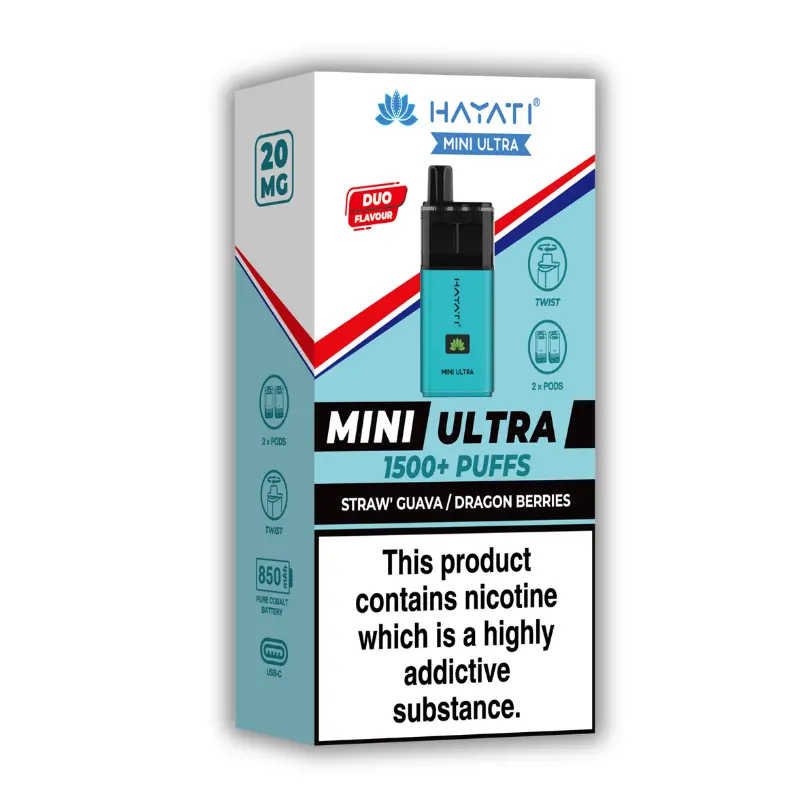
Hayati · Mini Ultra
Straw’ Guava / Dragon Berries Hayati Mini Ultra Pod Kit
£3.99
✔ In stock — ready to ship
Genuine Hayati
Free over £20
Same-day dispatch
Secure checkout
The Straw’ Guava / Dragon Berries Hayati Mini Ultra Pod Kit is a complete £3.99 package: the Mini Ultra body, and a prefilled 4ml pod holding two liquids at once. One side is strawberry with guava over it. The other is a mixed-berry build with a dragon fruit note through it. Hayati state on this listing that the two are held apart from each other and that turning the rotating mouthpiece selects which one you draw, and they state nothing at all about how that is arranged inside the housing, so neither does this page. The cell is 850mAh, the strength is 20mg nicotine salt, and the manufacturer's laboratory rating is up to 1,500 puffs, a bench figure produced by apparatus rather than by anybody's actual use.
That is the product. What follows is mostly not about the product. It is about the row of structured data sitting underneath it, because this listing has a property that is easy to miss and turns out to be systematic across the whole range once you go looking.
The catalogue keeps a single flavour value against every item it sells. For a pod holding one liquid that is a sensible arrangement and it works. For this one it cannot work, because there are two liquids and one slot, and the slot has to pick. It picks Dragon Berries. The guava half, which is the half carrying the unusual fruit and the entire reason anybody chooses this pairing over a plain berry kit, is not in the field. It is in the title and it is in the sales paragraph, and past that point, in the part of the record that machines read, it does not exist.
Two sibling pages have already noticed that about their own listings and said so. Neither counted it. Counting it is what this page does, and the count changes the explanation entirely, because the field turns out to be perfectly capable of holding both halves, and to do so on thirty-four other listings in this same catalogue. So the missing guava is not a limitation. It is a choice, made at data entry, and there is a rule behind which half gets chosen.
Counting the claim before building anything on it
The claim handed to this page was that the divided Mini Ultra kits each record one half of their pod and that nothing determines which half. Half of that is right. The second half is wrong, and finding out why is the most useful thing on this page, so here is the counting in full.
The Mini Ultra shelf holds fifty listings. Twenty are complete kits at £3.99 and thirty are bare replacement pods at £3.49, and eleven of the twenty kits carry two flavour names either side of an oblique. Those figures are established on the Cherry Berry Hayati Mini Ultra Pod Kit page, which also worked out that every single half of every divided kit is separately available as a full 4ml pod of its own, twenty-two halves and twenty-two single pods. They were re-checked against the catalogue for this page and they hold. They are cited here rather than rebuilt, and that page is the place to read what the shelf's shape says about how Hayati expect the format to be bought.
Now the part that is new. Take those eleven divided kits and read the flavour value the catalogue stores against each one. Every one of the eleven holds exactly one name. Not one holds both.
- Fruit Bomb / Straw’ Watermelon B’Gum records Fruit Bomb.
- Blue Razz Pineapple / Strawberry Ice records Blue Razz Pineapple.
- Blueberry Cotton K / Raspberry Cotton K records Blueberry Cotton K.
- Grape GB / Strawberry GB records Grape GB.
- Cherry Ice / Peach Mango records Cherry Ice.
- Blackcurrant Lemonade / Straw’ Lemonade records Blackcurrant Lemonade.
- Cola Ice / Orange Lemon Lime records Cola Ice.
- Sour Apple / Juicy Peach records Juicy Peach.
- Blueberry Straw’ Menthol / Blueberry Raspberry Menthol records Blueberry Raspberry Menthol.
- Straw’ Cranberry Cherry / Cherry Ice records Cherry Ice.
- Straw’ Guava / Dragon Berries, the pod in question, records Dragon Berries.
Seven of the eleven keep the half named first in the title. Four keep the half named second, and this listing is one of the four, along with the peach pairing, the menthol pairing and the cranberry one. That split is exactly as it was described to this page, and it is real.
The conclusion drawn from it was that position is arbitrary and nothing decides which half survives. It looks arbitrary. Seven against four is close enough to a coin toss that you would stop there, and a page could be written on the theme of an indifferent record making an indifferent choice. That page would be wrong. Position is not the variable. There is a variable, it is visible in the list above if you know to look for it, and it predicts the outcome in fifteen of the sixteen cases across the entire catalogue.
The field is not a one-flavour field, and thirty-four listings prove it
Before getting to the rule, the explanation that has been offered twice needs disposing of, because it is the obvious one and it is not true.
The 22ml version of this exact recipe and its bare-pod twin have the same single value in the same field, and the pod page states the observation plainly, noting in its specification table that the product type recorded in the data is Dragon Berries and that the guava half is missing from the field. It explains this as what happens when a recipe with two names is dropped into a slot built for one. A second page, covering the grapefruit pairing, found the same thing on its own listing and reached a similar reading: a taxonomy assembled for single-flavour sweet fruit has nowhere to put an item that is two things at once, so it files what it can and loses the rest.
Both observations are correct about their own listings. The explanation behind them is not, and the catalogue says so out loud.
Across all 492 products, sixty-one listings divide a pod between two named flavours. (The count excludes the forty bottle listings whose titles carry an oblique between two numbers, since a 70/30 or 50/50 in a title is a carrier ratio and not a second flavour. It is worth saying that a sibling page gives this figure as fifty-one against a catalogue that now yields sixty-one, so the number has moved since that page shipped; the one used here was taken from the data as it currently stands.) Fifty of the sixty-one are Pro Ultra Plus listings, sold both as complete kits and as bare pods. The remaining eleven are the Mini Ultra kits listed above.
Thirty-four of those sixty-one record both halves. The value is simply the two names with an oblique between them, exactly as the title has it. Blue Razz Cherry / Blue Razz GB at 22ml stores the string Blue Razz Cherry/Blue Razz GB and loses nothing. Blackcurrant Cotton K / Blue Raspberry does the same, one of only two listings in the range that puts spaces either side of the oblique in the stored value, which is itself a small sign that these strings were typed by a person rather than generated by a script.
So the field holds two flavours whenever somebody puts two flavours in it. It is a text field. It does not have a shape that a compound recipe fails to fit. Every one of the thirty-four is on the Pro Ultra Plus platform, and not one of the eleven Mini Ultra kits does it, which means the difference is a habit of whoever was entering that shelf rather than a property of the catalogue.
The strongest form of the proof is the four pairings sold on both platforms in the divided form. The same two flavour names, the same recipe, two records. Cherry Ice / Peach Mango is stored as Cherry Ice/Peach Mango at 22ml and as Cherry Ice alone at 4ml. Blue Razz Pineapple / Strawberry Ice, Sour Apple / Juicy Peach and Fruit Bomb / Straw’ Watermelon B’Gum all behave the same way, complete on the larger platform and halved on this one. Whatever is going on, it is not that a two-flavour recipe cannot be recorded. It has been recorded, four times, for four of these same eleven pairings.
What actually decides which half the record keeps
Here is the variable. Of the sixty-one divided listings, twenty-seven store a single name, and those twenty-seven are sixteen distinct recipes once you allow for the same pairing appearing as a kit and as a pod, and sometimes on two platforms.
Not one of the twenty-seven stored values uses the clipped spelling. Zero out of twenty-seven. Where a title writes Straw’ with an apostrophe standing in for the rest of the word, the flavour field either takes the other half or rewrites the clipped one until it is no longer clipped.
Sort the sixteen recipes by how many of their halves are clipped and the picture is tidy to the point of being suspicious.
Six recipes have exactly one clipped half. All six record the unclipped half. Six out of six, in both directions. Three of them have the clipped name first, so the record takes the second: this pairing, Straw’ Cranberry Cherry / Cherry Ice, and Blueberry Straw’ Menthol / Blueberry Raspberry Menthol. Three have the clipped name second, so the record takes the first: Fruit Bomb / Straw’ Watermelon B’Gum, Blackcurrant Lemonade / Straw’ Lemonade, and Kiwi Banana / Straw’ Banana on the larger platform. Running order changes nothing. The clipped half loses either way.
Three recipes have both halves clipped, and all three end up with a rewritten value rather than a clipped one. Watermelon B’Gum / Strawberry B’Gum is stored as Strawberry Bubblegum, with the abbreviation opened out into a word that appears nowhere in its own title. Straw’ Grapefruit / Straw’ Dragonfruit is stored as Strawberry Dragonfruit, same treatment. Blueberry H’Bubba / Watermelon H’Bubba is stored as Blueberry HBubba, where the apostrophe has simply been deleted and the result is a string that is not a word in any language. Three different ways of dealing with the same difficulty, all of them ending with no apostrophe in the field.
Seven recipes have no clipped half at all, and six of those seven take the first-named flavour. Grape GB, Blueberry Cotton K, Cherry Ice, Blue Razz Pineapple, Cola Ice and Kiwi Banana, in each case the name at the front. The single exception in the whole catalogue is Sour Apple / Juicy Peach on this shelf, which takes the peach for no reason that the data accounts for. One anomaly in sixteen recipes and 492 listings. Worth noting that the same pairing at 22ml records both halves, so the one unexplained case is also a case where the two platforms disagree with each other.
Put the two rules together and they call fifteen of the sixteen: if one half is clipped, the other half is recorded; if neither is, the first one is recorded. That is a great deal more than nothing deciding which.
One thing this is not. The clipped spelling itself has been settled elsewhere and is not reopened here. Twenty-two titles in the range use the short form and sixty write the fruit out in full, which is a house habit in the naming of products and carries no information whatsoever about what is in the bottle or the pod. That finding stands and this page accepts it entirely. The claim being made is a different one about a different field: the clipping tells you nothing about the liquid, and it tells you a great deal about which name survives into the structured record. A convention that is meaningless at the front of the catalogue turns out to be decisive at the back of it.
There is also a clean control for the argument, and it is the most satisfying single row in the data. Straw’ Cranberry Cherry appears in two different divided pairings. Paired with Strawberry Raspberry Ice on the larger platform, where the record keeps both halves, the stored value is Straw’ Cranberry Cherry/Strawberry Raspberry Ice, apostrophe and all, preserved exactly. Paired with Cherry Ice, across three listings and two platforms, where the record keeps one half, the stored value is Cherry Ice and the cranberry side is gone. The same string, in the same field, in the same catalogue, kept when it travels with a companion and dropped when it travels alone. Six of the thirty-four both-half values contain an apostrophe, so the field has no difficulty holding one. It only ever declines to hold one when it is choosing between halves.
Which is why the guava is the half that vanishes
Apply the rule to this pod and it comes out without ambiguity. The two halves are Straw’ Guava and Dragon Berries. One is clipped and one is not. The record keeps Dragon Berries.
That is the whole mechanism, and it is worth sitting with how little it has to do with the liquid. The guava side is not dropped because it is second in the title; three other recipes drop the half that is first. It is not dropped because it is the quieter side, and in any case it is not the quieter side: the case that guava is the loud half of this pairing is made at length on the 22ml pod page, which counted the word fragrant across all 492 descriptions, found it in thirty of them and found eight of those thirty to be the eight guava listings, with no guava listing anywhere in the range escaping an intensity word. It is not dropped for any reason connected to taste, cost, popularity or shelf placement. It is dropped because somebody writes Straw’ instead of Strawberry, and the person filling in the flavour column will not put an apostrophe in it.
All three listings of this recipe do the same thing. The Pro Ultra Plus pod at £7.99, the Pro Ultra Plus kit at £11.99 and this 4ml kit at £3.99 sit on two different platforms at three different prices, and all three of them record Dragon Berries and nothing else. Four of the eleven Mini Ultra pairings are recorded more completely on the larger platform than on this one, so there was no guarantee of that consistency. This recipe got it because the rule that governs it is a rule about the name, and the name does not change between platforms.
There is a mild irony in the outcome, given what the two halves are. Dragon Berries is the vaguer name of the two. It nominates a category, berries, and a modifier that may or may not be a fruit, and the Dragon Berries Hayati Pro Max Plus 6000 Pod Kit page is built around exactly that problem: what a name promises when it gives you one ingredient and one gesture. Straw’ Guava names two fruits precisely. The record kept the vague one and discarded the specific one, and it did so because the specific one had been abbreviated.
What the record does hold about the guava, a dozen rows away
The half is missing from this listing. It is not missing from the catalogue, and that is what makes the gap worth describing rather than merely noting.
The same shelf sells Straw’ Guava on its own, as a single 4ml Mini Ultra pod at £3.49, and the flavour field on that listing reads Straw Guava. The apostrophe has been stripped but the name is there. Two listings on the older Pro Max Plus platform sell the same fruit pairing under its unabbreviated name, and both of them store Strawberry Guava in the field, spelled out in full. So the catalogue holds this liquid's identity in four places, under two different strings, and holds it nowhere on any of the three listings where it shares a pod with Dragon Berries.
That is a more interesting shape than a simple absence. A gap caused by a vocabulary that has no word for something is one kind of problem, and the grapefruit page is genuinely an instance of it, since nothing in the range's flavour taxonomy accommodates a bitter fruit. This is not that. The word exists, twice over, in two spellings, on four sibling listings, and the field on those listings has no trouble accepting it. The gap here is purely the product of a choice made when two names competed for one cell.
The two spellings are their own small piece of evidence. Straw Guava on the Mini Ultra pod, Strawberry Guava on the Pro Max Plus pair. Nothing about the liquid differs; the platforms were entered by different hands or at different times, and the field simply records whatever was typed. A record built that way is not a description of the product. It is a transcript of what somebody wrote down, and the difference matters when you start to rely on it.
What inherits the hole, and the honest limit of the claim
The 22ml pod page draws the obvious conclusion from its own single observation, that every automated surface in this catalogue identifies the pod by the half that got recorded. That is cited rather than repeated. What the census adds is a specific, checkable consequence for anybody using this shelf.
Sort or filter the Mini Ultra shelf by its flavour values and the fifty listings resolve into thirty-nine distinct flavours, because eleven of them are reporting half of what they contain. Ask that list for a guava and you get one result, the £3.49 single pod. This kit, which contains the same guava, is not in the answer. Ask it for Dragon Berries and you get three results, of which this kit is one, so the same pod is discoverable through the berry side and invisible through the fruit that distinguishes it. The asymmetry is not a rounding error. It is the difference between the pod being found by the shopper who wants it and not being found.
Now the limit, stated because the claim would be overreaching without it. The flavour field is not the only structured thing the catalogue holds. This listing is filed on Strawberry Vapes alongside eighty-one others, and on Exotic Vapes with fifty-four others, and both of those filings clearly reflect the guava half, since the berry side alone would not have produced either. So the shelf structure knows about a fruit the flavour column does not. Anyone browsing by category will find this pod perfectly well. The hole is in one field, not in every surface, and this page is not claiming otherwise. Nor does it go further into how these shelves are assembled, which is somebody else's question and is better answered where it is asked.
What survives that qualification is still worth a buyer's attention. The field is the thing a search box and a sort order and a one-line summary reach for first, because it is the field whose job is to say what the liquid tastes of. It is the one place in the record where a single short string is supposed to stand in for the whole product, and on eleven listings on this shelf it stands in for half of one. Everything downstream of it inherits that, and the inheritance is silent: nothing about a result list announces that an entry is reporting fifty per cent of its contents.
The practical form of it is short. When you come back for this liquid, come back by the title or by the catalogue code, never by the flavour name, because the flavour name in the record is Dragon Berries and Dragon Berries is also sold on its own, at 4ml, at 12ml and inside this pod, and only one of those is what you had.
The two liquids, in summary, because three pages already own them
This pairing has been analysed properly elsewhere and there is no value in a fourth version. What follows is a map of where each part of it lives, with the conclusions attributed rather than re-derived.
The full case on how the two halves behave against each other belongs to the 22ml pod page. Its central finding is an asymmetry of intensity rather than of sweetness: guava is the one fruit in this range that Hayati have never once described without reaching for an aroma word, and dragon fruit is the one they most consistently describe by saying how little it does, with mild, subtle, softens and gently sweet doing the work across its listings. That page also establishes the running order that follows from the asymmetry, and a clearance rule with a specific count of draws attached to it for the direction of the switch that costs something. Anybody intending to use both halves in rotation should read it before forming a plan, because the rule it arrives at is not the one you would guess and the reasoning is longer than a summary can carry.
The guava side taken on its own, draw by draw, is covered on the Strawberry Guava Pro Max Plus kit page: how the strawberry opens, where the floral character arrives, and the way the two fruits share enough softness that the blend runs continuously instead of arriving in stages. The berry side taken on its own is covered on the Dragon Berries Pro Max Plus kit page, which is candid that the dragon fruit is doing less than its billing suggests and that the berry base carries the liquid.
What this listing's own copy adds to that record is small and worth stating exactly, since the listing diff is the sort of thing that repays precision. Hayati's paragraph for this 4ml kit says the guava gives the strawberry an exotic edge, and it says of the other half that the dragon fruit softens the berries rather than competes with them. That second clause is the only place in the range where the relationship between the two sides is stated as a contrast of behaviour rather than of fruit, and it is a denial rather than an assertion: it tells you what one half does not do. The £11.99 kit's copy for the same recipe says nothing of the kind, describing the guava side as a tropical, fragrant sweetness and the other as a berry blend with an exotic slant, so the two listings of one recipe do not agree on how much there is to say. That is evidence about how the copy was commissioned, not evidence about two recipes.
The short practical version, for anybody who wants it in one paragraph and will read the detail later: both halves are sweet, neither is cooled, neither is tart, and the difference between them is a difference of aroma rather than of structure. If you turn the collar expecting the second side to feel like a different kind of drink, it will not. It will feel like the same kind of drink with a different smell attached. Whether that is worth having depends entirely on how much you care about aroma, and it is a real axis, but it is not the axis a first-time buyer usually has in mind.
The kit as an object
The box holds the Mini Ultra body and the prefilled pod, and that is the inventory. There is nothing to fill, nothing to assemble and no spare.
Four millilitres is the total across both liquids, not four per side. Hayati publish the same 4ml and the same laboratory rating of up to 1,500 puffs for all fifty Mini Ultra listings, divided and undivided alike, which is the corroboration for reading the figure as a whole-pod number. What they do not publish anywhere is the split between the two sides, and no honest page can supply it. Assume it is even if you need a planning figure and treat that as a reading rather than a fact.
Turning the mouthpiece selects which liquid reaches the coil. Hayati say that much on this listing and say nothing about seals, chambers or how the separation is maintained, so this page describes the selection and stops there. One coil serves both, which is the consequence that actually reaches you: the two sides age together, and there is carryover across a switch. Check the range name printed on your device before ordering a replacement, because Hayati run several pod formats that resemble one another.
The Hayati Mini Ultra Prefilled Pod Kit shelf holds all twenty kits at this price, and the Hayati Mini Ultra shelf adds the thirty bare pods, which is where to go for the rest of the hardware picture rather than reading it here.
The sheet, arranged around the row that can only be half right
The table below is ordered by how much of this product each line manages to describe, starting with the line that manages least, because that is what the page has been about. Where it says a figure is unpublished, that means Hayati do not give it, not that it has been left out here.
| Flavour, as the structured record stores it | Dragon Berries. One value, and the pod has two liquids in it |
| Flavour, as the title gives it | Straw’ Guava / Dragon Berries |
| Halves recorded by the same field on 34 other divided listings | Both, written with an oblique between them |
| Split of the liquid between the two sides | Unpublished. No figure anywhere in the range |
| Liquid in the housing | 4ml in total, shared |
| Selecting a side | Rotating mouthpiece. No internal arrangement published |
| Cooling on either half | None named, in the title or the copy |
| Tartness on either half | None claimed, on either side |
| Strength | 20mg nicotine salt, the only figure this listing offers |
| Cell | 850mAh |
| Manufacturer's laboratory rating | Up to 1,500 puffs, bench apparatus, identical across all fifty Mini Ultra listings |
| Coil resistance | Not recorded against any Mini Ultra listing |
| Carrier ratio | Not recorded against this product |
| Refilling | No route published. The pod arrives filled |
| In the box | Device and prefilled pod |
| Shelves it is filed on | Eight, of which Berry, Exotic and Strawberry describe the liquid |
| Same recipe with a larger pod | Pro Ultra Plus, 22ml, £11.99 |
| Catalogue code | straw-guava-dragon-berries-hayati-mini-ultra-pod-kit |
| Maker | Hayati |
| Price | £3.99 |
Four of those lines want a word. The first is the page's subject and has had it. The point of putting it at the top of the sheet rather than in the middle is that a specification table is exactly the kind of surface that inherits the problem: this one is written by hand and can say what the field says and then correct it, but a table generated from the record could not, and would have printed Dragon Berries under Flavour and moved on.
The unpublished split is the line that could change somebody's mind. If you are buying this for the guava, and the guava is the distinguishing part, you have no way of knowing what proportion of the four millilitres is guava. It might be half. On a pod this size the consequence is small in money, which is the one mercy of the format, but it is not nothing: if the division is uneven against you, the side you wanted could be gone well before the cell stops holding a charge.
Twenty milligrams per millilitre is the highest strength a consumer e-liquid may be sold at in this country, so it is a ceiling rather than a recommendation, and every one of the fifty Mini Ultra listings carries the same figure because of that. There is no alternative to choose on this listing. Nicotine is addictive regardless of which side of the pod it arrives from.
The two blank technical lines are the ones most often filled in by copying a neighbouring page until a guess starts to look like a measurement. Hayati record neither for this range, so neither is given a value here, and a resistance figure read on any retail page, this one included, should be treated as unsourced until the maker publishes one.
Where it sits, and what to take instead
All twenty kits on this shelf are £3.99, so price decides nothing between them and the choice is about shape. The groupings below sort by what you are actually after.
If you want this pairing properly rather than as a sample. The Straw’ Guava / Dragon Berries Pro Ultra Plus 25000 kit at £11.99 is the same two liquids with more than five times the volume behind them, and it is the version where the running order and the clearance rule from the 22ml page become worth executing. Four millilitres will tell you whether you like a fragrant strawberry and whether you like a soft berry mix. It will not tell you how the pair holds up over a fortnight, because it does not last a fortnight.
If the guava is the part you care about and you have finished with the berries. The single Straw’ Guava pod at £3.49 puts the full four millilitres behind one liquid and costs fifty pence less, and it is the listing the flavour field will actually find for you. That is the standard exit from any divided kit on this shelf, and it applies in both directions: the berry half is sold on its own too, at the same price.
If you like the divided idea and want a sharper contrast. This pairing sets two sweet fruits against each other, which is a fine thing but a narrow gap. Blackcurrant Lemonade / Straw’ Lemonade keeps both halves in a drink register and moves the fruit underneath it, which is a different kind of comparison. Cherry Ice / Peach Mango puts a cooled half against an uncooled one, which is the widest gap on this shelf because it changes the sensation rather than the fruit. Blueberry Straw’ Menthol / Blueberry Raspberry Menthol goes the other way and holds the cooling constant across both sides while moving one berry, which is the narrowest comparison on the shelf and deliberately so.
If you want the two halves to be near-identical on purpose. Blueberry Cotton K / Raspberry Cotton K and Grape GB / Strawberry GB both hold a confectionery treatment steady and change only the fruit under it. Both are also, incidentally, cases where the record keeps the first half, since neither has a clipped name in it.
If you would rather not have a collar at all. Nine of the twenty kits are single-flavour and the whole four millilitres goes to one liquid. Cherry Berry is the nearest to this pod's register, sweet fruit without cooling. Blueberry Raspberry is the plain version of the hedgerow side. Blue Razz Cherry and Blue Razz GB sit in the confectionery end of the shelf, Mr Blue is the one whose name tells you nothing at all and has to be found out, and Blue Sour Raspberry is the shelf's answer if what you want from a fruit is acid rather than perfume. Strawberry Raspberry Ice is the cooled strawberry option, which is the one thing this pod does not offer on either side.
If the collar is what you want but four millilitres is not. The larger platform is where the divided format is taken seriously, and it is also where the record tends to be complete. Straw’ Cranberry Cherry / Cherry Ice at 22ml is a red-fruit pairing with a cooled half. Blue Razz Cherry / Blue Razz GB stays inside one family across both sides. Blackcurrant Cotton K / Blue Raspberry sets a treated half against an untreated one. Watermelon B’Gum / Strawberry B’Gum and Kiwi Banana / Straw’ Banana are both cases discussed above where the clipping rule bites, so their records are half-length too.
If you want a single flavour and a bigger pod. Blue Razz Cherry at 22ml is the undivided route on the largest hardware. On the 12ml platform, Strawberry Raspberry Blueberry and Strawberry Raspberry Cherry are three-berry builds with a strawberry lead, which is the closest anything gets to this pod's fruit without the tropical component. Blackcurrant Mango is the range's other berry-against-tropical construction and is a much heavier one. Blue Fusion and Galaxy Aura are both named for an impression rather than a fruit, which is the opposite failure of description to the one on this page: there the record and the title agree, and neither of them tells you anything.
For browsing rather than shortlisting, Berry Vapes runs to 225 listings and Exotic Vapes to fifty-five, and this pod is on both because of its two different halves. Hayati Pod Kits collects all 174 kits across every platform, and the full catalogue is 492.
Living with a pod the record only half describes
Most handling advice on this shelf is generic and is better read where it is written properly. What follows is the part that is specific to this pod, and two items of it come directly out of the argument above.
Keep your own note of which side is which. The device does not label the collar positions and the record names only one of the two liquids, so there is nothing on the product, in the listing or in the data that will remind you which way round you are. On a pairing with a cooled half you can tell instantly. On this one both halves are sweet, uncooled fruit, and after a few days of not thinking about it you can genuinely lose track of which position you are drawing from. Note the position the guava sits at on the first day, in whatever form you will still have in a fortnight.
Reorder by the title, not by the flavour. This is the practical consequence of everything above. Searching for Dragon Berries will return the berry liquid on its own at three different sizes, and one of those is not what you had. Searching for guava will not return this kit at all. The catalogue code at the bottom of the specification table is the unambiguous handle, and the full title is the next best thing.
Give the aroma side a fair hearing early. Guava's distinguishing character is volatile and sits at the top of the profile, which is the part of any liquid that fades first as a coil accumulates residue from a sweet build. The berry side will still taste substantially like itself late in the pod. The guava side will not, and the loss is specifically the part you bought it for. If you intend to judge whether the fragrant half is worth it, judge it in the first day or two rather than at the end.
Allow for carryover at the switch. One coil feeds both sides, so the first draws after turning the collar are not a clean reading of the side you have just moved to. The 22ml page works out how many draws that costs and, importantly, that the cost is very uneven between the two directions. The arithmetic there is built for a much larger pod, but the direction of the asymmetry is a property of the two liquids rather than of the volume, and it applies here.
Draw unhurriedly and leave gaps. A short, restricted inhale suits the format, and drawing hard in quick succession on a small pod outruns the wick's ability to keep up, which produces a thin, hot draw that nobody enjoys. This matters more on a divided pod than a single one, because a wick that is struggling holds on to the previous side's residue for longer.
Store it upright, away from heat and light, and somewhere children and pets cannot reach. Sweet fruit liquids darken with warmth and the aromatic top end is the first casualty, which on this pod means the guava again. A car in summer will cost you the distinguishing half of the product before you have opened it.
Know when it is done. There is no published refill route and the pod arrives filled, so the end of the liquid is the end of the pod. When the draw turns thin and harsh and does not recover after a rest, stop drawing on it: a spent coil gives you nothing worth having. The pod contains a heating element and a residue of liquid when you discard it, so it belongs at an electrical recycling point rather than in the household bin, and the same goes for the body when the cell will no longer hold a useful charge.
Questions this listing gets asked
Is this two pods or one?
One pod, holding two liquids, in a single kit with the device. The four millilitres is the total for the pod and it is shared between the two sides. Hayati publish no figure for how it is divided.
Why does the product data say Dragon Berries when the title says two flavours?
Because the catalogue keeps one flavour value per item and somebody had to choose. Across the range, when that choice is made, the clipped name is never the one kept, and Straw’ Guava is clipped. Thirty-four other divided listings avoid the problem by recording both halves in the same field, so it is a habit of data entry rather than a limit of the record.
Does that mean the pod does not actually contain the guava half?
It contains it. The title says so, the description says so, and the shelf filings reflect it. Only the single flavour value omits it, which matters for searching and sorting rather than for what arrives.
Is either half cooled?
No. Neither name carries a cooling word and neither description mentions one, so both sides are warm sweet fruit. If you want a cooled option at this size, Strawberry Raspberry Ice is the undivided one and the cherry and peach pairing has cooling on one side only.
How different do the two halves actually taste?
Less different than a divided pod usually manages. Both are sweet, both are fruit, and neither is tart or cold. The difference is aroma: the guava side is fragrant and slightly floral over a strawberry base, and the berry side is rounder with a mild tropical note through it. If you want two sides that feel like separate drinks, this is not that pairing.
Can I buy just the half I liked?
Yes. Both halves exist as single 4ml Mini Ultra pods at £3.49, which is the pattern for every divided kit on this shelf. The guava one is listed under Straw’ Guava and is the one the flavour field will find for you.
Is the 1,500 puff figure what I should expect?
Treat it as a comparison number. It is rated by the manufacturer at up to 1,500 puffs on bench apparatus drawing to a fixed pattern, and every Mini Ultra listing carries the identical figure whether it is divided or not. Longer and more frequent draws move the real total down. Four millilitres is the sounder planning number.
Is the 22ml version the same liquid?
It is the same recipe under the same two names, on different hardware at a different price. Nothing in either listing suggests a reformulation. The larger version is the one worth having if you already know you want the pairing rather than a sample of it.
What is the strength, and is there a choice?
20mg nicotine salt, and no. Every Mini Ultra listing is 20mg because that is the ceiling for a consumer e-liquid here, so it is a fixed property of the range. Nicotine is addictive.
Can I refill the pod when it runs out?
Hayati publish no refill route and the pod arrives filled, so treat it as finished when the liquid is gone. A replacement pod for either half is the way to continue on the same device.
Which half will run out first?
Whichever you use more, and there is no way to rebalance it and no warning before it happens. At that point the pod becomes a single-flavour pod for whatever is left, on a coil that is already part-way through its life.
The short version
A £3.99 kit with the device and a 4ml pod divided between a fragrant strawberry-and-guava liquid and a soft mixed-berry one, both sweet, neither cooled, selected with a rotating mouthpiece, at 20mg on an 850mAh cell. As a thing to buy it is a cheap way to find out whether you want either liquid, and the 22ml version is where the pairing is worth living with.
As a record it is half a description, and the reason is worth knowing because it generalises. Eleven divided kits on this shelf each store one flavour name; thirty-four divided listings elsewhere in the same catalogue store two, so the field was never the constraint. What decides which name survives is not position and not prominence but spelling: in six recipes out of six with one clipped half, the record keeps the other one, and in the three where both are clipped it rewrites one until it is not. Fifteen of sixteen cases fall to that rule and the sixteenth is a peach. On this listing the rule removes the guava, the half that carries the only unusual fruit in the pod, from every automated surface that reads the flavour column. The shelf filings still know about it and the title still says it, so nothing is hidden from a reader. It is hidden from a search, and the difference is worth one sentence of your attention when you come back to buy it again.
Strictly for adults aged 18 and over. Nicotine is an addictive substance.
You might also like


