
Home / Hayati Rubik Prefilled Pod Kit / Blue Razz Cherry Hayati Rubik Prefilled Pod Kit
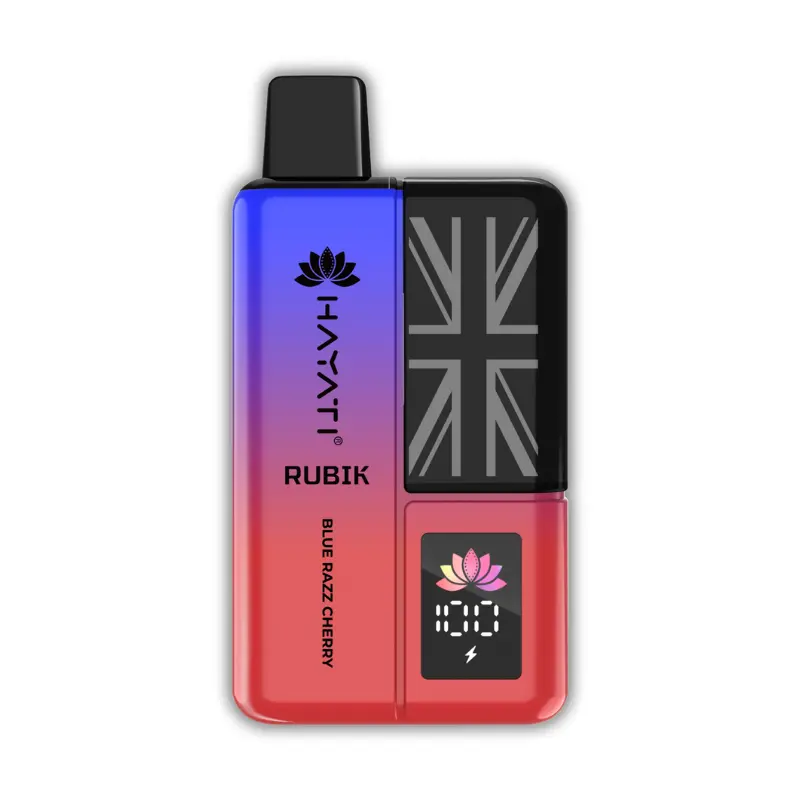
Hayati · Rubik
Blue Razz Cherry Hayati Rubik Prefilled Pod Kit
£5.99
✔ In stock — ready to ship
Genuine Hayati
Free over £20
Same-day dispatch
Secure checkout
Five pounds ninety-nine buys a Hayati Rubik body with a filled pod already seated in it, twelve millilitres of Blue Razz Cherry at 20mg nicotine salt, and an 850mAh cell to run it on. Hayati rate the pod at up to 7,000 puffs, a laboratory estimate produced on test apparatus rather than a forecast of your fortnight. Nothing needs filling and nothing needs assembling. As a description of a purchase that is the whole of it, and it would make for a short page.
What makes this listing worth more than three lines is where it sits. Blue Razz Cherry is one of the flavours Hayati manufacture on every device they operate, which means it arrives on the shop as four separate boxed kits at four separate prices, and each of those four boxes prints a different puff rating on it. One says 1,500. This one says 7,000. The next says 6,000. The last says 25,000. Four numbers, four cartons, and a liquid that carries the same name in all of them.
A buyer standing in front of those four is being invited to read the numbers as a scale, because that is what a column of figures looks like. They are not a scale. A puff rating is a manufacturer's laboratory estimate produced under conditions nobody publishes, on four different pieces of hardware, and two such estimates are not on a common axis. They cannot be divided by each other, ranked against each other or used to work out which box is more of a thing. Volume and price can. They are measured in units that mean the same thing on every carton.
That is a simple point and a genuinely useful one, because the rating is the largest text on most of these boxes and it is the one figure on them a buyer cannot actually use. The first half of this page works out what to use instead and puts the real figures in a table. The second half is about the liquid, which is where the pages on this shop that are worth reading spend their length, and where this flavour turns out to be more interesting than a two-fruit name suggests.
Four boxes of one liquid, counted before anything is built on it
An angle that opens by calling something a pattern should show its working, so here is the count, run against the catalogue rather than taken from another page.
Thirteen listings on this shop carry Blue Razz Cherry in the title. They divide four ways. Four are complete kits with a device in the carton, which is the set this page is about. Four are bare replacement pods for those same four devices. Three are bottles: a 10ml nicotine salt at 10mg and two 120ml shortfills supplied at 0mg. The remaining two are the divided Pro Ultra Plus pairing that puts this flavour on one side of a collar and Blue Razz GB on the other, sold once as a kit and once as a refill.
The four kits, with every figure taken from the listings themselves:
- Blue Razz Cherry Hayati Mini Ultra Pod Kit, £3.99, 4ml, 20mg, rated by Hayati at up to 1,500 puffs.
- This listing, the Rubik kit, £5.99, 12ml, 20mg, rated by Hayati at up to 7,000 puffs.
- Blue Razz Cherry Hayati Pro Max Plus Pod Kit, £7.99, 12ml, 20mg, rated by Hayati at roughly 6,000 puffs.
- Blue Razz Cherry Hayati Pro Ultra Plus 25000 Prefilled Pod Kit, £11.99, 22ml, 20mg, rated by Hayati at up to 25,000 puffs.
Every one of the four states an 850mAh cell. The nicotine concentration is 20mg on all four, which is the ceiling a prefilled pod may lawfully carry in the United Kingdom, so the strength column does no work in this comparison at all. Nicotine is an addictive substance and the figure is printed here so it can be lined up against whatever you already use, not as a suggestion.
Three of the four differences are therefore real and countable: what the box costs, how much liquid is in it, and what number is printed on it. The first two are measured in pounds and millilitres. The third is measured in a unit that four different laboratories, or four different test runs, have each defined for themselves.
One boundary before going further. The divided Blue Razz Cherry / Blue Razz GB Hayati Pro Ultra Plus 25000 Prefilled Pod Kit is a fifth box at £11.99 and it is deliberately excluded from the four. It holds 22ml split between this flavour and a second one behind a rotating collar, so it is not a box of Blue Razz Cherry, it is a box of two things one of which is Blue Razz Cherry. Its own page runs a full hardware audit of the Pro Ultra Plus platform and establishes, among other things, that the 850mAh figure appears identically across four Hayati devices carrying pods of four different sizes, which makes it the one published hardware specification that cannot separate Hayati's own hardware. That finding is sound, it is not being rebuilt here, and it is the reason the cell capacity has no column in the table below.
Only one of the four puts its number on the front
Look at the four titles rather than the four descriptions and something odd emerges. Three of them name no figure at all. Mini Ultra Pod Kit. Rubik Prefilled Pod Kit. Pro Max Plus Pod Kit. Each is a flavour, a range and a format word, and that is all. The fourth is called the Pro Ultra Plus 25000 Prefilled Pod Kit, so its rating is not a specification at all, it is part of the product's name.
That matters more than it sounds, because a shopper scanning a grid reads titles. Four tiles appear, one of them has a five-figure number in its name and the other three have nothing. The honest reading of those three blanks is that the figures exist and live in the small print. The reading most people will actually take is that the numbered one is the one with a number worth quoting, which is exactly the effect a title carrying a figure is there to produce.
I was handed one further claim about this set, that on one of the four listings the number appears only in the title and nowhere in the description, and it does not survive a check. All four descriptions carry their figure. So does every other listing of this flavour except the three bottles, which publish no rating because a bottle has no device attached to rate. Widening it out, 137 listings on this shop carry a puff figure somewhere in the title, and not one of them omits that figure from its own description. The claim is not merely unsupported on this flavour, it is unsupported across the catalogue.
What is true is the inverse, and it is worth saying in its corrected form because the corrected version is the more useful one. Three of these four boxes carry their rating only in the body copy, where a buyer has to open the listing and read down to find it. The number is not absent, it is unranked: it never appears in the place where products are compared against each other. So the set you are choosing from presents itself as one numbered box and three unnumbered ones, when in fact it is four numbered boxes, one of which has put its figure in the shop window.
The two boxes in the middle, which disagree with their own prices
The clearest way to see that the numbers are not a scale is to find two boxes where everything else is held constant, and this flavour provides them.
The Rubik kit and the Pro Max Plus kit both hold twelve millilitres. Both are 20mg nicotine salt. Both state an 850mAh cell. Both are complete kits with a device in the carton. The liquid carries the same name in both. The only two things that differ are the price, which is £5.99 here and £7.99 there, and the rating, which is 7,000 here and around 6,000 there.
So the cheaper of the two carries the higher number, by something close to seventeen per cent, on identical volume at identical strength. Whatever the extra two pounds on the Pro Max Plus box is buying, the published rating says it is not buying more of anything.
The temptation at this point is to conclude that the Rubik atomiser is more frugal with liquid, and that conclusion has already been examined properly and rejected on the Vim Ice kit page on this shelf, which found the same seventeen per cent gap on the same pair of platforms and worked out what it can and cannot support. Its finding, which I am taking as given rather than running again, is that the spread in rated puffs per millilitre across Hayati's four prefilled formats runs to a factor of three, and a seventeen per cent gap inside a threefold background variation cannot be read as evidence about hardware. It might be a real difference in how much liquid a draw consumes. It might be two numbers arrived at separately and never reconciled. Nothing Hayati publish lets anybody choose.
That is the general case. The particular case is what a buyer of this flavour is actually looking at, and it is worse than the general case, because here the two boxes are not merely on different platforms. They are the same volume of the same liquid at the same strength, and the numbers on them still disagree by a thousand.
Why the rating cannot be divided, compared or ranked
It is worth being precise about what a puff rating is, because the objection to it is not that it is dishonest.
A rating is produced by putting a sealed pod on test equipment and drawing on it to a fixed schedule until it stops producing vapour. The schedule has a puff duration, an interval between puffs, an airflow rate and a temperature, and the resulting figure is entirely a function of those choices. Lengthen the puff and the figure falls. Shorten it and the figure rises. None of the four boxes above states the schedule used, so there is no way to establish that any two of the four numbers were produced the same way.
Three consequences follow, and they are the practical content of the whole argument.
The first is that you cannot divide one rating by another. Twenty-five thousand over 1,500 is not a statement that the £11.99 box holds sixteen and a half times what the £3.99 box holds, because the two figures are not counting the same event. They are counting laboratory draws defined by unstated protocols, and the ratio between them is a ratio between two protocols as much as between two pods.
The second is that you cannot rank them. Ranking requires an ordering that holds, and these do not hold even against price: on this flavour the third most expensive box carries the second highest number while the second most expensive carries the third highest. An ordering that reverses against price on two adjacent boxes of one liquid is not an ordering anybody should act on.
The third is subtler and it is the one that catches careful buyers. You cannot derive anything from a rating either. Puffs per pound, puffs per millilitre, puffs per week: each of those looks like a legitimate calculation and each of them inherits the problem in the numerator. A derived figure built on an incomparable one is incomparable, and it is more dangerous than the raw number because it looks like analysis.
Here is that failure made concrete on these four boxes, which is the clearest single thing on this page. Take the ratings at face value and calculate rated puffs per pound spent. The Pro Ultra Plus box comes out at roughly 2,085, the Rubik box at roughly 1,169, the Pro Max Plus box at roughly 751 and the Mini Ultra box at roughly 376. On that measure the £11.99 box is the outstanding value and this one is a distant second.
Now do the same calculation with millilitres, which are measured the same way in every carton. The Rubik box gives 2.00ml per pound, the Pro Ultra Plus box 1.84ml, the Pro Max Plus box 1.50ml and the Mini Ultra box 1.00ml. On that measure this box is the best of the four and the £11.99 box is second.
Two methods, four identical boxes, and the two methods disagree about which one to buy. Only one of the two methods is using a unit that means the same thing in all four cartons. The per millilitre ordering across every prefilled format Hayati sell has already been worked out in full on the Vim Ice kit page and there is no sense in reproducing it; what is new here is that on this one flavour you can watch the two methods hand you different answers.
The figures that are on the same scale, and the one that is not
The table below sets the four boxes against the smallest of them, because ratios are what a buyer is implicitly forming when they look at a column of numbers, and putting the three sets of ratios side by side shows how far apart they are. The Mini Ultra kit is the baseline for no reason other than that it is the smallest and cheapest.
| Boxed kit | Ticket price | Liquid on board | Liquid against the 4ml box | Price against the 4ml box | Hayati's rating against the 4ml box |
|---|---|---|---|---|---|
| Mini Ultra Pod Kit | £3.99 | 4ml | 1.0x | 1.0x | 1.0x |
| Rubik Prefilled Pod Kit, this listing | £5.99 | 12ml | 3.0x | 1.5x | 4.7x |
| Pro Max Plus Pod Kit | £7.99 | 12ml | 3.0x | 2.0x | 4.0x |
| Pro Ultra Plus 25000 Prefilled Pod Kit | £11.99 | 22ml | 5.5x | 3.0x | 16.7x |
Read the last three columns across rather than down. Liquid spans a factor of five and a half from the smallest box to the largest. Price spans a factor of three. The manufacturer's rating spans a factor of nearly seventeen.
That is the whole problem in one line. A buyer who reads the ratings believes the biggest box is roughly sixteen times the smallest. It holds five and a half times the liquid and costs three times as much. The rating overstates the span between the ends of this range by a factor of about three, and it does so in the direction that flatters the most expensive item.
Two rows also swap places between columns four and six. By volume the two middle boxes are tied, dead level at twelve millilitres. By rating the cheaper one is seventeen per cent ahead. A tie and a seventeen per cent gap cannot both be descriptions of the same pair of pods, and the tie is the one measured in a unit that means the same thing in both cartons.
What the table deliberately omits is a cell capacity column. All four boxes state 850mAh, so it would be four identical cells conveying nothing, and the reason it conveys nothing is set out at length on the divided Pro Ultra Plus kit page rather than here.
The figure you already own, and how to read it off
Ratings are useless to you for a reason worth stating plainly: you have no personal puff count and you never will. Nobody counts their draws. There is no display on any of these four devices that Hayati describe, no log, and no way to compare a week of your own use against a laboratory schedule you have never seen.
You do have a personal millilitre count, and most people have never thought to work it out. Every prefilled pod on this shop is sold with its volume printed on it, so if you have ever finished one you already have the data. Note the date you seated your last pod and the date it stopped producing. Divide the volume by the number of days. That is your rate, in the only unit that is stated identically on all four of these cartons, and it is a measurement of you rather than an estimate of a machine.
Two cautions on the method, both of which make it more honest rather than less useful. Your rate is not constant: it moves with how your week is shaped, and a fortnight that includes two long evenings out is not a fortnight that predicts the next one. And a coil that has taken on residue produces less vapour per draw towards the end of a pod, which tends to lengthen draws slightly and pull a late-pod rate above an early-pod one. Take two or three pods' worth before trusting the figure, and treat it as a band rather than a point.
Once you have the band, the four boxes sort themselves without any reference to the number printed on them. Twelve millilitres at your own rate is a specific number of weeks. Four millilitres is a specific number of days. Twenty-two is a specific number of weeks and the answer will be uncomfortably large for most people, which is the useful part. The arithmetic of how long each format ties you to a profile at a standard rate has already been tabulated on the Strawberry Raspberry Ice kit page on this shelf, and the point here is different and simpler: use your own rate, not a standard one, because a standard rate is another number arrived at by somebody who is not you.
Which of the four boxes is right, and at what rate
Here is the recommendation stated plainly, because a page that dismantles the numbers and then declines to reach a view has done half a job. Every puff figure below is Hayati's own laboratory estimate and is included only so you can see that it plays no part in the reasoning.
If you have never had Blue Razz Cherry, or you get through under a few millilitres a week: the Mini Ultra kit at £3.99. Four millilitres is the most expensive liquid of the four by a wide margin and it is also the cheapest way to be wrong about a flavour, which for a blend this sweet is not a trivial consideration. It carries Hayati's lowest rating of the four, at up to 1,500, and that figure is not why it is the right box. It is the right box because 4ml is a small commitment.
If you know you like the profile and you are a steady, ordinary user: this box, at £5.99. Twelve millilitres is enough to be worth the £2.00 body charge and small enough to see the end of. It is the best millilitres-per-pound of the four on first purchase, and once the body is yours the Blue Razz Cherry Hayati Rubik Pods refill at £3.99 drops the running cost again. The 7,000 rating is the highest number per pound of the four and that is a coincidence of two incomparable figures, not a reason.
If you already own a Pro Max Plus body: the Pro Max Plus kit at £7.99 is the wrong purchase and the bare pod for that device is the right one, because you are being charged £2.50 for a second body you do not need. If you own nothing and are choosing between platforms, the honest case for spending the extra £2.00 on the Pro Max Plus box is the flavour library behind it rather than anything in the carton: that platform runs to ninety-two names against the Rubik's twenty, and the counting behind those two figures is on the Vim Ice page. What the extra £2.00 is definitely not buying is capacity, strength or a bigger published number, since the number goes the other way.
If your own millilitre rate is genuinely high and you have had this flavour before: the Pro Ultra Plus kit at £11.99. Twenty-two millilitres is the best value per millilitre of the four large formats after the Rubik refill, and it is also the largest sum you can lose by going off the flavour halfway, since a sealed pod has no recovery in it. The commitment side of that trade is argued properly on the Strawberry Raspberry Ice kit page. The 25,000 in its name should carry no weight in the decision at all, and it is the only one of the four figures a shopper will see before clicking.
A last note that cuts against all four rows. Compatibility between Hayati ranges is not published, so match the range name printed on your device against the range name in this title before ordering a refill.
Two confectionery references, not two fruits
The second half of this page is about the liquid, and the first thing to settle is what kind of thing the name describes.
Blue raspberry is not a fruit. No plant produces it, no farm grows it, and the accord was assembled at a sweet counter decades ago for slush syrups and boiled sugar. That argument is made in full elsewhere on this shop rather than here, on the Blue Razz GB Hayati Rubik Prefilled Pod Kit listing on this very shelf, on Mr Blue Hayati Rubik Prefilled Pod Kit where a colour stands in for a flavour name altogether, and at length on the Blue Razz GB / Lemon Lime Hayati Pro Ultra Plus 25000 Prefilled Pod Kit page. It is taken as read from here on.
One detail from that body of work bears directly on this flavour and is worth pulling out. The reason the accord ended up blue is that too many confectionery lines were red and one of them needed to be identifiable at a glance. The specific red it was being separated from was cherry. Blue raspberry was coloured blue so that a buyer would not mistake it for a cherry sweet.
Which makes Blue Razz Cherry an unusual thing to construct. It puts back together the pair that the colour code exists to keep apart. Whatever else is going on in this pod, it is not a fruit blend in the sense that a strawberry and a kiwi blend is a fruit blend, where two things from different families are set against each other. It is one confectionery register with a second confectionery reference laid into it, and the second reference is the one the first was invented to be distinguishable from.
The cherry deserves the same treatment as the blue raspberry. What Hayati mean by cherry in a liquid like this one is not the fruit off a tree. A fresh cherry is a quiet thing, mostly sweetness with a little acid and very little aroma; the flavour most people recognise as cherry comes from a compound that lives in the kernel and reads as almond at confectionery strength. The chemistry of that is set out carefully on the Fizzy Cherry Hayati Rubik Prefilled Pod Kit page, which is the best piece of writing about cherry on this shop and which I am not going to paraphrase badly. Take from it only the conclusion that matters here: every cherry in a sweet or a pod is a dosing decision made against a confectionery reference, not a portrait of a piece of fruit.
So both halves of this name point at the sweet counter. That is not a criticism and it does not make the liquid worse. What it does is predict the answer to the question this page was set: whether the cherry reads as a second fruit or as a deepening of the first. Two things from the same register, one of which was historically defined by its distinguishability from the other, are not going to arrive as two separate fruits. They are going to arrive as one thing with more underneath it.
Thirteen descriptions of one liquid, lined up against each other
That prediction can be tested, because Hayati wrote fresh copy for all thirteen listings and the thirteen do not agree with each other. Lining them up is the best evidence available about this liquid short of buying one, and it produces a clear result.
What all thirteen agree on. Every listing that describes both components gives the blue raspberry the bright, tangy, sugary role and the cherry the darker, rounder, juicier one. Not one of the thirteen reverses those roles. Whatever else the copy varies on, the character assignment is fixed, and a property asserted by every listing is the closest thing to a fact this exercise can produce.
What eleven of thirteen agree on. Eleven use explicitly vertical language to describe the arrangement. The cherry is underneath, under, beneath, the backbone, or the heart; the blue raspberry sits on top, or over the top. This is not one writer's tic repeated. It is eleven separate pieces of copy, written for four device ranges and three bottle formats, independently reaching for the same spatial metaphor.
The two that do not. They are both Rubik listings, which is to say this box and its refill. This kit describes two very different fruits meeting in the middle, with neither on top of the other. The Rubik pod puts them in sequence instead, tangy at the front of a draw and ripe cherry at the back. So the only two listings in thirteen that decline to stack the fruits are the two that describe this exact 12ml pod, and they do not agree with each other either: one says side by side, the other says one after the other.
The claim this listing makes alone. This kit says that neither fruit gets lost and that both stay identifiable from the beginning of the pod to the end. That is worth checking before leaning on it, because a claim of balance is ordinary house copy. Four listings say something to the effect that neither fruit dominates, including the Blueberry Raspberry pair on the Mini Ultra and the Double Apple bottle, and a statement that two components are evenly weighted tells you nothing about whether you can tell them apart. What this listing adds to balance is persistence: not merely that the two are level, but that both remain audible for the whole life of the pod. Across all 492 listings only one other makes that combined claim, the Blackberry Raspberry nicotine salt bottle, and it gives a reason for it, that only two fruits are involved. None of the other twelve Blue Razz Cherry listings claims it at all. So it is a rare formulation rather than a unique one, and within this flavour it is made exactly once, here.
Where the copy is only vocabulary. Four of the thirteen attach a tart word to the cherry, including the Rubik pod but not this kit, which is the same liquid described twice with the tartness present in one description and absent from the other. That tells you something about how the copy was written and nothing about two recipes. Similarly, this listing's phrase for the overall effect is a sweet-sharp one, which sounds distinctive and is not: it appears on eight listings across the catalogue. A tang word appears on 225 of the 492, so its presence here carries no information at all. By contrast, backbone, which the Mini Ultra pod uses for the cherry, appears on ten listings, and it is doing real work when it appears.
Where the copy inverts and it means nothing. Nine of the thirteen name the blue raspberry first in the sentence and four name the cherry first, including both 120ml bottles. It is tempting to read that as a claim about the bottles being cherry-led. It is not, because those same four still describe the cherry as the deep element and the blue raspberry as the bright one over it. The copy varies on which fruit gets the first clause and never on which fruit is the floor.
Put it together and the answer to the question is eleven to two. By Hayati's own account, repeated across every format they sell this liquid in, the cherry is a deepening of the blue raspberry rather than a second fruit standing beside it. The blend has one voice with something holding it up, and the thing holding it up is a confectionery cherry.
The two dissenting listings are the two that describe the pod in this box. That is either the most interesting fact on this page or a copywriting variant, and being honest about which it is matters. My reading is that it is mostly a variant, because the two Rubik listings contradict each other on the arrangement while agreeing with the other eleven on the characters, and a genuine recipe difference would show up as a disagreement about the characters rather than about the geometry. But it is a minority report from the only two people who wrote about this exact pod, and it should not be dismissed.
What arrives, and in what order
With the evidence stated, here is what to expect from a draw, written for twelve millilitres on this hardware. It is an inference from thirteen descriptions and a known flavour category, not a measurement, and it is flagged as such.
The opening is the blue raspberry and it is immediate. The accord is built to arrive fast and to announce itself, sitting broad across the front and sides of the tongue, with the acid line running through it rather than following it. This is the part of the liquid that is most predictable, because the accord is one of the most consistently reproduced things in vaping and your memory of it from any other blue listing will be close enough to rely on. Confidence: high.
The cherry does not arrive at the same moment and it is not supposed to. Somewhere in the middle of the inhale the profile gains weight underneath, and the flavour stops being a single bright layer over nothing. Because both components belong to the same confectionery family, that weight does not read as a second fruit turning up. It reads as the first one getting deeper. If you draw quickly while doing something else, the most likely outcome is that you register a fuller blue raspberry rather than a blend, which is a tidy demonstration of why eleven listings out of thirteen described it vertically. Confidence: reasonably high.
The exhale is where the cherry is most audible and where a careful draw can separate the two. The blue raspberry's acid has largely finished by then, having done its work on the tongue, while the cherry's character is an aroma read on the way out and therefore occupies the second half of the draw almost on its own. This is the window in which this listing's separability claim is most likely to be true, and if you want to test the claim rather than take it on trust, that is where to look. Confidence: moderate, and specifically an inference from how the two categories behave rather than from anything Hayati publish.
Sweetness sits in the upper band and there is no point being coy about it. Both components are sugar-forward, neither is a restrained fruit, and there is no cooling of any kind. No listing of this flavour names ice, menthol or a coolant, and on a pod this size the absence is structural rather than a footnote. Cold is the usual device for resetting a palate partway through a sweet profile, and this liquid does not have one. The acid is the only brake, and it is the same acid on both components.
How it ages over twelve millilitres is the part most worth planning for, and it bears directly on the one claim this listing makes alone. Residue builds on a coil over the life of a pod and it buries the quietest material first. In this blend the quietest material is precisely the thing that distinguishes the cherry from the berry: a little dry edge at the very back of the exhale, the closest thing here to a stone fruit. Lose that and what remains is a sweeter, flatter, less articulated version of the same liquid, which will read as more blue raspberry rather than as less cherry. So the promise that both fruits stay separable to the end of the pod is most likely true in week one and least likely true in week three, and a buyer who concludes in the last third that the pod was mis-sold is more probably describing an ordinary coil than a bad batch.
What this is not
It is not sour. The acid is a seam running through sweetness rather than the leading edge, and anybody who wants the front-loaded version should look at Blue Sour Raspberry Hayati Rubik Prefilled Pod Kit on this shelf, or Red Sour Raspberry Hayati Pro Max Plus 6000 Pod Kit for the red-fruit equivalent with the tang turned up.
It is not a realistic cherry. Anybody hoping for the fruit rather than the confection is on the wrong listing, and the cherry-forward builds elsewhere in the catalogue are a better bet than this one.
It is not cold, in any degree. If you want a red-berry profile with a chill on it, Strawberry Raspberry Ice Hayati Rubik Prefilled Pod Kit is the same price on the same shelf and does exactly that.
It is not a berry blend in the ordinary sense, because it is one berry construction treated twice rather than several fruits balanced against each other. Blueberry Raspberry Hayati Rubik Prefilled Pod Kit is the plain two-fruit option here, and Mixed Berries Hayati Pro Max Plus 6000 Pod Kit is the broader one.
And it is not mild. A high sugar level is a reason to avoid this pod outright rather than a detail to work around, and twelve millilitres is a long run at that level with no cold anywhere in it.
The Rubik box, kept to what it changes
The carton holds the Rubik body with the filled pod already in it, so there is nothing to assemble and nothing to fill. The Hayati Rubik Prefilled Pod Kit shelf page covers the platform properly: what the shaped body does in a pocket, why the £2.00 step between a kit and a refill is recovered quickly and when paying it twice is sensible rather than accumulation, and which of the four published figures the device actually has. There is no point restating any of it, and the wider Hayati Rubik shelf holds both tiers together if you want to see the whole range at once.
The one specification that matters for this particular liquid is the twelve millilitres, and it matters for a reason specific to a sweet blend with no cold in it. Twelve is a long time with one profile, and it is a long time for a coil to accumulate residue on a heavily sweetened liquid. Those two facts point the same way: the last third of this pod is the part of the purchase most at risk, and it is at risk of flattening rather than failing.
Everything else about the device is unpublished, and the Pro Ultra Plus kit page for this flavour catalogues those absences at length. Resistance, airflow, activation, whether anything indicates the state of the cell: none of it is on the record for the Rubik any more than for the rest of the range. Do not take a hardware specification for this device from a retail page, this one included, and match the range name on your body to the range name in this title before buying a refill.
The figures on this listing
| Field | What this listing states |
|---|---|
| Maker and range | Hayati, Rubik |
| Flavour as named | Blue Razz Cherry |
| Cooling declared | None |
| What the carton holds | Rubik body plus one filled pod, ready to draw |
| Ticket price | £5.99 |
| Liquid on board | 12ml, prefilled and sealed |
| Nicotine concentration | 20mg salt, the UK ceiling for this format |
| Cell as published | 850mAh |
| Rating, and where it came from | Up to 7,000, Hayati's laboratory apparatus |
| Route to a second pod | Blue Razz Cherry Hayati Rubik Pods, £3.99 |
| Carrier ratio, resistance, airflow | Not published for this range |
Two rows are doing more work than the rest. The refill row is the one that decides what this flavour costs you over a year rather than over one purchase, because £3.99 is the number you pay repeatedly and £5.99 is the number you pay once. And the last row is there deliberately: a table that lists only the knowns implies the unknowns do not exist, and three of the things a person might want before spending money on a device are simply absent from the record for this platform.
On the 20mg, one sentence and no more. It is a concentration, it is the highest a sealed pod may carry here, nicotine is addictive, and the figure is printed so it can be compared with what you already use.
Where it sits among the neighbours
Inside this shelf, the closest thing to it is Blue Razz GB Hayati Rubik Prefilled Pod Kit, which is the same accord with the confectionery treatment pushed further into gummy territory instead of being given a cherry floor. That is the direct comparison to make: both take the same starting material and add a second confectionery idea to it, and the choice between them is whether you want the sugar thickened or the body deepened. The GB version is the sweeter of the two and makes no attempt to hide it.
Going the other way from the same accord, Blue Sour Raspberry keeps the berry and turns up the acid rather than adding weight underneath. Over twelve millilitres that is arguably the more sustainable construction, because a sour layer keeps resetting the palate in a way a deeper sweetness does not, and this pod has no cold to do that job. Mr Blue is the shelf's unnamed blue, loud and sugared, and worth reading about before buying because its label commits to nothing.
For the cherry rather than the berry, Fizzy Cherry Hayati Rubik Prefilled Pod Kit is the one listing on this shelf where the cherry is the subject rather than the support, with carbonation rather than a second fruit over it. Blueberry Cherry Cranberry Hayati Rubik Prefilled Pod Kit puts the cherry in a three-fruit build where a dry cranberry edge stops the whole thing going jammy, which is a genuinely different structural answer to the same problem this pod solves with sugar. If you want a contrast built from two fruits that actually come from different families, Strawberry Kiwi Hayati Rubik Prefilled Pod Kit is the shelf's clearest example and a useful control against everything argued above.
Step off this shelf and the same flavour logic repeats at other prices. Blue Razz GB Hayati Pro Max Plus Pod Kit and Blue Sour Raspberry Hayati Pro Max Plus Pod Kit are the two nearest neighbours on that platform, both at £7.99 for the same twelve millilitres. Blue Razz Blackcurrant Hayati Pro Max Plus Pod Kit is the most instructive of the set for anyone thinking about what a second fruit does, because blackcurrant brings a genuine tannic edge that a confectionery cherry does not, and it therefore reads as a second component in a way this pod does not.
Cherry behind a berry is a recurring construction and two listings do it with a real raspberry rather than a blue one. Blueberry Raspberry Cherry Hayati Pro Max Plus 6000 Pod Kit and Strawberry Raspberry Cherry Hayati Pro Max Plus Pod Kit both put the cherry in the same structural position this pod does, underneath, and both give it fruit above rather than confectionery. Lining either of those up against this one is the cleanest way to hear what the invented accord is actually contributing.
At the top of the range the same idea is sold at 22ml. The divided Blue Razz Cherry / Blue Razz GB kit puts this flavour and the gummy version behind one collar, which is the pairing to consider if you want both of the two directions described above without choosing. Blue Razz Pineapple / Strawberry Ice keeps a blue half and puts a cold one opposite, which is the answer for anyone who knows they will want cooling before the pod is out.
For browsing rather than comparing, Cherry Vapes runs to seventy-two listings and is the shelf to start on if the cherry is what brought you here, while Raspberry Vapes at 119 and Berry Vapes at 225 are the wider nets. This kit appears on all three, which is itself worth noting: the same product is filed under cherry and under raspberry, and one of those two fruits does not exist.
Living with twelve millilitres of two sweets
A fresh pod is worth two or three short, unhurried draws before anything else, taken slowly enough that the wick is not being asked to keep up. The reward on this liquid specifically is that the cherry is at its most distinct at the start, so a careless first session throws away the clearest read you will get of whether this listing's separability claim holds for you.
Heavily sweetened liquids are harder on a coil than lean ones, and both components here are sugar-forward with no cold to thin the profile. The practical consequence is that the first thing to go is the quiet dry edge at the back of the exhale rather than the loud accord at the front, so the pod does not fade evenly. It flattens from the back forwards. Expect the cherry to become less of a separate thing and more of a general depth somewhere in the second half.
Long chains of draws in quick succession will produce the same effect temporarily, for a different reason: the wick has not caught up and the vapour thins. On a blend where the distinguishing material sits in the exhale, that thinning removes the cherry before it removes the berry, so a pod that seems to have gone one-dimensional during a heavy session is usually worth re-judging twenty minutes later.
Storage on a sealed pod is straightforward and specific to what is inside it. Upright, out of direct sun, away from a warm surface, and out of reach of children and pets. Warmth pushes aromatic material out of a sweet confectionery profile faster than it does out of a sharp citrus one, so a spare Blue Razz Cherry pod left on a sunny sill for a month is a duller pod than one kept in a drawer.
A part-used pod, if you swap to something else partway through, keeps better standing upright than lying down, and expect it to read slightly flatter when it goes back in. That is normal and it is not the same as a spent pod.
The pod is a sealed unit and is not intended to be opened or refilled. When it stops producing properly it is finished, with a coil and a residue of liquid inside it, which means it does not belong in household waste. Take it to a retailer offering a take back point or to a local recycling facility that accepts electricals.
Finally, the habit that removes the only genuinely annoying failure on a twelve millilitre pod. Order the next one when you open the current one rather than when it dies. Twelve millilitres is long enough that the changeover arrives weeks after you last thought about it, and rare events are the ones you are least prepared for.
Questions this listing raises
Why do the four Blue Razz Cherry kits have four different puff numbers?
Because each number is a separate laboratory estimate produced on different hardware under conditions Hayati do not publish. The pods hold 4ml, 12ml, 12ml and 22ml, so some difference is expected, but the ratings span a factor of nearly seventeen while the volumes span a factor of five and a half. The numbers are not on a common scale and should not be divided by each other.
The Rubik is cheaper than the Pro Max Plus but rated higher. Is it the better device?
Nothing published supports that conclusion. Both hold 12ml at 20mg and both state an 850mAh cell, and the roughly seventeen per cent gap between 7,000 and 6,000 sits inside a threefold variation in rated puffs per millilitre across Hayati's formats. The Vim Ice kit page works that through. The gap is too small against that background to tell you anything about the hardware.
What should I use instead of the puff rating?
Volume and price, because millilitres and pounds mean the same thing on every carton. Then work out your own rate: note the date you seat a pod of known volume and the date it stops, and divide. That gives you millilitres per week, which is a measurement of you rather than an estimate of a machine, and it converts each of these four boxes into a number of weeks.
Is this the same liquid as the Pro Max Plus version of Blue Razz Cherry?
It carries the same name, the same volume and the same strength, and Hayati publish no formulation for either, so nobody can promise you they are identical. What can be said is that all thirteen listings of this flavour describe the same structure, with the blue raspberry bright on top and the cherry deep underneath, and none of them describes a different recipe.
Is there any ice or menthol in it?
No. None of the thirteen listings of this flavour names ice, menthol or a coolant, and this one does not either. That matters more than usual on a 12ml pod, because cooling is the normal way of resetting a palate partway through a sweet profile and this liquid has no such mechanism. The acid is the only brake it has.
Does the cherry actually taste like cherry?
It tastes like confectionery cherry, which is a different thing from the fruit and is what almost everybody means when they say cherry in this context. In this blend it functions as depth underneath the berry rather than as a flavour you meet on its own, which is how eleven of the thirteen listings describe it. The Fizzy Cherry kit page is the place to read about what a cherry note is made of.
This listing says both fruits stay separable. Is that true?
It is the only one of the thirteen listings of this flavour to say so, and it is contradicted in arrangement by the Rubik pod listing for the same liquid, which describes one fruit following the other rather than the two sitting alongside each other. My reading is that it is most likely true early in the pod, on a slow draw, in the exhale, and progressively less true as residue accumulates on the coil. Treat it as a claim worth testing in the first week rather than a property of the liquid.
Should I buy the kit or just the pods?
The pods only if you already own a Rubik body, because a £3.99 pod does nothing on its own. If you do not own one, the £2.00 step to this kit buys the body once and every refill afterwards is £3.99. The shelf page for this range works the amortisation through properly, including when buying a second body is sensible.
How sweet is it, honestly?
Upper band, and both components are contributing to that rather than one balancing the other. There is no cooling and no genuinely sour layer, so if a high sugar level is something you tire of, twelve millilitres of this is a long run. Blue Sour Raspberry on the same shelf is the more restrained option for the same money.
Why is this filed under both cherry and raspberry when blue raspberry is not a fruit?
Because the shelves sort on the words in the name rather than on botany. It is a fair question and the honest answer is that the raspberry shelf is collecting a confectionery accord alongside genuine raspberry listings. If you are browsing for the real fruit, the listings that name a red raspberry are the ones to open.
Will a Rubik pod fit another Hayati device?
Assume not. Hayati publish no compatibility information between their ranges, and a prefilled system is normally built to reject another range's consumables. The safe method is to match the range name printed on your body against the range name in this title, and never to take a fitment decision from a retail page.
The short version
Blue Razz Cherry is sold as a boxed kit four times over, at £3.99, £5.99, £7.99 and £11.99, holding 4ml, 12ml, 12ml and 22ml, and carrying manufacturer's laboratory ratings of 1,500, 7,000, 6,000 and 25,000. Only the most expensive of the four puts its figure in its name. The ratings are not comparable with each other, they reverse against price on the two middle boxes, and taking them at face value produces a value ranking that contradicts the one you get from millilitres. Volume and price are the figures that travel between cartons, and your own millilitres per week is the figure that turns them into an answer.
On those terms this box is the sensible middle of the four: twelve millilitres for £5.99 with the body included, the best millilitres per pound of the four on a first purchase, and a £3.99 refill afterwards. Buy the 4ml box instead if you have not had the flavour, and the 22ml box only if your own rate genuinely justifies six weeks with one profile.
The liquid itself is two confectionery references rather than two fruits, and Hayati's own copy says so eleven times out of thirteen: an invented blue raspberry with a confectionery cherry underneath it, arriving as one deeper thing rather than as a blend you can pick apart. This listing is one of only two that claims otherwise, and that claim is worth testing on a fresh pod rather than at the end of one.
Strictly for adults aged 18 and over. Nicotine is an addictive substance.
You might also like


