
Home / Hayati Pro Ultra Plus Pods / Fresh Mint Hayati Pro Ultra Plus Pods
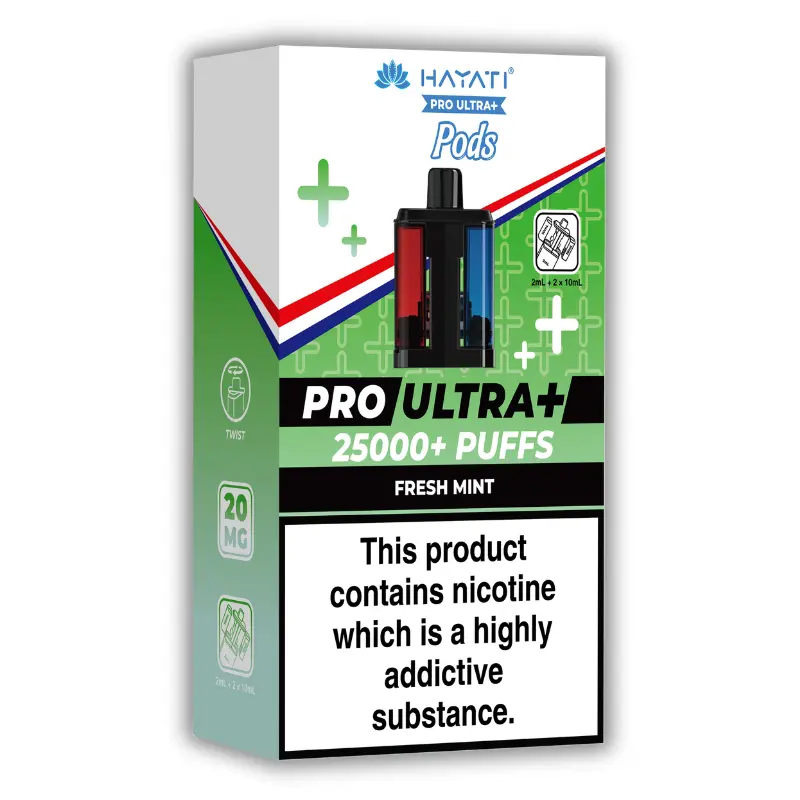
Hayati · Pro Ultra Plus
Fresh Mint Hayati Pro Ultra Plus Pods
£7.99
✔ In stock — ready to ship
Genuine Hayati
Free over £20
Same-day dispatch
Secure checkout
Fresh Mint Hayati Pro Ultra Plus Pods is the refill on its own: one sealed unit holding 22ml of a plain, fruit-free mint at 20mg nicotine salt, £7.99, with no device in the packet. Hayati rate it at up to 25,000 puffs, which is a number generated by a test rig taking the same pull over and over rather than a forecast of anybody's month. There is no rotating collar on this one, because there is only one liquid inside it, so the mid-session escape route a divided pod offers is not available. If the hardware is not already in the house, the Fresh Mint Hayati Pro Ultra Plus 25000 Prefilled Pod Kit at £11.99 is the listing that puts a body in the box, and the £4 between the two listings is the device and nothing else.
That is the ordinary description, and none of it tells you anything you could not read off the listing yourself. The argument this page exists to make concerns the relationship between two of those numbers, and it is not a flattering one.
Twenty-two millilitres is the largest quantity Hayati seal into a pod. Nothing in the 492-listing catalogue holds more: pod capacities run 2ml, 4ml, 7ml, 12ml and 22ml, and 104 listings sit at the top of that ladder. A plain mint, meanwhile, is the profile least able to absorb a long run, for a reason established elsewhere on this site and not in any doubt. Your response to a coolant falls with sustained exposure, it falls by a large amount rather than a marginal one, and it returns only with absence measured in days. Pair the biggest vessel in the range with the profile that suffers most from being lived with and you have, on the face of it, the poorest match between liquid and volume that Hayati sell.
Which is a strong thing to say, and strong claims on this site get counted before they get printed. The two sections after the next one do the counting. The short version of the result is that the claim holds, with one correction that materially softens it and one kind of buyer for whom the whole argument runs backwards.
What other pages have already settled, and what is left over
Very little of the mechanism below is new to this catalogue, and pretending otherwise would be dishonest as well as pointless. Five pages have done the underlying work and the right thing here is to name what each of them established and then use it rather than reconstruct it.
The Fresh Mint Rubik kit page owns most of what can be said about this liquid as a liquid. It settled what the word Fresh is doing in the name, which is nothing that a buyer can check: twelve of the 492 titles carry it, eleven of them are this flavour, and against Spearmint (a species), Menthol (a compound), Double (a quantity) and Frosted (a temperature) it is the one modifier in the mint family that names no property at all. It lined up all nine solo descriptions of Fresh Mint and found they cluster perfectly into four groups by platform, with no listing crossing a boundary, which means a difference between two descriptions of this flavour is evidence about which brief the copywriter had open and not evidence that the recipe varies. It established that a plain mint is judgeable on the first draw in a way almost nothing else in the range is, because there is no stack of components to learn and nothing arriving late. And it made the proportional argument that this page depends on: when the cooling dulls on a cooled fruit you still have a fruit, and when it dulls on a plain mint you have lost a large fraction of the product. All of that is cited here and rebuilt nowhere.
The two Double Menthol pages own the physiology. The bare pod page worked through the dose-response properly: cold arrives because menthol persuades a cold-sensing channel in the tissue to fire, that channel exists in finite numbers, and past a point extra menthol recruits progressively fewer of them while a second channel reporting pungency starts to answer instead. The kit page owns the timescales, and they are the figures this page runs its arithmetic on. Two separate things make a pod stop working. Boredom is an opinion changing, it answers to variety, and variety within the same afternoon fixes it. Adaptation is not an opinion at all, it answers only to absence, and the absence has to be measured in days rather than hours. That page also states the shape of the decline: it begins somewhere around day three, it is driven by you rather than by the hardware, and it is steepest early.
The Spearmint pages own the distinction between the two kinds of mint, which is why the flavour section below is short. Carvone and menthol are unrelated molecules doing unrelated jobs, so a spearmint is not a menthol turned down. A sensation fires at the tissue on contact and arrives whatever you do with your breath; an aroma has to travel to the olfactory tissue from behind the mouth on the way out, which makes it slower and heavily dependent on how you exhale. Those pages also established the morning-draw diagnostic and, importantly for what follows, the fact that olfactory adaptation resets fully overnight while a recalibrated response to a coolant does not.
The Frosted Mint pouches page added the picture that makes the timing intuitive. Cooling from a pod is a sawtooth: each draw puts a spike in, the spike decays, the next draw puts another one in, and each peak is read against the trough before it. That page's subject is what happens when the same sensation is delivered as a flat plateau instead, which is a pouch problem rather than a pod one, but the sawtooth half of the account belongs to any pod page that needs it.
Finally, the Fresh Mint / Blue Razz Mint refill page owns the rotation-partner case: mint as a flavour bought to interrupt something else, scored on what it leaves behind rather than on what it puts there, with the five properties that decide whether a liquid can do that job and the awkward finding that a pod used in bursts is never going to be finished. That page and this one are looking at the same 22ml from opposite ends, which is the reason both exist, and the section near the bottom of this page that concerns its buyer defers to it entirely.
What none of them covers is the interaction between the physiology and the pod size. Every page above that discusses adaptation discusses it on a 12ml pod or a pouch. The question of what happens when the same fixed biological window is set against nearly twice the liquid has not been asked, and it turns out to have an answer that is both calculable and unwelcome.
Counting the claim before making it
Start with the census, because the vague version of this argument is weaker than the counted one and much easier to overstate.
Every mint and menthol in the range, sorted by how much of it you have to get through
Twenty-six of the 492 titles carry a word from the mint or menthol family. Sort them by vessel rather than by flavour and the pattern is immediate.
- Four 10ml bottles hold a fruit-free mint or menthol: Spearmint, Menthol, Black Mint and Fresh Mint, all at £2.49.
- Eight sealed 12ml pods and kits hold one: the Spearmint pod and kit, the Double Menthol pod and kit, and Fresh Mint twice over on the Rubik and twice over on the Pro Max Plus.
- Three sealed 4ml pods carry a menthol, and every one of them has fruit in front of it.
- Two 120ml bottles hold Fresh Mint, and they are sub-ohm liquids at 0mg rather than anything comparable to a pod.
- Two sealed 22ml pods hold a fruit-free mint. They are this listing and the complete kit of it, which is the same liquid sold twice.
That accounts for nineteen of the twenty-six. The remaining seven all hang the mint on something else and are listed here so the census can be checked rather than taken on trust: the divided Fresh Mint pod and its kit, the Lemon & Mint pod and the Lemon Mint kit, a Lemon Mint bottle, a bottle called Fresh Menthol Mojito, and the Frosted Mint pouches, which are not a vape at all and belong to their own page.
So the claim narrows and improves in the process. It is not that a plain mint is unusual at this volume. It is that no plain mint exists at this volume except this one. Every other fruit-free cooling profile Hayati sell in a sealed pod stops at 12ml, and the two exceptions to the 12ml ceiling are both this flavour. The 120ml bottles are a real exception and they do not count against the point, because a bottle is decanted a few millilitres at a time into hardware the owner controls and can be put away for a month without anything being stranded. A sealed pod is a single decision about a single quantity, taken at the till.
Run the same count on the platform rather than on the flavour and it agrees. There are 104 Pro Ultra Plus listings, half of them pods and half complete kits. Eleven of the 104 mention a mint or a menthol anywhere in their copy, including the two Shisha listings whose grape-and-mint pairing is only visible in the flavour field. Of those eleven, exactly two describe a mint that is not sitting on top of a fruit, and they are this pod and its kit. Everything else on the largest-volume platform in the range either names a fruit or, in the handful of opaque cases, declines to say what is in it. Browse Hayati Pro Ultra Plus Pods and you are looking at 52 listings of which one, this one, has nothing underneath the cold.
The version of the claim that survives, and the part of it that does not
The claim as it was handed to me was that mint is the flavour category whose appeal decays fastest with exposure. Counted against the catalogue, that is too broad in one direction and correctly aimed in another, and the honest thing is to say which.
Too broad, because a plain mint is not the fastest-decaying profile Hayati sell. Double Menthol is, and the Double Menthol pages say so themselves at length: a liquid that is almost purely sensation is exposed to the fastest-adapting thing your senses do, with nothing else present to carry it when the sensation falls. A mint has an aroma as well as a coolant, and the aroma resets overnight, which is a genuine cushion that a pure menthol does not have. So mint sits second on that list rather than first.
Correctly aimed, because the products above it on that list are all sold at 12ml or less. The ranking that actually matters to a buyer is not which profile adapts fastest in the abstract but which profile adapts fastest at the volume you are being asked to commit to, and on that measure the answer is unambiguous and it is this pod. Double Menthol at 22ml would be worse. Hayati do not sell Double Menthol at 22ml. They sell this.
That is the claim in the form that survives counting, and it is narrower and more useful than the version it replaced: of everything Hayati seal into a pod, this is the largest quantity of the kind of liquid that is least able to be lived with. The catalogue itself appears to agree, since every other fruit-free mint and menthol in it is capped at 12ml. Whether that ceiling was a decision or an accident is not something anyone outside the company can know.
A fixed window set against a variable pod
Here is the part that has not been worked out anywhere on this site, and it is short enough to check.
The two quantities, and only one of them moves
Adaptation to a coolant consumes a number of days. It does not consume a fraction of a pod. Your palate has no idea how much liquid is behind the coil, and the decline described on the Double Menthol kit page (beginning around day three, steepest early, recovering only over days of absence) runs on the calendar and on how much coolant has crossed your palate, not on how much remains in reserve.
The pod, meanwhile, holds whatever it holds. And since your daily consumption is roughly fixed too, being a property of how much you vape rather than of which pod you bought, the number of days a pod lasts is simply its volume divided by that rate.
Put those two facts side by side and a conclusion falls out that is almost too simple to be interesting until you price it. The quantity of liquid you draw at full sensitivity equals your daily rate multiplied by the length of the window, and neither of those two terms depends in any way on the size of the pod. Buying a bigger pod does not buy you one extra millilitre of full-strength cooling. It buys you additional millilitres on the far side of the line.
Putting numbers on it, and labelling them honestly
None of what follows is a measurement. Hayati publish no coolant concentration, nobody publishes an adaptation curve for an individual palate, and the variation between people is large. What can be done is to take the figures this corpus already works with, apply them consistently, and show the sensitivity of the answer so you can move it to fit yourself.
Two figures come from pages already written. Twelve millilitres is treated throughout this site as roughly a fortnight of daily use as a sole liquid, which puts consumption a little under a millilitre a day. And the adaptation window, the period in which you are still reading the cooling at close to what you bought, runs from day one to somewhere around the end of the first week on the account the Double Menthol kit page gives.
Apply both to this pod. Twenty-two millilitres at a little under a millilitre a day is around twenty-five or twenty-six days, so call it three and a half weeks to a month of exclusive use. Seven days of that at a rate of a little under a millilitre is about six millilitres. Six millilitres out of twenty-two is a shade over a quarter.
Roughly three quarters of this pod will be drawn by a palate that has already recalibrated against it. That is the number, and it is reasoning rather than measurement, so here is how much it moves. Stretch the window to ten days, which is generous, and the full-sensitivity share rises to about two fifths, leaving three fifths on the other side. Shorten it to five days and the share drops to a fifth. Across the whole plausible range the answer is that between three fifths and four fifths of the pod arrives at reduced sensitivity, and no set of assumptions any reader can reasonably hold brings it below half.
Now run the identical calculation on the 12ml pod of the same liquid, which Hayati sell as Fresh Mint Hayati Pro Max Plus Pods at £5.49. Same window, same rate, half the liquid: fourteen days in service, six millilitres inside the window, so roughly half the pod at full sensitivity rather than a quarter of it. The smaller pod is not immune. It is merely less exposed, by about a factor of two.
The inversion, which is where it becomes a money argument
Six millilitres is the full-sensitivity yield of both pods, because the yield is rate multiplied by window and neither term noticed the pod. So:
- The 22ml pod at £7.99 delivers about six millilitres of mint at the cooling level you were buying, at a cost of a little over £1.30 for each of those millilitres.
- The 12ml pod at £5.49 delivers about the same six millilitres, at a little over 90p each.
The Grape GB / Blue Razz GB refill page established the headline rate for this platform, which is 36.3p per millilitre once the device cost has been absorbed, and it is a perfectly good number for shopping with. Against it, the 12ml format looks expensive at 45.75p. But change the unit from the millilitre you own to the millilitre you can still feel and the comparison turns over completely: the 22ml pod is about a fifth cheaper on the label and about forty-five per cent dearer on the thing you were actually buying. Two pounds fifty of the price difference between those listings is, on this reading, the price of ten millilitres that you will draw at a cooling level below the one that persuaded you to order.
The correction that has to be made, because the claim is otherwise unfair
Left there, this reads as though three quarters of the pod is waste, and that would be a distortion serious enough to undo the rest of the argument.
What adapts is the cooling. The aroma does not, or rather it adapts on a completely different clock: the Spearmint pages established that olfactory adaptation resets fully overnight, which is why the morning draw works as a diagnostic on a herb pod. So the green, faintly confected mint note that this liquid carries is arriving at full strength on day twenty-four exactly as it did on day two. Nothing is lost there at all. What has fallen is one of the two things in the pod.
The Fresh Mint Rubik kit page has already said how much of the product that one thing represents, and it is a large share rather than a garnish: with no fruit standing beneath it, a halving of the perceived chill takes somewhere between a quarter and a third of the whole product with it. That is the honest size of the loss. Not a dead pod. A pod whose colder half has been turned down by an amount you cannot control while its aroma carries on unchanged, which is precisely the pattern that makes people conclude a mint has gone flat.
So the claim in its final form is narrower than the headline and still worth making. You will not be disappointed by this pod because the liquid is poor. You will be disappointed, if you are, because the format guarantees that you meet the liquid in its dulled state for most of its life, and the property being dulled is the one Hayati's own copy leads with when it calls this a crisp, cooling mint.
What the month actually looks like
Set out as a sequence, because the shape is what makes it legible and because knowing the shape in advance stops you misdiagnosing it.
Days one to three. This is the pod as advertised and it is the only reading of it you will get that is not contaminated by your own history with it. The cooling is at its full size, the green note sits clearly on top of it, and the two come apart properly as the vapour leaves. Two or three deliberate draws taken here, at least one of them vented partly upward rather than straight out of the mouth, are worth more than any amount of later attention, and the reason is unsentimental: every later judgement about whether the pod has changed is a comparison against this reading and you cannot go back for it.
Days four to eight. The decline has begun and it is steepest here, which is the counter-intuitive part. Most people do not notice it during this stretch, because the change from one day to the next is small and because there is no reference alongside it. What tends to register instead is a vague sense that the pod is not quite as bracing as it was, usually dismissed as a bad day for tasting things. Close to a third of the liquid is gone by the end of this.
Days nine to eighteen. The reading has settled at something meaningfully below where it started and it is no longer moving much, because a recalibration completes rather than continuing forever. This is the stretch in which the complaint gets made. The pod feels quieter than the one you remember buying, the flavour is still arriving normally, and the mismatch between those two observations is confusing enough that most people reach for the wrong explanation. This is also the longest stretch by volume: you enter it about a third of the way into the pod and leave it about seven tenths of the way through, so almost four tenths of everything you paid for is drawn inside these ten days.
Days nineteen to twenty-six. Two things are now happening at once and they produce the same symptom, which is the genuinely awkward part of a 22ml pod. Your reading of the cold is still reduced, and the coil has by now done a month of work, so the aroma is starting to thin as well. The Rubik kit page sets out the three separate causes of a mint pod seeming to fade and how to tell them apart, and that method holds here without amendment. What the volume changes is how long the two causes run together. On a 12ml pod the coil only starts thinning the green top near the very end, so the overlap with a recalibrated palate is a matter of a few days. At 22ml it covers the best part of the final third, which is a long time to be looking at one symptom with two sources behind it.
Note what is not in that sequence. No point at which the liquid changes. Hayati filled the pod once and it has been the same recipe throughout. The whole of the arc above happens on your side of the mouthpiece.
The remedy is absence, and absence costs a second pod
All of which would be a warning rather than a useful page if nothing could be done about it. Something can, and the mechanism was settled on the Double Menthol kit page: adaptation answers only to absence, and absence measured in days does a great deal where variety measured in minutes does almost nothing. Run a different pod for twenty minutes and come back and you have achieved nothing. Run nothing cooled for two days and you have recovered most of what you lost.
The difficulty is obvious as soon as it is stated. You cannot take days off from your only liquid. A sole pod is, by definition, the thing you reach for, which means the one intervention that works is the one intervention a single-pod buyer structurally cannot make. Rotation is not a refinement here. It is the only lever, and it requires a second pod.
What a second pod costs on this platform
A bare Pro Ultra Plus refill is £7.99 across the board, so the rotation pair is £15.98 and 44ml, and every listing on the refill shelf is the same price whichever flavour you take. The partner wants to be uncooled, for the reason the Double Menthol pages give: adaptation is specific to the coolant rather than to flavour in general, so a second cooled pod gives your palate nothing to recover with. Something warm and fruit-led is the shape of it, and the shelf has plenty: Blueberry Raspberry Hayati Pro Ultra Plus Pods as a straightforward warm berry, Cherry Berry Hayati Pro Ultra Plus Pods for something rounder, Blue Sour Raspberry Hayati Pro Ultra Plus Pods if you want the acid rather than the sugar doing the contrast work.
The Grape GB / Blue Razz GB refill page already established the general point about this arrangement and it is worth repeating in one sentence rather than deriving again: running two pods costs nothing extra over time, because both of them get used eventually, so what a rotation brings forward is the outlay and not the spend. That is correct and it applies here.
What is different here is what the rotation buys, because on most pods it buys variety and on this one it buys back the product.
The arithmetic of alternating
Take the two pods and alternate them in blocks of three or four days rather than swapping several times a day. Blocks matter: a three-day block sits comfortably inside the window, and a three-day gap is the sort of absence the recovery mechanism actually responds to, whereas flicking between two pods within an afternoon addresses boredom and does nothing whatever for adaptation.
Run that pattern and the mint gets its twenty-six days of use spread across roughly fifty-two calendar days, in stints that each start from a palate that has had three or four days away from anything cooled. Instead of six millilitres inside the window and sixteen outside it, most of the 22ml is now being drawn at or near the reading you bought.
Be careful not to oversell that. A three-day gap restores a lot and probably not everything, nobody publishes the recovery curve, and the Frosted Mint pouches page documents that repeated exposures tend to start from a slightly lower baseline each time even with gaps between them. So the honest figure is not four times as much full-strength mint. Call it two to three times as much, which is still a large number for an intervention that costs nothing beyond buying in a different order.
There is one real cost and it is the elapsed time. Fifty-two days rather than twenty-six means each pod spends weeks part-used, and the Fresh Mint / Blue Razz Mint refill page is right that an opened pod drifts: the volatile mint top is the first thing to thin as a pod is warmed, cooled and handled over months. That page is discussing a pod stretched to eight or nine months, where the drift is substantial. At under two months it is small, and the trade is plainly worth taking. Store the resting pod upright and out of the light and most of even that disappears.
Two smaller pods against one large one
Which raises the sharper question. If the full-sensitivity yield is set by the window and not by the pod, why buy 22ml at all?
For a buyer who has not yet committed to hardware, the answer is that you probably should not. Two 12ml Pro Max Plus pods, being Fresh Mint at £5.49 and something warm at the same price, come to £10.98 for 24ml of two different liquids. Alternate them and the mint yield is roughly what the £15.98 Pro Ultra Plus pair delivers, for five pounds less, because you are not paying for ten extra millilitres per pod that will be drawn at a reduced reading. Say the fitment part once and move on: check the range name printed on your device against the range name in the listing before ordering anything, because these are different pods for different hardware and a compatibility decision should not be taken from a retail page, this one included.
For a buyer who already owns a Pro Ultra Plus, the Pro Max Plus comparison is not a comparison at all, it is a second device. The live options are then just two. Buy one pod and accept the arithmetic above, or buy two and alternate, which is the same money in a different order and two to three times the full-strength mint.
And for a buyer who wants a mint and nothing else, will not rotate, and is choosing only which vessel to buy it in, the 12ml pod at £5.49 delivers the same six millilitres of full-strength mint for two pounds fifty less. That is the cleanest statement of the whole argument. The larger pod is not worse liquid and it is not worse value per millilitre. It is a larger quantity of something whose useful share does not scale with quantity.
The buyer for whom none of this applies
Everything above assumes this pod is your main liquid, and a good number of people buying it are doing nothing of the kind. For them the analysis does not merely weaken. It inverts, and the page would be dishonest if it did not say so plainly.
Hayati name that buyer themselves. The listing's own copy describes this as a pod to keep alongside sweeter flavours, as a reset for when fruit and candy start to blur, which is a use that has almost nothing in common with the one the last four sections analysed. The Fresh Mint / Blue Razz Mint refill page argues that case out in full, scoring a flavour on what it leaves behind rather than on what it puts there, and establishing why mint holds the position more reliably than a contrasting fruit does: the cooling does not occupy the ground the fruit was standing on, and the aroma comes off the tongue fast instead of settling in. There is nothing to add to that and this page does not try.
What is worth adding is why the adaptation argument stops applying to them, because the reason is exactly the mechanism the rest of this page is built on.
Recall the sawtooth from the Frosted Mint pouches page: cooling delivered as spikes with troughs between them, each peak read against the trough before it. A main-liquid user has spikes all day and short troughs, which is continuous exposure in everything but name and is precisely the pattern the recovery mechanism does not answer to. A reset user has ten or fifteen draws, and then hours or days of nothing. The gaps are not an inconvenience in that pattern, they are most of it. Which means the window never closes: every session begins on a palate that has had its absence, so the twentieth reset in month four is very nearly the same event as the first one in week one.
For that buyer the volume stops being a liability and becomes the point. Twenty-two millilitres of something used fifteen draws at a time is a long standing supply, and at 36.3p a millilitre it is the cheapest way to hold a Pro Ultra Plus mint on hand. There is no millilitre drawn at a reduced reading, because there is no reduced reading, so the full-sensitivity arithmetic that dominates the rest of this page simply does not run.
Two honest qualifications on their side of it, both already priced elsewhere. They will not finish it, and that page works out what the unconsumed remainder does to the effective cost, which is not a small effect. And a pod kept for months drifts even when it is not being used, which is the binding constraint on that pattern in the way that sensitivity is the binding constraint on this one. Two completely different limits on the same 22ml, depending entirely on which buyer is holding it.
There is a third buyer and naming them is only fair. Some people want a plain mint all day, know perfectly well that their reading of the cold settles after the first week, and do not mind, because what they actually want from the pod is the dry, uncluttered, low-sugar character rather than the temperature. Nothing in this page is an argument against that person buying the biggest pod available. The aroma holds for the whole 22ml, the sweetness stays at the floor throughout, and the property they care about is not the one that moves. If that describes you, buy it and ignore the arithmetic.
The liquid at the top of the pod, briefly
The blow-by-blow of how this liquid arrives has been written twice on this site already: the Fresh Mint / Blue Razz Mint complete kit takes the Fresh Mint half apart in order, and the Rubik kit page handles how the parts sit in time. Printing a third version of either would be a poor use of the space, so this section is an orientation and one finding that belongs here and nowhere else.
In outline, and only in outline: the event fits comfortably inside a single breath and has two stages rather than three. Temperature reports first, since a cold channel answers to contact and nothing has to travel for it to fire, so the earliest instant of the pull is more chill than taste. Flavour catches up during the rest of the draw and is loudest somewhere around the middle of it. The two then part company as the vapour goes, with the green note peaking on the way out and the cold hanging on for a second or two after it in the throat. Nothing else turns up. There is no late development to wait for, no warming-in period, and the last millilitre contains the same inventory as the first.
Which species it is drawn from is not knowable from anything published, and the Rubik kit page lays out the evidence in both directions at length. Spearmint is named outright on three listings in the range; peppermint is named on none, which points at an incomplete naming convention rather than at an incomplete catalogue, and it stops well short of settling anything. Two things can be said with reasonable confidence because the copy desk repeats them across all nine solo descriptions of the flavour: this liquid leads on taste rather than on temperature, and the cooling is pitched at moderate. Hayati's own text on the 10ml bottle places Fresh Mint between Spearmint and Menthol, and that ordering is the only ranking of the mints anyone at the company has put their name to.
Why the two candidates are not a loud version and a quiet version of one thing is the Spearmint pages' argument and it is worth reading there in full. The short of it is that spearmint's leading aromatic delivers flavour and smell while doing almost nothing to the cold channel, whereas peppermint's leading aromatic is the compound that fires that channel, so it is doing both jobs from one molecule. If this liquid turns out to be peppermint-led, the neat two-column separation of aroma from sensation stops applying to it. As a weak piece of evidence against that, note what the Double Menthol pod page says menthol smells like with nothing in front of it, which is thin, high, dry and camphorous with a woody edge, detectable only on the portion of the breath leaving through the nose. This does not read like that at all.
One thing this listing's own copy does that is worth flagging
The Rubik kit page found that the nine solo descriptions cluster into four groups by platform, with no listing crossing a boundary, and identified the two Pro Ultra Plus listings as the plainest of the four: they deny fruit and skip the botanical vocabulary entirely, where seven of the nine reach for a herbal, green or leafy word. Checked against this listing today, that holds. The words here are crisp and cooling and fruit-free, and there is not a green or herbal adjective anywhere in the description.
Which produces a small consequence nobody has pointed at. The platform that asks for the largest single commitment is the platform whose copy says the least about what the liquid is like. A buyer looking at the 10ml bottle gets a description that places the flavour between two named siblings and tells them it is herbal in style. A buyer looking at this pod, which is more than twice the liquid and three times the money, gets the shortest description of the nine. That is a copywriting artefact rather than a statement about the recipe, for exactly the reason the Rubik page gives, and it still means that the listing you can least afford to misread is the one carrying the least information. Reading the bottle's description is a reasonable way to fill that in, as long as you remember it is describing the same liquid in a different vessel and not making a promise about this one.
What it is not
- Not cold at the top of the range. Nine descriptions, nine moderate words, none of the intensity vocabulary the same copy desk applies freely to the menthol listings. If maximum chill is the purchase, this is not it.
- Not a fruit with mint on it. Nothing here has been chilled, because nothing here is being chilled. Lemon & Mint Hayati Pro Ultra Plus 25K Pods is what that other arrangement looks like on the same platform, and the fruit is the subject there rather than the decoration.
- Not sweet. Sweetness sits at the floor, and some of what registers as sweetness is an artefact of the cooling rather than sugar, which the Double Menthol pod page takes apart properly.
- Not switchable. One reserve, one flavour, no collar. Whatever a divided pod offers by way of a mid-session change of subject, this does not have.
The pod itself, which does not need much
One sealed unit comes in the packet and nothing else. No body, no spare, no accessory. The liquid is filled at the factory at 20mg salt nicotine and the pod is finished as a whole when it runs out, so there is nothing to refill, rewick or service, and the coil retires inside it.
The specification that would matter most for this particular liquid is the one Hayati do not publish, which is the coil. No resistance, no material, no wattage window appears anywhere in this listing's data or in the range's. That gap is worth naming rather than quietly filling, and it bites harder on a mint than on a berry, because a mint aroma pushed too hot turns soapy and faintly medicinal in a way a sugared fruit does not, and a hot coil cannot be told apart from a worn one on a specification that omits both. Nothing on the device is adjustable in any case. The rest of what fits this platform sits on Hayati Pro Ultra Plus, and the wider group including the other pod formats is on Hayati Prefilled Pods & Refills.
The specification, with the rows this page actually turns on
| Liquid volume | 22ml, factory filled, the largest pod capacity in the range |
| Estimated days of exclusive use | Around 25 to 26, at a little under a millilitre a day |
| Share drawn at full sensitivity | Roughly a quarter. Reasoning from the corpus, not a measurement |
| Price | £7.99 for the pod alone, £11.99 for the complete kit |
| Supplied as | Refill only. No device, no spare, nothing else in the packet |
| Flavour content | Mint. No fruit, no confectionery element, no species named |
| Flavour selection | None. Single reserve, no rotating collar |
| Cooling | Moderate on the manufacturer's own ordering, below Menthol |
| Nicotine | 20mg per millilitre, salt |
| Manufacturer's puff figure | Up to 25,000, a laboratory result |
| Serviceable parts | None. Sealed, not refillable, coil retires with the pod |
| Not published | Coil resistance, coil material, liquid ratio, coolant type |
| Brand | Hayati |
Most of that table is the same information the listing already gives you. Five rows are worth stopping on, starting with the volume, which is the subject of this entire page and which reads as a benefit on every other listing at this size and as a liability here, for reasons that have nothing to do with the liquid being any good.
The two rows immediately beneath it are not from Hayati and are marked as such. They are there because a specification sheet that tells you the pod holds 22ml and stops has told you the less useful half of the fact. How long that is, and how much of it lands while you can still read what you bought, are the two questions a buyer is actually asking when they look at a volume, and nobody else is going to answer them on this listing.
The nicotine row does not bend. Twenty milligrams per millilitre is the ceiling permitted for a nicotine-containing liquid sold in the United Kingdom and there is no second option on this listing, so it is a fixed property of the purchase rather than a choice you are making. Nicotine is addictive. Worth one observation specific to this liquid: nicotine carries a slightly peppery texture of its own, sweetness masks that texture and cold does not mask it the same way, so a pod with no sugar in front of it presents the same 20mg more plainly than a lemonade does. Arriving here from Blackcurrant Lemonade Hayati Pro Ultra Plus 25K Pods you may read the difference as a higher strength. It is not higher.
The puff figure is a bench result from equipment repeating one draw at a fixed interval, so it is a way of ranking listings and not a forecast of your month. It is a weaker guide than usual here for a reason the arithmetic above explains: people lengthen their draws as their reading of a coolant falls, without noticing they are doing it, and no test rig has that feedback loop.
Which pod to actually buy
The useful comparisons here are not between flavours, because the flavour is settled by whether you want a mint. They are between vessels and between rotation strategies.
If you want this liquid and have no hardware
The complete Fresh Mint kit at £11.99 is the only listing that puts a Pro Ultra Plus body in a box with this flavour already in it. Four pounds over the refill price is the device, and every pod after that is £7.99. If the flavour is not settled, buying the body inside a kit of something you are more confident about and adding this as a second pod is the lower-risk order to do it in, since the body is the same body whichever flavour rides in with it.
If the mint is a rotation partner rather than a main liquid
Then most of this page is not about you and the Fresh Mint / Blue Razz Mint refill page is the one to read, because it works the reset case properly and prices the part you will not consume. One thing decides between that pod and this one, and it is simple. The divided pod splits its 22ml between plain mint and a sweetened blue raspberry, roughly eleven a side on the working assumption that page uses, since Hayati publish no division. This one gives you twenty-two of the mint and no raspberry at all. If the pod you are interrupting is already a blue raspberry, the fruited half duplicates what you have and this listing is the better purchase. If you would use a spare fruit option, the divided one is better value for the same money.
If you are assembling the rotation pair
Warm and uncooled is the requirement, and the shelf has three useful registers. A plain berry keeps the contrast simple, which is Blueberry Raspberry or Cherry Berry. Confectionery goes furthest from a dry mint, and Blackcurrant Cotton K / Blue Raspberry and Blueberry Cotton K / Raspberry Cotton K are the spun-sugar end of it, with the caveat that a dairy or candyfloss profile and a cooling trace sit awkwardly together on the first draws back. Sharp and dry is the third option and it works well against a mint precisely because it is not competing on sugar: Orange Lemon & Lime and Sour Apple / Juicy Peach both qualify.
If what you want is cold rather than mint
Buy a cooled fruit and the arithmetic on this page largely stops applying to you, which is the honest recommendation even though it points away from this listing. When your sensitivity to the coolant falls on Watermelon Ice or Cherry Ice / Peach Mango or Blue Razz Pineapple / Strawberry Ice, there is still a fruit there, and a fruit is a complete product. The Rubik kit page makes this comparison in its general form. What this page adds is the volume term: the larger the pod, the more the argument favours having something underneath the cold, because the share of the pod affected grows while the fruit does not go anywhere.
If you want mint and fruit in the same purchase
Three listings on this platform put a mint word on something else. The divided Fresh Mint pod is one, Lemon & Mint is the second and is really a citrus, and the divided kit at £11.99 is the third if you also need the body. None of the three is a plain mint, and none of them is subject to the argument above in the same degree, because in each case something remains when the cold recedes.
The rest of the platform
Among the pods worth knowing about for other reasons: Blue Razz GB is the reference sweet on this shelf, Blue Razz Cherry deepens it, and H'Berg / P'Man is the listing whose name tells a buyer the least, which is a different problem from the one on this page and one its own listing handles. The Hayati Pro Ultra Plus 25000 Pods entry is worth a note because its title carries no flavour at all and the pairing is only in the description, so it is easy to miss when comparing. Grape GB / Blue Razz GB as a complete kit is one of the cheaper routes to a spare body if you decide the rotation deserves its own device. The eleven listings of this flavour across every format are on Fresh Mint Vapes, the wider family is on Mint Vapes, recent additions are on New Products, and everything is on the full Hayati range.
Living with twenty-two millilitres of one mint
Most handling advice for prefilled pods is generic and there is no point printing a ninth version of it. These are the parts that change on a large pod of a single cooled profile.
Take the day-one reading and write it down if you have to. Three or four unhurried draws in the first ten minutes, with at least one vented partly upward rather than straight out of the mouth, taken before coffee. Every later question about whether the pod has changed is a comparison against that reading, and on a 22ml pod you will be asking the question for a month. The reading is available once.
Plan the gaps in days rather than in minutes. This is the single instruction that follows from everything above, and it runs against how most people treat a pod, which is to put it in and run it until it stops. Two or three days away from anything cooled, every week or fortnight, does more for what you are actually buying than any handling habit on this list. Nothing in the pod deteriorates meaningfully over that timescale.
Do not chase a colder pod. When the chill drops, the instinct is to conclude the liquid was not strong enough and to look for something at the top of the range. The Double Menthol pages establish why that does not work: a liquid built near the ceiling has less headroom rather than more when your sensitivity falls, and whatever you replace this with will do the same thing on the same schedule. The lever is absence, not intensity.
The morning draw works for the flavour and not for the cold. An overnight break fully resets olfactory adaptation, so a morning draw on day twenty is directly comparable with a morning draw on day two for the green note, which is why that diagnostic is reliable on a herb pod. It restores very little of a month's coolant exposure, so the morning reading of the cold is just the day-twenty reading taken at its best moment. The Double Menthol kit page spells out why the two sibling accounts that look contradictory on this are both correct: they are describing different clocks.
Slow down, especially on the first few draws. The cooling arrives whatever you do; the aroma does not. Short sharp pulls deliver the sensation and leave most of the flavour in the device, which is why a mint drawn quickly reads as thin. If the opening draws seem empty, change the draw before concluding anything about the liquid.
Leave gaps between draws within a session too. Back-to-back pulls run the coil hotter, and heat is the specific thing that turns a mint aroma soapy. That fault is reversible and clears within a few pulls after half an hour with the device down, which is precisely how you tell it apart from wear, since wear does not clear.
Mind what you taste next. A coolant leaves the tissue reporting cold for some minutes, so anything drawn straight afterwards reads colder and less detailed than it is. Give it a few minutes and a mouthful of water before switching pods, or you will decide a perfectly good fruit has gone off. On a rotation this is the commonest false alarm there is.
Store a resting pod upright, cool and dark. The green top of this profile is the lightest fraction in it and the first thing lost to warmth and time; the coolant is heavier and survives both. A pod left somewhere warm therefore comes back proportionally colder than it is flavoursome, which is the opposite of the pattern adaptation produces and a useful way to tell the two apart. Store it where children and pets cannot get at it.
Know what the end looks like. A worn coil on this liquid takes the aroma and leaves the chill, so the late signature is cold with less mint on it, arriving alongside a thinner exhale and a dry heat underneath. That is the pod. Less cold with the aroma unchanged is you. The two are distinguishable if you took the day-one reading, and close to indistinguishable if you did not.
Disposal. A spent pod still holds a coil and traces of liquid, so household waste is the wrong destination for it. A retailer's take-back bin or the electricals bay at a local recycling site is where it goes.
Questions this listing raises
Why does it feel less cold after a fortnight?
Because your response to a coolant falls with sustained exposure and recovers only across days of absence. The liquid is unchanged and the coil is probably fine. The tell is that the green mint note is arriving roughly as it always did while only the cold has dropped, since aroma resets overnight and the cold does not.
How much of a 22ml pod will I be drawing at full strength?
Around a quarter of it, on the reasoning set out above rather than on any measurement. The full-sensitivity window is a number of days rather than a fraction of a pod, so it delivers roughly the same six millilitres whatever size pod you bought. Stretch the assumptions as far as they reasonably go and the answer still sits between a fifth and two fifths.
Is the 12ml version better value then?
For a single pod with no rotation, yes, and by two pounds fifty. Both deliver about the same quantity of mint at the reading you bought, so the extra you pay for 22ml buys ten millilitres that will be drawn at a reduced one. That reverses if you rotate, and it reverses completely if you use the pod occasionally rather than daily.
Does rotating actually cost anything?
Not over time, because both pods get used eventually, so all a rotation brings forward is the outlay rather than the spend. That point belongs to the Grape GB / Blue Razz GB refill page. What is specific to this liquid is what the rotation buys, which is two to three times as much full-strength mint out of the same 22ml.
What should the second pod be?
Something warm with no cooling in it, because the recalibration is specific to the coolant rather than to flavour generally. A second cooled pod gives your palate nothing to recover with and the gap does nothing. A plain berry, a confectionery profile or a sharp citrus all qualify.
How long should the blocks be?
Three or four days on each pod is the shape of it. Blocks that long sit inside the window and the gaps between them are the kind of absence the recovery answers to. Swapping several times in an afternoon addresses boredom, which is a different mechanism with a different fix, and does essentially nothing for the cold.
Will a pod that sits part-used for a week be spoiled?
No. Over weeks the drift is small, and it is the volatile mint top that thins rather than the coolant. Over many months it becomes substantial, which is the constraint on using this pod occasionally rather than the constraint on rotating with it. Upright, cool and out of the light slows it either way.
Is there any fruit or sweetener in it?
No fruit. The listing says so outright and seven of the nine solo descriptions of this flavour do the same. Sweetness is low, and part of what registers as sweetness on a cooled liquid is produced by the coolant rather than by sugar, which the Double Menthol pod page takes apart properly.
Is this peppermint or spearmint?
Hayati do not say, here or on any of the other listings that carry the name. The range names spearmint on three listings and never uses peppermint in a title, which is suggestive and nothing more. The manufacturer's own copy on the 10ml bottle places this between Spearmint and Menthol, which is the only ranking of the mints anyone at Hayati has committed to.
Can I switch between two flavours in this pod?
No. This is a single reserve with one liquid in it and no rotating collar, so the mid-session change of subject that a divided pod allows is not available. If that matters, the Fresh Mint / Blue Razz Mint pod is the same price and puts a sweetened blue raspberry behind the collar.
What does the 25,000 figure mean in practice?
Not much as a forecast. It is a bench result from equipment repeating one identical draw at a fixed interval, so it is useful for ranking listings against each other. It is a weaker guide than usual on a cooled liquid, because people lengthen their draws as their reading of the cold falls and no machine does that.
Can the pod be refilled or the coil changed?
Neither. It arrives filled with 22ml and finishes as a single unit, with the coil sealed inside and no replacement element sold. That also means a worn coil and a stale liquid cannot be separated diagnostically, because they retire together.
What nicotine strengths are there?
One. This pod is 20mg per millilitre as a salt, which is the maximum permitted for a nicotine-containing liquid sold in the United Kingdom, and no alternative appears on the listing. Nicotine is addictive.
The short version
Seven pounds ninety-nine buys one sealed Pro Ultra Plus refill holding 22ml of a plain, fruit-free mint at 20mg salt nicotine, no device, no collar, rated by the manufacturer at up to 25,000 puffs on a laboratory test. The liquid leads on flavour rather than on cold, at a cooling level nine separate Hayati descriptions agree is moderate, and the manufacturer's own ordering puts it between Spearmint and Menthol.
The argument against it is structural rather than about the liquid. Twenty-two millilitres is the largest quantity Hayati seal into a pod, and across 26 mint and menthol listings this pod and its kit are the only two that put a fruit-free mint in a sealed vessel bigger than 12ml. Adaptation to a coolant consumes a number of days rather than a fraction of a pod, so the quantity of mint you draw at the reading you bought is set by your daily rate and by your own palate, and not at all by how much liquid is behind the coil. On this pod that works out at roughly a quarter of it, which means the other three quarters arrive with the cold turned down and the flavour untouched. That is reasoning from the corpus rather than a measurement, and it is not a claim that the liquid is poor: what is reduced is one of the two things in the pod, and it is the one the copy leads with.
The remedy is absence, absence requires a second pod, and a second refill on this platform is another £7.99 that you were going to spend eventually anyway. Alternate in blocks of three or four days and two to three times as much of the 22ml lands inside the window. If you have not committed to hardware, two 12ml pods at £5.49 do the same job for five pounds less. If you will not rotate at all, the 12ml pod of this flavour delivers the same six millilitres of full-strength mint for two pounds fifty under this one.
And if you keep a mint for the occasional reset rather than as your main liquid, ignore every paragraph of that. Your gaps are long enough that the window never closes, the volume stops being a liability and becomes a long supply of something you use sparingly, and at 36.3p a millilitre it is the cheapest standing supply of a mint this platform offers. Two different buyers, the same pod, opposite conclusions, and the only thing that decides which one you are is how often you put it down.
Strictly for adults aged 18 and over. Nicotine is an addictive substance.
You might also like


