Home / Hayati Pro Ultra Plus Pods / Orange Lemon & Lime Hayati Pro Ultra Plus 25K Pods
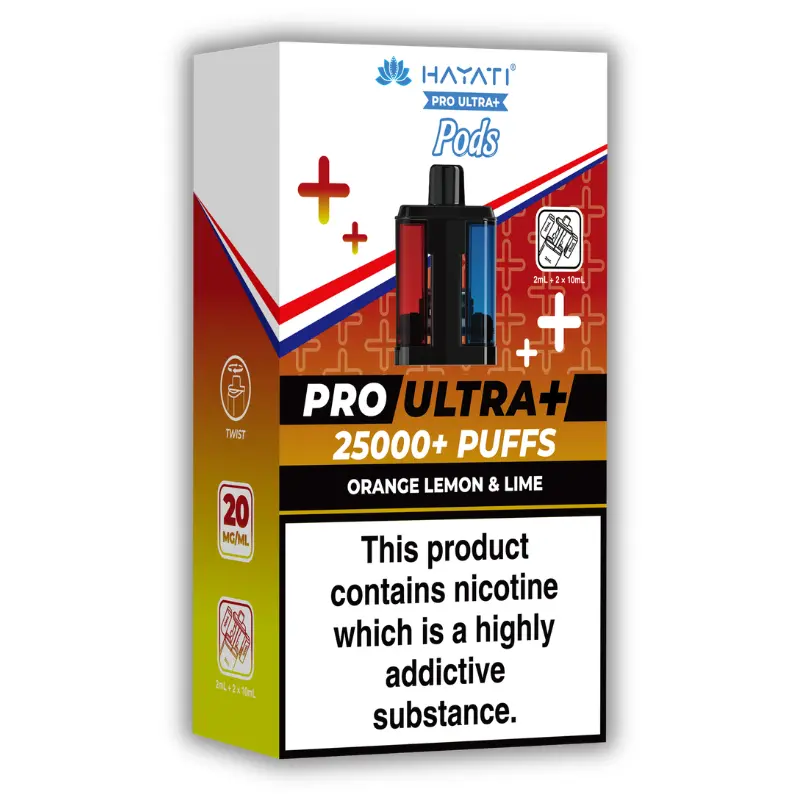
Hayati · Pro Ultra Plus
Orange Lemon & Lime Hayati Pro Ultra Plus 25K Pods
£7.99
✔ In stock — ready to ship
Genuine Hayati
Free over £20
Same-day dispatch
Secure checkout
Three fruits are printed on this pod and every one of them is a citrus. That is worth pausing on, because it is not how most of this range is built. The usual construction sets one family against another, a berry beside a melon, a stone fruit beside something tropical, and the distance between them is what gives the blend its shape. Orange Lemon & Lime has no distance in it. It puts three close relatives into one 22ml reservoir and lets the name carry an implied promise of variety that the chemistry may or may not be able to keep.
Seven pounds ninety-nine gets you the pod alone. There is no device in the pack, no charger, no spare, and the listing assumes a Hayati Pro Ultra Plus already in your possession. Anyone without one wants the Orange Lemon Lime kit at £11.99, which pairs the identical liquid with the hardware. The liquid inside is fixed at 20mg nicotine salt, filled to 22ml before it leaves the factory, with one flavour running from the first draw to the last. Hayati attach a rating of up to 25,000 puffs to it, a figure produced on bench equipment under conditions nobody reproduces in a pocket, and useful mainly for ranking one pod against another rather than for planning a fortnight.
What follows spends most of its length on one question, because it is the only genuinely interesting question about this product and the answer is not the obvious one. Does naming three citrus fruits buy you three flavours? No. But the thing three citrus fruits do buy is real, and it is not what the label appears to be offering, so working out which of the two you were shopping for decides whether this is a good £7.99 or a mildly disappointing one.
Three names, one family
The acid is a single channel, and that argument is already made
Start with the part that has already been worked out elsewhere on this site, because re-deriving it would waste your time and mine. The page for Cherry Sour Raspberry Hayati Pro Max Plus 6000 Pod Kit takes apart a red blend with three separate contributors of acid in it and reaches a conclusion that applies with full force here. Sourness is registered as a magnitude, not as an identity. Your tongue reports how acidic something is; it does not report which acid did it. Aroma is the opposite, spread across an enormous number of distinct receptors, which is why a nose can pick three fruits apart while a tongue cannot pick three acids apart. The upshot on that pod was that three acid sources produce one sourness, louder, rather than three sournesses in sequence.
Take that as established and apply it here, where it lands harder. Orange, lemon and lime do not merely each contribute acid. They contribute the same acid. Citric acid is the principal organic acid in all three fruits, and it dominates in each of them by a wide margin, with malic acid present in supporting quantities that vary but never take the lead. This is not three acids merging into an average. It is one acid arriving from three directions.
Which means the sour dimension of this pod is settled before you take a draw. There is one acid level. It sits somewhere near the upper middle for the format, firmer than a berry pod and short of a dosed sour coating, and it does not change between the front and the back of a draw because there is nothing in the recipe capable of changing it. Anyone who came to a three-citrus listing hoping for sourness with stages, an early sharpness resolving into a different late sharpness, is going to be looking for something that the underlying chemistry cannot supply.
Peel is where the three fruits are actually different
So if the acid cannot separate them, what can? The answer is the peel, and understanding why makes the rest of this page make sense.
The juice of a citrus fruit is mostly water, acid and sugar. The character, the thing that lets you identify a fruit blindfolded, lives overwhelmingly in the oil held in the flavedo, the coloured outer layer of the rind. That oil is a terpene mixture, and here is the awkward part: it is broadly the same terpene mixture in all three. Limonene is the dominant component of sweet orange peel oil, of lemon peel oil and of lime peel oil alike, present in every case as the clear majority constituent. If you stripped each of the three back to its single largest aroma compound, you would have three jars of very similar smelling liquid.
The differences are in what sits around the limonene, and they are differences of a few percent by mass carrying most of the identity. Lemon peel is distinguished chiefly by citral, the combined geranial and neral that produces the specific lifted, almost metallic brightness people mean when they say lemon rather than citrus. Lime carries more beta-pinene and gamma-terpinene, which read as green, resinous and faintly bitter, and distilled lime oil picks up further rearranged compounds that produce the character most people recognise from cordial rather than from a fresh fruit. Orange is the outlier of the three: its peel oil is the most limonene-heavy and the least sharp, and its distinguishing notes are aldehydes, octanal and decanal among them, which read as weight and roundness rather than as lift.
Those are genuine differences and they are audible. They are also small, structurally fragile and concentrated in the most volatile fraction of the profile, which is the single most consequential fact about this pod and the one I keep returning to. Everything that separates orange from lemon from lime lives in the part of the aroma that evaporates first, degrades first under heat, and fades first as a coil ages. The part that is common to all three, the limonene base and the citric acid, is the durable part.
Nobody pressed a fruit into this pod
One honest caveat before going further, because it cuts against the neatness of the argument in one direction and reinforces it in another. There is no juice in this liquid. No vape flavour is made by squeezing fruit into a bottle. A flavour house builds a profile from aroma compounds chosen to reference a fruit, and the compounds it reaches for are frequently the same isolates that occur naturally, used at concentrations chosen for how they behave when heated on a mesh coil rather than for fidelity to the original.
That cuts one way in the blend's favour: a formulator is not bound by what a fruit actually contains, and can push the green terpinene note well past the level real lime would supply. Differentiation is available to anyone who chooses to pay for it. It cuts the other way harder. The economical route to any citrus profile runs through the same limonene-led base, and a three-citrus name is an invitation to build one base and modulate it rather than to construct three profiles and combine them. Hayati publish a name, a volume, a strength and a rating. They do not publish a composition, and you should distrust any page that implies otherwise, this one included.
What each of the three is bringing
Here is the structure the blend appears to be reaching for, described as a shape rather than as three sequential tastings, because the shape is what you actually get.
Orange occupies the bottom. It is the sweetest of the three by a long way, the least acidic by a long way, and the only one carrying real body. In a mix dominated by two sharp fruits it is doing the job that sugar and flesh do in a berry blend: giving the draw something to stand on. Remove it and the liquid would have nothing underneath the acid at all.
Lemon occupies the top. The citral lift is the brightest thing in the recipe and arrives first, which is why the opening of this pod reads as lemon-led rather than orange-led despite orange being the heavier presence. Brightness is loud and early; weight is quiet and late.
Lime occupies the finish. Its contribution is the green, slightly bitter edge that stops the draw rather than letting it trail off into sweetness. On a fresh pod this is the most distinctive single moment in the whole profile, and the most useful, for reasons covered further down.
Read that back and notice what it is not. It is not three flavours. It is one citrus with three regions of its own profile reinforced, low, high and terminal. That is a coherent thing to build and there is nothing dishonest about it. It is simply not what a reader parsing three fruit names off a label is likely to picture.
The strongest case for naming three, put properly
Before delivering a verdict I want to state the case in favour at its best, because it is a better case than sceptics usually allow and I do not think the answer is a flat dismissal.
Every single citrus has a hole in it. Lemon on its own is thin. It has magnificent lift and almost nothing behind it, so it opens brilliantly and then stops, and over a 22ml pod that abruptness becomes wearing in a way it never is in a glass of something. Lime on its own is worse for the opposite reason: it is aggressive, narrow and tends to read as cordial rather than as fruit, and it gives the palate nothing soft to rest on between draws. Orange on its own is the most comfortable of the three and the least interesting, prone to flattening out into something that tastes like a soft drink gone slightly warm, because without a sharp element the sweetness has nothing pushing against it.
Put all three in and each one patches what the others lack. Orange gives lemon a floor. Lemon gives orange a top. Lime gives the whole thing a finish instead of a fade. The result is a rounder, better-proportioned citrus than any of the three could be alone, and for a pod holding 22ml, proportion matters more than excitement, because you are going to be living with this liquid for a long stretch rather than tasting it once. A well-balanced profile you can return to for weeks is worth considerably more than a striking one that grates by the fourth day.
That case is sound. I believe it. It is also, and this is the whole point, an argument for a better single citrus. It is not an argument that you are getting three.
Front to back, one draw
The draw is restricted and mouth-to-lung, narrow rather than open, and it rewards a slow measured pull. Taken at a reasonable pace on a fresh pod, this is the order things happen in.
The opening is bright and immediate, lemon-dominant, with the acid arriving almost at the same moment as the aroma rather than behind it. There is very little delay at the front of this liquid, which is characteristic of citrus and quite unlike a berry pod where the sweetness usually gets there first.
The middle is where orange asserts itself, and it is the quietest phase. The sharpness drops back a little, something rounder and heavier comes up underneath it, and for a moment the draw has actual body. This is the shortest of the three phases and the one most easily missed if you are drawing quickly or chaining, which is a genuine handling point rather than a criticism of the recipe.
The finish is where lime does its work, a dry green edge that cuts the sweetness off rather than letting it linger. The aftertaste is short. Citrus does not coat the mouth the way a jammy berry or a cream note does, so you are back to neutral quickly, which is exactly why a liquid like this works as a reset between heavier pods and also why some people find it insubstantial.
Three phases, then. But notice they are three phases of one profile, arriving in the order the compound volatility dictates, rather than three fruits taking turns. You are not tasting orange, then lemon, then lime. You are tasting a citrus whose bright end arrives first and whose heavy end arrives late, which is what would happen with a single well-constructed lemon as well, only less completely.
Sweetness, and the amount citrus quietly needs
On a scale running from an unsweetened tobacco profile at one end to a confectionery blend at the other, this sits below the middle but not dramatically so, and it is almost certainly sweeter than its reputation suggests. That is worth explaining rather than asserting.
Acid suppresses the perception of sweetness. The two are not independent dials that simply add up; raise the acid and the same quantity of sweetener registers as less sweet. A liquid built on three acidic fruits therefore needs more sweetener than a berry blend to arrive at the same perceived level, and the result is a pod that tastes tart while carrying a sugar-substitute load well above what the tartness implies.
This has a practical consequence for the coil, and it is one of the few places where flavour chemistry and hardware behaviour meet directly. Sweeteners are the main cause of residue building on a mesh surface. A tart liquid that needs heavy sweetening to stay balanced is therefore not the gentle option on a coil that its sharpness might suggest, and over 22ml that accumulation is the mechanism behind most of what people describe as a pod going dull. Do not assume a citrus pod runs clean simply because it does not taste like dessert.
Nothing cold in it, and what that costs here
There is no ice, no menthol and no cooling agent listed for this pod, and nothing in the flavour name implies one. Hayati mark cooled listings plainly with Ice, Frozen or a similar word in the title, and the absence of such a word here is reliable.
The consequence is larger on a citrus than on almost anything else, and it is the same point the peel discussion above arrives at from another direction. A coolant is a durable sensation. It is not an aroma, it is a receptor effect, and it survives coil ageing, warm storage and a tired palate largely intact. That is why a cooled pod tends to feel lively right to the end even when its fruit has gone quiet. This pod has no such backstop. Every bit of its liveliness is carried by fruit acid and by volatile peel notes, and when those soften there is nothing underneath holding the line. Compare it against a cooled listing such as Watermelon Ice or Cherry Ice and the difference is not that one is colder. It is that one has a component that does not age and the other does not.
Whether that is a drawback depends entirely on what you want. A great many people specifically want an uncooled citrus because a coolant flattens the distinction between the three fruits still further, numbing exactly the fine top-end detail that this blend is relying on to justify its name. If you are buying this pod for the three-fruit structure, an uncooled version is the only one in which that structure is even potentially audible.
The things it is not
No lemonade construction. There is no fizz, no carbonated impression and no diluted sugar-water base. That distinction separates this from Blackcurrant Lemonade and Straw’ Lemonade, both of which use citrus as a base for something else rather than as the subject.
No berry anywhere in it, which rules it out as a substitute for Blueberry Raspberry Lemon despite the shared word in the name. On that listing the lemon is a brightener sitting on top of a berry body. Here there is no body other than orange.
No sour coating. The sharpness is fruit acid, which is dry and immediate, rather than a dosed sour treatment, which is mouth-watering and sits on the tongue afterwards. Those two things feel quite different and are frequently confused when people describe a liquid as sour.
No herbal or mint element, which is what separates it from Lemon & Mint, where the second component changes the category rather than reinforcing it.
And no second liquid. Many listings on the Pro Ultra Plus pods shelf carry an oblique in the name and hold two separate flavours in one pod. This one holds a single liquid throughout, so the three fruits in the title are three components of one recipe rather than three things you could ever encounter separately.
So does the third fruit earn its billing?
Here is the verdict, stated plainly.
Naming three citrus fruits does not buy three flavours and cannot, for the reason the acid argument establishes and for the further reason that all three share a limonene-led aroma base. What it buys is one citrus with better proportions than any single citrus on this shelf: a floor, a top and a finish, where a single fruit would give you at most two of the three. That is a real gain and it is the honest reason to prefer this pod.
But the three do not contribute equally, and the count is closer to two than to three. Orange is doing structurally distinct work, because it is the only one of the trio that is not primarily a vehicle for acid; it supplies weight and sweetness that neither of the others can. Lemon and lime are doing overlapping work, both sharp, both acid-led, differing in a handful of minor terpenes that split a single role between them. If you removed the lime from this recipe and lifted the lemon slightly you would have a liquid most drinkers could not distinguish from this one in a blind comparison. Remove the orange and everybody would notice immediately.
The second half of the verdict is harder on the name. The one thing that could separate lemon from lime in the mouth, the peel terpene layer, is the most fragile component in the pod. It goes first as residue builds on the coil, it goes first if a spare is stored somewhere warm, and it goes first on a palate that has been working for an hour. So a three-citrus pod is unusual in that it becomes less like its own name over its life than almost any other kind of blend. By the last few millilitres you have sweetened citric acid with a limonene note on it, which is to say one citrus, and not a particularly specific one.
Does the name mostly buy reassurance? Partly, yes. Three named fruits tell a buyer they are not gambling on an abstraction, which matters on a shelf containing several listings named for moods. But it is not only reassurance, and it would be too cynical to say so. The blend is better proportioned than a single citrus would be, and proportion is what you want over 22ml. Buy it for the roundness. Do not buy it expecting to taste three things.
The pod, briefly
One sealed pod arrives, prefilled, ready to seat. Nothing else is in the pack, and the price is the reliable tell across this whole shelf: listings at £11.99 include the device, listings at £7.99 like this one do not. That single point accounts for most complaints raised against bare pods, so it is worth reading the price before the title.
A single mesh coil sits inside the pod and processes the entire 22ml. It cannot be changed, rewicked or serviced, so its condition at any moment simply is the condition you are vaping in, and it is discarded with the pod. The one specification that genuinely matters for this particular liquid is that arrangement, because it means coil ageing and flavour ageing are the same event here. On a refillable device you could pair a tired coil with fresh liquid and diagnose the problem. On a sealed pod you cannot, and on a profile whose identity is carried by volatile peel notes rather than by anything durable, the two decline together and the top end goes noticeably before the sweetness does.
Hayati publish the capacity, the strength, the flavour and the puff rating for this product. They do not publish a coil resistance, a wattage, an airflow figure, a wick material or any pod dimensions, and none of those has been supplied from any other source for this page. Other listings will quote such numbers with confidence. They are not quoting this product's specification, because this product's specification does not contain them, and a hardware figure taken off a retail page is worth what you paid for it. The rest of the format, including every kit and pod variation of it, is gathered on the Pro Ultra Plus kits and pods shelf, and the wider group of everything Hayati sell that works this way sits on prefilled pods and refills.
The sheet, and how to read it for a citrus
| Flavour | Orange Lemon & Lime. Three citrus components, one liquid. |
| Cooling | None listed, and none implied by the name |
| Sharpness | Upper middle. Fruit acid rather than a sour coating. |
| Sweetness | Below the middle as perceived, higher than that as formulated |
| Liquid volume | 22ml, prefilled |
| Nicotine | 20mg nicotine salt. No other strength offered on this listing. |
| Manufacturer rating | Up to 25,000 puffs, measured in a laboratory |
| Coil | Mesh, fixed inside the pod, not serviceable |
| Supplied as | Pod only. No device, no charger, no accessories. |
| Device needed | A Hayati Pro Ultra Plus you already own |
| Price | £7.99 |
| Brand | Hayati |
| Reference | orange-lemon-and-lime-hayati-pro-ultra-plus-pods |
Two rows on that table deserve more attention than they usually get, and on a citrus they deserve it for reasons specific to the profile.
The sweetness row is deliberately worded awkwardly, and the awkwardness is the information. Perceived sweetness and formulated sweetness diverge more on an acidic liquid than on any other kind, for the suppression reason set out above. If you are choosing between listings by scanning sweetness descriptions, a citrus will consistently read lower than a berry carrying the identical sweetener load. Treat the number as a description of the experience, not of the recipe, and do not conclude that a tart pod is gentler on its coil.
The cooling row matters here in the negative. On roughly half the listings across this shelf that row would say Ice or Frozen, and on this one it says nothing, which removes the one component capable of masking a declining coil. The absence is a design decision rather than an omission, and for a blend whose selling point is fine distinction between three near-identical fruits, it is the correct decision. A coolant would bury exactly the detail the name is charging for.
The nicotine row is fixed at 20mg in salt form with no alternative on this listing, which is the ceiling permitted in the United Kingdom and close to universal for prefilled pods of this kind. Salt rather than freebase is the usual formulation at that concentration because of how it behaves on a narrow restricted draw. Nicotine is addictive, and what strength suits any individual is their own business and not a retail page's to advise on.
The volume row turns the flavour argument into a purchasing one. Twenty-two millilitres is a long commitment to a profile with no internal variation, no coolant, and a thesis that says it narrows as it goes.
Which citrus listing you should actually buy
If the three-fruit structure is the appeal
Then this is the right listing and there is no closer alternative. The same three-way construction turns up in a smaller format as Orange Lemon Lime Hayati Mini Ultra Pods at £3.49, a much smaller pod for different hardware, which is the cheap way to find out whether you get on with the profile before committing 22ml to it.
If you suspect orange is the part you actually want
This is the interesting branch, and it follows directly from the verdict above. If orange is doing the distinctive work, a buyer who likes this pod might be a buyer who wants weight and sweetness in a citrus rather than sharpness. The Orange Vapes shelf is the place to check that, and it is a short shelf with nine listings, which tells you something in itself about how rarely orange leads in this category. Orange is an unfashionable citrus in vape flavouring precisely because it is the least sharp, and sharpness is what most of the market is buying.
If you suspect lemon and lime were the parts you wanted
Then you should probably not buy this one, and I would rather say so than sell you a pod. Lemon Lime Hayati Pro Ultra Plus Pods gives you the sharp pair without the orange floor underneath, which is a drier, narrower and more emphatic liquid. It is the more punishing of the two over a long pod and the more precise on a fresh coil. On the argument this page has been making, it is also the more honest name, since two overlapping fruits claiming to be two is a smaller stretch than three overlapping fruits claiming to be three.
The whole sharp-citrus group is collected on Lemon Lime Vapes, twenty-one listings deep, and the broader Lemon Vapes shelf runs to fifty-four, which between them contain most of the alternatives worth considering.
If the problem is 22ml of one thing
Several paired listings put a citrus on one side and something else on the other, which addresses the commitment problem directly rather than by changing the flavour. Lemon Lime / Lemon Blueberry keeps the lemon constant and swaps what sits behind it, which is a neat construction because the variable is isolated. Lemon & Lime / Summer Dream pairs the sharp citrus against something Hayati decline to specify, so you are buying one known quantity and one unknown. Blue Razz GB / Lemon & Lime puts the citrus against a sweet blue berry, which is the widest gap of the three and the most useful if what you want from the second side is genuine contrast rather than a variation.
If you would rather have the paired construction with the device included, the Lemon Lime / Lemon Blueberry kit bundles both.
If you want a citrus that survives its own coil
This is the most practically important comparison on the page and it follows from the fragility argument. A cooled pod holds its apparent freshness late because a coolant does not age the way a peel note does. If the thing you dislike about citrus pods is that they go dull in the last quarter, the answer is not a different citrus, it is a citrus-adjacent profile with a durable component in it. Strawberry Raspberry Ice and Blue Razz Pineapple / Strawberry Ice both keep a sharp fruit character with a coolant holding the back end up. Neither is a citrus. Both solve the problem citrus has.
If you want the opposite of this pod
Knowing what sits at the far end of an axis makes the middle legible. Raspberry Cola is the one listing nearby built on something that is not a fruit. Fruit Bomb / Straw’ Watermelon B’Gum is sweet-led with essentially no acid structure. Watermelon Fruit Twist is soft and round where this is dry and sharp. If any of those appeals, the money is better spent there.
The dark-fruit side of the same shelf
For completeness, because plenty of people rotate a citrus against a berry rather than choosing between them. Mr Blue and Blueberry Raspberry / Blueberry Raspberry Cherry are the standard blue and red options, and H’Berg / P’Man is the abbreviated listing that people keep having to identify a second time. A citrus rotates well against all three, and better against them than against another citrus, for the obvious reason that two liquids from the same family give a palate no rest from each other.
Keeping the top end alive
Generic pod advice applies here as everywhere. What follows is the narrower set that applies to a liquid whose identity is carried by a volatile peel layer.
The lime edge is your instrument. This is the single most useful thing on the page for anyone who has already bought the pod. That dry green stop at the end of the draw is the most fragile element in the recipe, so it is the first to go. While you can still detect it, the coil is in good condition and the blend is doing what it was designed to do. When it disappears and the draw starts trailing off into sweetness rather than stopping, you are in the back half of the pod's useful life. Nothing else about the liquid gives you a signal that clear, and it is specific to a blend with a green terpene note at the finish.
Heat is worse for this pod than for most. A warm drawer, a dashboard, a windowsill or the shelf above a radiator will strip the volatile fraction out of a spare over a few weeks. On a jammy berry pod that loss is modest, because most of the character sits in heavier compounds. On a three-citrus pod it removes the entire basis on which the three fruits differ from one another, and what you fit is a generic sweetened citrus. Cool, dark, upright.
Do not chain it. Repeated draws without a pause raise coil temperature, and the hotter it runs the more of the light aroma end is driven off before it reaches you. A chained citrus pod therefore tastes more like sugar and acid and less like fruit as a session goes on, then largely recovers after a rest. That is a temperature effect rather than coil death, and confusing the two leads people to write off a pod that is fine.
Let a delivered pod settle before judging it. A pod that has spent the morning in a cold van will under-report its top end for the first few pulls, which is precisely the part you are trying to assess. Give it a minute upright.
Judge it on a rested palate. Citrus fine detail is the first casualty of palate fatigue, and a verdict formed at the end of a long session will consistently underrate the pod. Assess it in the morning if you want a reading you can trust.
Rotate it against something from a different family. Two citrus pods in rotation defeat the purpose, since the palate adapts to the shared limonene base and stops registering either of them properly. A berry or a cooled pod as the alternate keeps the citrus reading as citrus.
Keep nicotine products where children and pets cannot get at them. A sealed pod is not a locked one, and spares count as much as the one in use.
Dispose of it properly. A finished pod still contains a coil and a residue of liquid, so it belongs at a retailer take-back point or a local recycling facility rather than in household waste. There is nothing inside worth keeping.
Questions that come up on a citrus pod
Can you actually taste three separate fruits in it?
No, and this page argues at length that you cannot, because all three share the same principal acid and a heavily overlapping aroma base. What you can taste is one citrus with a sweet heavy element, a bright element and a green finish. Most people can place the orange and can place the sharpness; very few can separate the lemon from the lime without reading the label first.
Is it sour?
It is tart rather than sour in the confectionery sense. The sharpness comes from fruit acid, which is dry and arrives immediately, rather than from a dosed sour coating, which is mouth-watering and lingers. The level sits in the upper middle for the format, firmer than a berry pod and well short of anything marketed as sour.
Is there any cooling in it?
None is listed and none is implied by the name. Hayati label cooled products plainly, and the absence of Ice or Frozen in a title is reliable across this range. The absence matters more on a citrus than elsewhere, because a coolant is the one component that does not fade as a coil ages.
Does the device come with it?
It does not. This listing is the pod alone, and it assumes a Hayati Pro Ultra Plus already in your possession. The kit version at £11.99 includes the hardware with the same liquid, and across this shelf the price is the most reliable indicator of which you are looking at.
How is this different from the Lemon Lime pod?
The orange. Removing it takes away the sweet, heavy floor the blend stands on, which leaves a drier and narrower liquid that is sharper on a fresh coil and more wearing over 22ml. If you found this one too soft, that is the direction to go. If you found it well balanced, the orange is why.
Why does it seem to lose its character before it runs out?
Because the components that distinguish the three fruits are the most volatile ones in the recipe, and they are the first to be affected as residue builds on the coil. The durable parts are the acid and the sweetener, so a pod near the end of its life tends towards a generic sweetened citrus. That progression is more pronounced here than on a blend whose character sits in heavier compounds.
Is a tart flavour easier on the coil than a sweet one?
Not necessarily, and assuming so is a common mistake. Acid suppresses perceived sweetness, so an acidic liquid needs a higher sweetener load to taste balanced than a berry does. The pod may taste sharp while carrying as much sweetener as something that tastes considerably sweeter.
Can I choose between the three fruits while vaping?
No. This is a single liquid filling the whole pod, so the three fruits are components of one recipe rather than options. Listings with an oblique in the name hold two separate liquids; this one does not have an oblique and does not work that way.
What about the puff rating?
Hayati rate this pod at up to 25,000 puffs. That number is generated on test equipment drawing at a fixed length and interval, which is nothing like how anybody uses a device, so treat it as a way of ranking products against each other rather than as a forecast. Draw length, frequency and how hard you pull all move the real figure substantially.
Is it a good palate reset between heavier pods?
Yes, and it is one of the better arguments for buying it. Citrus does not coat the mouth the way a cream or jam note does, so the aftertaste is short and the palate returns to neutral quickly. That makes it a useful alternate for anyone whose main pod is sweet and heavy.
Summing up the three-fruit question
Orange Lemon & Lime is a single uncooled citrus liquid in a 22ml prefilled pod at 20mg nicotine salt, £7.99, pod only, for a Hayati Pro Ultra Plus you already own. Hayati rate it at up to 25,000 puffs in laboratory conditions. It is tart, moderately sweetened, dry at the finish, and it clears the palate quickly.
The three names on the label are not three flavours and the chemistry does not permit them to be. One acid family, one shared aroma base, and a set of differences small enough to live entirely in the most fragile part of the profile. What the blend does buy is worth having anyway: a citrus with a floor, a top and a finish, better proportioned than any single citrus on this shelf and easier to live with across a long pod. Orange is the component doing genuinely distinct work. Lemon and lime are splitting one role between them.
Buy it if you want a rounded, uncooled, tart citrus you can run for weeks. Buy the sharp pair instead if you want emphasis over balance. And if you were buying it for variety within one pod, buy a paired listing, because no amount of naming fruits from the same family will produce it.
Strictly for adults aged 18 and over. Nicotine is an addictive substance.
You might also like