
Home / Hayati Pro Ultra Plus Pods / Cherry Berry Hayati Pro Ultra Plus Pods
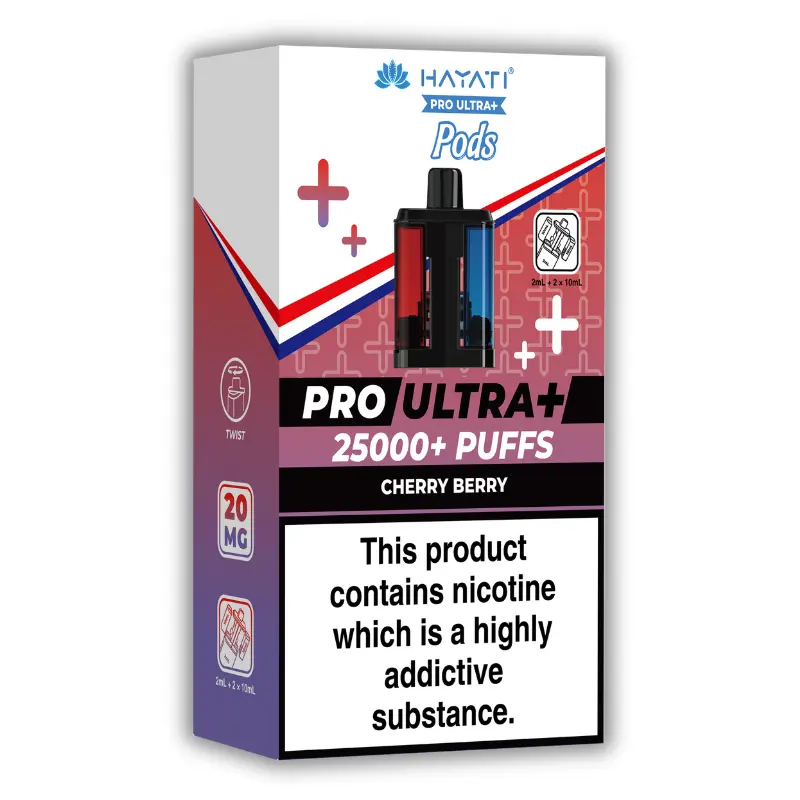
Hayati · Pro Ultra Plus
Cherry Berry Hayati Pro Ultra Plus Pods
£7.99
✔ In stock — ready to ship
Genuine Hayati
Free over £20
Same-day dispatch
Secure checkout
Seven pounds ninety-nine buys a single replacement pod for a Hayati Pro Ultra Plus, prefilled with 22ml of liquid at 20mg nicotine salt and carrying one flavour rather than two. There is no device in the pack and no rotating collar on the pod, so nothing is selected and nothing is switched. You fit it, and from the first draw to the last you are getting Cherry Berry.
Which raises the question this page exists to answer. Half of that name is an ingredient. Cherry is a thing that grows on a tree, and a liquid either tastes of it or does not, so a buyer who finds no cherry in the pod has a complaint with content in it. The other half is not an ingredient. Berry is a class, a bag containing raspberry and blackcurrant and cranberry and blueberry and strawberry and blackberry, fruits whose characters have so little in common that knowing a liquid contains one of them tells you close to nothing about how it will taste. Blackcurrant is dark, musky and tart. Strawberry is soft, ripe and sweet. Both are berries. Put the class word in a title and you have narrowed the partner from everything down to a family, and then stopped.
The obvious response to that is a shrug: unnamed means unknowable, buy something else. This page does not take it, because the catalogue is not actually silent. Hayati have published 492 listings, they have named a great many fruits across those listings, they use a fairly consistent vocabulary for what each one contributes, and they have written seven separate descriptions of this exact liquid. That is a lot of evidence for a blend nobody has itemised. Used carefully it narrows the berry half considerably, not to a recipe but to a short list with some members ruled out, which is a more useful thing to hand a buyer than either a confident tasting note or a refusal to guess.
So: what the name commits to, what the catalogue lets you infer about the rest, how confident each piece of that is, and what it costs to be wrong about it when the pod holds 22ml. The flavour writing that has already been done on this liquid is cited rather than repeated, and where the page infers, it says so in the sentence that does the inferring.
What the title commits to, and what it only gestures at
Before arguing about the convention it is worth saying that the counting has already been done, and done properly, so this page is not going to do it again. The Grape Berry pods page worked through the Pro Max Plus Pods shelf and found nine of eighty-nine listings using a class noun where a species could stand, five of them pairing a named thing with a bare class and four handing the entire recipe to a class. It extended that across the full catalogue to thirty-eight listings resolving to fifteen distinct flavour names. It then itemised what the convention costs a buyer, in five parts, and it put the case for the defence at equal length. Cherry Berry appears in that analysis by name. Anyone who wants the argument about whether the convention is defensible should read it there, because it is thorough and this page has nothing to add to it.
What is worth adding is a narrower count, because the question of how vague a name is depends on what it is being compared with. Across the 492 listings there are 173 distinct flavour-name strings once the format words are stripped off. Take only the ones that pair a single specific named fruit with a bare class noun and nothing else, which is the shape this title has, and the list runs to three: Cherry Berry, Grape Berry and Dragon Berries. Widen or narrow the definition and it moves, but not by much. Dragon Berries is arguably not in the set, because "Dragon" on its own is not a fruit name, it is a clipping of dragon fruit, so you are inferring the specific half as well as the general one. Tighten it that far and you are down to two names in the entire range: this one and Grape Berry.
That is the useful figure, and it cuts in an unexpected direction. The convention as a whole is not rare, and the Grape Berry page is right that it is a settled habit rather than an oversight. But this particular shape of it, one confirmed fruit plus one unconfirmed family, is genuinely uncommon. Almost every other two-part name in the range tells you both halves. Blackberry Raspberry names both. Blueberry Pomegranate names both. Strawberry Kiwi, Strawberry Lychee, Peach Mango, Cola Lime, Mango Banana, Blackcurrant Mango, Lemon Pineapple, Sakura Grape, Strawberry Watermelon: both halves, every time. Where a title has two components, the overwhelming default is to declare them.
Cherry Berry is also the most heavily published example of the shape. It is sold seven times over, across four formats, against two listings for Grape Berry and three for Dragon Berries. If a shopper meets the one-named-one-unnamed construction anywhere in this range, statistically it is most likely to be here. So the convention is a house habit, this version of it is not, and the listing you are looking at is the one the house has repeated more than any other.
One more observation from the filing, which is small but points the same way. This pod sits on both Berry Vapes and Cherry Vapes, and so do thirty-nine other listings, forty in total across the catalogue. Cherry is a stone fruit rather than a berry in any botanical sense, and the range files it as both without apparent difficulty. That is not a criticism. It is a demonstration that "berry" is being used here in the loose retail sense of small sweet red or dark fruit, not in a sense that would let you exclude anything. The shelf is 225 listings deep, which tells you how wide the word has to be to hold it.
Narrowing the family from the supply side
Here is the move that makes this listing more legible than it looks. Instead of asking what berries might exist in the world, ask what berries this manufacturer demonstrably has in the building.
A range of 492 listings is not built by sourcing a fresh flavour material for every product. It is built from a set of concentrates that gets recombined, and the set is smaller than the catalogue. You can see the recombination happening in the titles: the same handful of fruits reappear in different arrangements, some of them a dozen times over. Those repetitions are the visible edge of the palette. A flavour house does not print a fruit name on a label unless it has that fruit's concentrate on hand, so every named fruit in the catalogue is a confirmed member of the set, and the frequency with which it recurs is a reasonable proxy for how central it is to the house style.
This is inference, and it has a clear limit, which is worth putting before the numbers rather than after them. The names show what Hayati are willing to declare, not the full contents of their stockroom. A concentrate could be in constant use and never named once, which is exactly what the class-noun convention allows. So the count below establishes a floor on the palette and never a ceiling. What it does establish is which materials the house reaches for repeatedly when it does decide to name something, and that is the closest available evidence about what an unnamed berry bed is likely to be assembled from.
The berries Hayati are willing to print
Counting distinct flavour names rather than listings, so that a flavour sold six times does not swamp one sold twice, the berry family in this catalogue breaks down like this.
| Berry | Distinct flavour names | Listings |
|---|---|---|
| Strawberry (including the abbreviated Straw') | 36 | 80 |
| Raspberry (including blue raspberry spelled out) | 25 | 74 |
| Blue Razz (the confected blue raspberry) | 18 | 48 |
| Blueberry | 18 | 46 |
| Cranberry | 6 | 16 |
| Blackcurrant | 6 | 16 |
| Blackberry | 2 | 6 |
The shape of that is more informative than any single row. Three fruits carry the range: strawberry, raspberry and blueberry, in that order, appearing in seventy-nine distinct names between them. Three more are present but occasional: cranberry, blackcurrant and blackberry, fourteen names between them. Blackberry in particular is almost absent, confined to Blackberry Raspberry and Blackberry Ice and nothing else in 173 names.
Blueberry and raspberry also form the single most repeated pairing in the catalogue. Blueberry Raspberry exists as a flavour in its own right, and it then reappears as Blueberry Raspberry Cherry, Blueberry Raspberry Lemon, Blueberry Raspberry Menthol, Blueberry Raspberry / Mr Blue and Blueberry Straw' Menthol / Blueberry Raspberry Menthol. That is a house accord: a two-fruit base the formulators clearly have made up and keep building on top of. You can buy the base on its own as Blueberry Raspberry Hayati Pro Ultra Plus Pods at the same £7.99 as this pod, and you can buy it with citrus laid across the top as Blueberry Raspberry Lemon Hayati Pro Ultra Plus 25K Pods.
Hold that thought, because it is the hinge of the argument. When this range wants a berry background under a lead note, it already owns one.
What each of them is for, in this range's own vocabulary
The second piece of evidence is more interesting than the first. Hayati's flavour copy is not written by one person and it is not internally consistent about everything, but it is remarkably consistent about which adjectives attach to which fruit. Read across all 492 descriptions and the assignments are close to fixed.
- Raspberry is the brightness. It is described as brighter, tangier, livelier, sharper, as supplying the sparkle, as a lift, as waking a blend up, as a top note over something rounder. It is never the base.
- Blueberry is the cushion. Smooth, sweet, soft, rounded, a base, something that softens edges and makes a blend fuller. On one listing it is described as darker and jammier than the raspberry it sits with, which is the same job stated from the other side.
- Strawberry is ripeness and body. Sweet, juicy, ripe, and repeatedly described as softening something sharper. On the cranberry blends it is the element that takes the edge off.
- Blackcurrant is depth with a sharp edge. Deep, tart, musky, cordial-like, dark-fruit rich. It is used as a base, but a base with a point on it, and the musk is mentioned often enough to count as house vocabulary rather than a one-off.
- Blackberry is weight. Deep, dark, earthy, winey, rounded, with a tartness placed near the seeds. It is the heaviest berry in the range's language.
- Cranberry is the dry snap. Tart, sharp, dry, and described as keeping a blend honest or stopping sweetness from building. It is used as a corrective, never as a body note.
That lexicon is the tool. If the copy for an unnamed berry bed says the berries do a particular job, and the range has a fruit whose stated job is precisely that, you have a candidate. If the copy never uses any of the words the range reserves for a given fruit, you have grounds for an exclusion. Neither is proof. Both are better than nothing, and both are checkable by anyone with the catalogue open.
What the seven Cherry Berry listings say the berries do
Cherry Berry is described seven times in this catalogue, once for each listing, in seven separately written pieces of copy. The Cherry Berry Mini Ultra kit page lined all seven up and reported what it found, and the central finding there is not about the liquid at all: the descriptions were evidently written in platform batches, so a difference in wording between two listings of this flavour is evidence about who had which spreadsheet open, not evidence about two recipes. That page also established what all seven agree on, including the absence of any cooling agent across seven independent descriptions. None of that is rebuilt here. It is worth reading before the paragraphs below, because the paragraphs below depend on it.
What that analysis went looking for was where the acidity lives, and it answered that question. The question left standing is a different one, and it is the one that matters for a name with an unnamed half: not where the tang sits, but what the berries are for. Are they the thing that lifts the cherry, or the thing that cushions it? Those are opposite structural roles and they point at different fruits.
Six of the seven listings agree, and they agree on the lifting role. The berries add brightness and variety. They add brighter, tangier notes. They add juiciness and a rounder finish. They add a brighter, more varied fruit character. They fill out the middle and add juiciness so the cherry never turns one-note. The recurring words across those six are bright, tangy, juicy and varied, and the recurring structural claim is that the berry material stops a rich dark cherry from becoming monotonous. The cherry is consistently the heavy element and the berries are consistently the light one.
The one listing that says the opposite
The seventh is the 10ml bottle in the Pro Max nic salt line, and it inverts the relationship. There the berries are a softer medley that fills in the sweetness and rounds the whole thing out, with the tang belonging to the cherry. Same liquid, opposite architecture: the berries are the cushion rather than the lift.
Two things can be said about that, and honesty requires both. The first is that on the Mini Ultra page's finding, a single listing disagreeing with six others is most likely a copywriting variant rather than a formulation difference, and the bottle is a different platform written at a different time. The second is that the bottle page is also the page in this corpus that has done the most careful sensory work on this liquid, including a long passage on how a mixed-berry accord is typically constructed and why its components are designed not to be individually nameable. That page reached its reading from perfumery reasoning rather than from the catalogue, and it concluded the berry mass is red-leaning and doing the work of sweetness and body.
Those two conclusions are not as far apart as they look. A berry bed can supply body and still read as brighter than a dark cherry sitting on top of it, because brightness here is relative to the lead, not absolute. The six listings are describing the berries against the cherry. The bottle is describing them against nothing. Both can be accurate, and if they are, the berry material is lighter and more acidic than the cherry and heavier and sweeter than a citrus, which is a narrower band than either description gives on its own.
The words that never appear
The exclusions are the stronger half of this, because absence across seven independently written descriptions is harder to dismiss than a single positive claim.
No Cherry Berry listing uses any of the vocabulary this range reserves for its dark and dry berries. Nothing is musky. Nothing is earthy or winey. Nothing has a dry snap or a sharp, dry finish. Nothing is described as cordial-like. Those words are not rare in the catalogue, they are simply attached elsewhere: musky and cordial to blackcurrant, earthy and winey to blackberry, dry and snapping to cranberry. Seven writers describing this liquid across four platforms reached for bright, juicy, tangy and varied, and not one of them reached for the dark-berry set.
There is a second exclusion available from the naming convention itself, and it is the more reliable one. Hayati are demonstrably willing to name cranberry. They name it in six distinct flavour names, including as the third word of a three-fruit title, and on those listings they make a point of the tart, drying character it brings. Straw' Cranberry Cherry / Cherry Ice Hayati Pro Ultra Plus Pods puts it in the title on this very shelf. They are equally willing to name blackcurrant, in six names. A house that names cranberry when it uses cranberry, and names blackcurrant when it uses blackcurrant, has given you reasonable grounds to suppose that a blend which names neither probably contains neither in any leading quantity. That reasoning is not watertight, since the whole point of a class noun is that it permits silence, but it is the same reasoning a shopper uses about every other product they buy and it is not unreasonable here.
The reading, with the confidence marked on each line
Pulling the record and the reasoning together, here is what the berry half of this name most likely is. Each line carries its own confidence, and the tags mean exactly what they say: stated is on the record in Hayati's own copy, probable is an inference with converging evidence behind it, possible is an inference with one thread of evidence, and unknown is where the record runs out.
- Stated. Cherry leads, from the first draw, in every listing. The berries sit behind it. There is no cooling agent of any kind. There is one liquid in the pod and no second side.
- Stated. The berry material is described as brighter and more varied than the cherry on six of the seven listings, and as the softer, sweeter element on the seventh.
- Probable. Raspberry is present and is carrying the brightness. It is the range's designated lift note, it is the second most-named berry in the catalogue, and brightness is the property six of seven listings attribute to the berry half. Of all the candidate fruits, this one has the most evidence behind it.
- Probable. A soft, round, sweet berry sits underneath supplying body, and the two likeliest candidates are blueberry and strawberry. Both are described in exactly those terms throughout the range, both are among the three most-used berries, and the bottle page's independent reading of a red-leaning mass with a strawberry-ish rounding note points the same way.
- Possible. The base is the existing blueberry and raspberry accord with cherry laid over it. This is the cheapest thing a formulator with that accord already made could do, and the range does exactly that repeatedly, but nothing on the record confirms it for this particular liquid.
- Unlikely. Cranberry, blackcurrant or blackberry in any leading quantity. The vocabulary attached to all three is absent from all seven descriptions, and Hayati name all three when they use them.
- Unknown. How many berries there are. Whether the mix is two fruits or five. The ratio between the cherry and the bed. Whether the accord is identical across the four formats this flavour is sold in. Hayati publish an ingredient list for none of their liquids and nothing here is going to conjure one.
The honest summary of that: you are probably buying a rich, sweet, uncooled cherry over a bright red and blue berry base, with the acidity distributed between the two in a way that four different writers could not agree about, which itself suggests the two are well integrated rather than sitting in separate layers. If that description sounds like a reasonable thing to spend £7.99 on, it probably is. If the thing you actually want is a specific berry you can identify on the exhale, this is the wrong pod and the next section names several right ones.
The range already sells this architecture with the berries named
Here is the finding that makes the inference above checkable rather than merely plausible, and it has been sitting on the same shelf the whole time.
Hayati sell a flavour called Blueberry Raspberry Cherry. Their copy describes it as the blueberry and raspberry base with cherry laying a darker, deeper note over the berries for a heavier, more rounded taste. Read that sentence next to the Cherry Berry copy, which has cherry supplying a rich deep sweetness while the berries add brightness and variety around it, and the two are describing the same structure from opposite ends: a dark sweet cherry on top, a bright berry pair underneath, the cherry providing weight and the berries providing lift.
One of those liquids names its berries. The other calls them berries.
You can buy the named one on this exact shelf, in this exact format, at this exact price. Blueberry Raspberry / Blueberry Raspberry Cherry Hayati Pro Ultra Plus 25K Pods is a divided 22ml pod at £7.99 with the plain two-berry base on one side and the cherry-topped version on the other, selected by the rotating mouthpiece. As an instrument for answering the question this page is about, that is close to purpose-built: it lets you taste the base alone, then taste the same base with cherry over it, then compare the result against your Cherry Berry pod. If you would rather have the device in the box, the same pairing is sold as Blueberry Raspberry / Blueberry Raspberry Cherry Hayati Pro Ultra Plus 25000 Prefilled Pod Kit for £11.99.
Now the hedge, which matters as much as the finding. None of this establishes that the two liquids are the same recipe. It establishes something weaker and still worth having: that the architecture Cherry Berry's name gestures at is one this house builds, has a ready-made base for, and is perfectly willing to name when it chooses to. Two readings survive that and nothing on the record picks between them.
The first reading is the charitable one and it is the one the bottle page argues for. Cherry Berry's bed is a genuine accord, assembled so that no component is individually findable, and printing three fruit names on it would claim a structure the liquid does not have. On this reading the class noun is the accurate word and Blueberry Raspberry Cherry is a different construction, one where the berries are meant to be distinguishable, which is why they are declared.
The second reading is less flattering and not unreasonable. The two liquids are built on similar material, and the difference between naming and not naming is a decision made at the copy desk rather than in the lab. Nothing in this catalogue rules that out, and the Mini Ultra page's platform-batching finding is a reminder of how much of a Hayati product description is generated at the desk rather than at the bench.
There is a third named construction worth putting beside both, because it settles a smaller point. Blueberry Cherry Cranberry Hayati Pro Max Plus Pods at £5.49 is cherry plus berries again, this time with all three components declared and each given a job: blueberry for softness, cherry for depth, cranberry for a dry finish that holds the sugar back. The same blend exists on smaller hardware as Blueberry Cherry Cranberry Hayati Rubik Pods at £3.99. What those listings prove is that this range does put cherry over a named berry pair when it wants to, does declare a corrective fruit when one is present, and describes the result in noticeably drier terms than anything ever written about Cherry Berry. That is the exclusion argument from earlier, demonstrated rather than asserted.
One more named comparison, closer to home. Blue Razz Cherry Hayati Pro Ultra Plus Pods is a single-flavour 22ml pod at £7.99 whose copy runs: the blue raspberry provides the tang and brightness, while cherry adds a rich, deep sweetness underneath. That is almost word for word the division of labour Cherry Berry's own listing describes, with the bright partner named instead of classed. If you want to know what "cherry plus a bright berry" tastes like when the bright berry is on the record, that pod is the answer, and it is available divided against a confected blue as Blue Razz Cherry/Blue Razz GB Hayati Pro Ultra Plus 25K Pods or on smaller hardware as Blue Razz Cherry Hayati Rubik Pods at £3.99.
Why a class noun might be the one that survives a recipe change
This section is speculation about why names like this exist, and it should be read as speculation rather than as a claim about anything Hayati have done. Nothing here is evidence of a reformulation and none is alleged.
A name that specifies is a name that can be falsified. Print Blueberry Cherry Cranberry on a pod and you have made three checkable assertions, and if the cranberry ever comes out of the recipe the label is wrong in a way a customer can point at. Print Cherry Berry and you have made one checkable assertion and one that no possible liquid could fail, because any small sweet fruit in the general red and dark family satisfies it. The unnamed half is not just vague at the point of sale. It is durably vague, and that durability has a practical value to whoever owns the recipe.
The usual version of this argument is about time: a class-named blend can drift across batches without the label going stale. That version is worth less here than it looks, because ordinary batch variation happens to named blends too and nobody relabels for it.
The version that has teeth on this particular product is about format. Cherry Berry is sold in four formats, from a 4ml prefilled pod up to this 22ml one, plus a 10ml bottle in an entirely different carrier base at a different nicotine strength. Those are not trivially the same manufacturing problem. A liquid built for a 50/50 bottle and a liquid built for a high-capacity prefilled pod can reasonably differ, and a flavour house is under no obligation to keep a concentrate identical across four production lines. If the name declares three fruits, any divergence between formats becomes a discrepancy someone can demonstrate. If the name declares one fruit and a family, four different berry beds could ship under one title and every one of them would be accurately labelled.
The Mini Ultra page established that the copy for this flavour was written in platform batches. It is worth being clear that this tells us nothing whatsoever about whether the liquid was made in platform batches, and the two questions are independent. What can be said is that a class noun would absorb such a difference silently and a specific name would not, and that this is exactly the sort of quiet operational convenience that explains why category names persist in ranges this large.
The fairness note, which is owed. A house blend sold under a general name is an entirely ordinary thing to put on a shelf, and it has been for as long as anyone has sold flavoured anything. Mixed berry jam does not list its berries. Nobody thinks a fruit cordial is being evasive. The reason it deserves more scrutiny in a vape catalogue is not that it is dishonest, it is that the price of finding out is high relative to the price of the product, and this listing sits at the top end of that problem.
Twenty-two millilitres of an inference, and the cheaper ways in
Which brings the argument to its practical point. Everything above is reasoning, well-supported reasoning in places and thin reasoning in others, and the question a buyer actually faces is how much liquid to commit to it.
The volume risk on this format has been worked through repeatedly elsewhere in this catalogue and the reasoning does not need rebuilding: a 22ml prefilled pod is not divisible, is not refillable, cannot be decanted, and whatever is left in it when you lose interest goes in the bin with the pod. That is a familiar cost on any large prefilled format. What is specific here is the interaction between that cost and an unresolved name. On a pod whose title declares both components, the thing you are betting on is your own taste, which you know something about. On this one, you are betting on your taste and on a reading of the berry half, and the two risks compound.
Twenty-two millilitres is roughly five and a half times what the smallest format of this flavour holds. At £7.99 the pod works out at about thirty-six pence per millilitre, which is the cheapest way to own this liquid in prefilled form and precisely the reason it is a poor way to find out whether you like it. Cost efficiency and trial cost move in opposite directions, and only one of them matters on a first purchase.
The cheaper routes, for anyone who has not tasted this flavour before:
- The Mini Ultra pod kit at £3.99. Four millilitres, self-contained, nothing else required. Half the price of this pod and a fifth of the liquid. The Cherry Berry Mini Ultra kit page makes the case for it as a deliberate instrument rather than a compromise, and that case is a good one.
- The Mini Ultra replacement pod at £3.49, if you already own that device.
- The 10ml Pro Max nic salt bottle at £2.49. The lowest outlay of all, at a different nicotine strength and in a different carrier base, so it is a read on the flavour rather than on this pod. Useful if you own something you can put it in.
- The 12ml Pro Max Plus replacement pod at £5.49, which is the middle option if that is the hardware in your pocket.
Against all of those, the case for going straight to 22ml is simple and it is not a bad one: if you already know you like cherry-led red fruit without ice, the unresolved half is a detail rather than a risk, and paying twice for the same discovery is its own kind of waste. If you own a Pro Ultra Plus and you already liked this flavour in another format, the argument for the small formats disappears entirely and you should just buy the pod.
The other option at this level is the complete kit. Cherry Berry Hayati Pro Ultra Plus 25000 Prefilled Pod Kit is £11.99 and puts the device in the box with the same 22ml of liquid, which is a four pound premium over this listing for hardware you may already own. That is the right purchase for a first Pro Ultra Plus and the wrong one for a restock.
The pod itself, which is the short part
There is not a great deal to say about the object, and the range has said most of it already on other pages. What arrives is one prefilled pod in a pack, filled with 22ml of liquid at 20mg nicotine salt, which is the highest strength that may be sold in the United Kingdom. No device, no charging accessory, no spare.
The single structural fact worth dwelling on is the absence of a collar. Roughly half the pods on this shelf are divided, holding two flavours in separate reserves with a rotating mouthpiece selecting which one reaches the coil. Twenty-five of the fifty-two listings on Hayati Pro Ultra Plus Pods are built that way. This one is not. The whole 22ml is one liquid, there is nothing to turn, and there is no carryover between sides because there are no sides. The Cherry Berry Mini Ultra kit page argues at length that an undivided pod is the better instrument when what you want is a clear reading of one blend, and that argument holds with more force here, because there is five and a half times as much of it to read.
The practical consequences of a single 22ml reserve are the ordinary ones for the format. One coil does all the work from the first draw to the last, so whatever coil ageing does to this profile, it does progressively and you will see the whole arc of it. The pod is not refillable and there is no serviceable part inside it. When the flavour thins out and the vapour drops away, the pod is finished, and the correct destination for a spent one is a retailer take-back point or a household electrical recycling facility rather than a bin, because there is a cell-free electronic assembly and a residue of liquid in there.
On fitment, one sentence and then the subject is closed: Hayati sell several ranges whose pods do not interchange, so the range name printed on your device is the thing to confirm before ordering. If the answer is anything other than Pro Ultra Plus, this is not your pod and the wider Hayati Prefilled Pods & Refills shelf, 201 listings deep, is where the right one lives.
The published numbers
| Nicotine strength | 20mg nicotine salt, the UK maximum |
|---|---|
| Liquid volume | 22ml, prefilled, one reserve |
| Flavours in the pod | One. No collar, no second side |
| Cooling | None stated on any of the seven Cherry Berry listings |
| Manufacturer puff rating | Up to 25,000, a laboratory figure |
| Price | £7.99, about 36p per millilitre |
| Device | Not included. Requires a compatible Pro Ultra Plus |
| Fruits named in the title | One of two |
Two of those rows deserve a word. The puff rating first: 25,000 is a manufacturer's laboratory estimate arrived at under test conditions, and it is a way of expressing capacity rather than a promise about your week. Longer, warmer draws consume liquid faster than short ones, and on a layered profile like this one draw length also changes what you taste, so the number and your experience of the pod are linked in more than one direction.
The last row is there on purpose, and it is the only row on this table that no sibling page would print. Every other line is a specification. That one is a description of the information you are buying, and on a pod that costs the same as its fully-named neighbours it is as relevant to the decision as the volume is. Strawberry Raspberry Ice Hayati Pro Ultra Plus 25K Pods is £7.99 and names two fruits and a cooling agent. Mango Peach Pineapple Hayati Pro Ultra Plus 25K Pods is £7.99 and names three fruits with a stated role each. The liquid volume is identical, the strength is identical, the money is identical. What differs is how much of the recipe is on the label.
Where it sits against the neighbours
Seventy-two listings carry cherry somewhere in the catalogue and 225 sit on the berry shelf, so there is no shortage of alternatives. The useful way to sort them is by what you want resolved.
If you want the berries named
Blueberry Raspberry Hayati Pro Ultra Plus Pods is the direct answer. Same shelf, same 22ml, same £7.99, same absence of ice, same undivided single-flavour construction, and both components declared with their roles stated: sweet blueberry as the base, brighter and tangier raspberry on top. It is the closest thing in the range to a control for this pod, because the only meaningful difference is that one of them tells you what is in it and the other does not. If you buy both you will learn more about your own preferences than either would teach alone.
Add citrus to that base and you get Blueberry Raspberry Lemon Hayati Pro Ultra Plus 25K Pods, which cuts the berries rather than sweetening them and is the one to take if you find sweet red fruit heavy after a few hours. Put cherry over that base instead of lemon and you are at Blueberry Raspberry / Blueberry Raspberry Cherry Hayati Pro Ultra Plus 25K Pods, which for the purposes of this page is the single most informative pod on the shelf.
If you want the cherry, with something specific behind it
Blue Razz Cherry Hayati Pro Ultra Plus Pods keeps the cherry in the same role and replaces the anonymous bright partner with a confected blue raspberry, which is louder and tangier than a natural raspberry would be. It is the same shape of blend with the volume turned up.
Straw' Cranberry Cherry / Cherry Ice Hayati Pro Ultra Plus Pods is the opposite move: every fruit declared, a cranberry doing the drying, and an iced cherry on the other side of the collar for contrast. Take it if the thing you suspect you want from a red blend is a sharper, drier finish than Cherry Berry's copy ever promises. The same tart blend appears against an iced berry as Straw' Cranberry Cherry/Strawberry Raspberry Ice Hayati Pro Ultra Plus 25K Pods.
For cherry against something outside the berry family entirely, Cherry Ice/Peach Mango Hayati Pro Ultra Plus 25K Pods pairs a cooled cherry with a soft stone-fruit and tropical side, which is a different proposition from anything discussed above and a reasonable second pod if you want your cherry cold some of the time.
If the berries are the point and the cherry is not
Blue Sour Raspberry Hayati Pro Ultra Plus Pods goes hard in the direction Cherry Berry deliberately avoids, with the sour dial turned up and no sweet lead to hide behind. Strawberry Ice / Strawberry Raspberry Ice Hayati Pro Ultra Plus 25K Pods is the iced red-berry route, and it has the useful property of putting a one-fruit version and a two-fruit version of the same base either side of one collar, which is another good instrument for anyone who likes taking blends apart.
For a confected treatment of the same fruits, Blueberry Cotton K / Raspberry Cotton K Hayati Pro Ultra Plus Pods runs the blueberry and raspberry pair through a candy-floss sweetness on both sides, and Blackcurrant Cotton K / Blue Raspberry Hayati Pro Ultra Plus Pods does the same to a blackcurrant and sets a sharp blue raspberry opposite it. Both are sweeter than this pod and neither pretends otherwise. Plain confected blue on its own is Blue Razz GB Hayati Pro Ultra Plus Pods, and the gummy treatment applied to grape and strawberry is Grape GB / Strawberry GB Hayati Pro Ultra Plus Pods.
Further out, for when the red shelf tires
A sweet uncooled red fruit is a pleasant thing to vape and a tiring thing to vape exclusively, and most people who run one keep something unlike it in rotation. Cola Ice Hayati Pro Ultra Plus 25K Pods has no fruit in it at all and a cold finish, which makes it about as far from this pod as the shelf goes while staying on the same hardware. Mango Peach Pineapple Hayati Pro Ultra Plus 25K Pods is the tropical equivalent and is notable here for the opposite reason to everything else on this page: three fruits, three declared roles, nothing left to infer.
If none of that lands, the full shelf is Hayati Pro Ultra Plus Prefilled Pod Kits & Pods at 104 listings, the pods across every range sit under Hayati Pods at 202, and the whole catalogue of 492 is on the Hayati shop.
Getting a usable read on the unnamed half
If you are going to spend 22ml on an inference, it is worth getting an answer out of it rather than drifting through the pod and forming a vague impression. The advantage you have over anyone running this flavour in a small format is duration, and duration is what separates layers.
Start with a negative result rather than a positive one. The exclusions in this page are testable and the inclusions mostly are not, so the first thing to check on a new pod is whether any of the dark-berry markers are present. Cranberry announces itself by drying the tongue at the end of the exhale, a slight astringent pull rather than a taste. Blackcurrant announces itself with a musky, almost savoury note underneath the fruit. Blackberry announces itself as weight, a winey heaviness that sits lower than the cherry. Spend the first few sessions listening for those three specifically. If none of them turn up, the reading in this page is holding. If one of them does, the reading is wrong and you should say so, because a demonstrable correction is worth more than a confident page.
Then use the arc of the pod rather than fighting it. A coil that has been running a sweet liquid for a couple of weeks does not simply get worse, it gets selective. The lightest and most volatile aromatic material is the first thing to drop away, and heavier, sweeter material persists longer. On a layered profile that is a slow separation happening for free: the bright top of the blend recedes first and what remains is the base. So the berry bed you cannot isolate at the start of a 22ml pod becomes considerably easier to hear at the end of one, when the cherry's top notes have thinned and there is less sitting on top of it. That is not an option on 4ml. It is one of the few genuine advantages of committing to a large pod, and almost nobody uses it deliberately.
Run a control if you are serious. The divided Blueberry Raspberry pod described earlier gives you the base alone and the base with cherry over it, from one purchase, switchable mid-session. Taste the plain side, then the cherry side, then your Cherry Berry, in that order, leaving a gap between each. If the third tastes like the second, the supply-side reading in this page is probably right. If it tastes like neither, something else is in there and the interesting question becomes what.
Two practical notes and then the housekeeping is done. Draw length changes the balance of this blend substantially, with short draws favouring the cherry's bright top and longer ones bringing the sweeter base forward, and the bottle page works through exactly why, so vary it deliberately rather than by accident when you are trying to characterise the bed. And judge nothing in the first day. A fresh pod on a fresh wick reads differently from a settled one, palates calibrate to whatever they have been doing, and a sweet red fruit assessed immediately after another sweet red fruit will read as unremarkable when it is not.
Storage is unremarkable and the same as any prefilled pod: somewhere cool and dark, out of direct sunlight, not on a warm windowsill, and somewhere children and pets cannot get at it. Heat and light are what age a sweet fruit liquid in the pack, and a spare kept warm for a month will not read the same as the one you bought it alongside.
Questions this listing raises
Which berries are actually in it?
Hayati do not say, and no listing of this flavour has ever said. Reasoning from the fruits this range names most often and from the vocabulary its copy attaches to each of them, raspberry supplying brightness over a soft round base of blueberry or strawberry is the most probable reading. Cranberry, blackcurrant and blackberry are unlikely, because the distinctive words attached to those three appear on none of the seven Cherry Berry descriptions. All of that is inference and it is marked as inference throughout this page.
Is there any ice or cooling in this one?
No, and this is one of the better-evidenced facts about the liquid. Seven separately written descriptions across four formats mention no menthol, no koolada and no cooling agent of any kind, and two of them state the absence outright. The range marks its cold products in the title as a matter of routine, and this title carries no such marker.
Is this the same liquid as the Cherry Berry kit?
Nothing in either listing suggests a difference. The kit is the same 22ml of the same flavour with a device in the box for £11.99, and this listing is the pod alone at £7.99. If you already own a compatible Pro Ultra Plus, the pod is the purchase and the extra four pounds buys hardware you have.
How much cherry is there, relative to the berries?
Every listing puts cherry in front and the berries behind, in those terms or close ones, so the ordering is not in doubt. The ratio is not published and cannot be worked out from the copy. What can be said is that the blend is described as layered rather than blended, with cherry occupying the top of the draw consistently rather than trading places with the bed.
Can I switch to a second flavour mid-session with this pod?
No. This is a single-flavour pod with no rotating mouthpiece and one reserve. About half the pods on this shelf are divided and offer that, but this is not one of them, so the whole 22ml is Cherry Berry from start to finish.
Is 25,000 puffs what I will actually get?
Treat it as a manufacturer's laboratory estimate rather than a forecast. It is produced under test conditions and expresses the capacity of the pod, not a guarantee about your usage. Longer and warmer draws consume liquid faster than short ones, so real-world figures vary widely between people using identical hardware.
Why does the price match pods that name all their fruits?
Because the price is set by the format, not by the recipe. Twenty-two millilitres at 20mg is £7.99 across this shelf whether the title declares one fruit or three. That is precisely why the information difference is worth noticing: it is a variable you are choosing between at a fixed price, rather than something you are paying less for.
Should I buy this or try the flavour in a smaller format first?
If you have had Cherry Berry before and liked it, buy this, since the smaller formats cost more per millilitre and teach you nothing new. If you have not, the 4ml Mini Ultra kit at £3.99 or the 10ml bottle at £2.49 are much cheaper ways to find out, and the 22ml pod is a large amount of liquid to commit to a flavour whose second component you are inferring.
What is the nicotine, and is it a salt?
Twenty milligrams per millilitre, which is the maximum strength permitted for sale in the United Kingdom, in a nicotine salt preparation. The listing itself states the strength rather than the preparation, but salt is the standard formulation for prefilled pods at this strength and the rest of this range is described the same way.
Will the berry bed become easier to identify as the pod ages?
Probably, and that is worth exploiting rather than resenting. A coil running a sweet liquid loses the lightest aromatic material first, so the bright top of the profile recedes before the heavier base does. Late in a 22ml pod there is less cherry sitting over the bed than there was at the start, which is the easiest listening conditions you will get.
Is Cherry Berry sweet?
Yes, and every listing says so directly rather than hedging. It sits on the sweeter side of this range without reaching the confectionery pods, and the acidity in the blend is what keeps it legible over a long session. If you want something drier, the cranberry blends are where to look.
What happens to the pod when it is finished?
It is not refillable and has no serviceable parts, so a spent one goes to a retailer take-back point or a household electrical recycling facility rather than in with general waste. There is an electronic assembly and a residue of liquid inside it either way.
The short version
A 22ml single-flavour replacement pod for a Pro Ultra Plus at £7.99, 20mg nicotine salt, rated by the manufacturer at up to 25,000 puffs under laboratory conditions, with a rich sweet cherry leading and an uncooled berry base behind it. The cherry is on the record. The berries are not, and this page has tried to narrow them as far as the catalogue honestly allows: probably raspberry for the brightness over a soft round blueberry or strawberry base, probably not cranberry or blackcurrant or blackberry, and the ratio unknown. Everything in that sentence after the word "probably" is inference and should be treated as such.
If you already know you like this flavour, none of the above matters and the pod is simply the cheapest way to own a lot of it. If you do not, the honest advice is to spend less to find out, either in the 4ml kit or the 10ml bottle, or to buy one of the neighbouring pods that names both of its fruits and costs exactly the same. And if you want to test the reading in this page directly, the divided blueberry and raspberry pod with the cherry-topped side is on the same shelf at the same money and does the job better than any description could. A newly listed pod sits with the rest of the recent additions under New Products.
Strictly for adults aged 18 and over. Nicotine is an addictive substance.
You might also like


