
Home / Hayati Pro Ultra Plus Pods / Lemon & Mint Hayati Pro Ultra Plus 25K Pods
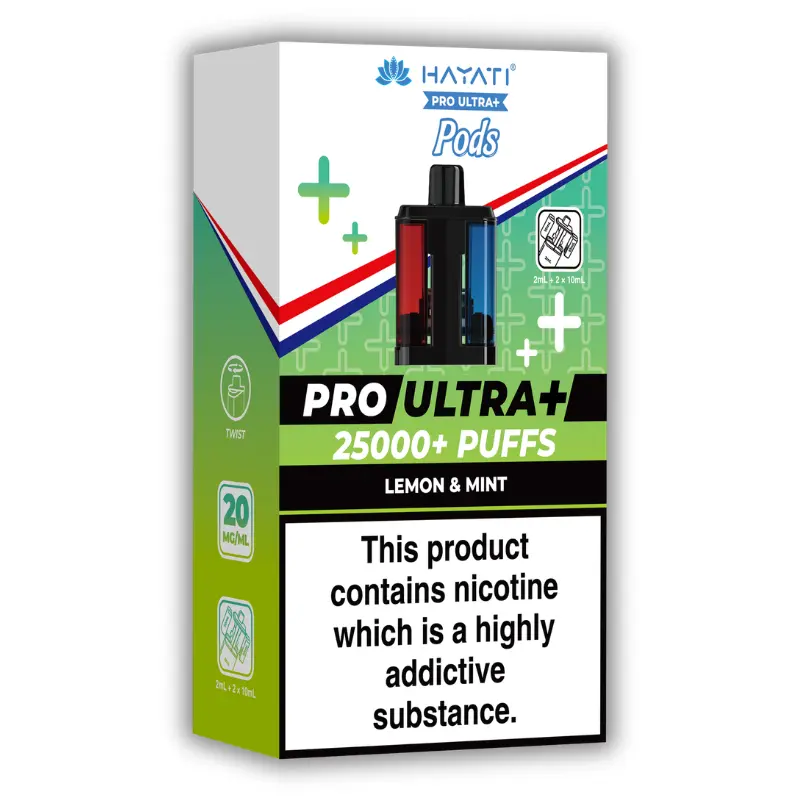
Hayati · Pro Ultra Plus
Lemon & Mint Hayati Pro Ultra Plus 25K Pods
£7.99
✔ In stock — ready to ship
Genuine Hayati
Free over £20
Same-day dispatch
Secure checkout
One pod, one liquid, twenty-two millilitres of it, and a name with two words in it. Lemon & Mint is a single blend rather than a paired listing. There is no oblique in the title, nothing on the pod to turn, and no second reserve sitting behind the first, so whatever is in there arrives on the opening draw and is still there on the last one. Seven pounds ninety-nine buys the pod by itself, filled at the factory at 20mg nicotine salt, and the listing assumes a Hayati Pro Ultra Plus already in your possession. Hayati rate the pod at up to 25,000 puffs, a figure generated in a laboratory by equipment repeating one identical draw at a fixed interval, which makes it useful for ranking products against each other and useless as a forecast of your own fortnight. Anyone without the device wants the Lemon Mint kit at £11.99, which pairs the hardware with the same liquid.
That is the whole of the ordinary part. The interesting part of this listing is the second word, because in vape flavouring "mint" names two entirely different things, and this label does not say which of them it means.
One of those things is a sensation. Cold is not a taste. It is a signal produced when certain compounds bind to a receptor in the mouth and throat that normally reports temperature, and the receptor cannot tell the difference between a genuinely cold liquid and a molecule that has activated it chemically. That is why a cooled vape feels cold while the vapour itself is warm. The other thing is an aroma: mint the plant, a green, slightly bitter, faintly peppery leaf with a soft waxy edge to it, which you detect through your nose in the same way you detect basil or fennel and which has nothing whatever to do with temperature.
Most blends that print the word mint on a label are selling the first of those and very little of the second. This page is about working out which one Hayati have put in this pod, why the answer changes what the lemon tastes like more than any other variable in the recipe, and how to settle it for yourself inside the first two minutes of opening the packet. I will say now, so it is not buried: the facts published for this product do not resolve it. What follows explains why, what each version would be like, and how to find out.
Two different things are wearing the same word
A sensation and an aroma are not the same kind of fact
The cold signal in a vape is a receptor event. A compound docks with a cold-sensing channel in the tissue of your mouth and throat, the channel fires, and your brain is told the surface temperature has dropped. Nothing has actually cooled. The reaction is mechanical and it is extremely reliable: the same molecule at the same concentration produces close to the same effect in nearly everybody, on the first draw and on the thousandth, and it works on a tired palate, a blocked nose and a coil that has seen better days.
Menthol is the familiar example and it is a genuine constituent of peppermint, which is where the confusion begins. But the trade does not depend on menthol for this any more. There is a family of purpose-built cooling compounds in wide use that produce the same receptor effect with almost no smell and almost no taste of their own. They are, in the most literal sense, cold without mint. A formulator can dose one of those into a lemon liquid and produce something every buyer will describe as minty, without a single molecule from a mint plant being involved. That is not a scandal, it is just how the category works, and it is why the word on a label is such weak evidence about what is inside.
Aroma behaves nothing like that. Smell runs on a very large number of distinct receptors reading a mixture, most of it arriving retronasally, which is to say up the back of the throat rather than through the nostrils. It is fragile, it varies from person to person, it fades as a palate gets tired, and the light end of it evaporates first under heat. An aroma is a description. A cold signal is a switch.
What the herb tastes like when nothing is cooling
Describe mint as a plant and the description contains no temperature words at all, which is worth doing deliberately, because the habit of reaching for cold vocabulary is exactly what obscures the distinction.
The leaf is green in the way that a bruised stalk is green: vegetal, a little grassy, with a wet quality to it. There is a bitterness, low but definitely present, arriving late. There is a peppery lift near the top, closer to a crushed seed than to ground pepper. And there is a soft, faintly waxy body in the middle, the part most people cannot name and the part that separates a real herb note from a confectionery impression of one. That is closer in character to a culinary garnish than to a sweet. No chill, no numbing, no band of cold across the soft palate twenty seconds after the exhale. A herb-led mint can be entirely warm and still be unmistakably mint, and if you have only ever met mint in cooled products that sentence will read as nonsense until the first time you encounter it.
Why formulators keep choosing the switch over the description
Four reasons, and they compound. Cost: a cooling compound is one ingredient dosed at a fraction of a percent, while a convincing herb profile is a built aroma with several components in balance, and balance is what costs money. Stability: cooling compounds are comparatively heavy and unreactive, they survive months in a warm warehouse, and they are not the first thing lost as residue builds on a coil, whereas the volatile green top of a herb note is the first casualty in all three situations. Legibility: nobody opens a cooled pod and wonders whether they got the right one, and ambiguity is expensive in retail.
The fourth reason is the failure mode, and it is the one that decides most of these arguments inside a flavour house. Herbal mint has a narrow window. Push the aroma too hard, or run it too hot, and it tips over into soap. That is not a metaphor: several of the compounds that make a mint leaf smell green also occur in fragrance and detergent, and a palate meeting them in a vape frequently files them under washing-up rather than under kitchen. A blend that risks being called soapy by one buyer in five is a worse commercial proposition than a blend that is merely a bit plain. A cooling compound cannot be called soapy. It has no smell to be called anything.
So the default in this category is the sensation, and the herb is the exception. That is the prior to bring to any listing that prints the word without qualifying it, this one included.
Everything Hayati put on the record for this pod
- The flavour is called Lemon & Mint, one liquid, no second side.
- The lemon leads and is described as sharp and zesty.
- The mint comes in behind it and is described as reading cool at the finish.
- The two are presented as balancing each other, the mint taking an edge off the citrus and the citrus stopping the mint sitting flat.
- The profile is positioned as crisp rather than sugary, aimed at buyers who find the confectionery end of the range too much.
- Filled volume is 22ml, nicotine is 20mg per millilitre, and the manufacturer's rating is up to 25,000 puffs.
- It is a replacement pod. The device is not in the pack and needs to be a compatible Pro Ultra Plus.
- The price is £7.99.
Everything they leave off
- Which mint. Peppermint, spearmint and a generic confectionery mint are three different profiles and the listing names none of them.
- Whether the cold comes from the mint element itself or from a separate cooling compound dosed alongside it.
- How much cold. "Cool" covers everything from a faint lift to a numbing front.
- Whether there is any green herb character behind the cold, and if so how loud.
- Where the sweetness sits in absolute terms. Crisp rather than sugary is a comparison, not a level.
- Whether the lemon is a juice-style brightness or a zest-style oiliness, which changes how it sits against a herb.
- Coil resistance, wick material, airflow, pod dimensions, and anything else about the hardware. None of that is in this product's data and none of it has been borrowed from a neighbouring listing for this page.
The naming convention is evidence, and weaker evidence than it looks
Hayati badge their cooled fruit listings openly. A pod with a coolant front of any real size tends to carry Ice or Frozen in the title, which is how Cola Ice and Blue Razz Pineapple / Strawberry Ice announce themselves before you read a word of the description. This pod carries neither badge, and yet the description still says cool. Two readings of that, both consistent with everything published.
Reading one: the word mint is doing the badging. Hayati assume a buyer reading mint already expects cold, so a second label would be redundant, and the absence tells you nothing at all. Reading two: the cold here is genuinely milder than the level that earns an Ice badge, which would mean a moderate lift rather than a front, with more room underneath it for the herb to be audible.
I cannot choose between those from the outside and neither can you. Anybody who tells you the naming convention settles the question has reasoned from a label to a formulation, which is precisely the move that produces confident pages contradicting each other. The shelving is no more decisive. This listing appears on Mint Vapes, nineteen products deep, and on Lemon Vapes, which runs to fifty-four. A shelf groups by the word on the label, not by what the word turned out to mean.
The two products this listing might be
These are genuinely different purchases, not two descriptions of one thing, and the difference is larger than the gap between most named flavours on this shelf.
Version one: lemon over a cooling compound
Assume the mint element is mostly a cold signal with a light confectionery mint impression on top of it. What you get is a sharp cold citrus, and the two halves of that phrase reinforce each other in a specific way.
Lemon acid registers as sharpness. Cold registers as sharpness. They are completely different mechanisms, one a taste and one a temperature signal, but the words your brain reaches for to describe them are the same, and stacking them produces a single hard bright edge rather than two separate events. The draw opens with citrus and cold arriving almost together, there is not much of a middle, and the finish is the cold outlasting the lemon by a wide margin and holding for twenty or thirty seconds after you have stopped.
Very legible, in that you know exactly what you have on the first pull. Low complexity, low perceived sweetness, and highly consistent across the life of the pod, because neither of its components is the sort of thing that degrades quietly. Undemanding over 22ml, which is a larger virtue than it sounds. It suits anyone who wants a citrus with a hard edge and does not want to think about it, and it disappoints anyone hoping for internal structure.
Version two: lemon with the actual herb in it
Now assume a real mint aroma, the green leafy kind, carrying whatever cold the plant brings and no more. This is a substantially different liquid and a considerably more divisive one.
Lemon and mint leaf is a kitchen pairing before it is a vape one, and the kitchen version tells you what to expect. In a dressing, an infusion or a cordial, the two do not stack into one edge. They sit in different registers. The lemon is bright, acidic and quick, and it occupies the front. The herb is slower, rounder, greener, arriving underneath and behind, with a bitterness that shows up at the very end and stops the whole thing dead rather than letting it fade into sweetness.
Draw shape has three distinct phases where the other version has one: sharp citrus opening, a green vegetal middle where the leaf comes up waxy and faintly peppery, then a bitter close. The retrohale is where most of the herb lives, so anyone who exhales entirely through the mouth will get perhaps half of what is there and may conclude the mint is missing.
More interesting, with something to notice on the two hundredth draw that you missed on the first. More fragile, because the green top is what heat and coil residue remove first. Riskier, because the bitterness and the waxy edge are exactly the notes filed under soap by a palate expecting cold. A meaningful minority of people who like the idea of lemon and mint find the real herb version unpleasant in a vape, and they are no more wrong than people who dislike fennel.
The third possibility, which is probably the real one
Those two are set out as a clean choice because that makes the difference legible, but the honest expectation for a product like this is a mixture, and there is a chemical reason the line blurs. Menthol is both things at once. It is a real constituent of peppermint and it is a cold-receptor agonist, so a peppermint-led formulation delivers aroma and sensation from the same molecule and cannot be sorted into one column. A liquid can also carry a genuine herb aroma with a synthetic coolant dosed alongside to lift the front, which is common.
So the useful question is not which of two boxes this pod falls into. It is how much of the herb survives behind however much cold is present, because the cold does not merely sit beside the aroma. It masks it. A cold-sensing receptor firing across the mouth and throat raises the threshold at which fine green detail registers at all, so the more coolant there is, the less of the leaf you will hear even if the leaf is in the bottle. Two pods could contain identical herb aroma at identical concentration and taste like different products because one has twice the coolant.
What each version does to the lemon
Under a coolant, the lemon narrows. Cold flattens fine aromatic detail, and citrus identity lives almost entirely in the light volatile fraction of its aroma, so a heavily cooled lemon reads as generic sharpness with a lemon-shaped flavour attached rather than as a specific fruit. It gets louder and less particular at once.
Under the herb, the lemon stays specific but loses primacy. It has something to be measured against, so you pick out its acidity against the leaf's bitterness and its brightness against the leaf's greenness. The cost is that the lemon is no longer the whole event. If lemon on its own is what you actually want, neither version is your best route: Lemon Lime Hayati Pro Ultra Plus Pods gives a sharp uncooled citrus with no second family in it, and Orange Lemon & Lime adds weight underneath rather than a green note beside.
What it is not, in either version
It is not a lemonade. There is no fizz, no carbonated impression and no diluted sugar-water base, which is the whole architecture of Straw’ Lemonade and Blackcurrant Lemonade. It is not a mojito construction, which puts mint against lime with a sweet body underneath, and nothing here implies a third element of that kind. It is not a mint-on-mint blend; there is one herb word in the name and one fruit word. And it is not a dual pod. Many listings on the Pro Ultra Plus pods shelf carry an oblique and hold two liquids you select between, so there is no way here to step off the mint for an hour without physically changing the pod.
Settling it yourself in the first two minutes
You cannot resolve this from the listing, but you can resolve it almost immediately from the pod. The tests below are ordered by how quickly they pay off, none needs equipment, and all of them exploit the fact that a sensation and an aroma travel by different routes and behave differently in time.
Test one: shut the nose
The decisive one, and it takes a single draw. Pinch your nostrils closed, take a slow pull, hold the vapour in the mouth for two seconds, and exhale through the mouth with the nose still shut. Aroma is overwhelmingly retronasal, so block the nasal passage and the herb is simply not delivered whatever quantity of it is in the liquid. A cold signal is generated at the tissue surface and does not care about your nose, so it comes through the block undiminished.
If the draw still reads emphatically minty with the nose closed, you are feeling the switch. If the mint largely disappears and you are left with lemon plus a mild chill, there is a real aroma component doing most of the work. Then take a second draw normally, with a little of the vapour going out through the nose. Whatever is added back is the herb, and the size of the difference between the two draws is your answer as a quantity rather than a guess.
Test two: where it lands, and how long it stays
Pay attention to geography. A cooling compound is felt across the soft palate and down the throat, in places that do not report taste, and it is often strongest on the inhale of plain air immediately afterwards. A herb aroma is perceived somewhere behind the bridge of the nose and has no location in the throat at all.
Then count. Exhale, wait twenty seconds, and check what is left. Coolant persists, and the cold band can still be there at half a minute. The green herb note is short and usually gone inside five or six seconds. A pod still cold at thirty seconds with no mint flavour attached to the cold is a coolant pod with a mint word on the box.
Test three: cold water afterwards
Take a mouthful of cold water a few seconds after an exhale. Cold-receptor compounds sensitise the tissue, so plain water reads as startlingly colder than it should for a while afterwards, and drawing cool air in through the mouth does the same. An aroma cannot do that, because an aroma is not talking to the temperature receptor. If the water comes back normal, there is not much coolant in the pod.
Test four: look for the bitterness on purpose
People miss the herb because they are listening for cold and the bitterness is quiet. On a slow draw with a partial nasal exhale, look specifically for two things at the very end: a low bitter edge arriving after the lemon has gone, and a slightly waxy, leafy texture sitting behind it. Those are the plant's signature and nothing else in a lemon blend produces them. If they are present, expect some sessions where they read as soapy rather than as green, and take that swing as diagnostic in itself. Coolant never swings. It is the same every time.
Test five: the same pod a fortnight later
The slowest test and the most conclusive. Aroma compounds are the first casualties of a coil that has been working for a few thousand draws, because residue builds on the mesh and the lightest fraction of the profile stops being reproduced faithfully. Cooling compounds are heavier, less reactive and much more durable through that process.
So: if the mint is exactly as loud in the last quarter of the pod as it was on day one, it was never the herb. If the mint thins over the run while the cold sits where it was, you had both and the herb went first. If mint and lemon fade together and the pod finishes with nothing cold in it, you had a herb-led blend with little or no added coolant, which is the rarest of the three outcomes. Marking that prediction honestly: the reasoning is mine, built from how volatile and non-volatile components behave on a fixed coil, and Hayati publish nothing about the composition of this liquid. It is an inference with the working shown, not a specification.
Established, probable, unknown
Reasonably confident. One liquid, no selectable second side. Lemon is the lead and arrives first. There is some cold at the finish, because the listing copy says so plainly and there is no reason to doubt it. Sweetness is below the middle for this shelf. The pod is sealed, prefilled to 22ml, fixed at 20mg.
Probable. That the cold is moderate rather than a front, on the grounds that Hayati badge their hard-cooled products and did not badge this one. That the sensation carries more of the mint impression than the herb does, on the grounds that this is the commercial default. Both are inferences from a pattern, and a pattern is not a data sheet.
Unknown. Which mint. Whether any of the cold is added separately from the mint element. How much green herb character is audible behind it. That last one is the axis that decides whether you enjoy this pod, and it is the one Hayati leave blank, which is an uncomfortable thing for a product page to admit and true anyway. If the herb specifically is what you are shopping for, Fresh Mint Hayati Pro Ultra Plus Pods is the listing on this shelf that puts mint on its own with nothing in front of it, and a solo mint answers the herb question in one draw where a blend never quite does.
The pod, and the one thing about it that bears on all this
What arrives is one sealed pod, prefilled, ready to seat, and nothing else. No device, no accessories, no spare. Across this range the price is the reliable tell: £11.99 listings include the hardware and £7.99 listings like this one do not, which accounts for most of the disappointment reported on bare pod orders. Kits and pods for the format sit together on Hayati Pro Ultra Plus, and the wider group of everything Hayati sell in this arrangement is on prefilled pods and refills.
The specification that matters for this particular liquid is the coil arrangement, for a reason specific to the mint question. One mesh element is sealed inside the pod and processes the whole 22ml. It cannot be changed, rewicked or serviced. On a refillable device you could isolate the variables, putting fresh liquid on a tired coil to find out which had changed. Here you cannot, so if the green note goes quiet in week three you have no way to prove whether the aroma degraded or the coil stopped reproducing it. For a blend whose identity may rest on a fragile component, that is a real limitation.
Hayati publish the volume, the strength, the flavour name and the puff rating. They do not publish a coil resistance, a wattage, an airflow figure or any dimensions for this product, and none of those numbers has been supplied here from another listing. Other pages quote such figures with confidence. They are not quoting this product's data, because this product's data does not contain them.
The sheet, with the row that would have ended the argument
| Mint type | Not published. Hayati print the word and nothing under it. |
| Source of the cold | Not published. Could be the mint element, an added coolant, or both. |
| Cooling level | Described as cool at the finish. No Ice or Frozen badge on the title. |
| Flavour | Lemon & Mint, one liquid running the whole pod |
| Citrus character | Sharp and zesty, fruit acid rather than a dosed sour treatment |
| Sweetness | Below the middle of this shelf. Crisp rather than confected. |
| Selector | None. No oblique in the name, nothing to turn, no second reserve. |
| Coil | One mesh element, sealed in, retired with the pod |
| Filled volume | 22ml, done at the factory |
| Nicotine | 20mg per millilitre, salt. No other strength on this listing. |
| Hayati puff rating | Up to 25,000, measured on laboratory test equipment |
| Supplied as | The pod. Nothing else in the pack. |
| Device required | A compatible Hayati Pro Ultra Plus you already own |
| Price | £7.99 |
| Brand | Hayati |
| Listing reference | lemon-and-mint-hayati-pro-ultra-plus-pods |
The first two rows are the point of the table. Every other row is a number or a fact you can act on, and those two are blanks, which is an unusual shape for a specification sheet and an honest one. A single line reading "spearmint aroma with a light synthetic coolant" or "menthol-led, no added cooling agent" would have made this entire page unnecessary. That line does not exist anywhere in the product's data.
The sweetness row misleads people in a predictable direction. Acid suppresses the perception of sweetness and so does cold, so a sharp cooled citrus can carry a sweetener load well above what it tastes like it carries. Sweetener residue is the main mechanism by which a mesh surface stops reproducing the light end of a profile, and on this pod the light end is the part that might be the herb.
Nicotine is fixed at 20mg in salt form with nothing else offered, the ceiling permitted in the United Kingdom and near universal in prefilled pods of this kind. Salt rather than freebase is the usual choice at that concentration because of how it behaves on a narrow restricted draw. Nicotine is addictive, and what strength suits any individual is their own decision rather than a retail page's to advise on.
Which listing to buy, once you know which mint you wanted
If you want the cold and do not care about the herb
Then the ambiguity here is probably good news, because the commercial default runs in your favour. If you want the cold guaranteed rather than probable, the badge is the thing to shop on. Blue Razz Pineapple / Strawberry Ice puts the word in the title, which across this range reliably signals a substantial coolant front. You lose the citrus and gain certainty.
If the herb is the whole point
Then this is a gamble and I would rather say so. A blend gives the herb somewhere to hide, and a lemon in front of it is an unusually effective place to hide, because citrus and green notes overlap in the bright part of the profile and a quiet leaf can be mistaken for the lemon's own edge. Buy the solo Fresh Mint pod first to find out cheaply what the range's mint actually is, then come back here knowing what you are listening for. Same money, considerably more information.
If lemon is the part you came for
Several listings put the fruit in front without a herb behind it, differing in what they put underneath instead. Blueberry Raspberry Lemon uses citrus as a brightener over a berry body, which is the opposite construction to this pod: there the lemon is the accent and here it is the subject. Lemon Lime / Lemon Blueberry holds the lemon constant across two sides and changes what sits behind it, which isolates the variable neatly if you are working out what you actually like about citrus. Blue Razz GB / Lemon & Lime sets the sharp citrus against a sweet blue berry, the widest gap of the three.
Lemon & Lime / Summer Dream earns a word of caution rather than a recommendation, not for the citrus but because the other half is named for a mood and Hayati decline to say what is in it. That is one known quantity and one blank, a different kind of uncertainty from the one on this page and arguably a larger one.
If you found the herb and disliked it
A real outcome that deserves a route out rather than a shrug. A green bitter edge reading as soap is not something you get used to, and 22ml is a long time to spend disliking something. The fastest way out of a herbal profile is into a sweet one with no vegetal component at all. H’Bubba and Blackcurrant Cotton K / Blue Raspberry sit at the confectionery end of this shelf, and Grape GB / Strawberry GB is the sweet-shop pairing.
If it was the sharpness you liked rather than the mint
Worth separating, because plenty of people who enjoy a cooled citrus turn out to be enjoying the edge rather than the flavour. Blue Sour Raspberry pushes acidity considerably further than any lemon on this shelf, and Sour Apple / Juicy Peach gives you a sharp side and a soft one in the same pod so you can test the proposition directly. If the answer is that you wanted sourness, neither needs a mint word to deliver it.
If this is the second pod in a rotation
Plenty of people buy a mint listing not as a daily flavour but as the thing they put next to one. On that plan the mint question matters less, because either version will interrupt a sweet fruit adequately. Check instead that your main pod is not already cooled, since two cold pods give the palate very little to move between. A warm fruit pairs better: Mango Peach Pineapple and Mr Blue both work on that basis, and Raspberry Cola is the nearby listing built on something that is not a fruit at all, which makes it the widest available contrast.
If £7.99 is more than you want to risk on an unknown
The smaller format is the cheaper way to place a bet. Blackcurrant Lemonade Hayati Pro Max Plus Pods sits at £5.49 for a different device and a smaller volume, though it does not offer this flavour and so answers a different question. The full spread of bare refills across every Hayati format is on Hayati Pods, and everything the brand sells is on the complete Hayati range if none of the above fits.
Handling a pod whose best component may be the fragile one
General pod advice applies here as everywhere. What follows is the narrower set that matters when part of what you have bought might be a volatile green aroma.
Draw length is the only setting you have. No wattage control is published for this device and no airflow adjustment is listed, so pace and duration are your whole influence over how the liquid presents. A slow three-second pull gives an aroma time to reach you. A short sharp one delivers the cold, which arrives instantly, and very little else. If the mint reads as pure sensation on your first few draws, slow down before concluding there is no herb in it.
Retrohale at least once per pod, even if you never otherwise do. Exhaling entirely through the mouth withholds most of the aroma from you, so a mouth-only vaper will systematically underrate the herb content of any blend and will get almost nothing from this one beyond the cold and the acid.
Do not chain it. Repeated draws without a pause drive coil temperature up, and heat is what tips a green mint note towards soap. A chained session tastes progressively more like sweetened acid and cold and less like anything identifiable, then largely recovers after a rest. That is a temperature effect rather than the coil dying, and confusing the two leads people to write off a pod that is fine.
Judge it before anything else in the day. Fine aromatic detail is the first casualty of a tired palate, and the herb, if present, is entirely in the fine detail. The cold will survive a late-night verdict intact, which is exactly the problem: you will conclude it is a coolant pod when what has gone quiet is your reading of the aroma.
Storage is not neutral here. Warmth removes the volatile fraction preferentially, and the volatile fraction is where the herb lives, so a spare left somewhere warm for a few weeks arrives having quietly become a colder, plainer version of itself. Upright, room temperature, out of direct light.
Know what the end looks like on this liquid. A sweet pod signals its death with a scorched note that makes the decision for you. This one is likely to signal differently: the lemon goes hollow first, thinning to a generic sourness with no fruit identity behind it, while the cold sits where it always was. A pod that has become cold and sour with nothing in between is finished, whatever is left in the window.
Keep spares where children and pets cannot reach them, and dispose of a finished pod at a retailer take-back point or a local recycling facility rather than in household waste, since there is a coil and a residue of liquid inside it.
Questions this listing keeps raising
Is this a menthol pod or a herbal mint one?
Hayati do not say, and that is the honest answer rather than an evasion. The listing prints the word mint without naming a plant and without stating whether the cold comes from the mint element or from a separate cooling compound. The nose-block test above will tell you within one draw, and the commercial default across this category is that the sensation carries more of the impression than the herb does.
Is there cooling in it at all?
Yes. The listing copy describes the mint as arriving cool behind the lemon, and there is no reason to doubt it. What is not stated is how much, and the title carries neither Ice nor Frozen, which across this range usually marks the properly cold products. Read that as an indication of moderate rather than heavy, and treat it as an indication rather than a specification.
What is the difference between mint the herb and mint the cooling agent?
One is something you smell and one is something you feel. The herb is a green, slightly bitter, faintly peppery aroma detected mostly through the back of the nose. The cold is a receptor effect on the surface of the mouth and throat that reports a temperature drop which has not actually happened. A liquid can have either, both, or a cold signal with no plant material involved at all.
How do I tell which one I have?
Pinch your nose shut and take a draw. Aroma is delivered retronasally and disappears when the nose is blocked, while the cold signal comes through unaffected. If the pod still reads strongly minty with the nose closed, you are feeling a coolant. Repeat with the nose open and the size of the difference is the amount of herb you have.
Is it a dual pod? Can I switch between the two flavours?
No. This is one liquid filling the whole pod, so the lemon and the mint are components of a single recipe rather than options you select. Listings with an oblique in the name hold two separate liquids with something to turn; this title has no oblique and the pod has no selector.
Is it sour?
Sharp rather than sour in the confectionery sense. The edge comes from fruit acid, which is dry and immediate, rather than from a dosed sour coating, which is mouth-watering and lingers. If a cooling compound is present it will add to the impression of sharpness without adding any acid, which is one reason cooled citrus pods often read as more sour than they are.
Why does mine taste soapy?
Two likely causes with different fixes. If it is intermittent, it is usually heat: chaining draws raises coil temperature and a green mint note tips towards soap when it gets too hot, so slow the pace and leave longer gaps. If it is constant from the first draw, you have a herb-led formulation and your palate files those particular green compounds under detergent, which a meaningful minority of people do and which will not change with use.
Will the mint or the lemon fade first?
My expectation is that the lightest aromatic components go first, meaning the green herb note if there is one, followed by the specific character of the lemon, with any cooling compound outlasting both. That is reasoning from how volatile and non-volatile components behave on a coil accumulating residue, not something Hayati publish, so treat it as a prediction you can check rather than a fact.
Does the device come with it, and how sweet is it?
No device: this is the pod on its own and it assumes a compatible Pro Ultra Plus already in your possession, with the £11.99 kit version carrying the same liquid plus hardware. On sweetness it sits below the middle for this shelf, crisp rather than confected, though both acid and cold suppress the perception of sugar, so the sweetener load is probably higher than the taste suggests.
What does the 25,000 rating actually mean?
Hayati rate the pod at up to 25,000 puffs, a figure produced on test equipment taking identical draws at a fixed interval in laboratory conditions. Nobody vapes like that, so read it as a way of ranking one pod against another rather than as a quantity you have purchased. Draw length and pace move the real number substantially in both directions.
Can I refill it or replace the coil?
Neither. The pod arrives filled, the mesh element is sealed inside it, and no replacement part is sold, so the whole pod is changed when it is done. That also means you cannot separate a tired coil from a tired liquid when the flavour starts thinning, which is worth knowing before you form an opinion about how the blend has aged.
The short version
Seven pounds ninety-nine buys one sealed Pro Ultra Plus pod holding 22ml of a single Lemon & Mint liquid at 20mg nicotine salt, no device in the pack, rated by Hayati at up to 25,000 puffs in laboratory conditions. The lemon leads and is sharp. The mint follows and is described as cool. Those facts are not in dispute.
What is in dispute is which mint. The word covers a cold signal produced by a compound binding to a temperature receptor, and it covers the aroma of a green, faintly bitter, slightly peppery leaf, and those two produce genuinely different products when a lemon is put in front of them. The cold version is a sharp bright citrus with a long chill behind it, consistent and uncomplicated. The herb version is closer to a kitchen pairing, with a green middle and a bitter close, more interesting to live with and disliked outright by a significant minority. Hayati name neither, and the two hints available, the missing Ice badge and the economics of flavour formulation, are inferences from a pattern rather than anything published.
You can settle it yourself faster than you can research it. Block your nose on the first draw and see what survives, count to twenty after an exhale and see what is left, and look deliberately for a bitter leafy edge at the very end rather than listening for cold. Buy it if a sharp cooled citrus is what you want, because that is the most probable thing in the pod. Buy the plain mint listing first if the herb is what you are after.
Strictly for adults aged 18 and over. Nicotine is an addictive substance.
You might also like


