
Home / Hayati Pro Max Plus Prefilled Pod Kit / Strawberry Raspberry Cherry Hayati Pro Max Plus Pod Kit
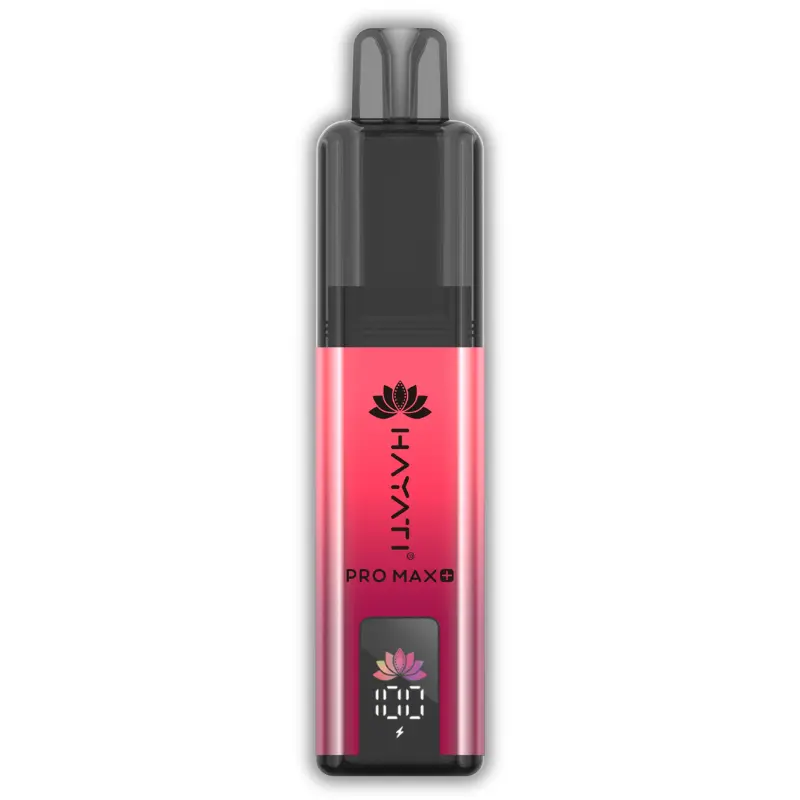
Hayati · Pro Max Plus
Strawberry Raspberry Cherry Hayati Pro Max Plus Pod Kit
£7.99
✔ In stock — ready to ship
Genuine Hayati
Free over £20
Same-day dispatch
Secure checkout
Strawberry Raspberry Cherry is a complete Hayati Pro Max Plus at £7.99: an 850mAh rechargeable body and a prefilled 12ml pod of 20mg nicotine salt, sold as one box so that nothing else is needed to use it. The liquid is three red fruits and nothing else. No coolant, no sour dosing, no confectionery treatment, no drink or dessert framing. Three fruits from one colour, one sweetness band and, to a large extent, one family of aroma compounds.
That last sentence is the whole subject of this page, and it is not a complaint. A blend built this way is at the far end of a curve that this catalogue traces quite clearly once you count it, and the interesting question is not whether the recipe is any good. It is what a third ingredient can and cannot do when the first two have already taken the positions it would otherwise occupy. Get that right and you can tell, before spending anything, whether you are buying a blend of three fruits or a single dense red assembled from three sources. Those are different products. Both are worth owning. The label does not separate them, and most of the writing about liquids like this one quietly assumes the first when the honest answer is the second.
There is a second thing worth knowing about this listing and it is a negative. Cooling is the commonest thing Hayati add to a red fruit blend, and there is none here. That is unusual enough in the red part of the range to be worth a proper look, and it turns out not to be an oversight on this one product but a rule the whole catalogue keeps without ever stating it.
What follows is mostly about the liquid, because the hardware is the same hardware carried by the other eighty-seven listings on the Hayati Pro Max Plus Prefilled Pod Kit shelf and there is nothing left to say about it that has not been said. The pod-only version of this exact liquid is the Strawberry Raspberry Cherry Hayati Pro Max Plus Pods at £5.49, which is the listing to buy on every occasion after this one. The money difference between owning the body and not owning it has been worked through in detail on the Blue Razz GB Pro Max Plus Pod Kit and on the refill-economics pages for the bare pods, and this page takes their arithmetic as read rather than repeating it: two pounds fifty buys the body once, and after that you are buying pods.
Fourteen names, forty-three listings, and a ceiling nobody advertises
Before arguing anything about three-fruit blends, it is worth establishing how many of them there actually are, because a claim about how crowded or how rare a construction is should be checked rather than assumed. The brief that produced this page asserted that a red triple was a point of diminishing returns. That is an opinion until somebody counts, so here is the count.
Stripping the hardware words off every title
Hayati list 492 products. Take the hardware wording off each title and split any listing whose name carries an oblique into its two halves, and you are left with 171 distinct flavour names. Sort those by how many fruits are printed in them and the distribution is lopsided in a way that says something. Sixty-four name no fruit at all, being either a mood word, a confectionery idea or a drink. Fifty-seven name exactly one. Thirty-five name two. Fourteen name three.
Nothing in the entire catalogue names four. Not one listing out of 492. Whatever internal rule Hayati work to, three printed fruits is the ceiling, and it is a hard ceiling rather than a tendency. That is the first piece of evidence that three is understood, somewhere inside the company that writes these labels, as the point where adding another name stops paying.
Those fourteen three-fruit names cover forty-three listings, which is under nine per cent of the range. They are Blueberry Cherry Cranberry, Blueberry Raspberry Cherry, Blueberry Raspberry Lemon, Cherry Peach Lemon, Guava Kiwi Passion Fruit, Kiwi Grape Raspberry, Lemon Peach Passionfruit, Mango Peach Pineapple, Orange Lemon Lime in two spellings, Straw’ Cranberry Cherry, Strawberry Cherry Cranberry, Strawberry Raspberry Blueberry, and this one.
The rule the catalogue keeps without stating it
Now look at what those fourteen names do not contain, because it is more striking than what they do.
Not one of the fourteen carries a cooling word. No Ice, no Frozen, no Cooler, no Mint, no Menthol. Across the rest of the range cooling is everywhere: 118 of the 492 listings have a cold word in the flavour part of the title, which is about one listing in four. Among names carrying one or two fruits, cooling is entirely normal. Among names carrying three, it has never once happened.
Not one of the fourteen carries a confectionery or drink word either. No GB, no bubblegum, no jelly, no cola, no mojito, no fizzy. Again, those treatments are common elsewhere and absent here without exception.
What the fourteen do carry, in five of the name-strings, is an acid word. Blueberry Raspberry Lemon, Cherry Peach Lemon, Lemon Peach Passionfruit and Orange Lemon Lime all put a citrus in the list. So when Hayati build a three, and they want something other than more fruit sweetness in it, the thing they reach for is acid, and the thing they never reach for is cold.
That is a real finding and it constrains everything said further down this page. The absence of a coolant on this particular listing is not a decision anybody made about Strawberry Raspberry Cherry specifically. It is a decision that appears to have been made about three-fruit blends in general, and it has held forty-three times in a row.
Narrowing to the family this one belongs to
Of the fourteen, how many draw all three fruits from the same colour family? Three. Strawberry Cherry Cranberry, sold three times. Straw’ Cranberry Cherry, sold six times. And Strawberry Raspberry Cherry, sold twice: this kit and its pod.
Narrow once more, to the ones that stand on their own rather than being one side of a divided pod. Five of Straw’ Cranberry Cherry's six listings are dual pods where the other half is cooled, so on those the buyer gets a cold red to turn to whenever the warm one gets heavy. Strip those out and the standalone, uncooled, all-red three-fruit listings in this catalogue number six, out of 492.
So the construction is genuinely uncommon, which is the opposite of what the shelf feels like when you are scrolling it. What makes the red part of the range feel crowded is not triples. It is pairs, and pairs with a coolant in particular. The Strawberry Raspberry Ice pages did that count properly and found twenty-nine listings pairing a red berry with a coolant, some of them close enough to each other to be interchangeable in practice. That finding is theirs and this page does not rebuild it. What it does is sit beside it: the saturated part of the shelf is red-plus-cold, and this listing is one of the six that is red-plus-red-plus-red with nothing cold anywhere near it.
Why a third fruit sometimes pays and sometimes does not
Here is the principle, stated plainly before it is applied, because it is a real principle of blending rather than a rhetorical device and it holds well outside vaping.
A blend has a fixed number of positions and they fill up
A flavour is not one thing arriving at one moment. It is several kinds of information reaching you along separate routes and on separate timetables. Acid lands on the tongue immediately, because it does not need to reach the nose to register. Light aromatic material arrives next and leaves quickly. Heavier aromatic material arrives later, sits through the middle and stays into the exhale. Sweetness is a broad background that holds the whole thing up. Temperature, when there is any, runs on a different receptor entirely and is not a taste at all. Texture, in the sense of the syrupy or the drying or the prickling, is another position again.
Call each of those a channel. A component added to a recipe adds information only if it occupies a channel the existing components leave open. If it lands in a channel that is already filled, it does not become a new thing you can point at. It joins whatever is already there.
That is not a hard rule about what tastes nice. It is a statement about what is possible to perceive. Two sources putting similar material into the same channel at the same moment do not arrive as two things, because there is nothing for the palate to separate them by. It reports edges, changes and novelty. Two versions of the same edge are one edge.
Strawberry, and why it is the most-used fruit in the range
Strawberry appears in 26 of the 171 flavour names and 86 of the 492 listings, which makes it the most heavily used fruit Hayati have. Raspberry is second at 17 names and 76 listings. Cherry is third at 12 and 65. That ranking is worth a moment, because the reason strawberry wins is not that it is the most popular fruit in Britain. It is that strawberry is the least channel-exclusive thing on the list.
Strawberry as a flavouring is broad and low in acid. Its aromatic material is spread across a lot of compounds without one of them dominating, it reads as ripe rather than green in nearly every commercial version of it, and it carries a lot of perceived sweetness without a sharp event anywhere in it. The practical consequence is that strawberry fills space without claiming a position. It sets a colour and a sugar level and then gets out of the way, which is precisely why it can be put next to almost anything: a tropical, a coolant, a confectionery build, a banana, a lychee. Twenty-six names is what maximum compatibility looks like on a spreadsheet.
In this recipe, strawberry occupies sweetness and body. It does not occupy acid, it does not occupy the volatile top, and it does not occupy the finish. Three channels open after the first ingredient.
Raspberry, which takes two of those channels at once
Raspberry is the fruit here with an actual event in it, and it puts that event in two places simultaneously.
The first is acid. Raspberry carries a genuine acid load and acid is the fastest-registering thing in any recipe, so raspberry is what you meet at the front of a draw on this liquid even though it is printed second. The second is a bright, slightly powdery aromatic top that sits above the sugar and is the single most identifiable feature in the blend for most people. Whether a given liquid reaches it by the obvious isolate or by some other route is not published by Hayati for any pod in this catalogue, and nothing here should be read as a claim about what is in the bottle.
The qualification that matters is that both of raspberry's channels are front-loaded and short. The acid thins out well before the draw finishes and the bright top goes with it. Raspberry standing alone reads as sharp and unsupported, which is what makes Blue Sour Raspberry the useful demonstration on this shelf: a raspberry sharpened further with nothing underneath, which stops rather than finishes.
So after two ingredients the account stands like this. Sweetness and body: taken by strawberry. Acid and the volatile top: taken by raspberry, briefly. Still open: the middle after raspberry leaves, the finish, the temperature, and any texture beyond ordinary sweetness.
Cherry, arriving at a position that is already occupied
Cherry is chemically the odd one out of the three and this page is not going to pretend otherwise. What people recognise as cherry comes substantially from kernel character rather than flesh, which is material of a different kind from anything strawberry or raspberry brings. The narrow window that creates, where too little reads as anonymous dark sweetness and too much reads as marzipan, is worked through properly on the Blueberry Raspberry Cherry Pro Max Plus 6000 Pod Kit and its pod sibling, which established the whole base-plus-cherry-extension argument. It is cited here and deliberately not re-derived.
What that analysis means for this recipe is the part that is new, and it is not the same conclusion, because the other two fruits are different. On the blueberry version, cherry is competing against a low-acid berry for the weight and length positions. Here it is competing against strawberry for exactly the same two, and strawberry is broader, sweeter and more dominant in that role than blueberry is. Cherry on top of a strawberry base has less room than cherry on top of a blueberry base, not more.
Set at the level that keeps it reading as a fruit rather than a sweet, cherry contributes depth, a rounder middle and a longer finish. Depth and a rounded middle are what strawberry is already doing. The genuinely open channel in this recipe, the one nothing has claimed, is the stretch after raspberry's acid drops away and before the exhale ends. Cherry does reach into that. It is the one place the third fruit is unambiguously adding something rather than thickening something.
Three entries, two channels, one of them held jointly
Put the ledger together. Three named fruits. One acid-and-brightness event at the front, supplied entirely by raspberry and gone quickly. One broad sweet weight running underneath and behind it, supplied jointly by strawberry and cherry, with no way for anyone drawing on it to apportion that weight between the two. A slightly longer tail than the strawberry would have managed alone, which is cherry's real contribution and is a matter of duration rather than of a flavour you can name.
A buyer reading three fruit names is entitled to expect three things taking their turn. The architecture will not deliver that, and the reason is not that the formulation is lazy. It is that two of the three fruits are congeners. They share a large part of their ester profile, they sit in the same sweetness register, and they are both doing body. There is no arrangement of those two that makes them audible as separate items, at any proportions, because the palate has nothing to separate them by.
The catalogue already ran the control, and it involves cranberry
The argument above is reasoning. The catalogue contains something better than reasoning, which is a controlled comparison Hayati set up without meaning to, and it is the strongest evidence on this page.
Two recipes, two ingredients in common, one variable
Strawberry Cherry Cranberry and Strawberry Raspberry Cherry share two of their three fruits. Strawberry leads both. Cherry is in both. The variable is the third fruit: cranberry in one, raspberry in the other. Both are red. Both are tart in the loose sense in which anybody would describe them as tart. And they do completely different jobs, which is exactly the point.
Raspberry's tartness is bright, fast and front-loaded, arriving with the aromatic top and leaving with it. It lands in the same part of the draw that is busiest already. Cranberry's is slower, drier and astringent rather than merely sour, and astringency is a texture rather than a taste, so it registers on a channel nothing else in either recipe is using. It also arrives late, on the exhale, in the stretch both recipes otherwise leave thinly occupied.
So the cranberry version gets a genuine third position out of its third ingredient: a drying, palate-clearing finish that resets the mouth between draws. The raspberry version gets more of what it already had at the front, plus a slightly longer tail from the cherry. That is the diminishing-returns argument in one comparison, with both products sitting on the same shelf at the same £7.99, and you can run it yourself against the Strawberry Cherry Cranberry Pro Max Plus Pod Kit without taking anyone's word for it.
Cranberry never gets to be the headline, and that is informative
Here is the count that turns the comparison into something firmer. Cranberry appears in exactly three flavour names across all 492 listings, and all three of them are three-fruit names: Strawberry Cherry Cranberry, Straw’ Cranberry Cherry and Blueberry Cherry Cranberry. There is no Cranberry, no Cranberry Ice, no cranberry pair. Sixteen listings in total and not one of them lets cranberry lead.
Compare that to strawberry's twenty-six names or cherry's twelve, both of which head plenty of recipes on their own. Cranberry is used by Hayati exclusively as a third element in a crowded red, and it is used that way three times out of three. Whatever the internal reasoning, the distribution behaves precisely as it would if cranberry were understood as a corrective rather than as a flavour: something you add when a red blend needs a brake, not something you build a pod around. The Blueberry Cherry Cranberry Pro Max Plus Pod Kit is the third instance, with the lead fruit swapped and the corrective left in place.
Read against that, the recipe on this page is the one where the third slot went to a fruit that could not act as a corrective, because it is a congener of what is already there. That is a description of the blend rather than a criticism of it, and the next section is about what the blend gets in exchange.
The same three fruits under two different orders
One more thing falls out of the count and it is worth flagging because it qualifies something a sibling page argues. Strawberry Cherry Cranberry and Straw’ Cranberry Cherry are the same three fruits in two different sequences, sold on different hardware. The nic salt bottle of the first is written on the reasonable premise that Hayati list the fruits roughly in the order the palate meets them, and on that bottle the reading works well.
It cannot be a rule of the range, though, because the identical trio is printed in a different order six listings later. Either the two are different recipes, which Hayati do not say anywhere, or the ordering convention is applied loosely. Both are possible and nothing published settles it. The honest position is that word order on a Hayati label is suggestive rather than reliable, and on a three-fruit red it is not a strong enough signal to buy on. You can see the alternative order for yourself on the Straw’ Cranberry Cherry / Strawberry Raspberry Ice Pro Ultra Plus kit and on the smaller Straw’ Cranberry Cherry / Cherry Ice Mini Ultra Pod Kit.
The base you cannot buy
There is a gap in the range that matters specifically to anyone weighing up this pod, and it is easy to miss.
Strawberry and raspberry appear together in four flavour names: with Ice, with Mojito, with Blueberry, and with Cherry. Plain Strawberry Raspberry, the two-fruit version with nothing added, does not exist. Not on this platform, not on any other, not in a bottle. Hayati sell the base only in extended form.
That is unlike the blueberry case, where the two-fruit parent is one of the house flavours and appears fifteen times, so a buyer can put the extension next to its base for a few pounds and hear the difference directly. Here there is no control to run. The nearest thing you can buy is Strawberry Raspberry Ice in the Mini Ultra format at £3.99, and it is not a control, because it adds a coolant. You would be testing two variables at once.
The practical consequence is that nobody can demonstrate what the cherry adds to this particular pair by direct comparison, including me. The argument in this page is made from what the fruits are capable of and from what the catalogue's other combinations show, and it should be read at that strength rather than as a report of an A/B test that cannot be run.
What overlapping ingredients genuinely do add
Having spent several thousand words arguing that the third fruit does not arrive as a third flavour, it would be dishonest to leave it there, because the thing overlapping components do produce is real, is wanted by plenty of people, and is very probably the reason the blend exists.
Amplitude is not information, and amplitude is still worth money
Two sources putting similar material into the same channel do not give you two identifiable items. They do give you more material in that channel. The result is not three fruits. It is a bigger, rounder, more saturated single red than any one of them could produce alone.
That has consequences you can feel. A profile assembled from three overlapping contributors has material at more points across the draw than a single contributor manages, because each brings its own spread of compounds with its own weights and its own timings. The gaps get filled in. Nothing drops out between the raspberry leaving and the exhale ending, because two things are holding that stretch instead of one. The liquid reads as dense and continuous rather than as a sequence with steps in it.
Density is a legitimate thing to buy. It is, arguably, the thing that separates a red blend you can stay on for a fortnight from one that is striking on day one and tiring by day four. A pod holding twelve millilitres is not a sample. It is a commitment of a week or two, and over that distance a liquid that is well filled out beats a liquid that is interesting, most of the time, for most people.
The verdict, and it cuts both ways
So the honest description of this product is that it is not a three-flavour liquid. It is a one-flavour liquid built from three ingredients, and the flavour is a dense red with a short bright opening on it.
A buyer who came here expecting to pick out the cherry will be disappointed, and will spend the first pod hunting for something that is present but not separable. A buyer who wants a saturated red that does not thin out, does not go anywhere surprising, and holds the same shape from the first draw to the last, will be very well served indeed. Those are two different people and the label speaks to the first one while the liquid serves the second.
If what you actually want is a cherry you can point at, this is the wrong listing and the range has better answers. Cherry needs a partner that holds it up rather than one that shares its job, which is why the versions where cherry is audible are the ones next to something sharp or fizzy. If what you want is red fruit with an edge that stays legible, the acid-led builds like Red Sour Raspberry are the ones to look at instead.
Hayati's own two descriptions, read side by side
This liquid is sold twice, as this kit and as the bare pod, and Hayati wrote fresh copy for each. Lining up every listing of one recipe and asking where they agree is the most productive check available on a catalogue like this, and it produced something here.
Both assign jobs, and both assign the same ones
Each description hands every fruit a distinct role, and the two allocations match exactly. Strawberry is given the sweetness on both. Raspberry is given the tang or the sparkle on both. Cherry is given the depth or the richness on both. The pod listing states the principle outright, saying that each fruit has a job.
Taken alone, that is copy treating the three as separable. It is an itemised list of contributions with one contribution per ingredient, which is exactly the reading this page has spent its length arguing the palate cannot support. And the agreement between the two listings is itself notable, because in this catalogue the several listings of one flavour routinely disagree with each other. The blackcurrant lemonade work found seven listings of one recipe splitting over whether the berry was tart or merely sweet. Here there is no disagreement at all. The role allocation is stable across both.
Then both reach for a dish in which the fruit is cooked into one mass
The interesting part is what each description does immediately after handing out the jobs. The kit listing says the three share a similar red-berry character, that the blend is cohesive rather than busy, and compares it to a compote. The pod listing compares it to a summer pudding.
A compote and a summer pudding are both preparations in which separate fruits are broken down and combined until they are no longer individually recoverable. That is what those dishes are for. So the copy assigns three separable roles and then, in the next sentence, names a result in which separability is definitionally gone.
Both words are worth checking against house vocabulary before anything is built on them, because a term Hayati use everywhere means nothing. Jammy appears in twenty-seven of the 492 descriptions and is plainly house language. Depth appears in fifty-one. Sparkle appears in thirteen, zingy in twelve. Compote appears exactly once in 492 descriptions, and summer pudding appears exactly once, and the two occurrences are the two listings of this recipe. So the whole-fruit-dish metaphor is not a tic the copywriter applies to everything red. It was reached for twice, independently, for this liquid and for nothing else in the range.
The fair conclusion, and the answer to the question this section set out to test: Hayati's copy treats the three fruits as separable at the level of function and as a single accord at the level of result, and it does both in the same paragraph on both listings. The prediction this page made before looking, that the blend would behave as one saturated red rather than as three identifiable fruits, is not contradicted by the copy. It is corroborated by the only two words in the copy that are unique to this product.
The coolant that is not here, and whether its absence is a gap
The second question worth a proper answer on this listing is what the missing cold does to it. A coolant is the one addition that cannot possibly overlap with a fruit, because it does not work on the nose at all. It works on a receptor that registers temperature, which means it occupies a channel nothing else in any recipe can occupy. Whatever else is in the pod, adding cold adds information. That is the structural reason cooling is so common, and it is why the cooled red pairs are the crowded part of the shelf.
Why the range never cools a three
Set against that, the count from earlier becomes quite pointed. Cooling appears in 118 of 492 listings and in none of the fourteen three-fruit names. If cold is guaranteed to add a channel, and if the problem with a three is that the channels are full, then cooling a three is precisely the thing you would expect somebody to try. Nobody has, forty-three times.
The most likely explanation is a commercial one rather than a sensory one, and it should be marked as inference because Hayati publish no reasoning about their naming at all. A label can carry a limited number of words before it stops being read. Three fruits plus a cold word is four pieces of information, and the range has drawn its line at three. On that reading, the reason this pod is not cooled is that the third fruit used up the slot a coolant would have taken, and the buyer is being offered one or the other.
The alternative explanation is sensory: that a coolant over three overlapping reds would flatten the one thing the recipe is actually delivering, which is density. Cold shortens an aftertaste and numbs a middle. Applied to a liquid whose whole proposition is a long, continuous, filled-in red, it would remove the proposition. That reading is also plausible and the two are not exclusive.
What the absence costs, over twelve millilitres
Either way, the consequence for anyone living with the pod is the same and it is worth being straight about. A coolant is the thing that would have cut through a dense sweet mass, and there is nothing else in this recipe doing that job. Raspberry's acid is the only interruption and it is over early in each draw. There is no astringency, as there is in the cranberry builds, so nothing strips the sweetness off the palate between draws. Sweet liquids accumulate. Twenty minutes of steady use on something like this and the palate is coated, everything reads at half strength, and the liquid starts to feel like more effort than it did at the start of the session.
Whether that is a design choice that works or a gap depends entirely on how you use a pod, and the honest answer is that it is both, for different people.
It works for the person who uses a pod in short, spread-out visits through a day. On that pattern the palate resets itself between sessions and the density is exactly the point: every return to it is full and round from the first draw, with none of the thinness a cooled liquid can have when the cold has worn off and the fruit underneath turns out to be slight.
It is a gap for the person who vapes in long continuous stretches, or who runs one flavour exclusively for a fortnight, or whose palate is used to a coolant doing the resetting. Those buyers will find this pod heavy by the middle of the second week, and no amount of willingness will fix it, because the liquid has no built-in brake. The two ways round it are both sound. Keep a second, colder pod in rotation and switch when this one gets claggy, which is what Blue Frozen exists for on this shelf. Or choose a red that has its own brake, which is the cranberry route described above.
One thing the absence definitely is not
It is not an omission you can correct. This is a prefilled, factory-sealed pod. Nothing can be added to it, and the coil inside is built in, unreachable and discarded with the shell. The choice between the cooled and uncooled versions of this territory is made once, at the point of purchase, and it lasts twelve millilitres. That is a longer commitment than most buyers register when they are comparing thumbnails on a shelf page.
The kit, kept to what it changes
One box, one device, one pod, and a charging cable is not something Hayati list against this product so nothing is claimed about how the body takes power. The body holds 850mAh and is rechargeable. The pod is prefilled with twelve millilitres, factory sealed, with a mesh coil inside it that cannot be reached, rewicked or replaced and that processes the whole twelve millilitres before going in the bin with the shell.
The specification that actually bears on this liquid is that last one, and the reason is specific to a blend built this way. Coil ageing and flavour ageing are the same event here, and you cannot separate them, because there is no way to pair a tired coil with fresh liquid and see which has changed. What goes first on any pod is the light, volatile material, and on this recipe that is the raspberry: the acid and the bright top, the only two things in the pod that are not sweetness and weight. What survives is the strawberry and cherry mass, which is the durable part. So this liquid does not fade evenly. It loses its one sharp feature early and then gets rounder, heavier and less distinct, until what is left is a generic dark red sweetness that could be several other listings on the same shelf.
That is worth knowing in advance, because the failure mode looks like the liquid getting sweeter rather than the coil getting tired, and people blame the recipe. If a pod that opened with a tang has stopped having one, that is the coil telling you where it is in its life.
On fitment, match the range name printed on your device to the range name in this title rather than reasoning from the brand, because Hayati publish no cross-range fitment chart and a compatibility decision from a retail page is worth nothing. The rest of the platform, all eighty-eight listings of it, is on the Pro Max Plus kit shelf, and the whole Hayati catalogue across every system is on the full product list.
The figures, ordered by how much they decide
The table runs from the things that determine whether you want this pod, through the things that are published and change nothing, to the things nobody publishes at all. That last group is larger than most buyers expect and it is the group most often filled in with guesswork on pages like this one.
| What is in the name | Three fruits from one colour family. No coolant, no sour dosing, no confectionery treatment. |
| How many of them are separable | Two contributions. A short bright opening from the raspberry, a shared sweet weight from strawberry and cherry. |
| Sweetness | Clearly sweet, short of a confectionery build. Nothing in the recipe interrupts it. |
| Sharpness | Present, front-loaded, finished before the exhale. A tang rather than a dosed sour. |
| Cooling | None, and no cold word appears in the title, which is how this range marks a cooled listing. |
| Liquid volume | 12ml, filled at the factory, sealed |
| Nicotine | 20mg nicotine salt, the UK maximum for a consumer e-liquid, and the only strength on this listing |
| Battery | 850mAh, rechargeable |
| Manufacturer puff figure | Up to 6,000, a laboratory estimate from test equipment rather than a measurement of use |
| Coil | Mesh, sealed into the pod, discarded with it |
| Price, complete | £7.99 with the device included |
| Price, pod only, afterwards | £5.49 |
| Proportions of the three fruits | Not published for this or any pod in the catalogue |
| VG/PG ratio | Not published against this listing |
| Coil resistance and wattage | Not published against this listing |
Three rows need a sentence each. The 20mg figure is the legal ceiling in this country rather than a choice Hayati made about this flavour, so it tells you nothing about the recipe and it is the same on every prefilled pod they sell. Nicotine is addictive whatever the preparation and whatever the number beside it. The up to 6,000 figure comes off a drawing machine running to a timer, so read it as a rough budget for one sealed coil rather than as a duration; how long twelve millilitres lasts is a fact about you. And the last three rows are the ones that matter most for honesty. If another page quotes you a fruit ratio, a resistance or a flavour concentration for this pod, it has invented them.
The neighbours, sorted by what each one changes about the third position
The useful way to arrange the alternatives here is not by colour or by price, since almost everything on this shelf is red and £7.99. It is by what the recipe does with its third ingredient, because that is the variable this page has been about.
The same two fruits with a different third
Strawberry Raspberry Blueberry is the closest listing in the range by construction. Same lead, same acid, and a third fruit that is again low in acid and again doing weight, so it is another instance of the same design decision. It is darker and slightly less sweet than this one because blueberry brings a mild tartness of its own where cherry brings none, but the architecture is identical: one bright opening over a shared mass. Anyone who found this pod too round will find that one marginally less so and will not find it a different kind of product.
The one where the third fruit takes an empty position
The cranberry pair are the genuine alternatives rather than variations. Strawberry Cherry Cranberry keeps two of this recipe's three fruits and swaps in the drying finish, and Blueberry Cherry Cranberry does the same with a darker lead. If the description of density above sounded like a warning rather than a selling point, one of those two is what you want, and the £7.99 is the same.
The ones that add cold instead of fruit
Strawberry Raspberry Ice is the same opening pair with a coolant where this one has a cherry, which is the single cleanest comparison available for the argument on this page even though it is not a control. For a colder and less fruit-led answer, Blue Frozen is the one on this shelf built around the cold rather than around a berry.
The ones that add acid instead of fruit
Red Sour Raspberry and Blue Sour Raspberry are the two on this platform that dose the acid hard enough for it to be the point. Both are the opposite proposition to this pod: an edge with less behind it rather than a mass with a short edge on the front. The second of the two exists in a much larger format as well, as Blue Sour Raspberry on the Pro Ultra Plus at £11.99, if it turns out to be the direction you want.
The ones that reach red through confectionery
Strawberry GB and Blue Razz GB take the sweet-shop route to the same colour, which is a different kind of sweetness rather than more of this one. Blue Razz Cherry is the useful one to note here, because it is the listing where cherry is given a confectionery partner rather than a congener, and it is audible as a result. That is the same fruit doing a completely different job because of what is next to it, and it makes the point of this page better than any amount of argument.
Pairs, which is what most of the shelf actually is
If three fruits has started to look like a false economy, thirty-five of the 171 names are pairs and they are where the shelf's clearest liquids live. Blackberry Raspberry keeps the raspberry edge over a darker floor. Blue Razz Blackcurrant pairs a confectionery blue with a real dark berry. Blue Razz Pineapple crosses out of the berry family entirely, which is the surest way to get two things you can actually tell apart. The two-dials argument about sugar and acid being independent of each other is set out on the Blue Razz Fruit Twist kit and is the right page to read next if this one has interested you.
The unitemised version, and the version with no list at all
Mixed Berries is the same idea as this pod with the itemising removed, and on the reading argued above that is a more accurate label for a liquid of this kind rather than a less informative one. Black Mamba goes further and names nothing at all, which is a different problem and one its own page deals with.
The same territory in other sizes
Nothing on the smaller or larger platforms carries this exact recipe, so the cross-format options are approximations. Strawberry Raspberry Ice on the Mini Ultra at £3.99 is the cheapest way into the opening pair. Blue Razz Cherry on the Pro Ultra Plus at £11.99 is the big-format cherry. Browsing by fruit is often quicker than browsing by platform: Cherry Vapes runs to seventy-two listings, Strawberry Vapes to eighty-two, Raspberry Vapes to a hundred and nineteen, and Berry Vapes collects two hundred and twenty-five of them in one place.
Living with twelve millilitres of a dense red
Most handling advice is the same on every pod and is not repeated here. What follows is the part that is specific to a liquid with no brake in it.
Let the first pod settle before judging it. A factory-filled pod that has been in a warehouse and then a van arrives with its wick fully saturated, and the first few draws off a cold device tend to read heavier and sweeter than the pod does an hour later. On a blend whose whole character is density, that first impression is misleading in the direction you are already worried about. Give it a morning.
Draw length is the only dial you have. There is no collar, no airflow adjustment and no power setting on this device, so the single variable under your control is how long you pull. On this recipe that matters more than it does on most, because the raspberry material is front-loaded. A short draw is proportionally brighter. A long one pulls through more of the strawberry and cherry mass and reads sweeter and rounder. If the pod is getting heavy, shorten the draws before concluding it has gone off.
Water, not another flavour, between long stretches. The accumulation problem described earlier is a coating on the palate rather than a change in the liquid. Plain water clears it in a couple of minutes. Reaching for a different sweet pod does not, which is why rotating between two sweet reds tends to make both of them taste worse rather than either taste better.
Rotate against something that is not red. If you want a second pod in the rotation, the useful partner is one that does not share a channel with this one. Something cold, something sour or something outside the berry family will all work. Another dense red will not, and this is the single most common mistake people make when they buy two pods at once off the same shelf.
Store it flat, cool and dark, out of reach of children and pets. Heat is the enemy of the part of this liquid that is worth having. The raspberry top is the most volatile material in the pod and it is the first thing a warm glovebox or a sunny windowsill takes off. A pod stored badly for a month does not taste spoiled. It tastes like the version of itself with the interesting bit already gone, which is much harder to notice and much more annoying.
Know what a finished pod looks like. There is no window and no gauge, so the signals are indirect: the vapour thins, the sweetness turns slightly flat and papery, and the tang that used to open each draw is simply not there any more. On this liquid the tang goes well before the liquid does, so the pod will still be producing something long after it has stopped producing the thing you bought. Deciding when that crosses the line is a personal call and nobody else can make it for you.
At the end. A spent pod is a sealed plastic shell containing a mesh coil, a wick and whatever liquid the wick has kept hold of, and the device contains a lithium cell. Neither belongs in a household bin. Vape retailers in the UK are obliged to take back small electricals, and local authority recycling centres take them too. The body outlasts many pods if it is looked after, so there is no reason to discard a working one.
Questions this listing raises
Can I actually taste three separate fruits in this?
Two, realistically. A bright tang at the start of each draw, which is the raspberry, and a broad sweet weight behind it that the strawberry and the cherry produce jointly. The cherry is present and it lengthens the finish, but there is no arrangement of these three fruits in which it arrives as a separately identifiable event, because it is doing the same job as the strawberry.
Is there any ice or menthol in this one?
None. No cooling word appears anywhere in the title, and in this range that is how a cooled version announces itself. It is worth knowing that no three-fruit flavour name in the entire Hayati catalogue carries a cold word, so this is not a variant of a cooled original. There is no cooled version of this recipe to find.
How sweet is it, compared with the rest of the shelf?
Sweet, and with nothing in the recipe pushing back against the sweetness. It is short of the sweet-shop builds like Strawberry GB, which are constructed to taste like a confection rather than like fruit, but it is sweeter in effect than any of the cooled or sour reds because those have something interrupting them and this does not.
What is the difference between this and the pod on its own?
The device. This listing is £7.99 and includes the rechargeable body; the pod by itself is £5.49 and does not. The liquid is identical. If you already own a working Pro Max Plus, buy the pod and keep the two pounds fifty.
Which is closer to this, Strawberry Cherry Cranberry or Strawberry Raspberry Blueberry?
Strawberry Raspberry Blueberry is closer in how it is built, because its third fruit is doing weight just as the cherry does here. Strawberry Cherry Cranberry shares more actual ingredients but behaves differently, because cranberry brings a drying finish that nothing in this recipe has. If you want something similar, take the first. If you want a corrective, take the second.
Why is there no plain Strawberry Raspberry to compare it against?
Hayati do not sell one. Strawberry and raspberry appear together in four flavour names and all four add something: ice, mojito, blueberry or cherry. The two-fruit base has never been listed on its own in any format, so there is no way to isolate what the cherry contributes by direct comparison, and any page claiming to have done so has not.
Will it get boring over a full pod?
That depends on how you use it more than on the liquid. Used in short spells through the day it stays full and consistent, which is what it is good at. Used in long continuous stretches it accumulates, because there is no coolant and no astringency to reset the palate between draws. Keeping a second, contrasting pod alongside it solves the problem entirely.
What changes as the coil gets older?
The raspberry goes first, because the acid and the bright top are the lightest material in the pod. What is left is the strawberry and cherry weight, which is durable. So an old pod on this flavour does not get weaker so much as rounder and duller, drifting towards a generic sweet red. A pod that has stopped having a tang is telling you where the coil is in its life.
Does the order of the names tell me which fruit leads?
Not reliably. The idea that Hayati list fruits in the order the palate meets them works on some listings, but the same three fruits appear in this catalogue under two different orders on different hardware, which means the convention is not enforced. On this recipe the fruit that actually arrives first is the raspberry, and it is printed second.
How long does 12ml last?
Nobody can answer that for you, and the up to 6,000 figure does not either. It is a laboratory estimate produced by test equipment drawing on a timer, so it describes the budget given to one sealed coil rather than a number of days. Draw length, how often you reach for it and how warm the device runs all change the answer by a wide margin.
Can I refill the pod when it is empty?
No. It arrives sealed and filled, with no opening designed to be used, and the coil inside is fixed and cannot be reached or replaced. When it is finished it is finished, and the replacement is the bare pod listing at £5.49 rather than a bottle.
The short version
Strawberry Raspberry Cherry is a complete Pro Max Plus at £7.99, holding twelve millilitres of 20mg nicotine salt in a sealed pod and an 850mAh rechargeable body, with no coolant and no sour or confectionery treatment anywhere in it. It is one of six standalone listings in a catalogue of 492 that builds a blend from three fruits of the same colour with nothing to contrast them.
What that produces is not three flavours. It is one flavour built from three ingredients: a dense, round, continuous red with a short bright opening on the front of each draw, in which the cherry lengthens the finish without ever becoming something you can point at. Anyone buying this to taste the cherry specifically has misread the label, through no fault of their own, because the label invites exactly that reading and Hayati's own copy invites it twice before comparing the result to a compote in one listing and a summer pudding in the other.
Anyone buying a saturated red that holds its shape from the first draw to the last has bought the right thing, and the absence of a coolant is part of why it holds that shape rather than an oversight. The cost of it is that nothing resets the palate, so the pod suits spread-out use better than long continuous stretches, and a contrasting second pod in the rotation is worth more here than a second red would be.
Strictly for adults aged 18 and over. Nicotine is an addictive substance.
You might also like


