
Home / Hayati Pro Max Plus Prefilled Pod Kit / Red Sour Raspberry Hayati Pro Max Plus 6000 Pod Kit
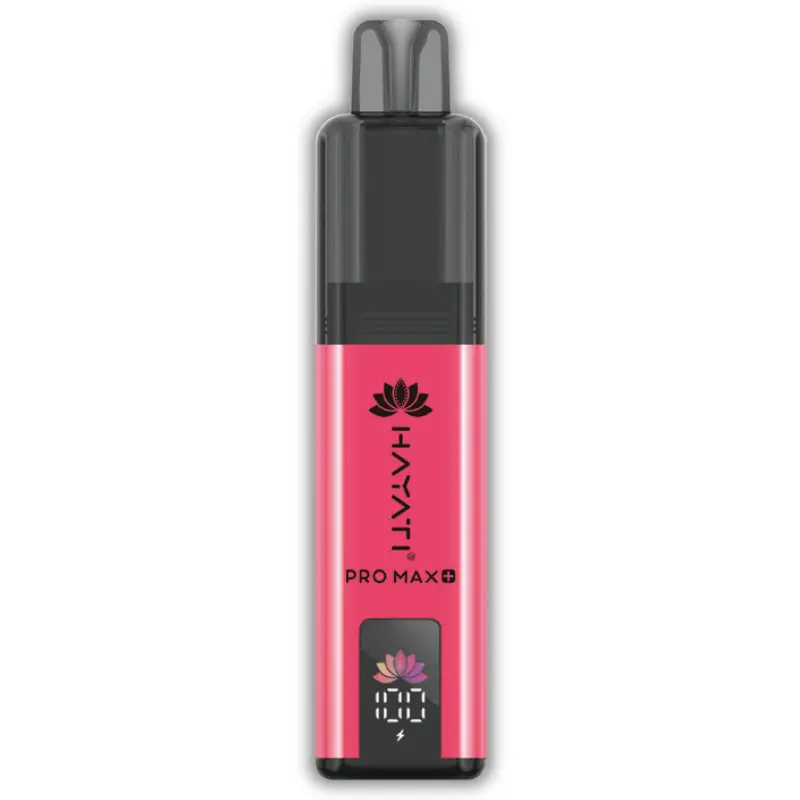
Hayati · Pro Max Plus
Red Sour Raspberry Hayati Pro Max Plus 6000 Pod Kit
£7.99
✔ In stock — ready to ship
Genuine Hayati
Free over £20
Same-day dispatch
Secure checkout
Red Sour Raspberry arrives here as the boxed pair: a rechargeable 850mAh body and one factory-filled pod holding 12ml at 20mg nicotine salt, £7.99 for both together. The manufacturer puts a bench rating on a full pod of up to 6,000 puffs, produced on test apparatus that draws to a set rhythm, so treat it as a laboratory estimate of how much vapour one coil can be made to produce rather than as a quantity you have bought. Every one of those numbers is shared with the other eighty-seven listings on the Hayati Pro Max Plus Prefilled Pod Kit shelf. The liquid is not.
The liquid is one fruit and one declared treatment, and that is a rarer thing on this shelf than it sounds. Of the eighty-eight listings sitting on it, eight name a single fruit with no partner fruit and no cooling word attached: Double Apple, Triple Mango, Triple Melon, Juicy Peach, Fizzy Cherry, Blackcurrant Juice, and the two sour raspberries. Four listings carry a declared Sour marker. Two of those four are this pod and its blue counterpart, both single-fruit, both raspberry, both priced identically at kit level. So the choice this page exists to help with is not really a choice between eighty-eight flavours. It is a choice between two, and the only published difference between them is a colour word.
That colour word has already been taken apart properly, and not on this page. The bare-refill listing, Red Sour Raspberry Hayati Pro Max Plus Pods, ran the census across all 492 listings and settled what Red is doing in the title. Its verdict, which this page takes as established and does not re-derive: a colour restating a colour the fruit already has occurs in only four listings out of 492, so the word is not a house habit, and it is informative about the catalogue rather than about the berry. Red is an index entry. It means the sour raspberry that is not the blue one.
Which leaves the interesting half of the job undone, deliberately, and this page picks it up. If the name is built by negation, the useful question is what is on the other side of the negation. What does an actual raspberry do that a blue razz accord cannot do, what happens when you dose declared acid onto a fruit that already brought its own, and what does a liquid built this way look like after nine days in a coil. Those three, in that order, and at length.
Starting from the negative space
A name that works by exclusion only helps you if you know what is being excluded. For a large share of the people reading this, the blue accord is not an abstraction. It is the most frequently met flavour in the entire Hayati range: sixty-one of the 122 raspberry-or-razz titles across the catalogue are blue-coded, and eight of the eighteen raspberry listings on this particular shelf are. If you have worked through this shelf at all, you have met it.
So the negation is doing real work. The trouble is that it is a one-word negation of something people know by taste and not by description, and nobody has written down what the positive version consists of. Saying "this is not the blue one" narrows the field by one item. It does not tell you what you get instead, and it certainly does not tell you whether the thing you get is worth £7.99 and twelve millilitres of commitment.
The reason this matters more here than it would on a blend is that there is nothing else in the pod to think about. Three-fruit listings give a page plenty to describe even when one of the fruits is doing very little. Blueberry Raspberry Cherry Hayati Pro Max Plus 6000 Pod Kit has an internal argument going on between its components, and how those three resolve is the subject of that page. Here there is no argument. There is one fruit, an acid dose, and a sweetened base, and either the fruit is interesting enough to carry twelve millilitres or it is not.
One page on this shelf has already gestured at the distinction and then declined to pursue it. The Blue Razz Fruit Twist Hayati Pro Max Plus 6000 Pod Kit page notes in passing that a real raspberry carries a seedy, faintly tannic quality and a floral top that the blue accord does not attempt, then points readers who want the fruit rather than the sweet towards the Raspberry Vapes shelf. That page also works out why the blue accord is so consistent from brand to brand, which is a good piece of reasoning and belongs to it. Consider that observation cashed here. What follows is the version with the working shown.
Two things wearing the same fruit's name
Set aside for a moment which of these you prefer. The claim being made in this section is narrower and more useful: real raspberry and the blue confectionery accord are not two intensities of one flavour. They are two different constructions, built from different material, with their components arranged in a different order. A person who likes one has almost no information about whether they will like the other, and the shared word in the two names is misleading about how close they sit.
What a raspberry is actually made of
Break the fruit into what a mouth can detect and you get four separable things, and it is worth being precise because three of them are hard to build and one of them is trivially easy.
Acid, and a proper amount of it. Raspberry carries citric acid with malic behind it, at a level that is a structural part of the fruit rather than a trace. This is not the same as saying raspberries taste sour. It is saying that the sweetness in a raspberry is always arriving against resistance, and that the fruit's sugar reads as bright rather than as heavy because something is pushing back on it from the same mouthful. Breed the acid out of a raspberry and you do not get a sweeter raspberry. You get a vague red thing with no edges, which is what a great many cheap raspberry flavourings taste like.
A single dominant aromatic marker. Raspberry is unusual among berries in having one compound that says raspberry and says almost nothing else, a ketone that dominates its identity, supported by ionone-type material reading as violet and faintly powdery. That combination sits high and light in the profile, it is what you get when you put your face in a punnet, and it is the reason most people can name a raspberry blind while being unable to name a blueberry. Whether any particular liquid reaches that profile via that exact isolate is not published by anybody and this page cannot tell you. The profile is what is being referenced regardless of the route taken to it.
A jammy, cooked-fruit body. Warmer, rounder, sweeter, slower. This is raspberry as it appears in a preserve or a filling rather than raspberry off the cane, and it is the most robust part of the fruit's character and the easiest part to reproduce. It is also, crucially, the part that is not distinctive. Cooked raspberry, cooked strawberry and cooked blackberry converge, which is why a jam-led berry liquid so often reads as generic red.
A faint astringency from the seeds and the stalk end. Raspberries are aggregates of small drupelets, each carrying a hard seed, and the fruit picks up a thin drying note from those seeds and from the green material at the cap. It is quiet. On the actual fruit most people never notice it as a separate sensation, they only notice that a raspberry finishes slightly drier than a strawberry does. In a liquid, if it is present at all, it shows up at the very back of the exhale as a mild tightening rather than as a flavour, and its practical effect is to stop the sweetness from feeling syrupy.
Four components, and note the order they arrive in and how durable each one is, because both of those facts come back later. Acid lands first and is the toughest of the four. The aromatic top note is the most identifiable and by a wide margin the most fragile. The jam body is the least distinctive and nearly indestructible. The astringency is quiet, slow, and moderately robust.
What the blue accord is made of
The blue construction has a different shape entirely, because it was not built by copying a fruit. It was built to match a sweet, and the sweet was blue before anybody decided what it should taste like.
Its load-bearing element is sugar. A blue razz profile is sweet through the whole middle of the draw, and that sweetness is not a supporting layer under a fruit. It is the structure itself. Above it sits a bright, simple, ester-led top that is loud, immediately recognisable and much less complex than it sounds, closer to a boiled sweet than to anything aromatic off a plant. And then there is acid, which is present, often quite forwardly present as a sherbet prickle, but which behaves like something applied to the surface rather than something grown into the middle.
The distinction there is the whole section, so it is worth stating flatly. In a raspberry, the acid and the sugar arrive from the same place at the same moment because they are both properties of the fruit. In the blue accord, the sweetness is the object and the acid is a treatment sitting on top of it. This is why blue razz liquids so often taste front-loaded and then plush: the prickle at the start is not connected to the sugar it introduces, so the two feel like separate events in a way real fruit never does.
What the blue accord does not have, at all, is the other two raspberry components. There is no violet-and-powder aromatic layer, because the reference object is a sweet and sweets do not have one. There is no seed astringency, because there are no seeds in a slush machine and nothing in the confectionery reference asks for a drying finish. So of the four things a raspberry consists of, the blue version reproduces one convincingly, approximates the second from the wrong direction, and omits the other two completely.
Where the sweetness sits, and why that is the real difference
Sugar level is not the useful axis here. Both of these are sweet, and any prefilled pod in this format is built on a sweetened base. What differs is what the sweetness is doing structurally.
In the fruit version, the sweetness is the thing being modified. Acid cuts it, the aromatic top lifts off it, the astringency dries it at the close. The sugar is a ground that three other components act on, and the interest in the liquid comes from those interactions. In the blue version, the sweetness is the thing being presented, and the other elements are there to stop it becoming monotonous.
That is why a blue razz can support endless partners while a fruit-accurate raspberry cannot. Look at how the range treats the two. Blue Razz appears with cherry, blackcurrant, pineapple, lemonade, gummy bear, mojito framing and an unspecified fruit twist, seven partners on this shelf alone, and the accord survives all of them because the partner is only filling a space in the middle. Actual raspberry, on this shelf, hardly ever leads. It turns up behind blackberry, behind blueberry, behind strawberry, behind white peach, as the bright element in somebody else's blend. There are exactly two listings on the whole kit shelf where an uncoloured raspberry is the subject rather than the accent, and they are this one and its blue sibling, which is not quite the same thing.
Which means the honest framing of this purchase is not "sour raspberry, in red instead of blue". It is closer to: a fruit that this range almost never lets lead, given the lead, with an acid treatment applied to it. That is a much more interesting listing than a colour swap, and it is also a riskier one, for reasons the next section is entirely about.
Adding acid to something that already had acid
Here is where the two halves meet. Hayati have applied a declared sour treatment to the one fruit on the shelf whose own acidity is a defining feature. That is a specific formulation decision with a specific consequence, and the consequence is not the obvious one.
The obvious reading is additive: fruit acid plus dosed acid equals more acid, and so this ought to be the sharpest raspberry available. That reading is half right and it misses what actually happens.
What the two listings of this liquid say, and where they part
Before any of that, a check that costs nothing and turns out to be worth making. This flavour is sold twice, as this kit and as the bare refill, and separate copy was written for each. Putting the two descriptions side by side is a five-minute job and they do not agree.
Both agree on the important structural points. One fruit, no partner, stated outright on the refill listing. Sourness arriving ahead of the fruit rather than alongside it. And, most usefully, both describe the acid as sitting on the outside of the berry rather than running through it: the refill copy calls it a coating, this listing calls it something wrapped around the sweetness. Two descriptions reaching independently for the same spatial metaphor is about as close to a fact as flavour copy ever gets, and the draw shape set out further down rests on it.
Where they separate is the berry itself, and the gap is not cosmetic. The refill copy puts a ripe raspberry at the centre, sweet and juicy, with the sourness applied over the top of it. This listing says the raspberry is naturally tart and that the treatment leans into what the fruit already does. Those are two different accounts of the same liquid. In one, the fruit is a sweet object receiving acid. In the other, the fruit is already an acid object and the dose is amplification.
Which raises the obvious objection: is that a real distinction, or two people describing one pod on two different afternoons? The catalogue can answer it. Tart is house vocabulary here, appearing somewhere in 101 of the 492 listing descriptions, so the bare word settles nothing at all. The phrase naturally tart appears exactly once across all 492, and it is on this product. Whoever wrote this listing did not reach for a stock formula; they wrote something about this liquid that has not been written about anything else Hayati sell.
That is a copywriter rather than a laboratory, and it is not a measurement. What it does is put the premise of this page on the record instead of resting it on general botany. The description attached to this kit asserts that the fruit brought its own acidity before anything was dosed into it. The rest of this section takes that seriously and works out what follows.
The merge, and what it costs on this particular liquid
The Cherry Sour Raspberry kit page on this site worked out the mechanism and settled it, so it is cited here rather than rebuilt. The short form, with credit where it belongs: sourness is not detected the way aroma is. Aroma is read across a wide field of receptors, which is why a blend can present as three separable fruits. Acidity is read as a single magnitude, so a mouth can tell you how sour something is but cannot tell you which acid is responsible. Put three acid sources in one recipe and you do not get three sournesses. You get one, louder. That page found the result on its own product to be a single firm edge at the front of every draw, less intricate than its ingredient list promised.
Carry that finding onto this pod and it behaves differently, because the arithmetic is different and so is what is at stake.
Numerically there is less going on. Two contributors rather than three: the fruit's own citric and malic, and the declared dose. Fewer sources should mean a quieter result, and in absolute terms it probably does. This is very unlikely to be the sharpest thing on the shelf, whatever the name implies, because Cherry Sour Raspberry is stacking one more source on top of the same treatment.
But the merge is more complete here, and that is the part worth paying attention to. On the cherry blend the two fruit acids at least arrive attached to two different aromatic profiles, so the sharpness has two things to be associated with even if the tongue cannot separate the acids themselves. Here both acid sources land on the same fruit at the same instant. There is no second aroma to attribute any of it to. Whatever proportion of the sharpness came from the raspberry and whatever came from the bottle of acid, they are perceptually the same event, arriving together, indistinguishable by anyone.
And that is the cost, which is easy to miss because it does not sound like a cost. On Cherry Sour Raspberry the merge took nothing away, because cherry's modest malic content was never a load-bearing part of cherry's identity. Cherry is identified by its kernel note, not by its acid. Raspberry is different. A raspberry's own acidity is one of the four things that make a raspberry read as a raspberry rather than as red jam, and it is the second most identifiable of the four after the aromatic top. Merge it into a generic dosed sharpness and it stops being attributable to the fruit. The acid is still there in full. It just no longer says raspberry while it is there.
Everything now rests on the aroma channel
Follow that through and the structural position of this liquid becomes clear, and it is genuinely precarious.
A raspberry has four ways of telling you it is a raspberry. The jam body does not do it, because cooked berries converge and a jam note could be almost anything red. The seed astringency does not do it either, because it is too quiet and too unspecific, and plenty of other fruits finish dry. The acid did it, and the declared sour treatment has just merged the acid into an undifferentiated magnitude. That leaves one channel: the aromatic top, the ketone and the violet-powder material behind it.
So on this pod, and not on most pods, a single component is carrying the entire identity of the product. Not the flavour, which will happen regardless, but the identity, the thing the name promises when it says this is the raspberry that is not the blue one. If the aroma dosing is generous, the pod delivers exactly what the naming implies: a fruit reading, sharpened, with the perfume sitting up above the acid and the whole thing recognisably off a cane rather than out of a machine. If the aroma dosing is thin, you are left with sweetness, a firm generic sharpness and a red jam body, and nothing in the liquid is saying raspberry any more.
This is inference and it is labelled as such. Hayati publish a flavour description and a specification. They do not publish a formulation, an acid dose, an aroma load or a coil resistance, and nothing above is a measurement. What it is, is a structural argument: given what a raspberry is made of and given what a declared sour marker does to an acid channel, the aroma layer is where the differentiation has to live, because the other three channels have each been ruled out for a stated reason. That argument is checkable against your own pod, and the handling section says how.
The convergence problem, stated plainly
There is an uncomfortable corollary and it deserves saying rather than burying.
Describe the thin outcome from the paragraph above, and then describe a blue razz with its sugar pulled back slightly and its acid pushed forward. Sweet base. Firm undifferentiated sharpness at the front. No specific aromatic identity. Those two descriptions are close to identical. A red sour raspberry that fails on the aroma channel and a sour blue razz are very nearly the same object, and the colour word in the title would be the only remaining difference between them.
That is not a prediction that this pod fails. It is a statement of where the risk sits, and it is a more useful thing to know than an adjective would be. The whole case for choosing this over Blue Sour Raspberry Hayati Pro Max Plus Pod Kit rests on one component, and that component is the most fragile thing in the pod. Anyone buying for the fruit reading should know that is the bet they are placing, and anyone who was going to buy the blue one anyway has just been given a reason to stop worrying about it.
How a draw is likely to be shaped
With the caveat standing, the ordering follows from the structure and from what Hayati themselves describe, which is acid first and fruit second, with the sourness wrapped around the berry rather than running through it.
Take a draw and the first thing that registers is the sharpness, arriving before you have identified any fruit at all, along the sides and the tip of the tongue, with the salivary response that always accompanies it. Sweetness comes in behind it during the back half of the inhale and arrives suppressed, because acid reduces perceived sugar across the board. The fruit itself is a retronasal event and therefore belongs to the exhale: this is where the aromatic top note either appears or does not, and where you find out what you have bought. The close is the jam body with whatever drying note the seed character contributes, fading over ten or fifteen seconds.
Two practical consequences follow immediately. The first is that a short draw and a long draw are different products. A brisk pull is mostly the front of that sequence, which is to say mostly acid, while a long slow one moves more liquid and gives the exhale proportionally more to work with. Nearly everybody's first encounter with a new pod is a cautious short pull, which means most people's first impression of this liquid will be its least representative one.
The second is that the verdict on this pod is delivered on the exhale, not the inhale, and you have to be paying attention at the right moment to collect it. Breathe out through the mouth while thinking about the sharpness you just felt and you will miss the only channel that distinguishes this listing from its blue counterpart. That is an unusual instruction to have to give about a pod, and it follows directly from the argument above rather than from general advice.
Who this suits and who should go elsewhere
It suits somebody who has been running berry blends and has stopped being able to hear the individual fruits in them. A single-fruit liquid is legible in a way a medley cannot be, and after a run of composites that legibility is the thing people come back for.
It suits somebody who wants sharpness in a red fruit without the drying, scouring quality that cranberry-led builds produce. This is acid, not tannin, and the two behave differently in the mouth and over a long sitting.
It does not suit somebody who wants complexity, because there is exactly one fruit and one treatment and no second component to change the subject halfway through a draw. It does not suit somebody who wants the sweet-shop character, which is a legitimate preference and is served properly by the blue listings. And it does not suit anyone who runs one flavour all day without variation, for reasons that have nothing to do with taste and everything to do with what a declared acid does to a palate over hours, which the Tropical Sour Juice pages on this site set out in full.
The kit, in brief
Two items in the box: the rechargeable 850mAh Pro Max Plus body, and a pod that leaves the factory already filled with 12ml at 20mg. Nothing here is refillable and nothing is serviceable. The coil lives inside the pod rather than inside the device, which is the defining trade of the whole prefilled format: you are buying a consumable that happens to contain a heating element, and when the liquid is finished the element is finished with it.
The specification that matters most for this particular liquid is the one nobody publishes, which is the coil resistance. Resistance sets how warm the coil runs, warmth raises perceived sweetness without doing much for perceived acidity, and on a pod where the balance between those two is the entire product, that is not a trivial gap. Two people running this pod with different draw habits are genuinely tasting different ratios, and neither of them is mistaken. Anyone quoting you a resistance figure for this device has it from somewhere other than Hayati.
Match the range name printed on your device to the range name in the title before you order refills, because Hayati build several pod families that do not interchange. That is the only fitment point worth making here.
Everything else about this body has been covered elsewhere on the shelf at considerable length: how it handles condensate, how the cell ages, how the pod seats, how to recycle it at the end. There are eighty-eight listings running the same hardware and there is no ninth thing to say about it. The Hayati Pod Kits shelf collects every complete device Hayati make, and the rest of this page is spent on the liquid, which is the only part of the purchase that is actually specific to it.
The specification, and what each line changes here
The rows below are ordered by how much each one alters the experience of this liquid specifically, which is not the order a spec sheet usually runs in. The two naming rows sit at the top because they are the only lines distinguishing this listing from the eighty-seven around it.
| Fruit named | Raspberry. One fruit, no partner |
| Treatment declared | Sour |
| Colour word | Red, marking this against the blue raspberry family |
| Cooling declared | None |
| Coil resistance | Not published |
| Nicotine | 20mg nicotine salt |
| Liquid volume | 12ml, factory filled |
| Device cell | 850mAh, rechargeable |
| Refillable | No |
| Manufacturer puff rating | Up to 6,000, a laboratory figure |
| Kit price | £7.99, body and pod together |
Take the nicotine line first, because it is the one most likely to be misread on a sour pod. Twenty milligrams per millilitre is the maximum permitted for nicotine-containing e-liquid sold in this country, which is why nearly every prefilled pod on the shelf carries it and why the figure tells you nothing whatever about this recipe. Nicotine is an addictive substance at any strength. The reason it is worth flagging here rather than skipping past is that acid at the front of a draw is routinely reported as harshness, and harshness is routinely blamed on nicotine. On this pod it is very unlikely to be the nicotine. Salt preparations sit more smoothly in the throat than freebase at the same figure, and there is only one strength on this listing in any case, so if the opening is uncomfortable the answer is a different flavour rather than a different number.
The absent resistance row is doing more work here than on most listings, and the reason is the balance argument above. A cooler coil favours the acid, a warmer one favours the sugar, and the whole character of this liquid sits on where that lands. On a sweet berry pod the same variation moves the flavour a little. On this one it moves it across the axis the product is named for.
The cooling row says none, and that is a real absence rather than an oversight. The Blue Frozen pods page established by counting the whole catalogue that Hayati declare cooling in a title whenever it is present, that the ice family and the mint family never appear together, and that the various cooling words are not graded against each other. No such word appears in this title. Anything cold you think you detect in this pod is the acid producing a mouth reaction that is easy to confuse with cooling, which is a genuinely common mix-up and one worth testing against a declared ice listing such as Blackberry Ice Hayati Pro Max Plus 6000 Pod Kit if you want to feel the difference cleanly.
The volume line carries a commitment that a smaller pod would not. Twelve millilitres in one sealed unit, with no collar and no second reserve, means every millilitre is this flavour and there is no way to change your mind partway. On a single-fruit liquid with one strong opinion, that is the number worth thinking hardest about before ordering.
Where it sits against everything else red
The decision almost everyone arrives here with is the two-way one, so take it first and take it seriously.
Blue Sour Raspberry is the established recipe of the pair and it is not close. It exists across every format Hayati make, including Blue Sour Raspberry Hayati Mini Ultra Pod Kit at £3.99 for a much shorter commitment and Blue Sour Raspberry Hayati Rubik Prefilled Pod Kit at £5.99 on a different body. This one exists on a single platform, in two listings, both new. Choose the blue if what you want is the confectionery construction sharpened: sweetness as the structure, a loud simple top, acid as a prickle over it. Choose this one if you want the fruit construction sharpened, and accept that the fruit construction has a failure mode the confectionery one does not, because the confectionery one is not depending on a fragile aromatic to be identifiable.
Neither is a mistake and the price is identical, which is unusually clean as choices go. If you already know you like the blue accord, the argument on this page is a reason to stay where you are rather than a reason to move.
The wider blue wall is what this listing is really positioned against, and it is worth naming because it is eight of the eighteen raspberries on the shelf. Blue Razz GB Hayati Pro Max Plus Pod Kit pushes the confectionery reading as far as it goes, with the sugar up and the fruit accuracy down. Blue Razz Cherry Hayati Pro Max Plus Pod Kit fills the middle with a named dark fruit. Blue Razz Blackcurrant Hayati Pro Max Plus Pod Kit goes the other way and adds a tannic dryness that cuts the sugar instead of adding to it, which makes it the nearest thing in the blue corner to what a buyer here might actually be after. Blue Razz Pineapple Hayati Pro Max Plus Pod Kit and Blue Razz Lemonade Hayati Pro Max Plus Pod Kit take it towards tropical and towards soft drink respectively, and Blue Razz Mojito Hayati Pro Max Plus 6000 Pod Kit borrows a cocktail framing for it. All seven hold the accord fixed and vary what sits under it. This listing does the reverse: it drops the partner entirely and changes the accord itself, which is a structurally different kind of product rather than another entry in the same series.
Among the uncoloured raspberries the question is whether raspberry is the subject or the accent, and the answer is almost always accent. In Blackberry Raspberry Hayati Pro Max Plus Pod Kit the raspberry supplies lift to a heavier, jammier berry and the blackberry is what you remember. In Blueberry Raspberry Hayati Pro Max Plus Pod Kit it provides the sharp end of a round, soft profile. Strawberry Raspberry Cherry Hayati Pro Max Plus Pod Kit and Strawberry Raspberry Blueberry Hayati Pro Max Plus Pod Kit both put it in the middle of a three-way where no single fruit is meant to win, and Mixed Berries Hayati Pro Max Plus 6000 Pod Kit dissolves it into a composite on purpose. Every one of those is a perfectly reasonable pod. None of them lets you find out what Hayati's raspberry tastes like, because in each case there is something louder in front of it.
Two comparisons are worth making for the sake of isolating variables rather than as alternatives. Strawberry Raspberry Ice Hayati Pro Max Plus Pod Kit takes red fruit in the opposite direction, replacing sharpness with cold, and running the two consecutively is the quickest way to prove to yourself that acid and coolant are not the same sensation even though people describe both as refreshing. Strawberry Cherry Cranberry Hayati Pro Max Plus Pod Kit supplies its bite from cranberry tannin rather than from dosed acid, which produces a slower, drier, more wearing sensation that lasts into the finish instead of clearing at the exhale. If you have found sour liquids tiring in the past, it is worth establishing which of those two things you were actually tired of.
Further out, two listings are useful as reference points on how little a name can commit to. Blue Fusion Hayati Pro Max Plus 6000 Pod Kit gives you a colour and an abstract noun and names no fruit at all, and Mr Blue Hayati Pro Max Plus Pod Kit does not even manage the noun. Held against those, a title that names its fruit, declares its treatment and marks its position in the range looks generous with information, apparently redundant colour word included.
Across platforms the arithmetic changes but the profiles do not travel as neatly as the names suggest. Strawberry Raspberry Ice Hayati Rubik Prefilled Pod Kit at £5.99 and Blueberry Raspberry Hayati Pro Ultra Plus 25000 Prefilled Pod Kit at £11.99 both put raspberry on other hardware entirely, at different volumes and different prices per millilitre. Those are separate devices and separate pod families, mentioned to show how far raspberry reaches across the catalogue rather than as things to add to this basket. The full spread of red and dark fruit across every format sits on Berry Vapes, and the complete Hayati range runs to 492 listings if you want to see the whole field at once.
One last comparison, the internal one. The bare pod of this same liquid is £5.49 and contains no device. The £2.50 between the two listings buys the body and buys it once. If there is already a Pro Max Plus in the house, the refill is the correct listing and this one is not.
Living with it, and how it ages
Four points, each following from something specific to this liquid rather than from the shelf in general: one fruit, a dosed acid, no coolant, and an identity resting on the most volatile component in the pod.
Let the wick wet properly before the first draw. Stand the device upright for a minute or two after unsealing. A dry first pull on an acid-forward liquid gives you a thin scratchy sharpness with no fruit behind it at all, which is not what the pod tastes like and is a poor thing to have as your reference impression. On a sweet pod a dry first draw is merely underwhelming. Here it is actively misleading, because it removes precisely the component you are meant to be judging.
Collect the verdict on the exhale. This follows from the structural argument and it is the single most useful handling instruction on the page. Take an early draw on a rested palate, before food or drink, and exhale slowly through the nose rather than the mouth. What you are listening for is whether a bright, slightly perfumed, faintly violet note appears above the sweetness. If it does, the aroma dosing is generous and you have bought the fruit reading the name implies. If nothing appears and you are left with sharpness over a round red sweetness, you have bought a competent generic sour berry, which is a coherent product but not the one the name is promising. Both outcomes are worth knowing about on day one rather than day nine.
Two opposite illusions, and how to tell them apart. This pod will mislead you in two different directions at two different timescales, and confusing them is the commonest way people misjudge a sour liquid. Within a session, the sharpness fades while the fruit stays put: acid provokes salivation, saliva buffers acid, and by the sixth draw of a chained run your mouth is neutralising the dose far more effectively than it was on the first. That mechanism is worked through properly on the Tropical Sour Juice kit page and is not re-derived here. The practical rule is that it is entirely reversible and a ten-minute break restores it. Across the life of the pod, the illusion runs the other way, which the next point is about. If the fruit has faded and the sharpness has not, that is the pod. If the sharpness has faded and the fruit has not, that is you.
Store it flat, cool and dark, and finish a part-used pod sooner than feels necessary. Aromatic material is what leaves a pod that has been opened and then abandoned in a warm car or on a sunny windowsill, and on this liquid the aromatic material is the entire differentiator. A half-used pod recovered from a bag after five weeks will come back with the acid completely intact and the perfume gone, which on most listings would be a shame and on this one changes what the product is. Keep unopened stock away from heat, and keep both device and pods out of reach of small hands and pets. At the end, the pod holds a coil and residual liquid so it does not belong in household waste: a retailer take-back point or a local recycling facility is where it goes.
How a sour raspberry wears, and what to watch for
This is the part that matters most over twelve millilitres, and it is where the two halves of this page finally cash out together.
The general mechanism is established and belongs to the Cherry Sour Raspberry kit page: acid survives a tiring coil and aroma does not. Aroma compounds have to be volatilised off a clean, well-wetted wick, and as sweeteners caramelise onto the coil that transfer degrades. Acidity is not a vapour-phase event in the same way. It is a tongue event, carried in the liquid itself, and it lands more or less unchanged on a coil that has stopped doing justice to anything else. So a sour pod does not fade towards blandness in the way a sweet one does. It fades towards sharpness, because the sharpness is the part that will not go.
That general finding produces a specific and worse outcome here, and the reason is the four-component breakdown from earlier. Rank the components of this liquid by durability and you get an exact prediction of the order in which it falls apart.
- First to go: the aromatic top. The ketone and the violet material are the lightest, most heat-labile and most transfer-dependent things in the pod. They are also, after the acid merge, the only thing carrying the product's identity. So the first thing this pod loses is the answer to the question the name asks.
- Second: the fine detail of the jam body. It coarsens rather than disappearing, moving from a fruit sweetness towards a flat syrup sweetness with a slightly caramelised edge picked up from the coil.
- Third, and slowly: the seed astringency. Reasonably robust, and it will still be there when the perfume has gone. It will also be more noticeable in proportion, because the aroma that was sitting above it has left. A liquid that finished pleasantly dry when new can finish papery when tired, without anything having been added.
- Last, and effectively not at all: the acid. Both sources, the fruit's and the dose, land as they always did. On the final third of the pod the sourness is not merely surviving, it is proportionally larger than it has ever been, because everything it was balanced against has shrunk.
Put that sequence together and the end state is unusually specific. A worn pod of this liquid is sharp, sweet in a flattened way, faintly drying, and anonymous. Which is to say it becomes exactly the thing the name was written to distinguish it from. The fruit reading is the first casualty, and once it is gone, the only argument for having chosen red over blue has gone with it.
Compare that with how a sweet berry pod ends and the contrast is clean. Mixed Berries at the end of its life gets quieter and duller and reads as a weaker version of what it was. Nothing about it becomes unpleasant, it simply recedes, and most people keep going until the liquid runs out because the decline is gentle and symmetrical. This pod does not decline symmetrically. One component holds at full strength while the other three retreat, so the balance tips further every day, and the last of the liquid tastes more assertive rather than less.
What to watch for, concretely. The signal is on the exhale and it is the same test as the day-one one. When the exhale stops producing the perfumed note and gives you only sweetness, the pod has finished doing the thing you bought it for, and that will happen while there is still visible liquid in it. The second signal is the tightening at the very back of the finish becoming a thing you notice rather than a thing you do not. The third is the crude one: if the sharpness starts reading as harsh rather than as bright, that is the ratio having moved rather than the acid having increased.
The practical conclusion is uncomfortable but honest. On this liquid, the useful life of the pod is shorter than the liquid in it, and shorter than it would be on a sweeter neighbour, because what degrades first is the whole point of the purchase. That is an argument for running this pod in a rotation rather than solidly, so it spends fewer sessions on a coil that has already been through a great deal of sweetener, and it is an argument against buying several at once and finishing them back to back. It is also a reason not to judge your restock decision on the last two millilitres, which will be the least representative liquid in the pod by a wide margin.
Questions worth asking before ordering
What is the actual difference between this and the blue sour raspberry?
They are two different constructions rather than two shades of one. The blue accord is built on sweetness with a bright simple top and acid applied over it, referencing a confectionery item rather than a fruit. This one references the fruit, which brings its own acid, a distinctive perfumed top note and a faint seed dryness that the blue version does not attempt. Nothing published ranks the two on sourness, and both carry the identical marker with no figure attached.
Does the word Red mean a different variety of raspberry?
No, and the refill listing settles this by counting. The catalogue contains no golden, yellow or black raspberry for it to be distinguishing against, and a colour restating a colour a fruit already has occurs in only four of the 492 listings. The word is an index entry marking this out from the blue raspberry family, not a botanical description.
Is it sourer than Cherry Sour Raspberry?
Probably not, and the reason is arithmetic rather than recipe. That pod puts the same declared treatment on two fruits that each bring their own acidity, giving three contributors against this pod's two. Sourness registers as one magnitude rather than as separable layers, so the extra source shows up as more of the same rather than as something new.
Is it sweet as well as sour?
Expect it to be. Every prefilled pod in this format sits on a sweetened base, and a declared acid does not remove sugar, it sits against it. What acid does is suppress how much of that sugar you perceive, which is why a sour liquid can read as less sweet while containing just as much.
Is there any menthol or ice in it?
No cooling word appears in the title and Hayati declare cooling when it is present, which the Blue Frozen pods page established by counting the whole catalogue. If something in the draw reads as cold to you, it is the acid producing a mouth reaction rather than a coolant, and holding it against a declared ice listing makes the difference obvious.
Why does it taste less sour after a while?
Your mouth is adapting rather than the pod fading. Acid triggers salivation and saliva buffers acid, so a run of quick draws leaves you progressively better equipped to neutralise the next one. Put the device down for ten minutes and most of the effect comes back. The opposite pattern, where the fruit fades and the sharpness stays, is the coil rather than you.
How will I know when the pod is finished?
Take a draw and exhale through the nose. When the perfumed note above the sweetness stops appearing, the pod has stopped delivering the thing that made it this flavour rather than a generic sour berry, and that point arrives before the liquid runs out. The sharpness will still be there in full, which is the confusing part, so do not use it as your indicator.
Should I buy the kit or just the pod?
The kit is the right listing once, because the £2.50 over the refill price is the device. Anyone who already owns a Pro Max Plus body should take the bare pod instead and keep the body they have.
What does the 6,000 figure mean?
It is a manufacturer rating produced on bench apparatus drawing at a fixed length and interval, published as an upper figure under test conditions. It describes how much vapour 12ml and one coil can be made to produce in a laboratory, not an amount you have purchased, and real use varies widely with how long you draw.
Can the pod be refilled when it empties?
No. It is filled and closed at the factory with the coil built in, so the coil reaches the end of its life at the same moment as the liquid and the whole unit is replaced. There is no fill point and nothing inside to service.
What is the coil resistance?
Hayati do not publish it for this product, and it matters more here than on most listings because resistance governs operating temperature, and temperature shifts the balance between the acid and the sugar. Anybody stating a figure has taken it from somewhere other than the manufacturer.
Where do I see the rest of the range?
The Hayati Pro Max Plus Prefilled Pod Kit shelf carries all eighty-eight kits on this platform, Raspberry Vapes gathers every raspberry listing across all formats, and Berry Vapes widens that to the whole berry category.
The short version
This is a complete Pro Max Plus kit at £7.99: an 850mAh body and one sealed 12ml pod at 20mg, one fruit, one declared acid treatment, no cooling, with a manufacturer bench rating of up to 6,000 puffs that is a laboratory estimate and nothing more. The colour word in the title tells you which of Hayati's two sour raspberries you are looking at and nothing about the berry, which the refill listing established by counting and this page took as settled.
What this page adds is the other half. A real raspberry and the blue confectionery accord are different objects, not different strengths of one thing: the fruit has its own acid, a distinctive perfumed top and a faint seed dryness, while the blue version is sweetness with a simple bright top and acid laid over it. Dosing declared sourness onto a fruit that already had acid does not produce layers, because acidity registers as a single magnitude. It merges, and here the merge quietly costs you the raspberry's own acid as an identifier. That pushes the whole burden of being recognisably raspberry onto the aromatic top note, which is the most fragile component in the pod.
Which is what makes the ageing question the one to plan around. Acid outlasts aroma, so this pod loses its identity before it loses its strength: the perfume goes first, the body flattens, the dryness becomes more obvious by subtraction, and the sharpness arrives at the end undiminished and proportionally larger than ever. Watch the exhale, not the inhale, and treat the day the perfume stops appearing as the day the pod is done, whatever the liquid level says. Buy it for the fruit reading, run it in a rotation rather than solidly, and buy the blue one instead if the sweet-shop version is the thing you actually enjoy.
Strictly for adults aged 18 and over. Nicotine is an addictive substance.
You might also like


