
Home / Hayati Pro Max Plus Pods / Strawberry Raspberry Cherry Hayati Pro Max Plus Pods
Hayati · Pro Max Plus
Strawberry Raspberry Cherry Hayati Pro Max Plus Pods
£5.49
✔ In stock — ready to ship
Genuine Hayati
Free over £20
Same-day dispatch
Secure checkout
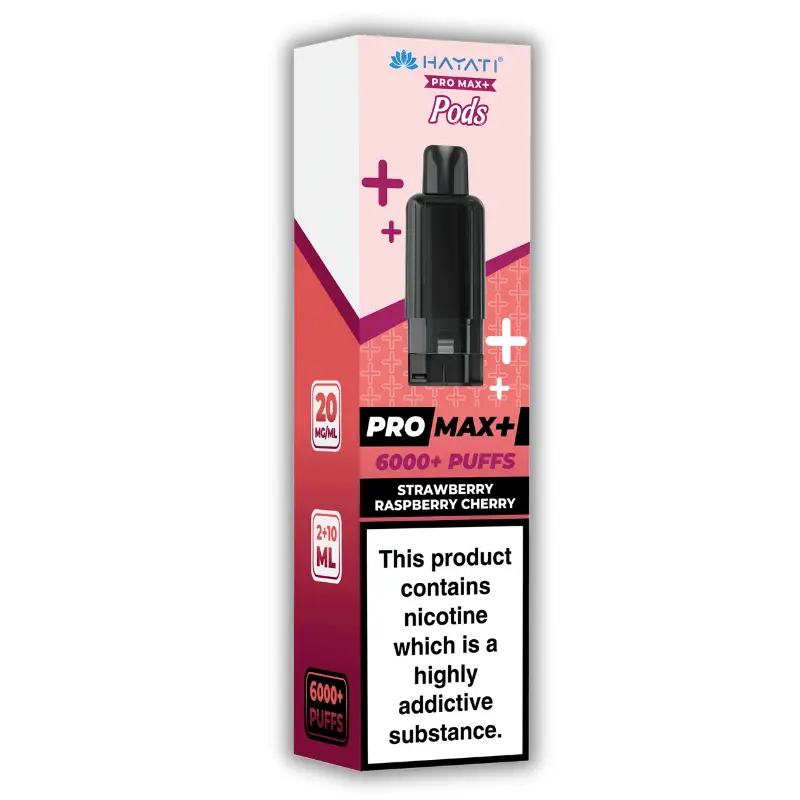
Strawberry Raspberry Cherry as a bare pod costs £5.49. What turns up is a single sealed pod holding twelve millilitres of 20mg nicotine salt with the coil already built into it, and nothing else in the pack: no body, no cable, nothing to put together. Hayati attach a manufacturer's rating of up to 6,000 puffs to a filled pod, produced on laboratory equipment drawing to a timer rather than as a forecast of anybody's fortnight. This listing does something for exactly one person, which is somebody who already has a working Pro Max Plus in a drawer and wants it filled again.
Divide the ticket by the volume and the rate is 45.75p a millilitre. That figure is not a discovery and several pages on this site have arrived at it already. What is worth a page is a property of it that belongs specifically to this recipe. It is not a floor that anybody shopped their way down to, and it is not the cheapest of several ways to buy this liquid. It is the only price Strawberry Raspberry Cherry has ever had.
The entire catalogue presence of this recipe is two entries. This pod, and the same pod boxed with a rechargeable body at £7.99 as the Strawberry Raspberry Cherry Hayati Pro Max Plus Pod Kit. There is no bottled nicotine salt of it, no 120ml shortfill, no four millilitre Mini Ultra pod, no twelve millilitre Rubik pod, no twenty-two millilitre Pro Ultra Plus pod. Two listings out of 492, on one platform, at two prices that differ only by the presence of hardware. Every millilitre of this blend Hayati have ever offered has come out of one of those two boxes.
The flavour question is settled elsewhere and this page will not reopen it. The kit listing takes the liquid apart at length and reaches a verdict worth carrying into any purchase: this is not a three-flavour liquid but a one-flavour liquid assembled from three overlapping ingredients, where the gain is amplitude rather than information and density rather than anything you can pick apart. That analysis is cited here and left where it is. What follows is about the money, and about what it means to be loyal to a recipe that exists in one place.
Two entries out of 492, and what that does to a price
Most Hayati liquids are sold several times over. A recipe that does well turns up as a bottled salt, as a shortfill, as a small pod, as a large pod, and as a complete kit on two or three systems, and the buyer picks whichever rung suits how much they want at a time and what hardware they already own. That ladder is the ordinary shape of this catalogue, and almost every argument about value on this site assumes it exists.
Here it does not. Checked against the catalogue rather than inferred from the naming, Strawberry Raspberry Cherry appears twice. Both listings are Pro Max Plus. Both hold twelve millilitres at 20mg. One has a body in the box and one does not, and the gap between them is £2.50, which is the marginal price of a Pro Max Plus body and has been worked out properly on the Kiwi Cooler pods page. That sum is not repeated here because it is the same £2.50 on every flavour this platform carries, and because it is a one-off rather than a recurring cost.
What is specific to this recipe is the second half of the picture, which is that there is no third entry. Compare the position with Mango Peach Pineapple, which is sold four times because the same recipe runs on two prefilled systems, and whose pod page counted the crossover and found 20 of the 85 flavour names on this shelf also carried on the Pro Ultra Plus pod shelf. That page is about a decision: keep buying on the platform you own, or move to the other one. A buyer of this pod does not have that decision to make, because the second platform never got this recipe.
Absent a ladder, a price stops behaving like a price. A price is informative when it is one of several, because the spread between them tells you something about what the extra money buys: more liquid, less hardware, a different format, a bulk discount. With a single rung there is no spread, and 45.75p a millilitre stops being a rate you are choosing and becomes a condition of wanting this particular blend at all.
That is the argument of this page in one sentence, and the rest of it is spent testing whether the position is as unusual as it sounds, which turned out to be the interesting part, because it is not.
Testing the rarity, which does not hold in the form it arrived in
The brief that produced this page described a single-route flavour as an oddity. Rarity claims on this site have a poor record of surviving a count, so this one was counted before anything was built on it. It did not survive, and the corrected version makes a better page than the original would have.
How the counting was done, so you can disagree with it
Take each of the 492 titles and cut it at the word Hayati. What is left in front is the flavour name as Hayati print it. Nineteen titles begin with the brand and therefore carry no flavour name at all, being strength variants and shisha listings. Collapse the inconsistent spacing around obliques, so that a pairing written with spaces and the same pairing written without them count as one thing, and 165 distinct name-strings remain. Thirty-one of those are paired names with an oblique in them, which are a different kind of object and are set aside for this count. That leaves 134 single-flavour names.
Two notes on the method, because a count is only as good as its unit. This is a different unit from the one the kit listing used when it sorted names by how many fruits they print, since that count split every paired name into halves and this one keeps pairings whole and then excludes them. The two numbers are not comparable and neither contradicts the other. And a name-string is not a recipe. Orange Lemon Lime is printed two ways in this catalogue and counts twice here, which slightly inflates the denominator and makes the finding below a little more conservative than it would otherwise be.
Thirty-six pairs, which is not a rarity
Now ask how many of the 134 exist as nothing but a Pro Max Plus kit and its matching bare pod. The answer is thirty-six. That is the exact shape of this listing: two entries, one platform, one with a body and one without, and no other format anywhere.
Thirty-six out of 134 is roughly one single-flavour name in four. Against all 165 name-strings it is a little over a fifth. Either way it is a large minority rather than an anomaly, and the flavours in it are not obscure filler. Mixed Berries, Cherry Sour Raspberry, Blue Razz Fruit Twist and Blue Razz Blackcurrant are all in the thirty-six, and so is the closest structural relative this recipe has, Blueberry Raspberry Cherry.
Widen it slightly and the picture gets firmer still. Seventy-six of the 134 single-flavour names exist on one platform only, whatever the number of listings. That is a clear majority. Thirty-five exist as a single listing with no sibling of any kind, which is a thinner position than this one, since a buyer of those has not even been given the choice between owning the body and not owning it. Forty-four names have exactly two listings in total, and thirty-six of those forty-four are the Pro Max Plus pair. The other eight take other shapes: two Pro Ultra Plus pairs, a Rubik pair, a couple of bottles sold only as the two shortfill ratios, and a few odd crossings such as a Mini Ultra pod with nothing but a Pro Ultra Plus kit beside it.
So the honest statement is the opposite of the one handed over. Living on one shelf is the normal condition in this catalogue, not the exception, and a page that told you otherwise would be flattering a listing that does not need it.
What is actually true once it is narrowed
Narrowing a claim until it is true is more useful than abandoning it, so here is what the count does support, stated at the strength the evidence allows.
Restrict attention to the shelf this pod actually sits on and to the fruit family a buyer of it would actually cross-shop. Twenty-four of the 85 flavour names on the Hayati Pro Max Plus Pods shelf print a strawberry, a raspberry, a cherry or a cranberry in the title. Of those twenty-four, eight can be bought more cheaply by the millilitre somewhere else in the catalogue and sixteen cannot. Nine of the sixteen are Pro Max Plus kit-and-pod pairs with no other listing at all, and this is one of the nine, along with Blueberry Raspberry Cherry, Strawberry Raspberry Mojito, Cherry Sour Raspberry and five others.
That is the claim in its surviving form. Not that this pod is alone, which it is not, but that a red-fruit buyer choosing among near neighbours on one shelf is choosing between recipes with quite different money attached to them, and that nothing on the product page tells them so. The difference does not appear in the ticket, because every one of these pods is £5.49. It appears in what happens after you decide you like one.
A premium needs two prices, and this liquid has one
The word premium turns up constantly in writing about this shelf and it is usually being used loosely. Getting it right changes who should act on the numbers below, so it is worth a section of its own.
What the neighbouring pages have already priced
Three pieces of arithmetic are established elsewhere on this site and are taken as read here rather than reworked. The Mango Peach Pineapple pods page divides each prefilled format and gets 45.75p a millilitre for this pod, 36.32p for a Pro Ultra Plus refill, 66.58p for a Pro Max Plus kit and 54.50p for a Pro Ultra Plus kit, and identifies kit minus pod as the marginal cost of a body on each system. The Grape GB and Blue Razz GB Pro Ultra Plus page makes the point that a headline per-millilitre rate assumes you draw everything in the pod, which nobody reliably does, so the real rate is the ticket divided by what you actually use and is always worse than the printed one. And the Strawberry Kiwi pods page establishes that both pod shelves are priced flat, that the difference between them is £1.50 on every flavour that appears on both, and that this works out at 12.5p a millilitre and therefore at eighteen pounds a year at a pod a month, thirty-nine at a pod a fortnight and seventy-eight at a pod a week.
Those are good numbers and there is no point in producing them twice. What has not been said is what they mean for a flavour that is not on both shelves.
Twelve and a half pence that is not being charged to you
A premium is a higher price for the same thing. It requires two prices and one object. Strawberry Raspberry Ice has that structure: the same liquid at the same volume and strength is £5.49 on this shelf and £3.99 on the Rubik shelf, so a buyer who stays here is paying 12.5p a millilitre for compatibility with the body they own, and can in principle stop paying it by buying a different device. The same is true of Blueberry Raspberry, which also runs on both.
Strawberry Raspberry Cherry has no such structure. There is no cheaper millilitre of this liquid to decline. Nobody is charging you extra for it, because there is nothing to charge extra against. Calling 45.75p a premium here would be a category error, and it matters because the two situations call for different responses. A real premium is a standing invitation to arbitrage, which is why the Strawberry Raspberry Ice buyer has a decision in front of them every time they reorder. This pod offers no arbitrage, so there is nothing to keep reviewing.
What the 12.5p actually represents for a buyer of this recipe is an opportunity cost rather than a charge. It is what preferring this blend over its nearest cooled cousin costs, and the cost is paid in money that never appears on any invoice as a line item. Seventy-eight pounds a year at a pod a week, using the Strawberry Kiwi figures, is the price of preferring an uncooled all-red triple to a cooled red pair. That is a real number and it is worth knowing, but it is a statement about flavour preference, not about being overcharged.
The sum that is real, and who it applies to
So the decision this page can actually help with is narrower than it first looked, and sharper for it.
If you have settled on this liquid and nothing else will do, there is no sum to run. Buy the pod, ignore the rate, and spend your attention on not wasting the liquid rather than on shopping it, because there is nowhere to shop. The rate is fixed for as long as you want the flavour.
If you are choosing between this and a neighbour, the rate becomes decision-relevant in a way it normally is not, because two pods that cost the same today will not cost the same over a year. A year of Strawberry Raspberry Ice bought on a Rubik body is seventy-eight pounds cheaper than a year of this, at a pod a week, for a liquid that is two-thirds the same fruit. That is not an argument that you should buy the cheaper one. It is an argument that the choice is worth making once, deliberately, rather than drifting into.
And if you are buying your first Pro Max Plus rather than restocking, the £2.50 body sits on top of everything above and the kit listing is the one to use. Buying a bare pod with no device is the one mistake this listing makes easy.
The reds that can leave, and the reds that cannot
Since the useful comparison is between recipes with different money behind them, here is the split on the red part of this shelf, counted rather than sampled.
Eight ways out
Eight of the twenty-four red names have a cheaper millilitre somewhere in the catalogue. Six of them reach it on the Rubik shelf, where a twelve millilitre pod is £3.99 and therefore 33.25p a millilitre, which is the cheapest sealed millilitre Hayati sell and a figure several Rubik pages have already established. Blue Razz Cherry Rubik Pods and Blue Razz GB Rubik Pods are the two on that shelf you can see from here, and both are the same liquid, the same volume and the same strength as their £5.49 counterparts.
The other two reach a cheaper millilitre a different way, on the Pro Ultra Plus, where twenty-two millilitres for £7.99 works out at 36.32p. That route costs more per purchase and less per millilitre, which is why the two counts of this phenomenon on this site differ. The Pineapple Ice pods page counted flavours with a cheaper pod, meaning a lower ticket, and found eighteen of eighty-nine. Counting flavours with a cheaper millilitre, which also picks up the bigger pod at the higher ticket, gives twenty-four of the eighty-five named flavours. Both are right for the question each asked, and the difference is a good reminder that the unit decides the answer.
Sixteen that stay
The other sixteen reds are where this pod lives, and the list is worth reading because it is full of the obvious neighbours. Strawberry Cherry Cranberry, Strawberry Raspberry Blueberry, Blackberry Raspberry, Strawberry GB and Blueberry Raspberry Cherry are all at 45.75p with no route down. So is this one. A buyer moving between any two of them is moving between liquids that cost identical money to run, which makes the choice purely a flavour choice and removes the one thing that would otherwise complicate it.
The eight that can leave are a different proposition. Choosing one of those is choosing a flavour and, quietly, a standing option on a cheaper year, which you may never exercise. Whether an unexercised option is worth anything is a matter of temperament. It is worth something to the person who might eventually buy a second device and nothing at all to the person who will not.
The cheap ticket that is the dear millilitre
One trap is worth flagging before anybody sorts a shelf by price. The lowest ticket in the prefilled range is not the lowest rate. A Mini Ultra pod is £3.49, which is the cheapest single thing on the site, and it holds four millilitres, which works out at 87.25p a millilitre, nearly double what this pod costs to run. Blue Razz Cherry Mini Ultra Pods sit on exactly those terms. The Vim Ice and Blue Razz GB Rubik pages have worked that inversion out properly and it is theirs, but it bears repeating in one line here because a buyer comparing this pod against a Mini Ultra on ticket alone will reach the wrong conclusion by a wide margin. Strawberry Raspberry Cherry has no Mini Ultra listing in any case, so the comparison is theoretical, but the habit it encourages is not.
Two listings and no bottle, which is a different kind of exposure
Price is only half of what a short catalogue footprint does to a buyer. The other half is availability, and it is the part nobody thinks about until it bites.
Forty-one of eighty-five have no bottled version
Counting again across the 85 named flavours on this shelf: forty-four of them are also sold as liquid in a bottle, either as a 10ml nicotine salt or as one of the 120ml shortfills, and forty-one are not. Strawberry Raspberry Cherry is in the forty-one. Among the twenty-four reds specifically, fifteen have a bottle and nine do not, and those nine turn out to be precisely the nine identified earlier as Pro Max Plus kit-and-pod pairs. Not approximately, but the same list of names twice over: Blueberry Raspberry Cherry, Cherry Peach Lemon, Cherry Sour Raspberry, Red Sour Raspberry, Smooth Strawberry Ice, Strawberry Guava, Strawberry H’Bubba, Strawberry Raspberry Mojito and this one. Two independent ways of asking which red recipes Hayati committed least to return an identical answer, which is stronger evidence than either count alone. A recipe they only ever filled into one kind of pod is a recipe they did not bottle either.
What a bottle is actually for, in this argument
A bottled version is not a rival to a prefilled pod. It needs hardware you fill yourself, it is a different nicotine strength, and on the shortfills it is zero nicotine and built for entirely different coils. Nobody cross-shops a 120ml shortfill against a 12ml sealed pod.
What a bottle does provide is continuity. A recipe that exists as a bottle exists independently of any one piece of hardware. Pods are tied to devices, devices get superseded, and a shelf can be reorganised in a way a liquid formulation cannot. A flavour with a bottled version has somewhere to survive a change of that kind. A flavour whose entire existence is two sealed pods on one platform does not, and a buyer holding a preference for it holds no route to the liquid that does not run through a single shelf.
Put concretely: if either of these two listings stopped being stocked, half of this recipe's presence in the world would be gone, and if both did, all of it would be. There is no bottle to fall back on, no other platform carrying the same blend, and no larger format to stock up from. By contrast the Strawberry Raspberry Ice buyer has eleven listings across five formats, and the Blue Razz Cherry buyer has eleven spread over four different devices, from the Pro Ultra Plus pod at £7.99 down to the Rubik pod at £3.99. Losing any one of those would be an inconvenience. Losing one of two is half of everything.
This is a structural observation, not a forecast
Nothing above predicts that anything will be discontinued. Hayati publish no roadmap, no production plans and no discontinuation notices, and a retail page is the last place a buyer should look for that sort of information. There is no evidence this recipe is going anywhere and none is claimed. What is being described is a property of the distribution as it stands today, which is that the recipe is concentrated rather than spread, and concentration is a risk whether or not it is ever realised.
The practical response is modest and it is the only one available. If this blend is a fixture in your rotation rather than an experiment, keeping one spare pod ahead of the one in use costs nothing extra, because both cost £5.49 and the price is the same whenever you buy it. No multipack or bulk unit appears in this product's data, so buying two is simply buying two. What it buys is a fortnight of warning rather than none, and on a recipe with two listings that is worth more than it would be on a recipe with eleven.
The liquid, in one paragraph, with the long version elsewhere
Everything worth saying about how this tastes is on the kit listing and repeating it here would waste your time and mine. In summary: three red fruits and nothing else, with no coolant, no dosed sourness and no confectionery or drink treatment anywhere in it. Raspberry supplies a short, bright, acid-led opening that is over well before the exhale finishes. Strawberry and cherry jointly supply a broad sweet weight underneath it, and because they overlap heavily in what they contribute, they do not arrive as two things. The cherry lengthens the finish rather than becoming a flavour you can point at. The result is dense and continuous rather than stepped, which is a legitimate thing to want over twelve millilitres and a disappointment to anyone who bought it expecting to pick the cherry out. The kit page also reads Hayati's two descriptions of this liquid against each other and notes that both hand each fruit a separate job and then reach for a dish in which the fruits are cooked into one mass, with compote appearing once in 492 descriptions and summer pudding once, and both times on this recipe.
The one flavour fact that bears on the money is how the pod ages. The raspberry goes first, because acid and bright volatiles are the lightest material in there, and what remains is the durable sweet weight. So the failure mode reads as the liquid getting sweeter rather than the coil getting tired. That matters for a repeat buyer because it determines when you have stopped getting what you paid 45.75p a millilitre for, which is a different moment from when the pod stops producing vapour.
The pod, and the one specification the money argument rests on
One sealed pod in the pack and nothing else. Twelve millilitres, filled at the factory, 20mg nicotine salt, which is the legal ceiling for a consumer e-liquid in this country and therefore the same figure on every prefilled pod Hayati sell rather than a decision anybody made about this flavour. Nicotine is addictive at any strength. The coil is a mesh element built into the shell, and it cannot be reached, rewicked or replaced.
That last point is the specification the whole of this page depends on. Because the coil is sealed in and thrown away with the shell, the pod is an indivisible unit of purchase: you buy twelve millilitres and one coil together, at one price, and you cannot buy either separately at any price. There is no partial purchase, no top-up and no way to keep a good coil going with fresh liquid. Every economy available to a buyer of refillable hardware is closed off, which is precisely why the per-millilitre rate is the only lever there is, and why on this recipe there is not even that.
Check the range name printed on your device against the range name in this title before ordering, since Hayati publish no cross-range fitment chart. The rest of the platform is on the Pro Max Plus pod shelf, the wider refill range is on Hayati Prefilled Pods & Refills, and everything Hayati make across every system is in the full product list.
The figures, ordered by what each one costs you
This table is arranged by money rather than by hardware, because the hardware rows are identical to eighty-four other pods on the same shelf and the money rows are not.
| Ticket price, this listing | £5.49 |
| What the ticket buys | One sealed pod, twelve millilitres, no device and no cable |
| Rate per millilitre | 45.75p, before any allowance for liquid you do not draw |
| The only other price this recipe has | £7.99, the kit, which adds a rechargeable body and £2.50 to the bill once |
| Cheapest millilitre of this recipe anywhere | 45.75p, because there is no other route to it |
| Cheapest sealed millilitre in the catalogue | 33.25p, on a £3.99 Rubik pod, in flavours that are not this one |
| Listings of this recipe, out of 492 | Two |
| Formats it is not sold in | Bottled salt, 120ml shortfill, Mini Ultra pod, Rubik pod, Pro Ultra Plus pod |
| Bulk or multipack unit | None appears in this product's data |
| Nicotine | 20mg salt, the UK maximum, identical across the shelf |
| Manufacturer's puff figure | Up to 6,000, a laboratory estimate rather than a measurement of use |
| Coil | Mesh, sealed in, discarded with the shell |
| Cooling | None, and no cooling word appears in the title |
| Fruit proportions | Not published for this or any pod in the range |
| VG and PG ratio | Not published against this listing |
| Coil resistance and wattage | Not published against this listing |
Four rows need a word. The 45.75p is the optimistic reading for the reason the Grape GB and Blue Razz GB page sets out: it assumes you get all twelve millilitres, and a pod retired early because the coil has tired costs more per millilitre actually drawn than the arithmetic suggests. The up to 6,000 figure comes off a drawing machine and is best read as a rough budget for one sealed coil rather than as a duration, since how long twelve millilitres lasts is a fact about you. The row about formats is the most useful one on the page and is the only one that could change: it is a statement about the catalogue as it stands today. And the last three rows are the honest ones. Any page quoting you a fruit ratio, a resistance or a VG split for this pod has made it up.
Where £5.49 goes if you leave this flavour
Every pod named below is £5.49 unless stated otherwise, so nothing here is a saving. The Galaxy Aura pods page makes the point that a flat shelf removes price as a signal entirely, which means the only thing left to choose on is what the liquid does. These are sorted by what changes about the money as well as about the taste, since that is the axis this page has been on.
The neighbours with the same money and different fruit
Blackberry Ice is the shortest step away if what you want is a darker berry with a cooling element, and it sits at the same rate with no cheaper route, so switching to it changes the flavour and nothing else. Black Mamba names nothing at all, which is a different kind of problem and one its own page handles. Blue Razz GB takes the sweet-shop route to a similar sweetness level and does have a Rubik counterpart, so it belongs in the group with an exit.
The neighbours with the same money and a similar build
Strawberry Raspberry Blueberry is the closest thing on the shelf by construction, since its third fruit is also doing weight rather than opening a new channel, and it is also stuck at 45.75p with three listings and no cheaper one. Strawberry Cherry Cranberry keeps two of this recipe's three fruits and swaps the third for one that dries the finish, and Blueberry Cherry Cranberry does the same with a darker lead, and that one is in the eight with a Rubik version at 33.25p. Blueberry Raspberry Cherry is the nearest relative of all and shares this listing's exact shape: two entries, one platform, no bottle.
The neighbours that let you stop paying 45.75p
Strawberry Raspberry Ice is the important one, because it is the same opening pair as this recipe with a coolant where the cherry sits. Eleven listings, five formats, and a floor of 33.25p. If the density this liquid is built on has become the problem, that pod solves it and costs less to run, which is an unusual combination. Blueberry Raspberry does the same trick from a darker base. Blue Razz Cherry is the extreme case on this shelf: eleven listings spread across four devices, so a buyer loyal to it can pick a rate rather than accept one.
Larger formats, if the twelve millilitres is the constraint
Nothing on the larger platform carries this exact recipe, so anything here is an approximation rather than a move. Strawberry Raspberry Ice on the Pro Ultra Plus is twenty-two millilitres for £7.99, a higher ticket and a lower rate. Strawberry Ice and Strawberry Raspberry Ice as a complete kit at £11.99 puts two related reds behind one collar, and Straw’ Cranberry Cherry with Strawberry Raspberry Ice pairs a warm red against a cold one on the same pod. Blueberry Raspberry with Blueberry Raspberry Cherry is the closest the larger platform gets to the base-and-extension question this recipe raises, and Blue Razz Cherry with Blue Razz GB is the confectionery version of the same idea. For a sharp red with no sugar behind it, Blue Sour Raspberry on the Pro Ultra Plus is the opposite proposition to this pod in every respect.
Browsing by fruit rather than by platform
Sorting by device is the slow way round when the flavour is what you are actually choosing. Cherry Vapes holds seventy-two listings, Strawberry Vapes eighty-two, Raspberry Vapes a hundred and nineteen, and Berry Vapes two hundred and twenty-five. Every Hayati pod of any kind is on Hayati Pods, which runs to two hundred and two, and the most recent additions across the whole range are on New Products.
Habits worth having when there is only one price
Ordinary pod handling advice applies here as it does everywhere and is not worth repeating. What follows is the part that changes when a liquid has no cheaper version and no bulk route, which is to say when the only way to get value out of it is to waste less of it.
Retire the pod on the tang, not on the vapour. On this recipe the bright raspberry opening is the first thing a tiring coil takes, and the sweet weight underneath it outlasts it comfortably. So the pod goes on producing something long after it has stopped producing the thing you chose it for. The signal to act on is the first draw of a morning: if it arrives round and sweet with no edge on the front, the useful part of that twelve millilitres is behind you. Carrying on past that point is not thrift, because you are paying full rate for material you did not buy the pod for.
Do not retire it early either. The opposite mistake costs the same money in the other direction. At 45.75p a millilitre, two millilitres binned is ninety-one pence, which is a fifth of the pod. On a liquid with a cheaper twin that would be an argument for buying the twin. Here it is simply money gone, so on this one it is worth being slightly more patient than you would be with a flavour you could rebuy at 33.25p.
Shorten the draw before you blame the pod. There is no collar, no airflow control and no power setting, so how long you pull is the only variable you own. Because the raspberry material arrives early and the weight accumulates later, a shorter draw reads brighter and a longer one reads sweeter and heavier. A pod that has started to feel claggy is sometimes a draw problem rather than a coil problem, and it costs nothing to check.
Store the spare properly, because heat charges you twice. The volatile top of this blend is the most fragile thing in the pod and it is what warmth takes first. A pod left in a car or on a sunny sill for a month does not taste spoiled, it tastes like the version of itself with the interesting part already gone, which is much harder to notice. Somewhere flat, cool and dark, where children and pets cannot get at it, and used in the order you bought it.
Rotate against something that is not another dense red. Nothing in this recipe resets the palate between draws, so a long continuous session flattens it. The useful second pod is one that occupies a different channel entirely: cold, sour, or outside the berry family. Two sweet reds in rotation make each other worse, and on a shelf where every pod is the same price that is a mistake with a real cost attached.
At the end of it. A finished pod is a plastic shell with a mesh coil, a wick and a little trapped liquid inside it, so it does not belong in a household bin. UK vape retailers are obliged to take back small electricals and council recycling centres accept them too.
Questions about the money
Is £5.49 a good price for this pod?
It is the same price as every other pod on this shelf, all of which hold twelve millilitres at the same strength, so there is no comparison to make within the range. Against the catalogue as a whole it is mid-table: a Rubik pod holds the same twelve millilitres for £3.99 and a Mini Ultra pod holds four for £3.49, which is much worse by the millilitre. Whether it is good in absolute terms depends on what you would otherwise buy, and this page cannot answer that for you.
Can I get this liquid cheaper anywhere in the range?
No. Strawberry Raspberry Cherry exists as two listings, this pod and the kit, and the kit is dearer because it includes a device. There is no bottled version, no shortfill, no Rubik pod and no Pro Ultra Plus pod of this recipe, so 45.75p a millilitre is not the lowest of several rates. It is the only one.
Why do some flavours have a £3.99 version and this one does not?
Hayati publish no reasoning about which recipes go on which platform, so anything beyond the observation would be invention. What can be counted is the scale of it: nineteen flavours exist on the Rubik shelf and eighty-five on this one, so the overlap is small by construction. Six of the twenty-four red-fruit names here have a Rubik counterpart and this is not one of them.
Should I buy the kit instead?
Only if you do not already own a working Pro Max Plus. The kit is £7.99 and adds a rechargeable body for £2.50, paid once. If you have the device, that £2.50 buys you a second body you did not ask for, and this listing is the one you want. If you do not have the device, this pod on its own will do nothing at all.
Does buying several at once work out cheaper?
No multipack or bulk unit appears in this product's data, and twelve millilitres is the largest single quantity of this recipe that exists anywhere in the catalogue. Buying three is buying three. The only reason to hold a spare is continuity rather than cost.
How much does preferring this over Strawberry Raspberry Ice actually cost?
Using the Strawberry Kiwi page's figures, the gap between the two pod shelves is 12.5p a millilitre, which is eighteen pounds a year at a pod a month and seventy-eight at a pod a week. That is not a charge on this pod, since this liquid has no cheaper version. It is the cost of preferring an uncooled red triple to a cooled red pair that happens to be sold on the cheaper platform as well.
Is it unusual for a flavour to be sold in only two places?
Less unusual than it sounds, and this page originally assumed otherwise before counting. Thirty-six of the 134 single-flavour names in the catalogue exist only as a Pro Max Plus kit and its matching pod, seventy-six exist on one platform only, and thirty-five exist as a single listing with no sibling at all. What is more specific is the red corner of this shelf, where nine of the twenty-four red names take this exact two-listing shape.
What happens if this listing is discontinued?
Nothing published suggests it will be, and no page should pretend to know. Structurally the position is that this recipe has no bottled version and no presence on any other platform, so there is no fallback format if the pods stop being stocked. That is a reason to keep one spare if the flavour is a fixture for you, not a reason to stockpile.
How will I know when I have had the value out of a pod?
Watch for the bright opening rather than the vapour. On this blend the acid and the light aromatic top fade before the sweet weight does, so a pod that still produces plenty but arrives flat and round on the first draw of the day has already given you what you paid for. Everything after that is the durable part of the liquid on a tired coil.
Does the pod hold anything back if I stop using it for a while?
It keeps for a reasonable period unopened and stored cool, but heat is not kind to it. The most volatile material in this recipe is the raspberry top, which is also the part that distinguishes it from a generic sweet red, so a pod that has been warm for weeks arrives already partway through its own ageing. Buy at the rate you use rather than far ahead.
Is the liquid in the kit different from the liquid in this pod?
No. Both listings are twelve millilitres at 20mg of the same recipe, and Hayati describe the same three fruits doing the same three jobs on both. The only difference between the two listings is whether a rechargeable body is in the box.
Can I refill the pod to bring the cost down?
No. It arrives sealed and filled with no opening intended for the purpose, and the mesh coil inside is fixed and cannot be reached or replaced. When it is finished the replacement is another pod at £5.49, and since there is no bottled version of this recipe there is no fill-it-yourself route to the flavour either.
The short version
This is a sealed twelve millilitre pod of 20mg nicotine salt at £5.49, for a Pro Max Plus you already own, carrying a manufacturer's laboratory figure of up to 6,000 puffs. The flavour analysis belongs to the kit listing, which concludes that the three fruits produce one dense continuous red rather than three identifiable flavours, and that the cherry lengthens the finish without ever becoming separable.
What is particular to this listing is its position in the catalogue. Strawberry Raspberry Cherry is sold twice out of 492 listings, both times on one platform, and 45.75p a millilitre is not a floor reached by shopping but the only rate this recipe has ever had. The rarity claim that framed this page did not survive the count and has been narrowed: single-route flavours are common, with thirty-six of the 134 single-flavour names existing only as a Pro Max Plus pair and seventy-six confined to one platform. The true version is local. Among the twenty-four red names on this shelf, eight can be bought more cheaply by the millilitre and sixteen cannot, and this is one of the nine that are a two-listing pair with no bottle behind them.
The practical consequences are two. There is no arbitrage here, so a reorder needs no thought and the 12.5p a millilitre that separates the two pod shelves is not a charge on this pod but the cost of preferring this blend to a cooled pair that happens to run on cheaper hardware. And the recipe is concentrated rather than spread, so a buyer who has settled on it holds no route to the liquid that does not pass through one shelf. Neither of those is a reason to avoid the pod. Both are reasons to make the choice once, knowingly, instead of arriving at it by habit.
Strictly for adults aged 18 and over. Nicotine is an addictive substance.
You might also like


