
Home / Hayati Rubik Prefilled Pod Kit / Strawberry Raspberry Ice Hayati Rubik Prefilled Pod Kit
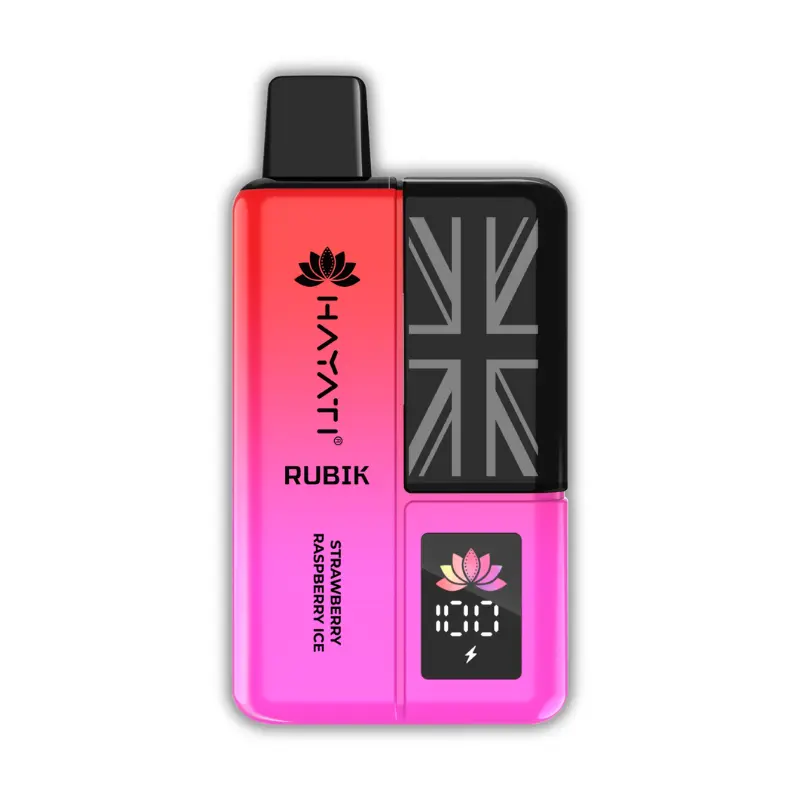
Hayati · Rubik
Strawberry Raspberry Ice Hayati Rubik Prefilled Pod Kit
£5.99
✔ In stock — ready to ship
Genuine Hayati
Free over £20
Same-day dispatch
Secure checkout
A Rubik body with a filled pod already seated in it, twelve millilitres of Strawberry Raspberry Ice at 20mg nicotine salt, £5.99. Hayati put a laboratory figure of up to 7,000 puffs on the pod, measured on test apparatus drawing to a fixed schedule, which makes it a number for ranking listings rather than a forecast of your fortnight. An 850mAh cell sits in the body. Unbox, draw, done. Described as a product it takes three lines, and if that were the whole of it this page would be three lines long.
What makes it worth more is the position the flavour occupies rather than anything inside the pod. Strawberry Raspberry Ice is one of a very small number of recipes Hayati manufacture in every format they operate. Not most formats. Every one of them, from a four-millilitre Mini Ultra pod to a hundred and twenty millilitre bottle, with this kit sitting near the middle of the ladder. Fifteen listings on this site carry the name, and eleven of those fifteen are single-flavour listings occupying one slot each in an eleven-slot grid, with no gaps.
That is a genuinely unusual position for a buyer to be standing in, and almost nobody notices it. Choosing a format normally costs you flavour options: the small device carries a short list, the big one carries a long list, and picking hardware quietly narrows what you can put in it. On this recipe that cost is zero. Whichever format you settle on, this liquid is waiting in it. Which means the format decision can be made on the things formats actually differ on, being how much liquid arrives at once, what it costs per millilitre, what strength it comes at and how many weeks you are agreeing to spend with one profile.
The last of those four is the one this page spends most of its length on, because it is the one that changes what the liquid tastes like rather than what it costs. A blend built from a red berry and a coolant does not behave the same way over four millilitres as it does over twenty-two, and the reason has nothing to do with the recipe.
Counting the fifteen before building anything on them
A page that opens by calling something rare should show the working, so here is the arithmetic, taken from the catalogue rather than from another page.
Hayati operate seven product lines on this site once the pouches and the refillable Quokka hardware are set aside: Pro Ultra Plus, Pro Max Plus, Rubik, Mini Ultra, the 10ml nicotine salt bottles, the 120ml 50/50 shortfills and the 120ml 70/30 bottles. Normalise every title down to its flavour names, splitting the dual listings at the oblique, and 142 distinct flavour names come out. Just over half of them, 72, exist on one line and nowhere else. Two lines is the next largest group at 40. Beyond that the numbers thin out fast, and only eight names appear on all seven lines.
Eight is the figure the Summer Dream Rubik kit page established, and it holds up exactly when recounted. That page also worked out why the top of the distribution matters and what it does and does not prove about a liquid, and I am taking its conclusions as given rather than running them again. The names in the group are Juicy Peach, Lemon Lime, Blueberry Raspberry, Blue Razz Cherry, Blue Sour Raspberry, Mr Blue, Summer Dream and this one.
One refinement is worth adding, because it bears directly on the format argument below. Seven lines is not the same as seven purchase formats. Four of those lines sell the same liquid twice, once as a complete kit and once as a bare refill, which makes eleven distinct things a buyer can actually order rather than seven. Eight names still reach all eleven slots if a flavour counts as present wherever its name appears on the label. Require a solo listing in every slot, which is the test that matters to anybody who wants this recipe and nothing else sharing the pod, and the group falls to seven. Juicy Peach is the one that drops out, and the manner of it is worth a sentence, because no slot is actually empty. Its Mini Ultra kit position is filled only by the divided Sour Apple / Juicy Peach pairing, so in that one format the peach cannot be bought on its own: you take the apple with it, sharing a coil and a single liquid budget. Strawberry Raspberry Ice survives the stricter test with an undivided single-flavour listing in all eleven.
Counted by listings rather than by lines, the name appears fifteen times. Eleven of the fifteen are single-flavour listings, one per format slot. The remaining four are dual Pro Ultra Plus pods in which this blend takes one collar position and something else takes the other: Strawberry Ice / Strawberry Raspberry Ice Hayati Pro Ultra Plus 25000 Prefilled Pod Kit, its matching bare pod, and the pair built around Straw’ Cranberry Cherry / Strawberry Raspberry Ice Hayati Pro Ultra Plus 25000 Prefilled Pod Kit. Fifteen listings puts this name joint second in the catalogue for sheer repetition, level with Lemon Lime and Blueberry Raspberry, one behind Blue Razz GB on sixteen.
The narrow Strawberry Raspberry Ice Vapes shelf collects eighteen listings, which is three more than the fifteen carrying the phrase, because somebody filed three further products alongside them by judgement rather than by text match. Eighteen tiles for one recipe is a lot of grid to scroll through when eleven of them differ only in packaging.
What full coverage buys you, and the part of it that is not free
The practical consequence is easiest to see by contrast. The Vim Ice Hayati Rubik Prefilled Pod Kit page priced the Rubik platform properly and found the saving is real but comes with a bill attached: choosing this range means choosing from a shortlist of twenty flavours instead of the ninety-two on the Pro Max Plus side, so the cheaper millilitre costs you seventy-two names you can no longer have. That is the honest shape of the trade for most of the catalogue, and it is why format and flavour are normally entangled decisions.
For this recipe the bill is zero. There is no flavour you forfeit by taking the cheap platform, because the flavour you want is on the cheap platform and on every other one. The two decisions come apart cleanly, which is rare enough to be worth exploiting: settle the format on its own merits, then collect the liquid from whichever slot you chose.
Two things stop that being quite as clean as it sounds, and both deserve saying before the table rather than after it.
The first is strength, which is not constant across the eleven. Eight of them, every sealed pod and every kit, are 20mg nicotine salt, which is the ceiling a prefilled pod can carry in the UK and the only figure this format is sold at. The 10ml salt bottle is listed at 10mg, half of that. The two 120ml bottles are supplied at 0mg, so a nicotine shot is a separate purchase and a separate decision. Anyone who has settled on a particular milligram figure therefore does not have eleven options at all. They have eight identical ones, or a bottle route with its own arithmetic. Nicotine is addictive, and what strength suits a person is theirs to judge.
The second is that a shared name is not a shared recipe, a caution the Strawberry Raspberry Ice Hayati Pro Ultra Plus 25K Pods page states plainly and which holds here. Hayati publish no formulation for any of the fifteen. Even if the liquid were byte-identical across all of them, a 50/50 bottle run through your own hardware, a sealed pod on an unpublished coil and a 70VG bottle in a sub-ohm tank would not render it the same way. The flavour name travels. The exact experience is not guaranteed to travel with it, and nobody should promise you that it does.
With those two caveats attached, the claim stands in its useful form: on strength-matched terms, across the eight sealed formats, you are choosing packaging and nothing else.
Eleven ways to buy one recipe, arranged by what you are committing to
Cost per millilitre for these formats has already been worked out twice on this site, on the Vim Ice page and again on the Summer Dream page, and both arrive at the same ordering. The short version, so you do not have to go and look: the Rubik refill is the cheapest prefilled millilitre Hayati sell, the Rubik kit is the cheapest first purchase per millilitre, the Pro Ultra Plus refill runs a close second, and the Mini Ultra is the most expensive liquid in the range despite having the lowest ticket price. The bottles undercut everything prefilled by a wide margin and need hardware you already own. That is settled, and rebuilding it here would waste your time.
The table below is a different cut, because price per millilitre answers the value question and says nothing at all about the risk question. What it leaves out is duration: how long a single purchase ties you to one profile, and how often the changeover comes round. Those two columns are worked from a flat rate of half a millilitre a day, chosen only because it makes the formats comparable with each other. It is an arithmetic device and not a claim about how much anybody gets through. Scale it to your own habit and every row moves in proportion, which is the point of using one rate for all of them.
| Listing | Price | Liquid | Strength as sold | Hardware needed | Days per unit at 0.5ml a day | Changeovers in a year |
| Mini Ultra Pods | £3.49 | 4ml | 20mg | Mini Ultra body | 8 | 46 |
| Mini Ultra Pod Kit | £3.99 | 4ml | 20mg | None, body included | 8 | 46 |
| Rubik Pods | £3.99 | 12ml | 20mg | Rubik body | 24 | 15 |
| Rubik Prefilled Pod Kit (this listing) | £5.99 | 12ml | 20mg | None, body included | 24 | 15 |
| Pro Max Plus Pods | £5.49 | 12ml | 20mg | Pro Max Plus body | 24 | 15 |
| Pro Max Plus Pod Kit | £7.99 | 12ml | 20mg | None, body included | 24 | 15 |
| Pro Ultra Plus 25K Pods | £7.99 | 22ml | 20mg | Pro Ultra Plus body | 44 | 8 |
| Pro Ultra Plus 25000 Prefilled Pod Kit | £11.99 | 22ml | 20mg | None, body included | 44 | 8 |
| Pro Max Nic Salt | £2.49 | 10ml | 10mg | Your own refillable MTL kit | 20 | 18 |
| Pro Max 50/50 Shortfill | £6.99 | 120ml | 0mg as supplied | Refillable MTL kit, plus a shot | 240 | Under 2 |
| Pro Max 70/30 | £6.99 | 120ml | 0mg as supplied | Sub-ohm tank, plus a shot | 240 | Under 2 |
Read the right-hand columns rather than the left-hand ones and the shelf reorganises itself. Three of the eleven tie you to this profile for roughly a week at a time. Four tie you to it for something like three and a half weeks. Two tie you to it for six weeks. Two tie you to it for the better part of a year, although a bottle is the one format you can set aside half-finished and come back to without wasting it, so its duration figure is soft in a way none of the sealed ones are.
The changeover column is the same information read from the other end, and it is the one that predicts annoyance. Forty-six pod swaps a year is a purchase you are constantly making. Eight is a purchase you will have forgotten about by the time it arrives, which is its own failure mode: the rare event is the one you are least prepared for, and running dry on a large pod tends to happen weeks after you last thought about ordering a replacement.
Commitment is the axis the price table hides
Cost per millilitre assumes you use every millilitre. That assumption is doing a lot of quiet work, and it fails in exactly one situation: when you stop wanting the flavour before the pod stops holding it.
A sealed pod has no recovery inside it. The liquid was filled and closed before it shipped, so tiring of it at the halfway mark is not a problem you can trade your way out of. Abandon a 22ml pod at eleven millilitres and you paid £7.99 for eleven millilitres, which puts the effective figure at a shade over 72p per millilitre and turns the cheapest format on the shelf into one of the dearest. Abandon a 4ml Mini Ultra pod at the halfway mark and you have wasted £1.75. The larger the format, the more of its advantage is contingent on you still liking the thing in five weeks.
That reframes the whole ladder as a bet rather than a purchase. The Mini Ultra is the most expensive liquid in the range and the cheapest way to be wrong. The Pro Ultra Plus is nearly the cheapest liquid in the range and the most expensive way to be wrong. The Rubik sits where the two curves cross: twelve millilitres at £3.99 as a refill is the smallest sum you can spend to get the cheapest prefilled millilitre, and three and a half weeks is a commitment most people can see the end of.
The kit-and-refill split on this platform is a £2.00 step, and the Hayati Rubik shelf page has already done the amortisation properly, including when paying it a second time for a duplicate body is sensible and when it is just accumulation. There is no point restating it. What is worth noting on this listing specifically is that the £2.00 is the smallest body charge of the three larger platforms, so if the eleven-format argument has persuaded you to start here, the entry cost of being persuaded is low.
One arithmetic trap to sidestep while we are on numbers. The manufacturer's puff ratings across these formats do not divide by volume to anything consistent, which the Vim Ice page demonstrated in detail and which means a rating cannot be used to compare one format against another. Compare the litres, not the laboratory figures.
Why volume is not neutral for a coolant and a red berry
Everything above treats format as a commercial question. For most flavour categories that would be the end of it. For this one it is not, and the reason is that two separate processes erode this particular blend over the life of a pod, both of them attack the same property, and how much of them you experience is set entirely by how much liquid you bought.
The first process is on the hardware side. The Pro Ultra Plus pods page traced it for this exact recipe: raspberry is a high, volatile top note, top notes are the first casualty as a coil accumulates residue, and the raspberry therefore thins gradually rather than failing on a particular day. Its conclusion is worth quoting in substance, because it is the sharpest thing anybody has written about this liquid. A worn pod of Strawberry Raspberry Ice converges on plain Strawberry Ice. The second berry is the thing that gives the blend its definition, and the second berry is the thing that goes.
The second process is on your side, and it is better documented elsewhere in this range than anywhere I could improve on. A palate recalibrates against a coolant faster and more completely than against almost any flavour, a point the Double Menthol pods page sets out and declines to soften. The Smooth Strawberry Ice pods page adds the distinction that actually matters, separating the short adaptation that happens inside one session and resets after a few minutes from the slow one that runs across days and weeks of uninterrupted use, moves the resting threshold and does not reset overnight. The Blue Frozen nic salt page reports the same thing from the bottle side and gives the fix, which is running something uncooled alongside. The Spearmint kit page supplies the diagnostic, judging the pod only on the first draw of the morning, when the night has reset what a night can reset. None of that needs rebuilding.
Put the two together and the shape of the problem is specific to blends like this one. Coil wear removes the raspberry. Adaptation removes the cold. Strawberry, coolant and raspberry are the three things the name promises, and the two of them that do the distinguishing are the two that decay. What is left at the end of a long pod is sweet strawberry with the definition sanded off both ends, and neither process has anything to do with the quality of the product.
This is where the eleven-format grid stops being a price table and starts being a flavour decision.
Four millilitres is over in about a week at the rate used above. Neither process gets properly started. The coil has barely accumulated anything, and the slow adaptation the Smooth Strawberry Ice page describes runs on a timescale of days to weeks, so a pod finished inside eight days is mostly drunk as designed. You pay heavily per millilitre for that and what you are buying is the recipe intact.
Twelve millilitres, which is this kit and the other two formats at that volume, runs to roughly three and a half weeks. Both processes are live by the end of it. The last third of the pod will read flatter than the first third did, and the sensible expectation is a noticeable loss of the raspberry edge rather than a collapse. That is a manageable amount of drift, and it is the main reason I think twelve is the right volume for this particular recipe rather than merely the cheapest one.
Twenty-two millilitres is six weeks of continuous exposure to the same coolant on the same coil. Both processes complete. If the convergence the pods page describes is right, and I think it is, the back half of a Pro Ultra Plus pod of this flavour is a materially different liquid from the front half, and it is a liquid you could have bought directly for less by picking the plain iced strawberry to begin with. That is not an argument against the format. It is an argument that the format should be paired with a rotation.
There is one way in which this recipe is better placed than its nearest sibling, and it is worth stating because it cuts the other way. The Smooth Strawberry Ice page makes the point that an adapted palate on a base-heavy strawberry has nothing to fall back on, since a liquid with no acid in it cannot clear itself once the coolant stops registering. This blend does have an acid line, supplied by the raspberry. So in principle it holds up better under adaptation than a pure iced strawberry would. The catch is that the acid line is carried by exactly the note the coil takes first. The fallback exists and it is on the same timer as the thing it is meant to be a fallback for, which is a neat and slightly unfortunate piece of engineering.
The practical instruction that falls out of all this is short. If you intend to run cold red berry as your only flavour, buy it in smaller units more often. If you intend to run it alongside something with no coolant in it, the large formats stop being a trap and become the value purchase they look like on paper. The rotation is not a refinement here. It is the thing that decides which row of the table is right for you.
The liquid, and what fifteen descriptions of it agree on
The draw-by-draw account of this blend is already written properly on the Pro Ultra Plus pods listing, which takes the inhale, the structural job the second berry performs, the late arrival of the cooling and the sweetness placement in more depth than a second pass would improve on. Read it there. What has not been done for this flavour is the other kind of reading, which is to put all fifteen Hayati descriptions of the same liquid side by side and ask where they agree, where they diverge and where one of them says something no other does.
Three properties are asserted by every single one of the fifteen. Strawberry is the base and arrives first. Raspberry is the sharper, brighter, tangier of the two and sits above it. Cooling arrives on the exhale rather than the inhale. Fifteen out of fifteen is the closest thing to a fact this catalogue will give you about a liquid, and those three sentences are as much as anybody can tell you with confidence.
Sweetness is the next most consistent, and it lands at medium rather than high. The dual Strawberry Ice pairing puts it flatly, saying neither side is heavily sweet and both sit around the middle. The salt bottle, the 50/50 and the 70/30 all use a variant of juicy rather than sugary. Nothing in the fifteen describes this as a confectionery build, which is a real signal given how freely the rest of the range reaches for candy language.
Then the interesting part, which is the disagreement. Texture is the one property where two listings of the same liquid contradict each other outright. The Strawberry Raspberry Ice Hayati Mini Ultra Pod Kit describes the strawberry as supplying a soft, jammy sweetness, positively and without qualification. This Rubik listing says the opposite, crediting the cooling with holding the fruit bright and putting the word jammy on the other side of the line. Same recipe, same manufacturer, opposite adjective on the axis a buyer would most want settled.
Before reading anything into that, it needs checking against house vocabulary, because a word that appears everywhere carries no information. Jammy turns up on 27 of the 492 listings on this site, so its presence means very little. Its negation is another matter: only two listings in the whole catalogue actively say something is not jammy, and this kit is one of the two. The same holds for the assertion that two berries remain separable instead of collapsing together into a single undifferentiated red: three listings out of 492 make it, and again this is one of the three. And the phrase about the blend working whatever the time of day appears exactly once in the entire catalogue, here.
The honest reading of that is not that the Rubik pod contains a different liquid from the Mini Ultra pod. It is evidence about how the copy was produced. Fifteen descriptions were written separately, the writer of each reached for whichever adjective fitted the sentence, and on a blend that genuinely sits between jammy and bright two different writers landed on opposite sides of the line. What it tells a buyer is that the texture question is unresolved in the source material, so anybody stating it as settled is going beyond the record.
Two further things only one listing says. The 70/30 bottle is the only one of the fifteen to comment on how the raspberry behaves in dense vapour, noting that its sharpness stops big clouds tasting flat, which is a remark about the format rather than the recipe and rather gives away that these descriptions are written to the packaging. The salt bottle is the only one that bothers with priming advice. Neither is a flavour claim.
What no listing publishes, in any of the fifteen: a ratio between the two berries, a coolant level or scale, a VG/PG split for any of the sealed pods, and a coil resistance. The cooling is declared as a binary in the name and its intensity is left entirely unstated, which the pods page identifies as the single largest source of disappointment in this corner of the range. Assume moderate, because the descriptions collectively read moderate, and understand that this is an inference from the copy rather than a figure anybody has issued.
What is not this flavour
Worth marking the boundaries, because several near neighbours share most of a name.
It is not a sour build. The raspberry carries acid and acid is not sourness. Anyone who wants the jaw to tighten should be looking at Blue Sour Raspberry Hayati Pro Ultra Plus 25000 Prefilled Pod Kit or its Rubik equivalent instead, where the sour layer is the point rather than a by-product.
It is not a three-fruit red. Strawberry Raspberry Blueberry, on the Pro Max Plus hardware, adds a third name to the same two, and a third name means every component has been trimmed to make room. If you want the strawberry and the raspberry to keep the space they have here, do not add a fruit to them.
It is not a cocktail or herbal build. Strawberry Raspberry Mojito exists on the Pro Max Plus hardware and reads as a similar string in a list. The liquids are not similar.
It is not a mint. The cooling has no herb behind it, which the Ice Vapes shelf muddles slightly by collecting both kinds of cold under one heading.
The Rubik kit, in the space it needs
One box, one body, one pod already seated in it. Nothing to assemble, nothing to fill, no spares and no documentation worth keeping. Charge it when it stops firing, which on this platform will be many times before the pod is empty, because twelve millilitres against an 850mAh cell is a deliberate imbalance rather than an oversight.
The specification that matters for this liquid is the twelve, and the preceding section is the whole of why. Everything else on the Rubik, being the casing shape, what it does in a pocket, how the body charge amortises and how the twenty flavours sort by cooling, is covered on the Hayati Rubik shelf and does not need repeating on a flavour page. The Hayati Rubik Prefilled Pod Kit shelf holds the twenty complete kits with no refills mixed into them, which is the harder grid to make a mistake on if you want a device in the box.
Hayati publish four figures for this device and no more: 12ml, 850mAh, 20mg, and a manufacturer rating of up to 7,000 puffs generated in laboratory conditions. Coil resistance, airflow, wick material and the identity of the cooling agent are all absent from the record, and a retail page supplying them would be inventing them. One brief caution on fit, said once: match the range name printed on your device to the range name in the title, because nothing Hayati publish says a pod from one range seats in another.
The figures, and what each one changes in use
| Liquid on board | 12ml, sealed before dispatch |
| Nicotine | 20mg nicotine salt |
| Cell | 850mAh, rechargeable |
| Manufacturer's puff rating | Up to 7,000, a laboratory estimate |
| Price | £5.99 with the body, £3.99 for the refill alone |
| Fruits named | Two, strawberry and raspberry |
| Cooling | Declared in the title, intensity not published |
| Flavour positions | One. No collar, nothing to select |
| Format slots this recipe occupies | 11 of 11 |
| Not published | Coil resistance, VG/PG, berry ratio, coolant level |
Three of those rows deserve a sentence rather than a glance. The twelve is a commitment figure as much as a capacity figure, for all the reasons set out above, and it is the only number on the list that changes what the liquid is rather than what it costs. The 20mg is the ceiling a sealed pod can carry here and it is the sole option on this platform, so it is a constraint rather than a choice. And the 7,000 is the one figure on the table that cannot be compared with anything, since the same rating divided by the same volume gives wildly different answers across the four prefilled platforms.
The bottom row is the one most specification tables leave out and the one that carries the argument of this page. Eleven of eleven is a property of the catalogue rather than of the liquid, it is checkable, and it is the reason the format decision here is unusually free.
Choosing a row: a recommendation by how much you actually get through
Everything above resolves into a fairly short set of answers, and they key off consumption rather than taste, because taste has already been settled by the time anybody reads this far.
If this is a rotation flavour rather than an all-day one. Buy small and buy often. The four-millilitre Mini Ultra format is the most expensive liquid per millilitre Hayati sell and it is the correct purchase for occasional use, because you finish it before either decay process has done anything and because a flavour you reach for twice a week would sit in a large pod for months. Either Strawberry Raspberry Ice Hayati Mini Ultra Pod Kit at £3.99 with a body, or the bare Mini Ultra pods at £3.49 if you have one. Accept the unit price as the cost of keeping the recipe fresh.
If it is one of two or three flavours you run steadily. This listing, then refills. Twelve millilitres is long enough to get the cheap millilitre and short enough that the drift stays within tolerable limits, and at £5.99 the entry cost of finding out is two pounds above the refill price. After the first one, Strawberry Raspberry Ice Hayati Rubik Pods at £3.99 is where the range pays off. This is the recommendation for most people, and it is the one I would make even if the arithmetic were closer than it is.
If it is your only flavour and you get through a lot of it. The twenty-two millilitre formats are the cheapest and the most exposed, so take them only with a second, uncooled pod running alongside. Strawberry Raspberry Ice Hayati Pro Ultra Plus 25000 Prefilled Pod Kit at £11.99 puts a body in the box, and the bare pod at £7.99 is the restock. That kit page is also the one to read before ordering either, because it documents the most expensive routine mistake available on this site, which is adding the kit when you meant the refill on a platform where the two tiles sit adjacent in the grid and the £4.00 difference is decided by the last word of a seventy-character title. It has the four checks that prevent it.
If you already run refillable mouth-to-lung hardware. Strawberry Raspberry Ice Hayati Pro Max Nic Salt at £2.49 for 10ml is the cheapest nicotine-bearing route to this recipe by a distance, at 10mg rather than 20mg, in a 50/50 base. It also solves the adaptation problem structurally, because a bottle lets you alternate freely between liquids without stranding anything, which no sealed pod allows. The two 120ml shortfills at £6.99 are cheaper still per millilitre and arrive at 0mg, so budget for a shot and for the hardware they suit: Strawberry Raspberry Ice Hayati Pro Max 50/50 Shortfill E-Liquid for compact pod kits, and the 70/30 bottle for a sub-ohm tank.
If you want this blend and something else on one device. The dual Pro Ultra Plus pods put it opposite a second flavour selected by a rotating collar, sharing one coil and one 22ml budget. The Strawberry Ice / Strawberry Raspberry Ice Hayati Pro Ultra Plus 25000 Prefilled Pod Kit pairs it with the plain iced strawberry, which given the convergence argument above is close to pairing it with its own future self and is therefore the weakest of the pairings on offer. The Straw’ Cranberry Cherry / Strawberry Raspberry Ice Hayati Pro Ultra Plus 25000 Prefilled Pod Kit is the better one, because cranberry is dry where this is sweet, so the two sides stay distinguishable as the pod ages. If a body is already in the house, the same pairing as a bare refill is Straw’ Cranberry Cherry / Strawberry Raspberry Ice Hayati Pro Ultra Plus 25K Pods at £7.99.
If you want the same twelve millilitres on the larger hardware family. Strawberry Raspberry Ice Hayati Pro Max Plus Pod Kit at £7.99 is the same volume and the same strength for £2.00 more, and what the £2.00 buys is the flavour library behind the platform rather than anything in this pod. If you expect to restock from a range of ninety-odd names rather than twenty, that is the reason to pay it.
The nineteen alongside it on this shelf
Within the Rubik range the comparison worth making is by how much cold is in a flavour, since that is what decides whether something survives a long pod. Watermelon Ice is the least demanding of the iced entries, watery and simple where this one is denser, and it is the better choice for anybody who found a two-berry build tiring by the end of the pod. Pineapple Ice Hayati Rubik Prefilled Pod Kit keeps a genuine tang on the inhale rather than in the middle, which is a different structure from this one even though both declare ice. Banana Ice Hayati Rubik Prefilled Pod Kit is the mellow one, and the only entry where the cold is doing weight management rather than brightening.
Staying inside the berries, Blueberry Raspberry Hayati Rubik Prefilled Pod Kit is the closest structural relative with the cooling removed, which makes it the natural rotation partner for anyone taking the adaptation point seriously: same berry family, no coolant for your palate to recalibrate against. Blue Razz Cherry Hayati Rubik Prefilled Pod Kit keeps two fruits separable in the same way this one does, with a darker body underneath. Blueberry Cherry Cranberry Hayati Rubik Prefilled Pod Kit is the three-fruit option and the driest thing on the shelf, since the cranberry is astringent rather than sweet.
Further out, Blue Sour Raspberry Hayati Rubik Prefilled Pod Kit is the one to take if the absence of any real sourness here reads as a shortcoming, and it is the entry most people find holds up longest across twelve millilitres because the sour layer keeps resetting the palate. Blue Razz GB Hayati Rubik Prefilled Pod Kit is the opposite direction entirely, sugared and thick, and it is the shelf's demonstration of what this blend would taste like with the restraint taken out. Strawberry Kiwi Hayati Rubik Prefilled Pod Kit builds its contrast from a green, faintly sour second fruit instead of from a coolant, which is the same structural job done a different way and is worth a look if the cold is the part you are unsure about. Lemon Cola Ice Hayati Rubik Prefilled Pod Kit is the furthest thing from a berry on the shelf and exists here only because it is the sharpest available change of direction.
Off the Rubik, Blackberry Raspberry on the Pro Max Plus swaps the strawberry for a darker berry while keeping the raspberry in its structural role, and Blue Razz Pineapple / Strawberry Ice Hayati Mini Ultra Pod Kit is the cheapest way to sample the iced strawberry half of this profile on its own. Blueberry Straw’ Menthol / Blueberry Raspberry Hayati Mini Ultra is where the range uses a menthol word instead of an ice word on a berry base, which is a different cooling vocabulary and possibly a different compound. The wider shelf is Berry Vapes, which holds 225 listings in the family and is the quickest way to set these blends against their counterparts on other hardware.
Living with twelve millilitres of a cold berry
The handling advice that matters here is not generic, because the decay pattern described earlier is specific and most of what follows is aimed at it.
Keep something uncooled in the rotation. This is the single most useful habit attached to this pod and it is worth more than anything else on the list. A second pod with no coolant in it, run for a day or two at a time, lets the resting threshold settle back, and the difference when you return to this one is not subtle. Two bodies at £5.99 makes that trivially easy, and if that feels like too much hardware, a bottle in a refillable kit does the same job.
Take a proper reading in the first day. Establish what the raspberry sounds like when the pod is new, deliberately, because you cannot measure a decline you never baselined. Pay attention to where the sharpness sits in the draw and how far the cold reaches on the exhale. Ten seconds of attention on day one buys you a diagnostic for the next three weeks.
Judge it on the morning draw. Borrowed from the Spearmint kit page and directly applicable here. The first draw of the day is taken on a palate that has had a night off, so day eighteen draw one is comparable with day three draw one in a way that mid-afternoon comparisons are not. If the morning raspberry has flattened, the coil has aged. If only the afternoons feel dull, that is you.
Vary the pull length. A short sharp draw brings the raspberry forward because the higher notes register first; a long slow one lets the strawberry fill underneath until the raspberry is only an edge. On a sealed single-flavour pod that is one of very few controls you have, and it is worth using deliberately once the top note starts thinning rather than waiting until the pod feels finished.
Do not chain draws. Back-to-back pulls stack coolant on tissue that has not recovered, which accelerates the short-term adaptation and makes the fourth draw measurably less cold than the first. Twenty or thirty seconds between draws is worth noticeably more on a cooled berry than it would be on a warm one.
Storing a part-used pod. If you swap this out with liquid still in it, stand it upright somewhere cool and dark, away from a window and a radiator, and out of reach of children and pets. An opened pod set aside for a few weeks comes back with the top notes flatter than you left them, and on this recipe the top note is the raspberry, so a stored pod of this flavour loses more of its character than a stored pod of something simpler would.
Knowing when it is done. Warm, slightly scorched sweetness with the fruit gone is the end of a pod rather than a fault in it, and since the coil is built in and cannot be replaced, the pod and the coil finish together whether or not the liquid did. Buy the next refill when you open the current one rather than when you finish it, which removes the running-dry problem entirely at the cost of £3.99 sitting in a drawer.
Disposal. The spent unit contains a cell, a coil and a residue of liquid, so it does not belong in household waste. UK retailers selling this hardware are obliged to take it back, and a local recycling facility will handle it. That applies to the body as much as the pod.
Questions this listing raises
Is this the same liquid as the Pro Max Plus and Pro Ultra Plus versions?
It carries the same flavour name and the descriptions across all fifteen listings agree on the same three properties, so the recipe is very probably shared. Hayati publish no formulation for any of them, so nobody can confirm it. Coil differences alone would stop two formats rendering an identical liquid identically, which matters more than the recipe question does in practice.
Which format is cheapest for this flavour?
The two 120ml bottles at £6.99 by a wide margin, but they arrive at 0mg and need your own hardware plus a nicotine shot. Among sealed pods the Rubik refill at £3.99 for 12ml is the cheapest per millilitre, with the Pro Ultra Plus refill close behind. The Mini Ultra has the lowest ticket price and the highest cost per millilitre, which catches people out regularly.
Why buy the £5.99 kit rather than the £3.99 pod?
Because the £3.99 pod does nothing without a Rubik body to seat it in. The £2.00 difference is the body and nothing else, paid once, and every refill after that is £3.99. If you already own a Rubik, the kit is a second device you did not ask for.
How much cooling is in it?
Moderate on the collective reading of the fifteen descriptions, clearly present on every exhale, not at the level where the cold becomes the flavour. Hayati publish no coolant figure and no scale, so that is inference from the copy rather than a number anybody has issued. If a hard chill is what you want, this is not the entry to pick.
Is it sweet?
Medium rather than high, and the cooling trims what registers by cutting the sugary tail short. None of the fifteen listings describes it in confectionery terms, which is a meaningful absence in a range that reaches for candy language freely. It is sweeter than anything with sour in the name and considerably less sweet than the blue-label entries.
Will it still taste the same at the end of the pod?
No, and the change is predictable. The raspberry is the first thing a tiring coil takes, and your own sensitivity to the coolant drops over weeks of steady use, so the last third of a pod reads flatter and less defined than the first. Running something uncooled alongside it slows the second half of that considerably.
Is twelve millilitres too much of one flavour?
Three and a half weeks at a moderate rate, which most people can see the end of. It is long enough that a profile you merely tolerate becomes tiresome, so it suits a flavour you already know you get on with. If you are unsure, the four-millilitre Mini Ultra version costs less to be wrong about.
Does a Rubik pod fit anything else?
No published information says so, and the working assumption across closed prefilled systems is that each range rejects the others' consumables. Nothing about a shared flavour name implies a shared fitting, and this recipe having eleven versions makes that mistake easier to make than usual.
How many puffs will I get?
Nobody can tell you. Hayati rate the pod at up to 7,000 in laboratory conditions on apparatus drawing to a fixed schedule, and real use varies with draw length, frequency and temperature. The figure is useful for ranking listings against each other and useless as a forecast, and it cannot be compared across formats because the ratings do not divide by volume consistently.
What strength options are there?
On this platform, one. Every Rubik listing is 20mg nicotine salt, which is the ceiling a prefilled pod carries in the UK, and no second figure is offered. Across the wider fifteen listings of this flavour the 10ml salt bottle is 10mg and the two 120ml bottles are 0mg as supplied. Nicotine is addictive.
Which should I rotate it with?
Something with no coolant in it, which is the point of the rotation. Blueberry Raspberry on this shelf is the closest berry relative without ice, so the contrast is in temperature rather than fruit family. Anything warm will do the job; a second cold pod will not, because your palate does not distinguish between two sources of the same sensation.
Where do I find the other versions of this flavour?
The narrow Strawberry Raspberry Ice shelf collects eighteen listings in one place, which is the quickest way to see all eleven formats and the four dual pods together. Check the price before ordering, since on most platforms the kit and the refill sit adjacent in the grid and differ only in the last word of the title.
The position, in plain terms
Strawberry Raspberry Ice is one of seven recipes Hayati make in every format they sell, which means that for once the format and the flavour are separate decisions rather than a single tangled one. You give up nothing by choosing the cheap platform, because the liquid is on the cheap platform too. That is worth knowing, and it is not visible from any single listing.
Where the decision stops being purely commercial is volume, because a coolant and a delicate second berry are exactly the two components that erode over a long pod, one of them in the hardware and one of them in you. Four millilitres finishes before either matters. Twenty-two does not, and the back half of a large pod of this blend is a different liquid from the front half unless you rotate. Twelve, which is what this kit holds, is the volume where the cheap millilitre and the intact recipe overlap, and that is the honest reason to take it rather than anything about the casing.
At £5.99 the entry cost is a £2.00 body charge on top of a refill price you will pay again anyway. If you already know you like cold red berry, this is the least complicated row in an eleven-row table, and the refill line at £3.99 is where it starts paying you back. If the twelve-millilitre commitment is the part giving you pause, the smaller formats exist for exactly that reason and cost very little to try.
Strictly for adults aged 18 and over. Nicotine is an addictive substance.
You might also like


