
Home / Hayati Pro Ultra Plus Prefilled Pod Kit / Watermelon B’Gum / Strawberry B’Gum Hayati Pro Ultra Plus 25000 Prefilled Pod Kit
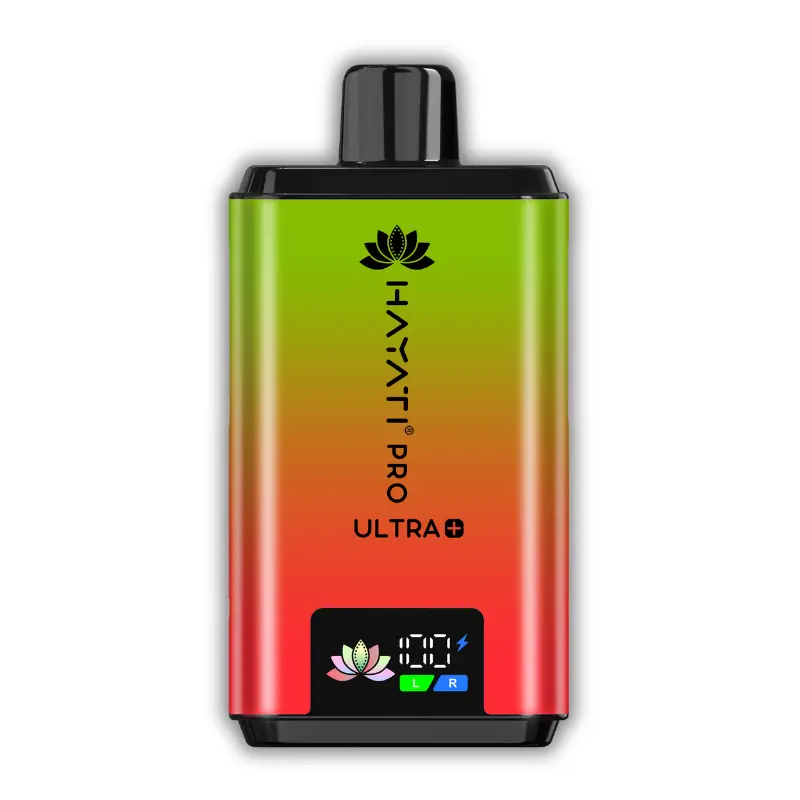
Hayati · Pro Ultra Plus
Watermelon B’Gum / Strawberry B’Gum Hayati Pro Ultra Plus 25000 Prefilled Pod Kit
£11.99
✔ In stock — ready to ship
Genuine Hayati
Free over £20
Same-day dispatch
Secure checkout
The Watermelon B’Gum / Strawberry B’Gum Hayati Pro Ultra Plus 25000 Prefilled Pod Kit is a complete box at £11.99: an 850mAh device, a prefilled pod system holding 22ml at 20mg nicotine salt, and a divided pod whose two reserves are selected by a rotating collar on the mouthpiece. The listing is explicit that the two sides are held apart and that turning the collar is what moves you between them, so this is one pod with two liquids in it rather than two pods in a box. Hayati rate it by laboratory estimate at up to 25,000 puffs. Neither side is cooled.
What this page is not going to do is tell you what the two sides taste like. That work is finished. The £7.99 Watermelon B’Gum / Strawberry B’Gum replacement pod carries 8,800 words on exactly this liquid, and it reached a verdict: hold a confectionery treatment steady across a collar, vary only the fruit behind it, and the two sides converge until they become the hardest kind of pair to tell apart. Seven pages in this corpus now carry a gum token. Between them the chemistry, the naming, the draw-by-draw and the listing diff are all spoken for, and an eighth account of how bubblegum tastes would be a worse page than no page.
So here is the question nobody has asked instead. If the twin is right about this pod, it is not making a claim about one pod. It is making a claim about a construction, and that construction is used more than once on the shelf this kit sits on. A verdict that applies to a construction is a rule about which box to buy, and a rule about which box to buy is worth more to somebody standing in front of 52 identically priced kits than another paragraph about melon. The rest of this page counts the construction, tests the prediction against what Hayati themselves wrote about every kit built that way, says where the evidence stops, and ends with the rule and the alternatives.
The premise, taken from the twin rather than rebuilt
Three findings from the pod page are used here as given. They are not re-derived, because re-deriving them would be both a waste of your time and a straight duplication of a page already on this site.
The first is the mechanism. A confectionery accord does not blur two fruits evenly. It occupies a set of perceptual channels and saturates them, and whatever is left over is the only route a difference has left to travel. Where both fruits are low in acid and neither side is cooled, almost everything the two fruits could have used to distinguish themselves has been taken. The second is the asymmetry: the fruit whose character sits inside the accord’s own territory gets absorbed by it, while the fruit that points somewhere the accord has nothing to say about survives better. The third is the direction of travel over a pod’s life, which is that the aromatic material carrying the difference is the first thing a working coil stops delivering, so two sides that start close finish closer.
The twin tagged its own confidence carefully, and that tagging carries over. It was reasonably confident about the flattening and about the asymmetry. It was only probable about whether you could tell the sides apart in practice, and it put the concentrations in the unknown column, because nothing Hayati publish says how much fruit is in either reserve or whether the two carry the same load. The conclusion it reached about choosing, and this is the sentence that started this page, was that if your two fruits have nothing the treatment does not already own, you are buying one flavour with two labels.
That is a general statement wearing the clothes of a specific one. It does not mention watermelon or strawberry. It is a property of shared-treatment construction, and it should therefore be checkable against every other kit built the same way. Checking it is the work below.
Counting the shelf, and correcting two numbers on the way through
The Hayati Pro Ultra Plus Prefilled Pod Kit shelf holds 52 listings. Every one of them is £11.99. That single fact does more work than it looks like it does, and it is the reason this page exists at all: when the price is constant across a shelf, price carries no information about what you are getting, and the only variable left is how each box is built. On a shelf where the kits cost different amounts you can reason about value. Here you cannot. You can only reason about construction.
Two-sided against single, with the count that titles get wrong
Tally the obliques in the titles and you get 25 two-sided listings against 27 singles. That is the naive count and it is the one I arrived at first. It is wrong, and the correction already exists on this site. The Fruit Bomb / Straw’ Watermelon B’Gum kit page found that two of the 52 boxes carry no flavour at all in the title and are nonetheless divided pods, with the pairing pushed down into the body text. One is listed plainly as the Pro Ultra Plus 25000 kit and is in fact the Blackcurrant Cotton K and Blue Raspberry pairing, duplicating a properly titled listing that sits on the same shelf. The other is the Shisha 30000 kit, which is Apple Mint Grape against Peach Grape Mint, filled at a lower strength and carrying a different puff figure. Move both across and the division is 27 two-sided against 25 single, spread over 26 distinct pairings because of the duplicate.
I was handed that figure as an error to fix, on the basis that the two columns had been transposed. I re-counted it from the catalogue rather than repeat either version, read the body copy of both unnamed listings, and the Fruit Bomb page is right. The transposition is in the naive count, not in the corrected one. This matters beyond bookkeeping, because the same oversight has a consequence further down: a census built by looking for obliques will miss any pairing whose names never reach the title, and one such pairing exists.
Sorting 26 pairings by what each one holds still
Now the part that the angle handed to me turned on. Take the 26 distinct pairings and sort them by what stays fixed across the collar.
- A confectionery marker repeated on both sides, only the fruit moving: six pairings. Grape GB / Strawberry GB, Grape GB / Blue Razz GB, Red Razz GB / Blue Razz GB, this kit, Blueberry H’Bubba / Watermelon H’Bubba and Blueberry Cotton K / Raspberry Cotton K.
- A fruit repeated on both sides, the partner moving: four pairings. Straw’ Grapefruit / Straw’ Dragonfruit, Kiwi Banana / Strawberry Banana, Lemon Lime / Lemon Blueberry and Blue Razz Cherry / Blue Razz GB.
- Two elements held at once: one pairing. The Shisha box keeps both grape and mint on both sides and moves only the third fruit, apple against peach. It is the most tightly anchored pairing on the shelf and it is invisible to a title search.
- One side a superset of the other: three pairings. Strawberry Ice / Strawberry Raspberry Ice, Blueberry Raspberry / Blueberry Raspberry Cherry and Fresh Mint / Blue Razz Mint, where one half is the other half plus a term.
- Nothing named in common: twelve pairings. Everything else, including the contrast constructions such as Straw’ Cranberry Cherry / Cherry Ice and Blue Razz Pineapple / Strawberry Ice.
Six plus four plus one plus three plus twelve is twenty-six. So fourteen of the twenty-six pairings on this shelf hold something named constant across the collar and twelve do not. Holding something still is the majority arrangement, not a curiosity, which is the opposite of what I expected before counting.
Where the number I was given had to be narrowed
The angle arrived claiming seven shared-treatment pairings, and listed Straw’ Grapefruit / Straw’ Dragonfruit among them. It does not belong there. What that pairing holds constant is strawberry, which is a fruit, and what varies is also a fruit. It is the mirror of this construction rather than an instance of it, and the twin had already classified it that way before I got here. So the honest figure for a confectionery marker held identical across a collar is six, not seven, and the seventh should be counted with the fruit-anchored group where it belongs. Kiwi Banana / Strawberry Banana behaves the same way, holding the banana and swapping its partner.
Six needs narrowing again, and the narrowing comes from a page that did the counting properly. The Grape GB / Strawberry GB pod page and the Blueberry B’Gum pod page between them established that GB cannot serve as a settled treatment. The letters are never expanded in any title, three separate retail descriptions gloss them in ways that do not agree, and one listing goes out of its way to hold its GB product apart from the bubblegum elsewhere in the range. An abbreviation with three accounts and no agreement between them is not a fixed quantity, so it cannot be the constant in anybody’s comparison. Three of the six are GB pairings. Remove them and three remain in which a confection is named, spelled and applied identically to two different fruits: this kit, the H’Bubba pair and the Cotton K pair. The twin reached the same three by a different route across the whole catalogue, which is reassuring rather than novel.
Three of twenty-six is a small number, and I would rather print it than dress the claim up. What follows is therefore tested on all six marker-repeating pairings, with the three GB ones flagged every time they are used, because six weak cases and three strong ones are worth more evidence than three strong ones alone.
The catalogue files these kits as one flavour, not two
Before the copy, there is a piece of evidence sitting in the data that nobody has picked up, and it is better than the copy because nobody wrote it to persuade anybody.
Every listing on this site carries a flavour field, separate from the title, used for filing. For most of the divided kits it records both sides, so Sour Apple / Juicy Peach is filed as Sour Apple and Juicy Peach, and Blueberry Raspberry / Mr Blue is filed as both of those. Eight of the twenty-five titled dual kits are not filed that way. Their flavour field records one side only, or collapses the pairing into a single label.
Sort those eight against the classification above and the distribution is not random. Six of the ten anchored pairings that have an oblique in the title are filed under one flavour. Only two of the fifteen unanchored or superset pairings are. Put plainly: when the two sides of a Pro Ultra Plus kit are built on a shared element, whoever filled in the flavour field was six times out of ten content to write one flavour down and stop.
This kit is one of them, and it is the most compressed case on the shelf. The title names Watermelon B’Gum and Strawberry B’Gum. The flavour field says Strawberry Bubblegum. Watermelon, which is the first word of the product name, is absent from it. The confection has also been spelled out in full, which the Strawberry Watermelon Bubblegum nic salt page already showed carries no meaning. The Blueberry B’Gum pod page counted four separate spellings for chewing gum across 20 of the 492 listings, and the H’Bubba pod page found that the choice between two of them tracks which device you are buying rather than what is in the pod. And the slug drops the apostrophes and the trailing format words as well, so the same product exists under three renderings that each throw away something different: the title keeps both fruits, the slug keeps both fruits without their punctuation, and the filing keeps one fruit and the gum.
I am not going to claim that a filing field is a chemical measurement. Somebody typed it, possibly in a hurry, and a database field is not a tasting. But it is an independent source, produced for a different purpose than selling the kit, and it points the same way as the twin’s reasoning did. Two sides that a filing clerk collapses into one label are two sides that at least one person who handled the product did not think needed distinguishing. Compare the Blueberry H’Bubba pairing, filed as Blueberry H’Bubba with the watermelon side dropped, and the Cotton K pairing, filed as Blueberry Cotton K with the raspberry side dropped. Three shared-confection kits, three collapsed fields, and in every case the surviving name is one fruit plus the treatment.
Testing the prediction against Hayati’s own copy
The second test is the retail description. Every kit on the shelf has one, written by the same hand or the same small set of hands, to the same template: an opening, a flavour paragraph, a bullet list. If the shared-treatment construction really does flatten two sides into something close to one, the person writing the flavour paragraph will run out of things to distinguish, and the shape of the writing should show it. That is a prediction about prose rather than liquid, which is a limitation I will come back to, but it is checkable and nobody has checked it.
What the six anchored descriptions have in common
All six resolve the difference between their two sides onto a single axis, and it is the same axis every time: weight against lightness, or calm against liveliness. For this kit, the melon side is put as the light one and the berry side as the richer one. For the H’Bubba pairing it is a gentler berry gum against a fresher melon one. For the Cotton K pairing the blueberry side is mellow and the raspberry side brighter. For Grape GB against Strawberry GB, the grape is deep and the strawberry lighter. For Grape GB against Blue Razz GB, the blue side is the livelier one. For Red Razz GB against Blue Razz GB, the red is more natural and the blue brighter and sweeter.
Six descriptions, six times the same dimension. No second axis appears anywhere in the set: nothing about texture differing, nothing about one side lasting longer on the exhale, nothing about a different kind of sweetness rather than a different amount of it. One knob, turned two ways.
Five of the six also say out loud that the treatment is shared, in a short phrase tucked into the flavour paragraph. The Grape GB and Strawberry GB copy has the two sides carrying "the same chewy-sweet character". The Cotton K copy puts its two berries against "the same sweet backdrop". The Grape GB and Blue Razz GB copy offers its second side as a change of fruit "in the same gummy-sweet style". The H’Bubba copy opens by announcing fruit bubblegum "twice over". The Red Razz and Blue Razz copy says "both in gummy style" in its first sentence. Only this kit’s own description leaves the observation implicit, and even here both sides are called sweet in the same breath.
What the contrast descriptions do instead, and it is different
Set the twelve unanchored pairings beside them and a second feature appears that the anchored six mostly lack: a sentence whose only job is to say what the collar is for. Straw’ Cranberry Cherry / Strawberry Raspberry Ice offers a move "from tart to chilled". Sour Apple / Juicy Peach promises "two distinct experiences" in one device. Straw’ Cranberry Cherry / Cherry Ice gives you depth one moment and crispness the next. Blue Razz GB / Lemon Lime is pitched at alternating between a sugary flavour and a zesty one. Cherry Ice / Peach Mango sets a refreshing option against a fuller one. In every case the copy names a benefit that belongs to the switching rather than to either side.
The anchored six do not do this, or do it weakly. This kit’s description simply states that the collar moves you between the two and stops. The Cotton K copy says the collar switches between the gentler berry and the livelier one, which is a restatement of the difference rather than a use for it. The H’Bubba and Grape GB copy manage a mild version, going from the darker to the brighter whenever you like. None of them constructs a reason to own both.
The one case where the copy changes its argument, which is the result
The most useful single data point in the set is the tightest pairing of the six. Red Razz GB and Blue Razz GB are not two fruits at all. They are two colour names for raspberry, under an identical marker. If the prediction is right, this is where the writer should have the least to work with, and it is.
Two things happen in that description that happen nowhere else on the shelf. It concedes the closeness explicitly, offering the pairing as a comparison between "two versions of the same berry", which is a remarkable thing for selling copy to volunteer. And then it stops arguing that the sides are different and starts arguing something else entirely: that switching between them "keeps either from growing stale". That is not a claim about variety. It is a claim about relief from repetition, and it would be just as true of two reserves filled with identical liquid, because palate fatigue is a property of continuous exposure rather than of flavour difference.
The value proposition has migrated. On the contrast kits the collar is sold as access to two things. On the tightest anchored kit it is sold as a break from one thing. That migration is precisely what the twin’s mechanism predicts should happen as the two sides converge, and it happened in the one place the mechanism says it should happen hardest. Nobody wrote that description with this argument in mind, which is what makes it worth something.
Where the evidence runs out, said before the rule and not after it
Four limits, and the first is the serious one.
Copy is not liquid. A writer handed two names that differ by one word has one word’s worth of difference to write about, and will write a single axis whether the two liquids converge or not. The flavour-paragraph test therefore cannot distinguish between two sides that genuinely taste nearly the same and two sides that taste quite different but were described by somebody reading the names off a spreadsheet. It corroborates the twin’s reasoning, in the weak sense of being exactly what you would see if the reasoning were right, and it rules nothing out. If you want the strong version, it is not available, and anyone offering it is guessing.
The filing field has the same weakness, doubled. A collapsed flavour field could mean a clerk who heard two names for one thing, or a clerk in a hurry. Its value is that it is independent of the sales copy, not that it is authoritative. Two weak signals pointing the same way is better than one, and it is still not a measurement.
Three of the six rest on a contested abbreviation. If GB does not denote one confection consistently, then Grape GB against Blue Razz GB may not be a shared-treatment pairing at all, and the two sides could be carrying different treatments under a shared two-letter label. That would weaken the count from six to three at a stroke. It does not weaken the three, and this kit is one of the three.
The concentrations are unpublished, on this kit and on all of them. A pairing whose two reserves carry different fruit loads would behave differently from one that is balanced, and nothing in any listing tells you which you have. The twin put this in its unknown column and it stays there.
What survives all four is modest and worth having. Across every kit on this shelf built by holding a marker steady, the maker’s own description and the site’s own filing behave as though the two sides were close, and in the closest case of all the copy abandons the difference claim and reaches for something else. No case on the shelf contradicts it. That is consistency, not proof, and it is enough to make a purchasing rule out of.
The rule, and what it costs when it is ignored
Here is the rule, stated so you can disagree with it.
A collar is worth paying for in proportion to how far apart the two sides are built. On a shelf with one price, the money is not what you are spending. The 22ml is.
Every box here is £11.99 and every box holds 22ml. A single-flavour kit gives you all of it as one liquid. A divided kit gives you roughly half of it as each of two. That split is the whole cost of the collar, and it is paid in liquid rather than in money, which is why it is easy to miss on a shelf where the numbers never move. If the two sides are built far apart, the split buys you a genuine second flavour for nothing. If the two sides converge, you have paid eleven millilitres to own a near-copy of the other eleven, and you cannot get them back, because the halves share one pod and one coil and are thrown away together.
That is the whole argument, and the practical form of it is a question to ask of any divided kit before buying: what do these two fruits have that the treatment does not already own? If the honest answer is a change of intensity, you are buying one flavour twice at the cost of not buying a second one.
The exit that exists for two of the six, and not for this one
The rule has a sharp consequence and it is checkable. Across the six marker-repeating pairings there are ten distinct half-flavours. Exactly one of them is also sold as an undivided 22ml kit on this shelf: Blue Razz GB, at the same £11.99, with no collar and the full volume in one liquid. Blue Razz GB happens to be a half of two of the six pairings. So if you accept the rule and you were looking at Red Razz GB / Blue Razz GB or at Grape GB / Blue Razz GB, the shelf has already answered you: the single gives you twice as much of the side you actually wanted, for the same outlay, and gives up a switch the copy itself only defends as a break from monotony.
No such exit exists here. Neither Watermelon B’Gum nor Strawberry B’Gum is sold on its own anywhere in the 492 listings, on any platform, in any format, under any of the four spellings the range uses for chewing gum. The nearest thing to a counter-example is the compound Straw’ Watermelon B’Gum, which puts both fruits on one side of a different pod rather than either fruit by itself, and which the nic salt page showed is the same recipe as the spelled-out Strawberry Watermelon Bubblegum. Neither half of this pairing can be bought alone. The collar is compulsory for this flavour.
That is not unique, and counting it is the last number on this page. Of the twenty-nine distinct divided pairings in the catalogue, seven are ones where neither half is sold standalone: H’Berg / P’Man, this pairing, Straw’ Grapefruit / Straw’ Dragonfruit, Kiwi Banana / Strawberry Banana, Blueberry H’Bubba / Watermelon H’Bubba, Blackcurrant Cotton K / Blue Raspberry and the Shisha pairing. Note the denominator: twenty-nine, not twenty-eight, because the Shisha pairing only exists in body copy and a census built on obliques will not find it. Five of those seven are anchored pairings, which is a sting in the tail. The construction where the collar is worth least is disproportionately the construction where the shelf gives you no way to decline it.
What the rule says about this specific box
Taking the rule and the exits together, the reading for this kit is straightforward and slightly unflattering. You are buying 22ml of sweet uncooled fruit bubblegum, arranged as two reserves whose difference is one axis of weight, with a collar that cannot be traded for a bigger portion of either side. Buy it if the register is what you want and you are content to receive it in two settings rather than one. Do not buy it expecting two flavours, and do not buy it because the pairing looks like a way to sample two things, because the sampling it offers is narrower than the names suggest. The twin’s method for testing that on your own pod is on the pod page and there is no sense repeating it here.
Cross-treatment alternatives at the same money
If the rule persuades you, the shelf is full of kits where the collar is doing more work. All of these are £11.99 and 22ml, so the comparison is genuinely like for like.
If you want the sweetness but want the collar to earn its keep
Blue Razz GB / Lemon Lime is the cleanest example on the shelf of the opposite construction: a confection on one side and a sharp citrus on the other, with nothing shared between them. Whatever you think of either half, the two are built apart, and the copy sells the alternation rather than the pair. Blackcurrant Cotton K / Blue Raspberry does the same trick with candy floss on one side only, so you get the confectionery register and an unsweetened-by-comparison fruit to move to, rather than two versions of the same idea.
If a temperature change is what you actually want from a collar
A coolant on one side and none on the other is the widest gap two reserves can be built with, because it moves a channel the fruit cannot reach. Straw’ Cranberry Cherry / Cherry Ice and Straw’ Cranberry Cherry / Strawberry Raspberry Ice both do it, as does Blue Razz Pineapple / Strawberry Ice. None of them is a gum flavour, which is the trade.
If you want a whole 22ml of one thing
Twenty-five of the fifty-two boxes are undivided. Strawberry Watermelon is the closest relative of this kit that has no gum in it at all, and it puts both fruits on one side of the draw rather than either side of a collar. H’Bubba is the inverse: gum with no fruit bolted to the front of it, and the only fruit-free gum flavour this platform sells. Watermelon Fruit Twist takes the melon somewhere other than a sweet shop, and Cherry Berry is a plain red-fruit blend for anyone who wants the volume without the sugar load.
If the sugar is what you want to get away from
Lemon Lime is among the driest of the single kits at this volume, and Strawberry Raspberry Ice keeps the berry but puts a cold finish on it. Neither is confectionery-led. If you want to look at the range as a whole rather than one construction at a time, the combined Pro Ultra Plus kits and pods shelf runs to 104 listings and the sweet shelf gathers 61 across every platform.
If you want the same experiment in a different treatment
Blueberry Cotton K / Raspberry Cotton K is candy floss over two berries, and it is the one anchored pairing where Hayati’s own copy attributes a genuine tang to one side, so it is the best test case on the shelf for whether the rule has exceptions. Blueberry H’Bubba / Watermelon H’Bubba is the nearest neighbour of all, being gum over two fruits under a different spelling, and its pod page established that the two gum markers cover identical ground and that the choice of marker tracks which device you are buying rather than what is in the pod. Grape GB / Strawberry GB and Red Razz GB / Blue Razz GB complete the set, with the caveat about the abbreviation attached to both.
If £11.99 is more than you want to commit to a pairing
The Mini Ultra kits are the small version of the same idea at £3.99, and two of them are useful here: Fruit Bomb / Straw’ Watermelon B’Gum puts a gum side against a mixed-fruit side in a much smaller box, and Straw’ Cranberry Cherry / Cherry Ice lets you test the warm-against-cold construction cheaply. Pod shelves also exist for most of these pairings at £7.99, including the Grape GB / Strawberry GB pod, though a pod needs a device you already own. Check the range name printed on your device against the range name in this title before ordering anything, since Hayati use different pods for different hardware.
If you are browsing rather than shortlisting
The watermelon shelf is a short one at 29 products across every format, which makes it a quicker way to see what the range does with that fruit than working through the kit shelf. Straw’ Guava / Dragon Berries and Kiwi Banana / Strawberry Banana are worth a look from opposite directions: the first shares nothing across its collar, the second shares its banana, and reading the two descriptions side by side is the fastest way to see the grammar this page has been counting.
The box, kept short
What arrives is the 850mAh device and the prefilled pod system, filled and sealed, with nothing to add before the first draw. The pod holds 22ml at 20mg nicotine salt, which is the maximum strength a prefilled pod is sold at in the UK, and the maker’s laboratory estimate is up to 25,000 puffs. When it is empty, the matching replacement pod is £7.99 and the device carries on.
The one specification that matters for this particular liquid is not on the list, and it is the coil count. There is one coil and one wick, shared by both reserves. That is what makes the two sides a single purchase rather than two: they age together, they gunk together, and a heavily sweetened liquid gunks a coil faster than a thin one. On a divided pod that consequence is doubled, because both halves here are sweet, so neither side ever gives the coil an easier shift. Hayati publish no resistance figure and no parts breakdown, so how the pod is retained and what the coil is made of are not things this page can tell you.
Nothing else about the hardware is worth your reading time, because other pages on this platform have already covered it and none of them found anything that changes with the flavour inside. The kit shelf holds the rest.
The published figures
| Listing | Watermelon B’Gum / Strawberry B’Gum Hayati Pro Ultra Plus 25000 Prefilled Pod Kit |
| Construction | Divided pod, two reserves, one collar, one coil |
| Filed under | Strawberry Bubblegum (one flavour, not two) |
| Liquid on board | 22ml, split across the two sides in an unpublished ratio |
| Nicotine | 20mg salt |
| Cell | 850mAh |
| Maker’s puff estimate | Up to 25,000, a laboratory figure |
| Cooling | None on either side |
| Price | £11.99, the same as all 52 kits on the shelf |
| Refill | Matching pod at £7.99, device reused |
Two rows in that table are doing work the others are not. The filing row is evidence, for the reasons set out above, and it is the only row that disagrees with the title. The price row is the reason the whole page exists: a constant price across a shelf removes the usual signal, and forces the decision onto construction.
The 22ml row is the one to read carefully. It is the total, not the per-side figure, and Hayati do not publish the split. If the two reserves are even then each side is about eleven millilitres, which is roughly a standard bottle’s worth of liquid committed to each. If they are not even, one side runs dry first and the collar stops being a choice partway through the pod’s life. Both are consistent with everything published, and neither can be confirmed from a retail listing, this one included.
The 20mg row is fixed by UK law rather than chosen by Hayati, so it tells you nothing about this kit that it does not tell you about almost every other prefilled pod on the shelf. The one exception on this platform is the Shisha box, filled lower, and it is also the pairing this page had to count separately for the unrelated reason that its flavour names never reach the title.
Living with a kit that is sweet on both sides
Most handling advice is the same for every pod on this platform and is not worth repeating. Three things are specific to a divided pod whose halves share a confectionery base, and they follow from the argument above rather than from a generic checklist.
The collar does not reset your palate, so do not use it as though it does. On a contrast pairing, turning from a cold side to a warm one genuinely changes what you are tasting and the change registers immediately. Here the two sides sit on one axis, and a switch made because you are tired of the sweetness will not help, because the sweetness is the part that does not move. If the sugar is getting heavy, the answer is to put the device down for a while, not to turn the collar. That is a real limitation of this construction and it is the practical face of everything this page has counted.
Carryover is worse here than on a contrast pod, and in an unhelpful direction. One coil and one wick means the first few draws after a switch are a mixture of what you just had and what you have moved to. On a pairing built far apart, that mixture is obvious and resolves quickly. On this pairing the two sides are already close, so the carryover period is not obvious at all, and you may simply conclude that the sides are identical when what you are tasting is the tail of the previous one. Give it a dozen draws before deciding anything, and do not attempt the comparison on a pod that is more than half spent.
Expect the two sides to draw together as the coil ages, and plan the pod around that. The material that distinguishes the fruits is the volatile part, and that is what a residue-coated coil stops delivering first. The sweetness and the heavy base of the gum are the last things to go. So whatever difference exists between the halves is at its widest on day one and narrowest at the end. If you bought the kit to hear the two sides, do that comparison early. Later in the pod’s life the honest description of what you have is a single sweet gum flavour with a slight change of shading, and there is no fault in the device when that happens.
Beyond that: draw at an unhurried pace, because a syrupy liquid wicks more slowly than a thin one and a fast chain of draws will out-run it; keep the kit out of a hot car and out of direct sun, since heat thins the liquid and makes seepage round the mouthpiece more likely on a pod this full; and when the flavour flattens on both sides at once, that is the coil rather than the liquid, and the pod is finished regardless of how much is left in it. The device contains a cell and the spent pod contains a coil and a residue of liquid, so neither belongs in household waste. Take both to a shop that operates a battery take-back point or to a local recycling facility.
Questions this kit raises
Are the two sides actually different?
Probably, slightly, and along one dimension rather than two. The twin pod page did the work and concluded that a shared gum treatment over two low-acid fruits leaves very little room for the fruits to separate, and that you are more likely to notice that one side is lighter than to identify which fruit is which. Everything on this page is consistent with that and none of it is a measurement.
If they are that close, why does the kit exist?
Because a divided pod is the arrangement the range uses for most of its two-flavour listings, and because fourteen of the twenty-six pairings on this shelf hold something constant across the collar. The construction is the norm here rather than an oddity. Whether it is the right purchase for you is a separate question from why it was made.
Can I buy just the watermelon side, or just the strawberry side?
No. Neither Watermelon B’Gum nor Strawberry B’Gum appears as a standalone flavour anywhere in the 492 listings, on any platform, under any of the spellings the range uses for gum. This pairing is one of seven in the catalogue where neither half is sold alone.
Is there a version of this pairing with a bigger gap between the sides?
Not with these two fruits. For the same money and the same volume, a pairing built without a shared element will give you two sides further apart: Blue Razz GB / Lemon Lime keeps a confection on one side and drops it on the other, and the cooled pairings widen the gap further still.
Is any of this kit iced?
No. Both sides are uncooled, which the listing states plainly. That matters more here than it would elsewhere, because a coolant on one side would have opened a channel the gum does not occupy and given the two halves somewhere to differ.
Why does the site file it as Strawberry Bubblegum when the title says two flavours?
Because the flavour field records one label and somebody chose the strawberry one. It is not an error you need to act on, and it is one of eight kits on this shelf filed that way, six of which are pairings built on a shared element. Whether that tells you anything about the liquid is discussed above, with the caveats attached.
How much liquid is on each side?
Unpublished. The listing gives 22ml as a total and says nothing about the split, so an even division is an assumption rather than a fact. If the reserves are uneven, one side will run out before the other and the collar stops offering a choice from that point on.
What happens when the pod is empty?
The device is reusable and the matching pod for this pairing is sold separately at £7.99. That is a £4 difference from buying the kit again, which only matters if you intend to stay on this pairing rather than move to another.
Does the 25,000 figure mean I will get 25,000 puffs?
No. It is a laboratory estimate published by the manufacturer, arrived at under test conditions rather than in use, and it is the same figure printed on most of this shelf. Treat it as a category label rather than a measurement of what you personally will get.
Is the rule on this page saying two-sided kits are a bad buy?
No, and the Fruit Bomb kit page makes the case for them properly. The rule is narrower: on a shelf with one price, the collar is worth what the distance between the two sides is worth, and a shared-treatment pairing is the construction where that distance is smallest.
Which kit would you buy instead if you wanted a gum flavour?
If you want the confection without a fruit attached, H’Bubba gives you the whole 22ml of it undivided. If you want gum and fruit but a wider collar, the Fruit Bomb pairing sets a gum side against a mixed-fruit one. If you want the two fruits and can leave the sugar behind, Strawberry Watermelon is the same two fruits with no confection over them.
The short version
This is a complete Pro Ultra Plus kit at £11.99 holding 22ml of sweet, uncooled fruit bubblegum at 20mg, divided into two reserves selected by a collar, with the maker rating it by laboratory estimate at up to 25,000 puffs. The flavour question was settled on the £7.99 pod page and is not reopened here.
What this page adds is what that settlement implies for the shelf. Of the twenty-six distinct pairings on this kit shelf, fourteen hold something named constant across the collar and six repeat a confectionery marker with only the fruit moving, of which three rest on a marker the range has never defined consistently. In every one of the six, Hayati’s own description resolves the two sides onto a single axis of weight, and in the closest case the copy gives up on difference altogether and sells the collar as a break from repetition. Six of the ten anchored pairings are filed in the catalogue under one flavour rather than two, against two of the fifteen unanchored ones. This kit is filed as Strawberry Bubblegum, with the watermelon dropped.
None of that is a measurement, and the page says so at the point where the evidence stops. What it supports is a rule: with the price fixed across the whole shelf, the collar costs you eleven millilitres rather than money, so it is worth having in proportion to how far apart the two sides are built. Where that rule tells you to buy the single instead, the shelf usually does not let you, and on this pairing it definitely does not, because neither half is sold alone anywhere. Buy this kit for the register, in two shades. Buy a cross-treatment pairing if you want the collar to do more than shade.
Strictly for adults aged 18 and over. Nicotine is an addictive substance.
You might also like


