
Home / Hayati Pro Ultra Plus Prefilled Pod Kit / Lemon Lime Hayati Pro Ultra Plus 25000 Prefilled Pod Kit
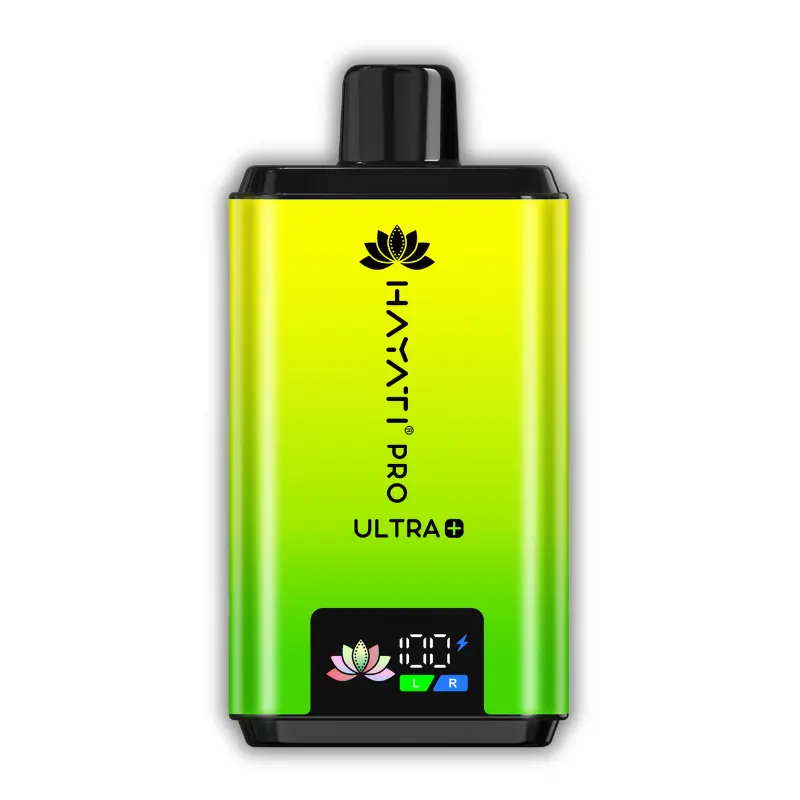
Hayati · Pro Ultra Plus
Lemon Lime Hayati Pro Ultra Plus 25000 Prefilled Pod Kit
£11.99
✔ In stock — ready to ship
Genuine Hayati
Free over £20
Same-day dispatch
Secure checkout
Eleven pounds ninety-nine buys the complete arrangement: a Hayati Pro Ultra Plus device with a published capacity of 850mAh, and one prefilled pod holding 22ml of Lemon Lime at 20mg nicotine salt, boxed together with nothing to assemble and nothing to fill. Hayati put a figure of up to 25,000 puffs on the pod, produced on bench equipment under a fixed draw pattern, which makes it a way of ranking listings against each other rather than a forecast of anything your own use will produce.
The title is worth reading rather than the address bar. This page lives at a URL ending in 25000, which drops the words that tell you what arrives, and the full name on the listing is Lemon Lime Hayati Pro Ultra Plus 25000 Prefilled Pod Kit. A kit, not a refill. That gap between slug and title is not a curiosity specific to this product: 21 of the 52 kits on this platform have a URL that loses the format words, so nothing rare is happening here and no argument on this page rests on it. It is worth one sentence because a buyer arriving from a search result reads the address before the heading, and on this shelf the address is the less reliable of the two.
One thing the listing does settle in its own words, which matters more than the URL. This pod carries one liquid. Their own sheet calls it a single flavour and says plainly that nothing needs switching, and that sentence is the reason none of the divided-pod reasoning elsewhere on this site applies here. There is no rotating collar under the mouthpiece. There is no second reserve. Twenty-two millilitres of citrus sit behind one coil from the first draw to the last.
So the decision this page exists for is not a flavour decision. Nine pages on this site already take the taste apart and between them they have finished the job. It is not a price decision either, because every single listing this one competes with costs exactly the same. It is a decision about what 22ml should be made of, and it comes down to one question: does 22ml of one citrus beat 11ml of that citrus plus 11ml of something else, when both cost £11.99?
The counts this page rests on, and the three figures elsewhere on this site that no longer match them
Everything below is built on the Pro Ultra Plus kit shelf as the catalogue records it today, counted rather than quoted. Three sibling pages state versions of these numbers and all three are now slightly out, which is worth flagging before the arithmetic starts rather than after.
The Hayati Pro Ultra Plus Prefilled Pod Kit shelf holds 52 listings. Twenty-seven carry one flavour and twenty-five carry two behind a collar. Every one of the 52 is £11.99. Every one of the 52 records a capacity of 22ml. There is no exception on price, no exception on volume, and the split between one flavour and two is closer to even than any other structural division on the shelf.
The Blue Razz GB / Lemon Lime kit page counts fifty-one kits, twenty-six of them single. The Orange Lemon Lime kit page counts fifty-two but says that with one exception every one is £11.99. Today there are fifty-two, twenty-seven are single, and there is no exception on price. The shelf has gained one single-flavour listing since those pages were written and the price outlier has either been corrected or never existed. None of this damages either page's argument, both of which turn on the uniformity rather than on the exact denominator, and both were right about the thing they were counting for. It is recorded here because a figure that drifts by one and then gets copied forward is how a corpus ends up confidently wrong, and because the arithmetic below divides by these numbers.
The matching pod shelf is the mirror image and I have not recounted it, because the Lemon Lime Pro Ultra Plus pods page already published it: 52 bare pods, twenty-seven single and twenty-five divided, every one £7.99 for 22ml. I checked that it still holds and it does. What is worth drawing out, and what that page had no reason to draw out, is that the two shelves match at every position. Same total, same split, one price each. Hayati have applied the same structure twice, at two price points, on the same platform. That is a policy rather than an accident of how one shelf was stocked.
What has already been said about the free collar, and by whom
This page was commissioned on an argument that turned out to be mostly written already, and the honest thing is to say so at the top rather than let a reader discover it three sections in.
The argument handed over was that the collar is priced at zero, so choosing an undivided pod looks like refusing something free, and that the per-millilitre arithmetic shows the opposite. Every component of that is on the site. The Blue Razz GB / Lemon Lime kit page states plainly that the second reserve and the collar both cost nothing, and it is the page that noticed the uniform pricing makes that true by subtraction. The Orange Lemon Lime kit page works out that the gap between a kit and its bare pod is four pounds exactly across the whole platform, which is the body priced by accident, and it says in terms that the divided pod is not a discount on anything. The Lemon Lime / Summer Dream kit page carries the doubling itself, citing about thirty-six pence a millilitre across a whole pod and about seventy-three pence for the liquid you actually wanted if you finish wanting only one side, and it even names this listing as the answer for a citrus buyer. The Lemon Lime / Lemon Blueberry pods page owns what one coil does to two liquids.
So the doubling is published, the free collar is published, the body premium is published and the stranded half is published. Repeating any of it would be a fifth telling. What none of those pages does is ask the question that has to be settled before the doubling means anything, and that question turns out to have a countable answer which changes who the arithmetic applies to. That is what the rest of this page is.
What "free" has to mean before the arithmetic can bite
Start with the word itself, because it is doing more work than it can carry.
Something thrown in at no extra charge is normally an unambiguous gain. You pay for the thing you wanted and a second thing arrives beside it. The worst case is that you ignore the second thing, and ignoring it costs nothing, so the floor on its value is zero and there is no version of the decision where accepting it leaves you worse off. That is what people mean when they say a feature is free, and it is why refusing one feels irrational.
The divided pod is not shaped like that. It is not additive, it is partitive. You do not receive 22ml of citrus and a second reserve alongside it. You receive one 22ml budget with a partition through the middle of it. Hayati charge nothing for the partition and nothing for the mechanism that selects a side, and both of those really are free. What is not free is the contents, because the second reserve is not added to your liquid, it is taken out of it.
Nothing on the shelf signals that difference. The price is identical, the capacity is identical, the device is identical, and the only visible change is an extra name in the title. A buyer comparing the two listings side by side sees more for the same money, which is the correct reading of every other case where a manufacturer adds a mechanism and holds the price. Here the correct reading is a substitution presented in the grammar of an addition.
Which is where the arithmetic would normally land, except that it lands on a premise nobody has checked. Saying you have lost half your citrus only means something if there was an alternative you gave up. If the second flavour is one you could have bought on its own, then yes, the divided pod took eleven millilitres of citrus from you and gave you eleven millilitres of a liquid you were free to buy separately, and the swap can be priced. If the second flavour cannot be bought on its own at any price, no swap took place, because there was no separate purchase to weigh against. You were never choosing between two routes to the same pair of liquids. You were choosing between one liquid and a liquid that exists nowhere else.
Those are two genuinely different products wearing the same price tag, and the catalogue can tell you which one any given pairing is.
Four pairings in twenty-five, and this liquid is in two of them
I classified all twenty-five divided kits by whether each half is also sold as a single-flavour kit on the same platform. The test is deliberately narrow: same shelf, same price, same format, so that the comparison is between two things a buyer could actually put in the same basket.
- Both halves buyable alone: four pairings. Blue Razz GB / Lemon Lime, Lemon Lime / Summer Dream, Blueberry Raspberry / Mr Blue, and Blue Razz Cherry / Blue Razz GB.
- One half buyable alone: ten pairings. Among them Lemon Lime / Lemon Blueberry, Sour Apple / Juicy Peach and Straw’ Cranberry Cherry / Strawberry Raspberry Ice.
- Neither half buyable alone: eleven pairings. Among them Blueberry Cotton K / Raspberry Cotton K, Blackcurrant Cotton K / Blue Raspberry and Blue Razz Pineapple / Strawberry Ice.
Four in twenty-five. For the other twenty-one, the loss framing does not apply, or applies only to one side of the pod, because at least one of the two liquids has no separate existence on this shelf. Buy Blueberry Cotton K / Raspberry Cotton K and you have not been talked out of two single kits. Those single kits do not exist. The collar there is free in the strict sense, because declining it would not have bought you anything else.
The flavour-level version of this count belongs to the Lemon Lime pods page, which found that thirty-nine distinct names appear across the twenty-five pairings and that ten of those thirty-nine are also sold undivided, arriving at the ten as five of the eight repeatedly paired names plus five of the thirty-one used once. My classification returns the same thirty-nine and the same ten, so that figure is confirmed rather than rebuilt. The pairing-level count is the new part, and it is the one the decision needs, because a buyer chooses a pairing rather than a flavour name. Ten substitutable flavours distributed across twenty-five pairings could in principle have produced anything from five fully substitutable pods to ten. It produced four.
A word on why one sibling counts forty names and another counts thirty-nine
The Orange Lemon Lime kit page puts the figure at forty and the pods page puts it at thirty-nine, and the disagreement has a cause rather than an error behind it. Hayati write this citrus two ways, and which way depends on which shelf you are standing on. On the kit shelf the pairings are titled Blue Razz GB / Lemon Lime and Lemon Lime / Summer Dream. On the pod shelf the same two pairings are titled with an ampersand instead, and the spaces around the oblique disappear as well. An automated pass over the pod shelf therefore sees two distinct names where a pass over the kit shelf sees one, and thirty-nine becomes forty. Both counts are defensible and neither page did anything careless; they were standing on different shelves. The general finding that Hayati's ampersand and no-ampersand spellings are one recipe written twice belongs to the Lemon Peach Passionfruit nic salt page, which established it for Orange Lemon & Lime and for Lemon & Mint, and I am citing it rather than re-deriving it. What is added here is only that the split runs along the kit and pod boundary on this platform, which is why two careful pages reached different totals.
This liquid's three pairings are one of each kind, which is unusual and useful
Lemon Lime appears in three of the twenty-five pairings, more than all but one name in the range, and the pods page has already settled what that frequency does and does not mean. What nobody has noticed is that the three fall into three different classes, so a buyer who fancies this citrus with something beside it faces three decisions that look identical on the shelf and are not.
Blue Razz GB / Lemon Lime: a priceable swap
Blue Razz GB / Lemon Lime is one of the four. Both halves have their own kit: this one, and Blue Razz GB, both £11.99, both 22ml, both on the same shelf. So the divided kit is a genuine alternative to a purchase you could have made, and you can put figures on it. Two single kits are £23.98 and bring 44ml, twenty-two of each, and two bodies. The divided kit is £11.99 and brings 22ml split between the two, and one body. It is not two flavours for the price of one. It is half of each for the price of one, which is a different offer and a much less generous-sounding one, although for a buyer who genuinely wanted a fortnight rather than a month of each it is exactly right.
Lemon Lime / Summer Dream: a priceable swap with an unreadable half
Lemon Lime / Summer Dream is the second of the four, and its own page has already worked through the complication, which is that one half of it is an ingredient list and the other is a mood word. It reaches a fair position and I am not going to relitigate it. What the classification adds is that the swap here is priceable in exactly the way the Blue Razz GB one is, because Summer Dream is also sold as a single kit at £11.99. That page frames the second reserve as insurance and concludes that the premium is about the size of the loss. The classification agrees with it and gives the reason it works: insurance requires an alternative to insure against, and this is one of only four pairings where the alternative exists.
Lemon Lime / Lemon Blueberry: not a swap at all
The third is the interesting one. Lemon Lime / Lemon Blueberry is one of the ten with a single substitutable half, and the half that is not substitutable is Lemon Blueberry. I searched all 492 listings for it. Lemon Blueberry appears twice in the entire catalogue, once as this kit and once as the matching bare pod at £7.99. It is not a 10ml bottle, it is not a Mini Ultra pod, it is not on the Rubik line, and it is not a single-flavour anything. It exists nowhere except behind that one collar.
Which means that for this pairing the whole argument reverses. Nobody is losing eleven millilitres of citrus to a liquid they could have bought separately, because the liquid cannot be bought separately. That pairing is the only route to Lemon Blueberry that Hayati have built, at any price, in any format. The collar there is not a partition taking something from you. It is a door, and it is the only door.
So one buyer, standing in front of three listings that carry the same flavour name, the same price and the same volume, is looking at a priceable swap, a priceable swap with one unreadable side, and a sole route to a liquid that has no other listing. Nothing on the shelf distinguishes them and the distinction decides the purchase.
The arithmetic, and the assumption it rests on
Now the numbers, stated once, with the assumption named before rather than after.
Hayati publish that the collar selects a side and publish nothing about how the two reserves are divided. Not the proportion, not whether the division is even, not whether it is the same proportion on every pairing. The total is on the record; the apportionment is not. So treat every number below as resting on an even division, a convention this site has adopted elsewhere and has always labelled as such rather than promoting to a fact. It is a convenience for reasoning, nothing more. Should the reserves turn out to be unequal, the argument still points the same way and only the magnitude moves.
On that assumption, and comparing this kit against any of the twenty-five divided ones at the same £11.99:
- This kit puts 22ml of Lemon Lime behind the coil.
- A divided kit puts roughly 11ml of its named liquids behind the coil each.
- Per millilitre of the specific liquid a buyer came for, the divided kit therefore costs in the region of twice as much. The pods page's thirty-six pence and seventy-three pence are the same relationship expressed on the £7.99 refill, and I am citing those figures rather than producing a second set.
The important thing about that doubling is what kind of cost it is. It is not a price rise. Nobody is charged more. The outlay is identical to the penny and the volume is identical to the millilitre. What changes is composition, and composition is the only variable on this shelf that the price does not track. The collar is free and the second reserve is free, and the citrus is what pays for them.
Which is why the classification matters more than the arithmetic. If the second reserve is a liquid you would have bought anyway, then the divided kit has not charged you eleven millilitres of citrus. It has sold you two things you wanted for the price of one, in half quantities, and the doubling in the citrus column is matched by a doubling of value in the other column that the calculation never shows. If the second reserve is a liquid you would never have bought, the doubling is the whole story and there is nothing on the other side of it. Same price, same pod, same collar, opposite conclusion, depending entirely on a fact about the buyer that no shelf can see.
The test, which is about your last pod rather than your preferences
What follows is the useful part, and it is a condition rather than a verdict, because a verdict would have to assume something about the reader that is not knowable from here.
The question people ask themselves in front of these listings is "would I use the other side?" That question is almost useless, because the answer is nearly always yes. Of course you would occasionally turn a collar that costs nothing to turn. Curiosity alone guarantees it, and a liquid sitting in a device you are holding will get sampled whether or not you wanted it.
The question that decides it is "would I have bought the other side?" Not used, bought. Would you have spent £11.99 on a kit of it, or £7.99 on a refill of it, inside the same period? That is the test, and it separates the two cases cleanly, because it asks whether the second reserve displaces a purchase or merely occupies space you had already paid for.
Four ways to run it honestly, all of which look backwards at behaviour rather than forwards at intentions.
- Did you finish your last one? If you retired a 22ml pod of this citrus with liquid still in it because you had stopped enjoying it, then a divided pod would not have cost you anything you were going to consume, and the collar is free in practice as well as in price. If you finished it and reordered, a divided pod would have halved your supply and sold you eleven millilitres of something you did not ask for.
- Count your actual rotation, not your intended one. If you habitually keep two or three liquids on the go and buy them separately, you are already paying for variety, and a pairing that supplies it inside one pod is a straightforward saving. If you have run one flavour at a time for months, the second reserve is a purchase you have consistently declined to make.
- Look at what you reordered last. Repeat purchases are the only reliable evidence of what a person actually wants. A liquid that appears twice in your order history is one you would have bought; a liquid you tried once is not, whatever you thought at the time.
- Ask whether the other half is even available separately. For twenty-one of the twenty-five pairings the answer is no for at least one side, which makes the test unanswerable and the collar genuinely free. For the four where it is answerable, run it properly. Two of those four carry this citrus.
The honest case for the divided pod on this particular liquid
One argument runs strongly against the undivided kit and it deserves to be put at its strongest rather than acknowledged and waved past.
A sharp, uncooled citrus is precisely the profile most likely to tire a palate before 22ml has gone. This liquid has no coolant of any kind and no confectionery weight: no berries, no gum, no ice. It is two acids and a modest amount of sweetener. That is a strong, narrow and short signal, and strong narrow signals are the ones that wear out first. Twenty-two millilitres is weeks of it rather than days, and there is no version of this pod where you can put the citrus down for an afternoon without putting the whole device down. If there is any liquid on this shelf where a free escape route earns its eleven millilitres, it is this one, and a buyer who is honest about having tired of sharp things before should weight that heavily.
The Lemon Lime / Summer Dream kit is the best-constructed version of that escape route, because the soft, sweet partner is at the opposite end from the citrus and its page has already worked out what the substitution is worth in real time. Blue Razz GB / Lemon Lime puts a wider gap still between the two halves.
The honest case for this one
Three things, and only the first is about money.
All twenty-two millilitres are liquid you chose. Not most of it, not the portion you turn the collar towards, all of it. On a pod this size that is weeks of not having to think about composition at all.
There is no carryover, because there is nothing to carry over from. The Lemon Lime / Lemon Blueberry kit page established that a divided pod runs both reserves through one coil and one wick, so the draws immediately after a switch are not a clean reading of the side you have just selected, and it found the effect asymmetric: a sweet berry residue is audible in a lean citrus in a way the reverse is not. That is the evidence for this point and it is theirs, not mine. Its consequence here is simply that the problem does not arise. Every draw from this pod is the same liquid the last one was.
And there is no collar, so there is no collar to leave halfway, no position to remember and no selector to fail. Hayati publish nothing about how the mechanism is built and I am not going to speculate about its reliability, which would be inventing a fault. The point is narrower and certain: a part that is absent cannot go wrong.
The condition
Buy this kit if you would not have spent money on the other flavour. That is the whole of it. If the second reserve in a pairing is a liquid you would have bought separately within the month, the pairing is a real saving and the doubling is an accounting illusion. If it is not, the pairing is a fifty per cent cut in your supply of the thing you came for, dressed as a free feature, and the undivided kit is the same money for twice the citrus.
It follows that the answer changes with the pairing rather than with the buyer's taste, which is why the classification is the useful output of this page and the arithmetic is not.
The hardware, which is briefly stated because little is published
The box holds a Pro Ultra Plus body with a published capacity of 850mAh and one prefilled pod carrying 22ml at 20mg nicotine salt. That is the full extent of what Hayati put on the record for this listing, and a retail page that tells you more is guessing, this one included.
Worth knowing, because it bears on how much weight to put on any specification quoted for this platform: the catalogue is not internally consistent about the battery. Of the 52 kits on this shelf, 41 record 850mAh, ten record no capacity at all, and one records 900mAh, that one being the Hayati Pro Ultra Plus Shisha 30000 kit, which also carries a different puff rating and may simply be different hardware under a shared range name. My own listing records 850mAh and that is the figure stated here. No Hayati product's data names a charging connector anywhere in the range, so none is named here either, and a page that tells you which cable to use has invented it.
Nothing is published about coil resistance, carrier ratio, airflow path or how the pod is held in the bay. The pod is prefilled and sealed with no fill port, so it is not intended to be opened, and when the liquid is gone the pod is finished rather than refillable. There is no window or gauge, so the first indication that it is running low is the taste thinning rather than anything you can see.
One line of housekeeping and then no more of it: match the range name on your existing device to the range name in this title before ordering, and do not settle a compatibility decision from a retail page.
Specifications, ordered by how much each row decides
Ordering here follows a single principle: a row goes near the top if it separates this listing from the twenty-five divided kits, and near the bottom if it is identical across all fifty-two. That is not the order a specification sheet prints, and it is the order the purchase actually uses.
| Reserves in the pod | One only. Nothing to select, nothing to rotate. |
| Of the 22ml, how much is Lemon Lime | All of it |
| Cooling agent declared | None. The listing names no ice, menthol or mint, and rules them out directly. |
| Replacement pod for this device | Lemon Lime Pro Ultra Plus pods, £7.99 |
| Ticket price | £11.99, body included |
| Pack contents | One Pro Ultra Plus body, one prefilled pod |
| Cell capacity on this listing | 850mAh |
| Strength | 20mg/ml, salt preparation |
| Puff figure | Rated by the manufacturer at up to 25,000 puffs, which is a laboratory estimate |
| Cable or connector | Unpublished across the whole Hayati range |
The first row is the only one that distinguishes this listing from the twenty-five divided kits on the same shelf, since price, volume, strength, device and puff rating are identical across all fifty-two. Everything this page argues is contained in that row.
The second and third rows together produce the four pounds that the Orange Lemon Lime kit page identified as the body price, arrived at by subtracting the refill from the kit. That page also works out what the four pounds is worth against the other platforms Hayati run, and anyone deciding whether to own a second device should read it there rather than have it summarised here.
The cooling row does more than it looks. A coolant holds its apparent freshness as a coil tires in a way fruit acid does not, so an uncooled citrus reads tired in its last quarter more noticeably than a cooled liquid on the same hardware. That is a property of the construction rather than a fault, and on a 22ml pod it is the difference between one quarter of your purchase and none of it. Strawberry Raspberry Ice is the nearest cooled listing for anyone weighing that specifically.
The strength row is the maximum permitted for sale in the United Kingdom for a liquid of this kind, so it is a ceiling rather than an option being offered, and no lower strength exists on this platform.
Where this sits among the other fifty-one
Twenty-six other single-flavour kits share the Pro Ultra Plus kit shelf with this one, and the full platform including refills runs to 104 listings on the Pro Ultra Plus kits and pods shelf.
If you want citrus but not this citrus
Orange Lemon Lime keeps both fruits and lays a sweeter, juicier orange over them, which fills the hollow middle without making the pod sugary, and it is also the only other undivided citrus route with no coolant. Its bare pod is the Orange Lemon & Lime refill at £7.99, spelled with the ampersand for the reason set out above. Lemon Mint takes the lime out and puts cold in its place, which is the closest structural substitute for this listing on the shelf and a genuinely different proposition rather than a variation.
If the sharpness is the problem rather than the fruit, the lemonade constructions dilute it into sweetness instead of leaving it standing alone. Blackcurrant Lemonade and Straw’ Lemonade are both on this shelf at the same price. Blueberry Raspberry Lemon is the version where the lemon is mixed into a berry recipe rather than sitting beside one, which is a different product from any pairing and worth distinguishing from them.
If you want the attitude rather than the fruit
Blue Sour Raspberry is the nearest thing on the shelf to this pod's disposition in a berry, declared sour rather than sugared, and one of the few sours available whole at 22ml. At the opposite pole sits Blue Razz GB, the confectionery reading of blue raspberry and the only name in the range reached for as a collar partner more often than this one. H’Bubba is further into the confectionery register again.
If the classification has persuaded you to want a collar
Then the four fully substitutable pairings are the ones where you can actually price what you are doing, and two of them carry this citrus. The other two are Blueberry Raspberry / Mr Blue and Blue Razz Cherry / Blue Razz GB, whose halves are also available as Blue Razz Cherry and Blue Razz GB respectively, and which is the narrowest pairing in the range since both sides share their principal component.
Among the eleven pairings where neither half exists alone, the collar is unambiguously free and the only question is whether you want the two liquids. Blueberry H’Bubba / Watermelon H’Bubba and Blackcurrant Cotton K / Blue Raspberry are in that group, and so is Blue Razz Pineapple / Strawberry Ice, which separates its halves on temperature rather than on acid. Straw’ Cranberry Cherry / Cherry Ice does the same thing inside one fruit family.
If the platform is the question rather than the flavour
The Lemon Lime Vapes shelf gathers 21 listings of this recipe and its close relatives across every format Hayati sell, and the wider Lemon Vapes shelf runs to 54. Smaller and cheaper routes into the flavour exist on other hardware: Lemon Cola Ice on the Rubik is £5.99 for a complete kit, which is a different format with its own pods and a different volume. Whether anything from one platform has business going near another is unpublished in both directions. The Hayati Pod Kits shelf holds 174 complete kits across every line, and the full Hayati range runs to 492 listings.
The liquid, kept short because it is finished
Nine pages on this site carry this recipe and the flavour writing is done. Listing what each owns is more useful to a buyer than a tenth description.
Structural analysis of the profile belongs to the Lemon Lime Vapes shelf page, which set out the order the two fruits arrive in and, by counting every lime title Hayati publish, showed that lime is never given first position in a name. Wear behaviour belongs to the Lemon Lime Rubik kit page, whose finding is that the two fruits do not fade together but in sequence, and which also holds the retirement arithmetic for a citrus pod. The relative-flavour problem is the Lemon Lime Rubik pods page's. Repeat purchasing and palate drift belong to the Lemon Lime Pro Max Plus pods page. Where the sweetness floor sits was settled on the Lemon Lime Pro Max nic salt page, and the shelf-filing argument on the Lemon Lime Mini Ultra kit page. None of it is repeated below.
For anyone arriving cold, three sentences. The shape is front-loaded: everything interesting happens at the start and the end of a draw, with very little in between, because neither fruit contributes weight. Sugar is present in small quantities and its job is structural rather than decorative, holding the acid in check instead of registering on its own account. No cooling agent is involved at any point, and nothing in the recipe resembles a lemonade, which means no carbonated impression, no syrup base and no sense of the citrus having been let down with water.
The one thing worth adding from this listing's own sheet, because it is this listing's own sheet that says it, is the negative specification. Hayati describe what the liquid does not contain: no berries, no gum, no ice. Stating a flavour by exclusion is unusual for them and it is the closest thing to a guarantee you get on a shelf where most copy describes what is present. On a 22ml purchase, knowing three things are definitely absent is worth more than a fourth adjective about what is present.
Living with twenty-two millilitres of one liquid
Handling advice for prefilled pods is well covered across this site, so this section sticks to what changes when the pod is large, the liquid is undivided and the profile has no padding.
Do not judge it on day one
Freshly saturated wicks flatter everything, and they flatter an acid top note more than most. Whatever you taste in the opening hours is the ceiling rather than the average, so a verdict formed then is a verdict about the best this pod will ever do. Wait until the following day before deciding whether to reorder. The reason to bother is arithmetic rather than fussiness: at 22ml you are committing to weeks, and a first impression formed on a saturated wick is a poor basis for that length of commitment.
Why hurrying costs more on an acid than on a sweet blend
Speed is the variable that changes this liquid most. Pull again before the wick has recovered and the bright opening arrives thin, since that opening is exactly the part that depends on fresh liquid reaching the coil. Sweet blends tolerate the same treatment because their body survives a dry pull; two acids and a little sweetener do not, and what you get instead is a soapy edge on the finish. Wait a few seconds. Over a pod of this size the habit is worth more than any other single thing you can do with it.
Where it lives between uses
Weeks of ownership makes storage a live concern rather than an abstract one. Somewhere stable, dark and on the cool side, and specifically not a sunny sill or the inside of a parked car, because repeated warming and cooling dulls the front of the draw. Most liquids can absorb that, having sugar or a coolant sitting underneath to cover for a flat opening. This one has neither, so the damage arrives in the first part of the first draw with nothing in front of it. Anything holding nicotine should be kept where children and pets cannot get to it, and a 22ml pod is no exception.
No second reference, and what to do about it
The Lemon Lime pods page set out the diagnostic cost of having one flavour rather than two: a divided pod lets you turn the collar and find out in seconds whether a change is the coil or the liquid or you, and an undivided pod gives you no such control. That argument is theirs and I am not rebuilding it. Its relevance to this listing is that a kit buyer is more exposed to it than a refill buyer, because a refill buyer already owns other pods and can run the comparison across them. A kit buyer, by definition, is starting with one device and one pod and has nothing to compare against at all. If that matters to you, the cheapest fix is to plan the second purchase before you need it rather than after.
When it is done
The end of this pod is audible at the back of the draw before anywhere else. First the green stop gets shorter, then the lime folds into the lemon instead of arriving after it, and what you are left with is a single rounder note that is duller than either fruit was separately. At that point the pod has nothing further to give and persisting with it only wears the impression. Coils, electronics and a film of remaining liquid are all inside the housing, which puts it outside the scope of a household bin; a retailer take-back scheme or a council recycling facility will take it. Your body is unaffected by any of this and carries on across many pods, which is precisely why the £7.99 refill exists.
Questions that come up on this listing
Does this one have the rotating collar?
No. Hayati state on this listing that it holds a single flavour with no switching involved, so there is no collar, no selector and no second reserve. All 22ml is Lemon Lime. The three pairings that put this citrus behind a collar are separate listings with two names in the title.
The dual-flavour kits are the same price. Am I not just turning down something free?
The collar and the second reserve genuinely cost nothing, which the Blue Razz GB / Lemon Lime kit page established. But the second reserve is taken out of your 22ml rather than added to it, so you pay for it in liquid instead of money. Whether that is a cost depends on whether you would have bought the second flavour separately.
So how much does a divided pod actually cost per millilitre of the flavour I wanted?
Roughly double, on the assumption that the 22ml divides evenly. Hayati publish the total and not the split, so that is an assumption rather than a specification and it is flagged as one everywhere it appears on this site. The pods page puts the figures at about thirty-six pence a millilitre across a whole pod and about seventy-three pence for one side of a divided one.
How do I tell whether a pairing is worth it for me?
Ask whether you would have bought the other flavour, not whether you would use it. Almost everyone would use a free second liquid; far fewer would have spent £11.99 or £7.99 on it. Look at what you actually reordered last rather than at what you intend, and check whether you finished your last pod or retired it early.
Can I buy both halves of a dual pod separately instead?
Usually not. Of the twenty-five pairings on this shelf, only four have both halves also sold as single-flavour kits, ten have one half available and eleven have neither. Two of the four carry this citrus, which is why the comparison can be run properly here and cannot be run on most listings.
Is Lemon Blueberry sold on its own anywhere?
No. It appears exactly twice in the 492-listing catalogue, as the divided kit and as its matching bare pod, and nowhere else in any format or volume. That pairing is the only route Hayati have built to it, so buying it is not a substitute for a purchase you could otherwise have made.
Why is the same pairing spelled two different ways?
The kit shelf writes this citrus as Lemon Lime and the pod shelf writes it with an ampersand, for the same pairings. It is one recipe written two ways, a finding that belongs to the Lemon Peach Passionfruit nic salt page, and it is the reason two careful pages on this site arrived at thirty-nine and forty for the same count of paired flavour names.
Is there any ice, menthol or mint in this?
None. This listing states the absence directly rather than leaving it to be inferred, and there is no cooling word in the name. What reads as freshness here comes from fruit acid, which behaves differently from a coolant as a coil ages and does not hold up as well late in a pod.
What is in the box, and is there anything else I need?
The Pro Ultra Plus body at 850mAh and one prefilled pod holding 22ml at 20mg nicotine salt. Hayati publish nothing beyond that for this listing, including no charging connector for any product in the range, so anything else you read about the contents is somebody's inference.
Should I buy this kit or the £7.99 refill?
The refill only works if you already own a Pro Ultra Plus body, since the four pound difference between the two is the device and nothing else. If you own one, buying this kit means paying for a second body you may not want, though the Orange Lemon Lime kit page makes a reasoned case for deliberately owning two.
What is the puff rating telling me?
The 25,000 figure is a manufacturer rating obtained on test equipment running a fixed draw pattern, so it describes bench conditions rather than a person. Its honest use is comparative: it lets you rank one format in this range against another. How long a pod serves you turns on how long and how often you draw, neither of which the bench figure knows.
Is it refillable when the liquid runs out?
It is not. The pod arrives filled and closed, with no aperture for adding liquid and no construction that invites opening. An empty one is spent, and what follows is a fresh pod at £7.99 rather than a second complete kit.
The position, plainly
This is 22ml of a two-acid citrus behind one coil, with an 850mAh Pro Ultra Plus body in the box, at £11.99. Its real competition is not the other flavours on the shelf. It is the twenty-five kits at the identical price that give part of the same 22ml to a second liquid, and the choice between them is about composition rather than about taste or money, because taste is settled on nine other pages and money does not vary at all.
The argument this page was set up to make was that the free collar is not free, and most of that argument turned out to be published already across three sibling pages, so it has been narrowed rather than repeated. What the counting adds is that the free collar is not free in only four cases out of twenty-five. For the other twenty-one pairings at least one half has no separate listing, so declining the collar would not have bought you anything and the mechanism really is a gift. Lemon Lime is in two of the four, which is why the arithmetic is live on this listing and rhetorical on most of the shelf.
That leaves a condition rather than a verdict, and it is the right output. If the second reserve in a pairing is a liquid you would genuinely have spent money on, that pairing is a real compression of two purchases into one and this kit is the worse buy. If it is not, this kit is the same £11.99 for twice as much of the thing you came for, and the collar you declined was never worth anything to you. Run the test on your last pod rather than on your intentions, because intentions consistently overestimate how much variety a person actually buys.
Strictly for adults aged 18 and over. Nicotine is an addictive substance.
You might also like


