
Home / Hayati Pro Ultra Plus Pods / Straw’ Cranberry Cherry / Cherry Ice Hayati Pro Ultra Plus Pods
Hayati · Pro Ultra Plus
Straw’ Cranberry Cherry / Cherry Ice Hayati Pro Ultra Plus Pods
£7.99
✔ In stock — ready to ship
Genuine Hayati
Free over £20
Same-day dispatch
Secure checkout
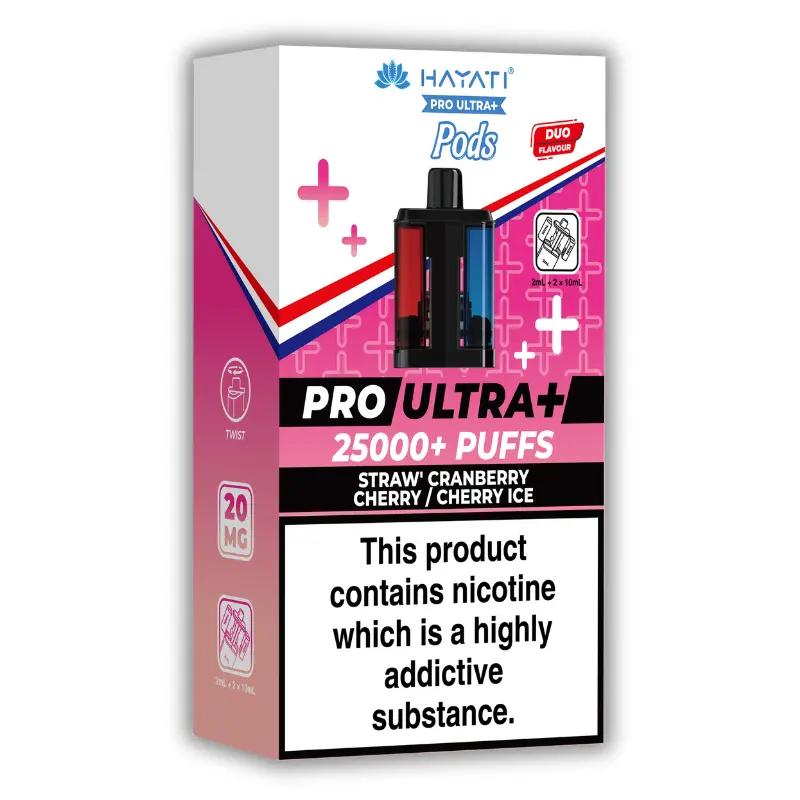
Seven pounds ninety-nine buys one replacement pod for a Hayati Pro Ultra Plus, prefilled with twenty-two millilitres of liquid at 20mg nicotine salt, holding two flavours rather than one. The oblique in the name is not a pack count and no second pod is coming. Straw’ Cranberry Cherry sits at one setting of the rotating mouthpiece and Cherry Ice at the other, the listing states that the two are kept apart from each other, and a turn of the collar decides which of them reaches the coil. Hayati attach a figure of up to 25,000 puffs to the pod, produced by machinery drawing to a fixed pattern rather than by anybody using one. No device is in the box. If you need the body as well, the Straw’ Cranberry Cherry / Cherry Ice Hayati Pro Ultra Plus 25000 Prefilled Pod Kit is the same pairing at £11.99 with hardware attached.
Now the part that is worth more than the specification. Read the two names again and notice what they have in common. Cherry is in both of them. Hayati noticed too, because the first line of their own description for this listing leads with it rather than with the format, and the Mini Ultra version of the identical pairing calls the two sides two different takes on cherry. That is an unusual thing for a dual pod to be built around, and it turns out to be a rarer thing than it sounds.
One pairing on this shelf has already been examined for exactly the opposite property. Blue Razz Cherry/Blue Razz GB Hayati Pro Ultra Plus 25K Pods holds one berry base still and changes what is put beside it, and the page for that pod works through why a single moving part makes a preference mean something. This pod is the mirror of it. The fruit that appears on both sides of the oblique is not accompanied by the same things and not doing the same job, but it is present twice, once buried in a tart three-fruit arrangement and once cooled and standing on its own. The variable is what has been done to the fruit rather than the company it keeps.
That is a more interesting question than which partner suits a base, because cooling is applied to ninety titles in this catalogue and almost nobody can say what it does to a fruit they already know. It is also a question this pod answers less cleanly than it first appears to, and the bulk of what follows is spent on both halves of that: what the comparison genuinely licenses you to conclude, and the four or five things that move alongside the one you meant to move.
Counting the arrangement before claiming it is rare
A page that says "nothing else does this" should have counted, so here is the count and the method, which matters as much as the number.
The Hayati catalogue on this site runs to 492 listings. Sixty-one of them put an oblique inside the flavour part of the title, which is the marker for a two-sided pod. Thirty-three of those sixty-one repeat at least one word across the oblique, so a shared component is not unusual in itself. It is close to a house habit.
Those thirty-three fall into recognisable groups. The largest holds a treatment still and swaps the fruit: Blueberry Cotton K / Raspberry Cotton K Hayati Pro Ultra Plus Pods runs a spun-sugar register under two berries, and Grape GB / Strawberry GB Hayati Pro Ultra Plus Pods does the same with a gummy one. The second group holds a fruit still and changes what accompanies it, usually by adding rather than substituting: Strawberry Ice / Strawberry Raspberry Ice Hayati Pro Ultra Plus 25K Pods sets a profile against itself with one more berry in it, Blueberry Raspberry / Blueberry Raspberry Cherry Hayati Pro Ultra Plus 25K Pods adds a cherry layer to one side only, Kiwi Banana / Straw’ Banana Hayati Pro Ultra Plus Pods keeps banana underneath two different partners, and Straw’ Grapefruit / Straw’ Dragonfruit Hayati Pro Ultra Plus Pods does it with strawberry.
Now narrow it. Of the thirty-three, how many share a fruit across the oblique and name cooling on exactly one of the two sides, so that the shared fruit is served warm at one setting and cold at the other? Three listings, and all three are this same flavour arrangement sold on three pieces of hardware: this pod, the kit above, and a Mini Ultra kit of the same pairing at a smaller volume. One arrangement, three listings, out of 492.
Two honest deductions from that. The first is that the count is of words in titles and not of recipes, so what I have established is that one naming pattern occurs once. A liquid could be cooled without the name saying so, although nothing in the range suggests Hayati are shy about the word: ice is in ninety titles, frozen in three and cooler in two, and the census of that vocabulary across the whole catalogue was done on the Blue Frozen pods page, which also established that the terms are not graded against each other. Take that as settled rather than recounted here. The second deduction is that the pairings with cooling on both sides, such as Fresh Mint / Blue Razz Mint Hayati Pro Ultra Plus 25K Pods, hold the cold constant and are therefore the opposite design again. Cooling in the range is usually either absent from both settings or present on both, and the asymmetric case with a repeated fruit happens once.
So the rarity claim survives counting, narrowed to the form that is actually true: among two-sided listings, exactly one flavour arrangement puts a named fruit on both sides and cools only one of them. That arrangement is what you are looking at.
Two kinds of experiment, and why this one asks a different question
The argument for owning a pod whose halves resemble each other has already been made properly, and it is set out on the Blue Razz Cherry pairing linked above: two liquids inside one housing arrive on the same coil, on the same day, in front of the same palate, which strips out nearly every difference that normally swamps a comparison between two vape liquids. That reasoning is not re-run here. It applies to this pod as it applies to that one, and anybody who wants the full version of it should read the page that owns it.
What is worth separating is the question each design can ask.
On a pairing that holds a base still and changes its companion, the thing that moves is a recipe decision. Something was added, or a different register was mixed in, and you find out which addition you prefer. The knowledge you take away is about ingredients: this fruit works under that one, that treatment suits this berry. It is useful and it is portable, and it is also a question about composition.
Cooling is not a composition question. A coolant supplies no flavour of its own, which is the point made at length on the Cherry Ice Hayati Pro Ultra Plus 25000 Prefilled Pod Kit listing, and what it changes is the way everything else in the liquid registers. Put cold over a fruit and you have not added a note to the recipe, you have altered the conditions under which the rest of the recipe is heard. Sweetness in particular reads lower in a cold mouth than in a warm one from the same amount of sugar.
That makes a treatment-varying pairing a different instrument from a partner-varying one. It is not asking what goes with cherry. It is asking what happens to cherry when the conditions change, with the fruit nominally the same on both sides and your own palate as the only measuring device in the room. Since ninety of the 492 listings carry ice in the name, an answer to that question is worth considerably more at the next reorder than an answer about one particular partner fruit. It travels across the whole cooled end of the catalogue instead of sitting on one listing.
Nobody in this range has been handed that experiment before, because the arrangement that supports it occurs once. Whether the pod delivers on it is the next section, and the answer is a heavily qualified yes.
Everything that moves when the collar turns
A comparison is only as good as its inventory of moving parts, so here is the inventory. Cooling is one of them. It is not the only one, and pretending otherwise would make this page the sort of confident nonsense the whole exercise is meant to avoid.
The company differs
On the tart setting the cherry arrives with strawberry and cranberry attached. On the iced setting it arrives alone. Two extra fruits is not a small perturbation: strawberry brings sweetness and body, and cranberry brings a drying finish whose mechanism is nothing like sourness at all. That distinction is argued in full on Straw’ Cranberry Cherry/Strawberry Raspberry Ice Hayati Pro Ultra Plus 25K Pods, which pairs the identical tart blend with a cold strawberry and raspberry instead, and which also carries the counting behind cranberry's scarcity in the range. Neither is repeated here. Take from it only what this page needs: the tart setting finishes dry by way of a physical grip on the tongue rather than an acid spike, and that grip accumulates across draws taken close together in a way sourness never does.
The structural role differs
This one is easy to miss and it undermines the experiment more than the fruit count does. Cherry is not doing the same job at the two settings. In the tart blend it is third in a list and it is working as depth, sitting underneath strawberry and giving the mix a floor. On the iced setting it is the entire flavour and there is nothing for it to sit underneath.
Hayati's own copy says as much across the range, and once you line the listings up it is consistent. Every description of the three-fruit blend gives cherry a supporting verb: it deepens the fruit, it adds a darker and fuller body, it supplies depth underneath. Every description of the single cooled cherry gives it the lead: the fruit stays front and centre, cherry is the star, there is no second fruit competing. A component in the floor of one blend and the ceiling of another is not one variable being treated two ways. It is one word appearing in two positions.
The formulation probably differs too
Here is the part a buyer should be told plainly. Nothing anywhere in Hayati's material says that the cherry flavouring in the tart blend is the cherry flavouring in the iced one. They are two liquids mixed as two recipes, and a flavour house dosing cherry into a three-fruit red blend has a different job from one building a single cooled cherry, so there is every reason to expect two different dosings and a fair chance of two different concentrates.
The listing copy across the range hints in the same direction. Line up every description of Cherry Ice that Hayati publish, across the bottled, Mini Ultra and Pro Ultra Plus versions, and they do not agree about tartness. Three of them attach a tart word to the fruit, describing a faint or slight tartness under the ice. The Pro Ultra Plus listings do not, and one of them says outright that this is a chilled cherry rather than a sour one. That split is not random: the listings that mention tartness are the ones on other hardware. What it is evidence of is an open question, because a disagreement between two descriptions of a liquid can mean two recipes or it can mean two copywriters, and this corpus has caught the second explanation more often than the first. Either way it should stop anybody treating "cherry" as a fixed quantity that this pod holds constant.
The sweetness differs, and so does the tail
The iced side sits in the middle of the sweetness range with a short cold finish that closes each draw off. The tart side is built the other way, with the sugar pulled back deliberately so the cranberry has room to work, and it finishes warm and dry rather than cold and crisp. So the two settings differ in perceived sweetness for two separate reasons stacked on top of each other: less sugar in the recipe on one side, and cold suppressing the perception of sugar on the other. Those two push in opposite directions and there is no way to weigh them from the outside.
Count the list up and at least five things move between the two settings of this collar. The experiment the pod appears to offer is a single-variable one. The experiment it actually offers is nothing of the kind, and the useful page is the one that says so rather than the one that sells the clean version.
What a difference you detect entitles you to say
None of that makes the pod useless as an instrument. It narrows what the instrument measures, and knowing the narrowed version is worth more than believing the wide one.
You may say that you prefer one of these two renderings of cherry to the other, on this pod, on this coil, with everything about the hardware and the day held still. That is a real result and most people never establish anything as clean about their own taste. You may also say something more portable, which is the genuine prize here: you can find out whether you want cherry as a lead or as a floor. Those are two different appetites and they point at different shelves. Somebody who prefers the iced setting wants a fruit they can identify in every draw. Somebody who prefers the tart setting wants cherry doing structural work underneath other things, which is a preference that would also be served by Blue Razz Cherry Hayati Pro Ultra Plus Pods, where the fruit fills out the bottom of a blue raspberry rather than leading.
You may not say that cooling does anything in particular to cherry. That conclusion requires the fruit to be the same on both sides in the same position with the same company, and it is none of those. A difference you detect has at least five candidate causes and this pod supplies no way to divide them. If the iced setting reads crisper and more legible, that could be the cold, or it could be that a single fruit is simply easier to perceive than a third of a blend. If the tart setting reads deeper, that could be the absence of cooling, or it could be the strawberry and the cranberry doing what they were put there to do.
You may not conclude anything about the cherry recipe from a difference in intensity either, because a dosing difference and a treatment difference produce the same symptom. This is the confound that cannot be removed, and it deserves stating in one sentence: the two sides are not the same cherry liquid with and without cold, they are two cherry liquids, one of which is cold, and no amount of careful drawing separates those two explanations.
The missing arm is the obvious fix and it is not available. What the design needs is a plain, uncooled cherry standing on its own, so the iced single could be compared against it and the cold isolated. That liquid is not in the Pro Ultra Plus range. The nearest thing is Cherry Berry Hayati Pro Ultra Plus Pods, which leads with cherry and runs warm, but beds it on a soft red blend, so it is a third arrangement rather than a baseline. Even if it were the right liquid, it would arrive in another pod on another coil, and every between-unit difference that a single housing eliminates would walk back in.
So the honest summary is that this is a degraded version of a valuable experiment, and it is still the only version of it the range offers. Treat a result as a statement about your preference between two specific liquids, not as a finding about temperature.
The kernel, and why cold and tannin do different things to it
The most interesting thing about comparing a fruit against itself is that cherry is a strange fruit to pick for it. Most flavours have one identity. Cherry has two, and which one you meet depends on what is sitting over the top.
The chemistry behind that is set out properly on the Cherry Ice kit page linked earlier, along with three specific reasons why the cooled single keeps the kernel note underneath the fruit rather than letting it up on top. Read it there. The short version needed for what follows is that the almond character people notice in cherry liquids is not an additive and cannot be removed, that sweetness is what keeps it down, and that cold reduces perceived sweetness and therefore thins the thing keeping it down. That page concluded that this particular recipe buries the kernel anyway, because the chill arrives late and the finish is short.
What nobody has asked is what happens to the kernel at the other setting, where the partner is not cold but a drying tannic finish. The two are not equivalent and the reasoning is worth doing carefully, with the inference marked as inference throughout, because none of it is a Hayati statement and none of it is a specification.
Four forces, pulling two ways
On the tart setting, four things bear on whether you meet the kernel, and they do not all point the same way.
Less sugar means less cover. The blend is built to be tangy rather than sweet, and a lower sweetness ceiling is exactly the condition under which the kernel becomes available. On that count alone the tart setting should show more almond than the iced one.
Less cherry means less kernel to show. Cherry is one fruit of three here and it is not the lead, so whatever kernel material exists is present in a smaller quantity to begin with. This pulls the other way, and it may pull harder than the sweetness effect.
Strawberry is a mask of its own. The base fruit is sweet and broad and it sits in front, occupying the early part of the draw and contributing sugar that the recipe has not stripped out. Some of what the cranberry takes away, the strawberry puts back.
The astringency lands in the same window. This is the part that makes cherry and cranberry an odd couple rather than a neat one. A kernel note is slow and late: it shows up in the tail of an exhale, after the fruit has gone. The drying grip from the tart blend also arrives at the back end and in the seconds after. They share a slot.
Sharing a slot is not the same as masking
Sugar hides a kernel note because both are things you taste and one is louder than the other. Astringency does not work that way. It is not a taste at all, it is a change in how your mouth feels, registered through touch rather than through the tongue's chemical senses. So a drying finish cannot bury an almond note the way sweetness can. The two occupy the same moment on two separate channels, and both get through.
The consequence is a prediction, and I would put it at probable rather than confirmed: the tart setting is the more likely of the two to let a kernel note reach you, because it has the lower sugar ceiling and nothing in it is capable of masking an aroma-borne note. The iced setting is the less likely, for the three reasons the kit page gives.
Now the twist, which is the reason this is worth a section rather than a sentence. The tart setting is also the place where you are least likely to identify the kernel correctly, and the mechanism for that is perceptual rather than chemical.
Two dry things arriving together
A kernel note reads as dry. It is nutty and it narrows the finish and it takes the juice out of the tail of a draw. Astringency also reads as dry, by a completely unrelated route, and a buyer has no reason to keep two dry sensations apart when only one of them is named on the label. Cranberry is on the label. Benzaldehyde is not, and neither is almond, and neither is the word kernel.
So the likely outcome at the tart setting is that any almond that does come through gets filed under cranberry and never counted. The pod hands you the kernel and simultaneously hands you a plausible alternative explanation for it, which is a worse situation than not hearing the kernel at all, because it feels like knowledge.
The iced setting has the opposite profile. Less kernel gets through, and when it does get through it is unmistakable, because there is nothing else in that liquid to attribute it to. A single cooled cherry that suddenly tastes of marzipan has one suspect. The page for Cherry Ice Hayati Pro Ultra Plus 25K Pods makes that legibility the whole argument for the flavour as a repeat purchase, since the balance tipping towards almond is how the liquid announces that its coil has finished. That is its argument, not mine, and it is worth reading before deciding which setting you intend to live on.
Which gives you the better hearing
Put the two together and you get a result that is genuinely useful and slightly perverse. If your question is whether cherry's kernel is something you enjoy, the place to listen is the iced setting, late, when the sweetness that was covering it has thinned with the coil. If your question is whether the kernel is present at all in a red-fruit blend, the tart setting probably carries more of it and will not let you prove it.
There is a way to use the collar on that. Take a run of draws at the tart setting and attend to the very end of the finish, past the grip, for anything nutty rather than merely dry. Then switch, allow for what the shared coil is still holding, and take a run at the iced setting attending to the same part of the draw. What you are listening for is not which is drier, because both are, but whether the dryness has a nut in it. Anybody who has met the same fruit sitting underneath a different lead on Blueberry Raspberry Cherry Hayati Pro Max Plus Pods will have a third reference point for what cherry contributes when it is not in charge.
Mark all of that as reasoning from how the fruit is built rather than as a description of a measured liquid. Hayati publish no concentrate details, no sweetness index and no statement about kernel dosing on either setting, and a page that gives you a number for any of it has invented the number.
The shared coil, and a carryover problem specific to this pairing
One coil, one wick and one airflow path serve both settings. That has a consequence at every switch, and on this pod the consequence is worse than it is on a pairing built for contrast.
The mechanical part is ordinary. Immediately after the collar moves, the wick is still holding the liquid it was feeding a moment ago, so the next several draws are a mixture of the two rather than a sample of either. Every dual pod has this. The reason it bites harder here is that the mixture is plausible.
Think about what a contaminated draw tastes like on a high-contrast pairing. Cold arriving over a warm tropical blend tastes wrong in a way nobody can mistake, and you discard it without being told to. Now think about what a contaminated draw tastes like on this pod. Cherry with a little cold on it, or cherry with a hint of strawberry behind it, is not an obviously broken draw. It is a perfectly credible third cherry liquid, and it will be filed as a reading of whichever setting you have just selected. The shared fruit that makes the comparison interesting is the same thing that makes the contamination undetectable.
That turns the discard rule from a matter of judgement into a matter of counting. On a contrasting pod you can stop discarding when the draw stops tasting muddled. Here there is no such cue, so the only sound approach is to fix a number of draws in advance, take them at your ordinary pace, judge none of them, and only then start paying attention. Err generously, because the cost of one extra ignored draw is nothing and the cost of an unnoticed blend is a conclusion you will act on at your next order.
The second carryover, which is in your mouth rather than the pod
There is a channel nobody accounts for, and on this pairing it is asymmetric.
Going from the iced setting to the tart one, the residual cold sensation in your mouth outlasts the draw that produced it by a good number of seconds. Arriving at the warm setting while the cold is still reporting means the tart blend is met by a mouth that is registering less sweetness than it otherwise would, which flatters the cranberry and makes the blend seem drier and sharper than it is.
Going the other way is worse and lasts longer. Astringency clears slowly, because what it does is strip lubrication out of your mouth rather than deposit a flavour in it, and replacing that takes minutes rather than seconds. Arriving at the iced setting from a dry mouth makes the cold read harsher and thinner, and takes the perceived juiciness out of the fruit that is supposed to be the whole point of that side.
So both directions are compromised, by different mechanisms, over different timescales. The practical rule that falls out is to make the switch in the direction of the thing that clears quickly. Finish a stretch at the tart setting, give it time, then move to the iced one, rather than dipping into the tart side between cold draws. And do not attempt any comparison at all within a minute or two of the previous setting, because at that point you are measuring your own mouth.
On how the pod keeps one liquid off the other, this page says nothing, because Hayati describe no dividers, no seals and no internal arrangement. What is on the record is the outcome: two liquids held apart, the collar selecting which one is drawn, and one coil serving whichever is chosen.
The specification, grouped by what changes at the collar
| What changes when you turn it | The liquid reaching the coil, and nothing else |
| Setting one | Straw’ Cranberry Cherry. Strawberry, cranberry, cherry. No cooling named. |
| Setting two | Cherry Ice. Cherry alone, with a cooling finish. |
| Shared between the settings | Cherry, the coil, the wick, the airflow, the nicotine strength, the fill date and every day of storage since |
| Selecting a side | Rotating mouthpiece collar, at any point |
| Liquid on board | 22ml in total, prefilled, covering both settings |
| Nicotine | 20mg nicotine salt. No second strength listed. |
| Hayati's puff figure | Up to 25,000, a measurement taken on test apparatus |
| Supplied as | One pod. No device, no accessories. |
| Device required | A compatible Hayati Pro Ultra Plus, bought separately |
| Preparation | None. It arrives filled and the wick already wetted. |
| Price | £7.99 |
| Brand | Hayati |
| Listing reference | straw-cranberry-cherry-cherry-ice-hayati-pro-ultra-plus-pods |
| Not published | Coil resistance, airflow, wattage, cooling strength, how the 22ml divides between the settings, and whether the cherry flavouring is the same at both |
Most of those rows repeat across the shelf and can be skimmed. The last one is the row this particular page needs, and it is the row that does not exist anywhere in Hayati's material.
Everything above about treatment and formulation rests on a fact that is simply not documented: whether the cherry at one setting is the cherry at the other. A single line stating that both sides draw on one concentrate would turn this pod into a proper single-variable instrument and make a preference mean something precise. A line stating they are different would settle it the other way and the experiment would be off. Neither line exists, so the ambiguity is permanent, and any page telling you the two cherries match is telling you something nobody outside the factory can know.
Two of the published rows also deserve a moment. The 22ml is not a guaranteed eleven and eleven, because the split is unpublished, and one coil serves both settings, which means the pod retires as one object with whatever is left in the side you use less. On a pairing where one setting is a layered blend and the other is a single chilled fruit, the odds of running level are poor, because a blend and a plain cold single are rarely wanted at the same rate by the same person. Decide early which side you are actually buying. The 20mg figure is the maximum concentration permitted for liquid sold here and there is no lighter version of this pairing, so nicotine strength is not a choice you get to make on this listing. Nicotine is addictive, and which strength suits a person is their own business rather than something a product page should be nudging.
The neighbours, sorted by what they hold still
Ordinary comparison shopping sorts pods by fruit. On a pod whose entire interest is its structure, the more useful sort is by what each neighbour keeps constant and what it lets move.
The same tart blend with a different partner
The three-fruit side is not sold on its own in this format, so a second liquid comes with it whichever listing you choose, and there are two. This one sets it against a cold version of a fruit it already contains. The alternative, linked above, sets it against a cold strawberry and raspberry instead, which is a wider gap on fruit and a much better fallback if the cranberry turns out not to suit you, since that iced half is a profile plenty of people run on its own. The case for the pairing you are reading about is that it is the more coherent design and the only one that asks a question. The case against is that it gives you a narrower second liquid to retreat to.
If you want the same three fruits without a collar at all, Strawberry Cherry Cranberry Hayati Pro Max Plus Pods puts them into a single liquid on other hardware at £5.49, which is the version to look at if the switching is the part you do not want.
The same cooled cherry with a different partner
Cherry Ice appears opposite two things in this format. Against the tart blend here, and against a warm tropical pairing in Cherry Ice/Peach Mango Hayati Pro Ultra Plus 25K Pods, which is about as far apart as this shelf puts two liquids inside one housing. That is the pod to buy if what you want from a second setting is somewhere genuinely different to stand. It is also the pod that teaches you nothing, for exactly the reason a high-contrast pairing never can. Those two listings are a clean illustration of the trade: variety and information pull against each other, and you cannot have both in one pod.
For all 22ml of the cooled cherry with nothing set aside, the single-flavour pod is the one linked in the kernel section above, at the same £7.99.
Designs that vary the partner instead of the treatment
If the structure interests you more than this particular fruit, several other pods run the partner-varying design. The strawberry pairings are the clearest: Straw’ Guava / Dragon Berries Hayati Pro Ultra Plus Pods is a wide one, while the grapefruit and dragonfruit pod named earlier keeps strawberry in front of two very different partners and is the tighter test. The nested pairings are tighter still, since one side is the other with something added: the strawberry and the blueberry examples above both work that way, and the blueberry one is sold as a complete kit as well if a device is needed alongside it.
If the iced berry is what you are really after
Plenty of people arrive at a pairing wanting one half of it, and on this pod that half is usually the cold one. There are cheaper and simpler ways to get a chilled red fruit than buying a three-fruit blend you will not use. Strawberry Raspberry Ice Hayati Pro Ultra Plus 25K Pods gives you a cooled berry across the whole pod at the same price, the Strawberry Ice / Strawberry Raspberry Ice Hayati Pro Ultra Plus 25000 Prefilled Pod Kit is the kit if a device is also needed, and Strawberry Raspberry Ice Hayati Mini Ultra Pods at £3.49 is the small-format version for different hardware. On fitment, the sound rule is to match the range name printed on your device to the range name in the title rather than assuming anything seats across ranges.
Browsing rather than shortlisting
Every refill that fits this device sits on the Hayati Pro Ultra Plus Pods shelf, fifty-two of them, and the kits are gathered with them under Hayati Pro Ultra Plus Prefilled Pod Kits & Pods. Every treatment of this fruit across all the hardware families is on Cherry Vapes, which is the fastest way to see how many directions one fruit has been taken in. The cold end of the catalogue is Ice Vapes, the red and blue selection is Berry Vapes, and the prefilled formats large and small, from the four millilitre pods up to this one, sit together on Hayati Prefilled Pods & Refills.
Getting a fair reading, and then living on it
The comparison occupies the first few days. The other three weeks are ordinary use, and a handful of things here are specific enough to this pairing to be worth stating rather than the general advice you have read on every pod page.
Do the listening early. Whatever separates the two settings lives in the quiet parts of each draw: the nut at the back of the finish, the top edge of the fruit, the exact point where the grip arrives. Those are the first things a mesh coil buries as residue builds. A comparison run in the third week is measuring a difference that has already been partly rubbed out, and it will hand you a confident verdict of no difference.
Write down which position is which before you have an opinion. Nothing on the pod says which setting selects which liquid, and there is no map published. A note made on day one, while the packaging is still in the house, is what makes every later observation attributable. It also lets your own behaviour vote: if the collar has been sitting one way for a fortnight without you deciding anything, that is a preference expressed more honestly than any tasting session will manage.
Pace matters more at the tart setting than the cold one. The drying finish compounds when draws are taken in quick succession, which cold does not, so a run of short pulls close together is a different liquid from the same number spread over an hour. Water helps between stretches, and it helps for a specific reason on this side rather than as general advice.
Do not run the two settings in short alternation once the comparison is over. Flipping constantly adapts you to everything the two sides share, which on this pod is the fruit both of them are named after, and leaves you tasting only the differences while missing the cherry entirely. Long runs at one setting are also what keeps the two volumes going down at similar rates, which matters because they retire together.
Heat is the storage risk worth naming. Coolant is stable and survives a warm week without complaint, but fruit does not: it drifts towards a stewed, jammy reading, and stewed cherry under a cold finish is a combination nobody is buying. Keep a spare in its wrapper, indoors, out of direct sun and out of a parked car, and store it where children and pets cannot reach it.
Expect two different end signals from one coil. The cooled single announces its own ending by turning nutty at the front of the draw, which the page for that pod treats as the reason to own it. The tart blend ends differently, with the aromatic parts fading while the dry grip stays, so it finishes as bare dryness with the fruit gone from behind it. Both of those arrive from the same worn mesh and they will not arrive at the same moment, so listen to whichever setting you actually use and do not wait for the other one to agree.
When it is finished it is finished. The coil is built into the pod and cannot be changed, rinsed or rested, so a draw that has gone thin and hot is the end of the object rather than a phase it will come out of. The spent pod holds an electrical component and liquid residue, so hand it in wherever vape hardware is collected rather than putting it out with the household rubbish.
Questions this pairing tends to raise
Is this two pods, one of each flavour?
One. The oblique separates two liquids inside a single 22ml housing, not two items in a box. The listing states that the flavours are kept apart from each other and that a rotating mouthpiece selects between them, and you can change setting as often as you like within a session.
Is the cherry the same on both sides?
Nobody outside the flavour house can tell you. The word appears in both names and that is the whole of what is published. There is good reason to expect two different dosings, since one is a supporting note in a three-fruit blend and the other is the entire liquid, and Hayati's descriptions across the range consistently give cherry those two different jobs. Treat the shared name as a shared name rather than as a shared recipe.
Which side is cooled?
Cherry Ice only. The three-fruit side names no ice, no menthol and no coolant, so expect it to finish warm. That makes the collar on this pod a temperature switch as well as a flavour switch, which is not true of most pairings on the shelf.
Why does the first draw after switching taste odd?
One wick feeds both settings, so immediately after a turn it still holds what it was feeding a moment before, and the next few draws are a mixture. It is worse on this pod than on a contrasting one, because a blend of two cherry liquids tastes like a credible cherry rather than like an obvious mistake. Fix a number of draws to discard and count them rather than waiting for the muddle to announce itself.
Is the tart side sour?
No. It finishes dry rather than sharp, and the difference between those two is a real one with real mechanics behind it. The full account of why a drying finish behaves nothing like an acid spike over the life of a large pod is on the other pairing of the same blend, and it is the single most useful thing to read before committing to this side.
Will I taste almond in it?
Possibly, and where you notice it is not where most people expect. The cooled single is built so the kernel note stays underneath the fruit, and it tends to surface only late in the pod's life as the coil tires. The tart side has less sugar covering it and nothing capable of masking an aroma note, so it may carry more of it, but the drying finish from the cranberry lands in the same part of the draw and reads dry as well, so any almond there is easy to misattribute.
Can I buy just one of the two flavours?
The cooled cherry, yes, as a single-flavour pod at the same £7.99 with the whole 22ml behind it. The three-fruit blend, no, at least not on this hardware. It is only sold paired, either with the cold cherry here or with a cold strawberry and raspberry on the other listing, so a second liquid arrives either way.
Which side will run out first?
Whichever one you prefer, and you will not finish level. Hayati do not publish how the 22ml divides, one coil serves both, and the pod retires as a single object with whatever remains in the neglected setting still inside it. That is worth thinking about before ordering rather than afterwards, because there is no way to move liquid out of a sealed pod.
What does the 25,000 figure mean?
It is a number Hayati produce on test apparatus, with a machine drawing to a fixed pattern under fixed conditions, which is nothing like how a person uses a device. Read it as a way of ranking one listing against another rather than as a forecast of your own weeks, and note that a machine keeps counting long past the point where a coil has stopped rendering the flavour properly.
Does the pod fit my device?
It is made for the Hayati Pro Ultra Plus and no device comes with it. Hayati publish no compatibility chart and no dimensions against this listing, so check the range name printed on your device against the range name in the title and do not extrapolate from a photograph or from another Hayati format.
Is there a lower nicotine strength?
Not for this pairing. It is listed at 20mg nicotine salt with no options attached, which is standard for prefilled pods of this size, and a different concentration means a different product rather than a variant of this one. Nicotine is an addictive substance at every strength it is sold in.
Can I refill it or replace the coil?
Neither. The pod arrives filled and sealed with the mesh built into it, so liquid and coil are bought together and discarded together. When the draw goes thin and hot you fit a fresh pod rather than servicing this one, and no amount of resting it brings the flavour back.
The short of it
One pod at £7.99 for a Pro Ultra Plus you already own, 22ml at 20mg nicotine salt, two liquids behind a rotating collar, a manufacturer figure of up to 25,000 puffs taken off a machine, and no device in the box. One setting is a tart three-fruit blend that finishes warm and dry. The other is a single cherry with a cooling finish. Cherry is in both names.
That shared fruit is the reason to look twice, and it is rarer than it sounds: among sixty-one two-sided listings, thirty-three repeat a word across the oblique, and exactly one arrangement out of 492 listings puts a fruit on both sides and cools only one of them. In principle that is a better experiment than the partner-varying pods offer, because it asks what a treatment does to a fruit you already know rather than what a new fruit does to a base, and the answer would travel across the ninety iced titles in this range.
In practice the pod is a blunter instrument than that. Five things move between the two settings, not one: the cooling, the two accompanying fruits, cherry's role as floor rather than lead, the sweetness level, and very probably the cherry formulation itself, which Hayati nowhere state to be shared. So a preference you form here is a preference between two specific liquids and an answer to whether you want cherry leading or supporting. It is not a finding about what cold does to cherry, and the missing arm that would make it one, a plain uncooled cherry standing alone, does not exist in this range.
Buy it if that narrower question interests you, or if you want cherry available two ways with a second away from the first. Buy the wide-contrast pairing instead if what you want from a collar is somewhere different to stand. And read the shared coil seriously, because on a pod whose halves share a fruit, the contaminated draws after a switch taste entirely believable, which is the one failure this design cannot warn you about.
Strictly for adults aged 18 and over. Nicotine is an addictive substance.
You might also like


