
Home / Hayati Pro Ultra Plus Pods / Cherry Ice Hayati Pro Ultra Plus 25K Pods
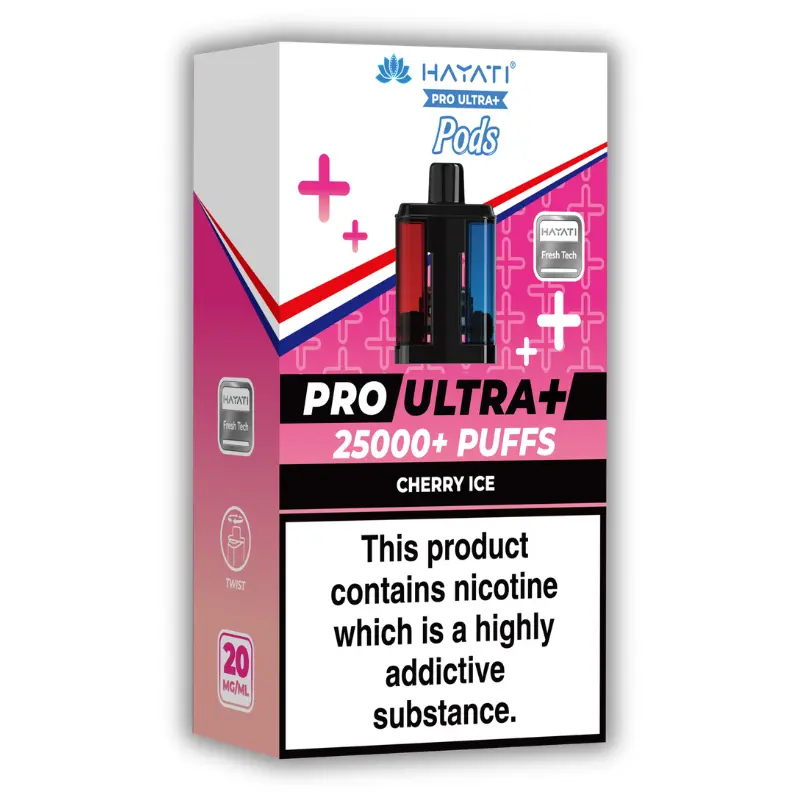
Hayati · Pro Ultra Plus
Cherry Ice Hayati Pro Ultra Plus 25K Pods
£7.99
✔ In stock — ready to ship
Genuine Hayati
Free over £20
Same-day dispatch
Secure checkout
Seven pounds ninety-nine buys one sealed Pro Ultra Plus pod holding 22ml of Cherry Ice at 20mg nicotine salt, with a manufacturer figure of up to 25,000 puffs attached to it that comes off a testing rig rather than out of anybody's pocket. Nothing else is in the pack. No device, no cable, no spare part, no instructions worth reading. This is the refill listing, and it takes for granted that the hardware is already yours. If it is not, the Cherry Ice kit at £11.99 is the identical liquid with a device in the box, and that is where a first purchase starts.
Almost everybody who orders this has ordered one before. Worth saying plainly, because it changes what the page is for. Nobody reaches a bare pod listing wanting to be told what cherry tastes like. They have already had 22ml of it through a coil of their own. The live question is whether to go round again, and more precisely, when.
That second word is the interesting one, and it is where this page spends its time. A repeat buyer owns something a first-time buyer cannot: the memory of how the last pod finished. Cherry Ice finishes in an unusually legible way. It does not trail off into a general vagueness the way most large pods do. It changes character, in a direction that can be named, and the twin listing works through the chemistry of why that happens at length. Take it as settled here. What follows is the consequence.
A liquid that announces its own ending is a different thing to own than a liquid that simply gets quieter. It moves the reorder decision off the calendar and onto an event. It turns the final stretch of the pod into a choice rather than a slow surrender. Over a run of four or five pods it decides how much of the liquid you paid for you actually enjoyed, which is a more honest measure of what a refill is worth than the figure on the price label. None of that is an argument about whether cherry is a good flavour. It is an argument about what a known failure signature is worth to somebody who is no longer choosing, only restocking.
The flavour anatomy, the almond question, and the three structural reasons this recipe handles that question the way it does are all set out on the kit page. Repeating them here would waste the time of the one reader this listing is written for. The Pro Ultra Plus pods shelf holds the rest of the refills if the decision turns out to be a change of flavour rather than a renewal.
What a repeat buyer knows that the price label does not say
Fading is invisible from the inside
Most flavours end by getting quieter. The fruit loses volume a little each day, the draw gets slightly warmer, and the whole profile slides downhill on a gradient so gentle that nothing about it ever registers as a change. That is not a failure of attention. It is how perception works. A palate recalibrates to whatever it is given, continuously and without asking, so a level that falls slowly enough never feels like it has fallen at all. Today's pod tastes like yesterday's. It also tastes nothing like it did three weeks ago, and both of those statements are true at once.
The result is the thing every large-format buyer has done at least once: run a pod a week past the point it stopped being good, then fitted a fresh one and learned in a single draw how much had gone. The information turns up several days after it would have been worth having.
A change of kind gets noticed, a change of level does not
Cherry is the exception, and the reason sits in its construction rather than in any quality difference. The profile has two registers in it that come from the same underlying chemistry, and as the coil ages, the balance between them tips one way. What you get is not less cherry. What you get is a different proportion of cherry to almond, and proportion is a change of kind.
Palates adapt to level in minutes. They do not adapt to a new flavour appearing where it was not before. A nutty, faintly marzipan register arriving at the front of a draw that used to open on fruit is a discontinuity, and discontinuities get through. That is the whole of the practical advantage: this pod tells you, in a language you cannot tune out, that it is done.
The kit page explains why the balance moves and why it moves in that direction. The only part that matters at the point of reordering is that it is a signal rather than a slope, it always points the same way, and it does not reverse. A pod that has turned stays turned. Resting it overnight, drawing more gently, charging the device, none of that brings the fruit back on top.
Which is why the second pod is where the knowledge pays
On the first pod the signal arrives and means nothing, because a first-time buyer has no reference for it. Plenty of people meet the marzipan turn and read it as a bad batch, or as the flavour being oversold, or as their own palate going off. They order something else and never find out that the pod had simply reached the end of its working life about where it was always going to.
The second pod is different, and every pod after it is different again. You know what the turn sounds like. You know roughly where in the pod it tends to land for the way you draw. You can therefore do three things that were not available the first time: order the replacement at the right moment instead of guessing, decide in advance what you are going to do about the last stretch, and judge the pod's value by how much of it was good rather than by how many millilitres were in it. Those three are the subject of the next three sections.
Two clocks inside one sealed pod
The listing publishes two numbers, and neither of them is the one that governs a reorder. Twenty-two millilitres describes what is inside. Up to 25,000 puffs, a laboratory estimate produced by machine at a fixed draw length, describes what came out of a rig. Neither is a statement about how long the flavour stays right, and the gap between those two ideas is where every reorder decision actually lives.
Liquid and coil retire together whether or not they wore out together
Two separate things are being used up in here at rates that have nothing to do with each other. The liquid depletes at whatever rate you draw. The mesh accumulates residue and gradually stops rendering the flavour faithfully, at a rate set by heat, draw length, how often you chain, and how much sweetener is going across it. On a refillable setup those two would be independent: the coil is a consumable you replace and the tank carries on. Here they are welded into one sealed unit with one fill, one mesh and one end date, and that date arrives for both of them on the same day regardless of which of them got there first.
So a 22ml pod has three possible endings. The liquid can run dry while the coil is still rendering the fruit properly, which is the outcome you paid for. The coil can degrade with liquid still sloshing about, which is common on a pod this size. Or the two can land close enough together that it does not matter, which happens, but not reliably enough to plan around.
The marzipan turn is how you find out which ending you were given. That is its practical function, and it is a genuinely useful one. It converts an unanswerable question about the state of a sealed coil into an observation you can make with your mouth, mid-draw, on a Tuesday.
What arrives and what to do with it
One pod in a sealed wrapper, prefilled at the factory, with the coil already inside it and already wetted. There is nothing to prime, no fill port, no waiting period and no measuring. Unwrap it, push it onto a Pro Ultra Plus, and it works from the first draw. Everything larger and smaller in the prefilled family sits together on prefilled pods and refills if you want to see how 22ml compares with the shorter formats before renewing at this size.
Because this listing holds one liquid rather than two, there is no selection to make anywhere. Several pods on this shelf carry a pair held apart inside the same housing with a way of choosing between them. Nothing of that kind applies here, and if the device you are fitting it to came from a paired pod, the absence is the product working as intended rather than a fault.
Draw character, and the limits of what is published
The airway is narrow and the pull is a restricted mouth-to-lung one, slow and measured. Pulling hard on it does not get more cherry out. It gets heat, and a draw that thins out because the wick is being emptied quicker than it refills. On this particular liquid the first thing you lose to that is the sharp edge on the finish, which is the part carrying the pod. The mesh also ages quicker under it, and on a flavour with a defined end point that means paying for the habit twice: worse draws now, and the turn arriving earlier than it needed to.
Hayati publish capacity, strength, price and a puff figure for this pod and nothing else. No coil resistance, no charging connector for the device it fits, no battery figure and no cooling intensity. This page will not supply any of those, because inventing them is how a guess made once on one listing gets copied across a range until it looks like a specification. If a number that is not on this page decides the purchase, ask before ordering rather than trusting a figure you found on a sibling listing.
For volume context across the whole prefilled catalogue, the Hayati Pods shelf sets the large pods against the small ones, and the size step is a bigger practical difference than most flavour differences are.
The pod in five stages rather than three draws
The inhale, body and finish of Cherry Ice are described properly on the kit listing, so there is no point in redrawing them here. A repeat buyer has a different question anyway. Not what a draw is like, but what the pod is like in week one against week four, because that is the shape you are buying into when you renew. Here is the same liquid laid out along its own life instead of along a single draw.
Stage one: the wet start, roughly the first day
Out of the wrapper the wick carries more liquid than the coil needs, and the first thirty or forty draws are heavier than the pod really is. Sweetness sits forward, the body reads slightly syrupy, and the cold is muffled underneath all of it. Anyone judging the cooling level in this window will underrate it by a noticeable margin. Nothing about stage one is representative, and a returning buyer who thinks the new pod is weaker than the last one is nearly always comparing a saturated fresh pod against a pod that had found its balance.
Stage two: the plateau, and most of what you are paying for
This is the long middle, and on a pod this size it is the overwhelming majority of the liquid. The cherry sits ripe and dark rather than bright and tart, closer to preserved fruit than to something off a stalk, with a rounded body and no acid seam anywhere to cut across it. Sweetness lands above the middle of the shelf: clearly sweeter than a lean, dry profile such as Blackcurrant Lemonade, and clearly short of the sugared confectionery listings. The chill arrives late and briefly, closing the draw off and clearing the palate within twenty seconds or so.
The behaviour worth knowing about the plateau is not what a single draw does but what a session does. Because each draw resets the palate, nothing accumulates. A warm sweet liquid coats the tongue over an hour and every subsequent draw gets duller; this one keeps wiping the slate. The upside is that the last draw of a long session tastes like the first. The downside, and it is the reason 22ml can disappear faster than expected, is that a pod which never wears out its welcome is a pod you reach for more often than you meant to.
Stage two is stable. Barring heat damage or a spell of heavy chain-drawing, it holds its character for the bulk of the pod, and if you have only ever used this flavour in short bursts, this is the stretch you remember.
Stage three: the narrowing
Somewhere past the halfway point the fruit starts losing width rather than volume. The loudness is unchanged. What goes is the top edge, the bright, faintly floral lift that sat over the flesh of the cherry, and it goes first because it is the lightest material in the recipe. The body underneath stays exactly where it was. So does the cooling, which is the misleading part: the coolant is chemically robust and holds up almost untouched, so the draw still finishes crisp and still feels lively, and the pod reads as fine when the fruit has already begun to simplify.
Most people never consciously register stage three. It shows up as a vague sense that the pod has become ordinary, with no moment you could point at, and if a second flavour is running alongside it is the point where you start reaching for the other one without knowing why.
Stage four: the turn
Then the signal. A draw opens on something nutty and dry, a sweet-shop almond character sitting ahead of the fruit rather than behind it, and the cherry arrives late and slightly stewed behind it. The back of the palate goes drier than it used to. The finish is still cold, which makes the whole thing faintly incoherent, as though the chill had been attached to a different liquid.
The first occurrence is usually a false alarm. Chain-drawing, a hot device, a strong coffee ten minutes earlier, any of those can produce one marzipan draw on a pod with weeks of life left. What matters is whether it repeats when the conditions are normal. Once it is the default opening of a cold pod on a fresh palate, the pod has turned, and it stays turned.
Stage five: the tail
After the turn the liquid keeps working and keeps being unpleasant in the same specific way. The nutty register broadens, the draw runs warmer, the fruit recedes further behind it, and the cold finish continues doing its job perfectly, which by this point is the strangest part of the experience. Nothing dangerous happens and nothing dramatic happens. It simply stops being the flavour you bought.
How much liquid is left when this arrives is the variable nobody can give you a number for. It depends on how hard you draw, how often, and how hot you let the device get. On a gentle regime the tail can be a millilitre or two. On a heavy one it can be considerably more, and that is the scenario the next section exists for.
The last two millilitres, and a rule for what to do with them
A fading pod never presents a decision. There is no moment at which it is obviously finished, so you keep going, and the end comes when the liquid runs out rather than when the quality does. Cherry Ice hands you an actual decision, at an identifiable moment, and it is worth deciding in advance rather than in the middle of it.
The arithmetic is trivial and not the point, but here it is so nobody has to do it. Twenty-two millilitres at £7.99 puts each millilitre at a little under thirty-seven pence. Abandoning the last two costs about seventy-three pence. That is the entire financial consequence of stopping at the signal, and against the price of the pod it is not a serious sum.
What it actually costs is days, and days are the better unit. Two millilitres on this format is not two draws, it is potentially several days of draws, and every one of those draws will be the turned version. The honest comparison is not seventy-three pence against nothing. It is seventy-three pence against several days of a flavour you specifically do not want, followed by the fresh pod you were going to fit anyway.
So a rule that works: three normal sessions, three turns, fit the spare. Normal meaning not after a chain-draw run, not on a device that has been in the sun, not straight after coffee. If the nutty opening shows up as the default across three separate occasions, the coil has finished and the remainder is not worth the days it will take to clear. Pull the pod, fit the new one, and do not be sentimental about the liquid left in the old one, because that liquid was never the asset. The coil was.
There is a legitimate contrary position and it deserves stating. Some people are genuinely untroubled by marzipan and read the turned pod as a deeper, drier version of the same thing rather than as a fault. If that is you, run it to empty and you will get more millilitres of acceptable vaping out of every pod than the person following the rule above. The signal is still useful to you, just as a notice rather than an instruction: it tells you the good stretch has ended and the reorder should be placed, even if you intend to keep drawing.
Either way the signal does the same job, which is the argument for this flavour over one that fades. A pod like Watermelon Ice, built on a light and delicate fruit, gives you no such notice. It thins, and thins, and the cooling holds up over the top of the thinning and disguises it, and you find out how far it had gone only when the replacement goes on. That is a worse deal even though nothing about it ever tastes actively wrong.
The published numbers, and the row that does not exist
| Listing | Cherry Ice Hayati Pro Ultra Plus 25K Pods |
| Price | £7.99 |
| In the pack | One prefilled pod. No device, no cable, no accessories |
| Liquid volume | 22ml, filled and sealed before it ships |
| Nicotine | 20mg nicotine salt, no alternative strength offered |
| Profile | Cherry Ice, one liquid for the whole pod |
| Puff figure | Up to 25,000, which is Hayati's own laboratory estimate |
| Coil | Fitted inside the pod, not serviceable, discarded with it |
| Fits | Hayati Pro Ultra Plus |
| Selectable flavours | None, the pod holds a single liquid end to end |
| Cooling intensity | Not published by the manufacturer |
| Working life of the coil | Not published by the manufacturer |
| Manufacturer | Hayati |
| Product code | HPU-25K-PODS-CHERRY-ICE |
| Listed under | Ice Vapes, New Products, Cherry Vapes, Hayati Pods, Pro Ultra Plus pods and kits, Prefilled Pods & Refills |
Two of those rows say nothing at all, and on a repeat purchase the blank ones matter more than the filled ones.
The missing figure that governs everything above is coil life. There is no published statement, anywhere in this range, about how many millilitres of a 22ml pod will be delivered at full quality. Not a range, not a caveat, not an asterisk. The liquid volume is stated as though it were all equivalent, and it is not, because a coil in its fourth week is not the component that was in there on day one. No manufacturer publishes that number and it would be hard to publish honestly, since it depends on how the person draws. But its absence is the reason a buyer has to develop their own signal, and it is the reason a flavour that supplies one is easier to live with than a flavour that does not.
The second blank is cooling intensity. One word in the product name is all Hayati say about it, and a word in a name sorts a product into a group without telling you how far along that group it sits. Anybody quoting a percentage or a scale for the chill in this pod has invented it.
Of the numbers that are published, the puff figure is the one most often misread on a restock. An automated rig takes identical draws at an identical spacing until the pod gives out, and the total it reaches is a fair way to sort one product into a size class against another. As a forecast of your own weeks it is close to useless, and worse than useless here, because the rig has no palate. It counts straight through the turn and keeps counting, so even a scrupulously accurate total describes more pod than you are going to want.
Strength is fixed at 20mg and the listing carries no dropdown, so there is no version of this pod at another figure. Nicotine is an addictive substance, and what concentration somebody uses is their own business and not something a listing should be nudging.
Neighbours, sorted by how they end
The usual way to compare pods is by fruit. On a restock that is the less useful axis, because you already know whether you like cherry. The axis that matters when you are buying your third or fourth pod is what each neighbour does at the end of its life, since that decides how much of it you will get to enjoy.
The two pairings that contain this liquid
Cherry Ice appears as one half of two paired pods, which is the standard hedge against committing 22ml to a single taste. Cherry Ice / Peach Mango sets it against a warm tropical blend, which is roughly the widest gap the shelf puts inside a single housing, with no overlap in temperature, fruit family or texture. Straw’ Cranberry Cherry / Cherry Ice is the narrower option, two red profiles where the contrast is structural rather than fruit-based, a tart layered blend against a chilled single note.
Both come with a complication that is specific to the argument on this page. A paired pod has two liquids and one coil, and the coil turns once. The cherry side will start showing marzipan while the other side is still perfectly serviceable, or the other way round, and you end up with half a pod that has ended and half that has not. On a single-flavour pod the signal is unambiguous. On a pairing you have to decide which half you are listening to. That is a reasonable price for the variety, but it is a real cost and nobody mentions it.
Cherry in other arrangements, and why their signals are muddier
Cherry sitting underneath something else does not announce itself the same way. Blue Razz Cherry uses cherry as depth under a blue raspberry lead, so the nutty register, when it arrives, surfaces into a profile that already has a tang over the top of it, and it reads as a general muddying rather than as a clean signal. The same applies to its paired version, Blue Razz Cherry / Blue Razz GB, where two treatments of the same tang are stacked in one pod.
Cherry Berry leads with the fruit but beds it on a soft red blend, and it carries no cooling, so it ends warm and quiet rather than turning. Blueberry Raspberry / Blueberry Raspberry Cherry is a pairing where one side is the other side with a dark cherry layer over it, which makes it a step in intensity rather than a change of direction, and the version that includes hardware is the £11.99 kit. Every cherry treatment across the formats is collected under Cherry Vapes if you want to see how far the fruit has been stretched.
Cold reds that fade instead of turning
The closest direct alternatives are the chilled berry pods, and they behave in exactly the opposite way at the end. Strawberry Raspberry Ice has no kernel register in it at all, so nothing new ever appears; it narrows and quietens and keeps its cold finish right to the bottom of the pod, which sounds like an advantage and is the reason people run those pods for a fortnight too long. Straw’ Cranberry Cherry / Strawberry Raspberry Ice puts the tart cranberry blend against it, and the cranberry dryness is the nearest thing that family has to a warning sign, since it grows more prominent as the fruit around it recedes.
If you want the cold without any red fruit, Cola Ice lays the chill over a fizzy soft-drink profile that has no fruit in it, and Raspberry Cola puts a berry on that base without the chill. At the far end of the cooling range, H’Berg / P’Man runs a heavy menthol well past the exhale and makes the cooling here look restrained, while Fresh Mint / Blue Razz Mint builds the whole pod around mint rather than using cold as a finish. Everything chilled across the ranges sits under Ice Vapes.
What to put next to it, if you run two
A flavour you have committed to needs a partner that is unlike it in the dimension your palate actually notices, and that dimension is temperature rather than fruit. Two cold pods blur into each other inside a week no matter how different their names look, which is the single most common mistake in a two-pod rotation. The partner for this one should be warm.
Beyond warmth, pick something whose sweetness sits in a different place, or the rotation collapses into one long sweet note. Fruit Twist is a warm mixed-fruit option with a busier structure. Blue Razz GB / Lemon & Lime gives you a sweet side and a sharp side in one pod, so it covers two directions at once and leaves this one as the cold slot. At the sugared end, Grape GB / Strawberry GB and Blueberry Cotton K / Raspberry Cotton K are both considerably sweeter than this and both warm, which makes them a strong contrast and a heavy one; they also carry more sweetener across the mesh, so their coils tend to tire sooner and they end in a sweetness collapse rather than in a flavour change.
Knowing when to stop rebuying something you still like
Here is the failure mode nobody warns a repeat buyer about, and it has nothing to do with the product going wrong. You can like a flavour perfectly well and still be finished with it. The symptom is not dislike, it is indifference: the pod stops being something you taste and becomes something you use, and because nothing about it is objectionable, there is never a trigger to change.
The diagnostic is easy and slightly uncomfortable. Fit a fresh Cherry Ice pod and pay attention to the first ten draws. On a flavour that still has your interest, a new pod is a small event; the fruit reads brighter and fuller than the tail of the last one and you notice it. If a fresh pod feels like nothing in particular, the liquid is not the problem and a fourth one will not fix it. That is the point to move sideways rather than renew, and the Pro Ultra Plus range holds both the pods and the kits if a different device is also part of the answer. New arrivals and the full catalogue are the wider view.
Worth adding the opposite case for balance, because this cuts both ways. Boredom that arrives at the very end of a pod is usually not boredom at all. It is a turned coil being read as a tired flavour, and people abandon liquids they still enjoy on the strength of a last week that was never representative. That is the third practical benefit of a legible signal: it lets you tell the two apart. If the pod turned, judge the flavour on the plateau, not the tail.
Running a restock properly
General pod advice applies here as everywhere. What follows is the part specific to owning this liquid on repeat rather than trying it once.
Buy on the signal, not on the calendar. There is no useful number of days for a 22ml pod, because consumption varies by a factor of three between light and heavy use. What is reliable is the sequence: narrowing, then the turn. Once the fruit has started losing its top edge you are in the last stretch, and that is the moment to place the order rather than after the marzipan has settled in.
Note the date you fitted it. One date tells you nothing. Three tell you your own cadence, at which point ordering ahead becomes accurate rather than a guess. A photograph of the pod on the day you fit it is enough and takes four seconds.
Keep an unopened spare cool, dark and still. The coolant survives heat perfectly well. The fruit does not: it drifts towards a stewed, jam-like reading, and stewed fruit under a chilled finish is a combination nobody wants. A car in summer manages this to a sealed pod inside a day. Somewhere indoors and out of the light is the whole requirement.
Verify the turn before acting on it. One nutty draw after a chain-draw run, on a hot device, or straight after coffee is not a signal. Leave it ten minutes, drink some water, and take one draw on a cool device. If the almond opens the draw then, it is real. If it does not, you had a hot coil and a busy palate.
Do not chase a weakening pod with harder draws. The instinct is to pull longer when the flavour recedes, and it makes things worse on two counts. Hotter draws push the heavy register further forward, which is precisely the direction you do not want, and they accelerate the residue that caused the problem. Easing off does more for the last stretch than pulling harder ever will.
Keep the spare in its wrapper until it goes on. A loose pod in a bag collects grit round the mouthpiece and can weep a little if it gets knocked about warm. The wrapper costs nothing to keep.
Questions from people on their second pod
I have the device already. Is there anything in the £11.99 listing I am missing?
Only the hardware. The liquid, the volume and the strength are identical between the two listings, and the £4 difference is the device and nothing else. Once you own a Pro Ultra Plus, this is the listing you want for every subsequent pod.
How do I separate a spent pod from a tired palate?
By what changes rather than by how much. A tired palate makes everything read flatter across the board, while a spent pod on this profile produces something new, a nutty, drier opening that was not there before. If a different flavour still tastes like itself and this one has gone almond-forward, the pod is the problem.
Does every pod turn at the same point?
In the same direction, yes. At the same point, no. How far into the 22ml it happens depends on how long and how hard you draw, how often you chain, and how warm the device gets, so a heavy user meets it earlier in the pod than a light one. Tracking your own dates over two or three pods gives a far more useful estimate than any published figure.
Should I finish the last bit or bin it?
That depends entirely on how much the almond register bothers you. Leaving the last two millilitres costs about seventy-three pence and saves you several days of a flavour you did not order. If marzipan does not trouble you, run it to empty and get more out of every pod than somebody who stops early.
How far ahead should I order the replacement?
Order when the fruit starts narrowing, which is one stage before the turn, so the spare is in the house by the time the signal arrives. Ordering at the turn itself leaves a gap with nothing to use, and that gap is what pushes people into running a finished pod for another week.
Can I slow the turn down?
Somewhat, and only by easing off. Shorter, gentler draws with a pause between them keep the coil cooler and lay down residue more slowly, which pushes the signal later into the pod. No handling changes the fact that the coil is fixed and will eventually stop rendering the fruit faithfully.
What should I run alongside it?
Something warm. Temperature is the loudest variable your palate tracks, so a second chilled pod delivers far less variety than its flavour name promises. A warm mixed fruit or a sweet-and-sharp pairing gives you a genuine change of register.
Is there anything to set on the device for this pod?
Nothing. One liquid fills the whole pod, so there is no selector to turn and no position to get wrong. If you have come from a paired pod, the mechanism simply has nothing to act on here.
Can I refill it or fit a fresh coil when it turns?
No to both. The pod arrives filled and sealed and the mesh is built into it, so the liquid and the coil are bought together and thrown away together. That is the trade for a prefilled format at this volume, and it is the reason the end signal matters: there is no service interval, only a replacement.
Does the 25,000 figure translate into a reorder date?
Not usefully. It is generated by a machine drawing at a fixed length and interval, which makes it fair for ranking one pod against another and close to meaningless as a prediction of your own weeks. It also carries on counting past the point the flavour has turned, so even a perfectly accurate figure would overstate the part of the pod you actually want.
Is a lower nicotine strength available?
Not here. The pod ships at 20mg nicotine salt and the listing offers no alternative, which is usual across prefilled pods of this size. Anything at another concentration is a separate purchase from a separate listing. Nicotine is an addictive substance at every strength it is sold in.
The short version
£7.99 buys one sealed 22ml pod of Cherry Ice at 20mg nicotine salt for a Pro Ultra Plus you already own, carrying a manufacturer figure of up to 25,000 puffs that was produced on test equipment. One liquid throughout, nothing to select, nothing to fill and nothing to service.
What makes it a good repeat purchase is not that the flavour is remarkable, because it is a competent, ripe, moderately sweet cherry with a short cold finish and it does not pretend to be more than that. It is that the pod tells you when it is over. A nutty, marzipan register arriving at the front of the draw is a signal you cannot tune out, unlike the slow fade that ends most large pods, and a signal you can act on is worth real money across a run of refills. It tells you when to order, it tells you whether to finish the last stretch, and it tells you whether a dull week was the flavour or just a finished coil.
Buy it if cherry has earned its place in your rotation and you want the whole pod to be cherry. Pair it with something warm rather than another cold pod. Order the next one when the fruit starts narrowing rather than when the almond arrives, and do not feel obliged to drain the last two millilitres out of tidiness.
Strictly for adults aged 18 and over. Nicotine is an addictive substance.
You might also like


