Home / Hayati Pro Ultra Plus Prefilled Pod Kits & Pods / Hayati Pro Ultra Plus Shisha 30000 Prefilled Pod Kit
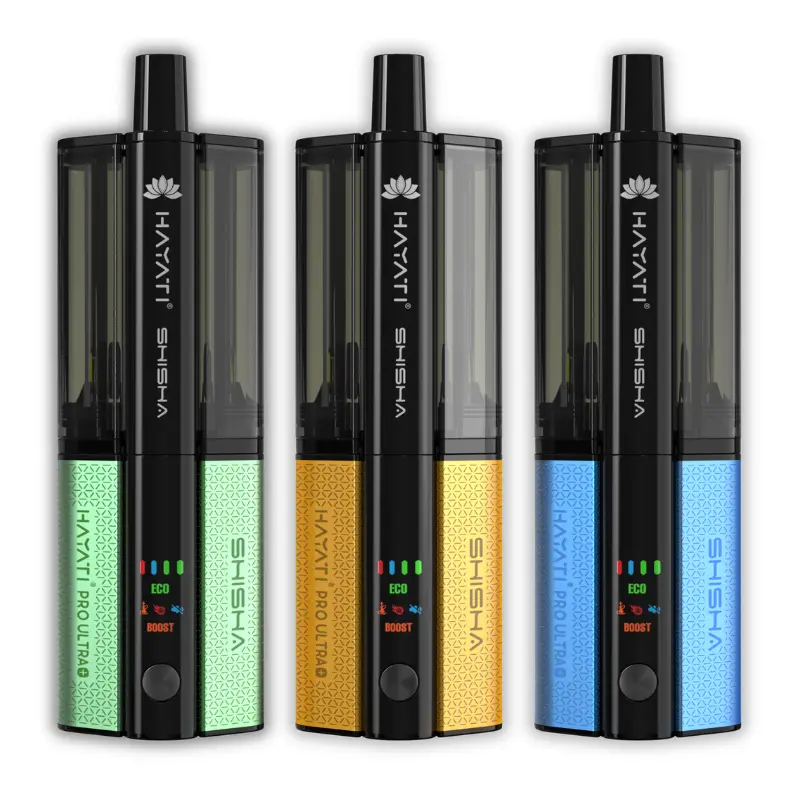
Hayati · Pro Ultra Plus
Hayati Pro Ultra Plus Shisha 30000 Prefilled Pod Kit
£11.99
✔ In stock — ready to ship
Genuine Hayati
Free over £20
Same-day dispatch
Secure checkout
£11.99 buys the complete Hayati Pro Ultra Plus Shisha 30000 Prefilled Pod Kit: the device, and a 22ml prefilled pod holding two flavours, Apple Mint Grape and Peach Grape Mint, selected by rotating the mouthpiece section. Nicotine is 5mg per millilitre. Hayati rate the pod, on their own laboratory apparatus, at up to 30,000 puffs. Those four figures are the whole commercial specification, and two of them are unlike anything else on the platform.
One point of clarification before the analysis, because the product name invites a misreading. This is a nicotine vape liquid and not a tobacco product. The word in the title is a flavour label, and that is the only sense in which this page uses it. What the borrowed name implies about the shape the profile was originally built for, and what happens to such a profile in a format used quite differently, is the argument made at length on the companion Hayati Pro Ultra Plus Shisha 30000 Pods listing. It is not rebuilt here. This page stays with the numbers.
And the numbers are why the page exists. The Pro Ultra Plus platform is remarkably uniform. Walk the Hayati Pro Ultra Plus Prefilled Pod Kit shelf and the specification column barely moves from one listing to the next, which is precisely what makes an exception worth measuring rather than merely mentioning. Several pages on this site have already noticed, in passing, that one listing on the platform does not fit the pattern, and have hedged their own claims with a phrase like "all but one outlier". This is that outlier. Its bare pod takes up three of the departures in detail. What nobody has done is work through the whole set against the kit shelf: which axes it actually departs on, which axes only look as though it does, and what each one can and cannot support.
That is the job here. Every published figure on this listing has been compared against every other Pro Ultra Plus kit in the catalogue: price, liquid volume, nicotine strength, puff rating, the cell capacity where a listing states one, which shelves it is filed on, and how the flavour is written into the title. Some of those come back identical. Some come back unique. The one that repays the most attention is the puff rating, because this listing carries a higher rating than its siblings on exactly the same published volume, and that single fact settles an argument about what a puff figure can possibly be measuring.
Six axes, counted against all fifty-two kits
The counts below come from the catalogue behind this site on the day the page was written. There are 104 Pro Ultra Plus listings in total: 52 kits at £11.99 and 52 bare pods at £7.99. Where a row says "1 of 52" it means this listing and no other kit. Ranges grow, so the figures are dated by the count rather than by assertion.
| Axis | This listing | The other kits | Outlier? |
|---|---|---|---|
| Shelf price | £11.99 | £11.99, all 51 | No, 52 of 52 agree |
| Liquid on board | 22ml | 22ml, all 51 | No, 104 of 104 agree |
| Nicotine strength | 5mg per millilitre | 20mg on 51 of 52 | Yes, 1 of 52 |
| Manufacturer puff rating | Up to 30,000 | Up to 25,000 on 51 of 52 | Yes, 1 of 52 |
| Cell figure where published | 900mAh | 850mAh on 41, nothing stated on 10 | Yes, 1 of 42 that state one |
| Number of shelves filed on | 7 | Between 5 and 11, median 8 | No, comfortably inside the spread |
| Flavour written into the title | None. "Shisha" occupies the slot | 50 of 52 lead with a flavour | Yes, 1 of 2 |
| Oblique shown in the title | No, though the pod holds two sides | 17 of 19 dual listings show it | Yes, 1 of 2 |
Read the first two rows before the rest, because they are the control. Price is flat across this entire platform, and so is volume. Every kit costs £11.99 and every pod holds 22ml, with no exception anywhere in the 104 listings. That matters enormously for what follows: it means that when the rating moves and the volume does not, the volume cannot be the cause. The experiment has been set up for us by the catalogue.
Rows three and four are the substantive departures. Five milligrams per millilitre appears on two of the 104 Pro Ultra Plus listings, this kit and its bare pod. Across the whole 492-product catalogue, spanning every format Hayati sell here, 5mg appears three times. The third is a Pro Max Plus pod on a different platform entirely. So the strength is not merely unusual on this shelf. It is close to absent from the business.
The rating behaves the same way. Fifty-one of the fifty-two kits carry a 30,000 figure of nowhere and a 25,000 figure everywhere; this one inverts that. Both Shisha listings, kit and pod, are rated at 30,000, and nothing else on the platform is.
Row five needs care, and the care is the point. A battery figure is a property of a device rather than of a flavour, and the Pro Ultra Plus listings are inconsistent about publishing one at all: 41 of the 52 kits state 850mAh, ten state nothing, and this one states 900mAh. What that inconsistency does not license is a conclusion about the hardware. Hayati do not say whether the 900 and the 850 describe two different cells or the same cell written two ways, and a retail page is not the place to settle it. What can be said is narrower and still useful: the published figure on this listing is higher than the published figure on the listings that state one, by about six per cent, and that six per cent is going to matter in a moment.
Row six is the one that dissolves under counting, and it is worth saying so plainly, because an angle that survives measurement is worth more than one that sounds bolder. Filing depth is unremarkable. Seven shelves is ordinary for a kit on this platform, where the spread runs from five to eleven. If the claim had been that this listing is buried or over-promoted, the count refuses it.
What the count does support is a different complaint about the filing, and it is about content rather than quantity. This kit sits on Apple Vapes and on Blueberry Vapes. Apple is defensible: apple is named in one of the two halves. Blueberry is not named anywhere in the product at all. Ten Pro Ultra Plus kits are filed under Blueberry Vapes and nine of them carry blueberry or blue raspberry in the flavour text, including Blueberry Raspberry, Blueberry Cotton K / Raspberry Cotton K and Blueberry Raspberry / Mr Blue. This is the tenth, and the only one where no blue fruit of any description appears in the recipe.
Meanwhile, three fruits that are named have shelves of their own on this site and this listing is on none of them. Grape appears in both halves and the grape shelf holds eighteen products, three of them Pro Ultra Plus kits. Mint appears in both halves and the mint shelf holds eighteen, three of them kits here. Peach appears in one half and the peach shelf holds thirty-two, four of them kits here. So of the four botanical words in the recipe, exactly one maps to a shelf the product is actually on, and the product sits on a shelf named for a fruit it does not contain.
The honest reading is that this is a cataloguing slip rather than a hidden ingredient, and the reason to say it out loud is practical. Anyone browsing by fruit will fail to find this listing under grape, mint or peach, and anyone who arrives at it from a blueberry shelf will be surprised by what is in the pod. If you want it, the reliable route is the platform shelf rather than the fruit shelf: it is on Hayati Pro Ultra Plus Prefilled Pod Kits & Pods with the other 103 listings, on Hayati Pod Kits and Hayati Prefilled Pod Kits with the wider kit range, and on New Products.
Rows seven and eight concern the title, and they are the axis a buyer meets first. Fifty of the fifty-two kits put a flavour in front of the brand: Watermelon Ice, Cherry Berry, Blue Sour Raspberry and so on down the shelf. Two do not. One is the plain Hayati Pro Ultra Plus 25000 Prefilled Pod Kit, which turns out to hold Blackcurrant Cotton K and Blue Raspberry despite saying so nowhere in its name. The other is this one, where a word that is not a fruit, not a colour, not a confection and not a mood has taken the flavour slot and pushed the recipe off the label entirely.
The oblique count runs the same way. Nineteen kits hold two flavours in one pod, and seventeen of them advertise the pairing with a slash in the title, as Blue Razz Cherry / Blue Razz GB and Lemon Lime / Summer Dream do. Two conceal it, and this is one of the two. A buyer scanning titles has no way of knowing from the name that this pod has two sides and a collar to turn between them.
The rating, and the sum that refuses to balance
Here is the finding the rest of the page is built on, stated as bluntly as it deserves. This listing carries twenty per cent more rated puffs than its platform siblings on exactly the same published volume of liquid.
Twenty-five thousand and thirty thousand, both on 22ml. Divide them out and the 25,000 kits imply roughly 1,136 rated puffs for every millilitre in the pod, while this one implies roughly 1,364. The pod is not bigger. The price is not higher. Nothing in the published specification has grown by a fifth.
The companion Shisha pods listing runs the same division the other way up, in microlitres of liquid per rated draw, and reaches the same place: the extra puffs are not extra liquid. That page also settles a related question, correcting a sibling kit page that had attributed the higher figure to the lower nicotine strength. Both of those are cited here rather than rebuilt. What this page adds is the rest of the sweep, because the rating is one axis of six and the others have not been counted anywhere.
Two things follow from the rating on its own, and the second is more useful than the first.
The first is that a puff rating on this platform cannot be a function of capacity. That is not a hedge or a caution, it is arithmetic: two listings, identical stated volume, different stated ratings. Whatever the number is measuring, it is not simply how much liquid is in the pod. One sibling page on this site states, in the course of a genuinely sound argument about which specifications can separate two flavours, that the puff rating "is a property of the hardware and the volume". Volume is now ruled out by its own platform. The claim was true of the fifty-two listings in front of that writer and this pair breaks it, which is the ordinary way a count improves a corpus rather than a reason to distrust it.
The second is the one that transfers. Pages on this site have already established that ratings are not comparable between Hayati's ranges, and the argument does not need repeating here: the Red Razz GB / Blue Razz GB kit page works through the per-millilitre economics across four platforms and concludes that the figure should play no part in choosing between them, and the Pro Max Plus 4000 kit page catches the same manufacturer rating a 7ml pod at roughly 571 puffs per millilitre and a 12ml pod at 500. Both are cited rather than rebuilt.
What this listing adds is a stronger version of the same evidence, and the reason it is stronger is worth being precise about. In the 4000 case, the two pods differ in volume as well as in rating, so a defender of the figures can always say the relationship between liquid and puffs is simply not linear across pod sizes. Here there is nothing to say. Volume is held constant at 22ml. Format is held constant. Platform is held constant. Price is held constant. One number moved and the thing it is supposed to depend on did not move at all.
Try to close the gap with the other published figures and it will not close. The volume multiplier is 1.0, because 22ml is 22ml. The cell multiplier, taking 900mAh against the 850mAh that 41 sibling kits publish, is about 1.06. The rating multiplier is 1.2 exactly. Even granting the battery figure the most generous reading available, six per cent of extra cell capacity does not produce twenty per cent of extra puffs, and it would have to be doing all of that work on its own, because every other published quantity is unchanged.
So the twenty per cent comes from somewhere Hayati do not publish. The honest list of candidates is short and none of its entries can be confirmed from a retail listing: a different coil in the pod, a different airflow, a different set of draw parameters on the test bench, or a figure set by a marketing decision rather than a measurement. Hayati publish no coil resistance for this pod, no airflow specification, and no description of the test protocol behind either number. I am not going to pick between those, and neither should any page you read.
What the difference cannot mean is a shorter list and a firmer one.
- It cannot mean more liquid. Both pods hold 22ml and the catalogue is unanimous on that across all 104 listings.
- It cannot mean a bigger pod. Same volume, same platform, same price, same format.
- It cannot mean better value. At £11.99 for 22ml, this kit costs exactly what Fruit Twist costs for 22ml. The pence you pay per millilitre is identical. Only the number printed above it differs.
- It cannot mean the coil is working less hard. If anything the arithmetic points the other way, because the same liquid is being asked to produce more rated actuations. But that inference depends on the ratings being commensurable, and the whole point of this section is that they may not be.
- It cannot be used as a duration estimate. Both figures are laboratory results obtained on machines that draw at a fixed length and interval, and no person does that. Hayati rate this pod at up to 30,000 puffs and the sentence stops there.
The transferable lesson for a buyer is simple and slightly deflationary. A puff rating is a label, not a measurement you can do anything with. Within one platform, holding volume and price and format constant, Hayati have published two different figures. If the number can move twenty per cent while nothing underneath it moves at all, then a difference of the same size between any two listings tells you nothing you can spend. Choose on volume, price and flavour, all three of which are stated unambiguously, and treat the puff figure as decoration.
Five milligrams in twenty-two millilitres
The strength is the other genuine departure, and it needs stating as a fact before anything is reasoned from it. This pod is filled at 5mg of nicotine per millilitre. Fifty-one of the fifty-two kits on this platform are filled at 20mg. Nicotine is an addictive substance at any strength, and because the pod is prefilled and sealed there is no version of this product at any other figure.
Multiply out and the scale of the difference becomes clearer than the milligram figures make it look. Twenty-two millilitres at 5mg per millilitre is 110mg of nicotine in the pod. Twenty-two millilitres at 20mg is 440mg. This listing therefore carries a quarter of the nicotine that Blackcurrant Lemonade or Orange Lemon Lime carries, in the same volume, in the same format, at the same £11.99.
That last clause is the interesting one, and it is a pricing observation rather than a recommendation. Price on this platform is indexed to volume and format and to nothing else. Twenty-two millilitres plus a device is £11.99 whether the liquid contains 110mg of nicotine or 440mg. Whatever Hayati are charging for, it is not the active ingredient.
It is natural to want one departure to explain the other, and that explanation does not work. The pods page sets out why in full: nicotine occupies a small enough fraction of either formulation that moving it cannot shift how much liquid a coil turns to vapour per draw by anything like the margin in question. The argument is theirs and is not repeated here. The conclusion to carry into the rest of this page is that the strength and the rating are two separate departures that happen to appear on the same listing, not one causing the other.
There is a further consequence of their appearing together, and it is the one that costs a buyer something. Because the Shisha recipe exists only at 5mg and 5mg exists only in the Shisha recipe, the two variables are welded. You cannot buy this flavour at 20mg and you cannot buy any other Pro Ultra Plus flavour at 5mg. Anything you notice when you try it is the joint effect of a new recipe and a new strength, and there is no way to attribute it to either.
That is a real limitation and it is worth knowing before you form an opinion. Elsewhere in Hayati's catalogue the variable is isolated: on the Pro Max Plus platform a single recipe is offered at four different nicotine figures with the price and volume held constant, and the 5mg pod page on this site works through what changes when only the strength moves. That analysis is not repeated here, partly because it belongs to that page and partly because the conditions that make it possible do not exist on this platform.
Two smaller notes on the strength, both factual. Twenty milligrams per millilitre is the maximum permitted in the United Kingdom, so the 51 siblings are all sitting at the ceiling and this one is not. And the same recipe name, Apple Mint Grape, appears on a 10ml Hayati bottle at 10mg, which means the house Shisha recipe exists at two published strengths across the catalogue and at neither of the figures the Pro Ultra Plus platform otherwise uses.
Two blends on one grape-and-mint spine
The pod holds Apple Mint Grape and Peach Grape Mint. A rotating mouthpiece section selects which of the two internal reserves feeds the coil, and the selection can be changed as often as you like within a session. What Hayati publish is that the collar picks a side. They publish nothing about how the reserves are divided or how the liquid is kept apart, so this page describes what the collar does and stops there.
Start with the structure of the two names, because it is unusual on this platform and it tells you something real. Both are three-word ingredient lists. Both contain grape. Both contain mint. The only component that changes between them is the third fruit: apple on one side, peach on the other. Compare that with almost any other dual listing here. Straw' Cranberry Cherry / Cherry Ice pairs a three-fruit blend with a cooled single fruit. Blackcurrant Cotton K / Blue Raspberry pairs a confectionery treatment with a plain berry. This pod pairs a blend with a variation on itself.
The practical consequence is the opposite of what people expect from a two-sided pod. Two thirds of the recipe is common to both positions, so the distance the collar travels is short. If you turn it mid-draw sequence and expect a change of subject, you will be disappointed, and you may conclude that the collar is not doing anything. It is; the thing it is selecting between is just narrower than the format usually implies.
Carryover makes that worse rather than better. One coil, one wick and one airflow path serve both sides, so the first draws after a switch carry residue from the side you left. On a pod that pairs, say, a cola with a mango, the residue is obvious and you can mentally subtract it. Here the residue is grape and mint, and so is the thing arriving. You cannot subtract what you cannot separate. Any honest attempt to tell the two halves apart has to allow for it.
Now the components, with the confidence level attached to each, because Hayati's description is short and a good deal of what a buyer wants is not in it.
Grape, and which grape is unstated. Grape in vape liquid divides into two broad families that taste almost nothing alike. There is the dark, jammy, slightly vinous grape that leans towards blackcurrant, and there is the pale confectionery grape, the one that tastes of a sweet shop rather than of fruit. Twenty-one listings in this catalogue carry the word grape, and nearly all of them qualify it: Grape GB, Grape Berry, Sakura Grape, Kiwi Grape Raspberry. The Shisha listings are among the very few where grape stands on its own with no modifier at all. That absence of a qualifier is genuinely uninformative, and I am not going to convert it into a tasting note. Treat the grape as unknown between the two families until your own first pod resolves it.
Mint, and which mint is unstated. The same problem, with better evidence available. Mint in this catalogue comes in at least three registers: peppermint, spearmint, and the generic confectionery mint that is neither. Hayati are perfectly capable of naming one when they mean it, since they sell Spearmint as a bottled liquid and as a pod under that exact word, and they sell Double Menthol where menthol is the point. On this listing they wrote "Mint" twice and qualified it neither time. The inference, and it is an inference rather than a specification, is that an unqualified mint on a Hayati label is the general confectionery mint rather than either named botanical. It is drawn from how Hayati write, not from anything they have stated about this pod, and it should be held loosely.
Apple, and how much the listing does say. Hayati characterise the apple side as the crisper and brighter of the two, relative to the peach side. Note the word relative. That is a comparison between the two halves of this pod, not a placement of the apple on any absolute scale, and it does not tell you whether the apple is the green, tart kind or the red, sweeter kind. The catalogue offers a weak steer: where Hayati mean a sharp apple they tend to say so, as on Sour Apple / Juicy Peach, which is the only other Pro Ultra Plus kit with an apple in it. No sour word appears here.
Peach, with a slightly firmer inference. Peach splits into the yellow, soft, jammy peach and the pale, floral white peach, and those are different flavours rather than different intensities of one. Hayati distinguish them in their own naming: White Peach Raspberry is sold under that name in more than one format, which implies that an unlabelled peach elsewhere in the catalogue is the yellow one. Again an inference from labelling habits, again flagged as one, and rather better supported than the mint inference because the contrast case actually exists in print.
Cooling, and what the name does not include. There is no ice-family word anywhere in this listing. That matters more than it might look, because a page on this site has already counted the cooling vocabulary across the whole catalogue and found that Ice, Frozen, Cooler, Mint, Menthol, Chill and Freeze are not a graded scale, that Ice appears in ninety titles against three for Frozen and two for Cooler, and that no listing ever combines an ice-family word with a mint-family word. This listing is consistent with that finding: mint twice, ice never. What that census establishes is that the absence of Ice here does not mean the pod is uncooled, and the presence of Mint does not tell you how cool it is. Hayati publish no coolant and no cooling level for this pod, and the terms are not comparable even when they appear on neighbouring listings.
Sweetness, which is unpublished. No sweetness scale exists in Hayati's data for any listing, so anything on this page about where the pod sits between the confectionery end and the dry end would be invented. What can be said is negative and useful. No confectionery marker appears in either name. There is no B'Gum, no Cotton K, no bubblegum or candyfloss term of the sort that Fruit Bomb / Straw' Watermelon B'Gum carries. No sour marker appears either. Both halves are written as plain fruit plus mint, which is the least decorated construction on the shelf.
Which leaves the question of what to actually do with a first pod, since a page that cannot describe the liquid can at least describe how to characterise it. Three things, in order.
Take the apple side first, on a fresh coil, and decide one thing only: whether the mint reads as cooling or as herbal. Those are different sensations and the distinction is the single most consequential thing about this pod, because a cooling mint sits underneath fruit and a herbal mint sits alongside it. Do not try to judge the grape yet.
Put it down. Come back to it after a meaningful gap, turn the collar to the peach side, and let the first few draws go past without assessment, since those are still carrying the apple. Then ask whether the grape underneath tastes like the same grape it did on the other side. It should, if the spine really is shared. If it does not, what you are most likely detecting is the third fruit changing how you read the grape rather than two different grapes, and that is worth knowing because it means the two sides are more closely related than they seem.
Third, and only after both of those, form a view on sweetness by comparison rather than in the abstract. If you have a plain fruit pod to hand, something like Blueberry Raspberry, the comparison will tell you more in two minutes than any description can.
What this pod is not, stated flatly so nobody arrives at it by mistake. It is not cooled with an ice-family coolant, at least not in name. It is not a sour or a sherbet profile. It is not a dessert, a bakery or a cream. It is not a single flavour, whatever the title implies by omitting the oblique. And it is not a tobacco flavour, despite where the word in the name came from; Hayati's own reading of that register, visible in the fact that all three of their Shisha-named products are built on apple, grape and mint, is fruit and mint rather than anything else.
What arrives, in the space it needs
The box contains the Pro Ultra Plus device and one prefilled 22ml pod. Nothing needs filling, nothing needs priming and no separate purchase is required to use it, which is the whole reason a kit costs four pounds more than the bare pod at £7.99.
One specification matters more than the rest for this particular liquid, and it is the collar. Because both sides share a coil, a wick and an airflow path, the pod ages as a single unit rather than as two. There is no sense in which you can preserve one half by using the other, and a coil tiring on the apple side is a coil tiring on the peach side. For a pod whose two halves differ by one fruit in three, that shared ageing is more consequential than it would be on a pairing of opposites, because the difference you are trying to detect is small enough to be swamped by it.
Hayati state a 900mAh cell for this listing. They do not publish coil resistance, wattage, airflow, dimensions, or any detail of how the pod is retained in the bay, and this page will not supply any of those. The pod is prefilled and finished as a unit, so it is not refillable and the coil is not replaceable; when the liquid is gone the whole assembly is spent. As with anything on this platform, match the range name printed on your device to the range name in the title before ordering, and do not take a compatibility decision from a retail page. The rest of the range sits on Hayati Prefilled Pod Kits.
The figures, with a column most tables leave off
The right-hand column below is the one worth reading, because it converts each specification into the only question that matters for a choice: does this number distinguish the listing from its neighbours, or is it the same on all of them?
| Specification | Published value | How many of the 52 kits share it |
|---|---|---|
| Nicotine strength | 5mg per millilitre, salt | 1 of 52. Every other kit is 20mg |
| Manufacturer puff rating | Up to 30,000, laboratory apparatus | 1 of 52. Every other kit is 25,000 |
| Cell capacity as listed | 900mAh | 1 of 42 that publish a figure at all |
| Flavour, as Hayati record it | Apple Mint Grape / Peach Grape Mint | 1 of 52. No recipe repeats on this shelf |
| Flavour selection | Rotating mouthpiece section | 19 of 52 hold two sides |
| Liquid on board | 22ml across both reserves | 52 of 52, and 104 of 104 platform-wide |
| Price | £11.99 | 52 of 52 |
| Supplied with | Device and one filled pod | 52 of 52 kits |
| Coil | One, sealed in, shared by both sides | Resistance not published for any listing |
| Refillable | No | 52 of 52 |
| Brand and reference | Hayati, hayati-pro-ultra-plus-shisha-30000-prefilled-pod-kit | Unique |
Four rows in that table carry information and seven do not. Volume, price, the contents of the box and the non-refillable construction are constants: knowing them tells you what the platform is and nothing about which listing to buy. The rows that discriminate are the strength, the rating, the published cell figure and the recipe, and three of those four are the reason this page exists.
The coil row deserves its own sentence. Hayati publish no resistance figure for any pod on this platform, which means that the usual way of estimating how a liquid will behave, by reading the resistance against the VG/PG ratio, is unavailable across the whole shelf. That is not specific to this listing and it is not a criticism of it. It is simply a gap that every Pro Ultra Plus page has to work around, and the honest response is to say so rather than to fill it.
Where it sits, and who should pick what
Because price and volume are flat across the platform, a choice between this kit and any other is entirely a choice about the liquid and, in this one case, about the strength. The money question does not arise. What follows is organised by what would actually send someone to a different listing.
If the 5mg figure is the reason you are here. There is exactly one alternative, and it is the bare Hayati Pro Ultra Plus Shisha 30000 Pods at £7.99, which is the same 22ml of the same two liquids with no device in the box. That is the whole set. Nothing else on this platform is offered at anything other than 20mg, so if the strength is the deciding factor then the recipe is not a variable you get to control. Buy the kit if you do not already own a compatible body, and the pod if you do.
If you want mint and are not committed to the grape. Mint is thin on this platform, at three kits out of fifty-two, and this would be the fourth if the shelf filing agreed. The nearest alternatives take mint in different directions and both are 20mg: one pairs a plain mint with a cooled blue raspberry across a collar, the other runs mint under a citrus. Neither shares the grape spine, which is the defining feature here rather than the mint.
If the grape is the draw. Grape is thinner still. Grape GB / Strawberry GB is the obvious neighbour and it is a genuinely different proposition, because GB signals a confectionery treatment of the fruit rather than a plain one. If what you want is grape as a sweet-shop flavour, that listing says so in its name and this one does not. If what you want is grape as fruit, this is closer, with the caveat above that the family is unstated.
If the apple is the draw. Sour Apple / Juicy Peach is the only other apple on the platform and it overlaps this pod in two of its four named fruits, apple and peach, while replacing the grape and mint spine with a sour treatment. Between the two, the sour listing is the more assertive and the more clearly signposted, since it tells you in its title exactly what kind of apple it holds. This one is the less declarative of the two and the one with more left unstated.
If you would rather have something the catalogue describes properly. That is a legitimate reason to walk away, and the berry end of the shelf is where the descriptions are fullest. Blueberry Raspberry Lemon, Blue Razz Pineapple / Strawberry Ice and Blueberry H'Bubba / Watermelon H'Bubba all put more on the record about what is in them than this listing does, and on a sealed 22ml pod that you cannot sample first, a fuller description is worth something.
If the two halves being similar is a problem. It might well be. Several dual listings pair genuinely distant flavours, which is a different value proposition: Lemon Lime / Summer Dream puts a sharp citrus against an undeclared blend, and Blue Razz Cherry / Blue Razz GB puts a fruit treatment against a confectionery one. If you buy a two-sided pod to have two different things, those serve better than a pod whose sides differ by one ingredient.
If a single flavour would suit you better. Half the kits on the platform hold one liquid and no collar, which removes the carryover problem entirely. Blue Sour Raspberry, Cherry Berry and Watermelon Ice are all single-side kits at the same £11.99 for the same 22ml.
If £11.99 is more than you want to commit to an untested flavour. The cross-platform option is real and the arithmetic is not subtle. Blue Razz Fruit Twist Pro Max Plus 6000 and Blueberry Raspberry Cherry Pro Max Plus 6000 are complete kits at £7.99 with 12ml on board, so the commitment is four pounds smaller and the liquid is roughly half. Different flavours, different device, and a smaller loss if the flavour turns out not to suit you. The whole range across every platform is on the full Hayati shop.
If you want the strangest listing on the shelf for its own sake. Then the one thing worth knowing is that its strangeness is entirely in the numbers and the naming, not in the price or the format. You are buying a standard Pro Ultra Plus kit with a non-standard label on it.
Living with a pod that has more label than description
Practical handling first, and then the two things that are specific to this listing rather than general to the platform.
Store it upright where it will not get warm, and out of direct sun. Heat is the enemy of any prefilled pod, and on a pod with a mint component there is a particular reason to care: the volatile top end of a mint is the part that goes first, and a pod that has spent a fortnight on a warm windowsill will read flatter on the mint than the same pod stored in a drawer. If you buy two, the spare goes somewhere cool and dark. Keep it out of reach of children and pets.
Draw length is the only variable you actually control on this platform, since there is no wattage setting and no airflow adjustment. Longer, slower draws pull more liquid through a given coil and produce a warmer, denser result; shorter ones do the opposite. On this pod the consequence is specific. The mint sits on the light end of the recipe and the grape sits underneath it, so a longer draw will tend to push the grape forward and a shorter one will leave the mint more prominent. If the balance is not where you want it, that is the dial to turn before you conclude the flavour is wrong.
The first listing-specific point concerns the collar and patience. Because the two sides share two thirds of their recipe, switching back and forth rapidly is the worst possible way to evaluate them and also the most tempting. Every switch carries residue, the residue is made of the same components as the destination, and the net effect is that the pod tastes like one thing. Give each side a proper run. If you want to know whether you prefer the apple or the peach, use one for a day.
The second concerns how a tiring coil will present on this recipe in particular. A coil that has been working for a while loses the light, volatile end of a flavour before it loses the heavy end. On a berry pod that shows up as the fruit going dull. Here the mint is the lightest thing in the recipe and the grape is among the heaviest, so the failure mode is predictable: the mint fades, the grape stays, and the pod drifts towards tasting like plain fruit with something missing. If that happens gradually rather than suddenly, the coil is the reason and not the batch.
One more thing about a part-used pod, which applies with extra force to a two-sided one. Liquid left in the side you use less is thrown away with the pod when the coil is finished, because the halves share a single 22ml budget and cannot be separated. On a pod where the two sides are closely related that is less painful than usual, since you are unlikely to detest one of them, but it is still worth knowing that the pod does not owe you an even split and Hayati do not publish how the 22ml is divided.
When it is spent, the pod contains a battery, a coil and a residue of liquid, so it does not belong in household waste. Electricals of this kind go to a retailer take-back point or a local recycling facility rather than a bin.
Questions this listing actually raises
Why is this rated at 30,000 when the rest of the platform is 25,000?
Hayati do not say. What can be established is that the extra twenty per cent is not explained by anything they publish: the volume is 22ml on both, the price is identical, and the only other figure that moves is a cell capacity that is about six per cent higher. Both numbers are laboratory results produced on test apparatus, and the gap between them is the clearest evidence on this site that such a figure is not a property of the liquid in the pod.
Does the higher rating mean there is more liquid in it?
No. Every one of the 104 Pro Ultra Plus listings states 22ml, including this one, so the volume is identical to its siblings. The higher figure is spread across the same quantity of liquid, which is exactly why it cannot be read as a capacity claim.
Is 5mg available on any other flavour in this range?
No. Two of the 104 Pro Ultra Plus listings are filled at 5mg, and both are this recipe: the kit and its bare pod. The other 102 are 20mg, which is the maximum strength permitted in the UK. Across the whole 492-product catalogue on this site, 5mg appears three times.
Can I get this flavour at 20mg instead?
Not on this platform. The recipe and the strength are tied together on these two listings and Hayati publish no 20mg version. The same recipe name does appear on a 10ml Hayati bottle at 10mg, which is a different format requiring a refillable device rather than a prefilled pod.
Is it cheaper because it holds less nicotine?
No. It is £11.99, which is what every other kit on this platform costs, and the bare pod is £7.99, which is what every other pod costs. Price here tracks volume and format only, so a quarter of the nicotine arrives at exactly the same price as the full amount.
Why is it filed under Blueberry Vapes when there is no blueberry in it?
That looks like a cataloguing slip rather than a hidden ingredient. It is the only one of the ten Pro Ultra Plus kits on that shelf whose recipe names no blue fruit at all. More usefully for finding it again, it is also absent from the grape, mint and peach shelves despite naming all three, so the platform shelves are the reliable route back to it.
How different are the two sides from each other?
Less than most two-sided pods on this shelf. Both are built on grape and mint and differ only in the third fruit, apple on one side and peach on the other. Hayati describe the apple side as the crisper of the two and the peach side as the rounder, which is a comparison between the halves rather than an absolute placement.
Is there any ice or menthol in it?
No coolant is named and no ice-family word appears in the listing. Mint is named on both sides. A count of Hayati's cooling vocabulary across this catalogue has established that the terms are not a graded scale and that mint-family and ice-family words never appear together on one listing, so the presence of mint here tells you a mint note is present and nothing about how cool the result is.
Which mint and which grape are they using?
Neither is published. Hayati name spearmint and menthol explicitly on other products when they mean them, and they qualify grape as GB, Berry or Sakura on almost every other grape listing, so the unqualified words here are most likely the general confectionery versions of each. That is an inference from how Hayati write their labels, not a specification, and it should be treated as such.
Does the device differ from the one in the other kits?
Unknown. This listing publishes 900mAh, 41 of the 52 kit listings publish 850mAh and ten publish no figure at all. Whether that describes a different cell or the same cell recorded differently is not something Hayati state, and it should not be settled from a retail page.
Can I refill the pod when the liquid runs out?
No. It arrives filled and finished as a single unit with the coil sealed inside, so when the 22ml is gone the pod is spent. It contains a cell and a coil, so it goes to a take-back point or a recycling facility rather than into household waste.
Should I buy the kit or just the pod?
The kit at £11.99 includes the device and the pod; the bare pod at £7.99 is the same 22ml with nothing to put it in. The four pounds between them is the whole of the hardware cost, so the kit is the right purchase only if you do not already have a compatible body, and the pod is the right one if you do.
The short version
This is a standard Pro Ultra Plus kit wearing a non-standard label. The price is £11.99, exactly like the other fifty-one. The pod holds 22ml, exactly like the other 103 listings on the platform. What differs is a 5mg nicotine strength that appears nowhere else on this shelf and only three times in the whole catalogue, a 30,000 puff rating where everything else is rated at 25,000, a published cell figure six per cent above the one its siblings quote, and a title that puts a borrowed word where every other listing puts a fruit.
The rating is the finding worth carrying away. Two listings on one platform, identical in volume, price and format, carry figures twenty per cent apart. Whatever a puff rating measures, it is not the liquid in the pod, and a buyer who was using those numbers to compare listings should stop. The strength is a plain fact rather than a recommendation: 110mg of nicotine in the pod against 440mg in its neighbours, at the same price, with no way to separate the strength from the recipe because neither is sold without the other. Nicotine is addictive at any figure.
As for the liquid, two grape-and-mint blends differing by one fruit, described briefly and specified thinly. If you want that combination, this is the only place on the platform it exists. If you want to know in advance what it tastes like, the listing will not tell you and neither will this page, and a berry pod with a fuller description is the more informed purchase.
Strictly for adults aged 18 and over. Nicotine is an addictive substance.
You might also like