
Home / Hayati Pro Max Plus Pods / Blue Razz Fruit Twist Hayati Pro Max Plus Pods
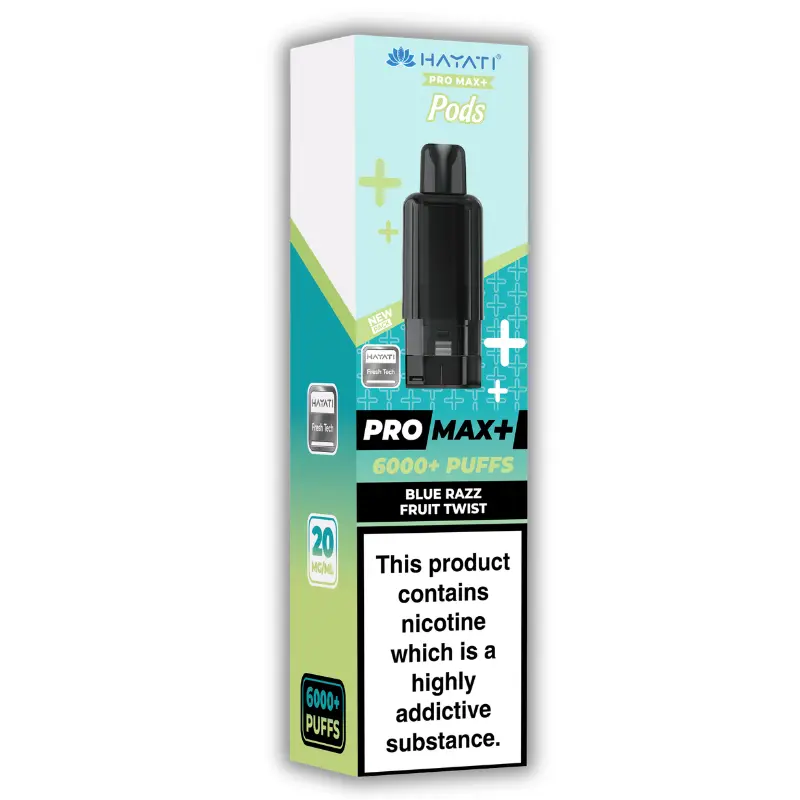
Hayati · Pro Max Plus
Blue Razz Fruit Twist Hayati Pro Max Plus Pods
£5.49
✔ In stock — ready to ship
Genuine Hayati
Free over £20
Same-day dispatch
Secure checkout
This listing is the refill on its own: 12ml of Blue Razz Fruit Twist at 20mg nicotine salt, £5.49, no device in the box. Almost nobody buys it first. It gets bought by somebody who already owns the body, has already emptied at least one of these, and has decided to have another. That is a narrow audience and it makes this a different page from the one attached to the kit, because the interesting question has moved. It is no longer what the liquid tastes like. It is what happens to it between the first millilitre and the twelfth, and whether that pattern repeats.
The flavour analysis proper sits on the Blue Razz Fruit Twist Hayati Pro Max Plus 6000 Pod Kit page, along with the account of why a confected blue leads and closes the draw while the unnamed mixed fruit fills the middle. That work is done and there is no point doing it twice. What that page cannot do, because it is addressed to somebody holding a first pod, is the thing this page is for.
Here is the claim, and it is a slightly unusual one for a product listing to make. Coil performance across a pod's working life is the single most consequential property of a prefilled vape that no manufacturer publishes anywhere. Hayati give a volume, a strength, a price and a laboratory puff rating. They do not give a fade curve, and neither does anyone else, because a fade curve is not a specification, it is a behaviour, and it varies with the recipe rather than with the hardware. Eighty-nine listings on the Hayati Pro Max Plus Pods shelf share one body and one pod format, and they do not all age at the same rate. The liquid decides that.
Which means the person on their second identical pod is holding something genuinely scarce: repeated observations of one recipe, on one device, taken by one palate. A first-time buyer has a single uncontrolled reading and no way to know whether it was typical. A repeat buyer can have three, and three is where a pattern starts being worth something. The argument of this page is that the data is worth capturing rather than losing, that capturing it costs almost nothing, and that a sugar-forward blue is a more rewarding subject for it than most things on the shelf.
The second pod is where the information starts
One pod tells you one thing, and it is not the thing most people think it is. You learn whether you liked the liquid. You learn nothing reliable about how it behaves, because a single run offers no comparison against which any of its behaviour can be read as normal or abnormal.
Consider what a first pod actually leaves you with. Somewhere around the middle of it, the sherbet edge that defines the opening of this blend goes quiet. That is an observation. It is also completely uninterpretable on its own, because at least four explanations fit it equally well and you cannot separate them with one run. The coil may have accumulated residue to the point where the fine top notes no longer survive the trip. The liquid in that particular pod may have been sitting somewhere warm for months before it reached you. Your palate may have adapted to a flavour you have been running continuously for six days, which feels exactly like the flavour weakening. Or you may have drifted, without noticing, into drawing longer and harder because the first two effects made you chase it, which heats the coil and accelerates everything.
Four candidates, one observation, no way to choose between them. That is not a failure of attention but a structural limit on what a single run can tell anyone, and paying closer attention on a first pod does not fix it.
The second pod breaks the deadlock for a simple reason. Fitting a fresh one resets exactly one of those four variables and leaves the rest where they were. Your palate is the palate it was yesterday, your draw habits are the same habits, the device is the same device. Only the coil and the liquid are new. So whatever comes back at that moment is attributable to the pod, and whatever does not come back is attributable to you.
That is a controlled comparison, arrived at by accident in the ordinary course of restocking, and most people throw the result away because they do not think of the moment as an experiment. If the sherbet returns in full on the first draw of pod two, the fade on pod one was the coil and the liquid. If it does not, the fade was at least partly habituation, and the pod was fine.
Those two conclusions point at completely different purchases. The first says buy this listing again and retire each pod earlier than the liquid level suggests. The second says the liquid is fine and the problem is running one flavour without a break. Getting it the wrong way round is how people decide a perfectly consistent product has gone downhill, or buy replacements for something no replacement fixes.
A third pod does something the second cannot, which is to tell you whether the second was itself typical. Two points define a line and any two points do; three points tell you whether the line is real. If the fade lands in roughly the same place on all three runs, you are looking at a property of the recipe. If pod two behaved and pods one and three did not, you are looking at variation between batches, which is a different and much less actionable finding.
What changes between the first millilitre and the twelfth
Before any method, it is worth being precise about what is known here, what is reasonable to infer, and what nobody can tell you. Mixing those three registers is how product pages end up stating folklore as specification, so this section is deliberately fussy about the boundary.
Published by Hayati for this listing: the flavour name, a 12ml fill, a 20mg nicotine salt, a price of £5.49, the fact that it is a pod without a device, that it is intended for the Pro Max Plus body, and a manufacturer rating of up to 6,000 puffs which is a laboratory estimate from a machine rather than a forecast about a person. That is the complete list. Everything else on this page is either general knowledge about how vapour devices behave or inference, and it is labelled as such below.
Not published by Hayati, for this or any sibling listing: the coil resistance, the wick material, the sweetener used, the concentration of it, the VG and PG split, the flavour house, or any statement whatsoever about how the taste changes across a pod's run. The last of those is the important omission. There is no figure anywhere for the point at which a given recipe stops presenting properly, and there could not easily be one, because it depends on the user as much as the product.
General to the category rather than specific to Hayati: heated coils accumulate residue from the liquid passing over them, and heavier, more heavily sweetened liquids leave more behind than light ones. This is not a Hayati statement and it is not a laboratory result quoted here. It is the common observation of anyone who has run both kinds through the same hardware, and it is offered at that level of confidence and no higher.
Inference, clearly marked as inference: Blue Razz Fruit Twist is described by its own listing as sweet, and the kit page's reading is that the mixed-fruit middle adds perceived sweetness by damping the acid rather than by adding sugar. If that reading is right, the liquid is at the heavy end of the range for residue, and a heavy liquid should show its age earlier in a pod's run than a light one. That is a chain of reasoning, not a measurement, and every link in it is arguable. A light citrus structure like Blue Razz Lemonade Hayati Pro Max Plus Pods should, on the same reasoning, hold its character further into the pod. Should. The entire point of keeping a record is that you can find out instead of reasoning about it.
There is one more reason this particular recipe is a good subject, and it comes from the naming gap rather than the chemistry. "Fruit Twist" names no fruit. The kit page works through what an abstract noun in a flavour name does and does not tell you, and the short version is that it tells you a process rather than a content. For present purposes the consequence is narrow and useful: you cannot predict how an unnamed mid-palate will age, because you do not know what is in it. With Blueberry Raspberry Hayati Pro Max Plus Pods you at least know which two things are supposed to survive. Here you do not, so measurement is the only route to the answer.
A record small enough that you will actually keep it
Everything below is built around one constraint: a record nobody maintains is worth less than none, because it produces gaps that look like data. So the version proposed here is four entries per pod, each under ten words, in whatever note application is already on your phone. Under a minute per pod, across its whole life.
Anchor the readings to the pod, not to the calendar
This is the part people get wrong, and it wrecks the comparison. Days are a poor unit because consumption is not constant: a week of driving and a week at a desk put wildly different mileage through a coil in the same seven days. Note the state of things on day three of each pod and you are comparing coils at different points in their working lives, then calling the difference a pattern.
Use the pod's own progress instead. The body holds a viewing window, so you can see roughly where the level sits, and rough is entirely sufficient. Four points do the job:
- Full. Within the first few draws of fitting it, before the coil has any real mileage. This is your baseline and the reading everything else is measured against.
- Around a third down. Early enough that nothing dramatic should have happened, which makes it the reading that catches an unusually fast decline.
- Around two thirds down. On a heavily sweetened liquid this is where the interesting change usually sits, if inference is any guide.
- At retirement. The moment you decide the pod is finished, whether or not there is liquid left in it, plus the reason you decided.
Four readings across four pods gives you sixteen data points describing one recipe on one device. That is more than anybody selling the product has.
What to write down
Do not attempt a tasting note. They are hard to produce consistently and impossible to compare across weeks, because the vocabulary drifts even when the experience does not. Score a small fixed set of things crudely instead. Precision you cannot sustain is worse than roughness you can.
For this liquid specifically, four dimensions carry nearly all the information:
- Sherbet, present or absent. The bright prickle at the front of the draw is the first casualty on a blue confection, so it is the most sensitive indicator available. Two states only. Do not grade it out of ten, because you will not grade it consistently.
- Mid-palate identity: fruit or generic sugar. The unnamed middle either still reads as something fruit-shaped or has collapsed into undifferentiated sweetness. This is a real and noticeable transition and it is the one that decides whether the pod is still worth running.
- Tail length, in rough seconds. How long you can still taste something after the exhale. Five, fifteen, thirty. It shortens as a coil tires and it is surprisingly easy to judge.
- Background note, present or absent. The flat, papery character that sits behind the sweetness on a struggling coil. On a dry flavour it is unmistakable; on a sugar-forward one it hides underneath the sugar, which is precisely why it belongs on the list.
A complete entry is therefore six words and a date: "two thirds, sherbet gone, sugar generic, tail short". That is the whole discipline, and anyone insisting it needs more has never kept one for three pods.
Take the reading the same way every time
A measurement taken under different conditions each time is not a measurement. Three habits cover almost all of it, and none of them requires planning.
Take it on a single unhurried draw rather than a run of them. Repeated pulls in quick succession raise coil temperature, and a hot coil presents differently from a cool one on the same liquid. If your baseline was taken cold and your later reading was taken four draws into a session, you have measured temperature and recorded it as age.
Take it before eating rather than after. Anything sweet eaten shortly before will flatten the perceived sugar of this blend considerably, which is the exact axis you are trying to track.
Take it when the device is not nearly flat. A body running low behaves differently from a full one, and with no output setting to hold constant the only control available is to avoid the end of the charge cycle. Not a demanding rule, but it has to be the same rule each time.
Four ways this goes wrong, one of which nobody notices
A record is only useful if it is not systematically wrong, and there are predictable ways to end up with a tidy log full of nonsense.
Habituation, which is the one nobody notices. Run any single flavour continuously for several days and your response to it declines. This is ordinary sensory adaptation and it has nothing to do with the pod. The trouble is that it produces an experience indistinguishable from a fading coil: the flavour gradually reads as less itself, in the same direction and over roughly the same timescale. On a repeat purchase it is worse still, because you are not running one pod for a week, you are running the same recipe for a month. Somewhere in the third consecutive pod of anything, the liquid will start to seem tired, and the pod may be in perfect condition.
The defence is the fresh-pod reset described earlier, used deliberately rather than accidentally. The first few draws from a newly fitted pod are the only moment where a new coil meets an unchanged palate, and the size of the jump at that moment is a direct measurement of how much of the decline belonged to the hardware. A large jump means the coil was tiring. A small one means you were. Write the jump down as a fifth entry if you want the record to answer this question properly, and note it in the same two states: restored, or not restored.
Draw drift. This device has no button, no wattage control and no airflow collar, so the length and pace of your draw is the only input you have. That makes it the variable most likely to move without your knowledge. As a pod fades, people instinctively pull longer to get more out of it, which puts more liquid across a hotter coil and brings the decline forward. The record then shows an accelerating fade that you partly caused. There is no elegant fix for this, only awareness: if your later readings coincide with noticeably longer draws, note it, because it changes what the numbers mean.
Expectation. Decide in advance that a sweet liquid gunks a coil early and you will find that it does. That is how perception works when you are looking for something specific. Two partial defences: score the crude binary states rather than nuanced impressions, because binaries are harder to bend, and write the entry before you interpret it.
Changed conditions. A pod run in a cold February and one run in a warm August are not directly comparable, and neither are two pods run side by side with different flavours. If you are alternating this with something like Blue Razz Blackcurrant Hayati Pro Max Plus Pods, each pod's readings are taken against the residual taste of the other. Fine, but the record has to say so, or you will later compare a rotated pod with a continuously run one and conclude something false about the batch.
What three consistent pods actually entitles you to say
This is where amateur data usually goes wrong, by concluding more than the evidence supports. The boundaries are worth stating in both directions, because the licensed conclusions are genuinely useful and the unlicensed ones spread.
You are entitled to say: that on your device, with your draw pattern, this recipe reliably loses its sherbet edge at around a particular point in the pod, and that the mid-palate turns generic at around another. That is a statement about a repeatable interaction between one liquid, one coil design and one user, supported by three independent runs. It is narrow and it is sound.
You are also entitled to say: that a pod departing markedly from that pattern is unusual, and worth noticing. This is the real payoff, and it only exists once a baseline exists. Without three consistent runs behind you, a pod that fades at a quarter is just a pod. With them, it is an outlier, and you can treat it as one rather than concluding the product has changed.
You are entitled to act on it in three concrete ways. You can set a retirement trigger rather than running each pod to exhaustion, since a pod that has gone generic is not going to recover and drawing harder on it only accelerates the end. You can decide order size honestly, because knowing how much of a pod you actually enjoy is different from knowing how much liquid is in it. And you can decide whether this recipe suits continuous running or wants a break in the middle, which is a question your own log answers and no review can.
You are not entitled to say that the Pro Max Plus coil fades at a given point. You have tested one liquid on it, and the premise of this page is that the recipe drives the behaviour, so generalising from one recipe to the hardware would be self-defeating.
Nor that Hayati's liquids in general behave this way, or that sweet liquids do. Three pods of one flavour is a single case, and confirming a prediction on a single case is weak support for the general rule. Testing that properly means putting a lighter recipe through the same four readings, which is an argument for running Blue Razz Pineapple Hayati Pro Max Plus Pods or Blue Razz Mojito Hayati Pro Max Plus Pods alongside it.
And certainly not anything about what another person will experience. Palates differ, draw styles differ more, and the interaction between the two is where nearly all the variation lives.
One honest caveat about the exercise as a whole. This is unblinded self-observation by an interested party with a sample of three, which in any rigorous setting is thin evidence and should be called thin. Its value is not rigour. Its value is that it concerns your device and your use, which no properly designed study would ever be about.
The pod on its own
Very little needs saying about the format, since ninety listings share it and the kit page covers the device. The contents here are one prefilled pod holding 12ml at 20mg, and nothing else. No body, no accessories, and this page will not claim any, because the specification for this listing does not record any. It attaches to a Pro Max Plus body you already own. The kit listing supplies the same pod together with a device at £7.99; this one assumes you have the device already, which is the only reason it is £5.49.
The specification that matters for everything above is the 12ml, and specifically the fact that it arrives as one sealed unit. A 12ml pod is a single uninterrupted commitment to one recipe, and that is precisely what makes a fade curve measurable in the first place. A refillable setup would let you change liquid halfway and destroy the comparison. Here there is nothing to change, which is inconvenient if you tire of the flavour and extremely convenient if you are trying to observe how one recipe behaves from full to empty. The constraint that makes the format rigid is the same constraint that makes it a decent test bed.
There is no button, no wattage setting and no airflow adjustment, which is the other reason the readings are comparable at all. On an adjustable device you would have to hold three settings constant across four weeks and you would fail. Here the factory has held them for you, and the only variable left loose is draw length, which is why draw drift got its own paragraph above. The rest of the shelf, and the wider refill range, sit on Hayati Prefilled Pods & Refills.
Specifications
| Sold as | Prefilled pod only, no device |
| Fits | Hayati Pro Max Plus |
| Liquid in the pod | 12ml |
| Nicotine | 20mg nicotine salt |
| Flavour name | Blue Razz Fruit Twist |
| Manufacturer puff rating | Up to 6,000, a laboratory estimate |
| Cooling agent | None named in the listing |
| Price | £5.49 |
| Coil resistance | Not published |
Two of those rows are unusual and deserve an explanation, because they are the rows most product pages leave out.
The last one first. Coil resistance is not published for this pod, and listing an absence in a specification table is a deliberate choice rather than an oversight. It matters to the argument of this page. Resistance is one of the few numbers that would let you reason about how hard a coil is working and therefore how fast it should tire, and without it there is no route from the specification to a prediction. That absence is the gap the record fills. It is also a standing reason to distrust any page that tells you a resistance for this pod: the figure is not in the product data, and a number that appears from nowhere came from somewhere other than the manufacturer.
The cooling row next. Nothing in this listing's name or description names a coolant, and across this range cooling is signposted in the product name itself, with Ice, Frozen or Cooler doing that work. None of those words is here, so read it as uncooled. That has a direct bearing on the measurement schedule, because cooling suppresses perceived sweetness and shortens the finish. On a cooled blend the tail-length reading would be tracking two things at once and would be much harder to interpret. Here the tail is a fairly clean proxy for what the sugar is doing, which is a small piece of luck for anyone keeping the log.
On the puff rating: it comes from a machine taking fixed draws at fixed intervals, so its honest use is comparing one product with another rather than predicting your week, and your own record supersedes it within a month. On the strength: 20mg is the ceiling permitted in the UK and the only strength this listing is sold at. A lower option exists as a separate listing rather than a choice on this one, in the shape of Hayati Pro Max Plus Prefilled Pods 5mg. Switch strengths mid-experiment and the record starts again, since nicotine contributes to throat sensation and altering it alters what you are measuring. Nicotine is addictive, and the strength is your own decision.
Choosing what to compare it against
The comparison section on a repeat-purchase page has a different job. You are not choosing a flavour for the first time; you are choosing what else to put through the same four readings, so the record says something about more than one point. Neighbours are useful in proportion to how far they sit from this one along the axis being tested, which is sweetness load rather than fruit identity.
Further up the sweetness scale
Blue Razz GB Hayati Pro Max Plus Pods is the obvious upper anchor. It takes the same blue base further into confectionery, with more sugar and less fruit accuracy, and on the residue inference it should show its age sooner than this one does. Blueberry B’Gum Hayati Pro Max Plus Pods pushes in the same direction from a different base, trading the razz reference for a chewy sweet-shop one. If either of those fades visibly earlier in the pod than Blue Razz Fruit Twist, on the same device and the same schedule, the inference has survived a real test. If they do not, the inference was wrong and you have learned something more valuable than a confirmation.
Strawberry H’Bubba Hayati Pro Max Plus Pods belongs in the same bracket and has the additional interest of an abstract second word, so it shares this listing's problem of an unpredictable middle. Midnight Dream Hayati Pro Max Plus Pods is named entirely for a mood and tells you nothing about its sweetness in advance, which makes it a poor first comparison and an interesting later one, once your method is steady enough to characterise something blind.
Further down it
The lower anchors are the ones that make the experiment worth running. Blueberry Cherry Cranberry Hayati Pro Max Plus Pods brings cranberry's dryness into a berry blend and should sit well below this one on sugar load. Blueberry Pomegranate Hayati Pro Max Plus Pods is tart in a similar register. Blue Sour Raspberry Hayati Pro Max Plus Pods stays in the blue family while going a different way with the balance, so it holds the fruit reference constant and changes the thing you are testing, which is exactly what a good control does.
Blueberry Raspberry Cherry Hayati Pro Max Plus Pods and Mixed Berries Hayati Pro Max Plus Pods both read as fruit rather than confectionery, and both give you a mid-palate made of named things, which makes the second reading dimension much easier to score. Strawberry Raspberry Blueberry Hayati Pro Max Plus Pods is the red-led version of the same idea. Grape Berry Hayati Pro Max Plus Pods sits oddly between the two camps, since grape carries a confected association of its own while behaving like a fruit, and that ambiguity is worth a pod of its own attention. The full set to choose from is on the Berry Vapes shelf, with the narrower Blueberry Raspberry Vapes grouping for the immediate neighbours of this one.
Same corner, different construction
Three listings hold the blue reference and change how it is built. Blue Fusion Hayati Pro Max Plus Pods drops the razz framing while keeping the colour, and like this one it hides its contents behind an abstract noun. Mr Blue Hayati Pro Max Plus Pods does the same trick with a name that commits to even less. Both are honest comparisons for the naming problem and awkward ones for the sweetness axis, since you cannot place them on it in advance. That is not a reason to avoid them. It is a reason to read them once your baseline is established rather than before.
Where the record stops transferring
Data taken on one pod format does not carry to another, and this is worth stating plainly because it is the most tempting mistake available. A different pod is a different coil, a different wick geometry and a different liquid capacity, so a fade point expressed as a fraction of the pod means something different on each.
Blueberry Raspberry Hayati Mini Ultra Pods run a much shorter cycle, which makes them cheap to sample and useless as a comparison for a 12ml curve. Blueberry Cherry Cranberry Hayati Rubik Pods sit on different hardware again. At the other end, Blueberry Raspberry / Blueberry Raspberry Cherry Hayati Pro Ultra Plus 25K Pods hold far more liquid, which stretches the same four readings across a much longer run of calendar and gives residue more time to matter.
Paired listings are a separate difficulty. Several of the larger pods carry two profiles in one purchase, and switching between them mid-pod resets your palate in a way a single profile never does. Good products, awkward subjects. If you run the method across ranges anyway, keep the records separate and never average across formats.
Running the method without making a project of it
Practical notes, all of them aimed at keeping the record honest rather than at general handling.
Take the baseline late on the first day rather than on the very first draw. A pod fitted moments ago is saturated in a way it will not be again, and a reading taken in that state sits above everything that follows for reasons unconnected to ageing. An hour of ordinary use first removes a distortion that would otherwise contaminate every comparison on the sheet.
Note the date the pod goes on and the date it comes off, not because the calendar interval is the measurement, but because it flags the weeks that were atypical. A pod that lasted twice as long as usual was probably rotated with something else; one that vanished in three days saw unusually heavy use. Both change how the entries should be read.
Retire on the reading, not on the window. The useful trigger for this liquid is the second dimension: once the mid-palate has gone generic and the blue is no longer identifiable in it, the pod has given you what it is going to give. Continuing past that point produces a worse experience and, because people compensate by drawing harder, usually a faster end as well. Note the trigger point as a fraction, and after three pods you will be able to predict it.
Title the note with the full four-word flavour name. Blue listings are the easiest in the catalogue to confuse with one another, and a record you cannot match to a product is a record of nothing.
Lastly, let the record change your mind. Three consistent pods tell you how this recipe ages and, separately, whether you still want it. A log showing a reliable curve alongside steadily declining enthusiasm has established that the product is fine and the interest has gone, which is a good enough reason to go and look at the rest of the Hayati Pods shelf.
Questions repeat buyers ask
Is this the same liquid as the kit version?
Yes. The kit listing pairs the same 12ml pod of Blue Razz Fruit Twist at 20mg with a device, and this listing is that pod sold on its own at £5.49. If you already own a Pro Max Plus body, this is the one that makes sense, and the flavour description on the kit page applies without amendment.
How much of the pod is actually worth vaping?
Nobody can tell you in advance, which is the entire subject of this page. The manufacturer publishes a volume and a laboratory puff rating, neither of which speaks to the point at which the recipe stops presenting properly. Four short notes per pod across three pods will give you a number for your own device, and that number is the only reliable one available.
Why would a sweet liquid age differently from a light one?
The general observation is that heavier, more heavily sweetened liquids leave more residue on a heated coil than light ones do. That is category knowledge rather than a Hayati statement, and the specific claim that this recipe sits at the heavy end is an inference from its own description rather than a measurement. It is a reasonable inference and it is testable, which is why the comparison section suggests running a drier blend through the same schedule.
My second pod tasted weaker than the first. Is that a bad batch?
Possibly, but three other explanations fit equally well and you cannot separate them from two runs. The most commonly missed one is that your palate has adapted to a flavour you have been running for a fortnight, which feels exactly like a weaker pod. A third pod, and particularly the first few draws from it, is what distinguishes the cases.
What is the single most useful thing to record?
Whether the sherbet prickle at the front of the draw is present or absent, noted at four points across the pod. It is the first thing to go on a confected blue, it is binary rather than a matter of degree, and it therefore survives being scored by a tired person at the end of a working day. Everything else on the list is a refinement.
Does the record work if I rotate two flavours?
It works, but it measures something different and the log has to say so. Alternating pods slows both of them down in calendar terms and takes every reading against the residue of the other flavour. Rotated pods should be compared with other rotated pods, never averaged with ones run continuously.
Is there any cooling in this one?
Nothing in the name or the listing names a coolant, and in this range cooling is always declared in the product name with Ice, Frozen or Cooler. Treat it as uncooled. That is convenient for the record, because a coolant would make the tail-length reading much harder to interpret.
What strength does this come in?
20mg nicotine salt, which is the maximum permitted in the UK, and it is the only strength recorded for this listing. Other strengths in the range exist as separate products rather than as an option here. Nicotine is addictive and what strength you use is your own choice.
How many pods before the data is worth anything?
Three, with a real gain at the second and diminishing returns after the fourth. Two runs establish that something repeats; three tell you whether the repetition is the norm or the coincidence. Past four you are mostly confirming what you already know, and the record's job changes from discovery to spotting the pod that behaves oddly.
Should I order several at once?
Order according to what your own record says rather than to the price. Somebody whose log shows a consistent curve and continued enthusiasm has a good reason to stock up; somebody two pods in has not established either yet. A recipe you may abandon is a poor thing to hold four of, and the newest additions across the range surface on the New Products shelf if you would rather spread the order.
The short version
This is the refill on its own: one prefilled pod, 12ml at 20mg, £5.49, for a Pro Max Plus body you already have. The flavour case lives on the kit page and does not need restating.
What this page argues instead is that your second identical pod puts you in a position the first one could not. Coil behaviour across a pod's life is the property that decides how much of a 12ml purchase you actually enjoy, no manufacturer publishes it, and it depends on the recipe rather than the hardware. A confected, heavily sweetened blue sits at the demanding end of that range, or should on reasonable inference, and inference is exactly the thing worth replacing with observation when the observation costs four short notes per pod.
Keep the record anchored to the pod rather than the calendar, score crude binaries rather than tasting notes, use the first draws of each new pod as a reset test against your own habituation, and after three runs you will know when to retire a pod, how much of it is worth having, and whether an odd one is odd. That is a small amount of knowledge and nobody else can give it to you.
Strictly for adults aged 18 and over. Nicotine is an addictive substance.
You might also like


