
Home / Hayati Rubik Prefilled Pod Kit / Mr Blue Hayati Rubik Prefilled Pod Kit
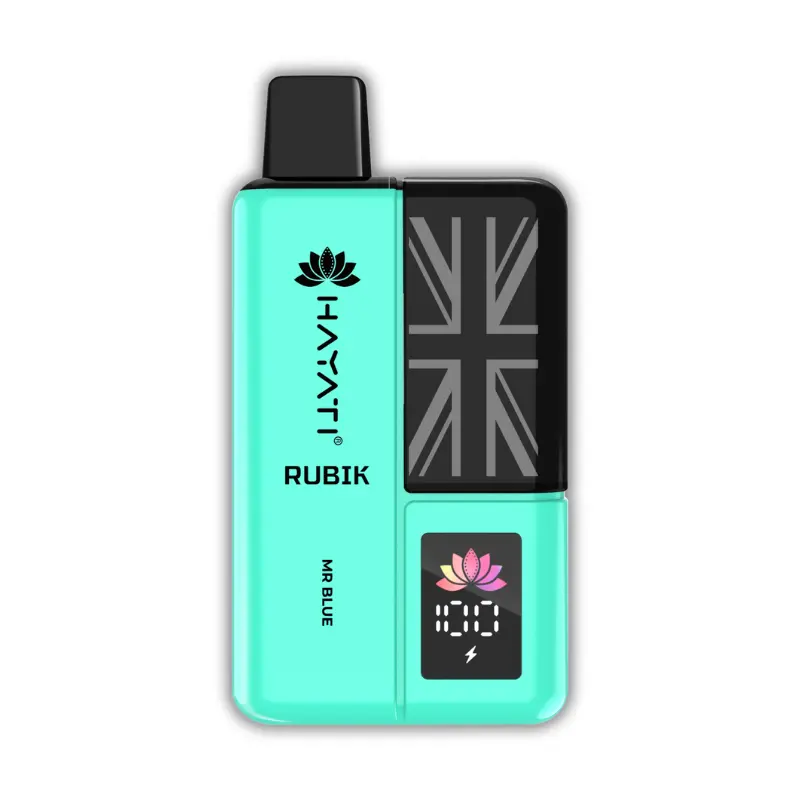
Hayati · Rubik
Mr Blue Hayati Rubik Prefilled Pod Kit
£5.99
✔ In stock — ready to ship
Genuine Hayati
Free over £20
Same-day dispatch
Secure checkout
The Mr Blue Hayati Rubik Prefilled Pod Kit is £5.99, and that buys the Rubik body with its 850mAh rechargeable cell together with a prefilled pod holding 12ml of liquid at 20mg nicotine salt. Hayati put the figure for a full pod at up to 7,000 puffs, which is a bench number produced under fixed test conditions rather than a forecast of anybody's fortnight. None of that is remarkable. Every kit on this shelf carries the same cell, the same 12ml, the same strength and the same price, so the hardware is not what distinguishes one listing here from another.
The first word of the title is. Mr is not a flavour word, a fruit, a treatment, a temperature or a level. It is a form of address, the thing you put in front of a surname when you are speaking to a person you have not been introduced to. Hayati sell 492 listings and this catalogue has developed a large, disciplined vocabulary for describing liquids: fruits, confections, cooling terms, acid terms, drinks, textures, seasons. An honorific belongs to none of those families. It does something else entirely, and what it does is worth taking apart, because a buyer looking at this listing is being asked to make a decision on the strength of it.
What follows is in three parts. The first counts the naming device properly, because the version of the claim handed to me was too strong and the corrected version is more interesting. The second asks what a title is actually claiming and why that claim is built so that it cannot be tested, then sets against it the one hard commercial fact in this product's favour, which is that Hayati have printed this name on thirteen listings across every product line they operate. The third works out what can honestly be established about the liquid from the record, marks the inference where it occurs, and ends with a way to settle the open question yourself on the first pod rather than on the fourth.
One thing this page will not do is play along. A name that invites you to treat a liquid as a personality is a marketing instrument, and writing about Mr Blue as though he were a fellow with opinions would be adopting the instrument rather than examining it. The liquid is a liquid. The name is a decision somebody made in an office.
Counting the title before leaning on it
The claim I was given was that this is the only flavour in the range given a title rather than a name. That is close and it is not true, and the correction takes ten minutes to make against the catalogue, which is where every rarity claim in this corpus ought to go before it gets printed.
Searching all 492 product titles for any honorific at all, meaning Mr, Mrs, Ms, Miss, Dr, Sir, Lord, Lady, Captain, Professor and the rest of the usual set, returns fourteen listings. Those fourteen resolve to exactly two flavour names. Thirteen of them are Mr Blue. The fourteenth is Mr Pink, which exists once, as a 10ml nicotine salt bottle at £2.49, and nowhere else in the catalogue.
So the honest version of the claim is narrower and, I think, sharper than the version I was handed. Two flavour names out of roughly 192 in this catalogue are built on a form of address. One of them is on a single listing. The other is on thirteen, spread across all seven of the product lines Hayati operate. The device is rare, it has been used twice, and the two outcomes could hardly be further apart.
It is worth being clear about what does and does not count here, because a loose definition would let all sorts of things in. Black Mamba is a creature, not a person, and nobody addresses a snake. Gummy Bear names a confection that happens to be shaped like an animal, and the confection is a real thing you can buy and eat, which makes it an ingredient reference. Hubba Bubba and its contractions name a chewing gum. T-Misu elides a dessert. None of those is a form of address. A title is specifically the word you use when you speak to somebody, and in 492 listings there are two of them.
Both are colours, which is not a coincidence and is the first useful thing the count produces. Whatever a title is doing in this catalogue, it has only ever been attached to a name that refuses to specify an ingredient. Hayati have never written Mr Peach or Mr Watermelon. The device has been reserved, on both occasions it has been used, for the case where there is no fruit to put on the label.
The slot where every other bare blue puts a property
Blue in this trade is not a fruit and it is not a colour description of a liquid either. It is a manufactured flavour convention with a reference confection behind it, and that argument has been made properly on the Blue Fusion Hayati Pro Max Plus 6000 Pod Kit page, which sets out the sensations the convention consists of and why accuracy against a real fruit is not a meaningful test for a liquid like this. I am not going to re-derive it. The relevant consequence for this page is that the word blue on its own is a complete flavour statement in Hayati's vocabulary, and that means whatever word sits next to it is doing a different job.
Take the four names in the catalogue where blue stands alone as the whole flavour, with no fruit attached to it anywhere in the title. Blue Razz does not qualify, because razz is raspberry and raspberry is a fruit, and that convention accounts for 48 listings by itself. Blueberry does not qualify either, for 46 listings. Blue Sour Raspberry names a fruit and an acid direction across 11 listings. Strip all of those out and four names remain in which blue is the entire flavour claim:
- Blue Frozen, three listings. The second word names a temperature.
- Blue Fusion, three listings. The second word names a formulation intent, that the components are meant to read as one thing.
- Mad Blue, three listings. The second word names a magnitude.
- Mr Blue, thirteen listings. The second word names a courtesy title.
Three of those four modifiers tell you something, however thin, about the liquid. Frozen tells you it is cold. Fusion tells you the parts are blended rather than sequenced. Mad tells you there is a lot of something, although not of what, which is the exact shape of the problem the Blue Fusion neighbours and the Mad Blue kit page have already worked through: a magnitude word with no vector attached asserts a quantity without naming the thing being quantified. Two words in 492 titles do that, and Mad is one of them. It is a weak signal but it is a signal, and it points at the liquid.
Mr points at nothing in the liquid. It cannot, because it is not that kind of word. And the distribution across those four names is the part that should make anyone sit up: Blue Frozen, Blue Fusion and Mad Blue have three listings each, nine between them. Mr Blue has thirteen on its own, more than the other three bare blues put together and more than four times any single one of them.
The wider context for that, which the Mad Blue pod listing established by counting and which I have checked rather than assumed, is that 127 of the 492 titles in this catalogue carry the word blue in some form. Blue is the largest single territory Hayati operate in. Within it, four names claim the colour outright with no fruit to hide behind, and the one that has travelled furthest is the one whose distinguishing word says the least about what is in the pod.
What a title claims, and why the claim is built so it cannot be checked
Sort the naming devices in this catalogue by what they point at and the difference becomes easy to state.
A fruit name points outward at a thing in the world. Strawberry Kiwi Hayati Rubik Prefilled Pod Kit commits to two objects you have eaten, and a buyer can hold the liquid up against them and find it wanting. That is a risk the manufacturer accepts in exchange for the buyer knowing what they are getting.
A mood name points at a feeling rather than an object, which is a softer commitment but still a commitment: Summer Dream promises a register, and a heavy, wintry, dessert-like liquid under that name would be mis-sold. A magnitude word points at a level on a dial. A cooling word points at a sensation with a physical cause. A confectionery word points at a sweet you can buy in a shop and compare. Every one of those names has a referent sitting outside the product, and every referent gives the buyer a lever.
A title has no referent outside the product at all. It points at the product and asserts that the product has a self. That is a claim about identity rather than about contents, and it is the only naming device in this catalogue that makes one. You can say a peach liquid is a poor peach. You can say a liquid called Frozen is barely cold, and that a liquid called Sour is not sour. There is no corresponding sentence for Mr Blue, because nothing has been promised that the liquid could fail to be. The name is unfalsifiable by construction, and that is not an accident of language. It is the commercial property that makes the device attractive.
Personification also changes what is being asked of the buyer. A description invites an opinion: is this a good peach, is it sweet enough, is the cooling right. A character invites a relationship: do you get on with him, is he your usual, do you want him around. Those are different mental operations, and the second one is far stickier, because relationships survive disappointments that opinions do not. A liquid you have judged and found merely adequate is easy to abandon. A liquid you have adopted is harder, and rebuying is the entire commercial problem a range like this is trying to solve.
There is a third effect, and on a shelf this size it may be the most valuable of the three. An honorific singles something out. Of the 127 blue titles in this catalogue, one is a gentleman. That does not make the liquid better and it does not make it different, but it does make it memorable in a corner of the range where memorability is genuinely scarce, and where a buyer restocking is faced with a wall of near-identical blue names at near-identical prices. A name you can recall without reading it is worth real money to a manufacturer, and none of the other blues can be recalled that way.
What I am inferring, and where it could be wrong. Hayati publish nothing about why this name was chosen, and no part of the reasoning above is sourced from them. I am reading a naming choice and describing the effects that choice has, which is a different thing from knowing what anybody intended. It is entirely possible that Mr Blue was named in five minutes by somebody who liked the sound of it and thought no further, and that every effect described here is real but accidental. The effects do not depend on the intent, which is why I am willing to state them, but the intent is not mine to assert and I am not asserting it.
The people who had to write about it noticed the same thing
Here is a check on all of the above that does not depend on my reading at all. Hayati write fresh copy for every listing, which means thirteen different attempts have been made to describe this flavour, by writers working at different times and not consulting each other. If a personified name pushes description away from the liquid and towards the name itself, that pressure should show up in their vocabulary. It does, and it shows up hard enough that the numbers are worth printing.
The method here is the one the Peach Vapes shelf established and it is not optional: count a word inside your set and then count it in the rest of the catalogue, because a word that is common everywhere tells you nothing no matter how often it appears in front of you. Counting both ways on the thirteen Mr Blue descriptions against the other 479 listings:
- Colour. Seven of the eleven single-flavour Mr Blue listings use the word colour to explain the flavour. The whole of the rest of the catalogue uses it seven times in 479 listings, which is 1.5 per cent. Half of every appearance of the word colour in Hayati's product copy is on this one flavour.
- The name as a subject. Twelve of the thirteen descriptions discuss the product's own name. Widen it to include colour, label, vague and abstract and the figure is ten of the eleven single listings, against a catalogue base rate of 19 per cent. Copy that talks about the title instead of the liquid is roughly five times as likely here as anywhere else.
- Blue-fruit as a compound. Eight of thirteen, against four listings in the other 479. That is a term the copy desk appears to have coined specifically to have something to call this.
- Person words. Two listings describe the liquid as having a character. One says it has a strong identity, and identity appears exactly once in the other 479. Two call it cohesive, a word used three times elsewhere. One tells you to judge it by feel. These are not flavour words. They are the words you reach for when describing somebody.
- Instructions to stop analysing. Eight of the eleven single listings tell the reader, in one form or another, that the flavour is to be taken as a whole rather than picked apart: chosen for its overall character rather than a single named ingredient, judged by feel rather than by naming individual fruits, suited to people who do not need every note labelled. The same construction appears in 24 of the other 479 listings, which is 5 per cent.
Now the control, because the same method has to be applied to the words that flatter the reading as well as the ones that do not. Sweet appears in eleven of thirteen, which looks like a finding until you see that 94 per cent of the rest of the catalogue uses it too. It is house vocabulary and it says nothing. Sugary sits exactly at its base rate. Bright runs at 69 per cent against 41 per cent, which is a mild lift and not much more. Approachable, easy-going, bold and vivid all run well above base rate, between roughly four and eighteen times it, and those are worth something, though what they are worth is a tone rather than a taste.
What the counts add up to is this. Handed a name that names nothing, thirteen copywriters independently wrote about the name, wrote about the colour, reached for words normally used of people, and eight times out of eleven told the reader to stop looking for ingredients. That is exactly what a personified name does to anyone obliged to describe the product underneath it. It is also, read less charitably, thirteen consecutive admissions that the information was not available at the writing end either.
The control case, and it argues against me
An angle that only collects supporting evidence is not worth much, and this one has an obvious test sitting in the catalogue. If a courtesy title is a powerful commercial device, the other flavour that uses it should have done well too.
Mr Pink has one listing. Same grammar, same two-word shape, same trick of attaching an honorific to a colour that names no fruit, same range, and Hayati's own copy for it explicitly cross-references this product, describing itself as the pink counterpart to Mr Blue in the same range. The naming device created a pair, the copy desk treated them as relatives, and one of the two was tooled onto seven product lines while the other stayed on a single £2.49 bottle.
That is a sample of two and it cannot settle anything on its own, but it points in one direction and it is the direction that undercuts the simple version of my argument. If the honorific were doing the commercial work, Mr Pink should have travelled too, and it did not. So the title is not sufficient. Something else is carrying Mr Blue.
The most likely candidate is the colour itself. Blue is an established trade convention with a reference confection behind it and a very large existing audience, which is why 127 listings in this catalogue carry the word. Pink is not a convention in the same way. There is no single reference sweet that pink points at, no equivalent of the blue slush syrup, and a buyer reading pink has to guess between strawberry, raspberry, watermelon, bubblegum and lemonade with nothing to narrow it. The honorific is the same in both cases. What differs is the strength of the word it is attached to.
Where that leaves the angle, stated honestly: the title is a decoration on a convention that was already selling, and the convention is doing the heavy lifting. What the title adds is memorability and the relationship framing, and those are real effects with no way to size them from public catalogue data. Anyone who tells you the name is why this flavour is on seven lines is guessing, and so is anyone who tells you it is irrelevant. The one available control says it is not the whole story.
Thirteen listings, and what distribution is evidence of
The counterweight to all of the above is not an argument, it is an arithmetic fact, and it was established properly on the Summer Dream Hayati Rubik Prefilled Pod Kit page rather than here, so I am citing it and not recounting it. There are roughly 192 distinct flavour names in this catalogue. The average one reaches 1.78 of the seven product lines Hayati operate, and 124 of them, about two in three, exist on a single line and nowhere else. Exactly eight flavours appear on all seven lines. Six of those eight say in the title what is in them. Two do not, and they are Summer Dream and this one.
So Mr Blue is one of only two coined names in the catalogue's top distribution tier. Eleven listings carry it on its own, two more carry it as half of a dual pod, and the eleven cover the Rubik, the Pro Max Plus, the Pro Ultra Plus, the Mini Ultra, a 10ml nicotine salt, a 120ml 50/50 shortfill and a 120ml 70/30. Seven formats, seven sets of packaging, seven inventory lines, seven separate decisions to commit stock. That is expensive, and manufacturers do not repeat it out of affection.
One count of my own to add to that, because it sharpens the picture on this particular shelf. The Hayati Rubik Prefilled Pod Kit shelf holds twenty flavours. Eighteen of the twenty name something you could put in a bowl, a glass or a paper bag: a fruit, a drink, a herb, a confection. Two name nothing edible whatsoever, and they are Summer Dream and Mr Blue, which are also the two coined names in the seven-line tier. Narrow it further to the blues on this shelf and the picture repeats: six of the twenty kits are blue-titled, and five of the six name a fruit. Blue Razz Cherry, Blue Sour Raspberry, Blueberry Raspberry and Blueberry Cherry Cranberry all tell you what is in them, and Blue Razz GB tells you the fruit and the confection it is dressed as. Mr Blue is the exception on a shelf of twenty that was otherwise assembled from the range's most literal names.
Now the limits, which matter more here than usual. Distribution is evidence of sales, and sales and quality come apart in a predictable way in a range built for breadth: the recipe that gets tooled repeatedly tends to be the one with the lowest refusal rate rather than the one anybody loves hardest. A mild, sweet, unobjectionable blue offends almost nobody. A savage citrus or an aggressive menthol gets adored and rejected in roughly equal measure and never reaches seven lines. There is also a feedback loop in the number, since a flavour on more lines is seen by more buyers and therefore sells more, which justifies more lines, and nothing in public data separates that loop from genuine preference.
And distribution says nothing whatsoever about the recipe. A liquid formulated for a 70/30 sub-ohm bottle and a liquid formulated for a 12ml prefilled pod at 20mg are not obviously the same liquid, and Hayati publish nothing confirming that the Mr Blue in this pod matches the Mr Blue in the bottles beyond the shared name. Thirteen listings tells you Hayati keep choosing to make this. It does not tell you that you will like it, and it does not tell you what it tastes of.
Thirteen descriptions of one liquid, lined up against each other
A flavour sold thirteen times has been described thirteen times independently, and comparing those descriptions is the closest thing to evidence available on a product whose name withholds everything. Where independent writers agree, the agreement is worth something. Where they split, the split is usually evidence about how the copy was produced rather than about two different recipes.
What every listing agrees on
Berry-family and blue-family placement: thirteen of thirteen. Not one description puts this outside blue fruit. Sweetness: eleven of thirteen, though as noted above that word is near-universal in this catalogue and carries no information. And an absence, which in this case is the most useful single finding on the page.
No cooling, thirteen times out of thirteen. Not one description mentions ice, iced, frozen, menthol, mint, chill or a cool finish, and one listing goes further and states outright that no ice is named in the blend. The catalogue base rates make that silence loud: about 30 per cent of the other listings use a cooling word, and the Blue Frozen pods page established by counting that Hayati signal cooling in the title whenever it is present, an audit the Mad Blue kit page extended to 121 of 492 titles carrying a cooling or mint term. A flavour with no cold word in its title and no cold word in any of thirteen descriptions is an uncooled liquid. That is the one thing about this pod I would state without hedging, and it is worth knowing, because it separates this listing cleanly from Strawberry Raspberry Ice, Pineapple Ice and Banana Ice on the same shelf at the same price.
The acid words, and what happens to every single one of them
This is the finding I did not expect, and it runs against what the convention would predict. The blue accord is normally described as carrying an early acid hit, and the Blue Fusion analysis treats that acid as a structural component of the profile rather than an optional garnish. So the copy for a blue flavour should be full of sharp, tangy, tart and sour.
It is not. Sharp appears in one of the thirteen against a catalogue base rate of 45 per cent. Tang and tangy appear in three, against 45 per cent. Sour appears in none at all, against 14 per cent. Tart sits at its base rate and no higher. On every acid word available, this flavour's own copy runs at or below the rate for the rest of the catalogue, and on two of them it runs at a fraction of it.
Direction matters as much as frequency, which is the second half of the base-rate method, so I read every one. Six of the eleven single-flavour listings mention acid at all. All six diminish it in the same sentence: a slightly sharp edge, a tangy streak that keeps it from tasting flat, a hint of tartness, a gentle tang running underneath, a bright tangy side. Not one description anywhere in the thirteen asserts acidity without a qualifier attached, and five of the eleven do not mention it at all.
The defensible reading is that this sits at the low-acid end of the blue corner. It is not a denial, because six listings do say the acid is present, but the consistency of the hedging across six independent writers is a pattern rather than a coincidence. If sharpness is the property you want from a blue, Blue Sour Raspberry Hayati Rubik Prefilled Pod Kit puts the word in the title on this shelf at this price, and a range that reaches for Sour when it means it is telling you something by leaving it off here.
Where the thirteen split, and why the split is about the copy desk
Three listings name blue raspberry and blueberry explicitly, and all three are bottles: the 10ml nicotine salt and the two 120ml shortfills. Every prefilled pod listing declines to name a fruit. That is a clean format boundary, and the Blackcurrant Lemonade page established the right way to read one: a property that splits along a format line is evidence about who wrote the copy, not evidence about two recipes. The bottle template is preoccupied with ratios, strengths and what device the liquid suits, and it appears to permit naming a reference fruit where the pod template does not.
Read the bottle listings closely and they are careful anyway. None of them says the liquid contains blue raspberry and blueberry. All three say it sits in that territory, or that the colour points there, which is a statement about the convention rather than about the recipe. A copywriter explaining what the word blue usually means is not disclosing an ingredient list, and it would be a mistake to promote that to one.
Register words split the same way. Easy-going, approachable and their relatives cluster on the bottles and the pods unevenly, and bold appears mostly on the Mini Ultra and Rubik pod listings. I would not read anything into that beyond different writers working to different templates in different months.
What the two dual listings add
Mr Blue also appears as one half of a 22ml dual pod, sold as the Blueberry Raspberry / Mr Blue Hayati Pro Ultra Plus 25000 Prefilled Pod Kit and as a bare pod. That pairing has its own page and its own argument about what happens to a half you keep declining, so I will take only the piece of evidence relevant here.
Those two listings are the only place in 492 where Hayati put Mr Blue side by side with a named blend and rank them. Both rank it as the vaguer of the two. One calls Blueberry Raspberry the more defined of the pair; the other says Mr Blue is less a literal two-berry mix and more an all-round blue profile. That is Hayati's own copy describing this flavour as the less specific option when they have something to compare it against, which is a small but genuine contribution to the record, and it is consistent with everything else the thirteen descriptions do.
The shelf tags, and the one that is not evidence
This listing is filed under Blueberry Vapes and Berry Vapes. It would be easy to treat the first of those as the catalogue quietly confirming a blueberry component, and it is not. The Summer Dream page counted the unsupported fruit tags across this catalogue and found that around thirty of the forty-three cases are the blueberry shelf applied to anything with blue in the name, Mr Blue included. That is a colour rule operating on the title, not knowledge about the recipe, and it should be discounted entirely.
The Mr Blue Vapes shelf is more useful, not as evidence about taste but as a convenience: all thirteen listings of this name sit there, which is the quickest way to see the seven formats in one place and to compare what each costs.
What can honestly be said, and how confident each claim is
| Claim | What supports it | Status |
|---|---|---|
| It is uncooled | No cooling word in any of thirteen descriptions, none in the title, and a catalogue convention of always declaring cooling in the title | Reasonably confident |
| It sits in the blue confectionery accord rather than reading as a fresh fruit | Thirteen of thirteen place it there, and the convention itself has a manufactured reference | Reasonably confident |
| It is sweet | Eleven of thirteen, but sweet runs at 94 per cent across the catalogue and carries no information | Reasonably confident, and nearly useless |
| Acid is present but restrained | Six of eleven mention it, all six qualify it, and every acid word runs at or below its catalogue base rate | Probable |
| It reads as one thing rather than as separable components | Two listings call it cohesive, four instruct the reader not to pick it apart, and no listing describes a sequence of notes | Probable, though this may be a consequence of the name rather than of the recipe |
| Blue raspberry and blueberry are in it | Three bottle listings name them, but as territory rather than as contents, and the blueberry shelf tag is produced by a colour rule | Possible, and weaker than it looks |
| Where its sweetness sits against the rest of this shelf | Nothing. No listing places it on a scale, and there is no sweetness-level vocabulary anywhere in this catalogue to place it with | Unknown |
| Whether it is distinguishable from the other blues at this price | Nothing published either way, and this is the axis the purchase actually turns on | Unknown |
| Whether the pod recipe matches the bottle recipe | Only the shared name | Unknown |
Two of those rows carry the decision and both are in the unknown column, which is the honest position and not a dodge. If either of them is what you care about, a named pod closes the question before you pay rather than after, and there are four of them on this shelf at exactly this price.
A test that follows from the name itself
No tasting note is possible here and inventing one would be worse than useless. What is possible is a test, and the right test is set by what the name claims rather than by what a flavour page normally asks.
A title does not promise a flavour. It promises an identity: that there is one recognisable thing here, consistent enough to be addressed by name and to be re-encountered later. That is a testable promise, and the test is identification rather than description. The question to take to the first pod is not what fruits are in this, which the record cannot answer and your palate probably cannot either. It is whether you could pick this out of the blue corner blind.
The procedure
Buy this kit and one named blue from the same shelf at the same £5.99, chosen to sit at a known position on the axis the copy is vaguest about. Blue Razz GB anchors the confectionery end, since GB is a declared sweet-shop reading. Blue Sour Raspberry anchors the acid end. Either will do as a reference; the point is that you know in advance what the reference is claiming, and you do not know what this one is claiming at all.
Take the first three or four draws on the fresh coil before you have formed an expectation and before the coil has warmed. A warm coil pushes sweetness forward and blurs the separation between components, which on an unnamed blend is precisely the information you are trying to extract. Write down, in whatever words come, what arrives first, what sits underneath it, and whether anything appears at the back of the exhale.
Then alternate. Three draws from one pod, three from the other, back and forth, with a minute between sets. You are not asking which is nicer. You are asking a narrower question with a yes or no answer: could you tell them apart without looking at the device. If a friend handed you one of the two at random, would you know which you had.
Repeat it once on day three, because the first-day answer on a fresh coil is not the answer you will live with. As a sweetened liquid accumulates residue on a coil, the light and volatile notes drop out before the heavy ones, which on a blend reads as the whole thing collapsing towards whichever component has the most weight. If two blue pods are distinguishable on day one and indistinguishable on day three, that is worth knowing before you buy either of them again.
How to read the result
If you can tell them apart reliably, the title has delivered what a title can deliver. There is a single recognisable thing here, you have now met it, and the Mr Blue Hayati Rubik Pods refill at £3.99 is a sensible standing order. You will not be able to describe it to anybody, which is a small ongoing annoyance and nothing more.
If you cannot, the name has bought you nothing and the named pod is the better repeat purchase for a plain reason: you can predict it, you can order it again after a gap without wondering, and you can tell somebody else what it is. An unnamed liquid that is indistinguishable from a named one at the same price is strictly the worse of the two to commit a shelf slot to.
The prediction the name makes across the seven formats
There is a second consequence of a title worth testing, and this flavour is unusually well placed for it. A person is the same person in different clothes. If Mr Blue is an identity rather than a label, the identity should survive a change of hardware, and Hayati sell this name on seven lines, including the Mr Blue Hayati Pro Max Plus Pod Kit, which is the closest comparison available: the same 12ml at the same 20mg in a prefilled pod, on a different body at £7.99.
Two cautions before anybody treats that as a controlled experiment. Hayati publish no coil resistance, no carrier ratio and no wicking detail for either format, so a difference you find could be the hardware rather than the liquid. And their own copy already concedes the point in one place: the 70/30 bottle listing says the profile picks up extra body and a rounder exhale through a sub-ohm tank, which is a statement about what the hardware does to a liquid, not about two recipes. The identity claim is therefore not cleanly testable across bottles and pods, and only roughly testable between two prefilled formats. It is still more than a buyer of a two-listing coined name ever gets.
The Rubik, which is the short part
In the box: the Rubik body with its 850mAh rechargeable cell, and a pod already filled with 12ml of 20mg liquid. Nothing to fill, nothing to assemble. The Vim Ice kit page did the useful work of collecting every hardware statement Hayati make across the whole thirty-nine-listing Rubik range into one place, and the finding there is that the list is very short and that no listing names a coil resistance, a carrier ratio, an airflow arrangement or a charging method. This page states none of those either, and any page that does has taken them from somewhere other than the manufacturer.
The specification that bears on this particular listing is the flat price. Every kit on the Rubik kits shelf is £5.99 and every Rubik pod is £3.99, with no flavour costing a penny more than another. That matters for the argument this page has been making: the name is not a price tier. Hayati charge the same for the one liquid on this shelf that refuses to tell you what it is as they charge for the nineteen that do. The naming device is competing for attention rather than for money, which is the only condition under which a device like this can be judged purely on whether it makes a listing memorable.
On fitment, once and briefly: check the range name printed on your device against the range name in the title before ordering any replacement pod, because a retail page is not a hardware specification. Hayati describe the Rubik as one of their compact, lower-priced ranges and never attach a reason to the lower price, so what has been left out to reach it is not something anybody outside the factory can tell you. The rest of the platform, kits and bare pods together, sits on the Hayati Rubik shelf.
The figures
| Field | Value |
|---|---|
| Price of this kit | £5.99 |
| Matching refill | Mr Blue Hayati Rubik Pods, £3.99 |
| Supplied as | Rubik device plus prefilled pod system, complete |
| Liquid in the pod | 12ml, prefilled |
| Nicotine | 20mg nicotine salt |
| Cell | 850mAh, rechargeable |
| Manufacturer puff figure | Up to 7,000 for a full pod, a laboratory estimate |
| Cooling | None declared, on the title and on all thirteen descriptions |
| Fruit components published | None |
| Carrier ratio in the pod | Not published |
| Coil resistance | Not published |
| Listings carrying this flavour name | 13, of which 11 are single-flavour |
| Honorific flavour names in the catalogue | 2 of roughly 192 |
Three of those rows are the ones that actually change a decision. The 20mg is the UK maximum for a pod of this kind and it is the same figure across every prefilled listing Hayati sell, so it does not separate this pod from any neighbour; what it does mean is that the strength is fixed and there is no lighter version of this flavour in this format. The 12ml passes through one coil from new to spent, since neither the pod nor the coil is replaceable, so everything you conclude about the liquid is entangled with how far through that coil you are. And the blank rows are worth reading as deliberately as the filled ones: a prefilled pod is sold on the flavour, and the flavour here is the field Hayati have left emptiest of all.
Where it sits against the neighbours
If you want the blue and would rather know what is in it
Four kits on this shelf give you the same convention with the contents declared, at the same £5.99. Blue Razz Cherry Hayati Rubik Prefilled Pod Kit puts a stone fruit against the blue accord and tells you so. Blueberry Raspberry Hayati Rubik Prefilled Pod Kit is the plainest reading of a blue berry mix in the range and the one Hayati's own dual-pod copy treats as the defined half. Blueberry Cherry Cranberry Hayati Rubik Prefilled Pod Kit adds a genuinely non-sweet berry to the bottom of the blend. Blue Razz GB Hayati Rubik Prefilled Pod Kit declares the sweet-shop reading in the title, which makes it the useful anchor if you want to know where the confectionery ceiling of this shelf is.
If the restraint on the acid is the problem
The evidence above puts this liquid at the low-acid end of blue. Blue Sour Raspberry Hayati Rubik Prefilled Pod Kit is the direct answer on this shelf, and Blue Sour Raspberry Hayati Pro Max Plus Pod Kit is the same idea on the larger platform if you already own that body. Sour is a word Hayati use when they mean it, on 21 listings across seven names, and its absence here is informative.
If you want this exact name on other hardware
The cheapest route into the flavour that is not this kit is the 10ml nicotine salt bottle at £2.49, which is 10mg rather than 20mg and goes into a device you already own, so it is a check on the name rather than a replicate of this pod. Within prefilled hardware, the Mr Blue Hayati Pro Max Plus Pod Kit at £7.99 is the nearest construction, and the Blueberry Raspberry / Mr Blue Hayati Pro Ultra Plus 25000 Prefilled Pod Kit at £11.99 puts it in a 22ml pod alongside a named berry mix, with a rotating mouthpiece selecting which reserve feeds the coil. All thirteen instances are collected on the Mr Blue Vapes shelf if you want to compare what each format costs.
If the naming question is what interests you
Summer Dream Hayati Rubik Prefilled Pod Kit is the other coined name in the seven-line tier and the page that counted the distribution properly. Blue Fusion Hayati Pro Max Plus 6000 Pod Kit is where the blue convention itself is taken apart. Blue Razz Fruit Twist Hayati Pro Max Plus 6000 Pod Kit works on the grammar of these names, and Blueberry B'Gum Hayati Pro Max Plus 6000 Pod Kit is the case where a confectionery suffix does the job an honorific cannot, by naming the sweet the liquid is imitating.
If you want to leave the blue corner entirely
This shelf has plenty that is not blue and is explicit about what it is. Strawberry Kiwi Hayati Rubik Prefilled Pod Kit uses one of the range's scarcest fruits. Lemon Lime Hayati Rubik Prefilled Pod Kit is the citrus option and another of the eight seven-line flavours. Vim Ice Hayati Rubik Prefilled Pod Kit is built on a cordial rather than on fresh fruit. Fresh Mint Hayati Rubik Prefilled Pod Kit sits at the opposite end of the shelf's sweetness range and is the obvious rotation partner if a sweet blue becomes wearing after a week. For cooled fruit there is Pineapple Ice, Banana Ice and Strawberry Raspberry Ice, all at £5.99.
Further afield
On the larger platform, Blue Razz Mojito Hayati Pro Max Plus 6000 Pod Kit is the case of a name whose defining component cannot physically be in the pod, which is a different naming problem worth reading alongside this one. On the small format, Blue Razz GB Hayati Mini Ultra Pod Kit at £3.99 is the lowest-cost way onto a blue at all. The full range of both kits and bare pods is on the Hayati Rubik shelf, the wider berry category is at Berry Vapes, and everything Hayati list is at the full Hayati range.
Living with twelve millilitres you cannot describe
The practical notes below are anchored to this liquid rather than offered as general advice, because a sweet uncooled blue behaves differently in use from a cold citrus or a tobacco profile, and the differences are the part worth writing down.
Start it when you have a clear hour. Everything useful you are going to learn about an unnamed blend is available in the first day, and it becomes progressively less available afterwards, so opening a pod at the end of a long day and taking your first twenty draws while distracted wastes the one genuinely informative window this purchase has.
Draw slowly and do not chain. The blue accord is built on sugar with acid over the top, and a hot coil pushes the sugar forward and shortens the acid, which on a liquid whose acid is already restrained can flatten it into a single sweet impression with nothing behind it. Several unhurried draws with a pause between them will tell you more about the structure than a rapid run of ten.
Expect the sweetness to change character before it changes intensity. Sweetened liquids leave residue on a coil, and on this kind of profile the first thing to go is the high, bright edge at the front of the mouth, which is exactly the part six of the eleven descriptions hedge about. A pod at the two-thirds mark tends to read heavier and rounder than the same pod on day one, not because there is less sweetness but because there is less of anything else. If you are still trying to work out what this is, do your thinking early.
Charge it before it drops rather than after. The output is regulated, so a pod that is starting to taste thin is not always telling you about the liquid; it can be telling you about the cell. On a flavour you already know, you notice the difference at once. On one you are still forming a view of, a low battery and a tiring coil produce very similar symptoms and you can easily attribute one to the other. Rule the battery out first.
Store it upright, somewhere cool and dark, and out of reach of children and pets. Heat and light both work on a sweetened fruit liquid over time, and a pod kept in a car through a warm week will not taste the way it did in the shop. Upright matters because the pod is prefilled and not user-refillable, and a pod left on its side for long stretches can leave liquid sitting where you would rather it did not.
On disposal: the pod contains a coil and a residue of e-liquid and the body contains a cell, so neither belongs in a household bin. Take them to a retailer with a take-back point or to a local recycling facility that handles electricals. This applies to the whole kit at the end of its life, not just the pod.
One last note specific to this listing. If you decide you like it, buy the refill sooner rather than later. A flavour you cannot name is a flavour you cannot reliably search for, and while the Mr Blue Hayati Rubik Pods listing is easy enough to find today, a buyer coming back in three months with nothing in their memory but a colour and a courtesy title is in a worse position than one who wrote down a fruit.
Questions this listing raises
What flavour is Mr Blue, in plain terms?
Hayati do not say, on any of the thirteen listings that carry the name. What all thirteen agree on is that it sits in the blue confectionery accord, the sweet blue-raspberry-adjacent territory that is invented for manufactured sweets rather than grown, and that it is sweet. Three bottle listings mention blue raspberry and blueberry as the territory the colour points at, which is a statement about the convention rather than a declaration of contents.
Does anything in this pod cool?
No cooling is declared anywhere. The title carries no cold word, and none of the thirteen descriptions mentions ice, menthol, mint, frozen or a cool finish, while one states outright that no ice is named in the blend. Hayati put cooling in the title whenever it is present, across 121 of their 492 listings, so the silence here is reliable.
Why is it called Mr Blue rather than something descriptive?
Nobody outside Hayati can answer that, and they publish no explanation. What can be said is what the choice does: an honorific makes no checkable claim about the liquid, it makes the listing memorable in a corner of the range where 127 titles carry the word blue, and it invites the buyer to relate to the product rather than to assess it. Whether any of that was intended is not something a catalogue can tell you.
Is it the only Hayati flavour with a title in its name?
No, and the corrected count is more useful. Fourteen listings in 492 carry an honorific of any kind, and they resolve to two flavour names: this one, on thirteen listings, and Mr Pink, on one. Both attach a title to a colour that names no fruit, and Hayati have never used the device on a name that does specify an ingredient.
Does the wide distribution mean it is good?
It means it sells, which is not the same thing. Eleven single-flavour listings across all seven of Hayati's product lines is expensive to maintain and manufacturers only do it for a recipe that keeps moving. In a range built for breadth the recipe that gets tooled everywhere is usually the one fewest people refuse rather than the one most people love, and there is a feedback loop in the figure too, since more listings mean more exposure mean more sales.
How sweet is it against the rest of this shelf?
Unknown, and honestly so. Eleven of thirteen descriptions call it sweet, but 94 per cent of the rest of the catalogue uses the same word, so it carries no information. Hayati have no sweetness-level vocabulary at all, which means no listing in the range can be placed on a sweetness scale from its copy. Fresh Mint at one end and Blue Razz GB at the other are the cheapest way to bracket it yourself.
Is it sharp or tart?
Less so than the average listing in this catalogue, which was not what I expected to find. Sharp appears on one of the thirteen against a base rate of 45 per cent, sour on none against 14 per cent, and tang on three against 45 per cent. Six of the eleven single listings do mention acid, and every one of those six qualifies it as slight, gentle or a streak. Restrained rather than absent.
It is filed under Blueberry Vapes. Does that mean there is blueberry in it?
No. Around thirty of the catalogue's forty-three unsupported fruit tags are the blueberry shelf being applied to anything with blue in the title, and this listing is one of them. That is a rule operating on the word in the name, not a merchandiser disclosing a recipe, and it should carry no weight in a purchase decision.
How does this compare with the same flavour on other hardware?
Mr Blue exists on seven product lines, and the closest comparison is the Pro Max Plus kit, which is also 12ml of 20mg liquid in a prefilled pod, at £7.99. Nothing published confirms that the liquid is identical across formats, and the 70/30 bottle listing notes that the profile gains body through a sub-ohm tank, which is the hardware acting on the liquid rather than a different recipe. Treat cross-format comparisons as rough.
What is in the box, and what does the refill cost?
The Rubik body with its 850mAh rechargeable cell and a pod already holding 12ml of liquid at 20mg. Nothing to fill or assemble. The matching refill is £3.99, and pricing across the Rubik line is flat, so every kit on the shelf is £5.99 and every pod £3.99 regardless of flavour.
How many puffs will it do?
Hayati's figure is up to 7,000 for a full pod, and that is a laboratory estimate produced on test equipment under standardised conditions. What you actually get depends on how long your draws are and how often you reach for the device, and no real pattern of use matches a test bench.
Should I buy this or a pod that names its fruit?
If the fruit identity matters to you, buy the named one. Four other blues on this shelf declare their contents at exactly the same price, and nothing about this listing can be resolved before purchase. If you are happy to judge a liquid by how it lands and you already know that sweet, uncooled blue is your corner of the range, this is a reasonable £5.99 and the most distributed flavour Hayati make that does not tell you what it is.
The short version
£5.99 buys a complete Rubik kit, 850mAh, 12ml at 20mg, rated by the manufacturer at up to 7,000 puffs, in a flavour whose name is a form of address. That device is used twice in 492 listings, and the second use, Mr Pink, never got past a single bottle, which is the clearest available sign that the title is not what carries this product. What carries it is blue, the largest and most established convention in the range, with the honorific adding memorability and an invitation to treat the liquid as an acquaintance rather than as a purchase.
The record supports four things: it is uncooled, it is sweet, it sits in the manufactured blue accord, and its acid is real but consistently played down by the people paid to describe it. The record does not support any statement about which fruits are in it, where its sweetness sits against the shelf, or whether you could pick it out of a line-up of the other blues at the same price. That last question is the one the purchase turns on, and it is answerable in two days with one reference pod, which is a better use of £5.99 than any amount of reading.
Buy it if sweet uncooled blue is already your territory and you are content to meet a liquid rather than order one. Buy a named pod if you want to know before you pay, and there are nineteen others on this shelf, eighteen of which will tell you.
Strictly for adults aged 18 and over. Nicotine is an addictive substance.
You might also like


