
Home / Hayati Pro Ultra Plus Pods / Raspberry Cola Hayati Pro Ultra Plus 25K Pods
Hayati · Pro Ultra Plus
Raspberry Cola Hayati Pro Ultra Plus 25K Pods
£7.99
✔ In stock — ready to ship
Genuine Hayati
Free over £20
Same-day dispatch
Secure checkout
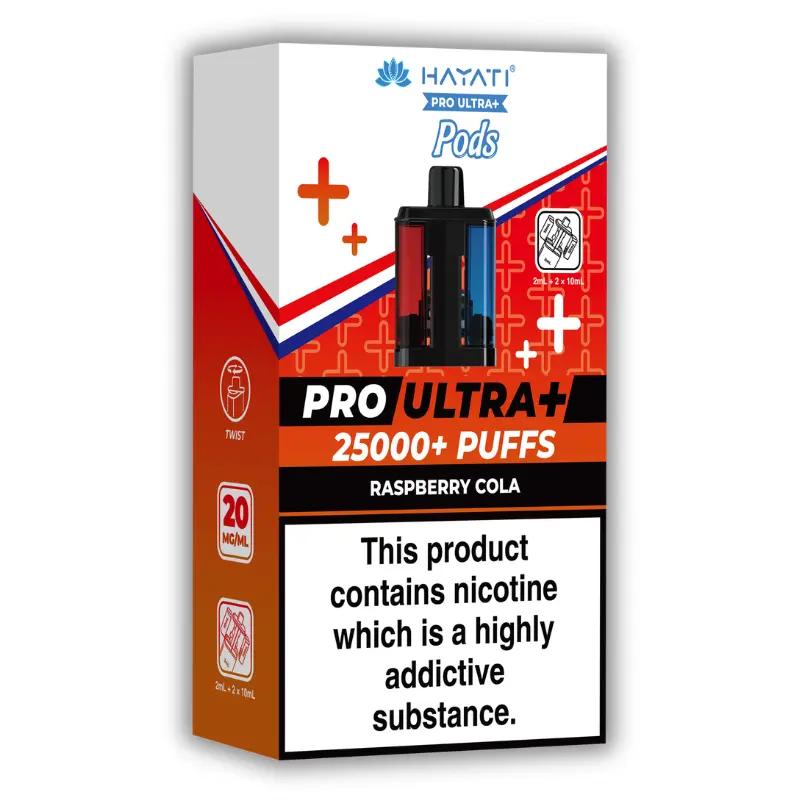
Raspberry Cola is sold here as a bare Hayati Pro Ultra Plus pod at £7.99, sealed at the factory, holding 22ml of liquid at 20mg nicotine salt. One blend fills the whole thing. There is no oblique in the title, no second reserve behind the mouthpiece and no collar that selects anything, so the liquid arriving on your first draw is the liquid that will still be arriving at the last millilitre. Nothing else is in the pack: no device, no accessory, no spare. Hayati's figure for the pod is up to 25,000 puffs, a bench rating produced by machine under fixed test conditions, useful for ranking pods against one another and close to useless for predicting your own month. Anyone without a Pro Ultra Plus already in a drawer needs the Raspberry Cola kit at £11.99, where the identical pod arrives with hardware attached.
Two words make up that name and they are not the same kind of word. Raspberry points at a fruit. You can buy a punnet, eat one, and hold the result in your head as a standard. Cola points at nothing you can pick up and verify, because what it refers to is a commercial formula that has never been published and was never intended to be. Every other name on this shelf points either at something that grows, or at a confectionery convention that flavour houses share openly between them. This one points at a locked recipe, and it is the only entry in the Hayati catalogue of which that is true.
That is worth more than a line of trivia, because it changes the kind of question you are asking when you judge whether a cola liquid is any good. With a fruit you can only ask whether you enjoy it. With a cola you can also ask whether it is right, and the strange part is that the secrecy of the original is exactly what makes the second question answerable. This page works through why, what it means for reading other people's opinions before you spend £7.99, and then the problem this pod sets itself: where a red berry goes in an accord that already has a bright top note and a sharp edge under it.
The only flavour here whose original is a trade secret
What the other names on the shelf are doing
Run down the Hayati Pro Ultra Plus Pods shelf, all fifty-two listings, and every name resolves to one of two things. Most resolve to produce. Peach, mango, watermelon, blueberry, lemon, cherry, pineapple: all of them exist publicly outside vaping entirely, and if you want to know whether a peach liquid is accurate, the test sits in a shop two streets away for under a pound.
The rest resolve to a confectionery convention. GB for a gummy sweet, Cotton K for candyfloss, B'Gum for bubblegum. Those are not natural products, but they are not secret either. The conventions are shared openly across the trade and the sweets they refer to sit on a counter in any corner shop, so a liquid named for a gummy raspberry is making a claim you can check against a bag of gummy raspberries for whatever a bag costs.
Cola belongs to neither group. It is not a plant and it is not an open convention. It names a manufactured drink built to a formula its owners have spent more than a century declining to publish, and the flavour trade's account of what is in it is a reconstruction from outside rather than a disclosure from inside. That is a different position from anything else on the shelf, and the consequences are practical rather than philosophical.
What is publicly understood, and how much weight it can carry
The general public understanding of the cola profile, repeated consistently across published accounts and broadly agreed on by people who mix flavours for a living, runs roughly as follows. It is a citrus-and-spice construction rather than a fruit one. Orange and lemon oils sit at the top, pressed from peel rather than squeezed from flesh, which is why the brightness in a cola is dry and faintly bitter instead of juicy. Warm spice notes of the baking kind sit under them. Vanilla rounds the whole thing and supplies the syrupy quality, and a distinct acidic bite runs beneath everything, holding the structure together.
Take that for what it is: the public understanding of a private recipe, which makes it a well-informed reconstruction rather than a specification. Nobody outside the company that owns the original can confirm the proportions, and published accounts disagree on details. Hayati publish nothing about how their own concentrate is built either, so there are two closed doors here rather than one. What can honestly be said is that the shape above is the shape a cola liquid aims at, and that anyone judging this pod is judging it against a target described in that general language rather than against an ingredient list.
Why a secret standard produces more agreement than a public one
Here is the part that seems backwards until you look at it properly. You might expect that a flavour with an unpublished reference would be the hardest one to reach consensus about, and the opposite is true. Cola is the profile buyers agree about most, and fruit is where they scatter.
The reason is that a public reference is not the same as a fixed one. Mango is public: anyone can go and taste one. But which one? A tinned Alphonso, a firm supermarket fruit eaten two days early, a very ripe one eaten over a sink. Those are genuinely different flavours, all legitimately called mango, and two people arguing about whether a mango liquid is accurate are frequently arguing about two different fruits without noticing. Neither is wrong. There is no single mango to be right about, and the same applies with less force to every other piece of produce on this shelf.
A secret commercial formula has the opposite property. The whole point of keeping a soft-drink recipe fixed and unpublished is that a bottle bought in Newcastle tastes like a bottle bought in Naples, this year and ten years ago. It has no season and it does not ripen. You cannot consult the recipe, but you do not need the recipe to judge resemblance. You need a stable target, and secrecy is precisely what keeps the target stable. A cola liquid is therefore measured against something unavailable but uniform, and a fruit liquid against something available but variable, and the unavailable one produces the tighter agreement.
What that buys you as somebody about to spend money
The first thing it buys you is that other people's verdicts transfer. Most flavour opinion is weakly portable, because the person writing it is measuring against a personal reference you cannot see. On a cola that hidden variable is very nearly eliminated. If somebody says a cola blend reads thin, or too sweet, or that the spice has been buried, the odds are high you would say the same, because you are both holding the same object in mind.
The second is that disagreement becomes informative rather than noisy. Two people at odds over a mango pod are probably just carrying different mangoes, and the pod is fine. That explanation is unavailable on a cola, so a genuine split is telling you something real: either the liquid sits on a boundary, or the two of them draw the line for an acceptable likeness in different places.
The third is that you can ask a question of a cola that a fruit will not support, which is whether it is accurate as distinct from whether you enjoy it. Those come apart more often than people expect. A cola liquid can be pleasant and wrong, and it can be quite faithful and no fun at all to spend three weeks with. Decide which you are shopping for before you order, because the answers point at different products.
The half of this pod that does not get any of that
Now the honest complication, and it is the reason this page is about Raspberry Cola rather than about cola in general. This blend has one foot on each side of the line just drawn.
The cola half is the high-agreement half and everything above applies to it. The raspberry half is not, and it is worse than an average fruit in this respect, because raspberry on a vape shelf is contested in three directions at once. There is fresh raspberry, tart, floral and thin. There is cooked or preserved raspberry, jammy and much sweeter. And there is the blue confectionery raspberry that dominates this very shelf, a separate convention again that tastes like neither. A dozen listings here are built on it, Blue Razz GB and Blue Razz Cherry among them, and why that convention exists at all is a question the pages covering those pods deal with.
What matters here is only this: the berry in Raspberry Cola is a red one, not that blue treatment, and a stranger's verdict on the fruit half of this pod is therefore worth much less to you than their verdict on the drink half. Somebody who finds the raspberry overdone may simply be carrying a different raspberry. Read opinion on this blend with that split in mind and you will be closer to right than someone treating it as one undivided judgement.
Where a berry goes in an accord that already has a bright top
The question stated properly
Adding a fruit syrup to a cola is not a vaping invention. It is a counter-service practice older than anybody reading this, done at soda fountains with whatever syrups were to hand, and raspberry was one of the common ones long before it was a pod. The combination has real precedent, which is more than several blends on this shelf can claim.
So the interesting question is not whether it works. It is where the berry actually lands. The usual shorthand says a fruit sits on top of the spice, and that shorthand is wrong in a way worth setting out, because getting it right tells you who should buy this pod and who should not.
Reasoning it through
A cola accord, on the public account given earlier, occupies four positions. A bright, dry, slightly bitter top from peel oils. A warm aromatic middle from the spices. A sweet, round exhale from vanilla. And an acid running underneath the whole length of the draw.
A raspberry occupies three. A high, floral, slightly perfumed top, which is the part your nose registers first and the part that makes a raspberry recognisable at a distance. A soft jammy body underneath it. And a tartness of its own, which is genuine rather than added, since the fruit is acidic in a way a banana or a peach is not.
Lay those two lists side by side and the overlap is plain. The berry collides with the cola at the top and at the bottom, and it has almost nothing to say about the middle. Spice is the one region where a raspberry makes no contribution at all.
Which means the shorthand has the geometry backwards. The berry never reaches the spice. It lands on the citrus, because that is where it lives, and in that collision it wins: fruit sweetness registers faster and louder than aromatic dryness, so a raspberry put over peel oil covers it rather than sitting beside it. The bitter edge that makes a cola's opening instant read as cola is the first casualty.
The acid is the opposite case. Raspberry tartness and the accord's own sharpness do not compete for the same space, they stack, and the result is a firmer sour spine than the plain drink profile carries. That stacking is why the pairing holds together. A soft, low-acid fruit dropped into a cola would bury the sharp edge and leave spiced syrup behind. A raspberry reinforces it.
The verdict this page reaches
So: the berry fights the citrus and beats it, reinforces the acid, and leaves the spice untouched but harder to read. That last part needs care, because untouched and unaffected are different things. Nothing covers the spice. What it loses is its introduction. In a plain cola the dry bitter opening is what makes the warm middle legible by contrast, the way a cold room makes a warm one obvious, and without that set-up the spice reads as general background warmth rather than as an event you can point at.
The practical translation is short. Raspberry Cola is sweeter, rounder and more front-loaded with fruit than a plain cola, and it is identifiable as a cola from the middle of the draw onward rather than from the first instant. It keeps the spine, the warmth and the syrupy exhale, and trades away the dry peel-oil opening that is arguably the most distinctive quarter-second the plain profile has.
Who that suits follows directly. If the bitter aromatic top is what you value in a cola, this pod removes the part you came for. If the warm middle and the sweet finish are what you value, this keeps all of it, adds fruit to the exhale and gives a sharper spine than the plain version. Both are defensible preferences and a listing cannot tell them apart for you.
The draw, in the order things arrive
Front of the inhale is raspberry and it is not shy. It reads as the preserved or jammy kind rather than the thin fresh kind, sweet before it is tart, and it occupies the opening on its own. Nothing about the first moment announces a soft drink.
The change happens across the middle, and it happens as a swell rather than a switch. Warmth comes up underneath the fruit, the berry loses its lead without disappearing, and somewhere around the middle of the inhale the blend stops being a berry with something behind it and becomes a drink with a berry in it. That transition is the pod's best moment and it is the thing a plain cola cannot do, since a plain cola is a drink from the first instant and has nowhere to travel to.
Exhale is where the two sweetnesses meet. Vanilla from the accord and fruit sugar from the berry arrive together, and they are additive rather than complementary, which is the single biggest reason this reads sweeter than the unfruited version. The finish is round, faintly warm and carries the tartness longer than it carries the fruit, so what is still on your palate three seconds later is closer to the drink than to the raspberry.
Throat character is moderate and a shade firmer than a plain berry pod at the same strength, which is what a profile with warm spice in it should do. The warmth sitting behind the 20mg salt formulation is aromatic rather than harsh.
Sweetness, sharpness and cooling, stated plainly
On sweetness this sits above the middle of the shelf and short of the confectionery end. It is sweeter than a plain cola, for the additive reason above, and less sweet than anything named for a sweet. Set it beside Blueberry Cotton K / Raspberry Cotton K, where the candyfloss treatment coats the tongue and accumulates through a session, and this one is noticeably more restrained.
Sharpness is where it beats expectations. Between the accord's structural acid and the berry's own tartness there is more bite here than the word raspberry usually implies on a vape shelf. It is not a sour pod, and anyone who wants an actual pucker should look at Blue Sour Raspberry, which is built for it. The sharpness here is structural, and it is what keeps the sweetness from turning heavy across a long pod.
On cooling, be careful about what is actually known. Hayati state no cooling agent for this pod and the facts supplied to this page mention none. The convention across the range is that cooled products say so in the title, with Ice, Frozen, Cooler or Menthol attached, and this title carries no such word. That is a strong signal, but it is an inference from how the range is named rather than a published statement. Treat it as a warm blend, and if a chilled finish is something you need, buy a pod that announces one.
What it is not
- Not a cherry cola. The berry here is raspberry, which is brighter, more floral and less stony than a dark cherry, and it sits further forward in the draw.
- Not a blue raspberry anything. The confectionery blue treatment is a separate convention with a separate taste, and it is all over this shelf in listings such as Red Razz GB / Blue Razz GB. This is not that.
- Not a sour listing. The acidity is real and structural. Puckering is not the intention.
- Not cooled. No cooling agent is listed and the name flags none.
- Not a dual pod. One blend fills the full 22ml, with nothing to select between.
- Not a raspberry dessert. No cream, no pastry, no bakery weight. This is drink sweetness, not pudding sweetness.
The pod itself, briefly
What arrives is one sealed pod, filled before it left the factory, ready to seat in a Pro Ultra Plus you already own. Nothing needs pouring, measuring or soaking. Inside is a single mesh coil handling the entire 22ml, fixed in place, impossible to rinse, rewick or swap, and it retires when the liquid does. That arrangement is standard across every product on the Hayati Prefilled Pods & Refills shelf, which groups the range by how liquid gets replaced rather than by flavour, and the wider Hayati Pods listing shows how the various systems sit relative to one another.
The draw is restricted and mouth-to-lung, narrow rather than airy, and the 20mg salt concentration is formulated on that assumption. Pulling hard does not extract more of anything. It raises coil temperature and moves liquid through the wick faster than the wick replaces it, and on this blend the specific consequence is that the loudest component gets louder: a hurried session narrows a raspberry cola down towards being a raspberry.
One number matters more than the rest for this particular liquid, and it is the 22ml. That volume is the largest sealed unit in the range, it cannot be divided, and no smaller listing of this exact blend exists to test yourself against first. Buying this pod is a single undivided commitment to a flavour you may not have met.
Hayati document the volume, the strength, the nicotine form, the flavour and the puff rating. They do not document coil resistance, wick material, airflow, wattage or pod dimensions, and none of those figures has been supplied from anywhere else for this page. Numbers for some of them circulate between retail listings. They do not come from this product's specification, and repeating one would only make somebody's guess look corroborated.
The sheet, sorted by what can and cannot be checked
The table below is ordered deliberately rather than conventionally. The upper block is what Hayati state. The lower block is what this page has worked out or ruled out, marked as such, so the two are not confused.
| Stated: flavour | Raspberry Cola, one blend across the full pod |
| Stated: liquid | 22ml, prefilled and sealed |
| Stated: nicotine | 20mg, in salt form |
| Stated: contents of the pack | The pod alone. No device. |
| Stated: manufacturer rating | Up to 25,000 puffs, measured on laboratory equipment |
| Stated: price | £7.99 |
| Stated: brand | Hayati |
| Stated: product code | raspberry-cola-hayati-pro-ultra-plus-pods |
| Assessed: sweetness | Above the middle of this shelf, below the confectionery listings |
| Assessed: sharpness | Present and structural, from two sources rather than one |
| Assessed: cooling | None listed, none flagged in the name |
| Assessed: selectable sides | None. Nothing behind the mouthpiece to choose. |
| Not published: coil | Built in and not serviceable. No resistance figure given. |
| Not published: device fitting | Pro Ultra Plus. No compatibility chart or dimensions issued. |
Splitting the sheet that way is the point of the whole page applied to a table. A buyer choosing a cola is already working with an unpublished reference for the flavour itself, and the least a retail listing can do is avoid stacking a second layer of unmarked guesswork on top of the first.
Two rows repay a second look. The 20mg salt pairing is fixed with no alternative offered, that concentration being the maximum permitted in the United Kingdom and near universal in this format. Salt rather than freebase is the standard formulation at that level given how it behaves on a narrow restricted draw, and on a blend carrying warm spice notes the choice matters slightly more than it would on a plain fruit, because the spice contributes a warmth of its own at the back of the throat. Nicotine is addictive, and what concentration suits any individual is their own business rather than something a product page should have an opinion about.
The puff rating is the row most often misread. It is a workload figure, generated by a machine drawing at a fixed length and interval until the pod stops producing, which makes it a fair basis for ranking pods within one format and a poor basis for anything else. Read it as how much work a single sealed coil is built to absorb, with no intervention available to you at any point.
Choosing this over the things around it
The plain cola, and why it is not a clean comparison
The obvious neighbour is the unfruited version, and the comparison this range offers is untidy. Cola Ice Hayati Pro Ultra Plus 25000 Prefilled Pod Kit is the plain accord in this format at £11.99 with the device included, and it changes two variables against this pod rather than one: it removes the raspberry and it adds cooling. Anyone working out what the berry does by tasting that instead will end up crediting part of the difference to the wrong component.
The direction of travel can still be stated cleanly. The cooled plain version is drier, sharper at the front and colder at the back. This one is warmer, rounder, sweeter and slower to declare itself. Someone who tried the cooled version and wanted more warmth and less chill is a good candidate here. Someone who liked the chill specifically will not find a substitute.
Every cola-flavoured product across all the Hayati hardware families sits on the Cola Vapes shelf, eighteen listings, short enough to read end to end and the fastest way to see whether a version of this profile exists for a device you already own.
The same blend with hardware
If you do not own a Pro Ultra Plus, this listing is a component rather than a purchase. The kit version at £11.99 carries the same 22ml of the same liquid at the same strength with a device attached, the difference being hardware paid for once. The Hayati Pro Ultra Plus Prefilled Pod Kits & Pods shelf holds both halves of the format together across a hundred and four listings, which is where to compare the two routes properly.
If the raspberry is what you are actually shopping for
Much of this shelf is raspberry in one guise or another, and the versions differ more than the shared word suggests. Blueberry Raspberry is the plain berry single, no drink construction in it anywhere, and the closest thing here to a straight comparison for the fruit alone. Blueberry Raspberry Lemon puts citrus over the same berry base, which makes it the nearest structural relative to what this pod does: an open citrus in place of a hidden one. Blueberry Raspberry / Mr Blue and Blueberry Raspberry / Blueberry Raspberry Cherry are the two-sided versions of that berry.
For the fruit taken somewhere darker, Straw' Cranberry Cherry / Strawberry Raspberry Ice pushes into cranberry and cherry with a cooled side, and Blackcurrant Cotton K / Blue Raspberry moves it into the confectionery register entirely. Everything raspberry across every Hayati format, a hundred and sixteen listings, is under Raspberry Vapes, and Berry Vapes widens that to two hundred and ten.
If it is the drink construction you want
Soft-drink profiles are a small minority in this catalogue and worth knowing as a group, because a drink build carries acidity as a structural element rather than as decoration, which keeps sweetness from stacking across a long session.
On other hardware, Blue Razz Lemonade Hayati Pro Max Plus Pods at £5.49 puts a berry into a lemonade rather than a cola, the same idea executed with a lighter and more openly citrus base. Blue Razz Mojito Hayati Pro Max Plus Pods at the same price runs a berry into a mint-and-lime construction. Both are Pro Max Plus pods and need that device, so treat them as comparisons rather than as alternatives unless you already own the hardware.
If you want a way out of it mid-session
Rather more than half of the listings in this format carry two names divided by an oblique, which buys a second liquid selectable from the mouthpiece. This pod does not offer that, and if changing your mind partway through matters to you, a pairing is the format to buy.
The size of that escape varies enormously between pairings. Blue Razz Cherry / Blue Razz GB keeps the same base berry on both sides, so the change is small. Blue Razz GB / Lemon & Lime runs sugared confectionery against straight citrus, a much wider gap. Cherry Ice / Peach Mango sets cold against warm, and Fresh Mint / Blue Razz Mint keeps mint constant and varies what sits over it. None of those is a cola, which is the limitation: no two-sided pod in this format carries a drink profile on either side, so taking a pairing means leaving the category.
Smaller formats, and what they can and cannot tell you
The smaller Hayati systems carry raspberry in several forms, and it is worth being precise about what buying one would establish. Blueberry Raspberry Hayati Mini Ultra Pods at £3.49 and Blue Sour Raspberry Hayati Rubik Pods at £3.99 are inexpensive, but they need their own devices and neither is this blend. Buying one tells you how you respond to a berry and nothing about how a berry behaves inside a cola, which is the actual question this pod poses. No cheap trial of this profile exists in this range.
Where to browse from here
Recent additions across every range are collected under New Products, and the full Hayati catalogue is there for anyone who would rather scan the lot than work through comparisons. Prices on the bare pods shelf are flat, so moving between flavours costs nothing at the till and staying loyal to one earns nothing either.
Getting a fair reading out of it
Standard pod handling applies here as it does to anything else and is not the interesting part. What follows is specific to a blend whose value depends on resemblance to something you can only consult from memory.
Take a deliberate reading in the first day or two. The judgement you will keep making is a comparison against a remembered target, and memory drifts while a pod is in service. Note once, early, which of the two halves is in front, how much warmth sits in the middle and how sharp the finish is. That reading is your baseline, and it is worth more than any quantity of vague impressions gathered later.
Do not test it against the actual drink side by side. The instinct is obvious and the result misleading. A liquid and an aerosol differ in temperature, texture, delivery and how much of your palate they touch, so a back-to-back comparison exaggerates every difference and flatters neither. The flavour was built to match a memory, not to survive a head-to-head.
Give it a neutral palate rather than a coated one. A resemblance judgement is destroyed faster by whatever came before it than a simple like-or-dislike is. Drawing on this straight after something heavily sugared makes the cola read flat and the berry read thin, and neither impression is about the pod.
Draw slowly and let it travel. The best part of this pod is the handover from fruit to drink across the middle of the inhale, and that handover needs a measured pull to happen at all. Short sharp draws stop before the transition, which leaves you with the raspberry and none of the reason you bought a cola.
Expect the drift to run towards the drink, not away from it. A reasoned expectation rather than a published fact, so treat it as one: the berry is the more delicate half and the accord's spice and vanilla the more robust, so as the pod works through its volume the likely direction is that the fruit recedes and the cola becomes proportionally louder. If the raspberry has gone quiet and the drink has not, the pod is late rather than faulty.
Check your reference before blaming the pod. A failure mode exists here that does not exist on a fruit. If the blend suddenly stops reading correctly, ask whether you have recently had the original drink for the first time in months, because a refreshed reference makes a previously acceptable liquid seem wrong overnight. The pod did not change. Your target got sharper.
Store it stable, upright and dark. Sustained warmth and daylight degrade the delicate top of any blend, and here the delicate top is the berry, which is also the half doing the most work at the front of the draw. A drawer is fine. A windowsill, a car and a shelf above a radiator are not. Anything containing nicotine belongs where a child or a pet cannot reach it, and a closed box on a low surface is not a barrier. A spent pod still contains a coil and a residue of liquid, so retire it to a recycling point rather than to household waste.
Questions this listing raises
Is this one flavour or two?
One. The title carries no oblique, both sides of the pod hold the same blend and there is nothing behind the mouthpiece to select. Buyers arriving from a two-sided listing sometimes try to turn the mouthpiece out of habit and find that nothing happens, which is the product working as described.
Does a device come with it at £7.99?
No. This is the pod on its own, sealed and prefilled, with no hardware in the pack. The same blend is sold as a complete kit at £11.99 on a separate listing, and that is the one to order if you do not already have a Pro Ultra Plus.
Which comes through more strongly, the raspberry or the cola?
The raspberry leads and the cola takes over. Fruit occupies the opening on its own, warmth comes up underneath it across the middle of the inhale, and by the exhale you are tasting a drink with a berry in it rather than the reverse. What remains on the palate afterwards is closer to the cola than to the fruit.
Is there any cooling in it?
None is listed and the name flags none. Cooled products in this range normally say so in the title, so the absence of Ice, Frozen, Cooler or Menthol from the name is a strong indication, though it is a reading of how the range is named rather than a statement Hayati have published. Treat it as a warm blend.
Is it fizzy?
Nothing in a pod can carbonate, so no. What gives the blend its liveliness is acidity, and this one has rather more of it than most fruited colas because the berry's own tartness adds to the sharpness already in the accord. The result reads as brisk rather than as sparkling.
Is it sour?
No, though it is sharper than the word raspberry usually promises. The acidity is doing structural work, holding the sweetness in check across a long pod, rather than being there to make you wince. A genuine sour listing states it in the name.
How sweet is it against the rest of the shelf?
Above the midpoint and short of the confectionery end. It is sweeter than a plain cola, because fruit sugar and vanilla arrive together on the exhale and add up, and it is less sweet than the gummy and candyfloss listings, which coat the tongue in a way this does not.
Why do people seem to agree about cola vapes more than fruit ones?
Because the reference is fixed. A mass-market soft drink is made to one unvarying specification, so two people judging a cola liquid are measuring against the same object, whereas two people judging a mango are often measuring against different fruits without realising it. The recipe being secret is what keeps the target stable, which is why other people's verdicts on a cola are worth more to you than their verdicts on a fruit.
Can I try this blend in a smaller pod first?
Not in this range. Smaller raspberry pods exist on the Mini Ultra and Rubik systems, but they are different flavours on different hardware and would tell you about a berry rather than a berry inside a cola. There is no low-cost trial of this profile.
What does the 25,000 figure mean in practice?
It is Hayati's own rating, generated by machine on laboratory equipment drawing to a fixed pattern. It ranks pods within one format and forecasts nobody's fortnight. Read as workload, it describes what a single non-serviceable coil is expected to process.
Will it fit the device I own?
It fits a Hayati Pro Ultra Plus, and that is the whole of what the listing states. No compatibility chart, dimensions or fitting description is published against this product, so match the range name printed on your device to the range name in the title and do not assume a similar-looking pod from another Hayati system will seat.
Can the pod be refilled once it is empty?
No provision for refilling is published and the coil is not a replaceable part, so treat it as one committed unit rather than a container you own. When the liquid is finished the coil has finished with it, and a fresh pod is the answer.
The short version
Raspberry Cola as a bare pod is £7.99 for 22ml of prefilled liquid at 20mg nicotine salt, one blend throughout, no cooling listed, nothing to select, and no device in the pack. Hayati rate it at up to 25,000 puffs on laboratory equipment, which is a workload measurement rather than a promise about your calendar.
What makes it worth thinking about is the word cola. Every other name in this catalogue points at something you can go and taste, a fruit or an openly shared confectionery convention. This one points at a commercial formula that has never been published, and the unexpected consequence is that it is the profile buyers agree about most, because an unavailable reference that never varies is a better shared standard than an available one that varies constantly. Other people's opinions on the cola half of this pod are unusually good evidence. Their opinions on the raspberry half are not.
As for the blend, the berry does not sit on the spice. It lands on the citrus at the front of the draw and covers it, stacks with the accord's acid to give a firmer spine than the plain profile has, and leaves the warm middle intact but harder to notice for want of a dry opening to set it off. Sweeter, rounder, slower to declare itself, and properly a drink by the exhale.
Buy it if the warmth and the syrupy finish are the parts of a cola you value and you like the idea of fruit in front of them. Look elsewhere if the dry bitter peel-oil opening is what you came for, because that is exactly the quarter-second this blend trades away. And note that 22ml of an untasted profile is one undivided bet, since no smaller version of this blend exists to try first.
Strictly for adults aged 18 and over. Nicotine is an addictive substance.
You might also like


