
Home / Hayati Pro Max Plus Prefilled Pod Kit / Blackcurrant Lemonade Hayati Pro Max Plus 6000 Pod Kit
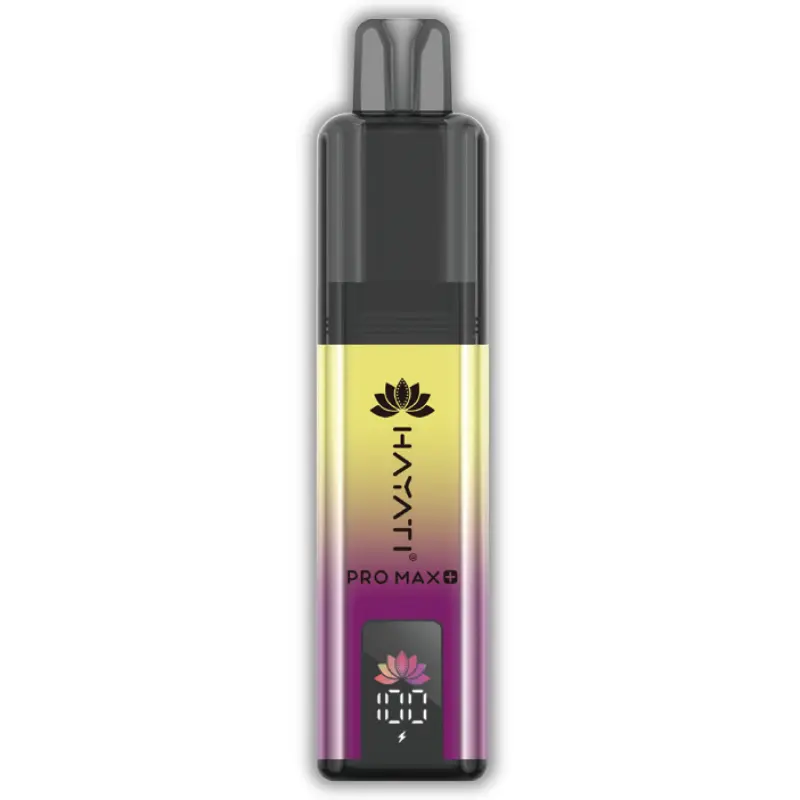
Hayati · Pro Max Plus
Blackcurrant Lemonade Hayati Pro Max Plus 6000 Pod Kit
£7.99
✔ In stock — ready to ship
Genuine Hayati
Free over £20
Same-day dispatch
Secure checkout
Two objects arrive in this box for £7.99: a rechargeable Pro Max Plus body carrying an 850mAh cell, and a prefilled pod holding 12ml of Blackcurrant Lemonade at 20mg nicotine salt. Hayati rate the pod at up to 6,000 puffs, a bench figure whose test conditions they have never published, which leaves it useful for putting two listings in order and useless for predicting how long you personally will have this one. There is nothing to fill and nothing to prime. The pod is sealed, its coil is fixed inside it, and the two go out of service together.
That is the transaction, and it is finished in a paragraph. The liquid takes longer, for a reason that belongs to this flavour and to very little else on the shelf. Hayati have now written a description of Blackcurrant Lemonade seven separate times, once for each listing the flavour appears on, and the seven descriptions do not agree with one another.
They do not disagree wildly. Nobody has called it a mint. But they disagree on the two questions a buyer would actually want settled, which are whether the berry in it is a sweet thing or a sour thing, and which of the two halves is holding the other one up. Four of the seven attach a tart or tangy word to the blackcurrant. Two attach only a sweetness word and no sourness word at all, and those two are precisely the two listings on this device. Six describe the berry as the floor with the citrus above it; one describes the lemonade as the floor with the fruit sitting on top of that. One says the halves meet as equals with neither underneath.
The page you are reading is the odd one in the set in three further ways, and they are worth naming before anything else, because they shape what you will expect when the pod arrives. This listing is the only one of the seven to call the berry jammy and then, one sentence later, to hand you an image of a long cold drink. It is the only listing in all 492 Hayati products, of any flavour, to use the word squash. And it makes a promise about durability that five of its six siblings decline to make.
None of that means the copy is dishonest. It means the copy is copy, written to sell a box rather than to specify a liquid, and that seven attempts at the same job leave a usable residue once you diff them. What follows does that diff first, because it is the only piece of evidence about this blend that is not somebody's taste memory, and then uses the surviving core to describe what the liquid is actually doing in the mouth. The hardware gets the short section it deserves.
Seven descriptions, one flavour name
Start with the count, since a rarity claim ought to be checked rather than repeated. Blackcurrant Lemonade appears on seven listings across four Hayati platforms. That sounds like a lot until you count the rest of the catalogue: 160 distinct flavour names are in use here, 20 of them reach seven listings or more, and Banana Ice tops the table at eighteen. Seven is comfortably mid-table. What makes the set unusual is not its size but its spread, because those seven listings sit on four different hardware platforms at four price points, which means they were almost certainly written at different times by different hands working from the same internal flavour note. Seven independent restatements of one brief is a better instrument than one statement would be, and nobody on this site has yet put them side by side.
What all seven commit to
Sort the descriptions by what survives in every one of them and the residue is short, which is the point of doing it. Four things are unanimous.
- The blackcurrant is dark. Every listing reaches for depth or darkness, and none of the seven describes the berry as bright, light or red-fruited.
- The lemonade is sharp. Every listing uses sharp, zesty, tangy or zing, usually two of them, and none softens the citrus into anything rounder.
- The two are the only components. No listing introduces a third fruit, a dessert note, a herb or a coolant. Across seven attempts at one blend, nobody ever mentions anything that is not blackcurrant or lemonade.
- Nothing is cold. No cooling agent, menthol or ice is named on any of the seven, and no listing describes a chilled finish. On a dark berry, which is the profile the wider trade ices more often than any other, that silence is worth treating as the answer rather than as an omission.
Then there is a fifth claim, and it is the most consistent thing in the entire set apart from the darkness of the berry. Six of the seven listings say, in one wording or another, that the blend is not heavy. Four of the six use the word heavy explicitly and negate it. The other two say the citrus keeps the blend lively. The single listing that makes no lightness claim is the dual Mini Ultra kit, which is describing two flavours in one paragraph and has half the word budget per flavour to do it in, so its silence is easily explained.
Notice what that means. The one property Hayati have committed to more consistently than any other, across seven separate attempts, is not a flavour at all. It is a textural claim. They are more sure about how this liquid moves through your mouth than about whether the fruit in it is sweet or sour. Hold on to that, because it turns out to be the axis this page keeps returning to.
The disagreement that decides the purchase
Now the part where the seven come apart, and it is the question a buyer most wants answered.
The Pro Ultra Plus pod listing calls the berry deep and tart-sweet. The Pro Ultra Plus kit listing opens its flavour paragraph with the word tart and then dark, in that order, and goes on to say the blend suits anyone who finds pure berry blends a little flat. The Mini Ultra pod listing calls the fruit intensely fruity and slightly tart. The Mini Ultra dual kit calls it a dark, tangy berry. Four listings, four sourness words attached to the blackcurrant itself.
The two Pro Max Plus listings do something different. The bare pod listing leads with jammy and then talks about deep berry sweetness. This page leads with the same word and describes what the fruit gives the blend as "a deep, jammy sweetness", with no tart or tangy word applied to the berry anywhere in the paragraph. The sourness in both of these is attributed entirely to the lemonade, never to the fruit.
The bottled 10ml version is the seventh and it sits outside both camps, calling the berry rich, full and juicy without committing to either direction.
So the split runs along platform lines: tart berry on Pro Ultra Plus and Mini Ultra, sweet berry on Pro Max Plus, undecided in the bottle. The tidy explanation, and the one this page thinks is most likely, is that each platform's copy was written in a batch and the writer of a batch settles on a word and reuses it across the two listings in front of them. Two listings per platform is not a sample. It is one decision, twice.
The untidy explanation, which cannot be excluded from the outside, is that the liquids genuinely differ. Nothing about a shared flavour name guarantees a shared recipe, and Hayati publish no flavouring percentage, no ingredient list and no development note for any listing in the range, so there is no document anywhere that would settle it. A page that told you which of those two explanations is correct would be inventing.
What can be said without inventing is the consequence, and the consequence is real. A buyer who arrives at this flavour through the Pro Ultra Plus shelf has been told to expect tartness with sweetness behind it. A buyer who arrives here has been told to expect sweetness with a lift over the top. Those are different expectations of the same named liquid, and expectation does a great deal of work in how a first draw registers. If you have read about this flavour elsewhere and then ordered it here, part of any surprise you get will have come from the copy rather than from the pod.
Which half is holding the other one up
The second disagreement is structural and it is stranger than the first.
Six of the seven listings put the berry underneath. The blackcurrant forms the base and the lemonade lifts it, or the berry supplies the weight and the citrus keeps it lively, or the lemon brightens the blackcurrant and lifts the finish. That is a consistent architecture: a dense floor with a bright ceiling.
The bare pod listing breaks ranks gently, describing the two as meeting halfway with deep berry on one side and bright citrus on the other, which is a claim of parity rather than of hierarchy. The dual Mini Ultra kit breaks ranks completely and inverts the whole thing, saying both of its sides are built on lemonade with a citrus sparkle underneath the fruit. On that listing the lemonade is the foundation and the blackcurrant is the thing sitting on top of it.
That inversion has an innocent explanation and it is worth giving, because a page that presents every inconsistency as a scandal is not much use. The dual kit pairs this flavour with a strawberry lemonade, so from that listing's point of view the lemonade genuinely is the common base: it is the element shared between the two halves of the pod, and describing it as the foundation is accurate to the product being sold even if it is a strange thing to say about this blend on its own.
Which is precisely the warning to take from the whole exercise. Each of the seven descriptions is shaped by the job its listing has to do. The kit listings emphasise readiness and ease. The replacement pod listing emphasises familiarity and everyday use. The dual listing emphasises contrast between two sides. None of them is a tasting note, and reading any single one as though it were is the mistake the diff exists to prevent.
The drink in the glass, and one word that appears nowhere else
Five of the seven reach for an image of a drink. The bottled version offers a tall glass of blackcurrant with lemonade added. The Pro Ultra Plus kit names cordial and has it topped up. The Pro Ultra Plus pod says only that the two behave like a mixed soft drink. The Mini Ultra pod calls it a familiar British drink pairing without specifying what the drink is. The bare Pro Max Plus pod offers no drink image at all.
This listing gives the most fully specified version in the set. It names the concentrate, it names the diluting drink, it specifies carbonation and it puts the result in a vessel: the copy offers "a tall glass of blackcurrant squash" and then has it "topped up with fizzy lemonade". Four variables, where its nearest sibling supplies two and the shortest supplies none.
One of those words is genuinely singular. Search all 492 product descriptions in this catalogue and squash appears exactly once, on this page. Cordial turns up on ten listings and syrup on twenty-six, so Hayati are not squeamish about concentrate vocabulary in general. They have simply never used that particular word anywhere else, for any flavour, on any platform.
The companion listing for this liquid has already worked out, at length and convincingly, what a dilution word can and cannot mean on a sealed object, and its conclusion is that the word claims a position rather than a preparation. That argument belongs to the Blackcurrant Lemonade replacement pod listing and will not be restated here. What that page did not have in front of it is the seven-way comparison, and the comparison adds one thing to its case: the dilution imagery is not a habit of the range, it is a habit of this flavour. Five of the seven Blackcurrant Lemonade listings reach for it. Across the whole catalogue, only five descriptions out of 492 pair a concentrated form with a long-drink image at all, and two of those five are this flavour. Whatever is pulling the copywriters towards a jug and a tap, it is specific to this blend.
What this page's own copy promises that the others do not
Three claims appear here and nowhere else in the set, and one of them matters a great deal.
The first is the recognition claim. The copy says the pairing is one that "most people in the UK" will "recognise instantly". No other listing in the catalogue uses that phrase, for any flavour. Two of the six siblings gesture at familiarity, one calling it a familiar British drink pairing and another a familiar, easy-drinking combination, but neither specifies the country or the speed. The reasoning behind the claim is sound and has been set out properly on the Pro Ultra Plus version of this flavour and its pod sibling, which establish why a sweetened blackcurrant drink and not the fresh berry is the reference nearly every British adult holds. Take that as read.
The second is carbonation. Three of the seven use a sparkle word. This is the only one that uses two, opening with "dark berry with sharp, sparkling citrus" in the summary and then specifying fizzy lemonade in the flavour paragraph. Vapour cannot carry carbonation, which the siblings have said and which is not in dispute, so the interesting question is not whether the fizz is real but what the doubling is trying to buy. The likeliest answer is emphasis rather than information.
The third is the durability claim, and this is the one with teeth. The copy says the lemonade brings a lift that "brightens every puff". Every is a warranty about the last draw as much as the first. Only one other listing in the set makes a comparable promise, the bottled version, which says the blend stays refreshing puff after puff. The other five describe the balance without saying how long it holds.
Hold that against the one thing every page on this site agrees about a sealed pod with a fixed coil, which is that the fragile half of a blend goes first and the durable half remains. Here the fragile half is the citrus and the durable half is the berry. So the claim on the page you are reading is a claim about precisely the component least able to honour it. That is not a lie and it is probably not even deliberate. It is what happens when a sentence written about a new pod is read by somebody holding an old one.
How much weight the diff can carry
Being honest about the limits of this, since a method is only worth as much as its caveats.
Seven descriptions of one flavour is marketing prose seven times over, not seven tastings. It is entirely possible that nobody tasted anything before writing any of them, and that all seven were generated from the two words in the title plus a house style guide. If that is what happened, the unanimous core is evidence about what the words blackcurrant and lemonade mean to a British copywriter, and nothing more.
Even so, that is not nothing. A liquid built to a two-word brief and sold into a market where those two words mean something specific is very likely to have been formulated against the same understanding the copy reflects. And the disagreements remain informative whatever caused them, because they mark out exactly the properties nobody was confident enough to state twice. Where seven attempts converge, you have something to lean on. Where they scatter, you have a question you will have to answer yourself on your own pod, and this page will tell you how.
The liquid, read from what survives the diff
Take the unanimous core as the specification: a dark berry, a sharp citrus, nothing else in the blend, nothing cold in it, and a body that six of seven listings insist stays light. That is a fuller brief than most listings on this shelf supply, and it is enough to reason from. Everything below is reasoning from that brief plus the ordinary behaviour of these components, flagged as such, because Hayati publish no flavour breakdown for this or any other listing and nobody outside the factory holds one.
The berry, and what dark has to earn
Whether the blackcurrant here is a recognisable blackcurrant or a generic purple accord wearing the name is a genuine question, and the bottled nic salt page for this flavour has already worked through the identity markers in detail, down to the resinous top note that distinguishes the real fruit from blackberry or plum. There is no sense in running that again. What the diff adds is something the identity question does not cover, which is the berry's structural job.
In a blend with exactly two components, each one is half the identity and there is nowhere for a weak part to hide. Three-fruit constructions get to average out. A pod like Blueberry Cherry Cranberry can carry one thin element and still read as complete, because two others are covering for it. Here there are two voices and no chorus, and if either one thins the blend does not become slightly less good, it becomes a different blend with a name that no longer fits.
The berry's specific job, on six of the seven descriptions, is to be the floor. Floor is a useful word because it is about weight and position rather than about taste. A dark fruit sits low on the palate, arrives as density rather than as attack, and occupies the middle of the mouth instead of the edges. That is why it can carry something brighter on top of it without the two fighting: they are not competing for the same space.
The consequence for this pod is that the berry is the component doing the structural work, and structural components are the ones you stop noticing. People describe this blend by its lemonade because the lemonade is the part that moves, arrives and departs. The blackcurrant is the part that is simply there for the whole draw, and the easiest way to hear it properly is to compare against a pod that has the same fruit with nothing over it, which is the comparison the neighbours section sets up.
The citrus, and what sharp can be in vapour
Here is where the unanimous core needs unpacking, because sharp is a word that means two different things and only one of them survives the format.
Sharpness in a glass of lemonade comes from two separate sources. There is acid, which is a taste, received on the tongue, and which in a drink is carried by non-volatile acids present in real quantity. And there is citrus aroma, the aromatic fraction that makes a lemon smell like a lemon, which is received in the nose and is made of light, volatile compounds. In a glass those two arrive together and nobody has cause to separate them.
Vapour separates them, and not evenly. The compounds that make a drink sour are heavy, solid at room temperature and poorly suited to travelling in an aerosol, whereas the aromatic fraction is volatile by definition and travels readily. Nothing published about this liquid says what is in it, so this is reasoning about classes of compound rather than a claim about the recipe, but the direction of the effect is not really in doubt: a vape lemonade delivers most of its sharpness as aroma, with a trigeminal prickle at the back of the throat that the brain readily files as sourness because it has nothing better to file it as.
Two things follow, and they are the practical payoff of the whole section.
The first is that the sharpness in this pod is more of a reconstruction than it feels like. The siblings have already established that the fizz is an impression rather than carbonation. The less obvious point is that the sourness is largely an impression too. What the format actually delivers is citrus aroma plus a prickle, assembled by the palate into something that reads as a tart drink. It works, and knowing how it works does not stop it working.
The second is the wear consequence, and it is sharper than the usual version of it. Every page on this site will tell you the citrus fades before the berry, which is true and is not this page's discovery. What the channel split adds is why the fade on this particular blend is so complete. If the sharpness had a non-volatile backbone underneath it, the way a drink does, then losing the aromatic top would leave a plainer but still tart liquid. It does not have that backbone. The sharpness here is aroma nearly all the way down, so when the aroma goes there is nothing beneath it holding the position, and what remains is sweet dark fruit with a faint prickle. A sealed pod does not so much dim this blend as remove one of its two halves and leave the other at full strength.
Which is exactly why the durability claim on this listing is the one to be sceptical about, and why the axis to watch is not the one the copy points at.
Body is the axis, not sweetness
Return to the thing all seven descriptions agree on. They are unanimous that the blend is not heavy, and only equivocal about whether the fruit is sweet or tart. A reader in a hurry treats the unanimous claim as the boring one and goes hunting for the sweetness answer. That is the wrong way round.
Body is what decides whether you finish 12ml of a sweetened fruit or abandon it at two thirds. It is the property that separates a liquid you can sit with for an afternoon from one that becomes work by mid-morning, and it is almost never the thing buyers check for, because body is difficult to notice in isolation and sweetness is not. Sweetness announces itself on draw one. Body announces itself on draw forty.
And body is the property this page's own copy puts at risk. Consider the flavour paragraph as a specification rather than as prose. It says the berry supplies "a deep, jammy sweetness". It then says the two together resemble a squash in a tall glass with something fizzy added. Jam is the most concentrated domestic form a fruit takes: cooked down, high in solids, thick, slow off a spoon and inclined to coat whatever it touches. A topped-up tall glass is the most dilute: mostly water, thin, fast, and gone from the mouth almost as soon as it arrives. The paragraph then closes by stating that "the citrus stops it from feeling heavy", which is the third textural claim in four sentences and it contradicts the first.
Read as a specification, that over-specifies and then argues with itself. Read as prose, which is what it is, it is perfectly coherent: it describes a tension being managed, with the citrus as the thing doing the managing. The jam is what the lemonade is working against.
Which is the useful reading, and it converts directly into advice. The check to run on your first pod is not whether it tastes sweet. It is whether it clears. If the blend releases and leaves the mouth between draws, the citrus is winning and the listing's promise is being kept. If a film sits on the tongue and builds across an hour, the jam is winning, and the pod will get harder to live with rather than easier. That question is answerable in a single unhurried session, and it is worth more than any sweetness estimate because it predicts whether you finish the pod.
Worth adding that the two failure directions are not equally likely over time. Residue accumulates on a coil rather than clearing from it, and sweetened dark fruit is harder on a coil than a plain citrus, so the natural drift of this blend is from the tall glass towards the jam. It starts at its lightest.
Placing the sweetness, with the error bar left on
Since four listings say tart and two say sweet, an honest page has to give a number and show its working rather than picking a side.
The reasoning runs like this. A drink-referenced blackcurrant has to be sweetened, because the unsweetened fruit is too sharp for the reference to hold. That puts a floor under it. It is not a confectionery build, because no listing in the set reaches for gum, candyfloss or the chewy register, and the range has perfectly good words for those when it wants them: the GB suffix on Grape GB announces exactly that treatment, and Blueberry B'Gum announces it in the name. That puts a ceiling on it. So the blend sits above the midpoint and below the sweet-counter end, which is where a cordial construction ought to sit and where five of the seven descriptions place it by implication.
The reason the seven cannot converge more tightly than that is not carelessness. Sweetness and acidity are not independent percepts. Adding acid to a sugared liquid reduces how sweet it registers without removing a single gram of sweetener, and the reverse holds too. On a blend whose entire construction is a sweet floor with an acid ceiling, the same liquid will honestly read as tart-sweet to somebody who tasted it after something bland and as jammy to somebody who tasted it after a dry citrus. Both reports are accurate to the moment they were taken. The related point, that sugar and acid are two dials a formulator can move independently even though the drinker cannot perceive them independently, is worked out properly on the Blue Razz Fruit Twist kit page and is the right frame for placing anything on this shelf.
So the honest placement is: above the middle, below confectionery, with a genuine uncertainty of a point or two in either direction depending on what you had before it. Anyone who needs more precision than that will have to get it from their own first pod, and the method for doing so is at the end of this page.
Seven descriptions, or one trajectory
One reading of the diff is more generous than any of the above, and it may well be the right one.
Suppose all seven descriptions are accurate and none of the writers was careless. They would still disagree if they had tasted the liquid at different points in a pod's life, because this blend does not hold still. A new pod is nearest the tart-and-lively descriptions, with the aromatic citrus at full strength and the berry sitting underneath it. A pod two thirds through is nearest the jammy ones, with the citrus thinned and the sweet dark fruit standing alone. The same liquid, honestly reported, twice.
On that reading the seven listings are not seven contradictory snapshots of one state. They are seven snapshots of one trajectory, taken at different points along it, and the disagreement is a measurement of how far the blend travels rather than evidence that somebody got it wrong.
That cannot be proved from a catalogue and it is offered as a possibility rather than a finding. But it has a consequence worth acting on either way. If the range of descriptions maps the range of states a single pod passes through, then the spread between them is a forecast: you should expect this pod to be a tart-sweet lively thing early and a plainer, sweeter, heavier thing late, and the distance between those two is roughly the distance between the Pro Ultra Plus copy and the copy on this page. That is a larger distance than most blends travel, and it is the single most useful thing the seven-way comparison produces.
What it is not
Six things, stated flatly, because a page that only says what a product is leaves the reader to discover the rest at their own expense.
Not cold. No coolant is named on any of the seven descriptions and none is described. Any freshness you register is acid and aroma doing the work, and that is a different sensation from a chill however often the two get reported in the same words. Anyone who wants cold with their dark fruit should buy a listing that says so, and Double Menthol is the uncompromising version of that on this shelf.
Not sour. Tang is not sourness. There is acidity here for lift and contrast, not as the headline, and nothing in this blend is built to make your jaw twitch.
Not a lemon liquid. The citrus is a lemonade accord, which is sweetened and rounded with its sugar and acid already balanced against each other, rather than the zest-and-rind character of the fruit. The catalogue keeps those two words distinct and uses lemon as an ingredient on a great many more listings than it uses lemonade.
Not a multi-fruit blend. Two components, no third act, nothing revealed in week two that was not there on day one. Whether that counts against it depends on whether you want a flavour to hold your attention or to stay out of the way.
Not carbonated, whatever the summary line says. That one is physics rather than an opinion about the formulation.
Not adjustable. One strength, one volume, one fixed proportion between the halves, and no options published against the listing.
The kit itself, kept brief
Roughly ninety products share this device and it has been taken apart from every angle worth taking on the Pro Max Plus prefilled kit shelf. Only the parts that bear on this liquid are repeated here.
The carton holds two items: the rechargeable body with its 850mAh cell, and one prefilled pod already filled with 12ml at 20mg. Nothing is assembled, soaked or measured before first use.
The specification that actually matters for this blend is the one that sounds least interesting, which is that a single coil is sealed inside the pod and has to process the entire 12ml. It cannot be rinsed, rewicked or exchanged, and when the liquid is gone the coil goes with it. On a durable single-note fruit that would be a footnote. On a two-part blend whose lighter half is carried almost entirely by fragile aromatics, it is the governing fact of the product, because everything the earlier sections said about drift is a consequence of one unserviceable coil seeing out the whole volume. A blend like this on a serviceable device would behave differently. On this one it cannot.
Airflow is narrow and the intended style is mouth-to-lung, which is the condition a 20mg salt preparation is formulated for. Forcing a fast pull through a tight airway wins nothing: the coil runs hotter and the wick empties quicker than liquid returns to it, and on this blend the aromatic citrus is what both of those take first. Sip at it.
On fitting, check the range name printed on your device against the range in this title, and build nothing further on top of that check. Resistance, wick material, airflow and dimensions are all absent from this listing. Where a figure is missing here it is missing because Hayati never issued it, not because this page declined to look it up.
The sheet, ordered by what bears on the liquid
Rows below run from the ones this page's argument depends on down to the ones included only for completeness, which is not the order a specification is usually printed in.
| Where the two halves sit | Berry as the floor, citrus above it, on six of the seven descriptions Hayati publish for this flavour |
| Descriptions on record | Seven, across four hardware platforms, agreeing on four things and disagreeing on two |
| Cooling | None named on any of the seven, and none described |
| Coil | One, fixed inside the pod, carrying the full volume and not serviceable |
| Liquid in the pod | 12ml, filled and sealed before it reached you |
| Nicotine | 20mg, in a salt preparation |
| Cell in the body | 850mAh, as stated on this listing |
| Bench rating | Hayati's own laboratory figure, quoted as up to 6,000 puffs |
| What the carton holds | The device and one prefilled pod, nothing else |
| Refill route | The bare pod, sold on its own listing |
| Price for the pair | £7.99 |
| Flavour name as listed | Blackcurrant Lemonade |
Three of those rows carry more than they appear to. The remainder are listed so that no number has to be hunted for in prose.
The top two rows are this page compressed into four cells, and they are rows no ordinary specification sheet carries. Putting the number of published descriptions on a spec sheet looks eccentric until you notice that for a prefilled pod the descriptions are the only sensory information that exists. There is no ingredient list to read, no flavouring percentage, no development note. Seven pieces of prose are the entire documentary record of what this liquid is meant to taste like, and treating them as evidence rather than as decoration is the only way to get anything out of them.
The cooling row should be read as disqualifying rather than as a detail if a cold finish is what you are after. Dark berry is the profile the wider trade ices more often than any other, so plenty of buyers assume a blackcurrant will arrive chilled unless warned. Nothing in any of the seven suggests it, and acid is not a substitute for a coolant however similar the two can sound when people describe them.
The 20mg figure is a plain statement of what is in the liquid. British law does not permit a higher strength to be sold, so 20mg is the ceiling rather than a setting chosen from a spread. Salt is the preparation the format uses throughout, freebase at that figure being poorly suited to a slow narrow pull. Nicotine is addictive. Matching a concentration to an individual is outside what a retail listing can responsibly do, so no attempt is made at it here.
The puff figure exists to be attributed rather than leaned on. What a laboratory rating describes is the workload one sealed coil was built to take, and comparing it against the numbers printed on the 22ml or 4ml formats is worse than useless, since those came off different hardware and nobody ever calibrated the three against one another.
Where it sits among the neighbours
Almost nobody buys a pod in isolation. They buy it instead of three or four others, so this is the section that decides most orders.
Against the same fruit with nothing over it
Everything except the second word is held constant between this pod and Blackcurrant Juice. Identical volume, identical strength, identical device, identical shelf price. Anyone who wants to hear what the berry in this blend is actually doing should run the two in the same week, because the citrus here is loud enough to draw attention away from the half that is holding everything up.
The practical choice between them is about pace rather than preference. The plain berry is rounder and more continuous and lands immediately, which suits short bursts through a day. This one is lighter across the middle and resets the palate between draws, which suits sitting with a pod for an hour. If dark fruit has ever started to feel like work by your third session, the lemonade version is the one to take.
Worth noting what the diff predicts here, since it is falsifiable. If the seven-description reading is right, this pod should be the lighter of the two and its late stage should converge on the plain berry rather than on anything else. A pod of this in its final third ought to taste roughly like a new pod of Blackcurrant Juice. If it does not, something in the reasoning above is wrong.
The rest of the blackcurrant shelf
One fruit name and sixteen entries: that is the Blackcurrant Vapes shelf, and what distinguishes any two of them is the word sitting beside the fruit. Two classes are worth keeping apart, because wanting a fruit lightened and wanting it accompanied are different wishes.
Blackcurrant Mango and Blue Razz Blackcurrant add a second fruit, which does not move the blackcurrant along an axis so much as hand away part of the draw to something else. Both are three-voice constructions in effect, and both are more forgiving than this one for the reason given earlier: there is more to cover a thin element.
Blackcurrant Cotton K with Blue Raspberry takes the opposite treatment to this pod, handing the same fruit to the candyfloss register instead of the drink one. Sugar goes up, the sweetness changes from something that releases to something that coats, and the blackcurrant becomes a direction rather than a subject. Anyone who reads the body section above and realises they actually want the jam rather than the tall glass should look there first.
The other lemonades
Nineteen listings carry the word across the catalogue and they sit together on the Lemonade Vapes shelf. The construction is constant and the fruit underneath is the variable, which makes them an unusually readable set.
Berry Lemonade is the nearest neighbour on this device and the honest answer is that a quick draw will not separate them. The difference shows over an hour. A family name rather than a fruit name is a looser promise, and a looser promise is harder to break, so that listing is playing an easier game than this one. In practice it is the friendlier and rounder of the pair. Take it for a blend you do not have to think about; take this one when you want the fruit to have some shape.
Pink Lemonade goes further into softness, with the lemonade itself showing through more and the fruit reduced to a colour word, and it is the closest thing on this shelf to a plain soft drink. Blue Razz Lemonade is the loud member of the group. Its dark half is a confectionery accord rather than a fruit, so the citrus there is lifting something that was never grown, and the result is a sweet under a lemonade instead of a berry under one.
Off this platform, Straw' Lemonade is the most instructive comparison in the family, because strawberry contributes sugar and hardly any acidity. On that pod the citrus is the sole source of tang. On this one it arrives on top of a fruit that had some of its own. Run them against each other and the difference between the two totals tells you roughly how much of the sharpness here belongs to the blackcurrant, which is a figure none of the seven descriptions will give you.
If the citrus is the part you came for
Strip the dark half out and several listings keep the bright end. Lemon Lime is the driest reference available, two citrus fruits with very little sweet body beneath them, and it is the right purchase for anyone who liked the lift here and found the berry in the way. Tropical partners are what Lemon Pineapple and Pineapple Lemon Burst set the citrus against, while Cherry Peach Lemon demotes it to the last name in a stack of three.
All of those use lemon as an ingredient. This pod uses lemonade as a treatment, and the difference shows up as rounding: a drink has had its sugar balanced against its acid before it reached anybody, and a fruit has not, so the drink version reads softer and carries less of the aromatic rind character. Fifty-four listings sit on the Lemon Vapes shelf for anyone shopping the citrus end rather than the berry.
If the sweetness is the part you came for
Grape Berry stays in dark fruit and drops the citrus framing entirely, which makes it the rounder and less refreshing of the two. Black Mamba is worth naming mainly as a caution: its listing is named for an impression rather than an ingredient and declines to say which fruits are in it, so it is a different kind of purchase from this one and its own page deals honestly with what that costs you.
Cola Lime runs the same drink logic through a spiced base with a citrus lift on top, so it answers a similar want for something beverage-shaped without going near the berry family. It is the obvious rotation partner if you like what a drink construction does but want a break from purple.
The same liquid at other sizes
Blackcurrant Lemonade exists seven times and three of those are relevant to somebody reading this page. The bare pod at £5.49 is the correct repeat purchase once you own the body, and buying a second kit means buying a second device. Mini Ultra pods at £3.49 are the cheapest way to reach a verdict on the flavour, and the dual Mini Ultra kit puts it alongside the strawberry version for exactly the comparison described above. Both of those need the Mini Ultra body, so neither is something you could drop into this device. They are other doors to the same flavour, not spares for this one. The whole Hayati catalogue is there for wider browsing.
Getting a fair reading of it
Nothing below is a substitute for ordinary pod handling, which is the same on this device as on any other. These are the eight points where a two-part drink blend with a fragile bright half behaves unlike the rest of the shelf.
Run the clearing test before the sweetness test. Take four or five unhurried draws over a few minutes, then leave it a quarter of an hour and notice what is still in your mouth. Nothing there means the citrus is doing its job and the blend will stay comfortable over 12ml. A film still sitting on the tongue means the jam is winning, and it will win harder later. That single observation predicts whether you finish the pod better than any flavour note does.
Take your reading in the first two days. A new coil is the only condition under which the tart-versus-sweet question has a clean answer, because once residue is involved you are rating the liquid and the mesh at the same time and cannot tell which is which. Verdicts formed late in a pod are usually verdicts on the pod's last third, delivered as though they were verdicts on the blend.
Expect the balance to move, and know which way. The aromatic half thins and the dense half does not, so the pod does not fade evenly. It drifts towards a plainer, sweeter blackcurrant, which is a perfectly pleasant liquid and is not the one the label describes. Noticing that shift tells you where you are in the pod far more reliably than counting days does.
Chasing the lemonade is how you lose it. Pulling harder recovers nothing from a narrow draw. It runs the coil warmer and empties the wick faster than it refills, and the volatile citrus is the first casualty of both, so the instinctive response to a fading bright note actively accelerates the fade. Ten or fifteen seconds between draws keeps both halves in play.
Do not judge a pod on its first draw after a rest. A blend that has sat untouched in a bag for a week opens heavy, and on this one that registers very specifically as the lemonade having vanished rather than as anything tasting stale. Nothing has vanished. Draw gently for a minute and the bright half comes back, but plenty of people never give it that minute and write off a perfectly serviceable pod on its worst thirty seconds.
Heat and daylight do the same job as a worn coil. Both attack the delicate end of a liquid before they touch anything else, so a spare left on a sunny sill loses its citrus while its sweetness sits there untouched, arriving in your hand already partway down the same road that use would have taken it down. Treating those as one problem rather than two is the accurate way round. A cupboard solves it, and spares belong where children and animals cannot reach them.
Have a plan for the tail before you get to it. Twelve millilitres leaves a meaningful stretch at the end where the blend has become a plain sweet blackcurrant, and both available answers are defensible: use it up, or bin the pod the day the lemonade stops turning up. What does not work is spending a fortnight undecided, which delivers a disappointing vape and a wasted remainder at the same time.
A finished pod does not belong in the kitchen bin. There is mesh in there along with whatever nicotine liquid did not make it out, which is why council collection sites and vape shops will take one. Prising it open recovers nothing worth having.
Questions this listing raises
Why does this page describe the flavour differently from the other Blackcurrant Lemonade listings?
Because Hayati wrote each description separately and they do not all say the same thing. Four of the seven attach a tart or tangy word to the berry and two attach only a sweetness word, and the two that do are the pair on this device. The likeliest explanation is that each platform's copy was written in a batch, but nothing published anywhere would settle whether the liquids themselves differ.
Is the berry sweet or tart?
Above the middle of the shelf for sweetness and below the confectionery end, with genuine uncertainty of a point or two either way. Sweetness and acidity mask one another, so the same liquid honestly reads as tart after something bland and as jammy after a dry citrus. That is most of why the seven descriptions cannot agree.
Is there any cooling in it?
None is named on any of the seven descriptions Hayati publish for this flavour, and none is described. Whatever freshness registers comes from acidity and citrus aroma, which is a different sensation from a chill. Buy a cold dark fruit from a title that advertises one, because nothing in this blend will stand in for it.
Is it fizzy?
No. Vapour cannot carry carbonation, so the sparkle is an impression assembled from sharp citrus and a slight prickle at the back of the throat. This listing is the only one of the seven to use two carbonation words, which is emphasis rather than extra information.
What does jammy mean on a vape listing?
It is ordinary house vocabulary rather than a special claim: twenty-seven Hayati descriptions use it. What makes its use here worth noticing is that this listing pairs it with an image of a long diluted drink in the same paragraph, which specifies two opposite textures. Read as prose it describes the citrus working against the berry's weight, which is coherent.
How does it compare with Blackcurrant Juice on the same device?
Everything but the modifier is held constant across those two listings, which makes the pair about as close to a controlled comparison as this catalogue gets. The plain version is deeper and more continuous. This one thins out across the middle of the draw and resets your palate between pulls, so it holds up better over a long sitting.
Will the lemonade really brighten every puff?
Not to the end of the pod, no. The citrus is carried largely by volatile aromatics and the berry is not, so the bright half thins first while the dense half stays at full strength. The claim describes a new pod accurately and an old one optimistically.
What is in the box for £7.99?
The rechargeable body with its 850mAh cell and one prefilled pod holding 12ml at 20mg nicotine salt. Nothing needs filling or priming. Anyone who already owns the device should order the bare pod instead and keep the difference.
Can the pod be topped up or the coil replaced?
Hayati describe no way into it and publish no filling method, so the sensible assumption is that what you receive is all you get. Replacing the mesh is equally not on offer. Anyone who did contrive a top-up would be pushing fresh liquid through metal that had already handled a full 12ml, which is the part of the pod that actually wore out.
What is the cheapest way to find out whether I like the flavour?
The Mini Ultra pods at £3.49 are the smallest prefilled commitment, though they run on their own device rather than this one. A 10ml bottle of the same flavour exists as a nicotine salt at a lower strength for anyone with something refillable. Expect either to tell you whether the profile suits you and not much more, since the device a liquid runs on changes how it reads.
Does it gunk a coil quickly?
Faster than a plain citrus, slower than a dessert or custard build. Sweetened dark fruit leaves residue over time, which is normal for the category, and on this blend the first sign is the citrus receding rather than anything tasting scorched. Flavour change arrives long before a burnt note does.
Is up to 6,000 puffs what I should expect?
No, and it was never meant to be read that way. The number comes off test apparatus repeating one pull at one interval, which is a fair basis for putting two products in order and no basis at all for forecasting a person. What it genuinely describes is the workload a single sealed coil was built to survive.
The short version
For £7.99 you get a Pro Max Plus body with an 850mAh cell and a sealed pod holding 12ml at 20mg nicotine salt, rated by Hayati at up to 6,000 puffs on their own equipment. Dark berry as the floor, sharp citrus above it, nothing cold anywhere in it, and no third component.
The argument on this page is that the best evidence about a prefilled liquid is the set of descriptions its own manufacturer has published, and that this flavour has an unusually large set. Seven of them exist. They agree that the berry is dark, that the citrus is sharp, that there is nothing else in the blend, that nothing is cold, and, most consistently of all, that the result is not heavy. They disagree about whether the fruit itself is sweet or sour, and about which of the two halves is structural. The copy on this page is the sweetest characterisation Hayati publish of this liquid anywhere, the only one in 492 listings to use the word squash, and the only one to promise that the lift holds across every draw.
What follows for a buyer is a change of what to check. The unanimous claim is textural, so body is the axis that matters, and the test is whether the blend clears from your mouth or coats it. The disputed claim is sweetness, so treat any single description as one reading taken at one moment. And the promise nobody else makes is the durability one, which is the claim the format is least able to keep, because the bright half of this blend is carried by the fragile components and the dark half is not. Expect a tart, lively thing early and a plainer, sweeter one late, and expect the distance between those two states to be larger here than on most of the shelf.
Strictly for adults aged 18 and over. Nicotine is an addictive substance.
You might also like


