
Home / Hayati Rubik Prefilled Pod Kit / Lemon Cola Ice Hayati Rubik Prefilled Pod Kit
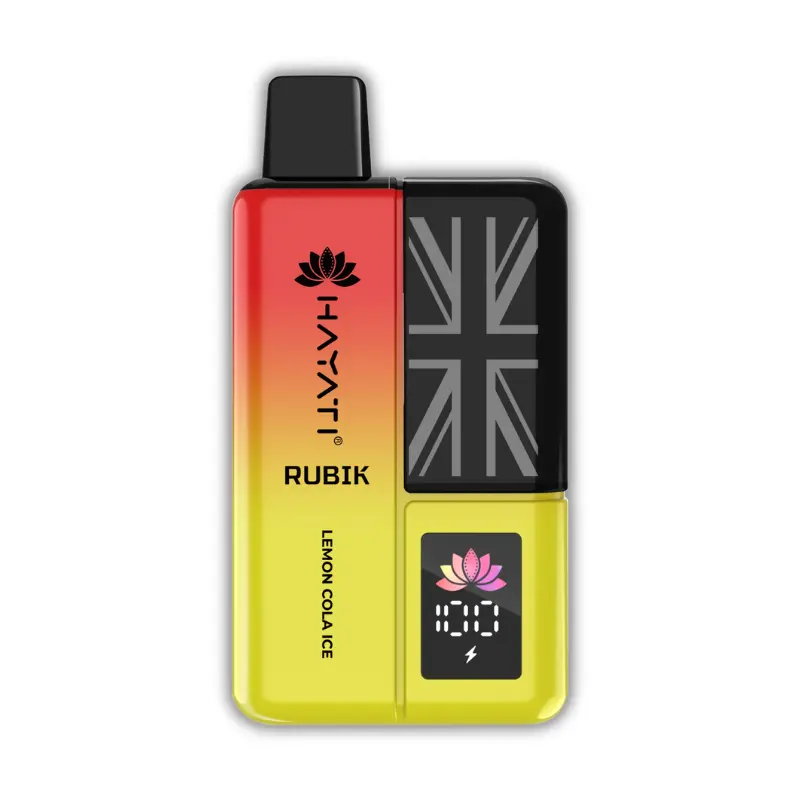
Hayati · Rubik
Lemon Cola Ice Hayati Rubik Prefilled Pod Kit
£5.99
✔ In stock — ready to ship
Genuine Hayati
Free over £20
Same-day dispatch
Secure checkout
Lemon Cola Ice arrives as a finished purchase. £5.99 buys a Hayati Rubik body with an 850mAh cell and a pod already filled with 12ml of liquid at 20mg nicotine salt, sealed at the factory and working from the moment it is seated. Hayati rate these pods by machine at up to 7,000 puffs, a laboratory figure taken on apparatus drawing at a fixed length and interval, which makes it a way of ranking one pod against another and a poor way of planning a month. One liquid runs the full 12ml. There is no collar and no second reserve, so whatever the title promises is what the next several weeks contain.
The title promises three things, and that is the interesting part, because one of them was already inside another one before Hayati wrote it down.
A cola accord is not a single material. It is a recipe, and on every public account of that recipe the top of it is citrus peel oil. Orange and lemon, pressed rather than juiced, sitting over a bed of warm baking spice and vanilla with a hard acid running underneath the whole length of it. Lemon is not an outsider being introduced to a cola. Lemon is one of the things a cola is made of. So the second word in this title does not name a new ingredient. It names an existing one, and it names it loudly enough to put it on the label.
That makes this a different kind of product from the two obvious neighbours. Cola Ice Hayati Pro Max Plus 6000 Pod Kit takes the accord and changes its temperature. The cherry and raspberry colas in this catalogue take the accord and put a fruit on top of it. This one takes the accord and turns up one of its own parts. Nothing has been brought in from outside the recipe, and nothing has been swapped out. A dial that was set at the factory has been moved.
Turning up a component you already have is not a smaller version of adding a component you do not. It is a separate move with separate consequences, and working out what those consequences are is what the rest of this page does. Then the cold, which is a second departure from a plain cola running at the same time as the first, and which pulls in the same direction rather than the opposite one. Then the question that decides whether any of this is worth £5.99: which of the three elements the coil takes first, and what is left in the pod once it has taken it.
The lemon was already in there
What the range has established about the accord, taken as established
Four pages in this shop have already done the structural work on cola and there is nothing to gain by doing it again. The component-by-component anatomy belongs to the Cola Ice / Orange Lemon Lime Hayati Mini Ultra Pod Kit page and to the Pro Ultra Plus kit page it cites, between them setting out the citrus group, the spice group, the vanilla and the acid, and saying what each contributes and when it arrives. The taxonomy of what a coolant is doing when it lands on a base belongs to the Cola Ice Pro Max Plus pods page, which separates a coolant supplying a quality the base lacks, a coolant restating a quality the base already implies, and a coolant opposing a quality the base actually has, and places cola in the third of those. The ownership arc, where a fresh pod sits at one extreme and a tired one at the other with the cold as the only fixed mark between them, belongs to the Cola Ice Pro Max Plus kit page. And the epistemics belong to the Raspberry Cola Pro Ultra Plus pods page, which explains why a drink whose formula has never been published produces more agreement among buyers than a fruit whose original grows on a tree.
All four are reachable from the Cola Vapes shelf, all four are taken as read here, and none of their arguments is rebuilt below. This page needs exactly one line out of that body of work, and it is the first one: the top of a cola is citrus, and the citrus is orange and lemon.
The hedge attached to that line has to travel with it. Nobody outside the company holding the original formula knows what is in it. Every published breakdown of a cola profile is a reconstruction made from the outside, Hayati publish nothing at all about how their own concentrate is built, and the facts supplied with this listing run to a flavour name, a volume, a strength, a battery figure and a bench rating. So the sentence is that lemon is in every public account of the accord, not that lemon is in this pod on a document. Everything built on it below is reasoning, and it is flagged as reasoning wherever it matters.
Why the premise is firmer here than the one the range has already tested
This is not the first listing in the catalogue to raise a citrus over a cola, and the earlier one is worth looking at closely, because the comparison turns out to favour this page rather than embarrass it.
Cola Lime does the same structural thing with a different fruit, and the Cola Lime Pro Max Plus pods page worked the argument through at length. It found a problem it could not solve. The published accounts of the classic recipe do not agree about lime. Some list it in the citrus group beside orange and lemon, others name only the two and leave lime out, and our own pages inherited the split and contradict each other on it. That page was honest about the consequence: whether Cola Lime amplifies an existing component or imports a new one depends entirely on a question nobody outside the formula holder can settle, so it ran its argument both ways and said so.
No such split exists for lemon. Lemon appears in every reconstruction of the accord that names any citrus at all. It is the least disputed member of the group, more consistently listed than lime and roughly as consistently listed as orange. Which produces a small inversion worth stating plainly: the listing this catalogue offers as its citrus-amplification case is the one whose premise cannot be verified, and the listing nobody has examined is the one whose premise holds without conditions. Lemon Cola Ice is the clean instance of the move. Cola Lime is the contested one.
The Cola Lime page was right about one thing in the other direction and it should be conceded here rather than argued with. As an experiment, Cola Lime is the better instrument, because it changes one variable against a plain cola and this pod changes two. You cannot isolate what raising a citrus does by tasting a liquid that has also been cooled. So each of the two is clean on one axis and muddy on the other: Cola Lime has a clean design and a premise it cannot check, this one has a premise that checks out and a design with a second variable bolted to it. Neither is the controlled version. The controlled version is not sold.
Hayati's own copy, lined up against itself
Descriptions are not recipes, but they are evidence about how the people selling a liquid understand it, and the eighteen cola listings in this catalogue turn out to sort themselves along exactly the line this page is drawing. Three patterns came out of reading all eighteen.
The first is a phrase count. The words "plain cola" appear in three of the 492 descriptions Hayati publish. Two of the three are the Lemon Cola Ice listings, this one and its refill. The third is the Cola Lime kit. That is the whole set. Not one of the six Cola Ice listings defines itself against plain cola, not one of the three Cherry Cola listings does, and neither Raspberry Cola listing does. Only the citrus-raised ones reach for the comparison, and they reach for it because it is the only comparison that describes what they are. A cherry cola is not usefully described as a plain cola with something done to it. This is.
The second is a vocabulary split, and it divides the eighteen more sharply than the phrase count does. Go through the eighteen looking for the language of a bar rather than the language of a mixing bowl: a squeeze, a wedge, a slice, a twist of something dropped into a glass. Five listings use it. They are the three Cola Lime listings and the two Lemon Cola Ice listings, which is to say all five of the citrus-raised colas and nothing else. The six Cola Ice listings use none of it. The three Cherry Cola listings use none of it. The nearest miss is the Raspberry Cola kit, which says twist in the sense of a variation rather than a wedge of fruit, which is a different word doing a different job.
What the fruited colas get instead are mixing verbs. The cherry is folded through the cola. The raspberry sits over the top of it. Two things meet halfway. That is the vocabulary of combination, and the vocabulary of combination is reserved, in Hayati's own copy, for the fruits that were never in the recipe. When the thing being raised is a citrus, the copy stops describing a blend and starts describing a gesture performed on a finished drink.
The third pattern is the one most directly about this listing. The kit description reaches for the slice in the glass, and the refill description says the lemon is what keeps the sweetness in check. Read those two together and they are not describing an ingredient at all. They are describing an adjustment: something added to correct a property the drink already had too much of. That is what a dial does. An imported fruit does not get described as a corrective, because an imported fruit has nothing to correct.
Two things the comparison turned up that are not evidence
Two findings looked promising and did not survive checking, and reporting them is more useful than quietly dropping them, because the next person to run this comparison will find the same two.
Neither Lemon Cola Ice description mentions caramel. Ten of the eighteen cola listings do, so an absence looked meaningful, and it is not. The word caramel appears in none of the 104 Pro Ultra Plus descriptions and in none of the 39 Rubik descriptions. Whoever wrote the Rubik batch did not use the word for anything, so its absence here says something about a copy desk and nothing whatever about a liquid. That is the trap this catalogue sets repeatedly: a term missing from one platform's copy is usually missing from all of that platform's copy.
The second is spice, and it half survives. The kit description names a faintly spiced backbone. The refill description of the same liquid does not mention spice at all. Within the Rubik batch the word appears exactly once in 39 listings, and the once is this listing. On its own that would be another platform artefact, except that the batch is almost entirely fruit and fruit gives nobody an occasion to mention spice. What is left is a genuine disagreement between two descriptions of one recipe, which tells you how the copy was produced rather than that two recipes exist. Worth noting only because the listing you are reading is the one that puts the spice on the record, and the spice is the component the rest of this page spends most of its time worrying about.
Turning a component up is a different move from adding one
What adding does, and why it is the easier thing to describe
Put a cherry over a cola and the buyer gets two things to taste. They arrive at different moments, they occupy different parts of the draw, and a reasonably attentive person can point at the seam between them. The fruit has a position of its own because nothing else in the accord is standing where it stands. That is why the fruited colas are easy to write about and easy to choose between: you are choosing a second flavour, and you already know whether you like cherries.
The failure modes of addition are equally legible. The imported note can sit awkwardly against the base, or it can cover the base, or it can be so well matched that you wonder why anyone bothered. All three are visible on a first pod. The Raspberry Cola pods page worked through where a berry can go in an accord that already has a bright top and a sweet floor, and found the answer genuinely constrained. That is an addition problem and it has an addition answer.
What amplifying does, which is not a smaller version of the same thing
Raising a component that is already present cannot give you a second voice, because there is no second thing to hear. What it gives you is a changed proportion, and proportion is not a minor property of an accord. It is most of what an accord is.
An accord is not an ingredient list. Two liquids can contain the same materials and read as entirely different drinks, and the difference between them is the ratio. Which is why the intuitive prediction about this product is wrong. You might reasonably expect that turning up one of a thing's own constituents would make it read as more itself, in the way that more salt makes a soup taste more like the soup it already was. Flavour accords do not behave like that past a very short distance, because their identity is stored in the relationship between parts rather than in the parts. Raise one member far enough and the relationship changes, and the thing stops being recognisable as itself even though nothing foreign has entered it.
There is a second consequence that follows immediately and is easy to miss. When you add a foreign fruit, the accord underneath it survives intact. It is covered, or it is contrasted with, but it is still down there doing exactly what it did before, and if you concentrate you can hear it unchanged. When you amplify a constituent, the accord does not survive intact, because the thing you moved was load-bearing. There is no unaltered cola underneath a Lemon Cola Ice waiting to be heard past the lemon. The cola has been reproportioned.
So when does raising a component stop helping and start breaking things
This is the question the product actually poses, and it has a shape rather than a number. Three stages, distinguished by what happens to the buyer's ability to name what they are tasting.
In the first stage the raised component becomes more legible without becoming separable. The accord still reads as one object and as the object it was, and what has changed is definition: the top is clearer, the opening arrives faster, the profile feels less muddy. Nobody tasting it says there is lemon in this. They say it is a sharper cola. This is amplification doing what it is supposed to do, and for a flavour category whose main structural risk is turning into syrup, it is a real improvement rather than a cosmetic one.
In the second stage the component crosses into audibility. It stops being a property of the accord and starts being a thing inside the accord. The buyer's description changes from an adjective to a noun: not a sharper cola but a cola with lemon in it. Nothing has gone wrong yet and many people prefer this point, but something important has happened, which is that the liquid has stopped being one flavour and become two. The accord has been converted into a compound, and it is now competing against the cherry and raspberry versions rather than against plain cola, on a field where it has no particular advantage.
In the third stage the balance tips and the raised component becomes the subject. The accord goes from being the thing described to being the setting for something else. A lemon drink with cola underneath is a coherent product and somebody will enjoy it, but it is no longer a cola in any sense a buyer can use, and it will be judged against lemon drinks, which is a comparison it will lose, because a cola accord is a poor bed for a lemon.
The breaking point, then, is not the point at which the liquid becomes unpleasant. It does not become unpleasant. It becomes unidentifiable, and that matters more on this flavour than it would on almost anything else in the catalogue.
The line is a reference line, not a taste line
Here is why. The Raspberry Cola page made the observation that a cola liquid is measured against a fixed external article. The original is a manufactured product built to a specification and kept deliberately identical, so every buyer has the same reference in their head, which is why people argue about whether a mango liquid is accurate and mostly agree about whether a cola one is. That agreement is the single asset a cola flavour has that a fruit flavour does not.
Amplify past the second stage and you spend that asset. The liquid stops matching the fixed article, so it stops being checkable, and the buyer is thrown back on whether they happen to like it. Which is the same position a mango buyer is in, except that a mango buyer at least knows what they were promised. A cola that has drifted out of range of its original is worse off than a fruit, not better, because it made a specific promise and a fruit only made a general one.
That is the verdict this page reaches on the general question, and it is worth stating in one line before moving to the particular case. Raising a component improves an accord for as long as the accord still names the thing it was named for, and it breaks the accord at the moment the reference stops working, which happens well before anything starts tasting bad.
Where this one lands, and how to tell
The title is the best evidence available, and it is not reassuring
Hayati's naming grammar was examined on the Cola Lime pods page and found to be inconsistent, which is true and which does not make it worthless. The pattern, as far as it goes: imported fruits go in front of the word cola, so Cherry Cola and Raspberry Cola, and treatments applied to a finished drink go behind it, so Cola Ice and Cola Lime. That page noted that Lemon Cola Ice breaks the pattern and used the break to argue that Hayati's titles are not a reliable guide to structure.
Accept that they are unreliable and the break still says something, because a title is not a structural claim in the first place. It is a claim about what you will notice. Read it that way and the grammar stops being broken and starts being informative: Hayati put lemon in the slot reserved for imported fruits because they expect you to hear lemon the way you hear a cherry, as a thing rather than as a property. Their own copy agrees, describing the lemon as what lifts the liquid above plain cola rather than as what makes the cola itself more distinct.
So the title is a prediction, and the prediction is stage two. Not a sharper cola. A cola with a lemon in it. If the title is honest, this liquid has crossed from definition into audibility, and the buyer is choosing a compound rather than a better-defined accord.
The test, and what to listen for
The Cola Lime pods page proposed the right test and there is no reason to invent another. The question is whether there is a moment in the draw you can point at, because a flavour is heard as separate when it has a moment of its own, and a component that never holds the stage alone reads as part of whatever it arrived with.
Applying that test to lemon needs one adjustment, because lemon fails the positional half of it by definition. It cannot occupy a moment of its own: it arrives at the front where the accord's own peel oils already are, and it leaves before the exhale, because volatile citrus does not survive into a finish that belongs to vanilla. On position alone, lemon can only ever read as amplification.
Which means the evidence has to come from character instead, and here lemon is at a disadvantage compared with lime. Lime brought resin, pine and a bitterness with no counterpart in the base, and the Cola Lime page's verdict, amplification with a change of accent, rested precisely on that imported character. Lemon has nothing equivalent to import. It is already the accent. There is no aromatic property lemon can bring to a cola that the cola's own lemon component was not already bringing in smaller measure.
So the honest structural description of this liquid, before anyone tastes it, is amplification without a change of accent. A dial and only a dial. That is the purest form of the move and also the least interesting one, because it has nothing novel to deliver. What you are buying is more of something you were already getting.
The thing to listen for, then, is not a new flavour. It is proportion. On the first few draws, pay attention to whether the opening reads as a brighter version of the same thing or as a separate sharpness laid over it. If the sharpness has a shape you could describe on its own, without reference to the cola, the liquid is at stage two and the title is accurate. If it does not, you have a better-defined cola and the title has oversold it. Both are perfectly good outcomes. They are different purchases, and the listing does not tell you which one it is.
Why the count matters here
One piece of arithmetic before moving on, because a claim of the form "this is the only one that does X" should be counted rather than repeated. The eighteen cola listings sort as follows: six are the plain accord cooled, one is the divided Mini Ultra pod that keeps a cooled cola on one side and a three-citrus blend on the other, three are cherry, two are raspberry, one is a nicotine pouch, three are Cola Lime and two are Lemon Cola Ice. Nine of the eighteen carry a cooling word, which is the split the Cola Ice pods page identified and which holds up on recounting.
Cross the two properties and the interesting cell has two entries in it. Of the five listings that raise a citrus, three are uncooled and two are cooled, and the two cooled ones are this kit and its refill. Nothing else in the catalogue runs both departures from a plain cola at the same time. That is the narrow version of the claim and it survives counting, which the wider versions do not: this is not the only cola with lemon raised in it, and it is not the only cooled cola. It is the only recipe that is both.
Two departures, pulling the same way
The mechanisms are different, which is what makes them compound
The temptation is to list the coolant and the raised lemon as two features and move on. They are not two features. They are two attacks on the same target, arriving by different routes, and the interaction is the most useful thing on this page if it holds up.
Take the two mechanisms as the corpus has them. The Cola Ice pods page established that a coolant and a warm spice are not cancelling each other chemically, because they are reported by separate systems that get reconciled further up, and that what actually happens is competition in the temperature channel, which a synthetic coolant wins by a wide margin. The spice is not halved. Its heat is overruled while its aroma survives untouched, so what is left is the smell of the spice cupboard without the fire underneath it.
The Cola Lime pods page established a completely different mechanism for the same symptom. Nothing is damped when you raise a citrus. The spice is intact, undamped and at full strength, and it is harder to notice anyway, because the brief dry opening that used to introduce it has been lengthened and brightened until it stops functioning as an introduction. The spice has to announce itself, and a component that has to announce itself arrives later and reads as background. That page summed the pair of them up as two routes to a quieter middle, one subtracting and one crowding, and noted that a buyer who wants the warm middle should avoid both.
This liquid is both. And because the two mechanisms act on different properties of the spice, they do not overlap and cannot substitute for each other. One removes the spice's physical dimension. The other removes its slot in the running order. You cannot lose the same warmth twice, so these are not two doses of the same medicine, they are two different things being taken away. What survives is the narrowest possible remnant: the aroma of the spice, without heat, arriving late, underneath a cold finish.
The prediction that follows is specific and it is testable on one pod. The warm middle of this accord should be the faintest of any cola in the range, by a margin that is structural rather than a matter of degree. Not a little quieter than Cola Ice and a little quieter than Cola Lime, but quieter than either, because it is subject to what each of them does separately.
The acid stacks too, and that is the part that carries risk
The same compounding happens on a second axis and it matters more, because the sweet and sour balance is where a cola is actually vulnerable.
Three things push in the same direction here. Lemon brings acid of its own, in absolute terms, and it is the same sort of acid the accord already runs on rather than a competing one, so the two read as a single spine rather than as two sharpnesses. That is straightforward addition and it is not conditional on anything.
The second push is the coolant's effect on sweetness, and this one has to carry the hedge the Cola Ice pods page attached to it. Real cold suppresses perceived sweetness, which anybody can verify with a warm drink and a chilled one. A vape coolant does not make anything cold, it triggers the receptors that report cold while the vapour stays at whatever temperature the coil produced, so whether the sweetness suppression transfers is genuinely unsettled. Either the reconciliation upstream applies the same downgrade whenever it receives a cold signal, in which case the suppression is real, or it needs actual low temperature, in which case the coolant merely distracts. Both produce a similar experience and nobody can say which is happening. Take the sweetness point as conditional.
The third push is the least conditional of the three. Whatever the coolant does or does not do to sweetness, it does nothing at all to acid. Acidity is not reported by the cold machinery and it is not reported by the aroma machinery, so it passes through the cooling untouched while at least one thing around it is reduced. Proportionally louder without being absolutely louder.
Stack those three and you have the risk. Sweetness in a cola is structural rather than decorative: the accord contains an aggressive acid and the sugar is what holds it in check, and the two are in tension by design. Reduce the apparent sweetness and raise the absolute acid at the same time, and the tension moves. This should be the sharpest cola available in the catalogue, and it should be sharp in a way that is not fully under the buyer's control, because two of the three mechanisms are baked into the liquid and the third is a matter of how your own perception handles a cold signal.
Which lands it exactly where the corpus said not to go, deliberately
The Cola Ice pods page identified a failure mode and named it precisely. Overcool a cola and it drifts towards its own top note, and its top note belongs to a different drink: citrus plus acid with the warm body knocked down and the sweetness dialled back is not a cola, it is a lemonade. That page treated the drift as a risk to be managed and a matter of degree.
Read this product against that finding and something clicks. Lemon Cola Ice does not drift towards that destination. It is pointed at it. The coolant pulls the accord towards its bright top and the raised lemon pushes the top up to meet it, and both of them reduce the warm middle by different routes on the way. Two departures from a plain cola, one internal and one external, and they point the same way.
The obvious reading is that this is a fault, and the obvious reading is wrong, for a reason worth separating carefully. A drift is an accident and an arrival is a decision, and the two produce different products even when they end up in the same place. A liquid that drifts towards lemonade was balanced for somewhere else and is failing to hold its position. A liquid designed to sit there can be balanced for where it sits: the sweetener set against the extra acid, the spice given whatever room is left, the coolant chosen against a top that was always going to be loud. Nobody outside the factory can confirm that Hayati did any of that, and the listing certainly does not say so. But a formulator raising the lemon and adding the cold on purpose is solving a different problem from one who added cold to a plain accord, and the second is the one with the unmanaged risk.
There is a second and more honest defence, which is that the destination is not a bad place to be. A cold, sharp, lemon-led drink built on a spiced base is a real thing people drink on purpose. The gesture the copy reaches for, a slice dropped into a glass, is not a vaping invention. Doing it with lemon is if anything the more conventional version in Britain, where the wedge that goes into a glass of cola is generally a lemon, which makes this listing the closer of the two citrus colas to the bar practice that the Cola Lime page cited as its strongest real-world evidence. The catalogue arrived at the less conventional version first.
So the verdict on the pairing is this. The two departures compound rather than balance, the compounding is real and predictable, and the result is the least cola-like cola in the range. Whether that is a recommendation depends entirely on which of the three words in the title you were shopping for. Anybody who wanted the accord and wanted it recognisable should take the plain cooled version on another platform. Anybody who wanted the cold sharp drink the accord turns into under pressure will find this the most direct route to it, and the only listing that takes that route deliberately.
What is not published, which is most of what would settle this
Everything above is reasoning from composition, and the parts that would turn it into measurement do not exist. Hayati publish no cooling strength for this pod or for any other, no sweetener content, no flavour concentration, no coil resistance and no carrier ratio. The Blue Frozen pods page settled the one question that looks like it might help and found that it does not: the cooling vocabulary in this catalogue is not graded. Ice appears in ninety titles, Frozen in three, Cooler in two, and the words are interchangeable labels rather than points on a scale, so the word Ice in this title tells you a coolant is present and nothing about how much.
Hayati also decline to claim carbonation anywhere, which the Mini Ultra kit page and the Fizzy Cherry Hayati Rubik Prefilled Pod Kit page between them established by counting: the word appears once in 492 descriptions and it appears inside a simile. The trade knows the gas cannot be in the pod and will not say so outright. That is worth knowing here because it means the coolant in this liquid may well be doing the job the cola pages credited it with, standing in for the physical half of a fizzy drink in the only sensory channel available, in which case removing it would cost more than the warmth it spends. The coolant is not a garnish on a cola even when it is inconvenient.
Where that leaves a buyer: the direction of every effect described above is well supported and the size of every one of them is unknown. A reader who wants a number will not get one from this page, from the listing, or from any other retailer, because nobody has been given one.
The draw, in the order things arrive
Everything in this section is reasoning from what the accord is built of and what the two departures do to it, set against the two descriptions Hayati publish. It is offered as a set of expectations to check rather than as a tasting note, and where it is likely to be wrong is flagged.
The front
The opening should be immediate and it should be dry. Citrus peel is the most volatile material in the pod and comes off the coil before anything else, and with the lemon raised there is more of it arriving at the same instant it always arrived. Expect aroma rather than juice: the smell released by scratching the skin of a lemon rather than the taste of the flesh, with a faint bitterness at the outer edge of it that belongs to the peel oil and not to the fruit.
Underneath, arriving almost simultaneously rather than behind, is the acid. It is unlikely to read as sourness in the way a deliberate sour listing does. It reads as a tightening along the sides of the tongue and as the mouth beginning to water, which is a physical event rather than a taste, and on a drink accord it is a large part of what makes the liquid read as a drink at all. With lemon's own acid stacked onto the accord's, this should be the firmest sour spine of any cola in the range.
The thing to notice in that first instant is whether the citrus has one shape or two. That is the whole test from the section above, and the front of the draw is the only place it can be answered.
The middle
This is where the compounding becomes audible, or rather where its absence becomes audible. The warmth should be present and it should be thin. Both mechanisms have already acted on it by this point in the draw: the coolant has taken its heat and the extended bright opening has taken its introduction, so what is left is aroma without physical warmth, arriving without anything setting it up.
Legible as spice, not legible as warm, is the shape to expect. Somebody who has had a plain cooled cola will recognise the character and find it fainter. Somebody who has had no cola liquid at all may not register a spice component as a separate thing and may simply describe the middle as slightly rounded. Both readings are consistent with the same liquid.
The vanilla is the one warm component with a reasonable chance of surviving in recognisable form, because its warmth is almost entirely a matter of aroma rather than of anything delivered to the tissue of the mouth. It should arrive on the turn and give the exhale a roundness the inhale did not have. If the sweetener has been set low to balance the extra acid, that roundness will be slighter here than on a plain cooled cola, which is the most likely place for the formulation to have been adjusted and the hardest thing to predict from outside.
The exhale and the finish
The cold should build through the draw rather than appear, peaking on the exhale at the back of the throat and up into the nose. That is how a coolant behaves in this format and there is no reason this pod would differ. What is unusual here is what it is peaking over. On a fruit pod the cold lands on a body with no temperature of its own. Here it lands on the remains of a warm middle, and the residue of the spice sits underneath the cold surface sensation without being covered by it.
The finish should take two or three seconds to resolve rather than stopping when the vapour does, which has a practical effect on pace: this is not a pod most people chain, because the next draw would start before the last one had finished. That is the liquid imposing a rhythm rather than a discipline anyone has to apply.
Sweetness, placed honestly
On the Rubik shelf specifically, this should sit below the middle for sweetness, which is a claim about the shelf rather than about the liquid. That shelf is dominated by blue confectionery profiles and ripe fruit blends, and against Blue Razz GB Hayati Rubik Prefilled Pod Kit or a heavy tropical listing this will read as restrained. Against a plain cooled cola it should read as less sweet, for the reasons in the acid section.
The shape of the sweetness matters more than the level, and it is different from the fruit around it. A berry sweetness announces itself at the front of the tongue and leaves. A vanilla and syrup sweetness settles broadly and stays between draws. Over a long day that difference decides whether a liquid accumulates, and the cold is the main thing working against accumulation here.
What it is not
Not a lemonade, although it is closer to one than anything else in the cola family. A lemonade has no spice under it and no vanilla in it, and both are present here even if both are quiet.
Not a lemon sweet. There is no confectionery construction in this, and anybody wanting sugared lemon will be disappointed by a liquid built on peel oil and acid.
Not a sour listing. The acid is doing structural work rather than performing, and Blue Sour Raspberry Hayati Rubik Prefilled Pod Kit on the same shelf is the listing that puts sharpness at the front as the event.
Not a menthol product. The cooling is a component of a flavour rather than the flavour, and the Rubik mint listing is the place to go for cold as the main subject.
Not a fruit, which sounds obvious and is worth stating on a shelf where seventeen of the twenty kits are built on fruit. The departure this makes from its neighbours is a change of category and not another flavour in the same family.
What the coil takes first, and why it matters more here
The order is established, and it is bad news for the title
The wear order on this accord is settled across several pages and they agree with each other. Volatile citrus goes first. The acid softens next and more slowly. The vanilla and the aroma of the spice hold on longest. The coolant does not change at all, because cooling compounds are robust and outlast everything above them.
Apply that to a liquid whose distinguishing feature is a raised citrus and the consequence is immediate: the component this product is named for is the first thing the coil takes. Not one of the things it takes. The first. Everything that makes this pod different from a plain cooled cola sits at the fragile end of the accord, and everything it shares with a plain cooled cola sits at the durable end.
That is the most useful finding on this page and it is worth being precise about what it does and does not claim. It does not claim the pod stops working. It claims that the difference you paid for is front-loaded in the pod's life, and that the liquid at the end of 12ml is more like its plainer sibling than the liquid at the start.
What a late pod reads as
Most pods decline towards a worse version of themselves. This one declines towards a different product that the catalogue also sells, which is an unusual property and a genuinely useful way to think about it.
Work the composition through. A tired pod has lost the top of its citrus, so the raised lemon is thinner and the accord's own peel oils are thinner with it. The acid has softened but not gone, because it decays more slowly than the aroma does. The vanilla and the spice aroma are close to where they started. The coolant is exactly where it started. Strip the lemon identity out of a cooled cola with the sweetness intact and the cold unchanged and what remains is, structurally, a cooled cola.
Hedge that properly. It is not the same liquid as Cola Ice Hayati Pro Max Plus 6000 Pod Kit, it is on different hardware with a different coil, and Hayati publish nothing about whether any two concentrates in the range share components. The claim is about direction, not identity. As the pod ages, the distance between this listing and the plain cooled accord shrinks, and it shrinks from the end that this listing charges for.
There is a refinement that makes the prediction sharper and easier to check. Aroma and acid do not fade at the same rate, so the middle of the pod's life should produce something quite specific: a liquid that is still noticeably sharp but whose sharpness has lost its name. The tightening at the sides of the tongue is still there. The lemon smell that told you what the tightening was has thinned. Sharp but nameless, and then eventually round and cold.
The Cola Ice kit page worked out how to read a pod's position without trusting your own memory, using the one component that does not move as a reference. That method transfers to this pod without modification and is not repeated here. The only thing to add is what you are measuring against it, which on this liquid is the lemon rather than the accord as a whole.
The practical consequence, which is about how you buy
Twelve millilitres is a long commitment. The Rubik shelf page makes that point about the range generally, arguing that a profile you merely tolerate becomes tiresome over a fill this size and that the unknowns belong on the £3.99 refill tier rather than on the first body. On this flavour there is a second version of the same argument and it points the other way.
If the differentiating element fades before the pod does, then a 12ml pod of this liquid is not 12ml of Lemon Cola Ice. It is some quantity of Lemon Cola Ice followed by some quantity of something closer to the plain cooled version, with no line marked between them. Nobody can say where the changeover sits, because that depends on the coil, the draw and how hard the pod is worked. What can be said is that a buyer who loves the lemon specifically is getting less of what they came for than the volume suggests, and a buyer who is unsure about the lemon has a built-in exit that arrives on its own.
The stockpiling advice follows from the same fact and is firmer than it would be on a berry. Peel oils are the most heat-sensitive and light-sensitive material in this pod, and they degrade whether the coil ever fires or not. Buy six of these on a good price and the last two will have lost their opening before they were ever used. Nothing on the pod records when it was filled, so there is no way to audit what is already in a drawer. One at a time, or two if you are rotating.
The Rubik, in the space it needs
The box holds two things: a Rubik body with an 850mAh cell, and one pod already filled with 12ml at 20mg and sealed before it shipped. Nothing to pour, nothing to soak, no waiting. The Hayati Rubik Prefilled Pod Kit shelf carries the full twenty kits and the arithmetic on why the £2 gap between a kit and a Lemon Cola Ice Hayati Rubik Pods refill is recovered on the first reorder, and there is no sense repeating the sums here. Short version: this listing is the correct first purchase and the £3.99 pod is the correct second one. Check the range name printed on your device against the range name in this title before ordering a refill.
The one specification that changes how this particular liquid behaves is the one the wear section has already spent its length on. A single sealed coil handles the entire 12ml. It cannot be removed, rinsed, inspected or replaced, and it retires with the pod. On a fruit that is a footnote, because a fruit survives losing its top end and still tastes like the fruit. On a liquid whose title names the most fragile component in it, the unserviceable coil is the fact that governs the whole ownership period, and every change described above traces back to it.
Beyond that, the body, the shape, the charging rhythm and the way a 12ml fill sits against an 850mAh cell are all covered properly on the Hayati Rubik shelf, which holds the twenty kits and the nineteen refills together. The wider hardware families are gathered under Hayati Pod Kits and Hayati Prefilled Pod Kits if you want to see where this sits among the other Hayati bodies.
The figures, and what each one changes
The table is ordered by how much each row tells you about the question this page has been asking, rather than by the order a specification sheet would use. The rows at the top are the ones that decide what the liquid does. The rows at the bottom identify the product.
| Row | Figure | What it changes here |
|---|---|---|
| Coil arrangement | One sealed unit, whole 12ml, not serviceable | The named component is the first thing it takes, so the difference you paid for goes first |
| Cooling strength | Not published, here or anywhere in the range | Decides how far the accord is pulled from its warm middle, and nobody has the number |
| Sweetener load | Not published | Decides whether the extra acid is held in check or left exposed |
| Concentrate composition | Not published | Whether the lemon is a raised accord component or a separate flavouring cannot be read off a document |
| Liquid supplied | 12ml, filled and sealed at the factory | A long commitment to one profile, and long enough to cross the whole wear range |
| Nicotine | 20mg, salt formulation | Low throat presence by design, which leaves the acid and the coolant as the draw's physical events |
| Cell | 850mAh | Empties well ahead of the pod, so charging is routine and a pod change is rare |
| Flavours in the pod | One, across the full volume | No collar, no second reserve, no way out mid-session |
| Bench rating | Up to 7,000 puffs, Hayati's own | A laboratory measure of workload for one coil, not a forecast of anybody's month |
| Complete price | £5.99 | The refill of the same liquid is £3.99, and the £2 difference is the body, paid once |
| Coil resistance and carrier ratio | Neither stated | No basis for predicting draw temperature or how the coolant is carried |
| Maker and profile | Hayati, Lemon Cola Ice | Three named elements, one of which was already inside another |
Four of those twelve rows say the figure does not exist, and three of the four are the rows this page needed most. That is not a complaint about Hayati, who publish about as much as anyone in this format does. It is a statement about what a retail listing can carry, and a page that filled any of those four with a number would have invented it.
The nicotine row is worth a sentence of its own because it interacts with the flavour rather than sitting beside it. Twenty milligrams is the ceiling permitted in a consumer nicotine product in the United Kingdom and it is the only strength the Rubik range is sold at, so it is not a choice being made at the checkout. Its relevance to this liquid is narrow: a salt preparation is formulated to sit light on the throat, which removes one candidate for physical sensation and concentrates the job onto the acid at the front and the coolant at the back. Nicotine is addictive, and what strength anyone uses is their own business rather than something a product page should steer.
On the 7,000 figure, one paragraph is enough. It is produced by apparatus drawing to a fixed pattern until a pod is empty, which makes it a reasonable way to rank pods measured the same way and close to useless as a duration. It says nothing about how long the lemon lasts, which is the number a buyer of this listing would actually want, and which is not measured by anybody.
What to buy instead, and when
The two colas this is really being chosen against
Cola Ice on the Pro Max Plus is the plain accord with the cold on it and nothing raised, at £7.99 as a complete kit on different hardware. It is the right purchase for anybody who wants the accord to remain recognisable as the accord. Everything this page argues about compounding predicts that it will hold its warm middle better, because it is subject to one of the two mechanisms rather than both. The catch is the one its own page documents: there is no uncooled plain cola anywhere in this catalogue, so a buyer cannot trade down to a warm version later.
Cola Lime is the other citrus-raised cola and it is uncooled, which makes it the closest thing available to a controlled comparison. If you want to know what raising a citrus does to a cola without a coolant confusing the reading, that is the listing that answers it. Its own page reached the verdict of amplification with a change of accent, the change being lime's resin and bitterness, and it found the cost to be imbalance rather than clash. Expect this liquid to make the same trade with a different accent, or rather with no accent at all, since lemon has nothing to bring that the accord's citrus was not already bringing.
Between them, the three options are reasonably clean. Plain accord with cold, on the largest hardware. Raised citrus without cold, with an unfamiliar accent. Raised citrus with cold, on the cheapest hardware. Everything with cola in the name across every format sits on the Cola Vapes shelf, which is eighteen listings and short enough to read end to end.
The pod that keeps them apart instead of mixing them
One listing in the catalogue takes cola and citrus and refuses to combine them. The Cola Ice / Orange Lemon Lime Hayati Mini Ultra Pod Kit at £3.99 puts a cooled cola behind one setting of a rotating mouthpiece and a three-citrus blend behind the other, with the listing stating in its own words that the two never mix. That is the structural opposite of this product. Here the citrus and the cola are one liquid and the proportion between them is fixed before you buy. There they are two reserves and the proportion is whatever you choose, switch by switch.
For anybody genuinely uncertain whether they want their citrus inside the cola or beside it, that pod is the cheaper way to find out, and it lets you hear both references separately on one coil. The cost is a smaller pod, smaller hardware and carryover at every switch, since one coil and one wick serve both sides.
The same shelf, without the cola underneath
Lemon Lime Hayati Rubik Prefilled Pod Kit is the control everybody should consider before buying this one, and it is on the same shelf at the same £5.99. It is citrus with nothing under it: sour from the lemon, faintly bitter from the lime zest, no spice, no vanilla, no syrup. If what appeals about Lemon Cola Ice is the lemon rather than the cola, that listing gives you the lemon without paying for an accord you then spend the whole pod trying to hear past. It is a genuinely different purchase and a cheaper way to be happy if the citrus is the point.
Vim Ice Hayati Rubik Prefilled Pod Kit is the other drink-referenced listing on this shelf, taking its cue from a British mixed-fruit cordial rather than from a carbonated soft drink. A cordial loses nothing by being vaporised, because there was never any gas in it, which makes it an easier target than a cola and a useful thing to have tasted before judging how close any cola liquid gets. Fizzy Cherry Hayati Rubik Prefilled Pod Kit is the third, and it is a fruit with an effervescent lift rather than a drink, and it is also the one kit on this shelf with no matching refill, which is worth knowing before settling on it.
The cold on this shelf, used as instruments
Seven of the twenty Rubik kits carry ice in the name and six of those seven are fruit, which puts them in the straightforward case where a coolant has a body to cut through rather than a warmth to argue with. Rather than rank them against this one, treat them as calibration for the variable nobody can publish.
Watermelon Ice Hayati Rubik Prefilled Pod Kit is the base that already suggested cold before any coolant arrived, and it is the reference case for a coolant with nothing to argue with. Red Apple Ice Hayati Rubik Prefilled Pod Kit is the most useful single comparison here, because apple brings a real acid of its own, so it isolates what cooling does to sharpness with no spice muddying the reading. Pineapple Ice Hayati Rubik Prefilled Pod Kit puts genuine tang on the inhale and lets the ice round it off, which is the same arrangement with a louder fruit.
Strawberry Raspberry Ice Hayati Rubik Prefilled Pod Kit is the gentlest reading of cold on the shelf, and if that registers as heavily cooled to you then this pod will read as very cold indeed and the spice will get almost no hearing. Banana Ice Hayati Rubik Prefilled Pod Kit is the heavy, rounded base that genuinely needs cutting, which is the opposite problem to the one a cola presents. The full cooled catalogue across every format is on the Ice Vapes shelf, ninety-eight listings deep.
Elsewhere on the shelf, and elsewhere in the range
Among the uncooled Rubik kits, Blueberry Cherry Cranberry Hayati Rubik Prefilled Pod Kit is the one with a dry, astringent edge holding a sweet blend together, which is the nearest thing on the shelf to the structural job the acid does in this pod, performed by a fruit instead. Summer Dream Hayati Rubik Prefilled Pod Kit names a mood and no ingredients, and is mentioned here only for the contrast: this listing names all three of its components in the title and withholds only the ratio between them, which is more than most listings manage.
If lemon rather than cola is what brought you here, the range sells it thirty-eight times outside the lemonades and never once on its own. It is always bracketed with something: twenty-one of those thirty-eight pair it with lime, and the rest pair it with another fruit, with mint, or in two cases with a cola. Lemon Pineapple Hayati Pro Max Plus 6000 Pod Kit is the version where lemon sharpens a tropical body, Blueberry Raspberry Lemon Hayati Pro Ultra Plus 25000 Prefilled Pod Kit is the version where it cuts a dark berry blend, and Lemon Lime Hayati Mini Ultra Pod Kit is the cheapest complete way to hear the citrus pair with nothing else attached. The whole set is on the Lemon Vapes shelf.
Two listings are worth naming as structural opposites rather than as flavour neighbours. Ice Pop Hayati Pro Max Plus Pod Kit is a liquid with no internal argument at all, pointing one way from the first draw to the last, which is exactly what this one is not. Cherry Ice / Peach Mango Hayati Mini Ultra Pod Kit is the divided-pod answer to the problem of committing to one profile, with the escape route built into the hardware rather than requiring a second purchase. The complete catalogue, every range and format, is at the full Hayati range.
Handling, and the one thing worth protecting
Almost everything in this section exists to protect one component, because on this liquid the fragile part and the named part are the same part.
Give it a day before deciding, but not a fortnight. A fresh pod runs wet while the wick settles, and the excess presents on a syrupy accord as vanilla and roundness with the sharpness buried underneath, which is the opposite of what the settled liquid does. Thirty or forty draws in you are tasting the pod rather than the flooding. Beyond that, do not leave the verdict too late either, because the thing you are judging is thinning from the first draw onwards.
Exhale through the nose on at least a few draws. Citrus is largely reported retronasally, which means a good deal of the lemon never reaches you if the exhale goes out through the mouth every time. On a berry that costs you a little brightness. On this pod it costs you the component in the title, and people who report that they cannot find the lemon are quite often exhaling past it.
Leave a gap between draws. Consecutive pulls raise the coil temperature and drive off the volatile citrus faster than anything else in the liquid, which removes the opening and drops you into the middle of the profile with the front missing. Twenty or thirty seconds is enough for it to reassemble. The finish on this pod takes a few seconds to clear anyway, so the liquid mostly enforces the pace without help.
Keep it out of the sun and out of a hot car, and keep the spares somewhere dark. Peel oils are the least stable material in the pod and heat and light take them before they take anything else, so a pod stored badly loses its lemon before its coil has done a thing. That is the same loss the coil causes, arriving by a different route, which is why the two pieces of advice here point the same way: use them, and do not hoard them.
Storing a part-used pod is the awkward case on a 12ml format and it is worth doing properly. Stand it upright so the liquid is not sitting against the mouthpiece, keep it somewhere stable in temperature, and expect the first draws after it goes back in to be flatter than the ones before it came out. Anything opened and set aside for a few weeks will have lost more of its top than a sealed one would.
Recognise the end for what it is on this liquid specifically, because it will not announce itself by tasting burnt unless you have worked it very hard. The signal is that the sharpness has outlived the smell that named it: the mouth still waters, the draw is still firm at the front, and you can no longer say what the sharpness is of. After that the roundness comes forward, the cold reads as the loudest thing in the draw, and vapour production carries on being perfectly respectable, which is exactly why people continue with a pod for a fortnight after it stopped being the thing they bought.
Dispose of a spent pod as small electrical waste rather than household rubbish, since it has a coil bonded inside it and a residue of liquid around the wick, so it belongs at a shop that takes electricals back or at a council collection point that accepts them. Keep both used and unused pods out of reach of children and pets in the meantime.
Questions this listing raises
Is there actually lemon in a plain cola to begin with?
On every public account of the accord, yes. The top of a cola is pressed citrus peel oil and lemon is named in every reconstruction that names any citrus at all, alongside orange. The original formula has never been published, so this is the public understanding rather than a document, and Hayati publish nothing about their own concentrate. What can be said firmly is that lemon's membership is not disputed in the way lime's is.
So what is the lemon in the title adding?
Not a new ingredient. More of one that was already there, which changes the proportions of the accord rather than giving you a second thing to taste. That is a different design move from putting a cherry or a raspberry over a cola, and it produces a different result: one flavour reproportioned instead of two flavours combined.
Does that make it taste more like cola or less?
Less, past a certain point, which is the counter-intuitive part. An accord's identity lives in the ratio between its parts rather than in the parts themselves, so raising one member far enough makes the whole thing read as something else even though nothing foreign was introduced. Below that point it reads as a better-defined cola. The listing does not tell you which side of the line this sits on, and the title suggests the far side.
How would I tell which side of the line it is on?
Concentrate on the first instant of the draw and ask whether the brightness has one shape or two. If the sharpness is describable on its own, without reference to the cola underneath it, the lemon has become a separate voice and the title is accurate. If it just reads as a sharper, faster cola opening, you have amplification and the liquid is still a cola.
Does the ice fight the lemon or work with it?
Works with it, which is the problem for anybody who wanted the warm middle. Both of them reduce the spice, by unrelated mechanisms: the coolant overrules the spice's heat in the temperature channel while leaving its aroma, and the raised citrus lengthens the bright opening until the spice has no introduction left. They act on different properties, so they compound rather than overlapping, and the warm middle should be fainter here than in any other cola in the range.
Is it sweeter or sharper than a plain cooled cola?
Sharper, and the reasoning stacks three ways. Lemon brings acid in absolute terms, the acid passes through the cooling untouched, and a cold signal probably suppresses perceived sweetness although that last one is genuinely unsettled. Sweetness is what holds a cola's acid in check, so pushing the balance in this direction is the real risk in the recipe rather than the cooling as such.
Which part fades first as the pod wears?
The lemon, which is the awkward answer. Volatile citrus is the first thing a tiring coil loses, ahead of the acid, and well ahead of the vanilla and the spice aroma. The coolant does not fade at all. So the component the product is named for sits at the fragile end of the accord and the components it shares with a plain cooled cola sit at the durable end.
What does a late pod taste like, then?
Closer to a plain cooled cola than to what you bought, in direction if not in identity. There is an interesting middle stage first, where the sharpness is still there but the smell that named it has thinned, so the liquid is sharp without being identifiably lemon. After that the roundness comes forward and the cold reads as the loudest thing in the draw.
Does that make 12ml the wrong size for this flavour?
It makes the volume less informative than it looks. You are not buying 12ml of Lemon Cola Ice, you are buying some quantity of it followed by some quantity of something plainer, with no marked line between the two. Whether that is a problem depends on which part you wanted. It is a built-in exit for anyone unsure about the lemon and a shortfall for anyone who loves it.
Can I get this flavour without the ice?
No. Both Lemon Cola Ice listings are cooled, and there is no uncooled lemon cola anywhere in the range. The nearest uncooled citrus-raised cola is Cola Lime on a larger platform, which raises a different citrus and brings a resinous, faintly bitter character that lemon does not have.
How strong is the cooling?
Unpublished, here and across the whole range. The word Ice in a Hayati title is not a grade: the cooling vocabulary has been counted across the catalogue and Ice, Frozen and Cooler are used interchangeably rather than as points on a scale, with Ice on ninety titles and the other two on a handful. The only way to place it is to taste it against a cooled fruit you already know.
Should I buy several pods at once?
Better not to on this one. The peel oils holding up the front of the draw degrade with time, heat and light whether a pod is ever used or not, so a stockpile loses the named component before the coil fires. Nothing on the pod records a fill date, so you cannot audit what is already in the drawer either.
The short version
£5.99 buys a complete Hayati Rubik kit: an 850mAh body and a sealed 12ml pod at 20mg nicotine salt, one liquid throughout, with a manufacturer's bench rating of up to 7,000 puffs that measures workload rather than calendar time.
The argument the page makes is that the second word in the title is redundant, and that the redundancy is the most revealing thing about the product. A cola accord is built on citrus peel oil, and lemon is in every public account of it, so this is not a cola with a new fruit attached. It is a cola with one of its own components turned up. That move does not give you a second thing to taste. It changes a ratio, and since an accord's identity is stored in its ratios, raising a constituent makes the liquid read as less like itself rather than more, past a point that arrives earlier than most buyers expect. The line is crossed not when the liquid starts tasting bad, which it does not, but when it stops matching the fixed article everyone has in their head, which is the one advantage a cola flavour has over a fruit.
Where this one sits on that line cannot be read off the listing, but the title is a clue and it points past the line: Hayati put the lemon in the slot they reserve for imported fruits, which says they expect you to hear it as a thing rather than as a property.
Two departures from a plain cola run at once here, one internal and one external, and they pull the same way rather than balancing. The coolant takes the spice's heat and the raised lemon takes its introduction, so the warm middle is reduced twice by unrelated mechanisms, and the acid stacks from three directions while the sweetness that holds it in check is at best unchanged. The result should be the sharpest and least cola-like cola in the catalogue, arriving on purpose at the place the cooled plain version can only drift towards.
The wear question settles the purchase. Volatile citrus is the first thing a coil takes, so the component in the title leaves before anything else, and a late pod is a sharpness that has lost its name and then a round, cold, plainer thing. Buy it if you want a cold sharp drink built on a spiced base and you understand that its defining element is front-loaded. Buy something else if you want the accord recognisable, because two mechanisms in this pod are working against exactly that. And buy one at a time, since the part that makes it worth the money is also the part that does not keep.
Strictly for adults aged 18 and over. Nicotine is an addictive substance.
You might also like


