
Home / Hayati Nicotine Pouches / Mango Ice Hayati Nicotine Pouches
Hayati
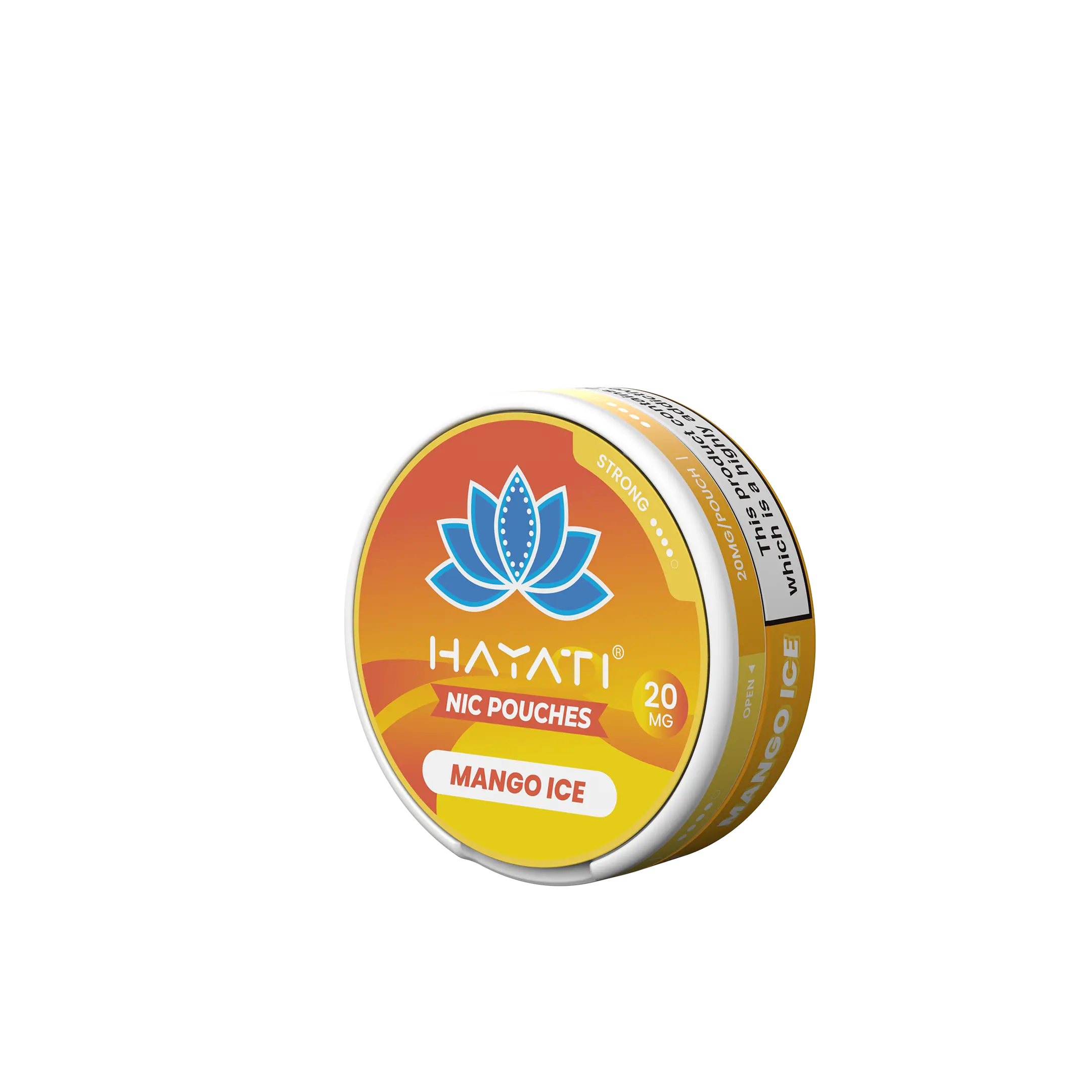
Mango Ice Hayati Nicotine Pouches
£4.49
✔ In stock — ready to ship
Genuine Hayati
Free over £20
Same-day dispatch
Secure checkout
Mango Ice Hayati Nicotine Pouches is a can of oral nicotine pouches at £4.49, rated by Hayati at 12mg, containing no tobacco. It is not a vape. There is no device, no battery, no coil, no liquid to fill and nothing that produces vapour. A pouch is a small soft sachet of fibre carrying flavouring, sweetener and nicotine, it is held between the gum and the upper lip, it releases into saliva while it sits there, and when you have finished with it you take it out and put it in a bin. That is the whole of the mechanism, and it is the reason this page exists in the form it does.
This is the first page on this site to cover a pouch. The other ten cans on the Hayati Nicotine Pouches shelf are new and none of them has been written up yet, so there is no sibling page to lean on and nothing to cite from the format. What there is instead is a large amount of flavour analysis built up across two hundred vape pages, and the central problem with all of it is that most of it does not apply here. Flavour in a vape arrives by one route. Flavour in a pouch arrives by a substantially different one. A buyer who walks over from the Mango Vapes shelf carrying a mental model of how a mango pod behaves will carry the wrong expectations into this can, and the wrong expectations in a fairly specific and predictable direction.
There is a second reason this particular can is worth the length. Of the 21 mango listings Hayati sell, four put a cooling word in the title, and three of those four are the Cherry Ice and Peach Mango pods, where the word Ice is attached to the cherry rather than to the mango. This can is the only listing in a catalogue of 492 where the cold is attached to the mango itself. It is also, separately, the only mango product Hayati sell that is not a vape at all. So it sits at the intersection of two things the rest of the range never combines, and working out what that combination actually delivers takes a route argument rather than a tasting note.
What is in the can, and what happens while a pouch is in
Start with the physical object, because the format is unfamiliar to a good proportion of the people reading a Hayati page. A nicotine pouch is a sealed portion of white fibrous material, roughly the size and shape of a small pillow, with the active contents held inside a permeable wrapper. The wrapper does not dissolve. It stays intact for the whole time the pouch is in the mouth and comes out in one piece. Hayati state that these are tobacco-free, which is a statement about composition: there is no tobacco leaf, stem or dust in the pouch, and the fibre is a carrier rather than a plant material with a flavour of its own.
In use, one pouch is placed under the upper lip and left resting against the gum. It is not chewed and it is not swallowed. What happens next is simple and entirely different from anything in the vape catalogue. Saliva wets the fibre, the soluble contents begin to dissolve out of it, and the dissolved material spreads across the surfaces it is in contact with. That process runs continuously for as long as the pouch is in place and it slows as the pouch is depleted. There is no discrete event equivalent to a draw. Nothing is inhaled, nothing is heated, and there is no combustion at any stage. Those three absences matter here for one specific reason that has nothing to do with anything except flavour, which is that heat, aerosol and exhalation are the three things a vape uses to move aroma, and a pouch has access to none of them.
When you are done, the pouch is removed and binned. It is not flushed and it is not dropped on the ground. The used fibre holds the residue of everything that did not dissolve, which is why the sensible place for it is a lidded bin rather than a pocket. Hayati also tell buyers to keep the can closed between uses, which is ordinary storage advice for anything sold in a humid sealed container, and the reasoning is that an open can exposes the pouches to air movement and the flavouring is the part that walks off first.
The strength is 12mg. State that plainly because Hayati do, and then note the thing the listing leaves out: the figure is published as a bare number with no denominator attached. The convention across the pouch trade is that a strength like this refers to milligrams per pouch rather than per gram of contents, and that is very probably what is meant here, but it is a convention and not a Hayati statement, so treat the per-gram equivalent as unpublished. That is worth saying because 12mg is unusual in this catalogue. Across all 492 listings the strength figures break down as 20mg on 365, 10mg on 67, zero nicotine on 42, 12mg on 11 and 5mg on three. Every single one of the eleven 12mg listings is a pouch. There is no vape product in the Hayati range at 12mg and no pouch at any other figure, so the number is effectively a format marker rather than a position on a scale, and nothing in the vape range sits at the same point for comparison.
What Hayati do not publish about this can is a longer list than what they do. There is no pouch count, no weight per pouch, no total weight, no statement of whether these are a slim or a regular format, no moisture description, no ingredient list beyond the tobacco-free statement, and no identification of which cooling agent is used. Several of those gaps have practical consequences later on this page, and the pouch count in particular removes the ability to do any per-unit arithmetic at all, which is normally the first thing a comparison section reaches for.
Two different routes to the same word
This is the part that matters and it is the reason a pouch page cannot be written by adapting a pod page. The word flavour covers two quite separate sensory systems, and the balance between them depends almost entirely on how the flavour material physically reaches you. A vape and a pouch load that balance in opposite directions.
How a vape delivers a named fruit
The corpus has worked this out in detail across a dozen pages and there is no need to derive it again. Triple Mango Hayati Pro Max Nic Salt sets out the front half of the chain: a coil heats a wick, the base evaporates, and the aerosol reaching the mouth is condensed droplets of that base carrying whatever was dissolved in the liquid, with each aroma compound making the transition into the vapour at its own temperature. The Blackcurrant Mango Hayati Pro Max Plus 6000 Pod Kit page and several others describe the back half: the aroma-laden vapour sits in the mouth, and on the exhale it travels up behind the soft palate, through the nasopharynx, and past the olfactory epithelium at the roof of the nasal cavity, where a large population of receptor types reads the mixture and assembles it into the perception of a specific fruit.
That second step is the one doing nearly all the work. Sweetness, sourness and saltiness are reported by the tongue and they are broad, unspecific signals. There is no taste receptor for mango. There is no taste receptor for cherry, blackcurrant or peach either. What distinguishes one fruit from another is aroma, read by the nose, and in eating and in vaping that reading happens retronasally, from behind, rather than through the nostrils. The Spearmint kit page puts the timing difference into a line worth borrowing: a signal fires, but a smell has to travel. The travelling is why a vape can taste of a named fruit at all, and it is also why a blocked nose flattens a fruit pod into sweetness while leaving the cold entirely intact.
Three features of that route are worth holding on to, because all three change in a pouch. It is fast, because the exhale is a single short burst of air carrying a high concentration of volatiles past the receptors in perhaps a second. It is high-volume, because an aerosol is an extraordinarily efficient carrier and puts a great deal of aroma material into the nasal airstream in one go. And it is biased towards the volatile end, because the compounds that leave the liquid most readily are the ones that arrive in the largest proportion, which is why vape flavours lead with a bright top note and why the bright top note is the first thing to go when a coil tires.
How a pouch delivers, and what it gives up
Now run the same analysis on a sachet of fibre resting against a gum. There is no heat, so no compound is being volatilised by the product. There is no aerosol, so there is no carrier moving material in bulk. There is no exhale, because you are not breathing through the product at any point, so the forced burst of air up the nasopharynx that a vape provides several hundred times a day simply does not occur. What is left is dissolution: the soluble fraction of the pouch's contents moves into saliva and lands on the tongue and the lining of the mouth.
The channel that route opens fully is the basic tastes. Sweetness is delivered by sweeteners, which are water-soluble by design, dissolve readily and sit directly on the receptors that report them. Acidity behaves the same way. Bitterness and saltiness, where present, likewise. A pouch is in fact a better delivery system for basic taste than a vape is, because a vape has to get its sweetener into the mouth suspended in droplets of condensed aerosol and a pouch just puts it into solution against the tissue. Anyone who has used both formats will recognise that pouches read as flatly, insistently sweet in a way that vapour does not.
The channel that route opens equally well is trigeminal sensation, and that gets its own section below because it is the good news in this product.
The channel that route largely closes is the one that carries fruit identity. Some aroma does still reach the nose from a pouch. The mouth and the nasal cavity are connected, ordinary breathing moves air across that junction, and swallowing pushes a small volume of air upwards. So the claim is not that a pouch delivers no aroma, which would be wrong and would be obvious to anyone who has used one. The claim is that it delivers far less of it, far more slowly, and with no mechanism for concentrating it into a burst. Instead of a second's worth of dense aerosol pushed past the receptors, you get a thin, continuous, passive seepage over twenty or thirty minutes. The receptors are reading a much weaker signal, and they are reading it while adapting to it, which the Spearmint page notes happens quickly with olfactory receptors and does not happen meaningfully with cold.
Four things that follow, and what to do with them
The mechanism is only useful if it changes what a buyer expects, so here is the change, in four parts.
A pouch flavour is simpler. Aroma is the high-resolution channel. It is where nuance, layering and the difference between one cultivar and another live. Reduce the aroma contribution and what remains is a small number of loud, broad signals: sweet, a bit of acid, cold. A blend that reads on a vape as three distinguishable fruits arriving in sequence will tend to read in a pouch as one sweet fruit-adjacent impression with a cold on top. That is not a criticism of the blending. It is a property of the format.
It arrives more slowly. A draw on a pod delivers the profile in under two seconds and you know within three draws what you have bought. A pouch has to wet, dissolve and diffuse. The first thirty seconds of a pouch tells you very little, and judging one on its first minute is the pouch equivalent of judging a pod on the first draw off a dry wick. Give it several minutes before forming a view.
It lasts far longer. A pod session is a series of brief events with gaps in between. A pouch is one continuous event lasting as long as you leave it in place. Everything about the flavour experience stretches across that window, which changes what "the finish" even means. On the Rubik mango page, the long finish of a mango liquid is explained by lactone molecules being heavy and slow to clear the mouth after the vapour has gone. In a pouch the finish is long for a completely different reason, which is that the source of the flavour is physically still in your mouth. Two mechanisms, one headline, and confusing them would mislead somebody.
It cannot deliver a top note. This is the sharpest of the four. The bright, immediate opening that a vape leads with is made of the most volatile material in the recipe, and volatility is exactly the property that a pouch has no way of exploiting. A compound that flashes off a warm wick and hits the nose on the exhale has, in a pouch, nothing pushing it anywhere. Whatever a Hayati blender puts in at the light end of this recipe, most of it is not going to reach the part of you that could identify it. What a vape opens with, a pouch mostly omits.
Mango is the hardest fruit to put in a pouch
Everything above is general to the format. Applied to this particular fruit it produces an unusually stark result, and the corpus has already done most of the groundwork.
What has already been established about mango here
The Triple Mango nic salt page is the reference. Its finding is that mango's identity is carried principally by lactones, the compound family that also carries peach and apricot, with gamma-decalactone, delta-decalactone and gamma-octalactone as the named examples. These are large molecules by the standards of flavour chemistry, they boil at high temperatures, and they are reluctant to leave a liquid. That page sets them against the rest of the shelf: berries and apples work through short-chain esters, which are small and quick, citrus works through terpenes which are lighter still, and confectionery profiles lean on maltol and vanillin, which are genuinely in the same heavy bracket. It also corrects the overstatement it was handed. Mango is not the heaviest material in the range outright, because around ten of the 65 bottles on that shelf are confectionery constructions sitting in the same territory. What survives the count is narrower: mango is one of a small set of fruits whose entire character depends on a fraction that needs energy to release.
The Triple Mango Hayati Rubik Prefilled Pod Kit page adds the cultivar split, which matters more here than it did there. Mango aroma divides into two recognisable styles. The Indian type, the Alphonso and Kesar end, is lactone-dominated and reads as perfumed, honeyed and almost dairy-adjacent. The Florida type, the Tommy Atkins and Keitt end, leans on monoterpenes, terpinolene and car-3-ene in particular, and reads green, resinous and faintly piney. Both of those styles are aroma descriptions. Neither of them is a taste in the technical sense. You cannot detect the difference between an Alphonso and a Tommy Atkins on your tongue, only in your nose.
No heat at all is the extreme case
Line those two findings up against the route argument and the conclusion follows directly. The vape pages spent thousands of words on a spectrum: a cool-running combination of coil, power and airway under-delivers the lactone fraction, a warmer one lifts it, and the practical advice was about moving along that spectrum. A pouch is not a point at the cool end of that spectrum. It is off the end of it. There is no heat applied to this product at any stage, so the energy that a coil supplies to get heavy aroma material airborne is simply not present.
Two qualifications keep this honest, because the mechanisms are not identical and pretending otherwise would be the kind of confident error this site keeps catching. First, boiling point is the relevant property when you are trying to get a molecule into a gas phase off a hot wick, and it is not directly the relevant property when the molecule is dissolving into saliva. A pouch is not failing to boil the lactones. It is failing to provide any carrier or airflow to move whatever does escape into the nasal cavity, which is a different constraint arriving at a similar place.
Second, and working in the same direction rather than against it, the physical property that makes a compound reluctant to leave a liquid tends to travel with poor water solubility. Lactones of this kind are sparingly soluble in water. A saliva-based delivery system is therefore not a back door for the heavy fraction, because the heavy fraction does not dissolve readily either. That is reasoning from general chemistry rather than from anything Hayati publish, and it is tagged as reasoning, but the two constraints point the same way and neither of them offers mango a route through.
What is probably carrying the flavour instead
Predict honestly, and label the confidence. These are inferences from mechanism, not tasting notes, and this site does not publish tasting notes for liquids nobody on the page has tasted.
Reasonably confident. Sweetness is doing a large share of the work. It is the channel the format serves best, it requires nothing except solubility, and every pouch product in every brand leans on it heavily for exactly that reason. Hayati's own listing describes the cold as cutting the sweetness, which is an implicit admission that there is a substantial amount of sweetness there to cut.
Reasonably confident. The cooling is arriving at full strength and probably reads as a larger share of the whole than it does on a cooled vape. The next section explains why.
Probable. There is a recognisable tropical direction rather than a specified fruit. A trickle of aroma over twenty minutes is still aroma, and the most abundant and most soluble components of a mango flavouring will make it through in some quantity. What that produces is a general impression pointing at the tropical end of the fruit spectrum, closer to a sweet tropical sweet than to a piece of fruit.
Probable. The cultivar character is absent. Whether a blender aimed at an Alphonso style or a Florida style, the compounds that would tell the two apart are aroma compounds and they are the ones this format struggles to deliver. The distinction the Rubik page spent nine hundred words on is, in a pouch, very likely inaudible.
Probable. There is no bright opening. On the vape versions of this fruit the just-ripe top note is the first thing to arrive and the first thing a tired coil drops. In a pouch it is not there to drop.
Unknown. How much mango character there actually is, in absolute terms. Flavour houses do produce concentrates weighted towards the water-soluble and lower-molecular-weight components precisely so they survive in cold applications, and a blender who knows the format may well have used one. If they have, there will be more fruit here than the pure lactone argument predicts. Hayati publish nothing about the concentrate, so this cannot be settled from the listing and nobody should pretend it can be.
Unknown, and it is the axis that decides the purchase. Whether the amount of mango that does come through is enough for you. That is a personal threshold and no page can answer it. What a page can do is tell you which direction the error will fall in, and the direction is that this will be less fruit and more sweet-and-cold than the same words on a vape listing would lead you to expect. If a precise mango is the thing you are shopping for, the Triple Mango Hayati Pro Max Plus Pods at £5.49 or the Triple Mango Hayati Rubik Pods at £3.99 are the products built to deliver it, and this can is not competing with them on that axis.
The cold half, which is the half with the advantage
Having spent a long section explaining what this format takes away, the honest counterweight is that it gives something back, and what it gives back is precisely the other word in the product name.
A receptor in contact with tissue needs no carrier
Cooling is not an aroma and it is not a taste. Menthol and the synthetic coolants used alongside it produce their effect by binding to a temperature-sensing receptor in the sensory nerve endings of the mouth, the same receptor population that reports actual cold. The Blackcurrant Mango kit page and the two menthol pages in this corpus have established the characteristics: the signal is fast, it is mechanical, it arrives whatever you do with your breath, it works on a tired palate and on a blocked nose, and the sensation persists for a while after the molecule itself has gone because the receptor stays open.
Every one of those properties is route-independent in the way aroma is not. A receptor event requires the molecule to be in contact with the tissue. It does not require heat, it does not require a carrier gas, it does not require an exhale, and it does not require the nasal cavity to be involved at all. A pouch held against the gum puts the coolant in direct, wet, continuous contact with a large area of oral tissue, which is the single best possible way of satisfying that requirement.
So cooling is one of the very few things a pouch delivers at least as well as a vape does. There is a reasonable case that it delivers it better, and the case rests on exposure profile rather than on dose.
Pulses against a continuous contact
A cooled pod delivers coolant in bursts. Each draw puts a quantity of it into the mouth over a second or two, and then there is a gap, and during the gap the molecules clear and the receptors quieten. The chill of a cooled vape is therefore a series of peaks with troughs between them, and the perceived intensity is largely set by how close together the peaks are, which is why chain-vaping a cooled pod feels dramatically colder than using the same pod occasionally.
A pouch has no troughs. From a couple of minutes after it goes in until you take it out, the coolant is in unbroken contact with the tissue and the receptor population is being stimulated continuously. That is a completely different exposure curve, and it is the reason why the cold from a pouch tends to feel less sharp at any given instant and far more persistent overall. There is no equivalent in the vape catalogue, because there is no vape product that sits in your mouth for half an hour.
The buyer-facing version of that is straightforward. If the thing you liked about a cooled mango pod was the slap of cold at the top of each draw, this is not the same sensation and it will read as less exciting. If the thing you liked was the state of having a cold mouth, this format supplies it with a consistency no pod can.
The ceiling, and why there is no number attached to it
The Banana Ice nic salt page and the double menthol pages record a finding worth carrying across with care: the cold receptor population has a finite response, so past a certain concentration additional coolant stops buying proportionally more cold and starts buying a prickling, needling sharpness through a second receptor instead. That is a property of the tissue, so it holds regardless of what delivered the molecule.
What does not carry across is any figure. That finding was made on products delivering pulses, and a pouch delivers a sustained contact, so the relationship between the amount of coolant in the product and where you sit against that ceiling is a different relationship. Hayati publish neither the coolant used nor the quantity, so a page that told you this can sits below or above that crossover would be inventing the most load-bearing fact in the paragraph. What can be said is directional: a sustained contact keeps you at whatever level it reaches for a long time, so if a pouch does tip into prickling rather than cold, it will not resolve itself in the way a pod's does between draws. Taking the pouch out is the only control available.
The cooling vocabulary, and a small addition to the count
The Blue Frozen pods page ran a census of Hayati's cooling words and concluded that they are not a graded scale. Its numbers recount correctly against the current catalogue: Ice appears in 90 titles, Frozen in three, Cooler in two, Chill in none and Freeze in none. Its conclusion stands and there is no point in re-deriving it. The word Ice in this product name carries no information about intensity relative to any other cooled listing, and a buyer cannot read a temperature off a title.
Two things are worth adding rather than repeating, and both come from the pouch shelf being newer than that census. The pouch range introduces two cooling words that appear nowhere else in 492 listings: Frosted, which occurs exactly once, and Cold, which also occurs exactly once. Both are pouches. And Ice Cold Hayati Nicotine Pouches is the only listing Hayati sell that stacks two cooling words with no fruit at all, which is as close as the range gets to declaring an intensity through vocabulary rather than through a number.
The census also found that no Hayati title ever puts an ice-family word and a mint-family word together. On its own terms that remains true, because Frosted was not in its word list. Extend the list to cover it and there is now exactly one exception in 492, Frosted Mint, and it is on this shelf. That is a genuine amendment rather than a contradiction, it was worth counting before stating, and the pouch range is where the pattern the earlier page found gets its only crack.
The asymmetry, stated plainly
Put the two halves of this product side by side and they are not in the same position.
The fruit half is the half at a disadvantage. It depends on a sensory channel this format serves poorly, it is built from a compound family that is particularly badly suited to a system with no heat and no carrier, and it will arrive quieter, simpler and later than the same fruit does on any of the ten mango vapes Hayati sell.
The cold half is the half at an advantage. It depends on a receptor in direct contact with tissue, the format supplies that contact better than any vape can, and it will arrive at full strength and stay there for the whole time the pouch is in.
The practical consequence is a shift in balance rather than a general loss of quality. A cooled mango vape is a fruit with a cold over it. A cooled mango pouch is much more likely to be a cold with a sweet tropical suggestion inside it. Both descriptions contain the same two components. The proportions are not the same, and the proportions are what somebody deciding between formats actually needs told. If you are buying this because Mango Ice is your favourite thing on the Ice Vapes shelf and you want it in a different container, expect the container to have rebalanced it.
Specifications, and the gaps in them
The useful thing to say around a table this short is which figures are load-bearing and which are conventions. Only two numbers appear on this listing at all, and one of them is the price.
| Listing | Mango Ice Hayati Nicotine Pouches |
| Brand | Hayati |
| Format | Oral nicotine pouches, supplied in a can |
| Flavour name | Mango Ice |
| Nicotine strength | 12mg |
| Tobacco content | None; Hayati state the pouches are tobacco-free |
| Hardware needed | None |
| Price | £4.49 |
| Shelves it appears on | Six |
| Pouches per can | Not published |
| Weight per pouch | Not published |
| Pouch size format | Not published |
| Cooling agent | Not published |
The 12mg figure is the interesting one and the earlier count is what makes it interesting. It is not a low strength or a high strength relative to the rest of this catalogue, because there is nothing in the rest of this catalogue at that figure to compare it against. Every 12mg listing Hayati sell is a pouch and every pouch they sell is 12mg. The number is not a choice the buyer is being offered, it is the specification of the format, and nobody should read it as a position on a ladder between the 10mg bottles and the 20mg pods. Those are different products delivering nicotine by a different route and the numbers are not interchangeable.
The missing pouch count is the gap with a real cost. £4.49 a can is a price, but a price per can is only a comparison if you know what a can holds, and Hayati do not say. That removes the cost-per-unit arithmetic that the bottle and pod pages on this site lean on heavily, and there is no honest way to reconstruct it from the listing. So the comparison in the next section is made on character rather than on value, and any page telling you how this compares on cost to a £5.49 pod is making up the denominator.
The unpublished coolant matters for the same reason it matters on the cooled vapes: menthol carries a minty aroma of its own and several synthetic coolants carry almost none, so which one is used changes whether the cold brings a herb note with it. On a vape that difference is audible. On a pouch, given everything above about the aroma channel, it is likely to be considerably less audible, which is one of the few places where this format's weakness works in a blender's favour.
Where this sits against the rest of the range
The other ten cans
All eleven pouches are £4.49 and all eleven are 12mg, so within the shelf the only variable is flavour. Five of the eleven carry a cooling word in the title, and three of those five pair a named fruit with the word Ice. This is one of the three. Banana Ice Hayati Nicotine Pouches and Grape Ice Hayati Nicotine Pouches are the other two, and the route argument on this page predicts something specific about how they will differ.
Banana is the closest thing on the shelf to mango in compound terms, in that its character also sits in the softer, heavier, creamier register, so the same disadvantage applies to it in roughly the same measure. Grape is a different case and probably the more interesting one. The dominant note in almost every commercial grape flavouring is methyl anthranilate, a single compound that is far smaller and lighter than a lactone, and a profile carried by one prominent light molecule has an easier time in this format than a profile carried by a family of heavy ones. If the argument on this page is right, Grape Ice should read as a more recognisable version of its own name than Mango Ice does, and anybody curious enough to buy both has a cheap test of whether the reasoning holds.
Bubblegum Hayati Nicotine Pouches is the useful third data point, because a confectionery profile is not trying to be a fruit in the first place. It is a constructed flavour built around sweetness and a couple of loud aroma notes rather than around a faithful reproduction of anything, so it has less to lose from a channel that flattens detail. Of the four fruit and confectionery cans, it is the one whose target is least damaged by the format.
Ice Cold is the outlier on the shelf and the one that plays entirely to the format's strengths, since it carries no fruit to lose and asks nothing of the aroma channel at all.
Banana Ice is the controlled experiment, and it is worth doing
One flavour in the whole Hayati range is sold both as a pouch and across most of the vape formats, and it happens to be a cooled soft tropical fruit, which makes it the single best available way to feel the route difference this page has been arguing for. The vape versions are Banana Ice Hayati Pro Max Plus Pods at £5.49, Banana Ice Hayati Pro Max Plus Pod Kit at £7.99, Banana Ice Hayati Rubik Prefilled Pod Kit at £5.99, Banana Ice Hayati Pro Max Nic Salts at £2.49 and Banana Ice Hayati Pro Max 70/30 E-Liquid at £6.99.
Put the pouch alongside any one of those and the comparison is clean, because the flavour brief is the same and only the delivery has changed. What you should notice, if the mechanism in this page is correct, is that the fruit is quieter and later in the pouch while the cold is at least as present and considerably more continuous. If you notice the opposite, the argument here is wrong and worth knowing to be wrong. Mango is not available for that test, because Hayati sell no mango vape where the cooling attaches to the mango, so Banana Ice is the nearest thing to a like-for-like the catalogue offers.
The mango shelf, and the thing worth counting on it
The Mango Vapes shelf holds 21 listings and this can is the only one that is not a vape. Within the other twenty there are four distinct mango propositions and it is worth naming which is which, because a buyer arriving here from one of them will be carrying a different expectation from a buyer arriving from another.
The Triple Mango family is mango alone, weighted towards ripeness, and it exists in more formats than anything else on the shelf: Triple Mango Hayati Pro Max Plus Pod Kit at £7.99, the Rubik pods and kit, the Pro Max Plus pods, the £2.49 nic salt, and two bottles in a 50/50 shortfill and a 70/30. That family is the direct opposite of this can in intent. It is built to maximise the exact fraction a pouch cannot deliver, and the pages covering it spend their length on how to get more of that fraction out of hardware. None of that advice applies here, which the nic salt page itself says when it names this product and notes that nothing in its hardware argument reaches it.
Mango Peach Pineapple surrounds the mango with fruits in adjacent registers and exists as a nic salt at £2.49, Pro Ultra Plus pods at £7.99 and the matching kit at £11.99. Its pineapple brings acid, and acid is one of the things a pouch does deliver properly, so of all the uncooled mango blends it is the one whose structure would translate least badly into this format. It is not available as a pouch, so that is a hypothetical rather than a recommendation.
Blackcurrant Mango Hayati Pro Max Plus 6000 Pod Kit at £7.99 puts a sharp, sulphur-edged fruit against the mango body and is the strongest contrast on the shelf. Peach Mango Hayati Mini Ultra Pods at £3.49 goes the other way and pairs mango with the other major lactone fruit, which the Triple Mango page identifies as the heaviest pairing in the range. Neither has a cooled counterpart.
Then the three Cherry Ice and Peach Mango listings, which are the ones a buyer is most likely to mistake for a cooled mango: the Mini Ultra kit at £3.99, the Pro Ultra Plus pods at £7.99 and the Pro Ultra Plus kit at £11.99. These are dual-flavour listings where the two names sit on either side of an oblique, and the word Ice belongs to the cherry side. Whatever the peach and mango side of those pods tastes like, it is not a cooled mango, which is why this can remains the only listing in the catalogue where the cold is applied to the mango itself.
Beyond mango, the can also sits on Sweet Vapes, which is the shelf its actual sensory profile probably fits best given how much of the delivery runs through the sweetness channel, and on the New Products shelf along with the rest of the range, the pouches having arrived more recently than most of what surrounds them.
Handling, timing and what changes while one is in
Almost none of the practical advice on this site transfers, because almost all of it is about hardware. There is no priming, no wicking, no draw technique, no coil to replace, no battery to charge, no airflow to adjust and no setting to change. The list of variables available to you is short: which pouch, where you put it, how long you leave it, and what you had in your mouth beforehand. That is the whole of it, and it is worth saying so plainly rather than manufacturing a routine.
Place one pouch, not several. There is no version of this product where doubling up is the intended use, and nothing on the listing suggests otherwise.
Leave it alone for the first few minutes. The dissolution curve on a pouch starts slow and the early part of the window is mostly wetting rather than releasing. If you judge this can on its first thirty seconds you will conclude it is weak, and that conclusion is an artefact of timing rather than a finding about the product. The vape equivalent is judging a pod on the first draw off a fresh wick, which several pages here warn against for the same underlying reason.
Expect the order of arrival to be the reverse of a vape. On a cooled mango pod the fruit and the cold arrive together in a single bundled second. Here the cooling should establish itself first, because a coolant molecule needs only to reach the tissue, and the sweetness should follow close behind, because sweeteners dissolve readily. Whatever fruit character there is will be the last thing to become apparent and the quietest of the three when it does. That ordering is a prediction from the mechanism, not a claim about this specific recipe, but it is the ordering the format imposes and it is the opposite of what the vape catalogue trains you to expect.
Take the adaptation effect seriously, because there is no hardware to blame here. On a pod, a flavour going quiet has two possible causes, a tired coil or a tired nose, and the Spearmint page's morning-draw test exists to tell them apart. A pouch has no coil, so that ambiguity is gone: if the mango fades over the course of a long session, it is your olfactory receptors adapting to a weak continuous signal, which is exactly the condition they adapt to fastest. The cold will not fade with it, because cold barely adapts within a session, and that divergence is itself the diagnostic. When the fruit has gone quiet but the chill has not, nothing is wrong with the pouch.
Eating and drinking reset things more than they do with a vape. A pouch is competing for the same tongue and the same saliva as whatever you last consumed, and a strongly flavoured drink will occupy both for some minutes. A sweet drink in particular will flatten the perceived sweetness of the pouch by comparison, which on a product carrying this much of its identity in the sweetness channel is a larger effect than it would be on a pod.
Keep the lid on the can. This is the one storage instruction Hayati give and the reason is worth stating in terms of this specific product: an open can loses moisture and volatiles, the volatiles are the fruit, and the fruit is already the fragile part of this recipe. A can left open is losing the half of the product that was at a disadvantage to begin with, while the coolant and the sweetener, both of which are far more stable, carry on unaffected. Neglecting the lid on this particular flavour therefore degrades it asymmetrically rather than evenly.
Keep the can out of direct heat and sunlight for the same reason, and keep it somewhere children and pets cannot get to it, as with anything containing nicotine. A used pouch goes straight in a bin, still in one piece, and it should not go down a sink or a drain.
Questions worth answering about this one
Is this a vape?
No. There is no device, no liquid and no vapour involved. It is an oral pouch that is held in the mouth and then binned. Nothing is inhaled or heated at any point, which is the reason its flavour behaves so differently from the pods and bottles in the rest of the Hayati range.
Will it taste like the Triple Mango pods or bottles?
Not closely, and the difference is structural rather than a matter of recipe quality. Those products deliver mango through aroma carried in an aerosol and read by the nose on the exhale, and a pouch has no aerosol and no exhale. Expect the fruit to be quieter, simpler and slower here, with sweetness and cooling taking up proportionally more of the total.
What strength is it?
12mg, as stated by Hayati. Every one of the eleven pouches they sell is at that figure and nothing else in the 492-listing catalogue is, so it is a property of the format rather than one option among several. The listing gives the number without stating a denominator, and while the trade convention is milligrams per pouch, Hayati themselves do not say so.
Why does the cold seem more prominent than the mango?
Because the cooling is delivered by a molecule binding directly to a temperature receptor in the tissue it is touching, which needs no heat, no carrier and no airflow, while the mango depends on aroma reaching the nose from the back of the mouth, which this format supplies only weakly. One half of the product is operating at full capacity and the other is not.
Is the cooling the same as the Ice on a Hayati pod?
The same kind of sensation, arriving on a very different schedule. A pod gives you a burst of it every draw with gaps in between, and a pouch gives you an unbroken contact for as long as it is in place. That tends to feel less sharp at any given moment and much more persistent overall, so whether it reads as more or less cooling depends entirely on which of those two things you were enjoying.
How many pouches are in a can?
Hayati do not publish it, and nothing on this page will guess. That also means a cost-per-pouch figure cannot be worked out from the £4.49 price, so any comparison on value against a pod or a bottle would be built on an invented number.
Does it contain tobacco?
No. Hayati describe these as tobacco-free, which means the pouch contains no tobacco leaf or plant material. The fibre inside is a carrier for the flavouring, sweetener and nicotine rather than an ingredient with a character of its own.
Does a blocked nose change it?
Less than it would change a fruit vape, and for an instructive reason. Aroma is delivered through the nasal cavity and a blocked nose removes it, which is why a fruit pod collapses into sweetness when you have a cold. A pouch is already getting comparatively little through that channel, so there is less for a blockage to take away, while the cooling and the sweetness are unaffected either way.
Which of the other cans is closest to this one?
Banana Ice, since banana sits in a similar soft, heavy register to mango and gets the same cooling treatment. Grape Ice is the most instructive contrast, because grape flavourings lean on a single light aroma compound rather than a family of heavy ones, so by the argument on this page it ought to survive the format better.
Can I compare a pouch and a vape of the same flavour directly?
Yes, and Banana Ice is the only flavour Hayati sell that allows it. The same flavour brief exists as a pouch and across five vape formats, so buying the pouch alongside any one of them isolates the delivery route as the only variable and lets you judge the difference for yourself.
How long should I leave one in?
That is a matter of preference and Hayati publish no guidance, so this page will not invent a figure. What is worth knowing is that the first few minutes deliver comparatively little, so a very short session gives an unrepresentative impression of the flavour, and that the cooling will still be present long after the fruit has receded.
Does the mango get stronger further into a pouch?
Probably the opposite, though for two reasons pulling in different directions. The release rate from the fibre falls as the pouch depletes, and olfactory receptors adapt quickly to a weak continuous aroma signal, so the fruit tends to recede on both counts. Cooling barely adapts within a session, so the balance shifts further towards the cold the longer a pouch is in.
In short
Mango Ice Hayati Nicotine Pouches is a £4.49 can of tobacco-free oral nicotine pouches at 12mg, on a shelf of eleven cans that share both of those figures. It is the only listing in Hayati's 492 products where a cooling word is attached to mango itself, and the only mango product they sell that is not a vape.
The single most useful thing to know before buying it is that a pouch and a vape deliver flavour by different routes, and the difference is not cosmetic. A vape carries aroma in an aerosol and pushes it past the olfactory receptors on the exhale, which is how it manages to taste of a named fruit. A pouch dissolves into saliva and works mainly through the basic tastes and through direct contact with the receptors that report cold. That trade is bad news for mango specifically, because mango's character rests on a heavy, high-boiling, poorly water-soluble compound family that this corpus has documented at length, and it is good news for the cooling, which needs nothing more than contact with tissue and gets that contact continuously here rather than in pulses.
So the honest summary is a split verdict. Expect less fruit than the name and the vape range would suggest, expect it later and simpler, expect no bright opening at all, and expect the cold to be the most reliable and most persistent thing in the can. If that balance is the one you want, this format delivers it better than any pod can. If you came for the mango, the mango lives on a different shelf.
Strictly for adults aged 18 and over. Nicotine is an addictive substance.
You might also like


