
Home / Hayati Rubik Prefilled Pod Kit / Triple Mango Hayati Rubik Prefilled Pod Kit
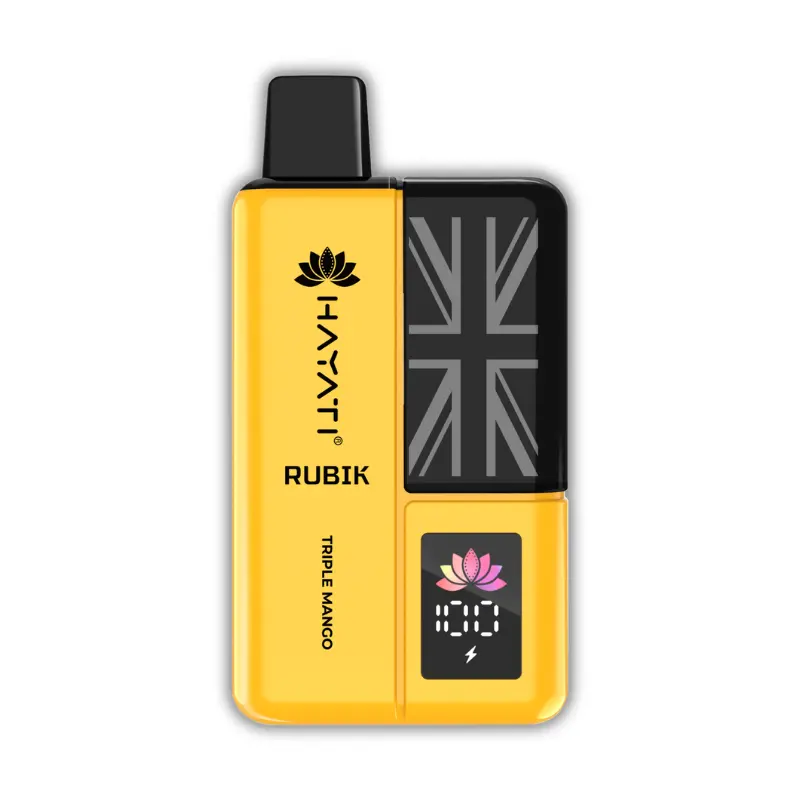
Hayati · Rubik
Triple Mango Hayati Rubik Prefilled Pod Kit
£5.99
✔ In stock — ready to ship
Genuine Hayati
Free over £20
Same-day dispatch
Secure checkout
Triple Mango on the Hayati Rubik is a complete kit at £5.99: the Rubik body and a prefilled 12ml pod in one box, filled at 20mg nicotine salt, with Hayati putting a figure of 7,000 puffs against the pod as a laboratory estimate rather than a promise about your pocket. Nothing about that specification is unusual for the range. Every one of the twenty kits on the Hayati Rubik Prefilled Pod Kit shelf carries the same four numbers, and if the spec sheet were all there was to say, this page could stop after a paragraph.
The name is what makes this listing worth a longer look, and not for the reason the word "triple" usually gets one. Hayati sell 492 products. Exactly four of their flavour names put a multiplier in front of the thing being sold: Double Apple, Double Menthol, Triple Melon and this one. Across those four names there are fourteen listings, and seven of the fourteen are Triple Mango, which makes this flavour half of the entire numbered-name family on its own. It is also the only one of the four built on a fruit whose varieties genuinely taste like different fruits.
That last point is the whole reason this page is organised the way it is. An apple is an apple whichever one you pick, within limits that the Double Apple pages in this range have already worked out in detail. A mango is not. An Alphonso and a Tommy Atkins are recognisably different objects in the mouth, not two settings on one dial, and anybody who has eaten both knows it without needing the chemistry explained. So when Hayati write "Triple" on a mango, they are writing it on the one fruit in their catalogue where a three-part varietal construction would be audible, describable and worth paying for.
Which raises a question the listing does not answer and this page is going to try to: is Hayati's "Triple" a claim about composition, or is it a volume knob? The two possibilities produce very different liquids and very different purchases. This page counts the evidence, reaches a view, says how confident it is, and then gets on with the practical half, which is what the pod actually does across a draw and how it sits against the twenty other mango listings Hayati sell.
The one fruit where a number in the name could have meant something
Two pages in this range have already taken apart the other numbered names, and it is worth saying what each of them settled before adding anything, because neither finding needs redoing and both of them frame the question here.
The Double Apple pages established the case for a numeral attached to two varieties of one fruit. Their conclusion, reached from the aroma chemistry and then confirmed against the draw, was that two apple varieties do not read as two fruits. They are built from overlapping families of the same volatile compounds in different proportions, so the blender is working with one vocabulary and a set of dials rather than two vocabularies. What the doubling buys is span rather than complexity: the flavour covers more of the draw and holds a middle that a single crisp apple leaves hollow, but there is no second thing in there to point at. One thing with more range, as that page put it. The failure mode follows directly, because when the span closes the liquid does not taste broken, it just tastes like an ordinary apple.
The Double Menthol pages took the other case, a numeral attached to a sensation. Menthol is one compound acting on one receptor family, so "double" cannot be a count of ingredients, and the thing that keeps growing when you add more of it is sharpness rather than cold. That page's argument is that the label is describing an input while the buyer is reading it as an output, and that the two part company sooner on a coolant than on anything else in the catalogue.
Mango is neither of those cases, and the Double Menthol page said so in passing while using this product as a foil. Its wording was that Triple Mango "works the same way" as Triple Melon, pointing at either three cultivars or three treatments of the fruit, and that in both cases the number is pointing at something that could in principle be enumerated. That is a fair reading of the logic and it is the right starting point. It is not, however, a reading of the evidence, because that page was arguing about menthol and had no reason to go and check what Hayati actually write about mango. This page did go and check, and the answer refines the passing claim rather than overturning it.
Before the evidence, the premise deserves a proper hearing, because if mango varieties were as similar to each other as apple varieties are, the question would collapse into the apple case and there would be nothing left to argue.
They are not that similar. Mango aroma splits into recognisable styles along lines that anybody who shops in more than one greengrocer has noticed. The Indian-type fruit, the Alphonso and Kesar end, leans heavily on lactones, the same family of compounds that gives peach and apricot their soft, creamy, almost dairy-adjacent sweetness. That is why a good Alphonso reads as perfumed and custardy and why people who grew up with it describe an ordinary supermarket mango as thin. The Florida-type fruit, the Tommy Atkins and Keitt end, leans instead on monoterpenes, terpinolene and car-3-ene in particular, which push the profile towards something green, resinous and faintly piney. That is the note people mean when they call a mango turpentiney, and it is not a defect, it is the cultivar.
The structural difference from the apple case is that these are not two weightings of one shared inventory. A lactone-led mango and a terpene-led mango are carrying different classes of compound as their headline, which is much closer to the situation the Double Apple page described for a genuine two-fruit blend than to the situation it described for two apples. Put a lactone mango and a terpene mango in the same liquid and a competent palate can hear both, in the way it can hear the sulphur edge of blackcurrant against the creamy body of mango in Blackcurrant Mango Hayati Pro Max Plus 6000 Pod Kit. Add a third, a honey-sweet Ataulfo type or a green underripe treatment, and you have a composition somebody could list on a label.
So the premise survives. Mango is the fruit in this catalogue where "triple" could have been a genuine varietal claim with real internal contrast, and it is close to the only one. The question is whether Hayati are making it.
Seven listings of the same liquid, lined up against each other
The technique here is not original to this page. The Blackcurrant Lemonade kit worked out that when a flavour is sold several times over, Hayati write fresh copy for each listing, and lining those descriptions up against each other turns out to be the richest evidence available about what the company actually knows and is willing to commit to. A property every listing asserts is close to a fact. A property only one asserts is either the most interesting thing on the page or a copywriter's flourish, and saying which is a real contribution. A disagreement between two listings of one liquid is evidence about how the copy was written, not about two recipes.
Triple Mango has seven listings, which is more than Blackcurrant Lemonade had and the joint largest set for any numbered name in the catalogue. They are this kit at £5.99, Triple Mango Hayati Rubik Pods at £3.99, Triple Mango Hayati Pro Max Plus Pod Kit at £7.99, Triple Mango Hayati Pro Max Plus Pods at £5.49, a 10ml nic salt at £2.49, a 70/30 shortfill at £6.99 and Triple Mango Hayati Pro Max 50/50 Shortfill E-Liquid at £6.99. Four hardware listings, three bottles, two platforms, one liquid family. Seven independent attempts to describe the same thing.
What all seven assert
Start with the agreements, because those are the closest thing to facts on offer.
All seven describe the flavour as rich, deep or dense. All seven place it firmly on the ripe side of the fruit rather than the green side. Six of the seven use a layering word explicitly, and the seventh implies one. Not one of the seven attaches a tart, sharp or sour word to the mango at any point, which is a notable silence given that Hayati are perfectly happy to write "slightly tangy" when they mean it and do so twice inside this very set. And all seven place it at the sweet end of the range without hedging.
Two caveats before those agreements get treated as gospel. Richness language is close to house vocabulary in this catalogue: "ripe" appears in 97 of the 492 listings and "tropical" in 70, so their presence here carries less weight than it looks like it does. "Honeyed", by contrast, appears in only ten, which makes it a more informative word when it turns up. The second caveat is that copy can describe the name rather than the liquid, a failure this corpus has caught more than once, and a set of seven descriptions all written from the same product title is exactly the situation where that happens.
Where two of them break ranks, and which two
Now the disagreements, which are where the evidence actually lives.
Five of the seven listings describe Triple Mango as a single undivided thing. The nic salt says nothing else competes for attention and the flavour stays consistent from the first puff to the last, and then, in the same paragraph, calls it one bold note rather than a busy mix. The 70/30 shortfill says three layers combine into one and then calls the result a single-fruit flavour. The 50/50 shortfill says the taste is built around a rich deep sweetness and that with a single fruit in focus the flavour stays consistent. The Rubik pods listing says mango is the only fruit on the label and that "triple" signals it is laid on thick. This kit's own listing offers only that the title promises a layered and intensified reading of the one fruit, and then adds that nothing citrus and nothing cold has been named alongside it.
Read those five together and the word "triple" is doing one job: it is telling you there is a lot of mango. Three of the five actively work against the idea of internal contrast, using phrases like "nothing else competes", "one bold note" and "a single fruit in focus". The Rubik pods listing puts it most bluntly of all with "laid on thick", which is an intensity phrase and not a composition phrase.
Two listings break from that, and it matters enormously which two. The Pro Max Plus kit enumerates three characters: the bright, slightly tangy top of a just-ripe mango, the thick honeyed sweetness of fully ripe flesh, and a rich, almost creamy body underneath. The Pro Max Plus pods listing enumerates the same three in the same order, compressed: bright and slightly tangy at the top, thick and honeyed in the middle, a smooth rich finish.
Those are exactly the pair of listings that sit on one platform. This is the same pattern the Blackcurrant Lemonade diff found, where the two listings that broke from the consensus on that flavour were also the pair on a single platform, and the conclusion that page drew applies unchanged here. A split that tracks platform rather than format is evidence about who wrote the copy and when, not evidence about two recipes. Somebody sat down to write the Pro Max Plus pair and decided to spell the layering out; somebody else wrote the Rubik pair and the bottles and did not. Nothing in the specification differs. The capacity is 12ml on both platforms and the strength is 20mg on both.
There is a second, smaller platform split worth recording for the same reason. The word "intense" or "intensified" appears in this set exactly twice, and it is the two Rubik listings, this kit and its bare pod. No bottle uses it and neither Pro Max Plus listing uses it. That is a copywriting fingerprint, not a formulation difference, and a buyer comparing the Rubik listing to the Pro Max Plus listing and concluding that the Rubik version is the stronger one would be reading a house style as a recipe.
What none of the seven does
Here is the finding that settles it, and it is a count rather than an assertion.
Across all 492 listings in this catalogue, Hayati name a mango cultivar zero times. Not Alphonso, not Kesar, not Ataulfo, not Honey, not Tommy Atkins, not Keitt, not Carabao, not one. They also name zero cultivars of any other fruit: no Granny Smith, no Pink Lady, no Bramley, no Cavendish, no Valencia, no Morello. The entire catalogue contains no cultivar name at all.
The word "variety" appears in fifteen listings, but eleven of those use it to mean assortment, as in a pod that offers variety across the day. Only four use it to distinguish one type of a fruit from another, and all four are instructive. Three are Red Apple Ice listings, which contrast a sweeter red apple against sharper green varieties. The fourth is White Peach Raspberry, which notes that white peach is paler and more fragrant than the yellow variety. In every one of those four cases the distinguishing feature is already in the product title. Hayati invoke a variety when the title has already named it, by colour, and never otherwise. Triple Mango's title names no colour, no origin and no type.
Set that against how readily this range enumerates when it has something to enumerate. Thirty-four listings carry a flavour name that lists three fruits outright, including Blueberry Cherry Cranberry, Guava Kiwi Passion Fruit, Kiwi Grape Raspberry and Cherry Peach Lemon. The naming grammar for a three-part composition exists, it is in heavy use, and it costs Hayati nothing. When they want to sell mango as part of a construction they use it without hesitation: Mango Peach Pineapple Hayati Pro Ultra Plus 25000 Prefilled Pod Kit names all three, Blackcurrant Mango names both, Mango Banana names both, and Cherry Ice / Peach Mango Hayati Pro Ultra Plus 25000 Prefilled Pod Kit names four things including the coolant. This range names a component whenever it can give that component a job.
The comparison with Triple Melon sharpens it further. Melon has the same property mango has, in that honeydew, cantaloupe and watermelon are genuinely different fruits and a blend of three of them is a listable composition. Hayati's own copy for that flavour goes out of its way to admit the omission, saying in as many words that the name does not list the three. Then, having admitted it, the same paragraph describes only two characters, a crisp watery one and a softer honeyed one. Three claimed, two described, and the gap acknowledged on the page. If a writer with access to the formulation had three melons to name, that sentence would not exist.
The field Hayati built for exactly this, and what they put in it
One further piece of evidence turned up while counting, and it is the most direct of the lot because it comes from structured product data rather than from prose.
Fifteen of the 492 listings carry a populated "profile" field in their specification, separate from the flavour name. All fifteen are on the Pro Max nic salt shelf, which runs to 65 products, so it is a field that was filled in for part of one range and then abandoned. What it contains is a decomposition of the flavour name into its parts: Blue Razz Mojito resolves to "Blue Raspberry, Citrus & Mint", Strawberry Cherry Cranberry to "Strawberry, Cherry & Cranberry", Grape GB to "Grape & Bubblegum", Blue Frozen to "Blue Raspberry & Menthol", Black Mamba to "Mixed Berries & Cool Finish". It is, in other words, a field that exists to tell you what is in a blend when the name does not.
Two entries in that list of fifteen do the work here. The first is Blackcurrant Juice, whose profile reads simply "Blackcurrant". A single component, written in a field that could have held several, which proves the field is not reserved for multi-part names and is filled in honestly rather than padded.
The second is Double Apple, and this is the one that decides the argument. Its profile reads "Sweet & Crisp Apple". Not two apples. Two adjectives and one singular noun. Hayati, given a structured field whose entire purpose is to enumerate the components of a blend, and given a product whose name carries a multiplier, wrote down one fruit with two attributes. That is independent corroboration of the conclusion the Double Apple pages reached from the chemistry, arriving from a completely different direction, and it tells you how this company reads its own numerals.
The Triple Mango nic salt sits on that same 65-product shelf. Its profile field is empty. An empty field is weaker evidence than a filled one, since fifty of the sixty-five are empty, so this is a hint rather than a proof. But the direction of the hint is clear enough, and it is not the only thing pointing that way.
The reading the evidence supports
Tagged by confidence, because the brief for this range is right that a page which states an inference in the same voice it uses for the price has told the reader something false.
Reasonably confident. "Triple" here is an intensity word carrying a layering gesture, not a varietal claim. Five of seven listings describe a single fruit. Zero of 492 listings name a cultivar. The enumerating grammar exists and is used 34 times elsewhere. The one structured field built for decomposition resolved the sibling multiplier to one fruit with two adjectives. No single one of those is decisive; together they point one way and nothing points the other.
Probable. The layering that the Pro Max Plus pair describes is real rather than invented, but it runs along ripeness rather than cultivar. Their three characters are a just-ripe tangy top, a fully ripe honeyed middle and a creamy body, and that is a single axis with three points on it, every one of them on the ripe half of the scale. Nothing green, nothing dried, nothing unripe, nothing in the direction of the sour green mango used in South Asian cooking. The Double Menthol page floated "ripe and green and dried" as a possible reading of the number. The listing evidence supports the first of those three and gives no support at all to the other two.
Unknown. How many flavour concentrates are actually in the liquid. This is worth stating plainly, because it is the question a reader may think has just been answered and it has not been. A flavour house sells more than one mango concentrate, and a blender combining a lactone-heavy one with a lighter one is doing something real even though neither is a cultivar in any meaningful sense. It is entirely possible that three concentrates went into this and that Hayati simply never say so, because the number of concentrates in a recipe is not a thing any vape company publishes. What the evidence establishes is that the word "Triple" on the label is not carrying that information, whatever the formulation sheet says. The label is describing an amount.
So the practical translation, which is what a buyer needs: expect one mango, taken a long way up the ripeness scale, occupying more of the draw than a single-note tropical liquid would, without a second identifiable thing in it to find. Buy it for depth rather than for interplay. If picking a blend apart is the pleasure you take in vaping, this will not give you anything to pick apart, and the twelve millilitres will start to feel long.
What is in the pod, and the order it arrives in
None of the argument above changes what the liquid does. This section is a reading of the draw, built from what the seven listings agree on, from what mango does in a 50/50-style pod liquid generally, and from the structure that the Pro Max Plus pair describe. Where it infers, it says so.
The first second
The opening is brighter than the rest of the profile and slightly thinner in body. This is the part the Pro Max Plus pair call the tangy top of a just-ripe mango, and it is the only moment in the draw where anything acidic registers at all. In fruit terms it is the flavour of the part of the mango nearest the skin rather than nearest the stone, a little firmer and a little sharper, and it lasts roughly the first third of an inhale before the heavier material catches up.
Two things are worth knowing about that opening. It is the lightest note in the liquid, which makes it the first thing to go when anything is wrong with the pod, and that becomes the basis of the handling advice further down. It is also the only structural relief in the profile. There is no citrus underneath it, no coolant behind it and no second fruit to push against it, so once it fades nothing else arrives to reset the palate. A liquid such as Tropical Sour Juice Hayati Pro Max Plus 6000 Pod Kit keeps a sour element live across the whole draw and gets a very different shape from it.
The middle, which is where the money is
The body is the point of this liquid and it takes up most of the draw. What arrives is the honeyed, thick, slightly viscous character of a properly ripe mango, the part that coats the mouth rather than refreshing it. All seven listings agree on this and the agreement is worth something even after discounting for house vocabulary, because it is the one property they describe in the same terms without varying the wording much between platforms.
Underneath the honey there should be a lactone character, the soft creamy layer the Pro Max Plus kit listing reaches for when it says "almost creamy". That is the compound family mango shares with peach and apricot, and it is the reason a rich mango liquid can read as faintly dairy without anybody having put anything dairy in it. Whether you notice it as a separate thing or simply as weight depends on your palate and on how fresh the coil is. On a new coil it should be audible as its own layer. Two thirds of the way through the pod it tends to merge into the general sweetness.
What you should not expect in the middle is any of the green, resinous, piney quality of a terpene-led mango. Nothing in any of the seven descriptions hints at it, every one of them pushes the profile towards ripeness and softness, and a liquid aiming at the mass UK market has every commercial reason to avoid a note that a good proportion of buyers read as a fault. Tagging this one as probable rather than confident, since none of the seven listings rules it out explicitly, but the direction of every description is the same.
The exhale and what stays behind
The finish is long, sweet and slow to clear. Mango lactones are relatively heavy molecules and they do not leave the mouth quickly, which is why a rich mango liquid tends to be still present a minute after the draw in a way that a berry or a citrus is not. Whether that is a feature depends entirely on what you want. If you like a flavour that keeps working between draws, this is one of the better things on the Mango Vapes shelf for it. If you prefer a profile that clears so the next draw arrives fresh, the persistence will become the main thing you notice about this pod by the third day and you will find it heavy.
The absence of cooling is what makes the finish behave this way. A coolant shortens a finish by giving the palate something to register after the flavour fades, which is a large part of why iced fruits feel less tiring across a long session than warm ones. Pineapple Ice Hayati Rubik Prefilled Pod Kit demonstrates the point on the same hardware with a fruit of comparable sweetness: the cooling on that one does not make the pineapple less sweet, it makes the sweetness stop sooner. Triple Mango has no such stop.
Sweetness, placed against the shelf
This sits at the sweet end. All seven listings say so, and this kit is filed on the Sweet Vapes shelf, which runs to 61 products, as well as on the 55-product Exotic Vapes shelf.
Placing it more precisely: this should land around the sweetness of tinned mango in syrup rather than around fresh fruit, and below the confectionery end of the range. The gummy and bubblegum listings, and things like Blue Razz GB Hayati Rubik Prefilled Pod Kit, sit clearly above it because they are selling a sweet rather than a fruit. Triple Mango is selling a fruit, but a fruit at the ripest point on its curve, which is a naturally sugary place to be. It will read as sweeter than most of the berry listings on the Rubik shelf and considerably sweeter than Blue Sour Raspberry Hayati Rubik Prefilled Pod Kit, which uses acid as its main structural device.
Dryness is a preference and not an achievement, so the reverse should be said with the same weight. If the sweet end is where you are comfortable, this is squarely aimed at you and the absence of a sour or cold counterweight is the feature rather than the compromise.
No cooling, no citrus, and why both absences are legible
Neither absence requires anybody to taste anything, because the naming convention settles both.
On cooling, the Blue Frozen pods page ran a full census of the range's cooling vocabulary and established that Hayati name a coolant in the product title every time they use one, that the terms are not graded against each other, and that no listing ever combines an ice-family word with a mint-family word. Ice appears in ninety titles. That page did the counting and there is no reason to repeat it. The consequence for this listing is direct: Triple Mango's title contains no cooling word, so there is no coolant, and the same reasoning tells you that the identically priced Banana Ice Hayati Rubik Prefilled Pod Kit and Vim Ice Hayati Rubik Prefilled Pod Kit do have one.
On citrus, the same argument runs through the evidence assembled earlier on this page. Hayati name a component when they can give it a job, 34 listings prove it, and no Triple Mango listing names a second fruit. This kit's own description goes further than the other six and states the absence outright, noting that neither a citrus nor a coolant has been named to draw attention away from the mango. That sentence is the one thing this listing asserts that none of its six siblings does, and by the diff logic it is either the most interesting thing here or a copywriter's variant. In this case it reads as the former, because it is negative information, and copywriters padding a description do not usually reach for what is missing.
What a tiring coil takes first from this particular liquid
Every pod loses flavour as it ages. What differs between liquids is which part goes first, and on this one the answer is unusually predictable because the profile is so top-light.
The bright just-ripe opening is the least robust thing in the pod. It is the lowest-intensity note, it depends on lighter volatiles, and it is the part that a coil carrying a few days of sugar residue stops delivering earliest. When it goes, the liquid does not taste broken. It tastes like an ordinary sweet mango, flat from the first millisecond of the draw, and the "triple" becomes inaudible in exactly the way the Double Apple page describes its own span closing. That is the specific failure mode to watch for here.
The heavy lactone body outlasts it by a considerable margin, which is both good and bad. Good, because the pod does not become undrinkable. Bad, because it becomes monotonous while still tasting of something, so there is no clear signal telling you the coil has moved on. A liquid with an acidic or cold element gives you a sharper warning: when the acid drops out you notice immediately. Triple Mango fades gradually into a syrupy version of itself and most people do not register it happening until they compare against something else.
Sweetened liquids gunk coils faster than unsweetened ones, and this is a sweetened liquid by the standards of the range. Twelve millilitres of it on one coil is a long commitment, and that matters more here than on a drier profile.
What this is not
Worth saying flatly, because several of these are things a buyer could reasonably assume from the name.
It is not a three-cultivar blend with audible internal contrast, for the reasons counted out above. It is not a tropical medley: there is no pineapple, no passion fruit and no coconut, and if a mixed tropical profile is what you want then Mango Peach Pineapple is built for it and this is not. It is not cooled. It is not sour, and nothing in it will cut through a heavy meal. It is not complex, in the sense the Double Apple page defined, which is that complexity is how many things you can identify while range is how much ground one identifiable thing covers. This is range. And it is not a subtle liquid, which two of the seven listings say in their own words, one of them warning that anyone who prefers subtle flavours may find it a lot to take on.
The Rubik kit, in the space it needs
The box holds the Rubik body and one prefilled pod, and that is the whole of it. Nothing needs filling, nothing needs priming before the first draw and no part of the pod is user-serviceable.
The Rubik is the compact, lower-priced end of Hayati's hardware. It carries a 12ml pod and an 850mAh cell, which are the same two figures the Pro Max Plus carries, while Hayati's puff rating for the Rubik pod is 7,000 against 6,000 for the Pro Max Plus pod of identical volume and identical strength. Another page in this range has already done the arithmetic on puffs per millilitre across all four Hayati platforms and on cost per millilitre, where the Rubik comes out cheapest, so there is no point repeating either calculation here. The one observation worth adding is about what the discrepancy means rather than what it equals: two pods holding the same twelve millilitres at the same twenty milligrams cannot differ in how much liquid there is to vaporise, so a rating that differs by a sixth is telling you about test conditions and not about the pod. Treat all of these figures as laboratory estimates produced under one manufacturer's protocol, because that is what they are.
The specification that actually matters for this liquid is not any of the four numbers. It is that the pod is prefilled and sealed, so the coil inside it is fixed for the life of the pod and there is no way to change it when the bright opening starts to fade. On a refillable device you would drop in a fresh coil and carry on with the same liquid. Here the coil and the liquid are one purchase and they retire together, which is why the handling section below is organised around not wasting the early part of the pod.
Twenty flavours exist as Rubik kits and nineteen of them are also sold as bare Rubik pods, so once the body is in the house the refill route is open at £3.99. Pods bought for one Hayati range are not interchangeable with another, so match the range name printed on your device before ordering refills. The rest of the hardware, and the other nineteen kits, sit on the Hayati Rubik shelf, which runs to 39 products across kits and pods.
The figures, and the one numeral with no unit
An observation about this table before it arrives, which follows from everything above. Four numbers appear in the Rubik specification and every one of them has a unit and a source: millilitres of liquid, milliampere-hours of cell, milligrams per millilitre of nicotine, and a puff count with a stated laboratory origin. A fifth number appears on this product and it is in the name. "Triple" has no unit, no source, and after seven listings and 492 catalogue entries, nothing published behind it. It is the only figure on the product that is not a measurement, and the section above is the attempt to work out what it is instead.
| What ships | Rubik device plus one prefilled pod | Complete, so nothing else is required to use it |
| Price of this listing | £5.99 | The bare pod is £3.99 once you own the body |
| Liquid in the pod | 12ml | A long run on one fixed coil, which matters on a sweet liquid |
| Nicotine | 20mg/ml nicotine salt | The UK maximum strength for this format |
| Cell | 850mAh, rechargeable | Reused across several Hayati ranges at different pod sizes |
| Manufacturer puff rating | Up to 7,000 | A laboratory estimate under one test protocol, not a guarantee |
| Coolant named in the title | None | By the range's own naming convention, there is no ice in it |
| Component fruits named | None beyond mango | No second fruit, no citrus, no cultivar, on any of seven listings |
| Range | Hayati Rubik | 39 products, of which 20 are kits |
The 20mg figure is the legal ceiling for nicotine strength in a product of this kind sold in the UK, which is why it appears on so much of this catalogue and why there is nothing above it to compare against. Salt rather than freebase is the standard preparation at that strength in a prefilled pod, and the rest of this corpus states it plainly, so this page does too.
Two rows in that table are doing work the others are not, and they are the two that record absences. A specification sheet normally tells you what is present. On a product whose name implies a composition, what is absent from the sheet is the more informative half, and those two rows are the compressed version of this page's argument.
Placing it against the alternatives
The mango shelf, counted
Twenty-one listings in the catalogue have mango in the title, resolving to seven distinct flavour names. Seven of the twenty-one are Triple Mango. One is a nicotine pouch rather than a vape product, and it is called Mango Ice, so it carries a coolant. That leaves thirteen mango vape listings other than this flavour, and every one of the thirteen names at least one partner: Mango Peach Pineapple in five listings across three platforms, Blackcurrant Mango in two, Mango Banana in two, Cherry Ice / Peach Mango in three, and a Peach Mango Mini Ultra pod.
The conclusion follows directly and it is the practical reason to consider this product at all. Triple Mango is the only mango vape liquid Hayati sell where mango is the entire flavour, with no partner fruit and no coolant. If what you want is mango and nothing arranged around it, there is exactly one place in this catalogue to get it, sold seven different ways. That is a genuine and narrow claim rather than a vague one, and it survived being counted.
Against the alternatives, then. Blackcurrant Mango is the closest thing to a controlled experiment, because it keeps mango as the body and puts a genuinely contrasting fruit on top of it. If the thing you suspect you will miss here is a second voice, that is the listing that supplies one, and the sulphurous green edge of blackcurrant is about as far from mango's creamy lactones as the catalogue gets. Mango Peach Pineapple goes the other way and surrounds the mango with fruits that share its register, which produces something fuller but less identifiable as mango specifically. Cherry Ice / Peach Mango Hayati Mini Ultra Pod Kit at £3.99 is the cheapest way to find out whether a cooled mango suits you better, though it is a much smaller pod on different hardware and it moves two variables at once.
The same liquid on other hardware
Four of the seven Triple Mango listings are things you can put in your mouth today rather than bottles you would have to decant, and choosing between them is a hardware decision rather than a flavour one.
This kit at £5.99 is the cheapest complete route into the flavour. The Pro Max Plus kit at £7.99 holds the same twelve millilitres at the same strength and carries a lower puff rating, and buys you access to a much larger flavour catalogue on that body, which is the real argument for spending the extra two pounds. If you already own either device, the bare pods are the only sensible purchase: Triple Mango Hayati Rubik Pods at £3.99 or Triple Mango Hayati Pro Max Plus Pods at £5.49, depending on what is in your pocket.
The three bottles serve a different buyer entirely. Triple Mango Hayati Pro Max 50/50 Shortfill E-Liquid puts 120ml of the flavour at 0mg into a format for people who fill their own pods and add their own nicotine, and the 70/30 version does the same job for sub-ohm tanks. Neither is a substitute for this kit and neither will work in it. They are worth knowing about for one reason relevant to this page: the shortfill listing is one of the five that describes the flavour as a single fruit in focus, which is a small piece of evidence that the copywriter for the large-format listing, writing for people who buy 120ml at a time, did not think there was a composition worth advertising.
The Rubik shelf, if mango turns out to be a mistake
Twenty kits sit on this shelf at £5.99 each, and the useful way to think about the other nineteen is by what they do that Triple Mango does not.
If the problem is that it is too sweet, Blue Sour Raspberry is the acid end of the shelf and Fizzy Cherry Hayati Rubik Prefilled Pod Kit uses a carbonation effect to the same structural purpose. If the problem is that it is too warm and heavy, the cooled listings solve it directly: Pineapple Ice keeps you in tropical territory, Strawberry Raspberry Ice Hayati Rubik Prefilled Pod Kit moves to red fruit, and Banana Ice is the closest cooled equivalent to a soft heavy tropical fruit. If the problem is monotony rather than the flavour itself, a three-fruit listing such as Blueberry Cherry Cranberry Hayati Rubik Prefilled Pod Kit gives you the thing this liquid deliberately does not, which is more than one identifiable component.
Two more are worth naming for particular buyers. Juicy Peach Hayati Rubik Prefilled Pod Kit is the nearest neighbour in character on the whole shelf, because peach shares mango's lactone family and produces a similar soft, honeyed, uncooled weight. Anyone who likes this will probably like that, and anyone choosing between them is choosing between two versions of the same idea. Fresh Mint Hayati Rubik Prefilled Pod Kit is the opposite, and it earns a mention here specifically as a rotation partner: a heavy sweet fruit run all day tires a palate, and a plain mint in the other pocket resets it, which makes the mango taste more like it did on the first morning.
Who should buy this and who should not
Buy it if mango is a flavour you return to deliberately rather than one you tolerate in a blend, if you want it warm and undiluted, and if you are comfortable at the sweet end. Twelve millilitres of a single fruit at £5.99 with a device in the box is a reasonable amount of committed mango for the money, and there is nothing else in the catalogue offering the same thing.
Do not buy it if you want a composition to explore, because the evidence says there is not one and the honest version of this page has to lead with that. Do not buy it if you dislike a long sweet finish, because nothing in the liquid shortens one. And think twice if you are the kind of vaper who tires of a flavour quickly, because a sealed 12ml pod with a fixed coil offers no way out except abandoning it part-used. Sunset Aura Hayati Pro Max Plus 6000 Pod Kit and the other mood-named listings have a different problem entirely, which is that you cannot tell what is in them at all. Triple Mango's problem is the opposite and much more manageable: you know exactly what is in it, and the only open question is how much.
Living with twelve millilitres of one fruit
The advice that matters for this pod is not generic pod advice. It follows from two specific properties: the bright opening is the first thing to fail, and there is no cold or sour element to warn you when the coil has moved on.
Protect the top note rather than the pod. The single most useful habit with this liquid is to draw slowly and with a gentle pull. A hard, fast draw floods the wick and pushes the heavier lactone material forward at the expense of the light just-ripe opening, which is the part you are paying the extra over a single-note mango for. The difference is audible on a fresh pod and it is worth ten seconds of deliberate technique to find out where your own comfortable draw sits.
Avoid long chains of draws. This applies to every pod, but the reason it applies here is specific. Back-to-back draws leave the wick short of liquid and the coil hotter than it should be, and a heavy sweetened mango is exactly the liquid that caramelises on a hot dry coil and leaves a residue. That residue costs you the top note permanently, not for a session. Two or three draws and then a pause is not fussiness on this profile, it is the difference between the pod tasting like the description at millilitre nine and tasting like sugar.
Build yourself a reference. Because the fade here is gradual and there is nothing sharp to drop out, you will not notice it happening. The fix is to taste something unrelated once a day, ideally a mint or a cold fruit, and then come back. If the mango's bright opening has gone, you will hear its absence immediately after the mint and not at all without it. This is a mango-specific version of a general habit and it matters more on this pod than on most because the failure is so quiet.
Storage. Heat is the enemy of this profile in particular. The lighter volatiles that make up the just-ripe top are the ones that degrade first in a warm car or on a sunny windowsill, so a pod left somewhere hot loses the interesting part of the flavour and keeps the dull part. Somewhere cool, dark and upright is best, and out of reach of children and pets as with anything containing nicotine.
A part-used pod. If you stop partway through and come back a fortnight later, expect the first two or three draws to taste duller than you remember, because the liquid sitting in the wick has been oxidising while the liquid in the reservoir has not. Draw through those and judge it on the fourth. Mango behaves reasonably well in storage compared with citrus, which goes off fast, but the top note is still the casualty.
Knowing when it is finished. The clear signals are a thin, warm, slightly burnt edge on the exhale and a drop in vapour that does not recover after a rest. At that point the pod is done regardless of how much liquid is visible, and continuing does nothing except make the last draws unpleasant. The device is not disposable and the pod is, so when a pod is spent, take it to a vape shop take-back point or a local recycling facility rather than putting it in household waste, since it contains a cell, a coil and a residue of liquid.
Questions this listing raises
Does "Triple" mean three different mango varieties?
On the evidence, no. Across 492 listings Hayati never name a mango cultivar, and five of this flavour's seven listings describe it as a single fruit with nothing competing for attention. The word is functioning as an intensity marker with a layering gesture attached, not as a count of ingredients.
But two of the listings do describe three characters. Why discount those?
They are not discounted, they are placed. The two that enumerate three characters are exactly the pair on the Pro Max Plus platform, which points at one copywriter rather than at a different recipe, and the three characters they name are a just-ripe top, a fully ripe middle and a creamy body. That is a ripeness scale with three points on it, all of them on the ripe half, rather than three different mangoes.
Is there any ice, menthol or cooling in it?
No. Hayati name a coolant in the title every time one is present, a convention established by counting the whole catalogue rather than by tasting, so a title with no cooling word has no coolant. Banana Ice and Vim Ice on the same shelf are the cooled comparisons at the same price.
How sweet is it, really?
Sweet, and all seven listings agree on that without hedging. Expect something around tinned mango in syrup rather than fresh fruit, above most of the berry listings on this shelf and below the gummy and bubblegum profiles. There is no acid or coolant to offset it.
What is the difference between this and the Pro Max Plus version?
Hardware and price. Both hold 12ml at 20mg. This kit is £5.99 and its pod is rated at up to 7,000 puffs; the Pro Max Plus kit is £7.99 and its pod is rated at up to 6,000, both figures being manufacturer laboratory estimates. The Pro Max Plus body gives access to a far longer flavour list, which is the main reason to pay the difference.
Will a Rubik pod fit a different Hayati device?
Treat every Hayati range as its own hardware unless Hayati say otherwise, and they do not publish cross-range fitment for these pods. Buy refills that carry the same range name as the device you own.
How long does a 12ml pod last?
That depends entirely on how you vape, and nobody can answer it for you. Hayati rate this pod at up to 7,000 puffs, which is a laboratory result under one test protocol and not a measurement of anyone's week. The twelve millilitres is the figure to plan around, because it is consistent and directly comparable across formats.
Is this a good all-day flavour?
For a committed mango drinker, probably. For anyone else, less so, because a sweet uncooled single fruit with a long finish is the profile most likely to tire a palate across a full day. Keeping a mint pod alongside it is the usual remedy and it works well here.
What is the closest alternative if this turns out too heavy?
Juicy Peach on the same shelf is the nearest thing in character, since peach shares mango's soft lactone sweetness in a slightly lighter frame. If the weight rather than the fruit is the problem, a cooled listing such as Pineapple Ice keeps you in tropical territory while shortening the finish considerably.
Why are there seven different Triple Mango listings?
Hayati sell the same flavour across platforms and formats, each with its own separately written description: two Rubik listings, two Pro Max Plus listings and three bottles. That is why lining the descriptions up against each other is informative, and it is where most of the evidence on this page came from.
Does the flavour change as the pod ages?
Yes, and in a predictable direction. The bright opening goes first, leaving the honeyed body behind, so the liquid gets flatter and sweeter rather than weaker. Because nothing sharp drops out, the change is easy to miss unless you taste something else and come back to it.
Is there any green or unripe mango character in it?
Nothing in any of the seven descriptions suggests so, and every one of them points towards ripeness. Treat that as probable rather than certain, since no listing rules it out in as many words, but the sour green mango used in South Asian cooking is not what this is aiming at.
The short version
Triple Mango on the Rubik is a complete £5.99 kit holding 12ml of warm, ripe, uncooled mango at 20mg, with the device in the box and refill pods at £3.99 once you own it. It is the only mango liquid in Hayati's catalogue with no partner fruit and no coolant, which is a real and countable distinction and the best reason to buy it.
What the name is doing is a narrower thing than it looks. Mango was the one fruit in this range where a three-part varietal claim could genuinely have meant something, because mango cultivars differ in kind and not just in degree. Hayati are not making that claim. They name no cultivar anywhere in 492 listings, five of this flavour's seven descriptions treat it as a single fruit, and the one structured field in their own data built for decomposing a blend resolved the sibling multiplier to one fruit with two adjectives. "Triple" here means a lot of mango, taken high up the ripeness scale, with more span across the draw than a single-note tropical liquid would manage.
Buy it for depth. Do not buy it expecting something to take apart. And if the sweetness or the long finish turns out to be too much, the same shelf holds nineteen other kits at the same price, several of them built to solve exactly that. The full range is on the All Hayati products listing.
Strictly for adults aged 18 and over. Nicotine is an addictive substance.
You might also like


