
Home / Hayati Nicotine Pouches / Grape Ice Hayati Nicotine Pouches
Hayati
Grape Ice Hayati Nicotine Pouches
£4.49
✔ In stock — ready to ship
Genuine Hayati
Free over £20
Same-day dispatch
Secure checkout
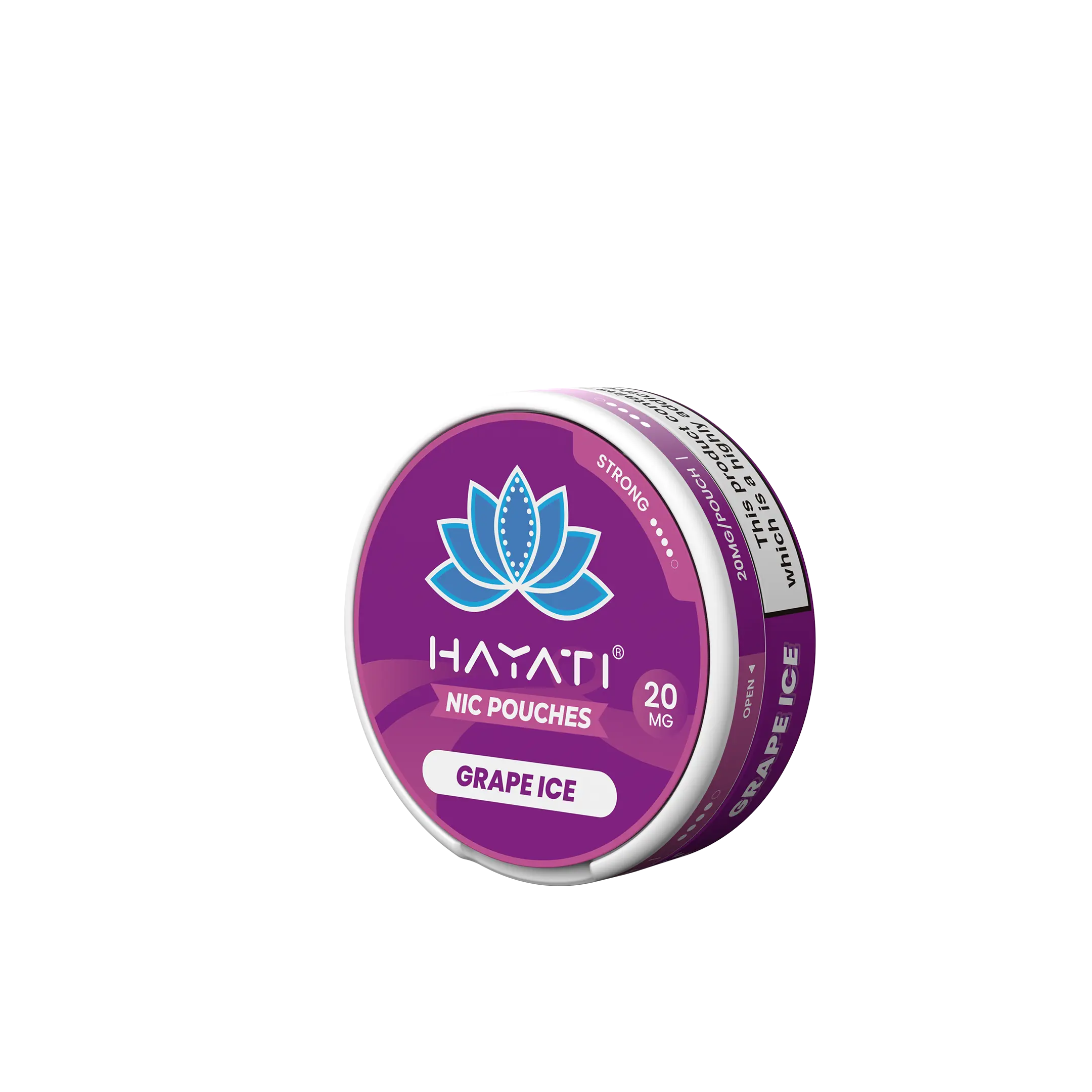
Grape Ice Hayati Nicotine Pouches is a can of oral nicotine pouches at £4.49, listed by Hayati at 12mg and stated by them to contain no tobacco. A pouch is a small sealed sachet of fibre carrying flavouring and nicotine inside a permeable wrapper. It is tucked inside the top lip so that it rests against the gum, it releases into saliva for as long as it stays put, and the spent sachet comes out in one piece and goes into a bin. No part of the transaction involves a device, a battery, a coil, a liquid or a charger, and nothing is heated, burned or drawn towards the lungs at any point. That is worth establishing in the first paragraph because almost everything else on this site works a different way, and the rest of this page depends on the difference being clear.
The reason this can needs several thousand words rather than a paragraph is a hole in the catalogue that sits directly behind it. Hayati sell fifteen listings whose title contains the word grape. Exactly one of those fifteen carries a cooling word, and it is this one. Every other grape they sell, in every format, on every platform, at every price from £2.49 to £11.99, is warm and sweet with no coolant in it. Put the two facts together and the conclusion is blunt: the only way to have a cold grape from Hayati is to stop inhaling. The Grape Vapes shelf page reached that finding first and stated it as the most actionable thing on the page, and it is right, with one correction that this page owes it and makes below.
A gap like that is unusual enough to deserve an explanation rather than a shrug. Grape is a well-used flavour here, running to seven distinct recipes across fifteen boxes. Cooling is applied to roughly a quarter of everything Hayati sell. Two common properties that never meet is the kind of pattern that usually has a reason behind it, and there are three plausible reasons available. This page tests all three against the catalogue, says which one the evidence actually supports, and admits where the evidence runs out. Then it does the harder half, which is working out what a cooled grape in this particular container is likely to taste like, given that a pouch is very good at delivering the cold and poor at delivering the thing a grape flavour is made of. That part ends in a prediction with the confidence marked on it and a test you can run in one sitting.
Fifteen grape listings, one coolant, and it is not in a pod
Start with the count, because a claim of this shape is worth nothing until somebody has done it. Searching the 492 listings for a title containing grape returns seventeen. Two of those are the Straw' Grapefruit pods, and a grapefruit is a citrus with no botanical connection to a grape at all, so they come out. That leaves fifteen.
Those fifteen resolve to seven flavour ideas, because Hayati sell the same liquid several times over in different bodies. Grape GB on its own accounts for four of them. Grape GB beside Blue Razz GB accounts for two, Grape GB beside Strawberry GB for three, Grape Berry for two, Sakura Grape for two, Kiwi Grape Raspberry for one, and Grape Ice, this can, for the last. Run a cooling-word test over all fifteen titles and exactly one comes back positive. Strip the pouch out and you are left with fourteen grape vapes, none of which has a coolant in the name.
Against that, the base rate. One hundred and twenty-one of the 492 titles carry a word from the cooling family, which is 24.6 per cent, and those 121 cover forty-five distinct flavour names. So cooling is not a niche treatment in this range. It is applied to something close to one listing in four, across a broad spread of fruits. A fruit family with fifteen listings and seven recipes that picks up a coolant zero times on the vape side is not a small sample producing a boring result. It is a deliberate-looking absence.
Narrowing the claim until it survives
Here is where this page owes the shelf a correction, and the correction makes the finding sharper rather than weaker. The flat sentence "there is no iced grape vape in the Hayati range" is true about titles and false about liquids. Grape sits behind a coolant in this catalogue nine times. It simply never says so on the front of the box.
The nine break into three groups. Four are Vim Ice, a cordial-named flavour that arrives as a Pro Max Plus pod, a Pro Max Plus kit, a Rubik pod and a Rubik kit, all of them cooled. Its two Rubik descriptions name grape outright, calling the blend a purple berry-and-grape drink profile; the Pro Max Plus pair describe a dark mixed fruit with a fizzy-drink character and never use the word at all. Even the tagging is inconsistent inside that pair, since Hayati's product data files the Vim Ice Hayati Pro Max Plus 6000 Pod Kit as a grape and does not file its own refill, Vim Ice Hayati Pro Max Plus Pods, the same way. Two more are the Vimbull Ice shortfills, both of which describe a blackcurrant-and-grape cordial crossed with an energy drink and both of which are cooled. The last three are the Shisha listings, built on Apple Mint Grape and Peach Grape Mint, where grape is stated to sit at the heart of the blend and mint runs through the middle of it.
Seven of those nine name grape in their own copy. So the honest version of the finding is this. Grape and cold do meet in the Hayati catalogue, nine times. They never meet on a label. Not one listing that advertises grape to a shopper who is looking for grape offers it cooled, with this can as the single exception, and this can is not a vape. That is a narrower claim than the shelf made and it is the one that holds up, and it is arguably more interesting, because a gap in what a company is willing to advertise is a different kind of fact from a gap in what it is willing to make.
Two of the three exceptions also come with caveats that stop them substituting. The Shisha trio carries no cooling word in the title at all, and its cold arrives as mint rather than as a bare coolant, which is a different sensation with a herb attached to it; it also sits at 5mg, a figure nothing else in the range uses except those three. The Vim Ice and Vimbull Ice group is cooled and genuinely purple, but its grape content is inferred from a cordial rather than declared, and a shopper who wants grape cannot verify from the listing how much of one is in there. That leaves the shelf's practical advice intact even after the correction: if you want a cold grape from Hayati and you want the label to say grape, this can is the entire available range.
Three explanations, and what a catalogue can decide between
An absence this systematic invites a reason, and three are worth putting up. A cooled grape was tried and did not sell. The grape accord and a coolant interact badly enough that nobody wants to ship one. Or nobody has got round to it. Those are not equally testable, and the responsible thing is to say which of them the data can touch.
Tried and withdrawn: nothing in the data can see this
This is the explanation most people reach for and it is the one this page can say least about. A retail catalogue is a snapshot of what is currently stocked. It contains no discontinued lines, no sales history and no record of anything that was once listed and is not now. The timestamps attached to these records are all from the same crawl, so they cannot even rank the products by age, let alone show a withdrawal. A cooled grape could have been made, sold badly and pulled in 2024 and there would be no trace of it here.
So this explanation is not refuted. It is untestable from the only evidence available, and a page that presented it as the answer would be dressing up a guess. Anyone who wants it settled needs Hayati's product history, which they do not publish, and not a retail listing, ours included.
Nobody got round to it: the count argues against this
The oversight explanation is the least flattering and the easiest to check, because oversights are random and the pattern here is not. If the missing iced grape were an accident of scheduling, you would expect it to be an isolated hole. It is not. It sits inside a much larger and much more regular one, which the next section sets out. A single omission is an oversight. Fifty-five out of fifty-six is a policy.
The interaction explanation is the one with support, and the support is not about grape
The third candidate holds up best, and it holds up in a form that is more useful than the version handed to this page. The evidence does point at an incompatibility between grape and a coolant. It also shows that the incompatibility is not really about grape at all. It is about the register grape belongs to in this range, and the same absence shows up across every other flavour in that register.
The register, not the fruit
Hayati's grape is not a general-purpose grape. Two pages on this site have already established what it is and there is no reason to build the argument a third time. The Grape GB Hayati Pro Max Plus Pods page decoded the GB suffix and found it marks a sugared confectionery treatment which no solo Grape GB listing ever spells out, and the Grape Berry kit page established that the underlying accord is the purple sweet-shop grape and that nothing in the catalogue offers a green or a white one. The Grape Vapes shelf then counted the vocabulary across all fifteen titles and confirmed a single register: dark, sugared, purple, and never once described as fresh. Take all of that as given.
Now run the cooling test over the whole confectionery register rather than over grape alone. Titles in this catalogue that name a sweet-shop construction, counting GB, B'Gum, Bubblegum, Gummy, Jelly Bean, Candy, Cotton, Rainbow and the rest, come to fifty-six listings across twenty-seven distinct flavour names. Exactly one of those fifty-six carries a cooling word, and it is Bubblegum Ice Hayati Pro Max Nic Salt, a single 10ml bottle at £2.49. That is 1.8 per cent against a catalogue base rate of 24.6 per cent, which is an under-representation by a factor of about thirteen.
Twenty-seven of those distinct GB names include Blue Razz GB, Strawberry GB, Red Razz GB, Blueberry B'Gum, Blueberry Cotton K, Gummy Bear, Blue Razz Gummy Bear, Strawberry Jelly Beans and Rainbow. Not one of them is sold cooled. Grape GB is not being singled out. It is being treated exactly like every other sugared accord in the range, and the question stops being "why is there no iced grape" and becomes "why does this company not ice its sweet shop".
The house says it out loud
Hayati's own copy answers that, repeatedly, and it is not subtle. Across the 492 listings, twenty-six use the word iced. Six of those use it to name a category the reader is being told they will not want: a sweet flavour is positioned as the choice for people who prefer sugar to tart or iced profiles. Strawberry Jelly Beans says it, Gummy Bear says it, both Rainbow listings say it, and the Watermelon B'Gum dual kit says it. Sweet and iced are treated throughout this catalogue as opposite ends of a single axis rather than as two properties that could both be true of one liquid.
The grape listings say it twice, and one of the two is remarkable. Of all 492 listings, exactly one uses the phrase "look elsewhere", and it is the solo Grape GB bottle, which tells anyone who prefers sharp or iced fruit to go and find it somewhere else in the range. The Grape GB pod's sibling kit puts the same thought less bluntly, describing the flavour as one that suits people who want their fruit full-on rather than subtle or refreshing. So on the two occasions where Hayati's copy discusses what this grape is not, the answer both times is: not cold.
That is as close to a stated reason as a catalogue can give you. It is a positioning decision, recorded in the product text, applied consistently across a whole register, and grape is inside that register by definition rather than by accident.
The two exceptions matter, because they show what kind of barrier this is
That one bottle exists and is on sale. A bubblegum accord is every bit as much a confectionery construction as a GB is, arguably more so, and Hayati's own copy for it says the cooling is there to keep the sweetness in check and to stop the gum turning heavy. Whatever is stopping them cooling a grape, then, is not a rule of chemistry that forbids putting a coolant on a sugared accord, because they have done precisely that once, described the result as working, and kept it in the range.
That single exception does most of the analytical work in this section. It converts the finding from "a cooled grape would not work" into "a cooled grape is not the sort of thing this range sells", which is a claim about a company rather than about a molecule. It also means nobody should read this page as saying a cooled grape liquid would taste bad. The catalogue cannot tell you that, this page has not tasted one, and the range has broken its own convention when it wanted to.
Where that leaves the three explanations
- Counted, not inferred. Fifteen grape-titled listings, seven flavour concepts, one cooling word among them and it belongs to this can. Fourteen grape vapes, zero cooled. One hundred and twenty-one cold-word titles in 492. Fifty-six confectionery-named titles, one cooled. Nine listings where grape sits behind a coolant without saying grape on the front.
- Well supported. That the absence is a property of the confectionery register rather than of grape, because the same absence covers twenty-seven flavour names that have nothing to do with grape, and because the copy states the sweet-versus-iced opposition in six separate listings.
- Not supported, and untestable here. That a cooled grape was tried and withdrawn. No catalogue can show this and this one shows nothing either way.
- Argued against. That nobody got round to it. The gap is too regular and too large to be an oversight, though it remains possible that the original decision was casual and simply never revisited.
- Unknown. Whether a cooled purple grape liquid would actually taste good, and whether it would sell. Bubblegum Ice shows the range is willing to cool a sweet accord when it chooses to, and nothing beyond that is knowable from here.
Cold on a flower that nobody has named
There is a second mechanism worth putting on the table, separate from the positioning argument and pointing the same way. It is a hypothesis rather than a count, and it is labelled as one, but it is the part of this that would explain why the positioning convention grew up in the first place.
Confectionery grape rests on methyl anthranilate. That is established elsewhere on this site rather than here, on the Grape GB and Sakura Grape pages and summarised on the grape shelf, and the load-bearing detail is that perfumery classes the compound as a floral material rather than a fruit one. It is potent at very low concentrations, it is cheap, it is instantly recognisable, and repetition across a century of sweets and sodas has trained a whole population to hear a flower and think fruit. Every purple grape in this range contains a floral note. The copy calls it purple and sweet and moves on, and the grape shelf page made the sharp version of that point: the trade is not avoiding floral notes, it is avoiding unattributed ones.
Now put a coolant on top of that. Cooling and floral character are an awkward pair, for reasons that are about perception rather than about a reaction in the bottle. A coolant sharpens and clarifies: it narrows a flavour, gives it edges, and pushes the whole impression towards the crisp and the linear. Floral notes work in the opposite direction. They are diffuse, warm, rounded and spread out, and a great deal of what makes a fragrance pleasant is that it does not have edges. Put a sharpening agent over a diffuse one and the common outcome is not a cold flower. It is a flower that has been cut into and now reads as soapy, or as medicinal, or as the smell of a cleaning product rather than of a plant. Anyone who has met a badly made floral shower gel has met the failure mode.
So the honest statement of the hypothesis is that a coolant over an unattributed floral accord carries a real risk of tipping the whole thing into soap, and that this risk is specific to grape in a way the confectionery-register argument is not. It would explain why a company happy to cool a bubblegum is not happy to cool a grape, since bubblegum's loud notes are fruity esters and vanillin rather than a perfumery floral.
The counterexample, and why it does not sink the hypothesis
Test it properly and the catalogue offers one case. Forty-four listings in 492 use a floral or fragrance word somewhere in their flavour copy. Three of those forty-four carry a cooling word in the title, and those three reduce to two flavour names, one of which is a dual pod where the cold is attached to the cherry side rather than to the fragrant one. So exactly one flavour in the entire range puts a declared coolant over a declared floral, and it is Lychee Ice, which Hayati sell as a Pro Max Plus pod and as the matching kit. They describe it as delicate, floral and chilled, call the fruit perfumed and almost rose-like, and say the cooling is set at a level that lifts the fragrance rather than overwhelming it.
So it can be done, which is worth knowing. But notice what makes it possible. Lychee's fragrance has a name on it. A shopper reading that listing knows in advance that a lychee is a perfumed fruit, so when the perfume arrives it is filed as lychee and the cold reads as a treatment applied to a known thing. The grape accord has no such label. The flower in it is never acknowledged, it is sold as fruit, and a buyer who suddenly notices perfume in a cooled grape has no box to put it in and will experience it as something having gone wrong. The risk is not really chemical. It is a risk about expectation, and it applies to an accord whose floral half has been kept quiet for a hundred years.
Both things can be true at once, and stating them plainly is better than picking a winner. The positioning explanation is supported by counts and by Hayati's own sentences. The floral explanation is a mechanism that would make the positioning sensible, it survives the one test the catalogue can run, and it remains a hypothesis. Neither is a measurement of what is in this can.
The pairing this can actually is
Everything above is about a gap. This section is about the product sitting in it, and it is the part where the argument gets genuinely awkward for the can.
Three pages on this shelf have already worked out what a pouch does to a flavour and none of it needs rebuilding. The Mango Ice Hayati Nicotine Pouches page owns the mechanism: a vape carries aroma in an aerosol and pushes it past the receptors in the nose on the exhale, which is how it manages to taste of a named fruit, while a pouch dissolves into saliva and is therefore left leaning on the basic tastes and on direct contact with the tissue, since the aroma route is weak and slow. That page also owns the exposure argument, that a coolant delivered in two-second pulses behaves differently from one held in unbroken contact for half an hour. The Frosted Mint page takes both as given and finds the format's one clean win, that cooling is a receptor event in tissue the pouch is pressed against, and it also documents the cost, which is that a continuous stimulus adapts inside a single sitting and again across a day. The Coffee page finds a second win on a different channel, bitterness being a basic taste rather than an aroma. Those arguments are theirs and they are sound.
Apply the settled mechanism to this can and the result is uncomfortable. The pouch is good at cold and poor at aroma. Grape's identity is almost entirely aroma, and unusually, it is almost entirely one aroma compound. So this product pairs the format's single greatest strength with a flavour whose whole case rests on the format's single greatest weakness. Of everything on the Hayati Nicotine Pouches shelf, this is the one where the two halves are pulling hardest in opposite directions, and the plausible failure mode is not that the grape is quiet but that the cold simply covers whatever is left of it.
The prediction handed to this page, and whether it holds
The Mango Ice page made a specific forecast about this can and it deserves testing rather than repeating. Its argument was that mango's identity lives in lactones, which are large, high-boiling and poorly soluble in water, whereas grape's lives in one small light molecule, and that a profile carried by a single prominent light compound should have an easier time in a format with no heat and no carrier than one carried by a family of heavy ones. Its conclusion was that Grape Ice ought to read as a more recognisable version of its own name than Mango Ice does.
That reasoning is sound as far as it goes and this page agrees with the direction. Methyl anthranilate is roughly the same molecular weight as a decalactone but considerably more polar, it is more willing to go into water than a lactone family is, and above all it is unusually potent, which matters enormously in a channel that delivers very little of anything. A compound that is recognisable at a low concentration is exactly the kind of compound that survives a weak delivery route.
But the reasoning misses something, and the thing it misses is the more interesting half. A single-compound identity is not simply a lighter version of a many-compound identity. It fails differently. Mango thinned out still reads as something: strip the cultivar detail and the top notes away and you are left with a sweet tropical impression that a person would still call fruit. The profile degrades gracefully, because there is a supporting cast to fall back on. Grape has no supporting cast. The accord is one compound doing nearly all the identifying work, so it is closer to a switch than to a dimmer. Either enough of that molecule reaches the receptors for the impression to lock into place as grape, or it does not and you are left with sweetness and cold and nothing that could be named.
There is a second complication in the same direction. At the concentrations a vape delivers, methyl anthranilate reads as grape sweets because it arrives loud and in company. At much lower delivered concentrations it is more likely to read as what it actually is, which is a perfumery material, and the perceived character can drift from confectionery towards something vaguer and more fragrant. So the format could plausibly produce a recognisable grape or a faint scented sweetness, and the gap between those two outcomes is not a matter of degree.
What to expect, with the confidence marked
These are inferences from mechanism, not tasting notes. Nobody writing this page has had the can open, Hayati publish a short flavour paragraph and a strength and nothing about the formulation, and a page that offered a draw-by-draw description of a product it has not tried would be making it up.
Reasonably confident. Sweetness leads and carries a large share of the total. Sweeteners are water-soluble by design and the format delivers them directly onto the receptors that report them, which is why pouches in general read as insistently sweet. Hayati's own text has the cold balancing the sweetness, which concedes there is a quantity of it to balance.
Reasonably confident. The cooling arrives at or near full strength and holds, because a coolant needs nothing except contact with tissue and this format supplies contact continuously.
Reasonably confident. The cold is proportionally larger here than it is in any cooled grape you have met elsewhere, for the simple reason that there is no cooled grape vape to have met, and in the cordial equivalents the ice sits over a full fruit blend rather than over a thinned one.
Probable. The grape is more identifiable than the mango is in its own can, which is the Mango Ice forecast and this page endorses it, on potency rather than on molecular weight.
Probable. What identity does come through is the confectionery reading rather than anything resembling fruit. The purple sweet-shop character is the whole of Hayati's grape anyway, as the shelf page established, so in this one respect the format is not removing something the liquid had.
Even money, and this is the axis that decides the purchase. Whether the cold masks the grape or frames it. A continuous coolant on tissue raises the floor of sensation for the entire time the pouch is in, and a quiet aroma signal has to be read against that floor. The same coolant in a pod is intermittent, so the fruit gets gaps to be heard in. Here it does not.
Unknown. Whether the accord tips towards soapy or perfumed under the cold. That is the floral hypothesis above and it is genuinely unresolved. The one relevant data point in the range, Lychee Ice, suggests it can be avoided when the fragrance is expected, and this label sets no such expectation.
Unknown. How much grape flavouring is in there in absolute terms. Flavour houses produce concentrates weighted towards the water-soluble fraction precisely so they work in cold applications, and a blender who knows the format may well have used one. Nothing in the listing settles it.
A test that separates masking from failure
The useful question about this can is not how strong the grape is. It is whether the grape is absent or merely buried, because those are different products and they call for different decisions. One can answers it, and the diagnostic is timing rather than intensity.
Use one as the first nicotine of a day, so that nothing is already adapted. Then take three readings. At around sixty seconds, before the cooling has built to its plateau, ask a recognition question and not an intensity one: is what you are tasting identifiable as grape, or is it purple-flavoured sweetness that could be several things? At around ten minutes, with the cold fully established, ask the same question again in the same words. Then take the pouch out and ask it a third time about the aftertaste, thirty seconds after removal, when the coolant is clearing and the sweetener has mostly gone.
The three answers tell you which product you bought. Grape legible at sixty seconds, gone at ten minutes, back in the aftertaste means the flavouring is present and the cold is masking it, which is a fixable problem: shorter sessions and wider spacing will get you more grape. Grape absent at sixty seconds and absent throughout means the aroma is not reaching you at all and no amount of timing will help, and the fruit you want lives on the vape side. Grape legible at sixty seconds and still legible at ten means this can has beaten the format and the Mango Ice forecast was right in its strong form. And if what you notice at any of the three points is soap or medicine rather than fruit, the floral hypothesis above has just been confirmed on your palate, and the honest conclusion is that you should buy something else.
What the listing publishes, and what it does not
Very little is specified here, and a table for a pouch is mostly a record of blanks. Those blanks are in the table rather than quietly left out, because the absence of a pouch count is the single fact that most changes how this price should be read.
| Price | £4.49 |
| Nicotine | 12mg, published as a bare figure with no denominator |
| Tobacco content | None. Hayati state these are tobacco-free |
| How it is taken | Orally. Held inside the top lip, resting on the gum |
| Heat, vapour or inhalation | None at any stage |
| Hardware required | None |
| Flavour as named | Grape Ice |
| Tags in the product data | grape, ice, grape ice |
| Shelves it is filed on | Four: the pouch shelf, grape, ice and new products |
| Grape-titled listings in the catalogue | Fifteen |
| Of those, carrying a cooling word | One, this can |
| Grape-titled vapes carrying a cooling word | None |
| End of life | Spent pouch into a bin. No electrical component to separate |
| Pouches per can | Not published |
| Weight of a pouch | Not published |
| Coolant used | Not published |
| Sweetener used | Not published |
| Intended wear time | Not published |
The strength is the only quantitative thing Hayati commit to and it is fixed. All eleven cans on this shelf carry 12mg, so within the pouch range there is no strength to choose and no stronger or milder Grape Ice to move to. The figure is also given without stating what it is measured against, and this page will not supply a convention Hayati did not print.
The unpublished coolant matters more on this product than it would on most, and for a reason specific to the argument above. Menthol carries a herbal aroma of its own; several synthetic coolants carry almost none. On a cooled grape that difference decides whether the cold arrives with a green note attached, and a green note beside an unacknowledged floral is exactly the combination most likely to read as medicinal. Hayati name neither the agent nor the quantity, so nobody can tell you in advance which of those two products this is. It is the most load-bearing blank on the list.
The missing pouch count has the ordinary consequence. £4.49 is a price for a can, and without knowing what a can holds there is no cost per unit to compare against anything else on this site. It does compare directly against the other ten flavours, since every one of them is the same £4.49, which means that within this shelf price is not a variable and flavour is the only decision on offer.
Choosing between this and its neighbours
This can has two sets of neighbours that answer completely different questions. One is the other ten pouches, where the container is fixed and the flavour varies. The other is the cooled side of the vape catalogue, where the flavour you actually want is available in the right register but never as a grape.
Against the other ten cans
Five of the eleven pouches carry a cooling word and this is one of them. Ice Cold Hayati Nicotine Pouches is the one built purely around the sensation, with no fruit named at all, and on everything this page has argued it is the pouch least exposed to the format's weakness, because it is asking nothing of the aroma channel. If the cold is the part you are buying, that can delivers it without a fruit to be disappointed by.
Mango Ice and Banana Ice Hayati Nicotine Pouches are the other two cooled fruits, and the comparison between the three is the most useful thing on this shelf. All three ask a fruit to survive a channel that does not carry fruit well, and they differ in what the fruit is made of. Mango depends on a family of heavy lactones and is the worst placed of the three. Banana sits in a similar soft, creamy register and is not much better off. Grape depends on one light, potent compound and should be the best placed, which is the Mango Ice forecast and this page has endorsed it with reservations. Buy two of the three and you have an experiment rather than a purchase.
Away from the cold, the plain Bubblegum can is the closest thing on this shelf to Grape Ice in construction. Both are confectionery accords rather than reproductions of a fruit, both are built from loud synthetic notes sitting on sugar, and both therefore have less to lose from a channel that flattens detail than a real fruit does. The difference is that the bubblegum has no coolant over it, so it gives you a clean read of how the sweet-shop register behaves in a pouch with nothing competing against it. If you want to know how much of the grape here is being covered by the cold rather than lost in transit, that can is the control, and the Cola can is the second one, being the other manufactured accord in the range that nobody could point at a plant for.
Coffee Hayati Nicotine Pouches belongs in a different part of this conversation and is worth reading against this one for contrast rather than as an alternative purchase. Its page argues that coffee is the one flavour on the shelf the format can carry better than a vape could, because bitterness is a basic taste reported on the tongue and needs no aroma route at all. Grape is the mirror image of that: almost nothing about it is a basic taste and almost everything about it is aroma. The two cans sit at opposite ends of the same mechanism, which is why one of them is the shelf's best-matched fruitless flavour and this one is the shelf's most exposed fruit.
Against the cooled vapes, since the grape ones do not exist
This is the harder half of the comparison and it is where the gap has consequences. A reader who wants a cold purple fruit in a device has three routes, and none of them is a grape.
The first is to accept a cordial whose grape is implied rather than declared. Vim Ice Hayati Pro Max Plus 6000 Pod Kit at £7.99 is the flagship of that group, a dark fizzy-cordial profile with a cooled exhale, filed by Hayati as a grape even though the kit's own copy never says the word, and Vim Ice Hayati Pro Max Plus Pods at £5.49 is the refill for anyone who already has the device. It is the closest thing to a cooled grape vape the range contains, and the closeness is inferred from a tag rather than stated in a sentence, which is exactly the sort of claim this site tries to label.
The second route is to change fruit and keep the cold. Blackberry Ice Hayati Pro Max Nic Salts at £2.49 is the nearest dark, sweet, cooled single fruit, and at ten millilitres in a bottle it is also the cheapest way to test whether a cold dark fruit is what you actually wanted, since you can stop after two millilitres without binning a sealed pod. Blackberry is not grape and it brings real acid, which this grape accord has none of, so the substitution changes the shape as well as the fruit. Beside it, Black Mamba Hayati Pro Max Nic Salts and Black Mamba Hayati Pro Max Plus 6000 Pod Kit take a dark berry blend and put the cooling late, so the inhale is rich and the finish turns cold, which is a structure no pouch can reproduce at all because a pouch has no inhale to separate from a finish. Blue Frozen Hayati Pro Max Plus 6000 Pod Kit at £7.99 goes the other way and leads with the cold, treating the blue fruit underneath as the support act, and Cherry Ice Hayati Pro Ultra Plus 25K Pods at £7.99 or the matching Cherry Ice Hayati Pro Ultra Plus 25000 Prefilled Pod Kit at £11.99 give you a cooled dark red fruit where Hayati's own copy says the ice sits beside the fruit rather than over it. That balance is the one a cooled grape would have needed.
The third route is to keep the sweet-and-cold combination and give up the fruit entirely, which is the closest anyone can get to the product this page is about without leaving the vape side. Ice Pop Hayati Pro Max Plus Pods at £5.49 and Ice Pop Hayati Pro Max Nic Salt at £2.49 are the range's sugary-frozen listings that never claim to be a specific fruit, which makes them the nearest thing in spirit to what a cooled Grape GB would have been. Cola Ice Hayati Pro Ultra Plus 25K Pods at £7.99 is the same idea on a drink accord, and it deserves a mention of its own because cola shares grape's defining property of being a constructed flavour with no plant standing behind it. That the range will happily cool a manufactured drink and will not cool a manufactured fruit is the sharpest illustration of how arbitrary this gap looks from outside. And Cherry Ice / Peach Mango Hayati Pro Ultra Plus 25000 Prefilled Pod Kit at £11.99 puts a cooled side and an uncooled side behind one collar, so a single purchase lets you move between the two registers whenever you like, which is the thing a can of pouches cannot offer. The whole cooled catalogue sits on Ice Vapes if none of those is close enough.
Against the grape vapes, since that is probably where you came from
If you already use a Hayati grape and have come here looking for the cold version of it, the honest answer is that you are looking at the only one and it is not a vape. Grape GB Hayati Pro Max Plus Pods at £5.49 is the solo accord in its most common body and the reference point for what this flavour is with no coolant on it. Grape Berry Hayati Pro Max Plus Pods at £5.49 is the version where mixed berries are put around the grape to supply the movement a coolant would otherwise have supplied, and if what you wanted from ice was relief from a single sweet register rather than cold as such, that is the listing that addresses it directly. Grape GB / Strawberry GB Hayati Pro Ultra Plus Pods at £7.99 puts the grape behind a collar with a lighter red in the same sugared style, so you can step off it mid-session, though Hayati's own copy concedes that neither half is the tart one, which leaves the gap between the two sides closer to a change of shade than a change of direction. The full set is on Grape Vapes, this can sits with the rest of the recent arrivals on New Products, and all Hayati products covers both sides of the catalogue at once.
One flavour crosses the two formats, and grape is not it
Banana Ice is the only flavour Hayati sell as both a pouch and a vape, which makes Banana Ice Hayati Pro Max Plus Pods at £5.49, Banana Ice Hayati Rubik Pods at £3.99 and Banana Ice Hayati Pro Max Nic Salts at £2.49 the only way anyone can hold the delivery route constant and change nothing else. The Mango Ice page sets out why that comparison is worth making and owns it. The point relevant here is narrower and slightly deflating: grape cannot be tested that way at all, because there is no cooled grape vape to test it against. Anyone wanting to know what this can loses relative to its own vape equivalent is asking about a product that does not exist, and the nearest available answer is the uncooled Grape GB pod plus an act of imagination.
Using one
The list of things a person can control here is short, and most of it bears on the cold rather than on the fruit.
Position it deliberately. Hayati's instruction is inside the top lip against the gum, and on a cooled product the area of contact is part of what sets the size of the sensation, because a coolant works by touching tissue. A pouch that has slid so that it is pressing on lip rather than on gum is presenting less of itself to the surface that responds. If the cold seems thin early in the day, check where it is sitting before drawing any conclusion about the can. Hayati publish nothing about moving one once it is in, so this page offers no advice either way.
Give the grape longer than you would give a first draw. A pouch has to wet, dissolve and diffuse before it is doing anything, and on this product the fruit is the slowest of the three components to become audible, behind the cold and behind the sweetness. Thirty seconds tells you nothing. The recognition test above is built around that ordering and is the better use of a first can.
Do not judge it after another cooled pouch. The Frosted Mint page documents what continuous cooling does to your reading of it across a sitting and across a day, and that finding applies here in full. What is specific to this can is which half of the product the effect damages. As the cold reading falls, the sweetness and whatever grape there is do not fall with it, so a heavily adapted palate will actually hear more fruit and less ice than a rested one. That is the opposite of the usual advice, and it means this is one product where the fourth pouch of a day tells you something the first does not.
Keep the lid on. Hayati ask for the can to be kept closed between uses so the pouches stay moist. On a flavour whose fruit rests on a single volatile compound, an open can is losing the exact fraction that was already the fragile part, while the sweetener and the coolant sit there unaffected. A neglected lid degrades this particular can lopsidedly rather than evenly, and what it takes is the half you were least likely to be able to spare.
Keep it cool and out of the light, for the same reason, and keep the can somewhere children and pets cannot reach it. Nothing about the storage advice here is unusual; what is unusual is which component it protects.
Disposal is one line. The spent pouch comes out whole and goes in a bin, not down a sink and not on the pavement. There is no cell, no circuit and no electrical component, so none of the end-of-life handling that applies to every device on the rest of this site applies to this can.
Questions this one raises
Is this a vape?
No. There is no device, no liquid, no coil and no vapour, and nothing is heated or drawn into the lungs at any stage. It is a sealed fibre sachet held inside the top lip against the gum, which releases into saliva while it sits there and is then binned. It appears alongside vapes because it is a Hayati nicotine product, not because it works the same way.
Is there really no cooled grape vape in the range?
Not one that says grape on it. Fifteen listings carry grape in the title, fourteen of them are vapes, and none of those fourteen has a cooling word. Grape does sit behind a coolant nine times in the catalogue, in the Vim Ice and Vimbull Ice cordials and in the three Shisha listings, but in every one of those cases the label names something else and the grape is a component rather than the headline.
Why would a company skip such an obvious combination?
The best-supported reading is that it is not a grape decision at all. Fifty-six titles in this catalogue name a confectionery construction and exactly one of them is cooled, against a cooling rate of about one listing in four across the whole range. Hayati's own copy repeatedly treats sweet and iced as opposite choices, most bluntly on the solo Grape GB bottle, which is the only listing in 492 that tells a reader wanting iced fruit to look elsewhere.
Could a cooled grape have been tried and dropped?
Possibly, and nothing here can tell you. A retail catalogue lists what is stocked now; it holds no discontinued lines, no sales figures and no usable dates. That explanation is neither supported nor refuted by the only evidence available, and this page would rather say so than pick the version that sounds most confident.
What strength is it?
12mg. Every one of the eleven cans in the pouch range carries the same figure, so there is no stronger or milder Grape Ice and no strength decision to make on this shelf. Hayati publish the number flat, without saying what it is measured against, and this page will not invent a denominator for it.
Will the grape actually come through?
More than the mango does in its can, probably, because the compound that carries confectionery grape is small and unusually potent and a potent compound survives a weak delivery route better than a family of heavy ones. Less than it does in a pod, certainly. The open question is whether the continuous cold covers what does arrive, and the timing test on this page is designed to answer that in one sitting.
Why might a cooled grape taste soapy?
Because confectionery grape is built on a perfumery material rather than a fruit one, and a coolant sharpens where a floral note spreads. Cutting into a diffuse fragrance with something crisp is the usual route to a soapy or medicinal impression. It is a hypothesis rather than a measurement, and the range's one cooled floral, Lychee Ice, shows it can be avoided when the buyer is told to expect perfume in the first place.
How does it compare with the Ice Cold pouch?
That one is the cooling with no flavour named at all, so nothing about it is at risk from the format's weakness. This can is the same sensation with a fruit underneath that may or may not be audible over it. If the cold is what you are buying, the plain one delivers it without a variable attached.
Is there any tobacco in it?
No. Hayati state that these pouches are tobacco-free, which is one of the few things the listing is explicit about. The fibre inside is a carrier for the flavouring, sweetener and nicotine rather than a plant material with a character of its own.
How many pouches are in a can and how long does one last?
Neither is published, so neither is stated here. Without a count there is no cost per pouch to work out from the £4.49, although the price compares directly against the other ten flavours, every one of which is the same. Without an intended wear time there is no way to estimate how far a can goes.
Which coolant is used?
Hayati do not say, and on this product it is the blank that matters most. A menthol brings a herbal note of its own while several synthetic coolants bring almost none, and beside an accord with an unacknowledged floral character that difference could decide whether the cold reads as fresh or as medicinal.
Is it worth buying alongside another can?
If you are curious about the argument on this page, yes, and the useful partner is the plain Bubblegum, which is the same kind of manufactured sweet accord with no cooling over it. Putting the two on different mornings isolates what the cold is doing to a confectionery flavour in this format, which is the question the whole page turns on.
Where that leaves it
Grape Ice Hayati Nicotine Pouches is a £4.49 can of tobacco-free oral nicotine pouches at 12mg, one of eleven flavours that share both figures. It goes inside the top lip against the gum, it releases while it sits there, nothing is inhaled or heated, and the spent pouch goes in a bin.
Its real distinction is positional. Hayati sell fifteen grape listings and this is the only one with a coolant in it, which means the only cold grape they make is one you do not inhale. The reason is not a grape reason: the whole confectionery register goes uncooled, fifty-five titles out of fifty-six, and the copy states the sweet-versus-iced opposition outright in half a dozen places. A cooled grape may also carry a specific risk, since the accord is a perfumery material in fruit clothing and a coolant tends to cut a fragrance into soap, but that is a hypothesis with one counterexample sitting against it and it is not offered as settled.
What the can itself is, is an awkward pairing honestly described. The format delivers cooling better than any pod can and delivers aroma badly, and grape's identity is almost entirely one aroma compound. That compound's potency is the reason to expect more of it here than a mango manages in the same container, and the continuous cold is the reason to doubt it will be heard. Either the fruit locks in or it does not, with very little middle ground, and which of those you get is not predictable from a listing that publishes four facts.
So buy it if the cold is the point and a purple sweetness underneath is a bonus you can live without. Do not buy it expecting the pod flavour with ice added, because that product does not exist anywhere in the range and this can was never going to be it. Run the sixty-second, ten-minute and post-removal reading on the first one and you will know within a single pouch which of the two you have.
Strictly for adults aged 18 and over. Nicotine is an addictive substance.
You might also like


