
Home / Hayati Pro Max Nic Salts / Triple Mango Hayati Pro Max Nic Salt
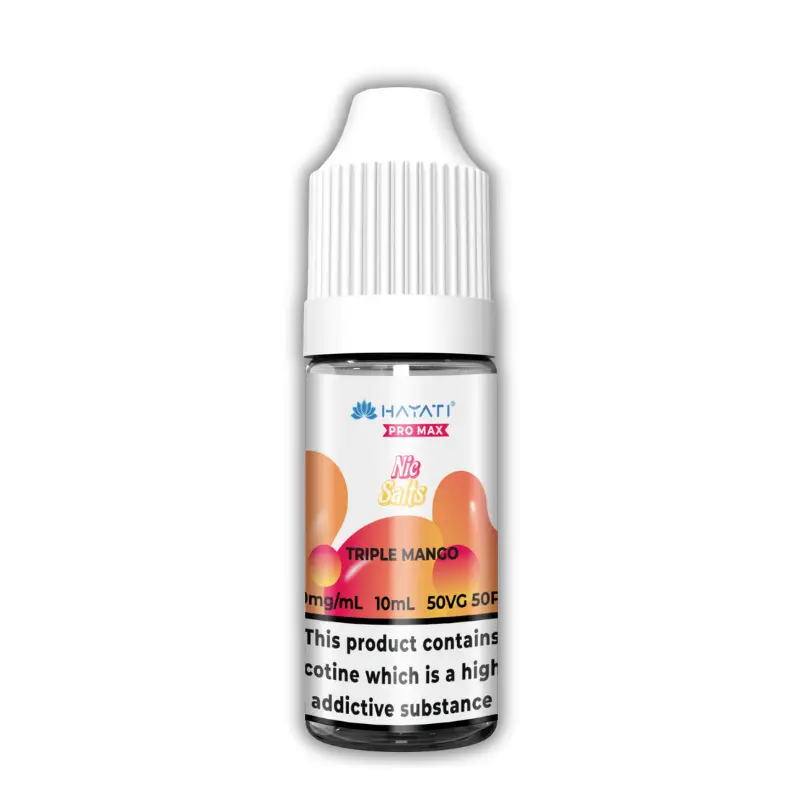
Hayati · Pro Max
Triple Mango Hayati Pro Max Nic Salt
£2.49
✔ In stock — ready to ship
Genuine Hayati
Free over £20
Same-day dispatch
Secure checkout
Triple Mango in the Pro Max nic salt format is ten millilitres of liquid in a bottle, listed at £2.49 under the SKU HPM-NS-TRIPLE-MANGO, carrying 10mg of nicotine per millilitre in salt form and mixed at an even fifty percent vegetable glycerine to fifty percent propylene glycol. Nothing else is in the purchase. There is no device, no pod, no coil and no cell, and the listing takes it for granted that you already own something to pour it into.
Hayati sell this flavour seven times over, and the seven split in a way that decides what this page is about. Four of them are sealed hardware holding twelve millilitres at 20mg, where the coil, the power and the airway were chosen in a factory and cannot be altered. Two are 120ml shortfills supplied at 0mg, one mixed at 50/50 and one at 70/30. That leaves exactly one listing in the set that is nicotine-bearing liquid with no hardware attached, and you are reading it.
The general case for buying liquid by the bottle rather than sealed in a pod has already been made in full on the Hayati Pro Max Nic Salts range-level listing, which works through what a bottle hands back to the buyer and what it charges them for the privilege. That argument is not being repeated here. What that page could not do, because it was arguing about a format rather than about a fruit, is say which flavours have the most riding on the outcome. They are not all equally affected, and the difference between them is not a matter of taste. It is a matter of which chemical family a flavour uses to announce itself.
Mango is at the far end of that spread. The compounds that make a mango recognisable as mango are among the heaviest and slowest to evaporate that any fruit in this catalogue relies on, which means they are the part of the recipe most dependent on the coil getting hot enough to lift them. A sealed pod that runs cool serves a thin, sweet, unremarkable mango and there is nothing whatever the owner can do about it. A bottle removes that constraint at a stroke. That is the argument, and the rest of this page works out what each adjustable property actually does to this specific profile, what the adjustment costs, and where the limits of the whole idea sit.
What the name settles before we start
The question of what "Triple" means on a Hayati mango has been answered elsewhere and does not need answering again. The Triple Mango Hayati Rubik Prefilled Pod Kit page took that on properly, counted the evidence out across the whole catalogue, and reached a verdict this page accepts wholesale.
Its finding, in summary: the word is an intensity marker with a layering gesture attached to it, and the layering runs along ripeness rather than along cultivar. It is not a varietal claim. The counting behind that is substantial and it is worth knowing the shape of it even if you take the conclusion on trust. Seven separate listings describe this liquid, five of the seven treat it as one undivided fruit, and the two that enumerate three characters are the pair sitting on a single platform, which points at one copywriter rather than at a second recipe. Across all 492 products Hayati name a mango cultivar zero times, and no cultivar of any other fruit either. The grammar for a three-part composition exists in the range and is used freely when there is a composition to advertise. And the one structured data field Hayati built for decomposing a blend into its parts, populated on fifteen bottles including this one's immediate neighbours, resolved the other multiplier-named product in the range to a single fruit with two adjectives.
Two things follow for this page and neither of them is a flavour analysis. The first is that the draw-by-draw reading of this liquid is settled: a bright, faintly tangy opening that is the lightest thing in the bottle, a thick honeyed middle carrying most of the weight, and a soft creamy tail that outlasts the vapour. The Rubik page sets that out at length and there is no version of repeating it that improves on it.
The second is more useful here, and it is the hinge of everything below. If the name is promising ripeness rather than variety, then what it is promising more of is specifically the heavy fraction. Ripeness in a mango is not a general increase in flavour. It is a shift in which compounds dominate: the green, resinous, faintly piney terpene notes of an underripe fruit recede, and the soft lactones that read as creamy and honeyed take over and keep climbing. A liquid built to sit high on that scale is a liquid built out of the material that is hardest to get off a wick and into your mouth. Hayati have, in effect, sold you a bottle whose selling point is the part of a recipe most sensitive to how the hardware is set up, and then sold most of it to you in hardware you cannot set up.
Why this fruit has the most riding on your equipment
Start with what aroma compounds have to do before you taste them. A coil heats a wick, the base evaporates, and the aerosol that reaches you is condensed droplets of that base carrying whatever was dissolved in it. Aroma chemicals have to make that transition themselves, and they do not all make it at the same temperature. A compound that boils readily is present in the vapour almost as soon as the coil is warm. A compound that needs considerably more energy is delivered partially or not at all until the wick surface gets hot enough, and the practical effect is not that the flavour is quieter overall. It is that the flavour arrives in the wrong proportions, with the light end intact and the heavy end missing.
Where mango sits, and where everything else on the shelf sits
Mango's identity is carried principally by lactones, the same family that carries peach and apricot: gamma and delta decalactone, gamma-octalactone and their relatives. These are large molecules by the standards of flavour chemistry and they are stubborn about leaving a liquid. Set them against what the rest of this shelf is built from. Berries and apples announce themselves through short-chain esters, which are small, quick and gone at the first hint of warmth. Citrus works through terpenes, lighter still. Menthol and the mint family sit in the middle and are notably efficient at making themselves felt. Confectionery profiles lean on maltol, vanillin and caramelised sugar notes, and those genuinely are in heavy territory.
That last sentence is a correction to the claim this page was commissioned to make, and it is worth making the correction out loud rather than quietly writing around it. The brief handed me "mango's defining compounds are the heaviest in the range". Counted against the actual shelf, that is too strong. Sixty-five bottles sit on the Pro Max nic salt shelf, and at least ten of them are confectionery constructions: the two gummy bear listings, the two bottles abbreviated to GB, a jelly bean, a rocky candy, a bubblegum, an ice pop, a rainbow and a bubblegum-inflected berry blend. Those are built on materials squarely in the same high-boiling bracket as a lactone. Two more have names so opaque that nobody outside Hayati can say what carries them. So mango is not the heaviest thing here outright and this page is not going to pretend otherwise.
What survives the count is narrower and considerably more interesting. Five of the 65 bottles put a lactone-carried fruit on the label: this one, Mango Peach Pineapple Hayati Pro Max Nic Salt, Lemon Peach Passionfruit Hayati Pro Max Nic Salt, a white peach and raspberry pairing, and a single juicy peach. Two of those five are that fruit and nothing else. And exactly two of the 65 carry a multiplier in the name: Double Apple and this one. Apple is an ester fruit, light and quick, and Hayati's own data field resolved that multiplier to one fruit with two adjectives. Mango is a lactone fruit. So of the two bottles on this shelf whose names promise more of something, only one of them is promising more of the material a cool coil cannot lift.
That is the claim in its defensible form: not that mango is the heaviest flavour Hayati sell, but that among the fruit bottles it is in the heaviest group, that it is one of only two on this shelf where that heavy group is the entire flavour rather than a partner in a blend, and that it is the only one whose name commits to pushing further in that direction. Every one of those is a count anybody can repeat.
What a cool setup actually does to it
The failure mode is specific and it is worth describing precisely, because it does not present as a fault. A combination of coil, power and airway that runs at the low end will still deliver the base, so the vapour volume looks normal. It will still deliver the sweetener, because sweetener rides along in the droplets rather than needing to be volatilised in the same sense. It will still deliver the bright, faintly tangy opening, because that is the lightest material in the bottle and it was never in difficulty. What it under-delivers is the honeyed middle and the creamy tail, which is to say the two things the word "Triple" was pointing at.
The result tastes sweet, thin, generic and slightly disappointing, and the natural conclusion for the person drinking it is that the liquid is mediocre. They have no way of knowing that the recipe was fine and the equipment was the problem, because nothing in the experience distinguishes a weak mango from a strong mango being badly served. It reads as an ordinary sweet tropical liquid rather than as a bad one, which is precisely why the diagnosis never gets made.
Now consider the same profile with its floor raised. The honeyed body arrives at full volume, the creamy lactone tail becomes audible as its own layer rather than merging into general sweetness, and the whole thing acquires the density that all seven listings claim for it. The bright opening has not changed, because it was always going to arrive. What has changed is everything behind it, and on a liquid whose entire proposition is depth, that is the difference between the product working and the product being pointless.
The part a sealed pod cannot do
On the four prefilled Triple Mango listings the coil resistance is not published, the power is fixed by the device, and the airway is a moulded channel with no collar to turn. Whatever combination the manufacturer settled on is the combination you get for the whole twelve millilitres. If it suits this liquid, excellent. If it runs at the cooler end, the buyer's only remaining lever is how they draw, and the Rubik page's handling advice reflects exactly that constraint: it tells you to pull slowly and gently in order to protect the light opening, because protecting what you have is the only move available when you cannot raise the floor.
A bottle inverts the instruction. Once the hardware is yours, the light opening is not the thing at risk and does not need protecting, because it will survive almost anything. The floor is the thing you can now go after. That reversal is the single clearest illustration of what the format changes for this particular fruit, and it does not apply nearly as sharply to a berry, a citrus or a mint, all of which arrive more or less intact regardless of how the equipment is configured.
The properties you now control, and which way each one pushes
What follows is not advice about settings and contains no recommended figures. Hayati publish no target resistance, no wattage and no airflow specification for this liquid, and a retail page inventing them would be doing the thing this site exists not to do. These are descriptions of what each adjustable property is and which direction it moves a lactone-heavy ripe mango, which is information a buyer can act on with their own hardware and their own judgement.
Power, which is the direct one
Power applied to a given area of heated surface is what sets how hot the wick gets, and temperature is the variable the heavy fraction responds to most. The important thing to understand is that raising it does not turn the flavour up evenly, like a volume control. It changes the shape of the profile.
The reason is that the light material was already fully delivered. A bright top note that volatilises readily is at its ceiling almost as soon as the coil is working at all, and giving it more energy adds nothing to it. The heavy material was not at its ceiling, so it has room to grow. Increase the energy and the parts of the recipe that grow are the honeyed middle and the creamy base, which means the whole profile rotates towards ripeness. On most liquids this reads as a modest increase in intensity. On this one it reads as the liquid becoming more like its own description, because its description is made almost entirely of the material that was being held back.
Going too far has its own signature and it is not subtle. Push past what the wick can feed and the sugars start to cook rather than evaporate, which produces a dry, faintly scorched edge sitting on top of the fruit and a finish that turns harsh instead of long. On a sweetened liquid that boundary arrives sooner than it does on a dry one. The useful window for this bottle is therefore real but bounded at both ends, and where it sits depends entirely on your own equipment.
Coil resistance, and why it is not a temperature setting
Resistance gets talked about as though it were a heat dial and it is not. A figure in ohms tells you how a coil will draw current at a given voltage, and on its own it says nothing about how hot the wick surface gets. What actually matters for the heavy fraction is power density, meaning how much energy is going into each unit of heated area, and how well the wick keeps that area supplied.
What resistance does tell you, in practice, is something about the element's construction. A lower-resistance mesh coil driven at the power its manufacturer matched to it generally presents more heated surface and converts more liquid per second, producing a denser mouthful in which everything including the heavy end arrives in greater quantity. A higher-resistance wire element in a narrow chamber generally converts less per second and produces a smaller, tighter mouthful. Neither is correct for this liquid. What they change is the total quantity of aroma reaching you per draw and the balance within it, and on a profile whose interest lies in its base rather than its top, a setup that moves more liquid tends to make more of the bottle audible.
The wick side of that matters more here than it usually would, and this is one place where the specification is genuinely on the liquid's side. An even fifty-fifty split between glycerine and glycol is thin and moves quickly through the narrow feed channels of a restricted-draw coil. A thicker, glycerine-heavy mix run at the same power would struggle to keep the wick supplied and would arrive at the dry cooked edge sooner. That the same mango is also sold as a 70/30 shortfill for wide-open low-resistance tanks, and is explicitly not intended for those tanks in this base, is Hayati acknowledging the same point from the other direction.
Airflow, which does two separate things at once
Airflow is the property most often discussed as if it had one effect, and for this profile the two effects it actually has both point the same way, which makes it unusually consequential.
The first effect is dilution. Whatever aroma the coil produced gets mixed into a volume of air, and a wider aperture means more air. The same quantity of mango spread across a larger mouthful reads as less concentrated, simply because there is less of it per unit of what arrives in your mouth. Narrow the aperture and the identical output becomes denser.
The second effect is cooling, and it is the one people forget. Air moving across a coil carries heat away from it. A wide-open airway at a given power runs the wick surface cooler than a restricted one does at the same power, which takes energy away from precisely the fraction that needed it. So opening the airflow on this liquid subtracts twice over: it thins the concentration and it lowers the temperature, and the honeyed middle pays for both. Closing it down concentrates and warms in the same single movement.
The trade going the other way is real and should be stated. A tight, warm draw is a small draw, and some people find a restricted airway tiring over a long session. A liquid this sweet compounds that, because sweetness accumulates on the palate in a way a dry or acidic flavour does not. The configuration that flatters the fruit most is not automatically the configuration you want to live in all day, and there is no reason a person cannot run it one way in the evening and another way at work.
Draw length and pace, which cost nothing
This one is available on any hardware, sealed or not, and it is worth listing with the others because it operates on the same mechanism. A longer pull sustains the heating for longer and gives the slow material time to come across. A short, brisk pull takes the top of the profile and leaves a proportion of the base behind in the wick. Several pages in this corpus have found the same effect on other flavours, and on a three-band liquid it changes which band you are hearing.
Where a bottle differs is that draw length stops being your only instrument and becomes the finest of several. On a sealed pod it is the whole of your control, which is why it carries so much weight in the advice on those pages. Here it is the adjustment you make between refills rather than the adjustment you make instead of everything else.
The chamber, the rotation and the base
Three smaller properties worth naming. The chamber you fill decides how much liquid sits at the coil and how often you interact with it, and on a heavy sweetened liquid a smaller chamber emptied and refilled more often keeps the wick in better condition than a large one run down to the last drops. What you run alongside it in a second device changes how this one tastes, because a palate that has been sitting in a single sweet uncooled fruit for two hours stops registering the top of it. And the base is a variable across the range even though it is fixed in this bottle: the same flavour exists at 50/50 for restricted draws and at 70/30 for wide ones, which is the manufacturer conceding that this recipe's presentation depends on the equipment carrying it.
The bill for running it the way it tastes best
Everything above is the case. Here is what it costs, because a page that lists the freedoms and skips the invoice is selling rather than informing.
The setting that flatters it is the setting that destroys the thing it flatters
This is the part that makes the trade genuinely awkward rather than merely expensive, and it is specific to sweetened liquids.
Heat and sugar produce residue. A sweetened liquid cooked at a higher wick temperature lays down caramelised deposit on the element faster than the same liquid run cooler, and the deposit is cumulative. That much is ordinary. What matters here is what the deposit does. A layer of baked sugar between the element and the wick behaves as insulation, so the surface the liquid actually touches runs cooler than the coil itself. Several pages in this corpus working on peach and stone fruit reached the same conclusion from their own evidence: a residue-loaded element stops lifting the heavy aromatic material before it stops lifting the light material.
Put the two halves together and the loop closes on itself. You raise the temperature in order to get the lactones out of the wick. Raising the temperature accelerates the residue. The residue's first victim is the delivery of the lactones. The configuration that makes this bottle taste most like its own description is therefore the configuration that most quickly erodes its ability to taste like that, and the erosion is invisible while it happens because the sweetness and the bright top note carry on arriving exactly as before.
There is no clever way out of that. It is simply the trade, and the honest framing is that you are buying flavour with consumables. The compensation, and it is a real one, is that on a bottle the consumable is a coil rather than the whole purchase. A tired element on a sealed pod means discarding liquid you paid for. A tired element on a refillable device means fitting another one while the bottle sits there unaffected, which is the structural point the range-level listing makes at length and the reason the arithmetic of a sweet liquid is not the same in the two formats.
What to watch for, in this liquid's own terms
The signal that residue has built up is not a general fading and it is not a burnt taste, both of which arrive much later. It is a change in shape. The draw starts finishing sooner: you exhale and there is nothing sitting in your mouth afterwards, where a week earlier there was a soft creamy weight that stayed for the better part of a minute. The sweetness is untouched, the opening is untouched, and the tail has quietly gone.
That is a legible early warning and it is more specific than anything a light-bodied flavour gives you. The reason to act on it rather than ride it out is the loop described above: a coil at that stage will keep getting worse at exactly the thing you were paying for, while continuing to serve a perfectly acceptable sweet mango that gives you no reason to intervene.
The rest of the invoice
You own hardware and you maintain it. That means keeping a spare element in the house, because a bottle with nowhere to go on the evening your coil dies is a worse position than a drawer of sealed pods would be. It means a filling step and a priming step. It means the device ages and eventually needs replacing. The full accounting of those obligations belongs to the range-level listing and is not being redone here, but the mango-specific version is worth one line: a sweet heavy liquid run warm gets through elements faster than a light one does, so whatever rate you are used to, budget above it for this bottle.
The second cost is subtler and it is about the nature of control. Having the variables does not hand you a correct answer. Nobody publishes a target for this liquid, this page is not going to invent one, and finding what suits you is an afternoon of paying attention rather than a number you can look up. Some people enjoy that. Others bought a sealed pod precisely so they would never have to, and for them the freedom on offer here is a chore wearing a nicer hat.
The third limit is the flattest one. Control over the equipment cannot add what is not in the bottle. There is no coolant in this liquid and no acid structure, and no configuration of coil, power or airway will produce either. Run it as warm as you like and it remains a single uncooled sweet fruit with a long finish. Hardware moves the balance between what is already there. It does not add a second voice.
The figures, and the one that differs from the pods
| Flavour recorded | Triple Mango | One fruit, taken high up the ripeness scale |
| Format | 10ml bottle of liquid | No device, pod, coil or cell in the purchase |
| Price | £2.49 | The standard figure for this shelf |
| SKU | HPM-NS-TRIPLE-MANGO | Useful when a title appears in several formats |
| Nicotine | 10mg per millilitre, salt form | The only concentration offered across all 65 bottles here |
| Carrier base | 50 percent glycerine, 50 percent glycol | Thin, wicks quickly, suits restricted low-power draws |
| Intended hardware | Refillable pods and compact restricted-draw devices | Not built for wide-open low-resistance tanks |
| Coolant named in the title | None | By the range's naming convention, there is no cold in it |
| Decomposition field in Hayati's data | Empty | Populated on 15 of the 65; this is not one of them |
| Set by your hardware, not by this listing | Coil, power, airway, chamber volume | The subject of most of this page |
| Not published by Hayati | Sweetener load, number of concentrates, target resistance | Stated as gaps rather than filled with guesses |
Most tables on this site get explained a row at a time. This one is more usefully read by its shape, in the same way the range-level bottle page suggests. Half the rows a sealed-pod listing would carry are absent, because the objects they describe are not in the box, and the two rows near the bottom are where they went. On a pod, resistance and airflow are unstated properties of something you cannot open. Here they are variables with your name against them, and the table says so instead of pretending the information has vanished.
One row does need a paragraph of its own. The nicotine figure on this bottle is 10mg per millilitre. The four prefilled Triple Mango listings, the two Rubik products and the two Pro Max Plus products, are all specified at 20mg. That is a plain difference between the bottled and the prefilled versions of the same flavour and it is stated here as a fact about the products, nothing more. This shelf offers no choice of concentration at all: every one of its 65 listings is recorded at the same figure, so there is nothing to select between and no comparison to draw. Nicotine is an addictive substance. This page does not advise on strength, does not suggest what anybody should be using, and has nothing to say about how the two numbers relate to any individual's habits.
The empty decomposition field deserves a note as well, since the Rubik page made good use of that field's contents. Fifteen of the 65 bottles carry a populated entry breaking a flavour name into its parts. This bottle's is blank. Fifty of the sixty-five are blank, so an empty field is weak evidence and should be treated as a hint at most. It is recorded here because a specification sheet's silences are part of the specification.
Where it sits among the alternatives
The same flavour in the six other places Hayati sell it
Choosing between the seven Triple Mango listings is a format decision, and after everything above the decision has a clear shape to it.
The two Rubik products and the two Pro Max Plus products are twelve millilitres of sealed liquid at 20mg on a fixed coil, and the hardware question is settled before you open the box. Triple Mango Hayati Pro Max Plus Pods at £5.49 is the bare refill for one of those platforms, rated by the manufacturer at up to 6,000 puffs as a laboratory estimate rather than a measurement of anyone's week, and the Rubik kit at £5.99 is the cheapest complete route into the flavour with a device included. Either is the right purchase for somebody who wants the thing to work without being asked any questions. Neither will ever let you find out what this recipe sounds like with the floor raised.
The two shortfills are the opposite extreme and they are 0mg as supplied. Triple Mango Hayati Pro Max 50/50 Shortfill E-Liquid is 120ml in the same base as this bottle, for somebody who has already decided they like the flavour and wants a standing supply of it. Triple Mango Hayati Pro Max 70/30 E-Liquid is the thicker mix intended for wide-open low-resistance tanks, and its own listing points out that the denser vapour of a high-glycerine blend suits a rich fruit. That is the same argument this page has been making, arrived at from the manufacturer's side and applied to different hardware.
So the bottle you are looking at occupies a specific and quite narrow position: enough liquid to learn something, nicotine already in it, and no equipment decisions taken on your behalf. Ten millilitres is roughly five fills of a two-millilitre chamber, which is enough to run the same recipe through two different configurations and hear the difference properly. That comparison is the one experiment none of the other six listings permits, and it is the best reason to start here rather than with a sealed pod.
Other mango in the catalogue
Twenty-one listings in the range have mango in the title and seven of them are this flavour, a count the Rubik page established along with the conclusion that Triple Mango is the only mango liquid Hayati sell with no partner fruit and no coolant. Everything else in the mango family is mango arranged against something.
The closest comparison on this shelf is Mango Peach Pineapple, and its own listing does something unusual by naming this product directly, suggesting itself as the more varied option for anybody who finds Triple Mango one-dimensional. Taken on the chemistry, it is also the more forgiving of the two on cool-running equipment, and that is worth knowing if your device is not adjustable. Pineapple brings acid, acid is carried by light, fast material, and a profile with a bright acidic component still has something to say when the heavy end is being under-delivered. Its peach is another lactone fruit, so the heavy layer is still there to be found, but the liquid does not collapse into sweetness without it.
The same blend exists as sealed hardware if the bottle route is not for you. Mango Peach Pineapple Hayati Pro Ultra Plus 25000 Prefilled Pod Kit is the large-format version on a different platform, and Peach Mango Hayati Mini Ultra Pods pairs the two lactone fruits with nothing else, which makes it the heaviest pairing in the range and, by the logic of this page, the pairing with the most to lose to a cool coil. There is also Mango Ice Hayati Nicotine Pouches, which is not a vape product at all and takes the fruit in the cooled direction. It is listed here for completeness rather than as an alternative, since nothing in this page's argument about hardware applies to it.
Lemon Peach Passionfruit is the other lactone bottle on this shelf and it is built the way Mango Peach Pineapple is built, with a sharp component in front of a soft one. If you have tried this mango and concluded that the heavy end is exactly what you do not want, that is the direction to walk in.
The shelf, organised by how much your equipment matters
Sixty-five bottles is too many to work through individually, so the useful map for this page is by chemical family rather than by fruit, because that is what decides how sensitive a bottle is to the way you have things set up.
At the least sensitive end are the cooled bottles, seventeen of the sixty-five by title. A coolant makes itself felt efficiently and does not need much coaxing out of a wick, so a cool-running setup takes proportionally less away from it than from a lactone fruit. Blue Frozen Hayati Pro Max Nic Salts pushes the cold hardest of the group, Cherry Ice Hayati Pro Max Nic Salt is a single fruit with a chill over it, Banana Ice Hayati Pro Max Nic Salts is the closest cooled equivalent to a soft heavy tropical fruit, and Bru Ice Hayati Pro Max Nic Salt is a soft-drink profile that exists nowhere else in the range. If your device is not adjustable and you want something that will present itself properly regardless, this is the group that behaves best.
The berry and dark fruit bottles sit in the middle. Their esters are quick and their acid is quick, so the identity arrives early and intact, and what a warmer setup adds is body rather than recognition. Blackcurrant Juice Hayati Pro Max Nic Salts is a single heavy fruit with nothing in front of it, which makes it the structural parallel to this mango in a completely different chemical currency. Blackberry Raspberry Hayati Pro Max Nic Salts pairs two berries with a tannic edge, and Blue Sour Raspberry Hayati Pro Max Nic Salt puts sourness at the very front, which is about as far from this bottle's construction as the shelf goes.
The confectionery group is the interesting comparison, because on materials they should be as demanding as mango and in practice they are not. Gummy Bear Hayati Pro Max Nic Salt, Blue Razz Gummy Bear Hayati Pro Max Nic Salt, Grape GB Hayati Pro Max Nic Salts and Rainbow Hayati Pro Max Nic Salt all carry heavy sweet materials, but they also carry loud, fast ester notes that do most of the identifying work. A cool setup on a gummy bear still tastes unmistakably of gummy bear, because the thing that makes it recognisable was never the heavy part. That is the distinction this page turns on, stated from the other side: what matters is not whether a liquid contains heavy material but whether the heavy material is what makes it itself.
For the wider picture, the Mango Vapes shelf collects all 21 mango listings across every format, Exotic Vapes and Sweet Vapes are the two other shelves this bottle sits on, and Hayati E-Liquids takes in the larger shortfills alongside the 10ml salts. The whole catalogue is on the All Hayati products listing.
A useful parallel outside the mango family
One flavour in the range is sold in the same three bases this one is, and comparing the two sets is instructive. Blue Razz Gummy Bear Hayati Pro Max 50/50 Shortfill E-Liquid and Blue Razz Gummy Bear Hayati Pro Max 70/30 E-Liquid mirror the two Triple Mango shortfills exactly, alongside a 10ml salt in the same base as this bottle.
The parallel is worth drawing because the two flavours will not respond alike to the same freedom. A buyer who takes the blue confectionery profile into adjustable hardware gains vapour volume, throat character and the ability to keep a coil alive longer by running it gently, all of which are real benefits. What they do not gain is a recovered layer of flavour, because nothing in that recipe was being withheld. Take this mango into the same hardware and there is something to recover. That asymmetry is the whole of the argument on this page, compressed into two products that are otherwise packaged identically.
Living with ten millilitres of heavy fruit
Practical notes tied to this liquid and this format rather than to vaping in general.
Run one experiment early and get it over with. The single most valuable thing a bottle permits, and the thing no sealed pod can offer, is the same recipe through two different configurations back to back. Fill, run it one way for a session, change one property and only one, and run it again. Change more than one and you will learn nothing. The thing to listen for is not whether it is louder but whether there is anything left in your mouth five seconds after the exhale, because that tail is the part being affected and it is the easiest thing to judge honestly.
Top up before the chamber runs low. A wick short of liquid gets hotter than a fed one, and on a sweetened heavy liquid that is the fastest route to baked residue. This matters more here than on a light bottle, because the residue attacks the exact component you bought the bottle for. Keeping a little liquid in reserve costs nothing, since it all ends up in the same place.
Give a new element time and judge it late. Dry cotton scorches on first contact with heat and does not recover. The even base in this bottle saturates faster than a thick glycerine-heavy mix would, so the wait is short, but it is not zero. Then judge the flavour from the sixth or seventh draw rather than the first, because a wick still equilibrating under-delivers the heavy end and you will conclude the mango is weaker than it is.
Change the element on the shape of the finish, not on a date. Described above and repeated here as a habit: when the draw starts ending abruptly and the soft weight afterwards has gone, the element has done its work. Waiting for a scorched taste wastes the part of the bottle you cared about, and unlike a sealed pod there is no reason to wait, because the liquid is unaffected either way.
Expect it to leave a ghost in a refilled pod. Heavy lactone material is persistent by nature and it clings to cotton and plastic longer than a light fruit does. Put something sharp or cold into a chamber that has been running this mango and the first several draws will be confused. Rinsing helps and does not fully solve it. If you rotate flavours frequently, a second pod kept for this one saves a good deal of irritation.
Keep something unlike it in the rotation. A sweet uncooled single fruit saturates a palate faster than a structured one does, and once saturated you stop hearing the top of the profile and start tasting mostly sweetness. A mint or a cooled bottle used once or twice a day resets it, and the mango comes back sounding like it did in the morning. This is also the only reliable way to notice gradual fade, since nothing sharp drops out of this liquid to warn you.
Storage. Cap on, upright, away from heat and direct light. The reason to bother is specific rather than general: warmth and light work on the aromatic fraction, and a bottle left somewhere hot loses definition while keeping every bit of its sweetness. That is the same degradation a worn element produces, arrived at from the other direction, and this version cannot be undone by fitting a new coil. Keep it away from children and pets, as with anything containing nicotine.
Open bottles drift. Any flavoured liquid changes slowly once air has been in the bottle. Ten millilitres used over a few weeks will stay consistent. The same bottle half-finished and left for several months will read flatter, which is an argument for buying two or three different flavours and rotating rather than stockpiling one.
Questions this listing raises
What is actually in the purchase?
A 10ml bottle of liquid at 10mg in salt form, mixed at an even split of glycerine and glycol, and nothing else. No device, no pod, no coil, no cell and no charging equipment. It assumes you already own hardware to put it in.
Does "Triple" mean three kinds of mango?
No, on the evidence. The Rubik kit page counted this out across the whole catalogue and found that Hayati name a mango cultivar zero times in 492 listings, and that five of this flavour's seven descriptions treat it as one undivided fruit. The word is an intensity marker with a layering gesture attached, and the layering runs along ripeness rather than variety.
Why does this page spend so long on hardware?
Because mango's identity is carried by lactones, which are among the slowest compounds in any of these recipes to leave a wick, and a combination of coil, power and airway that runs at the cool end under-delivers them specifically. The light top note arrives regardless. The honeyed body and creamy tail are the parts that depend on the equipment, and they are the parts the name is promising more of.
What settings should I use?
That is not a question this page will answer. Hayati publish no target resistance, wattage or airflow for this liquid, and a retail listing inventing one would be making it up. What can be said usefully is the direction each property pushes: more energy per unit of heated surface raises the heavy end, a narrower airway concentrates and warms, a wider one dilutes and cools, and a longer draw gives slow material time to arrive. The specific numbers belong to your own device.
Is it the same strength as the Triple Mango pods?
No. This bottle is 10mg per millilitre and the four prefilled Triple Mango listings are specified at 20mg. That is a plain difference between the two formats, stated as a fact about the products. Nicotine is an addictive substance and this page offers no guidance on strength.
Is there any ice or menthol in it?
None. Hayati name a coolant in the title every time one is present, a convention established by counting the whole catalogue rather than by tasting, and nothing in this title names one. Seventeen of the 65 bottles on this shelf do carry a cooling word if that is what you are after.
How sweet is it?
Sweet, and all seven listings of this flavour agree on that without hedging. Expect something closer to tinned fruit in syrup than to fresh, with no acid and no coolant to offset it. Where it lands exactly depends partly on your equipment, since a warmer setup brings more of the fruit up alongside the sweetness while a cool one leaves the sweetness relatively more prominent.
Will it work in a sub-ohm tank?
It is the wrong tool for that. A thin even base tends to flood a wide low-resistance coil rather than feeding it steadily, and a salt formulation is built around the small liquid throughput of a restricted low-power draw. The 70/30 version of this same flavour exists for higher-glycerine applications and is supplied at 0mg.
Does a sweet liquid like this get through coils faster?
Yes, and running it warm to bring the fruit forward makes that worse rather than better. Sugar cooked at a higher wick temperature lays down residue quicker, and the residue's first effect is to reduce how well the element lifts heavy aromatic material. The configuration that flatters this liquid is the configuration that erodes it fastest, which is a genuine trade rather than a detail.
How will I know when the element needs changing?
The finish goes before anything else does. Draws start ending abruptly with nothing sitting in your mouth afterwards, while the sweetness and the bright opening carry on unchanged. That is a clearer early signal than most liquids give, and it arrives well before anything tastes scorched.
Is this a good all-day flavour?
For somebody who returns to mango deliberately, probably. For anyone else, less so, because a sweet uncooled single fruit with a long finish is the profile most likely to tire a palate over a full day. Keeping something cold or sharp in a second device is the usual remedy and it works well here.
What if I try it and the mango tastes thin?
Check the equipment before blaming the bottle. A thin, sweet, generic reading of this liquid is the signature of a setup running at the cool end, and it is indistinguishable from a weak recipe unless you go looking. Change one property, run it again, and compare. If it is still thin after that, the flavour simply is not for you, and Mango Peach Pineapple is the more varied tropical option on the same shelf.
How many fills is 10ml?
That depends on the chamber. A two-millilitre chamber takes five fills from this bottle and a smaller one takes proportionally more. How quickly you get through them is a function of your coil, your power and how often you pick the thing up, so no honest figure in days can be given.
The short version
Ten millilitres of Triple Mango at £2.49, 10mg in salt form, mixed evenly between glycerine and glycol, with no hardware in the purchase. It is the only one of this flavour's seven listings that puts nicotine-bearing liquid in your hands and leaves every equipment decision to you, and for this particular fruit that matters more than it would for most.
The reason is chemical rather than commercial. Mango announces itself through lactones, which are among the slowest materials in any of these recipes to come off a wick, and the Rubik page's verdict on the name means that what "Triple" promises is more of exactly that fraction. A sealed pod fixes the coil, the power and the airway before you open the box, and if that combination sits at the cool end it serves a thin sweet mango while the bright opening arrives untouched, so nothing tells you anything is missing. A bottle hands those three properties back. More energy per unit of heated surface lifts the honeyed body, a narrower airway concentrates and warms in one movement, a wider one thins and cools in one movement, and a longer draw gives the slow material time to arrive.
The bill is real and it is circular. Heat plus sugar makes residue, residue insulates the element, and an insulated element stops carrying heavy material first, so the setting that makes this bottle taste most like its description is the setting that soonest stops it doing so. You also own the hardware and everything that comes with it, and the strength here is 10mg per millilitre where the prefilled versions of the same flavour are specified at 20mg. Anyone who wants the variables should be on this shelf. Anyone who wants them handled should be looking at the sealed pods, and there is no version of this argument in which one of those two people is making a mistake.
Strictly for adults aged 18 and over. Nicotine is an addictive substance.
You might also like


