
Home / Hayati Pro Ultra Plus Pods / Mango Peach Pineapple Hayati Pro Ultra Plus 25K Pods
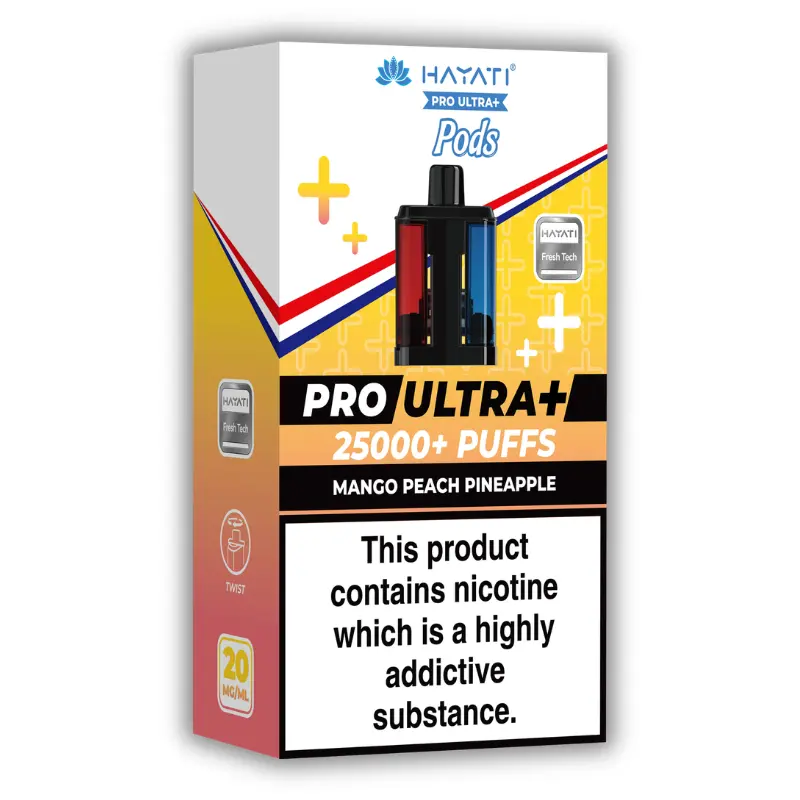
Hayati · Pro Ultra Plus
Mango Peach Pineapple Hayati Pro Ultra Plus 25K Pods
£7.99
✔ In stock — ready to ship
Genuine Hayati
Free over £20
Same-day dispatch
Secure checkout
£7.99 buys one sealed Hayati Pro Ultra Plus pod holding 22ml of prefilled liquid at 20mg nicotine salt, flavoured as a single Mango Peach Pineapple blend. No hardware travels with it. If there is no Pro Ultra Plus in your pocket already, this pack contains nothing you can draw on, and the complete Mango Peach Pineapple kit at £11.99 is the listing that will actually work on arrival.
The name has no slash in it, and on this shelf that punctuation carries information. Three fruits were combined into one recipe before the pod was sealed, and that one recipe fills all 22ml. There is no second liquid held apart, and no half of the volume waiting behind a selector. The kit listing for the same blend works through what that means draw by draw, in the order the fruits arrive and why pineapple gets to the front of the queue, so none of that is repeated at length here.
What is worth a page of its own is the thing that changes when you buy this liquid for the second time. The kit page ends on an observation: of the three fruits, peach is the one that fades first, so its absence is a reading on the state of the pod rather than a fault in the liquid. That is a useful thing to know once. It becomes something considerably more useful when you have already finished one of these, because you have a memory of what Mango Peach Pineapple tastes like on a working coil, and almost nobody holds one. A first-time buyer has no control sample. Whatever their pod does on day one becomes their definition of the flavour, correct or not. You have a before.
Three things follow from owning that before, and they are what the rest of this page is about. You can tell whether a new pod turned up in decent condition. You can notice when one pod is not behaving like the last one. And you can make a defensible decision about when a pod that has drifted heavy is finished rather than merely fading. There is also a cost to buying a three-fruit blend as a refill rather than a pairing, and it is set out honestly further down, because it is not small.
The reference sample you were not aware of collecting
Anyone who has emptied one of these pods is carrying a calibration standard around in their head. It is imperfect, it decays, and it is the only one available, since nothing printed on the pack tells you what the liquid is supposed to taste like at any point in its life.
Why three fruits make a better standard than one
A single-fruit pod gives you exactly one thing to compare across purchases, and that thing is intensity. Intensity is the least trustworthy quantity your palate produces. It moves with the weather, with what you last ate, with how long the previous coil had been running, and with whether you are paying attention. Two pods of a plain mango liquid can differ noticeably in strength and you will never be confident which of them was the odd one, because the measuring instrument is you and you are drifting.
A three-part recipe gives you something categorical instead. Mango and pineapple are both loud enough that they are always audible. The peach is not. It sits in the handover between the two of them as a soft, faintly floral smoothing, and it is either there or it is not. You are not judging whether it is slightly quieter than last time, which would be hopeless. You are answering yes or no, and a yes or no survives a wandering palate far better than a magnitude does.
That is the whole of the method, and it is deliberately unambitious. One question, asked of one component, at a fixed point in the pod's life. The answer tells you more about the pod in front of you than the liquid window does, because a pod can be visibly three quarters full and already past the point where the recipe is intact.
Taking the reading properly
A measurement is only worth anything if you take it the same way twice, so it is worth being slightly pedantic about the conditions. None of this takes extra time, it just takes doing it deliberately rather than whenever you happen to think of it.
Take the reading on the second day of a pod, not the first hour. A freshly fitted pod is saturated in a way it will not be later, and that surplus pushes the whole profile towards the heavy end, which is the same direction that age pushes it. Measuring at the moment of fitting is therefore the worst possible time, because the two distortions point the same way and you cannot tell them apart.
Take three or four unhurried draws with a gap between them. Consecutive pulls run the coil hotter, and heat costs you the delicate part of a blend before it touches the dense part, so a chain of five quick draws will hide the peach on a perfectly healthy pod. Ten or fifteen seconds between each is sufficient.
Take it on a neutral palate. Coffee, mint and anything strongly savoury will each flatten the middle of this blend for a good while afterwards. Mid-morning, before you have eaten anything assertive, is a reasonable standing appointment.
Then write it down, which sounds like an absurd amount of effort until you see how little it is. Three words in a note on your phone, with a date: clear, faint, or gone. Do that for three pods and you have a record of your own supply that no listing on this site can give you, because the condition of a given pod on a given week is not a fact anyone can publish in advance.
Where the standard is unreliable, which is worth admitting
Memory of a taste is not a recording. It is reconstructive, and it reconstructs optimistically. What people remember of a pod they enjoyed is the best draw they had from it, not the average one, and the best draw of a 22ml pod probably happened in the first few days. Compare a new pod against that and everything will seem slightly diminished, including pods that are entirely fine.
There is also a longer-running bias. If you have been on the same blend for several pods in a row, the version of it living in your head is an average of several pods rather than a fresh one, and averages include the tired weeks. This cuts the other way: it makes a new pod seem better than it is. Neither bias is correctable by trying harder to be objective. The only real defence is the written note, because a note taken on day two of the last pod is not subject to either.
Reading a pod that has just arrived
The freshness question is the one this method answers best, and it is a real question rather than a manufactured one. Liquid ages in a sealed pod as it ages anywhere, and the aromatic compounds that give a peach its identity are among the first things to go, well before anything happens to the sugar or the acid. A pod that has spent a long summer in a warm store room is not spoiled. It is blunted, and it is blunted in a specific, predictable place.
What a missing peach on a brand-new pod actually tells you
If you fit a new pod, wait a day, take the reading under the conditions above, and find mango and pineapple present and no soft middle between them, you have learned something the packaging cannot tell you. Fresh liquid on a fresh coil should have all three parts. Two out of three on day two is not the normal starting condition for this blend.
It is worth stating plainly what this does not tell you. It does not identify a cause. It could be storage heat, it could be the age of the fill, it could be a coil that is wicking poorly from the outset, and none of those can be distinguished from the chair you are sitting in. Hayati publish no manufacture date, no fill date and no batch reference against this listing, so there is no code to read off the pack and nothing to cross-check. Anyone claiming to diagnose a pod from a description of how it tastes is guessing.
What the reading is good for is deciding whether to say something. A pod that is missing a third of its recipe on the second day is worth raising with us rather than working through in the hope that it improves, and it will not improve, because nothing in a sealed pod gets more aromatic with use. Most pods are ordinary. The occasional one is not, and the only person positioned to notice quickly is somebody with a before.
Two confounds that will mislead you if you let them
The first is your own coil history, and it catches people on every refill purchase regardless of flavour. Coming off a coil that had been running for weeks, a new pod frequently seems thin, because a worn coil does not simply get quieter, it thickens and sweetens as residue builds against the mesh. That general trap is argued out properly on the Grape GB / Blue Razz GB refill listing, which is the page on this site that deals with the economics and the psychology of reordering, and there is no sense in rehearsing it twice.
What matters here is how it interacts with the peach reading, and the interaction is favourable. A worn coil biases you towards expecting a heavy, mango-leaning profile. If anything, that makes a fresh pod's brightness stand out more, not less. So the bias runs against a false alarm rather than towards one. A missing peach on a new pod, judged by somebody who has just come off an old one, is a stronger signal than it would be from a neutral starting point, not a weaker one. Intensity comparisons across that transition are worthless. A presence-or-absence comparison mostly survives it.
The second confound is the journey. A pod that has been in a van in July has been warm for longer than anything in your house will be, and the first draws after fitting a travelled pod are frequently thick and slightly stewed for reasons that have nothing to do with the liquid's condition. This is exactly why the reading belongs on day two. Give it a night upright in a cool room and a handful of ordinary draws before you decide anything. A pod that was merely hot recovers. A pod whose aromatics have gone does not.
Batch variation, and what a blend lets you see of it
Two pods of the same flavour are built to a tolerance, not to an absolute. Mesh, wick, the fit between them and the exact fill all vary a little, and across a range this size that variation is real and ordinary. Most pods land in the middle of the spread. A few come up quieter and a few livelier, and there is nothing sinister in it.
On a single-fruit pod all of that variation arrives as one undifferentiated impression: this one seems a bit weaker. On a three-part recipe it separates out, because the components do not all fail in the same way, and the pattern of what moved is more informative than the fact that something did.
Three patterns are worth learning to recognise, and it is worth being candid that these are patterns rather than diagnoses, since Hayati publish no coil resistance, no wattage and no airflow figure for this pod and there is no specification to reason from.
- The soft middle is gone, the other two are full. Pineapple still bright at the front, mango still dense behind it, nothing in between. This is the ageing signature, and it is the one that shows up on a pod that has been stored warm or has simply sat a long time.
- Everything is present but flat. All three fruits identifiable, the whole draw quieter and thinner than you remember, vapour a little sparse. This reads as a wicking or draw-rate difference rather than a liquid one, and it sometimes settles after a day of gentle use.
- The front has lost its edge but the middle is intact. Peach audible, mango fine, the pineapple's tart lift blunted into general sweetness. This is the least common of the three and the most disorientating, because the blend still has structure but the wrong part of it.
A caution attached to all of this. It is possible to turn pattern recognition into a hobby of suspicion, and that is a worse outcome than not noticing at all, because you will start finding faults in pods that are behaving normally. The honest baseline is that most pods of this blend are unremarkable and taste like the last one. The reading is there so that the genuine outlier registers quickly. It is not an invitation to audit every draw.
One thing that is not batch variation and gets mistaken for it. The same blend exists on other hardware, as Mango Peach Pineapple Hayati Pro Max Plus Pods at £5.49 and as the Mango Peach Pineapple Pro Max Plus 6000 pod kit at £7.99. Those are different pods for a different device, and a different coil presents a recipe differently even when the recipe is identical. They are close relations rather than control samples. Judging this pod against a memory of one of those tells you about the hardware, not about the fill.
The mango end: finishing a pod, or stopping
The drift is in one direction. As a coil ages the fragile part of the recipe goes first and the dense part goes last, so this blend moves steadily towards mango and never the other way. The kit page sets out why in detail. The question left over, and the one that actually costs you money, is what to do once it has started.
Spent is three different points, not one
Most people treat a pod as finished when it stops producing vapour, because that is the only unambiguous signal available. On a layered liquid that is much too late, and treating it as the cut-off means the last stretch of every pod is spent on something you would not have bought.
There are really three stages, and they are separated by days rather than minutes.
Stage one: the soft middle goes. Two thirds of the recipe is still working. What you have is a bright pineapple front over a dense mango body, which is a perfectly reasonable tropical liquid in its own right, just a simpler one than the one on the label. Nothing here says stop. This is the moment the reorder goes in, because you now know roughly how long you have left.
Stage two: the front loses its edge. The pineapple's tartness dulls into general sweetness and the acid lift that was keeping the mango honest stops arriving. This is the real cut-off, and it is the one worth learning to catch, because what remains is a flat sweet mango with no relief in it and no cooling anywhere in the pod to stand in. It is not unpleasant. It is simply not the product. Most people push on through this stage for a week or more without ever consciously registering that it happened.
Stage three: vapour thins. By this point the liquid has been one-dimensional for some time. The only thing arriving here that did not arrive at stage two is the certainty.
The waste that is actually available to you
A single-blend pod removes one category of waste entirely, and it is worth saying so. On a paired pod, part of what you paid for can be stranded because you favoured one side and the shared coil gave out with the other still in there. That cannot happen to you. There is one liquid, you are drawing on all of it, and every millilitre is a millilitre of the thing you chose. Anyone wanting the arithmetic of stranded volume on a dual pod will find it worked through on the Grape GB pairing linked above.
The waste available on this listing is a different shape. It is not liquid left behind, it is liquid consumed after the recipe stopped being the recipe. Running three or four days past stage two does not save you anything, because the pod is not getting cheaper, and it quietly resets your idea of what the blend tastes like, which then makes the next fresh pod seem oddly sharp. That is the mechanism by which people talk themselves into believing a new pod is wrong when it is the only accurate one they have had in a fortnight.
When finishing it anyway is the right call
Two situations where carrying on past stage two is defensible, because a rule with no exceptions is not an honest rule.
The first is that some people prefer the late phase. A thick, sweet, uncomplicated mango is a legitimate thing to enjoy, and if the last week of every pod is the part you look forward to, that is worth noticing rather than overriding. It does carry a conclusion, though: you are paying for three fruits and using one, and a mango-forward listing or the simpler Peach Mango Hayati Mini Ultra Pods at £3.49 would serve you better and cost less.
The second is supply. If the replacement has not arrived, a stage-two pod is still a working pod and there is no reason to bin it on principle. The point of catching stage one is precisely to avoid ever being in that position, since the reorder window opens the moment the soft middle disappears and that gives you a comfortable amount of notice.
Specification, and what the table leaves out
| Product | Mango Peach Pineapple Hayati Pro Ultra Plus 25K Pods |
| Brand | Hayati |
| SKU | HPU-25K-PODS-MANGO-PEACH-PINEAPPLE |
| Price | £7.99 |
| Supplied | Replacement pod only. No device in the pack. |
| Requires | A compatible Hayati Pro Ultra Plus, bought separately |
| Liquid | 22ml, prefilled, not refillable |
| Flavour | Mango Peach Pineapple, one blended recipe throughout |
| Second flavour | None. No slash in the name and nothing to select. |
| Sweetness | Medium to sweet |
| Cooling | None listed and none detectable |
| Nicotine | 20mg nicotine salt, no other strength offered |
| Manufacturer rating | Up to 25,000 puffs, produced by laboratory measurement |
| Coil | Built into the pod, not a serviceable part |
For a second-time buyer the interesting thing about that table is not any row in it. It is the absence of the rows you want.
There is no fill date, no manufacture date and no batch reference published against this product. That absence is directly relevant to everything above, because it means there is no way to know from the listing whether the pod arriving on your doorstep was filled last month or last year, and no way to tie two pods that behaved differently to anything traceable. Your own note is the only record that exists on your side of the transaction. That is not a complaint about Hayati specifically, since dating is uncommon across the format, but it is the reason a personal reading is worth taking at all.
There is also no coil resistance, no wattage and no airflow figure anywhere in this pod's documentation. Pages elsewhere in the trade will quote you all three with great confidence. They are not reading them off this specification, because this specification does not contain them, and a number invented once tends to get copied until it looks corroborated.
The puff rating has a particular and limited use on a repeat purchase. It is a constant. It does not change from one pod to the next, which means it cancels out of any comparison you make between two of your own pods, and therefore it explains nothing about why one behaved differently from another. Treat it as a way of lining this format up against a different one, and nothing more. The Pro Ultra Plus Shisha 30000 pods carry a higher figure on the same shelf at the same £7.99, which is the kind of comparison the number is genuinely built for.
One row does change meaning on a second purchase. "Second flavour: none" is neutral information the first time you read it. The second time it is a constraint you have now lived with for 22ml, and it deserves its own section.
Nothing to turn: the honest cost of a single blend
The device carries a rotating collar under the mouthpiece. On the paired listings it opens the airway to one liquid or the other. On this pod there is one liquid, so the collar has nothing behind it and turning it changes nothing you can taste. That much is mechanical and unremarkable.
The consequence for a repeat buyer is not unremarkable at all. On a pairing, palate fatigue has a free escape route built into the product. Get bored of one side halfway through and the other side is right there at no extra cost, which is worth more over 22ml than the marketing for those pods ever bothers to claim. Here there is no such route. When you tire of Mango Peach Pineapple, and 22ml of a sweet, uncooled, warm-finishing liquid is long enough that many people do, the only move available is to stop buying it or to carry a second pod.
It is worth being clear that this is a genuine disadvantage and not a trade with an obvious winner. Fatigue on a large pod is real, it is not a defect in the liquid, and it arrives faster on profiles with no cold element to reset the palate between draws. This pod has no cold element at all.
The counter-argument exists and it is the reason blends get made. Three fruits means there is something happening inside every inhale, and for some people that internal movement is exactly what keeps a large pod from becoming background noise. A pairing gives you two static things and a switch. A blend gives you one thing that does not sit still. Which of those tires faster is a matter of how you vape rather than a fact about the products, and the only way to know which type you are is to have finished one of each.
If you have finished this one and the answer is that you want an escape route next time, the useful thing is not a random rotation but a pairing that keeps some of what you liked. Cherry Ice / Peach Mango is the closest structural answer on the shelf, because one side is two of your three fruits and the other is a cold red fruit standing by as a reset. Sour Apple / Juicy Peach keeps peach as a headline rather than a bridge and puts a genuine acid bite opposite it. Blue Razz Pineapple / Strawberry Ice keeps the pineapple and puts the cold on the other side. All three are £7.99, the same as this, so the switch costs nothing beyond the risk of preferring what you had.
Neighbours, judged with a reference point in hand
The advantage of having finished one of these is that every other listing on the shelf can be described to you in terms of a liquid you already know, which is a much more useful frame than an adjective.
Taking a fruit out
Peach Mango on the Mini Ultra format, linked above at £3.49, is this blend with the pineapple removed. Without the acid lift the peach stops being a bridge and becomes a proper voice, but you lose the cut, and two soft low-acid fruits stacked together are heavier over a long run than three with a sharp one on top. Juicy Peach goes further and strips everything except the middle fruit across the full 22ml at the same £7.99, which is the right purchase for anyone whose conclusion after one of these pods was that the peach deserved more room.
Pineapple is scarce in this range, so if the front of the draw was the part you valued, the options are thin. The Blue Razz Pineapple pairing named above is the realistic one, and it puts the fruit in completely different company, behind a blue raspberry tang instead of in front of a mango, where it reads noticeably sharper for want of anything heavy to absorb it. The pineapple vapes shelf is short enough to read end to end, and the mango vapes and peach vapes shelves do the same job for the other two fruits across every Hayati format.
Staying tropical without staying here
Straw' Guava / Dragon Berries is the listing that goes furthest into the same territory, and it does it as a pairing rather than a blend, so it answers the fatigue problem and the exotic brief at once. The wider exotic vapes shelf collects everything of that kind across the catalogue. Kiwi Banana / Straw' Banana leaves the tropical idea intact but changes the fruit family entirely, and banana behaves more like the mango in this pod than like the pineapple, which is worth knowing before you order it expecting a lift.
Going drier
Sweetness is the most common reason a buyer of this pod wants something different next, and the honest fix is citrus or a soft-drink profile rather than a different fruit. Lemon and Lime / Summer Dream puts the sharpest thing on the shelf on one side of the pod. Blue Razz GB / Lemon and Lime hedges, keeping a sweet confectionery half in reserve. Blackcurrant Lemonade and Straw' Lemonade take the lemonade route, which reads drier than a fruit blend at a similar sugar level because the carbonated character does some of the work that acid does here. Cola Ice is the one listing on this shelf built on nothing fruit-shaped at all, and it is cooled, so it is the furthest thing from this pod that the range sells at the price.
Going sweeter, or going plainer
Some people finish a tropical blend and want more sugar rather than less. H'Bubba is the bubblegum build on its own, Blueberry H'Bubba / Watermelon H'Bubba runs the same treatment across two fruits, and Blackcurrant Cotton K / Blue Raspberry swaps chew for spun sugar on one half. All of those sit clearly above this pod for sweetness, and none of them has any cooling either.
In the other direction, the berry listings are where uncomplicated lives. Blueberry Raspberry is the plainest two-fruit pod in the range and is a genuinely useful benchmark for what one clear idea per draw feels like after three. Blueberry Raspberry / Mr Blue steps the same theme up rather than sideways, Blue Sour Raspberry leans on the tart edge, and Blue Razz Cherry deepens it with a darker fruit. Strawberry Ice / Strawberry Raspberry Ice brings cooling to both halves, which is the firmest palate reset the format offers. Grape GB / Strawberry GB and Blue Razz GB are the sweet-shop end of the same shelf if the confectionery register appeals more than the fruit one.
Where to browse
The Pro Ultra Plus pods shelf is the one to work through if you are rotating inside the format, since everything on it is £7.99 and the only thing a switch costs you is the risk of preferring the old one. Pro Ultra Plus kits and pods together is the place to look if you are weighing a second device rather than a second pod, prefilled pods and refills widens it across every Hayati system, and Hayati Pods lines up all the pod formats the brand builds, newest arrivals included.
Handling a pod you intend to measure
General pod advice applies to this one as it does to everything else on the shelf. What follows is the part that is specific to a warm, uncooled, three-part tropical liquid that you are trying to keep readable.
Separate the two kinds of mango shift. This is the single most useful distinction on the page. A pod pushed towards mango by heat, by chain-drawing, or by having just been fitted will come back to itself after a rest. A pod pushed towards mango by coil age will not. If the soft middle vanishes on a hot afternoon and returns the next morning, nothing has been lost. If it goes and stays gone across two calm days, that is stage one and the clock has started.
Keep spares away from heat and light. A drawer or a cupboard is entirely adequate. A windowsill, a dashboard and the shelf above a radiator are not, and the reason is not dramatic: sustained warmth over weeks strips the volatile end of a profile, and on this recipe the volatile end is the fruit you are using as your indicator. Store a pod badly and you have broken your own instrument before you fit it.
Buy one ahead rather than a stack. Ordering six feels efficient and mostly ages your own supply, since the last one reaches your device months after the first and this is a blend whose most interesting component does not enjoy waiting. One spare covers the delivery gap, which is the only problem stockpiling genuinely solves.
Let a travelled pod settle. A minute upright and a few unhurried draws before you form any view. This matters more to you than to a first-time buyer, precisely because you have an expectation and you will apply it immediately.
Do not judge it at the end of a long session. A palate that has been working for an hour on a sweet uncooled liquid has stopped registering the subtle third of it, and a reading taken there will report stage one on a pod that is fine.
Keep nicotine products where children and pets have no access. A sealed pod is not a locked one, and spares count as well as the pod in use.
Retire it properly. A finished pod still holds a coil and a residue of liquid, so it belongs at a vape retailer's take-back point or a local recycling facility rather than in household waste. There is nothing serviceable inside to keep back for later.
Questions from people buying this again
Is there a device in the pack at £7.99?
No. This is the pod on its own, sealed and prefilled, with no battery, no charger and nothing you can draw on without a Pro Ultra Plus already in hand. The complete kit version of the same blend is a separate listing at £11.99.
Is the liquid the same as the one in the kit?
Yes. Same three-fruit recipe, same 22ml, same 20mg nicotine salt, same manufacturer rating. What differs between the two listings is the presence of hardware in the box, not anything about the pod itself.
Is this three separate flavours in one pod?
No, it is one liquid made from three fruits. The absence of a slash in the title is the marker: pods with two distinct liquids put a slash between the names and let you pick between them. All 22ml here is the same blend from the first draw to the last.
My new pod has no peach in it. Is something wrong with it?
Possibly, though the reading is worth taking properly before deciding. Give it a day, then a few unhurried draws on a neutral palate, because a freshly fitted or recently travelled pod reads heavy for reasons that pass. If the soft middle is still absent after that, get in touch rather than working through the pod, since nothing about it will improve with use.
Can two pods of this flavour genuinely differ?
They can, within the ordinary tolerance any manufactured coil is built to. Most land in the middle of that spread and taste like the last one. What a blend gives you over a single fruit is the ability to notice which part moved rather than just registering that something did.
When should I stop using a pod that has gone heavy?
The practical cut-off is the point where the pineapple's tart edge dulls, not the point where vapour thins. Losing the soft middle happens earlier and is the signal to put the next order in. After the edge goes you are drawing on a flat sweet mango, which is fine but is not the blend you chose.
Does turning the collar do anything here?
Nothing you can taste. It selects between two liquids on the paired listings and there is only one liquid in this pod, so the control is present and unused. People arriving from a pairing reach for it out of habit and occasionally conclude the unit is faulty, which it is not.
Is anything in this pod cold?
No coolant, no menthol and no ice are listed, and none is detectable in use. The finish runs warm the whole way through. That absence is more noticeable on a dense mango base than it would be on a light berry, because nothing pulls the sweetness back down between draws.
Is there a batch code or a date on the pod?
None is published against this listing, so there is no fill date, no manufacture date and no batch reference to check. That is the practical reason for keeping your own short note of how each pod read on its second day, since no other record of it exists.
Can I refill the pod or change the coil?
No to both. Nothing in the product's description provides for topping it up, and the coil is fitted inside the pod rather than being a serviceable part, so the pod's working life ends with the mesh and the whole thing is replaced together. That is the trade for a sealed 22ml that needs no filling.
Is a different nicotine strength available?
Not on this listing. It is offered at 20mg in salt form with no alternative published, so the strength is settled by the product rather than chosen by you. Nicotine is addictive, and it is worth registering that you accept this figure again with every reorder rather than only once.
Is there a cheaper way into this blend?
The Pro Max Plus version at £5.49 costs less per pod, but it needs Pro Max Plus hardware and Hayati do not publish its capacity on the listing, so a lower price tells you nothing definite about cost per millilitre. Within the Pro Ultra Plus format this pod is the cheaper of the two routes, since the kit charges you again for a device you already own.
The short version
A replacement Pro Ultra Plus pod at £7.99, carrying 22ml of 20mg nicotine salt as a single Mango Peach Pineapple blend, rated in Hayati's laboratory at up to 25,000 puffs. No device is included and the pod is not refillable. The flavour itself is set out properly on the kit listing, and if you are still deciding whether three fruits in one liquid suits you, that is the page to read instead of this one.
For a second purchase the useful material is different. You have tasted this blend on a working coil, which makes you the only sort of buyer who can tell a fresh pod from a tired one, because the soft middle of the recipe is either present or it is not and that is a question a wandering palate can still answer. Take the reading on day two, on a neutral palate, with gaps between the draws, and write down one word. Three pods of that and you know your own supply better than any specification will tell you.
The honest cost is the missing escape route. A pairing lets you turn the collar when you tire of one side. This pod gives you 22ml of one idea and nothing to fall back on, and on a sweet liquid with no cooling that is a real constraint rather than a technicality. If it turns out to be the thing that ends your interest, the answer is a pairing that keeps a fruit you liked, and every one of them costs the same £7.99 as this.
Strictly for adults aged 18 and over. Nicotine is an addictive substance.
You might also like


