
Home / Hayati Nicotine Pouches / Ice Cold Hayati Nicotine Pouches
Hayati
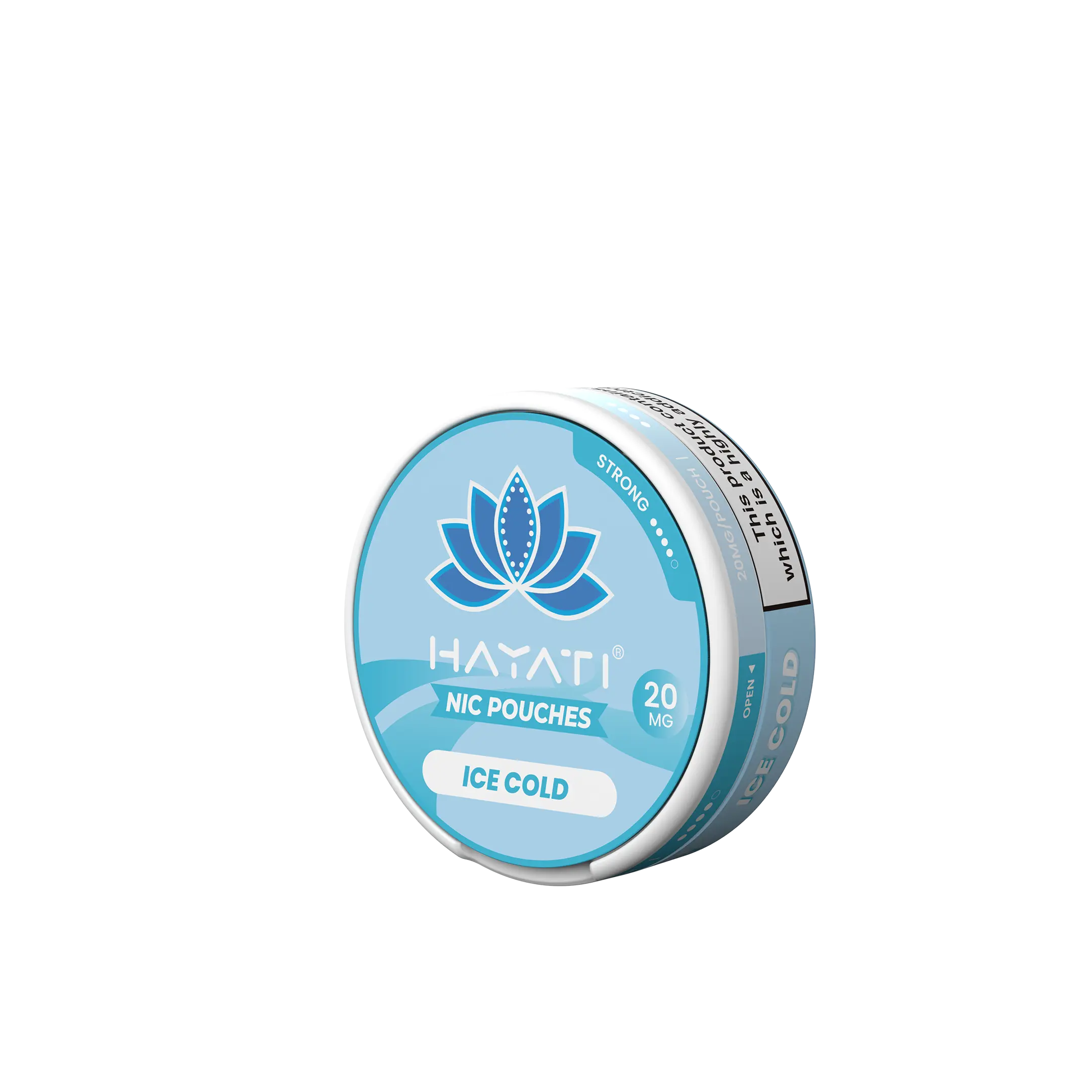
Ice Cold Hayati Nicotine Pouches
£4.49
✔ In stock — ready to ship
Genuine Hayati
Free over £20
Same-day dispatch
Secure checkout
Ice Cold Hayati Nicotine Pouches is a can of oral nicotine pouches, priced at £4.49 and listed by Hayati at 12mg, containing no tobacco. It is not a vape and it shares almost nothing with the rest of this catalogue except the brand on the lid. A pouch is a small sealed sachet of white fibre holding nicotine and flavouring material. It goes under the upper lip and rests against the gum, its contents dissolve gradually into saliva while it sits there, and when you have finished with it you take it out and drop it in a bin. Nothing is heated, nothing is burned and nothing goes anywhere near your lungs. There is no battery, no coil, no liquid and no device of any kind involved in owning one.
What makes this particular can worth a long page is not the format, which two other pages on this site have already worked through properly. It is the name. Every other listing Hayati sell points at something you could put in your mouth and taste: a fruit, a drink, a sweet, a herb, a leaf. This one points at a temperature, twice. There is no fruit in the title, no fruit in Hayati's own filing of it, and no fruit anywhere in the two sentences of flavour copy attached to it. The listing offers a sensation and declines to offer a flavour, and as far as this catalogue goes that is not merely unusual. It is the only case of it.
That single fact drives everything worth saying here, and it drives it in three directions. It makes the product a coherent design rather than a gap, because cooling happens to be the one thing this format is genuinely strong at. It makes adaptation the entire content of a session rather than one process among several, which changes what twenty minutes feels like and changes what a day of them feels like. And it removes the only way buyers normally have of telling one listing apart from its neighbours, which leaves a buyer here with less to go on than anywhere else in the range. The last of those is the most useful thing on this page, and the section that deals with it ends by giving you the best substitute available.
The name points at nothing edible, and the catalogue confirms it
Take the two words separately. "Cold" names a temperature. It is a property of things, not a thing, and there is no substance it refers to. "Ice" does name a substance, frozen water, and frozen water is the one material in the food world with no flavour of its own at all. So between them the two words in this title name one flavourless solid and one physical property, and nothing you could serve on a plate. Every other named product in this range fails that test immediately, because the whole point of a flavour name is to tell you what the thing is meant to taste of.
Counting it, because an assertion of uniqueness deserves a number
This site has a standing rule about claims of rarity, which is that they are hypotheses until somebody counts them. So I counted. Strip the platform and format words off all 492 titles in the catalogue, leaving only the flavour name, and ask which of those names consist entirely of cooling vocabulary. Four listings come back. Menthol Hayati Pro Max Nic Salt is one. The two Double Menthol listings, a set of Pro Max Plus pods and the matching 6000 pod kit, are the second and third. This can is the fourth. That is the whole set out of 492.
The same test run on Hayati's own product tags returns the same four, which is the part worth pausing on. Tags in this catalogue are assigned separately from titles and are not simply a copy of them, so two independent routes arriving at the same four listings is a check rather than a restatement. Ice Cold carries the tags "ice" and "ice cold" and nothing else. Menthol and Double Menthol carry a menthol tag alongside a format tag describing what kind of product they are. Every other tagged listing in the range, all 487 of them, carries at least one tag naming a flavour family or a product name that points at something edible.
Now separate the four, because they are not the same kind of thing. Menthol is not a sensation. It is a molecule, and it has an aroma of its own that anybody would recognise as minty. The Spearmint page in this corpus set out the chemistry and the Frosted Mint pouch page summarises it accurately: menthol binds the cold channel in the tissue of the mouth and also contributes a substantial share of what a mint tastes like, while carvone contributes the taste without the cold. So a product called Menthol names an ingredient. It happens to be an ingredient with a strong secondary effect, but the word on the label is the name of a thing in the bottle.
Ice Cold names no ingredient. It names what the ingredient does. Nothing in the title tells you what is in the pouch, only what you will feel, and the two words chosen to say it are a temperature and the commonest flavourless substance there is. On that reading the count is not four. It is one, out of 492.
Hayati's own filing agrees, which is the strongest evidence available
Product data is a better witness than marketing copy, because it was never written to be read by a buyer. The Frosted Mint pouch page made that argument first and applied it to the naming question, and its finding is worth citing rather than rebuilding: Hayati's tags treat this can as chill-led and treat Frosted Mint as taste-led, with Ice Cold picking up a cooling tag and a place on the Ice Vapes shelf while the mint picks up a flavour-family tag and no cooling tag at all. That page also notes that Hayati themselves make the comparison in the Frosted Mint flavour text, positioning the mint as the one where taste leads and this one as the one built around the chill. Both points are theirs and both hold.
What can be added on this side of the comparison is the shelving. Look at where the eleven cans are filed. Mango Ice sits on the mango shelf, the exotic shelf and the sweet shelf. Grape Ice sits on the grape shelf. Banana Ice sits on the banana shelf. Blueberry sits on the berry shelf and the blueberry shelf. Cola sits on the cola shelf, Coffee has a coffee tag, Bubblegum is filed with the sweets, Strawberry Lychee and Ruby Berry are both on the berry shelf, and Frosted Mint is with the mints. This can is filed on the pouch shelf, on Ice Vapes and on New Products. Those are a format shelf, a sensation shelf and a chronological shelf. It appears on no flavour-family shelf anywhere in the catalogue, and among the eleven cans it is the only one that does not.
On the cooling vocabulary itself there is nothing left to establish. The Blue Frozen pods page ran a census of every cold word across all 492 titles and found the words are not a graded scale, and the Mango Ice pouch page added the amendment that this can and Frosted Mint are the only two titles that stack two cooling words together. I re-ran the union of those word counts against the catalogue file before citing it and it comes to 121 titles carrying a cold word, which is the figure both pages report. The conclusion stands and does not need restating: the word Ice in a Hayati title carries no information about how cold anything is. What is new here is narrower and it is about position rather than vocabulary. Stacking two cooling words is one thing. Stacking two cooling words with nothing else in the name is another, and only this listing does it.
A name that withholds nothing, which is rarer than it sounds
Several Hayati products are named for a mood or a colour rather than for an ingredient, and this corpus has written a good deal about the problem that creates. Black Mamba Hayati Pro Max Nic Salts is the obvious example: the name tells a buyer nothing whatsoever about what the liquid contains, and the page covering it has to make the information gap its subject because there is no honest alternative.
It would be easy to file this can in the same drawer, and that would be wrong. An opaque name withholds information that exists. Somebody at Hayati knows what is in a Black Mamba bottle and has chosen not to put it on the label. Ice Cold withholds nothing, because there is no fruit being kept from you. The name is a complete and accurate description of the product's entire sensory proposition, delivered in two words. It is arguably the most informative name in the range relative to how much there is to say, and the reason it feels thin is not that the name is evasive but that the product genuinely has one property. Those two situations look similar on a shelf and they are opposites, and the difference matters for what a buyer should do next. With an opaque name you are missing a fact. Here you have all the facts there are, and the facts are just short.
A cooling sensation is not a taste, and it is not a lesser thing either
It is tempting to treat a product with no flavour as a product with something missing, and to write about it as a subtraction. That is a misreading of what is happening in your mouth, so it is worth being precise.
Cooling is not a taste and it is not an aroma. It is a receptor event in the same category as the burn of chilli or the tingle of carbonation, and it works by a compound binding to a temperature-sensing channel in the nerve endings of the oral tissue. That channel is the same one that reports genuine cold. Nothing in the pouch is at a low temperature and no heat is leaving your mouth, but the signal arriving at your brain is the signal your brain uses for cold, so the sensation is not an illusion or an approximation. It is a real and specific perceptual event with its own machinery, and it is no more a substitute for flavour than flavour is a substitute for it. They are different systems doing different jobs.
The delivery question follows from that, and the Mango Ice pouch page has already settled it at length. Its conclusion, which there is no point in deriving twice, is that an oral pouch is a poor route for the volatile aroma that carries the identity of a named fruit, because there is no heat to lift it, no aerosol to carry it and no exhale to push it past the receptors that read it. That same page establishes the other half: a coolant needs none of those things, only contact with tissue, and a pouch parked against a gum provides contact continuously rather than in the brief pulses a draw delivers. It concludes that cooling is the one property a pouch arguably supplies better than a pod does rather than merely as well.
Put those two findings next to this listing and the design reads differently. Of the eleven flavours on the Hayati Nicotine Pouches shelf, ten are asking the format to do something it does badly. Mango Ice needs a lactone fraction to reach a nose that the format gives it no route to. Blueberry needs berry esters to do the same. Coffee needs roast aromatics, Cola needs spice and citrus notes, and even Frosted Mint, which the mint page argues is the best-matched of the flavours, gives up its aromatic top. Every one of those products is a compromise between a channel the format serves well and a channel it serves poorly, and the interesting question on each of those pages is how much survives.
This can has no exposure to the weak channel at all. It is the only listing on the shelf whose success or failure is decided entirely by the thing the format is good at, and that is a coherent piece of product design rather than a lazy one. Somebody took the format's single strongest capability and built a product that asks for nothing else. Whether it is executed well is a separate question and one nobody can answer from the listing, but the concept is sound and it is sound for a reason specific to pouches.
The argument for no flavour is stronger in this format than it would be in a vape
Here is the part that does not transfer from the pod shelf, and it is the best case anyone can make for this product existing.
A flavour in a vape is an event you repeat. Each draw puts it in your mouth for a second or two and then it clears, and the gaps between draws are the majority of your day. If you tire of a flavour you stop drawing on it. A flavour in a pouch is not like that at all. It is in your mouth continuously, in contact with the same tissue, for as long as the pouch is in place, and you cannot put it down for thirty seconds without ending the session. Committing to a taste for twenty-five unbroken minutes is a materially larger commitment than committing to it for two seconds at a time, and the format offers no way to reduce the exposure short of removing the product.
Which means that a buyer who wants the sensation without the taste has a much better reason to want it here than they would on a pod. On the vape side, a cooled fruit is a fruit you experience in short bursts, and the nearest things to this can in that range are the Menthol and Double Menthol listings, neither of which is truly flavourless because menthol brings its herbal character with it. On the pouch side, an unwanted flavour is a half-hour of an unwanted flavour. The product that removes it is not a stripped-down version of the others. It is the answer to a problem the pod shelf does not have.
What is in it, which Hayati do not say
Honesty requires stating the gap here rather than glossing it. Hayati publish no ingredient information for this can beyond the statement that it contains no tobacco. They do not name the cooling agent, they do not give a concentration, and they do not say whether the pouch contains a sweetener or any aroma material at all.
That last point carries more weight on this listing than on any other in the range, and here is why. On a cooled fruit can, the identity of the coolant is a detail. If it is menthol there will be a faint herbal edge on top of the fruit, and if it is one of the synthetic coolants there will not be, and either way the fruit is the thing you bought. On this can the coolant is the entire product, so whether it carries an aroma with it is the difference between a pouch with a mint-adjacent character and a pouch with no character at all beyond the sensation. The same unpublished fact, applied to a product with nothing else in it, becomes the largest single unknown on the page. Nobody should pretend to know the answer, and this page does not.
A related gap: it is not stated whether the product is sweetened. Sweetness is the channel a pouch delivers most efficiently, since sweeteners are water-soluble by design and land directly on the receptors that report them, and most pouches on the market lean on it heavily for exactly that reason. Whether this one does is unpublished. It matters because a sweetened flavourless pouch and an unsweetened one are quite different objects, and it matters even more once you get to the adaptation section below, because sweetness is the one thing that might still be there when the cold has flattened out.
Twenty minutes in which only one thing is happening
Adaptation is the process by which continuous stimulation of a sensory channel reduces the size of the sensation that channel reports, and it hits coolants hard. The Frosted Mint page has the full treatment of it as it applies to this format, and its central finding is the one to carry across: a pouch compresses the whole coolant adaptation curve into a single sitting, because there are no gaps in the delivery for the channel to recover in, and recovery is slower than onset so the second and third pouch of a day start from a reduced baseline and reach a lower plateau. That is established, it is correct, and there is no value in deriving it again.
What is not established, because no page has had cause to look at it, is what that process does to a product that consists of nothing else.
The difference between a component and the whole thing
On Frosted Mint, on Mango Ice and on the other cooled cans, adaptation to the coolant is one process running alongside several others. The taste of the mint is still there when the cold recedes. The sweetness of the fruit is still there. Those channels do not adapt on the same schedule as the cold channel and they are not driven by the same molecule, so what a flavoured pouch does over twenty minutes is shift its balance. It starts cold-forward and ends taste-forward, and both of those states are the product. A buyer describing that experience would say it changed, not that it stopped.
Take the flavour away and adaptation is not a process within the experience. It is the experience. There is no second channel to take over, no balance to shift towards, and nothing underneath the cold to become more prominent as the cold gets quieter. The shape of a session on this can is therefore much starker than on anything else on the shelf, and it goes roughly like this.
The first minute or two is mostly wetting. Very little is happening, the fibre is taking up saliva, and the reading is close to nothing. This is the phase where people conclude a pouch is weak, and on this can the conclusion is available earlier and feels more definite than it would elsewhere, because there is no sweetness arriving to reassure you that something is in the pouch at all.
Then the ramp, which on a coolant is not instant. The sensation builds rather than lands, and it goes on building for some minutes before it settles. The peak of a pouch is not at the front.
Then the plateau, which is the part people buy this format for and the part no pod can produce. A level, unbroken cold with nothing arriving at a different rate to make the shape uneven. On a flavoured pouch the plateau is textured, because the taste is doing its own thing over the same window. Here it is genuinely flat, and for some people that is precisely the appeal.
Then the decline, and this is where a single-axis product is exposed. The reading falls while the pouch itself is unchanged. On a flavoured pouch you would notice the balance moving. Here you notice the product emptying out. In the last stretch of a long session there is a piece of fibre under your lip, there is nicotine, and there is very little else that you can point at. Whether that is a problem depends entirely on why you put it in, and it is worth knowing in advance rather than discovering it at minute twenty-five.
The one diagnostic advantage of having a single axis
There is a genuine upside to this and it is worth stating because it runs the other way from everything above. On a pod, a flavour going quiet has at least two possible causes and you cannot tell them apart without a test: the coil may be tiring, or your nose may be adapting. Several pages on this site exist partly to help a reader separate those. The Mango Ice page points out that a pouch removes the hardware half of that ambiguity outright, because there is no coil to tire.
This can removes what is left. There is exactly one signal in the product and exactly one thing that can happen to it, so when the cold goes quiet there is nothing to diagnose. It is not the batch, it is not the can, it is not a bad pouch and it is not the lid having been left off. It is your cold channel doing the thing cold channels do under continuous stimulation. That certainty is unusual on a consumer product and it is worth having, because the alternative explanations people reach for when a product seems to weaken are almost always wrong and almost always expensive.
Across a day, where the cost compounds
Run the same logic forward over a day of use and the arithmetic gets less friendly.
A cooled fruit can loses a fraction of its content as the day goes on. The second one is less cold than the first, which the Frosted Mint page explains, but the fruit and the sweetness arrive at more or less full strength regardless, because those channels are not the ones that have been sitting under continuous stimulation all morning. By the fourth pouch you are getting a sweet fruit thing with a modest chill instead of a sweet fruit thing with a strong one. That is a reduced product and it is still recognisably a product.
This can loses most of its content instead of a fraction of it. There is no second channel holding its value. By the third or fourth of a day of steady use, what you have in your lip is close to a delivery vehicle with no sensory character worth describing, and the difference between it and the first of the morning is not a matter of degree in the way it is on a flavoured can. That is the real cost of the design, it is specific to this listing, and no amount of good formulation can remove it, because it is a property of how perception works rather than of what is in the pouch.
Two things follow for anyone thinking about how to buy and use this. The first is that spacing matters more on this listing than on anything else on the shelf, and stacking them through an afternoon is close to pointless, because by the third one the thing you paid for has largely gone and you are consuming the part of the product that was never the reason for buying it. The second is that the value per pouch from this can is at its highest at the start of a day and falls faster than it does from any of the other ten. Whether that makes it good value depends on how you use it, and since Hayati do not publish how many pouches are in a can, nobody can put a figure on either side of that.
The counterweight, stated fairly
None of the above is a reason not to buy it, and writing it as one would be a distortion. The plateau is a real thing that some people actively want, and the Frosted Mint page is right that a long, level, unspiky cold from a single unit is something the vape side of this catalogue cannot produce at all, whatever is in the pod, because a draw is inherently intermittent.
What can be added is that the plateau here is flatter than on any of the flavoured cans, for exactly the reason that makes the decline starker. Nothing else is arriving on a different schedule to disturb the shape. If what you want is one sensation, held at one level, requiring nothing of you and competing with nothing, this product is a more faithful version of that than any of its neighbours, and the fact that it eventually fades is the price of a format that keeps the source in your mouth rather than a fault in the formulation.
What this page cannot tell you, and what to use instead
This is the section that matters most to somebody deciding whether to spend £4.49, and it starts with an admission.
The usual question does not exist here
Every other product on this shelf can be judged against a question that has a knowable answer: does the fruit taste like the fruit. That question is what makes a product page on a flavoured listing worth writing and what makes another buyer's opinion worth reading. The Mango Ice page could argue about whether mango survives the format, and reached a specific and checkable answer. The Frosted Mint page could argue about whether mint does, and reached a different one. Both had a subject with content in it, and both gave the reader a way of deciding whether the argument applied to them.
This can offers no such question. There is no fruit to be convincing or unconvincing, no blend whose components can be identified or missed, no sweetness level to describe, no top note to be present or absent, and no development to trace across a session beyond up and then down. The only two axes on which the product can be judged are how cold it gets and how long it holds that. Those are the entire evaluative surface.
And those are precisely the two things Hayati publish nothing about. No coolant is named. No concentration is given. No intended wear time is stated. No pouch count is stated, so even the crude proxy of arithmetic against the price is unavailable. What the listing publishes is a price, a strength, a format, a disposal instruction and a handful of adjectives describing a chill.
The consequence is worth putting plainly rather than softening, because it is the honest state of affairs. A buyer of this listing has strictly less to go on than a buyer of anything else in the catalogue. On a pod there is at least a capacity and a strength and usually a manufacturer rating. On a bottle there is a ratio and a volume. On a flavoured pouch there is at least a named fruit you can form an expectation about and then find out whether you were right. Here the entire axis on which the product will succeed or fail for you is unpublished, and there is no method a page can hand you for characterising it in advance the way the opaque-name pages hand you a method for characterising an unknown blend. Those methods work because there is something with structure to characterise. One variable and no vocabulary finer than "how cold" leaves nothing to apply a method to.
The best proxy available, in four parts
Saying the information is not there would be a poor place to stop, so here is the nearest substitute, assembled from what does exist. It is not as good as a number and it should not be dressed up as one.
One: there is exactly one published ranking, and it puts this can at the top. Nowhere in the range does Hayati state how cold anything is, but on the Frosted Mint listing they do state something relative. They position the mint as the one where the taste leads and the cooling supports, and they make that positioning by naming this can as the comparison. That is a manufacturer ranking two of their own products against each other on the cooling axis, written by people who know what is in both, and it places this one above the mint. It is a rank and not a level, it gives you no idea of the gap, and it should not be read as a quantity. It is still the only published relative positioning on the shelf and it is worth more than every adjective on this listing combined.
Two: calibrate inside the format, never across it. The instrument to measure this against is one of the cooled fruit cans, not one of your vapes. Mango Ice Hayati Nicotine Pouches, Banana Ice Hayati Nicotine Pouches and Grape Ice Hayati Nicotine Pouches share this can's manufacturer, format, strength, price and shelf, and in all likelihood its coolant stock too, which is the closest anything gets to a controlled comparison here. Take one you already have an opinion about, put it in, and pay attention only to the cold while deliberately ignoring the fruit. Whatever you read there is your floor for this can, and the direction of travel from that floor is upward by an amount nobody publishes. That is a genuinely useful number to hold, because it is a number in your own units, taken on your own tissue, from the same format.
What not to do is calibrate from a cooled vape. The Mango Ice page sets out why a pulsed delivery and a continuous one produce different perceptions of the same molecule, with the pulsed version reading sharper at any instant and the continuous one reading more persistent overall. Reading a level off Cherry Ice Hayati Pro Ultra Plus 25K Pods or Blue Frozen Hayati Pro Max Plus 6000 Pod Kit and expecting the same number here is a category error, and it will mislead you in both directions at once: less sharp than you expected at the peak, more present than you expected an hour later.
Three: take the reading properly, because on this product the reading is unstable. The only axis this can has is also the axis that adapts fastest, which means an unplanned reading is close to worthless. Use the first pouch of a day, on a day where nothing cooled has been in your mouth beforehand, and take the comparison pouch at the same time on a different day. One pouch each time, not two. Do not put this in after a cooled fruit can to compare them back to back, because that measures your adaptation state and not the two products. This costs you two pouches out of two cans and it is the only way to get a reading you can trust on a product where everything else is unpublished.
Four: the axis you control is duration, and it is the only one. Intensity is unpublished and moves with your adaptation state. Duration is set almost entirely by how long you choose to leave the pouch in place, which makes it the one variable in the whole transaction that belongs to you rather than to Hayati. The honest description of what you are buying, then, is an unknown intensity attached to a duration of your own choosing, in a format where the duration is the unusual part. That is not a flattering sentence and it is an accurate one.
A last practical note that costs nothing to say. All eleven cans are £4.49, so the price of finding out is the same whichever answer you get, and it is the same as the price of finding out about any of the others. Buy one before you buy several. That advice is obvious and it is worth writing down here specifically because this is the listing where a buyer has the least basis for predicting the answer in advance.
The specification, which is mostly a list of absences
The table below is short, and the useful observation is not any individual row but where the blanks fall. On most listings the unpublished figures are secondary: nobody's purchase turns on a wick material. Here every single unpublished row sits on the only axis the product has.
| Listing | Ice Cold Hayati Nicotine Pouches |
| Price | £4.49, the same as all ten other flavours in the range |
| Nicotine | 12mg |
| Tobacco | None. Hayati state the pouches are tobacco-free |
| What the name denotes | A sensation. No flavour is named |
| Flavour-family tag in Hayati's data | None. Tagged "ice" and "ice cold" |
| Flavour shelf | None. Filed on the pouch shelf, Ice Vapes and New Products |
| Hardware, charging or refilling | None at any stage |
| Where it goes | Under the upper lip, against the gum |
| End of life | The used pouch goes in a bin |
| Cooling agent used | Not published |
| Strength of the cooling | Not published |
| Whether it is sweetened | Not published |
| Aroma material, if any | Not published |
| Pouches in a can | Not published |
| Weight of a pouch | Not published |
| Intended time in the mouth | Not published |
The strength row deserves a sentence because the figure looks like a position on a scale and is not one. It is 12mg, stated by Hayati, and the Mango Ice page has already done the count that makes sense of it: eleven listings in the entire 492-product catalogue carry that figure and every one of them is a pouch, with no pouch at any other strength. So the number is a property of the format rather than an option you are being offered, there is nothing on the vape side sitting at the same figure to measure it against, and reading it as a rung between the bottles and the pods would be reading it wrong. Within this shelf there is no strength decision to make at all. There is one strength and there are eleven flavours, or in this case ten flavours and one sensation.
The price row carries less information than it looks like it does, for the same reason. Every can on the shelf costs the same, so price cannot be used to rank them, and without a pouch count it cannot be converted into a cost per use either. That removes the unit-economics comparison that most pages on this site lean on, and there is no honest way to reconstruct it from what is published. Any figure you see for cost per pouch on this product has an invented denominator in it.
The two rows recording the absent flavour tag and the absent flavour shelf are in the table deliberately. They are odd things to specify, and they are the hardest evidence available for the central claim on this page, since they come from Hayati's own filing rather than from anybody's reading of a name.
Who this suits, who it does not, and what else to look at
Wanting no flavour is a preference, not an absence of one
A product that offers no taste invites a condescending page, and that would be both unpleasant and wrong. Preferring a sensation without a flavour attached is a considered position that plenty of people hold for good reasons, and the reasons are specific enough to be worth listing.
Some people find a sweet layer sitting against the gum for half an hour tiresome in a way that a sweet layer arriving for two seconds at a time is not. That is a judgement about exposure rather than about taste, and the section above on why this argument is stronger in a pouch than in a vape is the case for it.
Some people have a flavour they are committed to elsewhere and do not want a second one running underneath it. If you have a fruit you use across the day, a second unrelated fruit occupying your mouth for twenty-five minutes is a distraction rather than a bonus, and a product with nothing in it does not compete.
Some people have tried the cooled fruit cans and concluded that the fruit was not worth what it cost the experience. The Mango Ice page is candid about this: a fruit in a pouch arrives quieter, later and simpler than the same fruit on a pod, and what often remains is a general sweetness pointing vaguely at the right part of the fruit spectrum. If your verdict on that was that a vague fruit is more irritating than no fruit, this listing removes it, and that is a rational response to a real property of the format rather than a failure of palate.
And some people simply like cold. That requires no justification at all and it is probably the largest group.
Against that, be clear about who should look elsewhere. Anybody buying primarily for taste should buy something with a taste in it. Anybody who wants variation across a day will find this the worst listing on the shelf for it, because there is one axis and it is the axis that flattens fastest. And anybody who likes being able to tell one session apart from another has picked the product where that is hardest, since two pouches from this can differ only in your own adaptation state.
Within the eleven cans
Five of the eleven carry a cooling word and this is the one with nothing else. If you want the sensation with a fruit alongside it, the three cooled fruits are Mango Ice, Banana Ice and Grape Ice, and the Mango Ice page makes a specific prediction worth knowing: grape ought to survive the format better than mango or banana, because grape flavourings lean on one comparatively light aroma compound rather than a family of heavy ones. Frosted Mint is the fifth cooled can and the only one where a flavour and the cooling come from related material, which is the argument its own page makes at length.
If you want to go the other way and drop the cooling entirely, Blueberry Hayati Nicotine Pouches is the plainest fruit in the range with nothing layered over it, and it makes the clearest contrast with this can of anything on the shelf: one product is a flavour with no sensation, the other is a sensation with no flavour, and they are the two ends of what this format can be asked to do. The remaining cans, Cola, Coffee, Bubblegum, Strawberry Lychee and Ruby Berry, are all flavour-led and all sit at the same £4.49.
Across to the vapes, where there is no equivalent
There is no vape in the Hayati range that corresponds to this can, and it is worth saying so rather than pointing somebody at an approximation. The nearest are the Menthol nic salt and the two Double Menthol listings, and as set out above those are menthol products rather than flavourless ones. Everything else with a cooling word on the Ice Vapes shelf is a cooled something.
The one flavour Hayati sell both as a pouch and across most of the vape formats is Banana Ice, which the Mango Ice page identifies as the only available like-for-like test of the format difference. If you want to feel what the pouch format does to a cooled product before deciding whether you want a pouch with the flavour taken out, that family is where to do it: Banana Ice Hayati Pro Max Nic Salts at £2.49 is the cheapest entry, Banana Ice Hayati Pro Max Plus Pods at £5.49 and the Banana Ice Hayati Pro Max Plus Pod Kit at £7.99 cover the prefilled route, Banana Ice Hayati Rubik Pods at £3.99 and the Banana Ice Hayati Rubik Prefilled Pod Kit at £5.99 cover the smaller platform, and the bottles are Banana Ice Hayati Pro Max 50/50 Shortfill E-Liquid and Banana Ice Hayati Pro Max 70/30 E-Liquid at £6.99 each.
For anyone who reads this page, decides the plateau is not what they want and would rather have the cold arriving in pulses, the cooled vape range is large and the choice is about which fruit sits underneath. Blackberry Ice Hayati Pro Max Nic Salts at £2.49 puts the cold behind a dark berry, with the same flavour as Blackberry Ice Hayati Pro Max Plus Pods at £5.49 and the Blackberry Ice Hayati Pro Max Plus 6000 Pod Kit at £7.99. Pineapple Ice Hayati Pro Max Plus Pods at £5.49 and the Pineapple Ice Hayati Pro Max Plus Pod Kit at £7.99 bring acid into it, which is one of the few things an oral format does deliver properly and which has no representative at all among the eleven cans. Bru Ice Hayati Pro Max Nic Salt and the two cola options, Cola Ice Hayati Pro Max Plus 6000 Pod Kit at £7.99 and Cola Ice Hayati Mini Ultra Pods at £3.49, put it behind a soft drink profile. Kiwi Cooler Hayati Pro Max Plus 6000 Pod Kit uses a different cooling word to no discernible effect, which is the census finding in miniature, and Blue Razz Pineapple / Strawberry Ice Hayati Pro Ultra Plus 25K Pods is the dual-flavour version of the same idea. The full range of both formats sits together across all Hayati products.
Handling a pouch that has one job
There is not much to do with any pouch, and most of the little there is lands differently on this one, so this section is not the standard list.
Placement carries more weight here than on any flavoured can. Hayati's instruction is the upper lip, against the gum. The reason it matters more on this product is mechanical: a cooling effect is a contact effect, so the area of tissue the pouch is touching is part of what determines its size. On a fruit can a badly seated pouch still delivers its sweetness, because sweeteners dissolve into saliva and go wherever saliva goes. Here a pouch that has drifted, or that is resting against the inside of the lip rather than against the gum, is presenting less of itself to the surface that responds, and there is no second channel to cover for it. If the cold seems thin and it is early in your day, check where the pouch actually is before drawing any conclusion about the can.
One pouch. Nothing in the listing points at any other use, and on a single-axis product the urge to add a second one when the reading drops is worth recognising for what it is. The reading dropped because the channel adapted. A second pouch is being read by the same adapted tissue and will not restore what the first one had at the start.
Give it longer than feels reasonable before judging it. The ramp on a coolant is slow and the first minute of this can is close to empty, with none of the early sweetness that tells you something is happening on the flavoured versions. Judging this product in its first sixty seconds is the pouch equivalent of judging a pod on a draw taken off a dry wick, and it will give you the wrong answer in a predictable direction.
Know when it is finished, which is earlier here than elsewhere. On a flavoured can you can reasonably leave a pouch in past the point where the cold has flattened, because there is still a taste and the product still has content. Once the cold has gone flat on this one there is nothing further to get from it, so the sensible end of a session comes sooner. Leaving it in longer is not buying you anything you put it in for.
Keep the can shut between uses. Hayati give this instruction for the range and the reason is simple enough on a flavoured can, where an open container loses the volatile part of the recipe first. On this one the logic is blunter rather than subtler: whatever is in the pouch producing the cooling is the only thing in it whose loss you would notice, so an open can is a straight subtraction from the single property you bought rather than a change of balance. Keep it out of direct sun and away from heat, and store it somewhere a child or an animal cannot get at it, as with anything containing nicotine.
Disposal is the shortest instruction anywhere on this site. The pouch comes out in one piece and goes in a bin. There is no battery, no circuit, no coil and no electrical component of any kind, so none of the end-of-life handling that applies to every device in the rest of the catalogue applies here. It does not go down a sink and it does not go on the ground.
How to test the main claim on this page. The argument above is that this product is a single sensation with no flavour behind it, and that its content is therefore front-loaded within a session and front-loaded across a day. Both halves are checkable and together they cost you two pouches. Take one as the first nicotine of a morning and note, at roughly two minutes and again at roughly fifteen, how much is there. Then take one late in a day during which you have already used two cooled products of any kind, and take the same two readings. If the four numbers are broadly the same, the argument here is wrong for you and you should ignore it. If the morning pair are far apart and the evening pair are both low, that is the shape this page has described, and the practical response is spacing rather than a different can.
Questions this listing raises
Is there any flavour in it at all?
Hayati name none, and their own product data carries no flavour tag for it, which is the only listing in the catalogue where that is true. What the listing describes is a cooling sensation. Whether the coolant used carries a faint aroma of its own is not published, so a mint-adjacent edge is possible and cannot be confirmed from anything on the record.
Is this a vape?
No. There is no device, no liquid, no coil, no heat and no aerosol, and nothing is inhaled or burned at any stage. It sits under your upper lip and releases its contents into your mouth while it is there. It appears alongside the vapes because Hayati make it, not because it works in any related way.
What strength is it?
12mg, as Hayati state. All eleven flavours in the pouch range carry that same figure and nothing else in the 492-product catalogue does, so it is a property of the format rather than a choice being offered. There is no stronger or milder version of this can.
Is it colder than Mango Ice or Frosted Mint?
Hayati publish no intensity figure for any of them, so there is no measured answer. There is one published ranking: on the Frosted Mint listing they position that product as taste-led by explicit comparison with this one, which places this one higher on the cooling axis. That is a rank and it says nothing about the size of the gap.
Does the word "Ice" tell me how cold it is?
No. The Blue Frozen pods page counted every cooling word across all 492 titles and established that the vocabulary is not a graded scale, and that finding reproduces against the current catalogue. What is unusual about this title is not which word it uses but that it uses two of them and nothing else, which is a statement about what the product is rather than about how strong it is.
Why does the cold fade while the pouch is still in?
Because continuous stimulation of a sensory channel reduces what that channel reports, and a pouch delivers its coolant without any gaps for the channel to recover in. The pouch has not weakened. On a flavoured can you would notice the balance shifting towards the taste instead; here there is no taste to shift towards, which is why the effect is more obvious on this listing than on its neighbours.
Why is the second one of the day weaker than the first?
Recovery from that adaptation is slower than its onset, so the second starts on tissue that has not returned to baseline and settles at a lower level, and the third lower again. The Frosted Mint page covers the general case. What is specific to this can is that a flavoured pouch still delivers its taste at full strength later in a day while this one has nothing left holding its value.
Does switching to a fruit pouch in between reset it?
No. The adaptation attaches to the sensation rather than to whatever is carrying it, so a fruit can with cooling in it makes no difference and an uncooled one changes only what you taste. A stretch with nothing cooled in it is the only thing that helps, and it is measured in hours rather than minutes.
How many pouches are in a can, and how long should one stay in?
Neither is published, and this page will not supply a figure for either. The absence of a count also means no cost per pouch can be worked out from the £4.49, although the price is directly comparable against the other ten flavours, which are all the same.
Does it contain tobacco?
No. Hayati state that these are tobacco-free, which is a statement about what is in the pouch: there is no tobacco leaf or plant material in it. The fibre inside is a carrier rather than something with a character of its own.
Is there a vape in the Hayati range that does the same thing?
Not really. The closest are the Menthol nic salt and the two Double Menthol listings, and menthol brings a recognisable herbal character along with the cooling, so none of them is genuinely flavourless. Every other cooled product on the Ice Vapes shelf has a fruit or a drink profile underneath it.
What should I compare it against to work out what I am buying?
Use one of the cooled fruit cans rather than one of your vapes. Mango Ice, Banana Ice and Grape Ice match this can on brand, format, strength, price and shelf, so the cold you read in one of them, with the fruit deliberately ignored, is a floor for what this one does. A cooled pod is the wrong reference, because a pulsed delivery and a continuous one are read differently even when the molecule is identical.
The short version
Ice Cold Hayati Nicotine Pouches is a tobacco-free oral pouch at 12mg, £4.49 a can, on a shelf of eleven flavours that all carry the same strength and the same price. It goes under the upper lip, it releases while it sits there, nothing is heated or inhaled, and the used pouch goes in a bin.
What separates it from everything else Hayati sell is that its name points at no edible thing. Of 492 listings, four have flavour names built entirely from cooling vocabulary, and three of those four name menthol, which is a molecule with an aroma of its own. This is the only one that names an effect rather than an ingredient, and Hayati's own tags and shelf assignments agree: it is the single listing in the catalogue with no flavour tag and no place on any flavour shelf.
That is a coherent product rather than an incomplete one. A cooling sensation is a receptor event, not a taste, and the sibling pages have established that direct continuous contact with oral tissue is the one job this format does at least as well as a pod. Ten of the eleven cans ask the format for something it delivers poorly. This one asks it for nothing but the thing it does well, and in a format where a flavour occupies your mouth for half an hour rather than for two seconds, wanting no flavour is a reasonable position rather than an odd one.
The costs are real and they are both consequences of having one axis. Adaptation is not a component of the experience here, it is the whole of it, so a session front-loads and a day front-loads harder than it does on any flavoured can. And with no fruit to judge, the product can only be assessed on intensity and duration, which are exactly the two things nobody publishes, leaving a buyer with less to work from than anywhere else in the range. The best available substitute is to rank rather than measure: Hayati's own Frosted Mint copy places this can higher on the chill, the cooled fruit cans are the right instrument to calibrate against because they match on everything but the fruit, the reading is only meaningful taken first thing on an unadapted day, and duration is the single part of it you control.
Strictly for adults aged 18 and over. Nicotine is an addictive substance.
You might also like


