
Home / Hayati Pro Max Plus Pods / Triple Mango Hayati Pro Max Plus Pods
Hayati · Pro Max Plus
Triple Mango Hayati Pro Max Plus Pods
£5.49
✔ In stock — ready to ship
Genuine Hayati
Free over £20
Same-day dispatch
Secure checkout
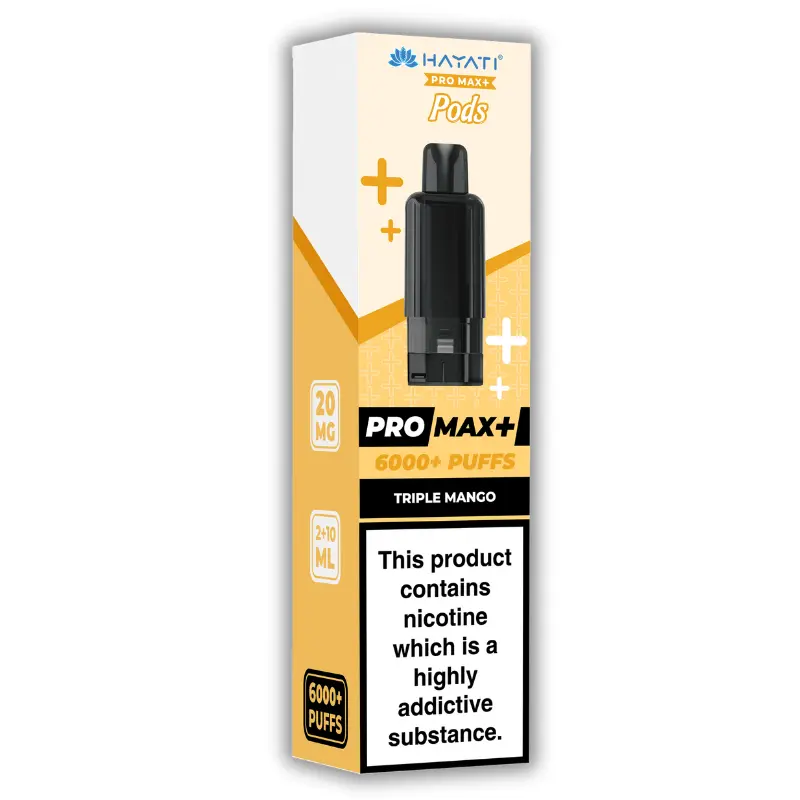
Five pounds forty-nine buys one sealed pod holding twelve millilitres of Triple Mango at 20mg nicotine salt, filed under the code hpm-plus-6k-pods-triple-mango, with no device in the packet. Hayati put a figure of up to 6,000 puffs against a filled pod. That came off a bench, produced by an apparatus drawing to a timer, so the honest way to read it is as a statement about how much work one factory-fitted coil has been asked to do rather than as a forecast of your fortnight. No cooling word appears in the title. No second fruit appears in it either. This is a refill, and it takes for granted that the body it seats in is already yours.
Check the range name on your device against the range name in this title before ordering, since Hayati build more than one pod shape and a retail page is not a fitting guide.
What the liquid tastes like has been worked out already, twice, in more detail than a third attempt could improve on. The Triple Mango Rubik kit page took the recipe and the name apart together. The Triple Mango Pro Max nic salt page took the same liquid and asked what changes when the equipment stops being somebody else's decision. Both of those arguments are sound and neither is being rebuilt here. What has not been done, and what this page exists to do, is put the two of them in the same room, because each one holds half of something neither could finish on its own.
Put briefly, and at length further down: the Rubik page found that this profile is top-light, that its bright opening is the least robust thing in the pod and the first casualty of a residue-loaded coil, and that nothing sits behind that opening to cover the loss. The nic salt page found that mango is the fruit in this range with the most riding on the equipment it is run through. A sealed Pro Max Plus pod hands its owner no coil choice, no power setting, no airflow and no wick. So on the flavour that is most sensitive to how it is served, this format removes every way of serving it differently, and the only lever left in the buyer's hand is when to stop drawing on the pod and open the next one.
That is the subject here. Not what to buy, which you have presumably settled by arriving on a refill listing, and not when to reorder, which is a different question owned by a different page. When to retire. The argument of this page is that you should retire this pod earlier than it invites you to, that the moment to do it is unusually easy to hear on this particular liquid, and that the cost of acting is ninety-one pence.
Two premises, and the thing that falls out of putting them together
Each of the two prior pages is cited here in a sentence or two and then left alone, because re-deriving either would waste your attention and add nothing.
From the Rubik kit page, three findings that this page depends on and does not restate. First, the numbered-name analysis: exactly four Hayati flavour names carry a multiplier, there are fourteen listings between them, seven of the fourteen are Triple Mango, and mango is the only one of the four built on a fruit whose varieties genuinely taste different. Second, the verdict on whether "Triple" is a claim about composition or a volume knob, reached by counting and tagged by confidence rather than asserted. Third, and the one that matters most here, the shape of the draw: a bright just-ripe opening, a honeyed middle where the money is, a rich finish, and the finding that on a tiring coil the opening goes first because it is top-light and there is no citrus, no coolant and no second fruit behind it to provide relief. Go there for all of that. It is the fuller treatment and this page assumes you have it.
From the Triple Mango Pro Max nic salt page, one finding and one caveat. The finding is that mango has more riding on your equipment than almost anything else Hayati sell, for reasons of chemistry rather than preference, and that page sets out which properties a bottle buyer controls, which direction each one pushes a ripe mango, and what the running-cost bill for a bottle comes to. The caveat is that the same page narrowed its own brief when counting contradicted it: mango is not the heaviest thing in the range outright, since confectionery profiles sit in the same bracket, and what survives is narrower and better. Both halves are taken as read.
Now put them side by side. One page says the profile's weakest component is the first to go and nothing masks its going. The other says this fruit, more than most, depends on the equipment to arrive at all. Neither page could finish the thought, because the Rubik page was arguing about a name and the nic salt page was arguing about a bottle, which is the one format where the equipment problem has an answer.
On a sealed pod it has no answer. The coil is fitted, the power is fixed, the airway is moulded and the wick is unreachable. Every adjustment the nic salt page describes is unavailable, and it is unavailable on exactly the fruit that page identified as the one where those adjustments matter most. What remains is the schedule: how long you stay with a given pod before you retire it. That is not a footnote to the ownership of this product. On this liquid it is the whole of the control surface, and a thing that is the whole of your control deserves more thought than a line at the end of a handling section.
What the sealed format actually removes
It is worth listing the missing levers plainly, because the usual way of describing a prefilled pod is by what it saves you rather than by what it takes away, and the saving is real enough that the taking rarely gets counted.
Coil resistance is not published against this listing or any other on the range, so it is not merely fixed, it is unknown. Power is whatever the device applies and there is no setting to change it. Airflow is a moulded channel with no collar and no adjustment ring. The wick is inside a sealed shell with no fill port, so it cannot be inspected, rinsed or replaced. The carrier ratio is not stated for a prefilled pod, so even the thickness of the liquid is something you infer rather than read. The strength is 20mg and there is no other option on this listing. Twelve millilitres arrive as one indivisible commitment, and the coil that has to deliver all twelve was chosen in a factory by somebody who never tasted your version of the pod.
Two variables survive, and they are not equal. The first is how you draw, which operates inside a session and is genuinely useful: a longer, gentler pull gives slow material time to come across, and the Rubik page's advice to protect the top note rather than force the body is the correct advice for a format where raising the floor is impossible. The second is when you stop. That operates across the life of the pod, and it is the only thing you can do that changes the average quality of the twelve millilitres rather than the quality of one mouthful.
Draw technique redistributes what a coil is currently capable of. Retirement timing decides how much of the pod you spend on a coil that is still capable of the full profile and how much you spend on one that is not. The second is the bigger lever by a wide margin, and it is the one nobody thinks of as a lever at all, because a sealed pod presents itself as an object with a fixed amount in it and an obvious moment to throw it away, which is when nothing comes out.
Retirement is not reordering, and the two get muddled
One distinction has to be nailed down before the rest of this makes sense, because a neighbouring page on this same shelf answers a question that sounds identical and is not.
Mango Banana Hayati Pro Max Plus Pods is about reorder cadence: when the next order goes in, why a dense low-acid liquid outlasts what its volume predicts, why the manufacturer's puff figure cannot carry the arithmetic, and why a buffer sized on habit rather than on delivery puts pods in a drawer. That work is thorough and it is about supply. Nothing in it is repeated here, and anybody deciding how many pods to hold should read it rather than this.
Retirement cadence is the other end of the same object. It is not about when the next pod arrives, it is about when the current one stops being worth drawing on, which can happen with four millilitres still visible through the shell. The two questions interact, since a policy of retiring early raises the number of pods you get through and therefore changes the reorder interval, but they are answered from different evidence. Reordering is answered from consumption. Retirement is answered from the liquid.
Does cadence really matter more here than on the other eighty-eight? A count
The claim handed to me was that retirement cadence is a bigger lever on this pod than on anything else on the shelf. That is exactly the shape of claim this catalogue has punished writers for repeating, so before building a page on it I counted, and the claim came back needing two corrections and ending up better for them.
The Hayati Pro Max Plus Pods shelf holds 89 listings as the catalogue stands. Every one of them is 12ml. Every one is £5.49. Every one is specified at 20mg. Four of the 89 are not flavours at all but strength variants of the pod itself, listed at 5mg, 10mg, 20mg and zero, which leaves 85 flavour listings. All 89 are sealed, and all 89 therefore have the same non-existent control surface. That is the first correction: having no adjustments is not a property of this pod, it is a property of the format, and a page claiming the lever is unique here would be wrong on its face.
So the question is not who has the lever. Everybody has it. The question is where the case for pulling it early is strongest, and that turns on two things: how much a tiring coil takes away, and whether you can tell when it has.
Narrowing one: what a coolant does to the question
Sixteen of the 85 flavour listings name a coolant or a mint in the title. Blue Frozen Hayati Pro Max Plus Pods and Blackberry Ice Hayati Pro Max Plus Pods are two of them. The Blue Frozen pods page established, by census rather than by tasting, that Hayati name a coolant in the title whenever one is present and that the vocabulary is not graded, so the count is reliable and there is no need to redo it.
A coolant changes the retirement question in two ways at once. It supplies a sensation that survives a residue-loaded element better than a delicate aromatic top note does, so the liquid degrades less severely. And it gives you a second, independent thing to notice: a cooled pod that has gone quiet on the cold is telling you something, and the drop is easy to hear because cold is either there or it is not. Those sixteen listings are the group with the least at stake and the clearest instrument, which is the opposite corner from this one.
Narrowing two: what an acid does
Of the 69 uncooled flavour listings, 19 put an acid, a citrus or a fizz in the title. Blue Razz Lemonade Hayati Pro Max Plus Pods and Cola Lime Hayati Pro Max Plus Pods sit in that group. An acid behaves like a coolant for these purposes, not because it feels the same but because it is structural and legible: when the sharp edge stops arriving you notice within a draw, and the noticing is binary rather than gradual.
That leaves 50 uncooled flavour listings on this shelf with neither a cold element nor a named acid to report their own condition. Fifty is a large number, and it is the second correction: the position this pod is in is common rather than rare. Roughly three listings in five on the shelf have the same structural problem.
Narrowing three: which of the fifty have the most to lose
Here the nic salt page's chemistry does the work and this page only counts with it. Mango's identity is carried by lactones, which are among the slowest materials in any of these recipes to leave a wick, and a coil that has stopped lifting heavy aromatic material stops being able to deliver the part of the profile that makes the fruit itself. That argument belongs to that page and is cited, not rebuilt.
Counting it across this shelf: of the 50 uncooled listings with no named acid, three are built on a lactone fruit with nothing beside it. They are Triple Mango, Juicy Peach and Peach Aura, the last of which pairs the fruit with a mood word that names nothing. Blackcurrant Mango Hayati Pro Max Plus Pods, Mango Peach Pineapple Hayati Pro Max Plus Pods and the two other peach blends on the shelf all give the lactone fruit a partner, which supplies exactly the relief the Rubik page found missing here.
So the honest version of the claim is not that this is the only pod where cadence matters. It is that the shelf divides into a group of sixteen with a coolant, a group of nineteen with an acid, a group of forty-seven with neither but with company in the pod, and a group of three where a slow-arriving fruit is carrying the whole thing alone. Triple Mango is one of the three, and Juicy Peach is in genuinely the same position.
The one count that does separate it
What distinguishes this listing from the other two is not what it loses. It is that you can tell.
Hayati write fresh copy for every product, and almost all of it describes a flavour as a whole: sweet, rich, tropical, balanced. A few listings describe an order of arrival. Very few describe a position within a draw. Across all 492 products in this catalogue, exactly one description places components at the top and in the middle of the draw and then names a finish, and it is this one. Seven listings on this shelf use a layering word of some kind, including Triple Melon, Double Apple Hayati Pro Max Plus Pods and Caribb Crush Hayati Pro Max Plus Pods, but a layering word is a texture claim. Only this one prints a map with three labelled positions on it.
Four other listings in the 492 contain both words, and all four are false positives on inspection: they use "top" positionally and "middle" in the phrase "a good middle ground", which is a recommendation rather than a description of a draw. Discount those and the count stands at one.
That is a real and narrow finding, and it is the hinge of this page. A buyer who wants to know whether a pod has moved on needs something to compare against, and on nearly every other listing in this catalogue there is nothing printed to compare against except a mood. Here there is a three-part reference published by the manufacturer on the product page itself, and the failure mode the Rubik page identified is precisely a failure of that reference: the top and the middle stop being distinguishable.
So the claim, narrowed until it survives: retirement cadence is the only lever on all 89 pods; the case for pulling it early is strongest on the fifty with neither cold nor acid, stronger still on the three carrying a lactone fruit alone, and this is the only one of the three whose own listing publishes the structure you would be checking against. Not the only pod where the lever matters. The one where you can most easily tell that the moment has come.
The trigger, named precisely
Vague triggers are useless. "When it starts to taste off" is not a rule anybody can act on, and "when it tastes burnt" is a rule that fires far too late. What follows is specific to this liquid and would not transfer to a berry or a lemonade.
What you are listening for
The signal is not that the pod gets quieter. It is that the pod gets simpler.
On a fresh pod there is a gap between the opening and the body. The first part of the inhale is brighter, thinner and faintly tangy, the flavour of the flesh nearer the skin than the stone, and it arrives before the weight does. Then the honeyed middle catches up and takes over, thicker and more coating, and it occupies most of the draw. The transition between those two is audible as a transition. There is a moment where one thing hands over to another.
What a residue-loaded coil does is close that gap. The bright opening fades first, exactly as the Rubik page predicted, and because there is nothing else at the front of the draw the honeyed middle simply moves forward to fill the space. The result is not a quieter pod. It is a pod in which the whole draw is one sweet mass from the first millisecond, with no arrival, no handover and no shape.
The compact way to put it, and the phrase worth carrying around, is that the pod stops being Triple before it stops being Mango. What you lose is structure, not strength. The sweetness is untouched. The volume of vapour is untouched. The fruit is still identifiably mango. The thing the name was selling, which is layering, has gone, and everything the name was not selling is still fully present.
Why that is easier to catch than it sounds
Losing a component is hard to notice when the component was quiet. Losing a boundary is easier, because a boundary is a change over time and human attention is much better at changes than at absolute levels. You are not being asked to remember how bright the opening was three weeks ago, which nobody can do. You are being asked whether the draw still has two parts, which is a yes or no question you can answer in one inhale.
Do it in the first half-second. Take a normal draw and pay attention only to its beginning. On a healthy pod there is something lighter there before the weight arrives. On a tired one the weight is there immediately. That is the entire test, it takes one draw, and it does not require a reference pod, a notebook or a second flavour to compare against.
Tagged by confidence, because this page should not state an inference in the same voice it states the price. Reasonably confident: the bright opening is the first thing to fail, since it is the lightest material in a profile whose own listing places it at the top, and a coil carrying sugar residue lifts light material last. Probable: that the loss presents as a merge rather than as a fade, because the honeyed middle is loud enough to occupy the space immediately. Unknown: how many millilitres in it happens for you. That depends on the coil, on how hard you draw, on how much sweetener is in the recipe, and Hayati publish none of those three. Anybody who tells you it happens at nine millilitres is guessing.
What the trigger is not
Three signals commonly used for retiring a pod do not work here, and using them is how people end up drawing on a pod for days after it stopped delivering what they paid for.
A drop in vapour is not the trigger. Vapour volume is a function of the base and the base is unaffected by the loss of an aromatic top note. The pod will produce the same cloud on the last useful draw as on the first.
A burnt or scorched edge is not the trigger either. That is a genuine signal and it is the end of the pod's life rather than the end of its usefulness, and by the time it arrives you have spent a substantial stretch of the twelve millilitres on a liquid that had already collapsed into one note.
And general fading is not the trigger, because the thing that fades is not the thing you would notice. The Rubik page put this well and it is worth citing rather than repeating: the heavy body outlasts the top by a considerable margin, so the pod becomes monotonous while still tasting of something, and there is no point at which it announces itself.
The opposite case, and why this pod is not it
Another page written on this range at the same time reaches the opposite conclusion from the same starting point, and the contrast is the clearest way to see what is specific here.
The Blueberry Raspberry Rubik pods page found that its liquid gives no usable signal at all. Its light half is the half that identifies it and its heavy half is the half that fills the mouth, so a tiring element takes the identity and leaves the volume, and the result is not a faint version of the pod but a different and perfectly ordinary dark berry. There is no drop in loudness, no sharp component to disappear and nothing to point an instrument at. That page concluded, correctly for that liquid, that a decision which cannot be triggered by observation has to be made in advance, and it priced a blind schedule in pods rather than in pence.
This pod is the other case, and the difference is not the chemistry. It is the printing. Both liquids lose their light end first. On the berry there is nothing published or perceptible that tells you the light end has gone, because what remains is a legitimate flavour in its own right. Here what remains is a structural absence you can hear inside one draw, and the manufacturer has helpfully published the structure. So the conclusion inverts. Do not run a calendar on this pod. Run a check, act when the check fails, and you will be right more often than any schedule adopted in advance, because you will be responding to your own coil rather than to an average of coils.
Which is the better position to be in, and it is worth saying that it is luck rather than design. Nobody at Hayati wrote that description in order to give refill buyers a diagnostic. They wrote it because a copywriter on one platform decided to spell the layering out, a decision the Rubik page traced through the seven listings of this flavour and found to be a house-style split rather than a recipe difference. The diagnostic is a by-product of a copywriting choice, and it is useful anyway.
Ninety-one pence, and what it buys
An argument for retiring something early is worthless without a price on it, because the whole objection to retiring early is that it feels wasteful. So here is the invoice.
Five pounds forty-nine divided by twelve millilitres is 45.75p a millilitre. That is the rate you paid, and it is the rate at which liquid left in a discarded pod is money left in a discarded pod. Walk away with one millilitre in it and the decision cost 46p. Walk away with two and it cost 91p. Walk away with three, which is a quarter of the pod, and it cost £1.37.
The general version of that arithmetic, the one that works out an effective rate per millilitre actually drawn rather than per millilitre bought and runs the ladder across formats, has already been done properly on the Grape GB / Blue Razz GB Pro Ultra Plus 25K pods page. It is a platform-level piece of reasoning rather than a flavour-level one, it holds here unchanged, and there is no version of restating it that improves on it. What is worth carrying across from it is the underlying point rather than its numbers: the sticker price of a pod is not the price of the liquid you use, and a pod retired with liquid in it has silently repriced itself.
The comparison that makes 91p look like the right answer
Ninety-one pence is not nothing, but it is the wrong thing to compare against zero. Compare it against the alternative, which is not saving 91p. The alternative is spending the last two millilitres of a £5.49 pod on a liquid that has stopped doing the one thing its name is selling.
Two millilitres is a sixth of the pod. If the structure collapsed at ten millilitres and you carry on to the end, you have spent a sixth of your purchase on a warm sweet mango with no layering in it, which is a product Hayati would have a hard time charging £5.49 for and which the catalogue already sells in various forms. You did not pay a premium for sweetness. Sweetness is the cheapest thing in the range. You paid for a three-part draw that only one listing in 492 even bothers to describe, and a sixth of that purchase is worth 91p by the same arithmetic that says the discarded liquid is worth 91p.
So the trade is not 91p against nothing. It is 91p of liquid against a sixth of a pod spent on something you would not have chosen off the shelf. Stated that way the decision is close to obvious, and the only reason it does not feel obvious is that the liquid is visible through the shell and the lost structure is not.
Where the argument stops working
Two honest limits, because a page that prices the upside and skips the downside is selling.
The first is that the trigger can fire very early, and if it does the arithmetic changes character. Retiring at ten millilitres costs 91p and raises your pod consumption by a fifth, since twelve divided by ten is one and one fifth, which most people will accept. Retiring at eight would cost £1.83 and raise it by half, and at that point the honest response is not a stricter schedule, it is to conclude that a sealed twelve-millilitre pod is the wrong container for this liquid and that the flavour is better bought in a format where the coil and the liquid are not one purchase. That is what the nic salt page is for, and its conclusion points the same way from the other direction.
The second is that not everybody is buying the layering. If what you want from this pod is a lot of warm sweet mango and you would not notice the top note going if it were pointed out to you, then none of this applies and you should run the pod to the end. There is no argument that your version of the purchase is wrong. The case for retiring early rests entirely on the premise that the structure is what you paid the money for, and a reader who does not hold that premise owes this section nothing.
The same discipline is cheaper on the other platform
Worth knowing rather than worth acting on immediately, since it involves owning a different body. The identical liquid is sold as Triple Mango Hayati Rubik Pods at £3.99 for the same twelve millilitres, which is 33.25p a millilitre. The same two-millilitre discipline costs 67p there instead of 91p, so the policy argued for on this page is about a quarter cheaper to practise on that platform.
The Rubik kit page has already set out the cross-format picture and the reasoning behind the two platforms' differing puff ratings, so this is a citation rather than a comparison. The single practical consequence is worth stating: if you find yourself retiring pods of this flavour early and often, the cost of the policy is a standing reason to think about which body you run it on, and that thought belongs to a hardware decision rather than to this listing.
The pod itself, which is the short part
One prefilled pod arrives in a wrapper. There is no device, no lead, no spare and nothing to assemble. You peel it, seat it in a Pro Max Plus you already own, and draw. Priming is not a step, because the wick left the factory wet.
The specification that matters for this liquid is not the volume, the strength or the puff figure. It is that the coil and the liquid are a single purchase with a single life. On a refillable device a tired element is a consumable you replace while the liquid carries on. Here the element and the twelve millilitres retire together, which is why the whole of this page has been about a schedule rather than about maintenance, and why the discarded-liquid arithmetic above exists at all. That coupling is the actual subject of a bare-pod listing, and everything else about the hardware is on the shelf page.
Hayati publish very little else. No coil resistance appears against this listing. No carrier ratio is stated for a prefilled pod, no wick material, no airflow figure and no parts breakdown. Anything you read anywhere that fills one of those gaps with a number is somebody's inference rather than a specification, including on this site, and this page is not adding to the pile. The rest of the range sits on the Hayati Prefilled Pods & Refills shelf, which runs to 201 listings across every platform.
The figures, ordered around the decision
The table below is arranged to put the retirement question next to the numbers that govern it rather than burying those at the bottom. Rows counted from the catalogue rather than published by Hayati are marked as counted.
| Ticket price | £5.49, pod only | Every listing on this shelf is the same figure |
| Liquid | 12ml, sealed at the factory | One coil is asked to deliver all of it |
| Rate paid | 45.75p per millilitre | Also the rate on anything left in a retired pod |
| Cost of stopping 2ml early | 91p | A sixth of the pod, which is the figure to weigh |
| Retirement signal | Opening and middle merge into one mass | Structure goes before strength does |
| Listings in 492 that print a top, a middle and a finish | One, this one | Counted, and the reason the signal is checkable |
| Nicotine | 20mg per millilitre, salt form | No alternative strength on this listing |
| Cooling | None named in the title or the listing | Counted: 16 of the 85 flavours here do name one |
| Second component | None. Mango alone | Nothing behind the top note to cover its loss |
| Maker's puff figure | Up to 6,000 per pod | A laboratory estimate from test equipment, not a promise |
| Coil | Sealed in, discarded with the pod | Resistance not published on this or any listing here |
| Code | hpm-plus-6k-pods-triple-mango | Useful when one flavour appears in seven listings |
| Device | Not included | The Triple Mango Hayati Pro Max Plus Pod Kit at £7.99 has one |
The 20mg figure is the ceiling the United Kingdom permits in a consumer e-liquid of this kind, which is why it turns up on so much of this catalogue and why there is nothing above it to set it against. A concentration on a listing is a statement about the liquid and not about anybody's habits, and nicotine is an addictive substance.
Two rows are doing work the rest are not. The row recording that one listing in 492 prints a three-part structure is the evidence behind this page's central claim, and the row costing two millilitres at 91p is the claim's price. A specification table normally tells you what is in the box. On a refill for a liquid whose quality degrades in a specific and predictable direction, the more useful rows are the ones describing how the contents change while you own them.
Where it sits against the neighbours
The same liquid, and which container suits an early-retirement policy
Hayati sell this flavour seven times over and the Rubik kit page counted them out, so this section is about which of them changes the cadence question rather than about which tastes best. They do not differ on taste.
The Triple Mango Hayati Pro Max Plus Pod Kit at £7.99 is the same pod with a body attached. For a first purchase it is the only sensible entry, and for a repeat buyer it is £2.50 of hardware you already own. Its relevance here is narrow: a kit gives you a second body, and a second body is what makes an early-retirement policy comfortable, because you can keep the outgoing pod in one device and the fresh one in the other and compare them in the same minute rather than from memory. That is the cheapest way to check whether your trigger is firing too early, and it is the only reason a refill buyer might rationally buy a kit.
The Rubik pods at £3.99 are the cheaper platform for the same policy, as set out above. The Triple Mango Pro Max nic salt is the format where the whole premise dissolves, because a bottle lets you replace the element without discarding the liquid, and its page works through what that hands you and what it charges.
Mango neighbours, sorted by what they do to the signal
Twenty-one listings in this catalogue have mango in the title, a count the Rubik kit page established along with the finding that Triple Mango is the only mango liquid here with no partner fruit and no coolant. Every other mango is mango arranged against something, and that arrangement is exactly what changes the retirement question.
Mango Peach Pineapple Hayati Pro Max Plus Pods is the closest thing to a controlled comparison on this shelf. Two of its three fruits are lactone-carried, so the heavy end is still the substance of it, but the pineapple supplies an acidic component that arrives early and reliably. The consequence for cadence is that the pod reports on itself differently: what you lose first is not the whole front of the draw but the balance between the sharp element and the soft one, and you notice it as the pineapple becoming disproportionate rather than as everything merging. That page is also where the four-listings-one-recipe arithmetic lives, along with the argument about a tasted reference point that a repeat buyer carries, so it is worth reading before any platform move.
The same blend on the bigger platform, Mango Peach Pineapple Hayati Pro Ultra Plus 25K Pods at £7.99 and Mango Peach Pineapple Hayati Pro Ultra Plus 25000 Prefilled Pod Kit at £11.99, raises the stakes on everything above, because a larger sealed pod means more liquid riding on one element and a bigger bill for retiring early. If you are the kind of buyer this page has been arguing for, a larger sealed pod is not obviously a saving.
Blackcurrant Mango Hayati Pro Max Plus Pods puts a genuinely contrasting fruit on top of the mango body, which gives the liquid a second voice and therefore a second thing to lose. Peach Mango Hayati Mini Ultra Pods at £3.49 pairs the two lactone fruits with nothing else, which makes it the heaviest pairing in the range and, by this page's logic, the one with the most to lose to a tired element, offset by sitting in a much smaller pod where the loss is cheaper. Cherry Ice / Peach Mango Hayati Pro Ultra Plus 25K Pods takes the fruit in the cooled direction behind a collar, which moves two variables at once and is a different purchase rather than a comparison.
The whole family is on the Mango Vapes shelf, which runs to 21 listings across every format Hayati sell.
If you would rather not run a check at all
A perfectly respectable answer to this entire page is that you do not want to be assessing your pod. In that case the shelf sells the alternative directly, and it is the sixteen cooled listings, because a coolant does the reporting for you.
Blackberry Ice Hayati Pro Max Plus Pods keeps you on dark fruit with a cold element that either arrives or does not. Blue Frozen Hayati Pro Max Plus Pods pushes the cold hardest of the group. Neither is a mango, and that is the trade: you are giving up the fruit in exchange for a pod that tells you when it has moved on.
The acid route is the other option and it keeps you closer to fruit. Blue Razz Cherry Hayati Pro Max Plus Pods and Cola Lime Hayati Pro Max Plus Pods both carry a sharp element that drops out audibly, and Blue Razz Lemonade Hayati Pro Max Plus Pods puts the citrus at the front where you cannot miss its absence.
The opposite problem, for contrast
A number of listings on this shelf are named for a mood or an image rather than an ingredient, and how many depends on whether you count a dessert name and a soft-drink one, so no figure is offered here. Four of them are the exact inverse of this pod. Sunset Aura Hayati Pro Max Plus Pods, Galaxy Aura Hayati Pro Max Plus Pods, Midnight Dream Hayati Pro Max Plus Pods and Black Mamba Hayati Pro Max Plus Pods publish a name that resolves to no fruit, so there is nothing to check a tiring pod against and no way to describe what has been lost. Their own pages take that gap as the subject and handle it properly.
Triple Mango's problem is the opposite and much more tractable. You know exactly what is in it, the listing tells you where each part sits in the draw, and the only question is how long the arrangement lasts. T-Misu Hayati Pro Max Plus Pods sits somewhere between the two, naming a dessert whose components are guessable but unlisted.
For browsing beyond the shelf, this pod is also filed on Sweet Vapes, 61 listings, and Exotic Vapes, 55 listings. The whole catalogue is on the All Hayati products page.
Running it on a trigger rather than a calendar
Everything below follows from the argument above and none of it is generic pod advice.
Take the reading at the same point every time. The check only works if the conditions are constant, so do it on the first draw after a rest of at least a few minutes, when the wick is fully fed and the element is cold. A draw taken at the end of a run of six will read as flatter than the pod actually is, and you will retire it early for the wrong reason. The Blue Razz Fruit Twist pods page makes the broader case for anchoring a reading to a fixed point rather than to a mood, and that discipline is what makes this trigger reliable rather than a feeling.
Listen to the first half-second and nothing else. The temptation is to assess the whole draw, and the whole draw is where the honeyed body will reassure you. It is not reassuring. It is the component that never fails. The only informative part of the inhale is its beginning, and the only question is whether something lighter arrives before the weight does.
Protect the top note while you have it. A slow, gentle pull keeps the element from running hot and dry, and a hot dry element on a sweetened liquid lays down the residue that costs you the opening. The Rubik kit page sets out why the technique matters on this liquid specifically, and the practical consequence for a refill buyer is that draw discipline and retirement discipline are the same policy at two different timescales: one delays the trigger, the other responds to it.
Do not chain draws. Back-to-back inhales leave the wick short and the coil hotter than it should be, which caramelises a heavy sweetened liquid onto the element. That residue is permanent and it attacks the exact part of the profile this page has been about. Two or three draws and a pause is not fussiness on this pod, it is the difference between the trigger firing at ten millilitres and firing at seven.
Keep the outgoing pod for one day. When you retire one and seat the next, do not bin the old one immediately. Take a draw on each within a minute of the other and you will hear whether your trigger was right. Three changeovers of that will calibrate you permanently, after which the check takes a second and you will stop thinking about it.
Rotate something unlike it. A sweet uncooled single fruit saturates a palate, and a saturated palate cannot hear a top note whether or not the top note is there. Something cold or sharp used once or twice a day resets it, and it also tells you whether a flat reading was the pod's fault or yours.
Storage. Heat works on this profile from the same end a tired coil does. The light material that makes up the opening degrades first in a warm car or a sunny window, so a pod stored badly arrives already missing the part you would have been checking for. Cool, dark and upright, and somewhere children and pets cannot get at it, as with anything holding nicotine.
A pod you left half-used. Coming back to one after a few weeks, expect the first two or three draws to read duller than you remember, because the liquid sitting in the wick has been in contact with air and the liquid in the reservoir has not. Judge it on the fourth. Applying the trigger to a cold pod's first draw will retire a perfectly good one.
Disposal. What is left in a spent pod is a coil, a wick and a smear of liquid, so it belongs in a vape shop's pod recycling rather than in the kitchen bin.
Questions a repeat buyer actually asks
How do I know when to retire this pod?
Take one draw after a rest and pay attention only to its first half-second. On a healthy pod something lighter and faintly tangy arrives before the honeyed weight does. When that gap has closed and the draw is one sweet mass from the start, the pod has stopped delivering the layering the name is selling, whatever is still visible in the shell.
Why not just wait until it tastes burnt?
Because that arrives long after the point this page is about. A scorched edge is the end of the pod's physical life. The loss of structure happens earlier and does not announce itself, since the sweetness, the vapour and the fruit all carry on exactly as before.
What does retiring early actually cost?
45.75p a millilitre, which is £5.49 divided by twelve. Stopping with two millilitres left costs 91p. Weigh that against spending a sixth of the pod on a liquid that has already collapsed into one note, which costs the same 91p by the same sum.
Can I change anything about how the pod performs?
Only how you draw. The coil is sealed in and its resistance is not published, the power is set by the device, the airway is moulded and the wick is unreachable. That is why the replacement schedule carries so much weight on this format, and the nic salt page is where the same flavour with adjustable equipment is worked through.
Is this the only pod on the shelf where cadence matters?
No, and the count says so plainly. All 89 listings here are sealed, so nobody has any adjustments. Fifty of the flavour listings have neither a coolant nor a named acid to report their own condition, and three of those carry a lactone fruit with nothing beside it. What is unusual about this one is that its own description publishes the three-part structure you would be checking against, which one listing in 492 does.
Is there any ice or menthol in it?
None. Hayati name a coolant in the title every time one is present, a convention established by counting the catalogue rather than by tasting, and nothing in this title names one. Sixteen of the 85 flavour listings on this shelf do carry a cooling or mint word if that is what you want.
Does "Triple" mean three kinds of mango?
On the evidence, no. The Rubik kit page counted it out across all 492 listings and found Hayati never name a mango cultivar, with five of this flavour's seven descriptions treating it as one undivided fruit. The word is an intensity marker carrying a layering gesture, and the layering runs along ripeness rather than variety.
What is in the packet?
One prefilled pod and nothing else. No device, no lead, no spare and nothing to fill or assemble. If you have arrived here without a Pro Max Plus body, this purchase hands you an object you cannot power, and the £7.99 kit is the listing that includes one.
How long will a pod last me?
Nobody can answer that for you, and the twelve millilitres is the only figure worth planning around because it is consistent and comparable across formats. Hayati's 6,000 is a laboratory result under one test protocol. The question of how many pods to hold and when to order the next is answered properly on the Mango Banana pods page, which is about supply rather than about retirement.
Is the Rubik version the same liquid?
Yes, and at £3.99 for the same twelve millilitres it is 33.25p a millilitre against 45.75p here, which makes an early-retirement policy about a quarter cheaper to run on that platform. The Rubik kit page covers the differences between the two platforms and their puff ratings.
Will retiring early make the flavour better?
It will not change what a fresh pod tastes like. What it changes is the proportion of your twelve millilitres spent on a coil still capable of the full three-part draw rather than on one that has flattened into sweetness. That is an average across the pod rather than an improvement at any single moment.
What if I cannot hear the difference?
Then the policy is not for you and you should run the pod to the end without guilt. The case for retiring early rests on the structure being the thing you bought, and plenty of people buy this pod for a lot of warm sweet mango and get exactly that until the last draw.
Does it get weaker as it ages, or just different?
Different, mostly. The heavy honeyed body outlasts the bright opening by a wide margin, so the pod does not get quieter, it gets simpler. That is the whole reason a schedule based on intensity fails here and a check based on shape works.
The short version
A £5.49 sealed pod holding twelve millilitres of uncooled ripe mango at 20mg, no device included, no coolant and no second fruit, at 45.75p a millilitre. What it tastes like is settled elsewhere and this page took the two prior arguments about this liquid and put them together instead.
The result is straightforward. The Rubik kit page found this profile top-light, with the bright opening first to fail and nothing behind it. The nic salt page found mango the fruit with the most riding on the equipment. A sealed pod removes the coil, the power, the airflow and the wick from your control, so on the flavour where equipment matters most, the replacement schedule is the only lever you hold. That lever exists on all 89 pods on this shelf, and the count narrowed the claim twice: fifty of the flavour listings have no coolant and no named acid to report on themselves, three carry a lactone fruit alone, and this is the one of the three whose listing publishes the structure you would check against, a thing exactly one description in 492 does.
So retire it earlier than the pod invites. The trigger is not a fade and not a burnt edge. It is the bright opening and the honeyed middle merging into a single sweet mass, which means the pod stops being Triple before it stops being Mango, a loss of structure rather than of strength. Acting on it with two millilitres left costs 91p, and the alternative is spending a sixth of the pod on a liquid you would not have chosen. The same discipline costs 67p on the Rubik refill of the identical liquid, which is a reason to think about hardware rather than to change your mind about this one.
Strictly for adults aged 18 and over. Nicotine is an addictive substance.
You might also like


