
Home / Hayati Pro Max Plus Pods / Red Sour Raspberry Hayati Pro Max Plus Pods
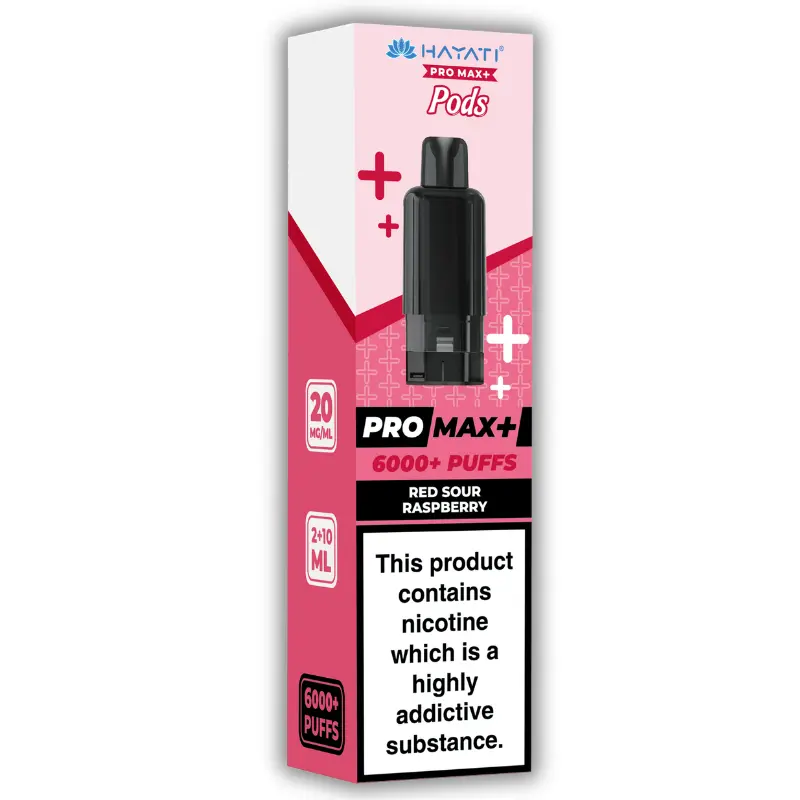
Hayati · Pro Max Plus
Red Sour Raspberry Hayati Pro Max Plus Pods
£5.49
✔ In stock — ready to ship
Genuine Hayati
Free over £20
Same-day dispatch
Secure checkout
Red Sour Raspberry is sold here as the refill on its own: one prefilled Hayati Pro Max Plus pod, 12ml of liquid at 20mg nicotine salt, £5.49, with no device in the packet. If there is no Pro Max Plus body already in the house, this pod has nothing to sit in, and the Red Sour Raspberry Pro Max Plus 6000 Pod Kit is the listing that boxes the same liquid with a body to run it in. Hayati put a laboratory rating on a filled pod of up to 6,000 puffs, measured on bench apparatus drawing to a fixed rhythm, which makes it a statement about how much liquid one sealed coil is expected to process rather than a quantity of anything you have bought.
That is the whole of the commercial description, and it is unremarkable. What is not unremarkable is the name. Read it again slowly: Red Sour Raspberry. Two of those three words are load bearing. Raspberry names the fruit. Sour declares a treatment applied to it, and that declaration is a real signal rather than a flourish, for reasons the Tropical Sour Juice pages on this site work out at length and which are not re-derived here. The third word is the interesting one, because on the face of it the third word does nothing at all.
Raspberries are red. Telling a buyer that a raspberry is red is like telling them that a lemon is yellow. The word carries no information the reader did not already have before they read it, and a qualifier that carries no information has not been selected to describe. It has been selected for some other purpose. That is not a complaint about the name and it is not a clever observation about marketing generally. It is a specific question with a checkable answer, because the catalogue that produced this name has 492 listings in it and 174 distinct flavour names, and the way those names are built is a matter of record rather than opinion.
So this page does the counting first and the tasting second. What follows works out what the word Red is actually doing in this title, tests the two readings under which it would be informative after all, establishes which of them the catalogue supports, and then draws a line and says plainly where the naming evidence stops and inference about the liquid begins. The conclusion is not that the word is decorative. It is that the word is informative about something other than the fruit, and knowing which thing changes who should buy this pod.
The word that appears to do no work
Start with the flat version of the objection, because it deserves to be stated properly rather than waved at. A qualifier earns its place by ruling something out. "White peach" is useful because peaches also come yellow and the two do not taste the same. "Green tea" is useful because tea is also processed black. "Pink lemonade" is useful because most lemonade is not pink and the pink version is conventionally softer and berried. In each case the adjective narrows a set that genuinely had more than one member in the buyer's head before they read it.
"Red raspberry" does not obviously narrow anything, because for almost every buyer the set of raspberries had exactly one member to begin with. You cannot go into a supermarket in this country and be confronted with a choice of raspberry colours. The word therefore looks like padding, and padding in a product name is usually there to make the name longer, more symmetrical or more distinctive on a shelf listing rather than to tell anyone anything.
That is the accusation. It is worth testing rather than repeating, and the way to test it is to ask whether the range that produced this name is generally in the habit of tinting fruit names with colours those fruits already have. If it is, Red is decoration and the case is closed. If it is not, then the one place the habit does appear is worth a much closer look.
Counting the habit before blaming it
Across the 492 listings on this site there are 174 distinct flavour names. Thirty-three of those names carry a colour word standing on its own, meaning a colour that is a separate word rather than one fused into a fruit's own English name. Blackcurrant, blackberry and blueberry do not count: the colour is inside the noun, nobody chose to put it there, and no alternative-coloured blackcurrant exists to be ruled out. Orange in Rocky Candy Orange and in Orange Lemon Lime is the fruit, not the colour, so those come out too. That leaves thirty names in which somebody at Hayati made an active decision to attach a colour to something.
Sorted by what the colour is actually doing, they fall into four groups, and the sizes are the point.
- The colour narrows a real set: five names. Red Apple Ice, White Peach Raspberry, Peach Green Tea, Pink Lemonade, Red Berry Ice. Apples come green, red and yellow and they taste different. Peaches come white and yellow. Tea is green or black. Lemonade is pink or it is not. Red Berry narrows a generic category rather than a fruit, which is a slightly different job but still a job. Every one of these adjectives rules something out.
- The colour is counter-factual, and that is the whole point: sixteen names. Every Blue Razz and Blue Raspberry name in the catalogue. Raspberries are not blue. The colour is not describing the fruit at all, it is invoking a confectionery accord that has been blue in sweet shops and slush machines for decades. The word is doing an enormous amount of work precisely because it contradicts the fruit.
- The colour is attached to a mood or an invented character rather than to a fruit: eight names. Mr Blue, Mad Blue, Mr Pink, Blue Fusion, Blue Frozen, Black Mamba, Black Mint, and the Blueberry Raspberry / Mr Blue pairing. Nothing here is being described. The colour is the name.
- The colour restates a colour the fruit already has: two names. Red Sour Raspberry, and Red Razz GB, which appears only inside the Red Razz GB / Blue Razz GB pairing.
Two names. In listing terms that is four listings out of 492: this pod, its kit, and the two Pro Ultra Plus dual listings that carry Red Razz GB. Everything else that wears a colour is either narrowing a genuine choice, contradicting the fruit on purpose, or naming a character.
That result cuts against the lazy reading rather than for it. If Hayati routinely sprinkled colours over fruit that already had them, you would expect a Red Strawberry somewhere among the sixty strawberry listings, a Red Cherry among the sixty-two cherry listings, a Purple Grape among the seventeen grape listings. There is not one. The house does not do this. It does it here, on raspberry, and nowhere else. A habit repeated once is not a habit. It is a decision, and decisions have reasons.
The varietal reading, and why it does not survive the catalogue
The first reading that would rescue the word is the botanical one, and it is genuinely available. Raspberries are not in fact only red. Black raspberries are a distinct species with a deeper, slightly drier, more brambly character. Golden or yellow raspberries exist as well and read sweeter and softer, with less of the sharp top that people associate with the fruit. If Hayati were distinguishing between those, then Red would be doing exactly the job White does in White Peach, and the objection collapses.
It does not survive two checks.
The first is internal. If a colour is functioning as a varietal marker inside a naming system, the system has to contain at least one other variety for it to mark against, or the marker is pointing at an empty space. Across all 492 titles there is not a single golden raspberry, yellow raspberry or black raspberry. The word golden appears in no title. The word yellow appears in no title. Black appears four times and every instance is Black Mamba or Black Mint, neither of which is a berry. There are six blackberry listings, but a blackberry is a different fruit with a different name, not a coloured variant of this one. Red is therefore marking a distinction against nothing at all, which is not how a varietal marker behaves.
The second check is sharper and it comes from a title already quoted above. White Peach Raspberry Pro Max Plus Pods sits on this same shelf at this same £5.49. In that name Hayati colour-qualify the peach and leave the raspberry completely bare. If red raspberry were a live category in their system, a title pairing a specified peach with an unspecified raspberry would be an obvious gap, and the writer of that title would have felt it. They did not, because there is no gap. Raspberry on its own already means the red one, in that title and in the other fifty-eight uncoloured raspberry listings on this site.
The varietal reading is therefore a real possibility that the catalogue refutes. Worth raising, and worth putting down.
The contrastive reading, and what the catalogue does to it
The second reading is that Red is not describing the fruit but positioning the product, and that it is positioning it against something specific inside Hayati's own naming system rather than against anything in the world. This one the catalogue supports, and it supports it hard enough that the evidence is worth laying out piece by piece.
Piece one: the scale of the blue raspberry accord. Count every title on the site containing raspberry or razz and you get 122 of 492 listings, so roughly a quarter of everything Hayati sell has a raspberry somewhere in it. Of those 122, exactly 61 are blue-coded, meaning Blue Razz, Blue Raspberry or Blue Sour Raspberry. Half of Hayati's raspberry output is blue raspberry. The Raspberry Vapes shelf carries 119 listings and 56 of them are blue. This is not one flavour among many. It is the single most repeated named accord in the range, and it is the thing a buyer is most likely to have already met.
Piece two: the word Red has no independent existence in razz naming. The catalogue contains exactly two titles using Red Razz, and both of them are Red Razz GB / Blue Razz GB, a dual Pro Ultra Plus listing on which the two halves sit side by side in the same sentence. Hayati have never once written Red Razz on a product that did not have Blue Razz printed next to it. The word exists only as one half of a contrast, in the same title as the thing it contrasts with. As naming evidence goes, that is close to conclusive: the adjective is not describing a berry, it is labelling a side.
Piece three: which of the two sour raspberries is the established one. Blue Sour Raspberry appears on eleven listings spread across eight formats: the Pro Max Plus pods and kit, the Pro Ultra Plus pods and kit, the Mini Ultra pods and kit, the Rubik pods and kit, the Pro Max nic salt, the 70/30 e-liquid and the 50/50 shortfill. It is in every format Hayati make. Red Sour Raspberry appears on exactly two listings, this pod and its kit, both on one platform, and both sit on the New Products shelf. One of these recipes is a fixture of the range and the other is a recent single-platform addition to one shelf. Given that, a name built by taking the established title and swapping one word is not an accident of vocabulary.
Piece four: the shelf you are actually standing on. The Hayati Pro Max Plus Pods shelf holds 89 listings. Eighteen of them contain a raspberry. Eight of those eighteen are blue-coded. Four carry a declared Sour marker, and of those four, one is Blue Sour Raspberry Pro Max Plus Pods at the identical £5.49. A shopper scrolling this shelf meets the blue version first, or meets eight blue relatives before they reach this one. In that environment a bare title of Sour Raspberry would be actively confusing, because a large proportion of readers would fill the gap with blue by default. Red is the word that stops them doing it.
The contrastive reading therefore wins, and it wins on four independent pieces of evidence rather than on plausibility. Red is not telling you what colour the fruit is. It is telling you which of Hayati's two sour raspberries this is, and it is doing that by negation: this is the one that is not the blue one.
Informative about the shelf, not about the fruit
This is the distinction worth being careful about, because it decides whether the word is any use to you personally.
A descriptive adjective tells you something about the object. A contrastive adjective tells you something about the set the object was drawn from. They look identical on a product listing and they behave completely differently in a buyer's head. If Red were descriptive, a person who had never seen a Hayati product in their life could read this title and learn something from it. They cannot. To that reader the word is noise, and their instinct that it is padding is entirely correct given what they know.
If Red is contrastive, then the same word is dense with information, but only for someone who already has the rest of the range in their head. To a reader who owns a Blue Sour Raspberry pod, or who has met Blue Razz GB Pro Max Plus Pods or Blue Razz Cherry Pro Max Plus Pods, the word Red says: you know the sweet-shop blue thing this house does constantly, and this is deliberately not that. That is a lot of meaning for three letters, and it is meaning about the catalogue rather than about the berry.
Which is why the honest summary is that the word is informative and the original objection is still half right. Red adds nothing to your picture of a raspberry. It adds a great deal to your picture of where this pod sits among the other 88 on its shelf. Anyone telling you it describes the fruit is wrong, and anyone telling you it is pure decoration has not counted.
One footnote while the naming system is open, because it comes up constantly on these listings and is easy to establish from the titles rather than guess at. GB is Gummy Bear. Hayati write it out in full on the bottle listings, as Blue Razz Gummy Bear, and abbreviate it to GB on the pod and kit listings for what is plainly the same recipe. Blueberry B'Gum is the same convention on a different fruit. That matters here only because it confirms what the blue names are gesturing at: confectionery, explicitly and by their own admission, not fruit.
Where the naming evidence stops
Everything above is counting. It is checkable, it does not depend on anyone's palate, and if a number in it is wrong the catalogue will say so. What follows is a different kind of claim, and the transition deserves a line drawn under it rather than a smooth paragraph.
From this point on I am inferring. Hayati publish a flavour description and a specification. They do not publish a formulation, a sweetener load, an acid dose, a coil resistance or any comparison between this recipe and the blue one. Nothing below is a measurement. What I can do is say what follows logically if the contrastive reading of the name is correct, tag each claim by how far it is from the evidence, and then tell you how to settle the open ones yourself. What I will not do is describe the liquid in the confident voice used for the price.
The inference runs like this. If Red is doing contrastive work against Blue, the contrast has to be in something, because a naming distinction that pointed at two identical liquids would be a distinction nobody could act on and Hayati would have gained nothing by making it. Blue raspberry, as a flavour convention rather than as a fruit, means a confectionery accord: candy-sweet through the middle, a simple bright top, acidity that reads as added rather than grown, and a general resemblance to a blue sweet rather than to anything off a bush. That convention is stable across brands and it is what those 61 blue listings are invoking. If this pod is named by not being that, the axis it moves along is naturalism. The expectation is a raspberry that reads as fruit rather than as sweet.
Tagged by confidence:
- Reasonably confident. One fruit and no partner, which Hayati state. A declared sour treatment, which Hayati state. 12ml at 20mg in a factory-filled pod for £5.49, which is on the listing. No cooling agent declared, because there is no ice, frozen, cooler, mint or menthol word in the title, and the Blue Frozen pods page established by counting the whole catalogue that Hayati never mix a cooling word into a title without meaning it and never combine the two families.
- Probable. That the berry reads more naturalistic and less confected than the blue siblings, because that is the only axis on which the naming contrast can be cashing out. Probable, not certain: it is derived from the name, not from the recipe.
- Probable. That the acid sits on the outside of the sweetness rather than running underneath it, since Hayati describe the sourness as a coating and as arriving early. That is their word and their ordering, and it is a description rather than a measurement.
- Unknown, and it matters. How sour this is relative to Blue Sour Raspberry. Both carry the identical marker. Neither carries an intensity. The Tropical Sour Juice pod page works through why a declared Sour marker is the single hardest thing in a flavour description to hold still in memory, and that argument applies here without modification, so it is not repeated. The practical upshot is that nothing published, here or by Hayati, ranks these two.
- Unknown. Sweetness level in absolute terms. Sour and sweet are not opposites in a liquid and a heavily sweetened base can carry a heavy acid dose, so the declared sourness tells you nothing about the sugar.
- Unknown. Coil resistance. It is not in this product's data, and resistance governs how hot the coil runs, which moves where the balance between acid and sugar lands. Anyone who tells you the number has got it from somewhere other than Hayati.
Read that list back and the shape of the purchase becomes clear. The things the name and the specification settle are the things about the category. The thing that will actually decide whether you like it, the intensity and placement of the acid, is in the unknown column, and no amount of reading will move it. If that axis is the one you care about, the method at the end of this page is worth more to you than any tasting note.
The flavour, taken draw by draw
With the caveat above standing, here is what the listing supports, what a single-fruit sour has to do that a blend does not, and where the honest gaps are.
The architecture is unusually simple and that simplicity is the defining fact about the liquid, more than the fruit or the acid. One berry. One treatment applied to it. Nothing else in the recipe that Hayati name. Most of this shelf is built from two or three fruits, and a blend has structural advantages a single-fruit liquid does not get: the draw can change subject halfway, a second fruit can cover a thin patch in the first, and the interaction between two accords produces a third thing that neither contributes alone. Strawberry Raspberry Cherry Pro Max Plus Pods has three chances to interest you in a single inhale. This pod has one, and it has to hold your attention for the whole length of the draw on one accord and one acid.
That is not a criticism. It is the trade being offered. Single-fruit liquids are legible in a way blends are not, and legibility is exactly what a lot of repeat buyers want after a run of medleys where the individual fruits have stopped being separable. But it does set the bar: a single-fruit sour either has enough going on inside the one fruit to sustain a draw, or it reads as thin by the third inhale. Which of those it is, I cannot tell you from a listing.
The order things arrive in
Hayati's own description puts the acid first and the fruit sugar second, and describes the sourness as a coating. Take those two statements seriously, because they are more specific than most flavour copy manages and they describe a particular shape.
A coating implies the acid is on the outside of the flavour rather than woven through it. In practice that means the front of the draw is where the sharpness lives, the mouth reacts to it before it has identified any fruit, and the berry arrives behind it as the acid falls away. That is a different sensation from a liquid where the acid runs the whole length of the draw underneath the fruit, which is what a genuinely tart berry does on its own. A coating peaks and releases. An integrated acid holds.
If that ordering is accurate, the practical consequence is that the first half-second of the inhale is dominated by the treatment and the rest of it by the fruit, so the pod will taste quite different depending on how long you draw. A short, sharp pull is mostly acid. A longer, slower one gives the berry proportionally more room and reads sweeter overall. That is worth knowing before you form a verdict on your first three inhales, because the first three inhales of anybody's new pod tend to be short ones.
What raspberry brings on its own
Raspberry is a more complicated fruit to build a flavour on than the shelf makes it look. It has two separable characters. There is a jammy, sweet, slightly cooked-fruit body, which is what raspberry tastes like in a dessert, and there is a high, perfumed, faintly floral top note that is what fresh raspberry smells like when you put your face in a punnet. The second one is the fragile part. It is the most volatile element in the profile and it is the first thing that goes missing when a raspberry flavour is made cheaply, which is why so many raspberry liquids taste like generic red jam.
Whether this pod keeps that top note is the single most interesting open question about it, and it is the question the contrastive naming argument points straight at. A confectionery blue razz does not need the floral top at all: it is not pretending to be fresh fruit, so it can run on body and acid alone. A liquid named specifically to signal that it is not the confectionery one has, at least by implication, promised the fruit reading. Whether the formulation delivers on that implication is not something I can establish from the catalogue, and I am not going to pretend otherwise.
There is also a question of what the acid does to that top note. Sharpness and perfume sit in different registers, and a heavy acid dose at the front of a draw can occupy enough attention that the delicate aromatic material behind it never gets noticed even when it is present. Whether the sour treatment here is calibrated to sit beside the perfume or to sit on top of it is, again, unpublished. It is the sort of thing you find out on the tenth draw rather than the first, once the novelty of the sourness has worn off and you start noticing what is underneath it.
What it is not
Ruling things out is often more useful than piling up adjectives, and on this listing the exclusions are unusually clean.
It is not a blue razz. That is the whole burden of the name, and it means you should not expect the sweet-shop character that Blue Razz Lemonade Pro Max Plus Pods or Blue Razz Pineapple Pro Max Plus Pods build on.
It is not a blend. No second fruit is named and Hayati are explicit that there is not one. If you are after the layered red-fruit thing, Blueberry Raspberry Cherry Pro Max Plus Pods and Strawberry Raspberry Blueberry Pro Max Plus Pods are the listings built for it.
It is not cooled. Nothing in the title declares ice, menthol or any cooling family term, and on the evidence of the catalogue-wide count published on the Blue Frozen pods page, Hayati are consistent about declaring cooling when it is there. If you want the cold version of a red berry, Strawberry Raspberry Ice Pro Max Plus Pods declares it in the title.
It is not a soft drink or a lemonade, which matters because a lot of sour liquids reach for a carbonated framing to justify the acid. There is no fizz reference in this name and no second component to provide one.
And it is not a stacked-acid construction. Cherry Sour Raspberry puts a declared sour treatment on two fruits that each bring their own acidity, and the question of whether three acid sources read as three things or as one flat edge is worked through properly on that product's kit page. It is a genuinely different problem from this one and it is not re-argued here. The relevance for a buyer is only this: if you have had Cherry Sour Raspberry and found the sharpness undifferentiated, the single-fruit version is the obvious next thing to try, because there is only one place the acid can be coming from.
Sweetness, honestly
Expect this to be sweet. Every prefilled pod in this range is built on a sweetened base, the fruit named is one of the sweeter berries, and nothing in the specification suggests a restrained formulation. A declared sour marker does not make a liquid dry. It adds a sharp element to a sweet one, and the usual result is a liquid that reads as intense rather than as austere.
If what you actually want is a red fruit with the sugar pulled back, this shelf does not really have one, and saying so is more useful than implying otherwise. Blueberry Cherry Cranberry Pro Max Plus Pods is the nearest thing to a drier berry on the shelf because cranberry brings a genuinely unsweet edge, though it is a three-fruit blend rather than a focused single berry. There is no version of this recipe with less sugar in it, and there is nothing on the listing to suggest Hayati intended one.
The pod, briefly
There is little to say about this hardware that the shelf has not already said ninety times, so this section is deliberately short and the words are spent elsewhere.
What arrives is one factory-filled pod holding 12ml at 20mg, closed at manufacture, with the coil built into the pod rather than into the device. You are buying a consumable, not a component: when the liquid is gone the coil goes with it, which is the trade the whole prefilled format makes. Nothing is refillable and there is nothing to service. The single specification that matters most for this particular liquid is the one Hayati do not publish, namely the coil resistance, because resistance sets operating temperature and temperature moves where a sour liquid balances between its acid and its sugar. Every other number on the listing is shared with 88 neighbours.
Match the range name printed on your device to the range name in the title before ordering, since Hayati make several pod families that are not interchangeable. For everything else about the platform, including what comes in the box when you buy it as a kit, the Hayati Prefilled Pods and Refills shelf and the kit listing linked at the top cover it in full.
Specifications, and what each line changes
The table below is the listing in full. The order is deliberately not the order the range usually prints, because the two rows that actually differentiate this pod from its neighbours are the naming ones and they belong at the top rather than buried under volume figures that 88 other listings share.
| Fruit named | Raspberry, one fruit, no partner |
| Colour word in the title | Red, contrastive against the blue raspberry family |
| Treatment declared | Sour |
| Cooling declared | None |
| Price | £5.49 |
| What the packet holds | One prefilled pod, no device |
| Liquid volume | 12ml |
| Nicotine | 20mg nicotine salt |
| Platform | Hayati Pro Max Plus |
| Manufacturer puff rating | Up to 6,000, a laboratory figure |
| Coil resistance | Not published by Hayati |
| Refillable | No |
Two of those lines deserve a sentence each. The 20mg figure is the ceiling permitted for nicotine-containing e-liquid sold in the UK, which is why almost every prefilled pod in this range carries it and why the number tells you nothing about this particular recipe. It is a regulatory limit, not a formulation choice, and nicotine is an addictive substance regardless of the strength printed on the box.
The puff rating is the number most likely to be misread. It comes from bench apparatus drawing at a fixed length and interval, which is not how anybody vapes, and it is best understood as a rough statement about how much vapour 12ml of liquid can be made to produce before the coil is finished. On a liquid where a long draw and a short draw taste noticeably different, as this one should if the acid really does sit at the front, the gap between laboratory conditions and real use is wider than usual.
The unpublished coil resistance is worth one more line because of what it prevents. Without it you cannot predict how warm the pod runs, and warmth is the variable that most reliably shifts a sour liquid's balance towards the sweet side. Two people running the same pod at different draw lengths can genuinely be tasting different ratios of acid to fruit, and neither of them is wrong.
How it sits against its neighbours
The comparison that matters most is obvious and the price makes it sharper: both candidates are £5.49, both are on the same shelf, both are single-fruit raspberries carrying the identical Sour marker, and the only published difference between them is the colour word. That is an unusually clean choice, so take it first.
Blue Sour Raspberry Pro Max Plus Pods is the established recipe, the one that exists in every format Hayati make, and the one a large number of people on this shelf have already had. Choose it if the confectionery reading is what you want from a sour raspberry, meaning sweet-shop sweetness, a simple bright top and an acid that announces itself as an addition. Choose this pod if you want the same treatment applied to something that is trying to read as fruit. That is the inference from the naming, flagged as an inference above, and it is the cleanest statement of the difference available given what is published. If you already know you prefer the blue accord, the naming argument on this page is a reason to skip this listing rather than to buy it, and that is a perfectly sensible outcome.
The wider blue wall on this shelf is worth naming because it is what you are choosing against, not just one listing. Blue Razz Cherry adds a dark stone-fruit sweetness under the blue. Blue Razz Blackcurrant Pro Max Plus Pods pushes it towards a deeper, more tannic berry. Blue Razz Fruit Twist Pro Max Plus Pods and Blue Razz Mojito Pro Max Plus Pods take it in two different directions again. All of them keep the blue accord fixed and vary the partner. This pod does the opposite: it removes the partner entirely and changes the accord. That is a genuinely different kind of listing, and on a shelf where eight of the eighteen raspberries are blue, it is the one that is not doing what the others are doing.
Among the uncoloured raspberries, the distinction is between raspberry as a lead and raspberry as a supporting fruit. In Blackberry Raspberry Pro Max Plus Pods the raspberry gives brightness to a darker, jammier berry and is not really the subject. In Blueberry Raspberry Pro Max Plus Pods it supplies the sharp end of a rounder profile. White Peach Raspberry uses it as an accent against soft stone fruit. Mixed Berries Pro Max Plus Pods buries it in a composite where no single fruit is meant to be identifiable. None of those is a raspberry page. This one is, and if you have been working through the berry listings wondering what Hayati's raspberry actually tastes like on its own, this and its blue counterpart are the only two places on the shelf you can find out.
Two listings sit slightly further out but are relevant to the same decision. Blueberry Pomegranate Pro Max Plus Pods is the other place on this shelf where a genuinely tart element is doing structural work rather than decorating a sweet base, so it is worth a look from anyone buying here for the sharpness rather than for the raspberry. Blue Fusion Pro Max Plus Pods is the opposite case and belongs in this section as a contrast of a different kind: a name that tells you a colour and nothing else at all, with no fruit on the record. Set beside it, a title that names its fruit, declares its treatment and marks its position in the range looks considerably more generous with information, redundant-seeming colour word included.
Across platforms, the same liquid family appears at different volumes and prices, and the arithmetic is not always in favour of the bigger one. Blue Sour Raspberry Mini Ultra Pods at £3.49 is the cheapest way to meet the blue version of this treatment, though the pod is much smaller and the cost per millilitre is accordingly worse. Blue Razz GB Rubik Pods at £3.99 holds the same 12ml as this pod on a different body, which makes it the better-value route to the blue confectionery accord if you happen to own a Rubik. On the Pro Ultra Plus side, Blue Razz Cherry / Blue Razz GB and Grape GB / Blue Razz GB put the blue accord on both or one half of a dual pod, and Blackcurrant Cotton K / Blue Raspberry spells the accord out as Blue Raspberry rather than abbreviating it. None of these will fit a Pro Max Plus, and they are listed here to show how far the blue naming reaches rather than as alternatives to add to the same basket.
One last comparison, and it is the one most people here will actually make. The Red Sour Raspberry Pro Max Plus 6000 Pod Kit at £7.99 is this same pod with a body included. The £2.50 gap buys the device, so the kit is the right listing exactly once, and every purchase after that is this page. If you are restocking, you are in the right place. If you are reading this without a Pro Max Plus in a drawer, you are not.
Living with a single-fruit sour
Most handling advice on this shelf is generic. These four points are not, because each one follows from something specific to this pod: one fruit, a declared acid, no cooling, and a direct blue counterpart at the same price.
You have no internal control, so build an external one. A three-fruit blend gives you a built-in reference: if the strawberry still tastes right but the cherry has faded, you know it is the pod and not you. A single-fruit liquid gives you nothing to check against. When this pod starts tasting less sharp on day nine, you genuinely cannot tell from the inside whether the liquid has changed, the coil has, or your palate has adjusted to it. The fix is to have something unrelated in the rotation, ideally not a berry, so you have a fixed point to calibrate against. This is the strongest practical argument for running two pods rather than one, and it is specific to single-fruit liquids rather than general advice.
Judge it on the long draw, not the first pull. If the acid really does sit at the front of the inhale, then short draws over-represent it and long draws over-represent the fruit. Your first encounter with a new pod is almost always a cautious short pull, which means most people's first impression of this liquid will be its sourest possible presentation. Give it a few full-length draws before deciding what it is. If it turns out you prefer the sharp version, that is a usable finding, because it means you can dial the character with draw length rather than by buying something else.
Run the A/B in both directions. The one question this page cannot answer is where this sits relative to Blue Sour Raspberry on intensity, and the only way to settle it is to own both at once and alternate. Do it in both orders, blue then red and red then blue, because whichever you taste second is at a disadvantage, and a single-direction comparison will reliably tell you that the first one was sharper. Two pods at £5.49 is a modest price for a genuine answer to the only open question on the listing, and it converts a guess into knowledge you keep.
Store it flat, cool and dark, and use a part-used pod sooner than you think. The delicate part of a raspberry profile is its perfumed top note, and aromatic material of that kind is the first thing to dissipate from a pod that has been opened, sat in a warm car or been left in direct light. A pod that has been half-used and then abandoned for a month will come back as the jammy body with the fresh top missing, which on this liquid reads as a duller, flatter fruit behind an acid that has not diminished at all. That is a worse outcome than on most listings precisely because there is no second fruit to disguise it.
On disposal, the pod contains a coil, electronics-adjacent materials and residual liquid, so it does not belong in household waste. Vape retailers in the UK are required to take back old units, and a pod handed back over a counter or dropped at a local recycling point goes to the right stream. Store unopened stock away from heat and out of reach of small hands and pets.
Questions buyers actually ask
Does the word Red mean this is a different variety of raspberry?
No. The catalogue contains no golden, yellow or black raspberry to distinguish it from, and Hayati leave the raspberry uncoloured in every other title where it appears beside another fruit. The word is marking this out against the blue raspberry listings in the range, not naming a botanical variety.
So is Red just marketing filler?
Not filler, but not descriptive either. It carries no information about the fruit and a good deal of information about the catalogue, namely that this is the sour raspberry that is not the blue one. That is genuinely useful if you know the range and genuinely useless if you do not.
How does this differ from Blue Sour Raspberry, which costs the same?
Nothing published ranks them on intensity, and both carry the identical Sour marker with no figure attached. The inference from the naming, flagged as an inference on this page, is that the blue one leans confectionery and this one leans towards a fruit reading. Owning both and alternating is the only way to settle it properly.
Is there any ice or menthol in this?
None is declared. Hayati name cooling in a title when it is present, which the catalogue-wide count on the Blue Frozen pods page established, and there is no cooling word in this one. If you want a cooled red berry, the Ice listings on this shelf say so in their names.
Is it sweet as well as sour?
Expect it to be. Sour and sweet are not opposites in an e-liquid, and the base under every prefilled pod in this range is sweetened. The declared acid adds a sharp element at the front rather than removing sugar from the middle.
How many fruits are in it?
One. Hayati state there is no second fruit, which makes this and its blue counterpart the only focused single-berry listings among the eighteen raspberry products on this shelf.
Does this pod fit any Hayati device?
No. It is built for the Hayati Pro Max Plus and Hayati make several pod families that do not interchange. Check the range name printed on your device against the range name in the title before ordering.
What does the 6,000 figure actually mean?
It is a laboratory rating produced by machine on a fixed draw, published by the manufacturer as an upper figure. It describes how much vapour the liquid and coil can be made to produce under test conditions, not a quantity you have purchased, and real use varies widely with draw length.
Can I refill the pod when it runs out?
No. It leaves the factory filled and closed, with the coil built in, so when the liquid is finished the coil is finished with it and the whole pod is replaced.
Should I buy the kit or the pod?
The kit at £7.99 includes a device and the pod on this page does not. If you already own a Pro Max Plus, this listing at £5.49 is the one you want and the extra £2.50 buys you a second body you do not need.
Why is GB written on some of the blue listings?
GB is Gummy Bear. Hayati write it out in full on the bottle listings and abbreviate it on the pods and kits for the same recipe. It is a useful confirmation that the blue names are describing confectionery rather than fruit.
Where can I see everything else on this shelf?
The Hayati Pro Max Plus Pods shelf carries all 89 refills for this platform, Berry Vapes groups the berry listings across every format, and the full Hayati range covers all 492 products.
The short version
Red Sour Raspberry is a 12ml prefilled Pro Max Plus pod at 20mg for £5.49, one fruit, a declared sour treatment, no cooling and no device in the packet. The manufacturer's 6,000 figure is a laboratory measurement rather than a promise. All of that is ordinary, and the listing next to it on the shelf shares most of it.
What is not ordinary is the name, and the counting settles what it is doing. Across 492 listings and 174 flavour names, Hayati attach a colour to a fruit that already has it exactly twice, and both instances are raspberry. There is no golden or black raspberry anywhere in the range for a varietal reading to point at, and the range leaves raspberry uncoloured in every title where the colour is not needed. Meanwhile half of all Hayati raspberry listings are blue, Red Razz has never once been printed without Blue Razz beside it, and the blue sour raspberry exists in eight formats to this one's single platform. The word is contrastive. It tells you this is the raspberry that is not the blue one.
Which makes it informative about the shelf rather than about the berry, and that is the distinction worth carrying to the checkout. Buy this if you want Hayati's sour treatment applied to something aiming at fruit rather than at confectionery, and accept that the strength of the acid relative to its blue counterpart is not published by anyone and will only be settled by running the two side by side. Buy the blue one if the sweet-shop accord is the thing you actually like. Both are £5.49, both are on the same shelf, and the colour word is the only part of either title telling you which is which.
Strictly for adults aged 18 and over. Nicotine is an addictive substance.
You might also like


