
Home / Hayati Pro Max Plus Prefilled Pod Kit / Blue Fusion Hayati Pro Max Plus 6000 Pod Kit
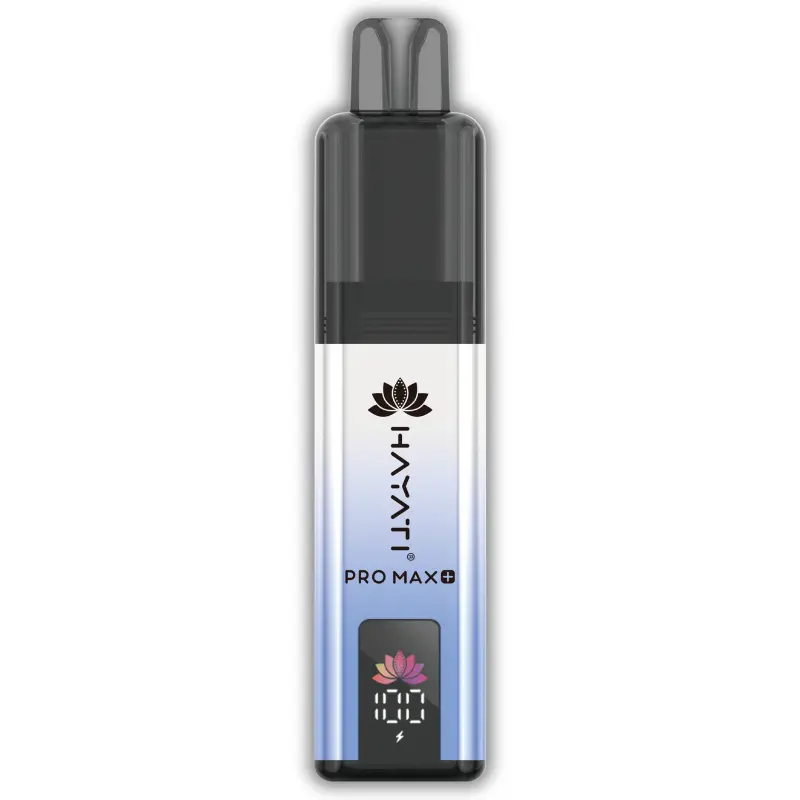
Hayati · Pro Max Plus
Blue Fusion Hayati Pro Max Plus 6000 Pod Kit
£7.99
✔ In stock — ready to ship
Genuine Hayati
Free over £20
Same-day dispatch
Secure checkout
Blue Fusion arrives as a complete Hayati Pro Max Plus 6000 kit: a rechargeable body carrying an 850mAh cell, a prefilled 12ml pod at 20mg nicotine, and £7.99 for the pair. Hayati rate a full pod at up to 6,000 puffs, a laboratory estimate produced by machine testing rather than a forecast of anyone's week. Those numbers hold constant right across the Hayati Pro Max Plus Prefilled Pod Kit shelf, which means the specification cannot help you choose this listing over the eighty-seven sitting beside it in the grid.
The name is supposed to do that job instead, and here it barely tries. Blue Fusion is two words, neither of which names a fruit. The first is a colour. The second says only that more than one thing went into the bottle. Put together they eliminate a handful of possibilities and commit to nothing, which makes this one of the least informative listings Hayati publish, on a range where around a sixth of the names already tell a buyer nothing at all.
That is the gap this page is written to close. What follows works out what Blue Fusion most likely is, describes how it behaves in the mouth from the first draw to the last one, sets it against every other blue listing in the same range, and marks clearly the points at which Hayati have published nothing. There is no component list for this liquid anywhere in the product data. Any page that gives you one has made it up, and this page will not.
One warning before the detail, because it is the mistake that costs people most often in this corner of the catalogue. Blue is not blueberry. This kit is tagged onto the Blueberry Vapes shelf and it earns its place there, but somebody who filters by blueberry, sees the word blue, and orders on that basis will receive something sharper and considerably sweeter than the fruit they had in mind. Separating the two is the single most useful thing a page about this product can do, and it takes up the next two sections.
What the word "blue" is actually telling you
Blue on a vape label is shorthand for a confectionery profile, not for a plant. The reference point is blue raspberry, and blue raspberry is a flavour invented for manufactured sweets: slush syrups, ice lollies, boiled sweets, hard-shelled chews. No raspberry bush has ever produced it. There is no fruit sitting behind it that a formulator could be judged against, which is why accuracy is not a meaningful criterion for a blue liquid in the way it is for a peach or a blackcurrant. The profile is defined by a set of sensations rather than by a source, and every manufacturer is working from the same sweets.
Those sensations are consistent enough to list. An acidic hit that lands early and high in the mouth, mostly on the tip and sides of the tongue. A sugar-syrup body underneath it with real weight to it. A berry-ish aroma across the top that resembles raspberry in outline only, without the seedy, faintly tannic character a real raspberry carries. And a slightly manufactured edge that reads as sweet-shop rather than as fruit. That edge is part of the profile by design. It is not a flaw in the liquid and it does not go away in a more expensive one.
A practical consequence follows from all of this, and it shapes how you should read the whole blue corner of the range. Because every blue liquid chases the same reference sweet, the blues converge. The genuinely interesting differences between them are not in the blue itself but in what has been done to it: cooled, carbonated, soured, sweetened further, or blended with something darker. Choosing between blue listings is choosing a modification, not choosing a fruit.
Where this catalogue complicates matters is in the tagging. Blue-named products sit on the blueberry shelf because blueberry is usually part of the recipe in a house blue blend, and that shelf sets out at length why blueberry almost never leads in a mixed liquid: it carries very little acid, so anything sharper takes the front of the mouth and the blueberry settles underneath as body. The label order and the tasting order come apart. Blue Fusion is a clean example of the problem, because the word blue is doing the marketing and the word blueberry is doing the filing, and the two point at different experiences.
So the honest summary of the first word: it places this liquid firmly in the sweet-counter half of the range, tells you to expect high sugar and noticeable acid, and gives you no information whatsoever about fruit. Anybody buying blue is buying a confection. That is not a criticism. It is the most popular corner of the Pro Max Plus range by some distance, and a lot of people know exactly what they want from it.
What "Fusion" rules out, which is more than it commits to
Hayati are reasonably disciplined about signposting treatments in their flavour names, and that discipline is what makes the second word readable by elimination rather than by definition. Cooling is always flagged: Ice, Frozen or Cooler appears in the name whenever a liquid has been cooled, so Blue Frozen announces itself and this one does not. Soft-drink structure is flagged too, with Lemonade, Juice or Cola doing the work. Pushed acidity gets the word Sour. The sweet-shop readings carry their own suffixes, so GB signals a chewy sweet version of a fruit and B'Gum signals bubblegum, which is exactly what Blueberry B'Gum is.
None of those markers appears on this listing. Taking the naming conventions at their word, Blue Fusion is therefore uncooled, not built on a carbonated or citrus-soda structure, not deliberately soured, and not a bubblegum or chewy-sweet reading. Four things ruled out by the absence of four words. That is a real amount of information, and it is nearly all the information the name contains.
What "fusion" adds on its own is thin. It says that more than one component went in and that the intent was to have them read as a single thing rather than as a sequence of identifiable notes. That is a formulation aim rather than an ingredient, and it is the giveaway: a liquid whose selling point is that its parts blend is a liquid whose parts you are not meant to name while tasting it. Where a listing wants you to identify what has been added, it tells you, as Blue Razz Cherry does. Fusion is the opposite decision.
Hayati's own listing text does offer one reading, and it is worth taking seriously while being clear about its status. The description points at two blues rather than one: a bright, tangy blue raspberry at the top and a darker, jammier blueberry underneath it, worked together into a single rounded sweetness. That is presented as the natural interpretation of the name, not as a recipe, and no proportions, no additional components and no flavour-house detail are given anywhere. Treat it as the manufacturer's best short description of their own product, which is more than a guess and less than a specification.
It is also, structurally, a sensible construction. Blue raspberry is all top and front: acid, brightness, a short life in the mouth. Blueberry is the reverse, with almost no acid and a slow, rounded weight that builds late. Put those two together and each covers the other's gap. If a house blend built on blue is going to work at all, a darker berry filling the middle is the obvious way to build it, and the description is consistent with what the liquid does.
The flavour, draw by draw
The opening
The attack is bright and fast. Within the first half second you are in no doubt which family this belongs to, because the acid arrives before anything else and it arrives high, across the front of the tongue rather than at the back. There is a tingling quality to it that people describe as fizzy even though nothing here is carbonated; that sensation is acid, not bubbles, and the two are easy to confuse when describing and impossible to confuse in the mouth.
Against a plain blue raspberry liquid the opening is a shade softer. Not damped out, and not polite, but the spike does not stand quite so alone. Something arrives underneath it faster than it would in a single-note blue, which shortens the moment where the acid is the only thing happening. First draws on a fresh pod are where this is most obvious; by the third or fourth the palate has adjusted and the opening reads as normal rather than as sharp.
The middle, where the second blue sits
Around the midpoint the liquid changes character, and this is the part the name is actually referring to. A rounder, heavier sweetness comes up from below, and it is not a second flavour standing alongside the first so much as a floor put underneath it. The character of that floor is stewed rather than fresh: soft, dark, slightly jammy, with the faint floral edge that blueberry carries and no sharpness of its own to contribute.
Trying to pick it apart is largely futile, which is the design working as intended. What you can do is notice its effects, and they are measurable by anyone paying attention. Perceived sweetness goes up, because sugar signalling spread across more of the palate reads as more sugar overall. Perceived sourness goes down, because the acid no longer has an empty middle to ring into. The liquid ends up sweeter and rounder than the blue it started from without a gram of extra sugar necessarily being involved.
There is a secondary effect worth flagging. Because the darker component is doing structural work rather than presenting itself, most people taste this as one flavour rather than two, and then struggle to describe it afterwards. That has consequences at reorder time, which the later sections come back to.
The exhale and the finish
Blue comes back on the way out, though quieter than it was on the way in. The acid reasserts for a moment, then hands over to a sweet tail that runs on longer than a sharp blue liquid would. Thirty seconds after an exhale there is still something there, which is not the case with the sour listings in the same corner.
Whether that length suits you depends entirely on your rhythm. Spaced out across a day it reads as pleasant and slightly indulgent. Taken in quick succession it stacks, because each draw lands on the residue of the last one rather than on a reset palate, and by the sixth or seventh in a row the sweetness has climbed somewhere you may not want it. This is the most useful behavioural fact about the liquid and it is the reason the handling section further down argues for pacing rather than for anything technical.
How sweet, placed against the rest of the shelf
Sweet, and above the middle of the range, but not at the top of it. The bubblegum and chewy-sweet listings are meaningfully sweeter, and anyone who finds this one heavy should understand that those are a step further in the same direction rather than a sideways move. At the other end, the blackcurrant and cranberry profiles are the genuinely dry things in this range, and the distance between them and Blue Fusion is large.
Sourness is the more useful axis here, because it is where this liquid is unusual. Sugar is high and acid is moderate, which is not the standard blue configuration. A plain blue raspberry runs high on both. A sour blue pushes acid higher still. Blue Fusion keeps the sugar and pulls the acid back, and the mechanism for that is the dark berry filling the middle rather than any reduction in the blue itself. Knowing that tells you which direction to move if this is not quite right, and the comparison section maps those moves.
Cooling
Nothing in the name flags a cooling agent and nothing in the product data names one. Across this range cooling is declared openly in the title, without exception, so the absence of Ice, Frozen or Cooler from a Pro Max Plus listing is reliable evidence. Read it as uncooled.
That matters more than it sounds. Cooling suppresses how sweet a liquid reads, shortens the finish and flattens some of the fine detail in a blend. None of that is happening here, so the sweetness arrives with nothing sitting on top of it and the tail runs its full length. Coming to this from a cooled listing, the change will feel larger than a change of fruit alone would explain, and the first impression will be of syrup. Give it a day before judging.
Things Blue Fusion is not
Not a blueberry liquid, in the sense that somebody asking for blueberry means. There is very probably blueberry in it, and the darker half of the profile behaves the way blueberry behaves, but it is underneath a confectionery flavour and it is not what you will register. Anyone who wants the fruit itself is looking at the wrong half of the shelf.
Not sour. There is acid, and the opening has bite, but a liquid built to be sour is doing something categorically different, and the disappointment would show up on the third draw rather than the third day.
Not complicated. Fusion suggests layers, and a buyer might reasonably expect a busy, many-fruited blend. What is actually here is two-part construction with one part hidden, which is simpler than the name implies and more coherent for it.
Not carbonated. There is no soda structure, no citrus scaffolding and nothing that reads as fizzy drink. The tingle on the opening is acid doing its work.
Not a dessert or cream profile. Nothing in the range's creamy corner has any bearing on this, and the sweetness here is boiled-sweet sweetness rather than the thick sort.
Day one against day eight
Twelve millilitres is enough liquid that the pod you finish is not quite the pod you started, and on a two-part blend the two parts do not fade at the same rate. The bright top goes first. Fine, volatile top notes always do, and on this liquid the top note is the whole of the blue raspberry character, so what flattens is precisely the thing that made the opening interesting.
What is left behind is the darker sweetness with less holding it in check, so the closing stretch of a pod reads heavier and blunter than the first days did. That is ordinary behaviour for a prefilled pod rather than a fault, but it is more noticeable on a sugar-forward liquid than on a dry one, and it gives you a clear signal. When the sweetness is still fully present but the blue has gone flat on top of it, the pod has reached the end of its useful life whatever the liquid level suggests. People who run two flavours in rotation rather than one continuously tend not to notice this at all.
Sorting the blues before you order
Four listings in this range are house blends of blue fruit with no fruit named: Blue Fusion, Mr Blue, Mad Blue and Blue Frozen. There is no naming logic connecting them, no consistent convention that would let you predict one from another, and the replacement-pod shelf for this range says plainly that these four are where reorder mistakes concentrate. Remembering a pod as "the blue one" is not enough information to find it again, and at £7.99 a time the guessing is not free.
Blue Frozen is the easiest of the four to place, because it declares its modification. It is a blue house blend with cooling over the top, which means it will read as less sweet and shorter in the finish than this one, and it will suppress exactly the dark, jammy middle that Blue Fusion depends on. If you have had Blue Frozen and found it thin, Blue Fusion is the sensible next stop. If you found Blue Fusion cloying, Blue Frozen is the direct fix and you do not need to change fruit to get it.
Mr Blue is the closest genuine relative and the hardest comparison to make honestly, because Hayati publish no component list for that one either. It is another house mixture of blue fruits, it is not cooled, and it is sold across several Hayati hardware ranges rather than just this one. Order them one at a time rather than together, because tasting two undeclared blue blends in the same week is how people end up unable to say which was which.
Against the Blue Razz family the picture is clearer, because those listings name their base and their modifier. Blue Razz GB is the chewy-sweet reading, with sugar pushed up and any pretence of fruit accuracy abandoned; it sits above Blue Fusion on sweetness and below it on acid, so it is a step in the same direction rather than an alternative. Blue Razz Blackcurrant goes the other way completely, since blackcurrant brings tartness and dryness and cuts the perceived sugar, making it the listing to reach for if the roundedness here is the problem.
Blue Razz Lemonade applies a soft-drink treatment, which lightens the body and shortens the tail without changing the base. Blue Razz Fruit Twist is the nearest structural twin to Blue Fusion in the whole range: same idea of filling the mid-palate to damp the acid, but with a mixed-fruit sweetness instead of a dark berry doing the filling. The practical difference is in the character of the middle. Fruit Twist fills it with something soft and orchard-like. Blue Fusion fills it with something darker and stewed. Which you prefer is a genuine matter of taste, and neither is sweeter than the other by any margin worth arguing about.
Blue Razz Cherry deserves a separate mention because it is the argument against this whole approach. Where Blue Fusion hides its second component, Blue Razz Cherry names it, and you can taste exactly what has been added. Some people much prefer that, because an identifiable second fruit makes a liquid feel like a composition rather than a blur. Others find a named fruit competes with the blue instead of supporting it, which is the exact problem an unnamed blend is built to avoid. That is the choice in one sentence.
If what you actually want is the sourness back, Red Sour Raspberry is the most direct answer in the range. It keeps the sweet-counter framing, swaps the blue reference for a red one and pushes the acid hard, which makes it close to the mirror image of what Blue Fusion does. And if you would rather find out what you think about blue in a smaller quantity before committing 12ml, Blue Razz Pineapple / Strawberry Ice Hayati Mini Ultra Pod Kit at £3.99 puts a blue profile on much smaller hardware for a fraction of the outlay.
Blue against actual blueberry
Plenty of people arrive at this listing from the blueberry shelf and want the fruit rather than the sweet. There are good landings for them and they are worth naming precisely, because the difference is not subtle once you have tasted both.
Blueberry Raspberry is the obvious first move and the most reordered profile Hayati make. Raspberry supplies the acid, blueberry supplies the body, and the whole thing reads as fruit rather than as confection. It is less sweet than Blue Fusion, it tires far more slowly over a full pod, and it is the listing most people settle on after they have worked through the blue corner. Blueberry Raspberry Cherry adds a third fruit to that and some find it one too many.
For blueberry standing as close to alone as this catalogue allows, Blueberry Pomegranate is the answer. Pomegranate is astringent and thin rather than sour, so it dries the finish without covering what is underneath, and the blueberry stays identifiable throughout. It is also an odd flavour that plenty of people do not get on with, which is worth saying rather than glossing over.
Going darker and drier, Blackberry Raspberry deepens the fruit without adding sugar, and Blackberry Ice is about as far from Blue Fusion as the range travels while staying in berries: tart fruit, cooling on top, no sweet tail at all. Blueberry Cherry Cranberry uses cranberry to supply real dryness, which is the most effective single correction available if sweetness is what you are escaping.
The red-fruit route is gentler. Strawberry Raspberry Blueberry keeps the blueberry as an underlayer and puts recognisable fruit over the top, while Strawberry Raspberry Cherry swaps the blueberry for cherry and lands somewhere brighter. Strawberry Raspberry Ice is the cooled version of that idea and the one to pick if the long sweet finish here is the specific thing you dislike.
For a complete change of direction rather than an adjustment, Blackcurrant Juice is the driest berry listing in the range and holds up over a full pod without turning sickly, while Blackcurrant Mango keeps that tartness and puts something thick underneath it. Berry Lemonade keeps sweetness but restructures it around a soda profile, which lightens everything. Black Mamba is worth a line of its own because it is another name that tells you nothing and turns out to be a sharp mixed berry, so it belongs on the same list of unknowns as this one.
On larger hardware the same territory is covered by Blueberry Raspberry Hayati Pro Ultra Plus 25000 Prefilled Pod Kit and Blueberry Raspberry Lemon, both at £11.99, with considerably more liquid committed to one decision. Blueberry H'Bubba / Watermelon H'Bubba pairs two profiles in a single listing, which is the one answer to the problem a single sealed flavour cannot solve. The cross-range view of all of it sits on Berry Vapes, the complete set of devices on Hayati Pod Kits, and the prefilled subset on Hayati Prefilled Pod Kits.
The kit, kept brief
Hardware gets less room here than flavour because the hardware is common to eighty-eight listings and the flavour is not. The short version: you get a rechargeable body with an 850mAh cell and a pod already filled with 12ml at 20mg, boxed together at £7.99. The listing itemises the device, the pod system and the liquid, and nothing beyond that, so this page will not promise you a cable or an accessory that the product data does not record, and it will not name a charging connector, because none is named anywhere in this listing's own facts.
How the 12ml is arranged inside the pod is not stated on this listing either. The kit shelf gives the range-level account of that and is the right place to read it; what matters at the point of purchase is that the pod arrives filled and there are no bottles involved, which the listing does say. You keep the battery charged and that is the whole of the maintenance.
The more interesting fact about this device, specifically in relation to this flavour, is how little of it you can adjust. There is no fire button, no wattage setting and no airflow collar. It fires when you draw and stops when you stop. Every variable a refillable setup would hand you has been decided at the factory, and exactly one input remains under your control: the length and pace of the draw.
On an undeclared two-part blend, that single input is worth more than it would be elsewhere, because it is effectively your only instrument for finding out what is in the pod. A short, brisk draw favours the top of the profile, which here means the blue raspberry acid and the bright opening. A long, unhurried draw moves more liquid across the coil and brings the darker middle forward, because the heavier component needs more vapour to register than the acid does. The gap between those two draws is wider on this liquid than on a single-fruit pod, precisely because there are two layers with different weights to play off. If Blue Fusion is reading too syrupy, shorten the draw before you write it off. If it is reading thin and sharp, lengthen it.
Twelve millilitres in one pod is a commitment rather than a convenience. You cannot decant it, dilute it or blend it with something you preferred, and on a sweet uncooled liquid that is a heavier commitment than it would be on something neutral. Buy this because you want several consecutive days of this specific profile, not as a hedge against indecision.
The body outlives the pod, which is the whole reason the kit and the pod are sold separately. Once you own a working Pro Max Plus, the restock is Blue Fusion Hayati Pro Max Plus Pods at £5.49, and the £2.50 between the two prices is the battery and nothing else. The replacement-pod shelf works through that arithmetic properly. If you want the range's plain generic listing rather than a named flavour, Hayati Pro Max Plus 6000 Prefilled Pod Kit is it.
Specifications
| Flavour | Blue Fusion |
| Format | Complete kit, device supplied with a prefilled pod |
| Pod liquid volume | 12ml, prefilled |
| Nicotine strength | 20mg |
| Battery cell | 850mAh, rechargeable |
| Manufacturer rating | Up to 6,000 puffs, a laboratory estimate |
| Price | £7.99 |
| Product code | HPM-6K-KIT-BLUE-FUSION |
| Brand | Hayati |
Read that table as a compatibility document rather than as a description, because eight of its nine rows are shared verbatim with every other kit in the range. Price, volume, strength, cell size, format, rating, brand: all identical across eighty-eight listings. A table that cannot distinguish between products cannot help you choose one, which is the underlying reason this page spends its length on flavour instead.
The one row that is unique is the product code, and it is quietly the most useful line on the page. HPM-6K-KIT-BLUE-FUSION identifies this exact listing with no ambiguity at all, which is precisely what the flavour name fails to do. On a shelf carrying four undeclared blue blends, a code you can search is worth more than a name you half remember. Note it down when the kit arrives, or photograph the box before it goes in the bin.
Two of the remaining rows are worth a sentence of interpretation. The strength is fixed at 20mg for this listing, so it cannot be used to separate one flavour from another on this shelf and should not be read as a recommendation of any kind. Nicotine is addictive, and what strength to buy is a decision for the buyer rather than for a product page. The rating tells you about relative scale and nothing about days: it is a reliable way to compare the liquid volume of one Hayati pod against another, and a poor way to predict your own week, because draw length alone can move the real figure by a factor of two in either direction.
Living with a blend nobody has itemised
Most handling advice is identical on every prefilled pod, so the points below are the ones that actually bear on this product rather than the generic list.
Start by letting the kit stand upright for two or three minutes before the first draw, and keep the first handful of pulls short and gentle. The generic reason is that the wick needs to saturate. The reason to care here is more specific: Blue Fusion is an undeclared blend, so the first ten draws are the only clean data you will ever get about what is in it, and a scorched wick contaminates that sample permanently. On a sugar-forward liquid a lightly burnt coil does not announce itself the way it would on a mint. It presents as a flat, slightly bitter edge behind the sweetness, which is exactly the sort of thing a first-time buyer will attribute to the flavour rather than to the handling. Two minutes of patience protects your own judgement, not just the pod.
Write down what you taste on day one. That sounds excessive for a £7.99 purchase and it is not, because there is no published component list for this liquid and there never will be. Your own notes are the only specification that will ever exist for Blue Fusion, and they are what will tell you, three months later, whether the pod in front of you is the same blend you liked or whether you have picked up Mad Blue by mistake. Two lines is enough: what hit first, what filled the middle, how long the finish ran.
Pace matters more on this liquid than on most. The long sweet tail means consecutive draws accumulate rather than reset, so a stretch of quick successive pulls will read considerably sweeter than the same liquid taken with gaps. If you find the sweetness climbing through an evening, that is usually rhythm rather than the pod deteriorating, and slowing down fixes it within a few minutes. Running a second, drier flavour alongside this one is the more durable solution; a blackcurrant or a cranberry-led listing makes an effective rotation partner precisely because it resets the palate rather than adding to it.
Storage is straightforward. Keep the kit upright, out of direct sunlight and out of a hot car, because warm liquid thins and thin liquid moves where you do not want it. Sweet liquids leave more residue than dry ones, so wipe the contacts and the pod bay with a dry cotton bud when you change pods; a faint film of condensate is the usual explanation for a new pod that appears not to fire. Keep spare pods and the device away from children and pets.
Knowing when a pod is spent is the last thing worth covering, and on this flavour the signal is unusually clear. The blue top note goes before the sweetness does, so the moment to reorder is when the liquid still tastes sweet but has lost its brightness, not when it tastes weak overall. Waiting for the liquid to run out entirely means spending the last couple of days on a flatter version of what you bought. If you like the profile enough to keep it in rotation, ordering the replacement pod before that point is a small saving in aggravation.
Everything recently added across the ranges surfaces on New Products, and the whole catalogue is on the All Hayati products page if you would rather browse the lot.
Questions people ask about this one
Is Blue Fusion a blueberry flavour?
Not in the sense most people mean. Blueberry is very likely part of the recipe and the darker half of the profile behaves the way blueberry behaves, but it sits underneath a blue raspberry confectionery flavour and it is not the thing you consciously taste. If you want blueberry you can point at, Blueberry Pomegranate is the closest the range gets.
What separates Blue Fusion from Mr Blue, Mad Blue and Blue Frozen?
Blue Frozen is the cooled one, which is the only difference any of the four names actually declares. Mr Blue, Mad Blue and Blue Fusion are all uncooled house blends of blue fruit with no published component lists, so nothing in the names distinguishes them. Order one at a time and keep notes, because trying two of them in the same week makes them impossible to tell apart afterwards.
Is there any cooling in it?
No cooling is declared. Hayati signal cooling in the product name across this whole range with Ice, Frozen or Cooler, and none of those words appears here, so treat it as uncooled. Expect the sweetness to arrive unmasked and the finish to run longer than a cooled listing would.
Is it sour?
There is real acid in the opening and it gives the first moment of the draw some bite, but this is not a sour liquid. The darker component underneath damps the acid rather than amplifying it. Red Sour Raspberry is the listing to pick if pushed sourness is what you want.
How sweet is it compared with the blue listings around it?
Above the middle of the range and below the top of it. The bubblegum and chewy-sweet readings such as Blueberry B'Gum and Blue Razz GB are meaningfully sweeter. The blackcurrant and cranberry profiles are far drier. Blue Fusion reads sweeter than a plain blue raspberry mostly because its acid has been reduced, not because more sugar has been added.
Is anything else needed to use the kit?
The listing records a device, a prefilled pod system and the liquid together in one box, so nothing separate needs buying to use it. Beyond that the product data does not itemise accessories, and this page will not claim a cable or a connector type that the facts do not state. Open the box and see what is in it.
How long does one pod last?
Hayati rate a full pod at up to 6,000 puffs, which is a laboratory estimate generated by a machine taking fixed draws at fixed intervals. Real use varies enormously with draw length, draw strength and how often you reach for it. The only figure worth planning around is your own, and one pod will produce it.
Can the pod be refilled?
No. It arrives prefilled and there is nothing on it designed to be opened or topped up, which is why the listing notes that no bottles are involved. When the liquid is done you fit a fresh pod rather than adding to the old one.
I already own a Pro Max Plus device. What should I order?
The bare Blue Fusion pod at £5.49 rather than this kit at £7.99. The difference between the two prices is the battery body, so buying a kit you do not need costs £2.50 and leaves you with a duplicate device to dispose of eventually. Same liquid, same 12ml, same flavour.
Will this pod fit my other Hayati device?
Pro Max Plus pods seat in Pro Max Plus bodies and in nothing else Hayati make. Mini Ultra, Rubik and Pro Ultra Plus all use their own pods, and none of them interchange. This listing is a kit, so it includes the body it needs.
How do I make sure I reorder the right one?
Use the product code, HPM-6K-KIT-BLUE-FUSION, rather than the flavour name. Four separate blue house blends sit in this range and a two-word memory of "the blue one" will not distinguish between them. Photographing the box before you throw it away takes five seconds and solves the problem permanently.
The short version
Blue Fusion is a sweet, uncooled blue confectionery liquid with a darker berry filling the middle of the draw, sold as a complete Pro Max Plus 6000 kit at £7.99 with an 850mAh rechargeable body and a prefilled 12ml pod at 20mg. It opens bright and acidic, thickens through the middle, and finishes long and sweet. The name declares none of that, and Hayati publish no component list, so the description here is built from what the naming conventions rule out and from what the liquid does in the mouth.
Buy it if you already know you like the blue corner of this range and want a rounder, fuller version of it than a plain blue raspberry gives. Avoid it if you came looking for the fruit, because the blueberry in it is structural rather than audible, and Blueberry Raspberry or Blueberry Pomegranate will serve you far better. If the sweetness is the sticking point, Blue Frozen applies cooling to a similar base and Blue Razz Blackcurrant brings the acid back. And whichever way you go, note the product code down, because on a shelf with four undeclared blues the name will not get you back here.
Strictly for adults aged 18 and over. Nicotine is an addictive substance.
You might also like


