
Home / Hayati Pro Max Plus Prefilled Pod Kit / White Peach Raspberry Hayati Pro Max Plus 6000 Pod Kit
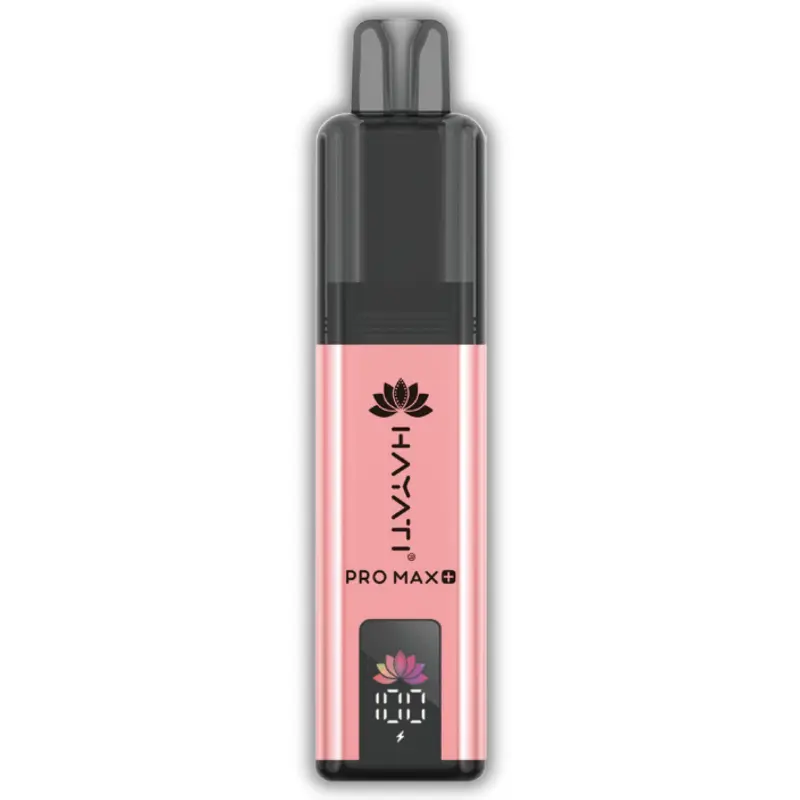
Hayati · Pro Max Plus
White Peach Raspberry Hayati Pro Max Plus 6000 Pod Kit
£7.99
✔ In stock — ready to ship
Genuine Hayati
Free over £20
Same-day dispatch
Secure checkout
White Peach Raspberry as a complete kit costs £7.99 and contains a rechargeable 850mAh body plus a prefilled pod holding twelve millilitres of liquid at 20mg nicotine salt. Hayati put a rating of up to 6,000 puffs on the pod, produced on bench equipment under laboratory conditions rather than by anyone actually vaping. Those numbers are shared with all eighty-seven other listings on the Hayati Pro Max Plus Prefilled Pod Kit shelf, and every one of those is also £7.99. Nothing in the specification distinguishes this purchase from any other on the shelf.
The liquid does, and it has already been examined twice from two different directions. The bare pod listing took the name apart and established what the words can and cannot promise. The 10ml nic salt bottle of the same blend went through the draw itself, what arrives when, and how the lead fruit moves with how you pull on it. Between them they cover the label and the mechanics.
Both of them stop at the same place, and both of them say so. Neither can tell you the proportion. How much raspberry sits against how much peach is not in the listing, not in Hayati's description, and not inferable from anything published anywhere. Both pages put that in the unknown column, note that it matters, and move on to something they can actually settle.
This page does not move on. The proportion is the subject here, because on this particular blend it is not one unspecified detail among several. It is the thing that decides which of two quite different products arrives in the packet, and the two are not equally worth £7.99. One of them is the only pod of its kind in a catalogue of 492 listings. The other is a decent raspberry pod that the same shelf sells in ten sturdier versions for exactly the same money. Working out which one is likelier, what each tastes like, how to tell them apart on your first pod, and what twelve millilitres of use does to the balance along the way is what the rest of this is for.
What the two earlier pages settled, and the column they both left blank
Starting with what is already known saves repeating it and makes clear where the new work begins.
On the name, the pod listing did the counting. Strip the hardware suffix from all 492 titles in this catalogue and 173 distinct flavour names remain. Exactly two of them specify a variety of the fruit they name, White Peach and Red Apple, and not one names a cultivar outright. On the peach shelf the ratio is three listings out of thirty-two, and all three are this liquid in its three formats. Its conclusion was that the phrase is a real signal of formulation intent and a poor guarantee of execution: it tells you what the mixer was asked for, not whether the mixer delivered. That finding stands and is not re-argued here.
On the mechanics, the nic salt page went through a draw in detail and established that the balance between the two halves is not fixed even within one bottle. Short pulls favour the sharp half, long ones let the soft half fill out, and coil temperature pushes in the same direction that draw length does. That work is also done, and this page uses its conclusion rather than restating its reasoning.
Now the gap. A conclusion about intent plus a conclusion about how a draw develops still leaves the quantities open, and quantities are what a blend of two unequal fruits actually is. Neither page could close it, because nothing published closes it. There is no ratio in the title, none in Hayati's paragraph of retail copy, none in the specification, and no flavour house, concentration or inclusion rate named anywhere.
What makes the absence unusual is that on most listings it would not matter much. Three berries in a red pile will taste of red fruit whether the cherry is fifteen per cent or twenty five. Two robust fruits of similar weight produce roughly the same drink across a wide band of proportions. That is why nobody demands a ratio for Strawberry Raspberry Blueberry and why its absence there is not worth a paragraph. The proportion only becomes load-bearing when the two components are perceptually mismatched, and this pairing is mismatched by design. That is the entire reason it was built.
Why the proportion is a hinge rather than a dial
A dial gives you a smooth run of intermediate results. Turn it a little, get a little more of one thing. A hinge gives you two positions and a short, unstable travel between them. This blend behaves like the second, and the reason is in how the two halves are perceived rather than in how much of each is present.
Masking does not run both ways
The pod listing stated the principle in one line: a sharp note masks a soft one far better than the reverse. That is correct and it is the foundation of everything below, so it is worth spelling out what follows from it rather than leaving it as an aphorism.
Take the proportion of the sharp half as a single number and imagine sliding it upward from nothing. At the bottom of the range you have peach alone, sweet and wide and with no structure, which is pleasant and quickly stops registering. Add a small amount of raspberry and things improve steeply: the acid resets the palate, the astringency stops sweetness accumulating, and the blend acquires a shape it did not have. Keep going and the improvement continues for a while. The peach is still what you would name if asked, and the raspberry is the finish.
Then, over a fairly narrow stretch, something switches. The sharp half stops being a finish and becomes the arrival. Once it is what registers first, it takes the description with it, and the soft half is no longer a fruit you can name. It has become the sweetness behind a raspberry. Push further and almost nothing more happens, because the raspberry already owns the percept and additional raspberry only makes it more so.
The shape of that curve matters. There is a long low region where peach leads and gets steadily better, a short transition, and then a very wide plateau where the answer is raspberry and stays raspberry no matter how much further you go. A parameter with that shape is not a dial. Land anywhere on the plateau and you get the same product. Land below the transition and you get a different one. The interesting band, where the peach leads and the raspberry does its job properly, is the narrowest of the three regions.
The two outcomes are not worth the same
If the two results were merely different, this would be a matter of taste and not worth eight hundred words. They are not merely different, because the range they sit in is not neutral between them.
Count the kit shelf. Of its eighty-eight listings, eleven name raspberry, and every single one of them is £7.99. Take this one out and ten remain, which is to say that a buyer who ends up with a raspberry-led pod has ten alternatives at identical cost, several of them built specifically to be raspberry-led and therefore better at it. Red Sour Raspberry and Blue Sour Raspberry put the acid at the front on purpose. Blackberry Raspberry gives it a partner of comparable weight so neither disappears. Blueberry Raspberry Cherry and Strawberry Raspberry Cherry surround it with fruit that can take the pressure.
Now count the other side. Six listings on that same shelf name peach. Five of them pair it with things that are not berries at all: a mango and a pineapple, a tea, a cherry and a lemon, a mood word, or nothing. This is the only listing on the shelf, and as far as the catalogue goes the only listing anywhere in it, that puts a peach against a berry as a two-fruit blend. If the peach leads, you own something with no substitute at any price in this range. If it does not, you own the eleventh raspberry pod on a shelf that already had ten.
That asymmetry is the practical stake. The downside of the hinge falling the wrong way is not that the pod is bad. It is that the pod becomes redundant, and redundancy is a real cost when the thing you paid for was the difference.
Outcome one: a peach with an edge on it
Describing a blend nobody has put in front of me is not the job, and the pod listing was right to refuse it. What can be done honestly is to describe the two products the parameter produces, because those follow from the structure rather than from a tasting.
Below the transition, what you have is a sweet, wide, low-contrast fruit with a short sharp close. The defining characteristic is not any single draw, it is what happens over a session. A blend in this region holds attention across a long stretch of use, because the sweetness never gets to settle. Every draw gets tidied up at the end, the palate is returned to roughly where it started, and draw forty tastes much like draw four. That is a genuinely uncommon property in a sweet fruit pod, and it is what the pairing was assembled to produce.
Two things would be true of it that are not true of most of the shelf. The first is that it would read as a stone fruit rather than as red fruit, which is a structural difference rather than a matter of degree. Stone fruit occupies the middle of the palate and spreads sideways. Berries are narrower, brighter and higher. Anyone whose rotation has drifted entirely into the Berry Vapes end of the catalogue, which runs to 210 listings against 32 for Peach Vapes, would notice the difference immediately and might notice it as relief.
The second is that the raspberry would still be doing plenty of work while staying out of the way. That is the part people get wrong about supporting components. A supporting fruit at the correct level is not faint. It is fully present and structurally placed, arriving where it is useful rather than where it is loudest. The test of whether it is at the right level is not whether you can taste it. It is whether removing it would collapse the blend, and in this arrangement it would.
There is a failure mode at the very bottom of this region too, and it deserves naming because it is the one people forget. Too little raspberry and you do not get a purer peach, you get a monotonous one. Without enough acid to reset between draws, sweetness accumulates, the palate stops responding, and by the middle of a session the pod has become a vague sugary warmth. That is worse than a raspberry-led outcome in at least one respect: a raspberry-led pod is still interesting to vape, whereas an under-sharpened peach is exhausting. The interesting band is bounded at both ends.
The nearest thing on the shelf to what this outcome would be is Blueberry Raspberry, which follows the same soft-plus-sharp logic with a far more durable soft half. The difference is that blueberry is robust enough that the arrangement works almost regardless of the proportion, which is precisely why it is the more predictable purchase and the less interesting one.
Outcome two: a raspberry pod with an unusual floor
Above the transition the description changes entirely, and the important thing to say first is that it is not a bad pod. Anybody who bought it without reading the name would report a decent red berry blend with a soft, faintly floral sweetness underneath, and would be content with it. Nothing about that outcome is a defect.
What it is, is generic in the one place it was supposed not to be. The raspberry accord in this range is a known quantity, appearing across 74 of the 492 listings in the catalogue, and it is competent: jammy at the top, sharp through the middle, dry and slightly tannic at the close. Put it in front and it produces a perfectly good raspberry pod. The white peach, at that proportion, is no longer functioning as a fruit. It has become a sweetener and a cushion, the thing that stops the raspberry being thin, which is a real job and an anonymous one. Any soft sweet fruit could do it.
The consequence is that the only reason to have chosen this listing over the other ten has evaporated. You have paid for the specification in the name and received something the Raspberry Vapes shelf supplies 116 times over. Worse, you have received a version of it that was not optimised for the job. A blend built to be raspberry-led has its supporting elements chosen to flatter raspberry. This one has a supporting element chosen for a different purpose entirely, and it is carrying that purpose badly in a role it was not built for.
There is one softening consideration. If the transition has only just been crossed, the floral note may still be detectable when conditions are good, which makes this a raspberry pod with something faintly unusual behind it. That is a more attractive object than a plain raspberry pod, and some buyers would prefer it to the peach-led version. Sharp is easier to enjoy than soft, and a great many people do not want to concentrate on what they are vaping. If that describes you, the raspberry-led outcome is not a disappointment at all, and the honest thing to say is that you should probably buy something built to be raspberry-led in the first place and save yourself the uncertainty.
The version to genuinely avoid is well up the plateau, where the peach registers only as sugar. At that point the blend has the vices of both sides: the raspberry is unsupported and tends towards thin and metallic at the back, and the sweetness underneath it has no fruit identity to justify itself. That combination is less pleasant than a straightforward sour raspberry and considerably less pleasant than the peach-led version. It is the genuine floor of the distribution rather than a merely uninspiring result.
Which way is it likelier to have fallen
The honest starting position is that nobody outside the blending room knows. That is not the same as a coin toss, though, and treating it as one would be lazy. Several structural pressures act on the answer and they mostly push the same way.
Equal amounts do not produce equal presence
This is the strongest of the arguments and it is a point about chemistry rather than about commerce. Aroma materials differ from one another in perceptual potency by orders of magnitude, not by percentages. Some are detectable at vanishingly small concentrations and some need to be dosed at percentage level in a concentrate before they register at all.
The materials that carry peach are in the second group. They are heavy, oily, high-boiling compounds, and a peach accord is built by putting quite a lot of them in. The materials that carry the bright top of a raspberry are in the first group: the violet-adjacent aromatics that give berries their lift are among the lowest-threshold substances used in flavour work anywhere. On top of that, the acid component of a raspberry is not an aroma at all. It is a taste, registered directly on the tongue, and taste-active acids are effective at trace inclusion because they do not have to survive being turned into vapour and routed through the nose to be noticed.
Put those together and a mixture that is fifty-fifty by weight is nowhere near fifty-fifty by perception. It is already raspberry-forward, substantially so. To arrive at the peach-led outcome, a formulator has to deliberately underdose the raspberry against the intuitive proportion, and keep underdosing it until the balance tips. That is an active decision made against the grain of the materials. The raspberry-led outcome, by contrast, is what you get by not making any decision at all.
The raspberry is probably a house accord at a house rate
The second argument is about how ranges of this size are actually assembled. Seventy-four listings in this catalogue carry raspberry, spread across pods, kits, bottles and every hardware line the brand sells. Nobody builds a fresh raspberry for each one. There is a raspberry accord in the house, it is used at a standard inclusion, and it turns up recognisably the same from listing to listing. The nic salt page for this liquid made exactly that observation, noting that the raspberry here is audibly the same concentrate that appears in the range's straighter berry mixes.
If that is right, and it is the ordinary way this industry works, then the raspberry side of this blend was not tuned for this blend. It was dropped in at the rate that already works everywhere else, and the only variable genuinely under adjustment was the peach. A house rate set to make raspberry read properly against a blackberry or a strawberry is a rate set for partners that can push back. White peach cannot push back. Using the standard rate against it would put the blend on the plateau without anyone intending to put it there.
The feedback a formulator gets is biased towards sharp
The third pressure is about how these decisions get checked. A blend gets assessed on fresh hardware, in short sessions, by people taking a few draws each. Every one of those conditions favours the sharp half. The nic salt page established that short pulls bring the raspberry forward and long ones let the peach develop, and a tasting panel takes short pulls. A blend that reads as nicely balanced across four quick draws on a new coil may be well onto the plateau across a two-hour session, and nothing in the assessment would reveal it.
So the error, when it happens, happens in one direction and is hard to catch. Overdosing the soft half produces an obvious fault that anybody notices in one draw, because the blend is flabby. Overdosing the sharp half produces something that tastes fine on the bench and is only wrong at the scale of a session.
The range's centre of gravity
Fourth and weakest, but worth stating. This catalogue is a berry catalogue. The berry shelf holds 210 of 492 listings, raspberry alone accounts for 116 once the blue confectionery entries are counted, and peach manages 32. A mixer working inside a house style tends towards what the house does, and what this house does is red and blue fruit. Blue Razz GB, Blue Razz Cherry, Blue Razz Pineapple and Blue Razz Blackcurrant all sit on this shelf, all loud, all built on the sweet-shop end of the palette. A delicate low-acid stone fruit is not this range's native register.
What the word order does and does not tell you
The obvious counter-argument is that the title puts white peach first, and titles usually lead with the headline. The pod listing already judged word order to be weak evidence in this range. There is a specific count that makes it weaker still, and it is worth having.
Of the 25 distinct raspberry flavour names in this catalogue, only two begin with the word raspberry, and both of those pair it with something that is not a fruit at all: a cola and a candy-floss note. Every single one of the twenty-three names that pairs raspberry with another fruit names the other fruit first. Blackberry Raspberry, Blueberry Raspberry, Strawberry Raspberry Cherry, Kiwi Grape Raspberry, Blueberry Raspberry Lemon, all of them.
Raspberry is never named first in this range when there is another fruit present. It is therefore impossible for its position in this title to carry any information about dominance, because the title could not have been written the other way round. The word order here is a naming convention, not a statement, and it should be discarded as evidence entirely rather than treated as a weak hint.
The honest counter-case, and where I come down
Two things point the other way and they deserve stating. The first is commercial: the peach is the reason this listing exists. Somebody chose to write a variety word on a label in a range that has never done it before, which is a decision nobody makes about an ingredient they intend to bury. There is a real incentive to make the peach audible, because an inaudible peach makes the name pointless and the listing indistinguishable.
The second is that the nic salt page, working on the same liquid, reports the peach as clearly present and describes the blend as one where the balance can be moved either way by how you draw. If that is accurate, the liquid is sitting near the transition rather than up the plateau, which is the most interesting place it could be.
Weighing those against the four pressures above, my reading is that the raspberry-forward outcome is more likely than not, without being anywhere near certain. If pushed to a number I would put it around two chances in three, and I would place most of the remaining third close to the transition rather than comfortably peach-led. That is a judgement built from structure, not a measurement, and the only thing that settles it is a pod. Which brings us to how you read one.
Reading the proportion off your own first pod
The pod listing supplies three checks for a different question, namely whether the white peach profile was achieved at all: whether the peach carries acid of its own, whether its sweetness is cool or cooked, and whether there is a blossom note above the fruit. Those are profile tests and they are not repeated here. What follows tests proportion, which is a separate question and a harder one, because a proportion has no reference point. You can taste whether something is floral. You cannot taste forty per cent.
Five approaches get round that, and they get round it in different ways, so run more than one.
Ask somebody who has not read the label
This is the crudest of the five and probably the most informative, because the thing corrupting your own judgement is not your palate. It is that you know what the pod is called.
Expectation has a large and well-documented effect on how people describe a flavour, and the effect is strongest exactly where the signal is weakest. You have read the words white peach. You will go looking for a peach, and going looking for something is an excellent way of finding a trace of it and then overweighting what you found. Somebody who has not read the label has no such pull. Hand them the device, ask them to name the fruits, and say nothing else.
Read the answer strictly. If they name raspberry and nothing else, you are on the plateau. If they name raspberry and say there is something sweet behind it they cannot place, you are on the plateau but near its edge. If they name a peach, or say stone fruit, or reach for apricot or nectarine, the peach is leading. The distinction that matters is not whether they can detect peach when prompted. It is what they volunteer unprompted, because that is what the blend actually presents.
Separate the two channels physically
The two halves of this blend are perceived through different routes, which means you can pull them apart without any equipment.
Acid and astringency are tasted and felt. They land on the tongue and the gums and they do not require your nose at all. The peach, by contrast, is almost entirely aroma, and aroma is perceived retronasally, on the way out through the back of the nose. So take one draw and let it out entirely through the mouth, then take another and let it out entirely through the nose, and compare what each one gave you.
The mouth exhale shows you the taste fraction close to unaccompanied: acid, the dry tannic close, and sweetness. The nasal exhale routes the aroma fraction over the receptors that detect it and shows the peach at maximum advantage. If the nasal version reveals a substantial peach that the mouth version gave no hint of, the peach is present and is being masked, which places you near the transition. If the nasal version reveals only a little more than the mouth version did, the peach is genuinely thin in the mix and you are on the plateau. If both routes give you peach and the raspberry reads as a finish in each, the blend is peach-led.
Use the draw-length swing as a measuring instrument
The nic salt page established that the lead fruit in this blend moves with how you draw, short pulls favouring the raspberry and long slow ones letting the peach fill out. That finding belongs to that page. What has not been done with it is to use it as an instrument, and it makes a good one.
The reasoning is simple. A parameter sitting close to a threshold can be pushed across it by a small nudge. A parameter sitting a long way from the threshold cannot. So take a one-second draw and a three-second draw, a few minutes apart, on a rested pod, and see whether the answer to "which fruit is this" actually changes.
If it does change, if the short one reads raspberry and the long one reads peach, your pod is sitting near the transition and the proportion is finely balanced. If both read raspberry, you are well up the plateau and no draw technique will retrieve the peach. If both read peach, the proportion is comfortably in the interesting band and you have bought the good version. The size of the swing is the measurement, not the direction of either individual draw.
Run a session, not a draw
Single draws are the wrong instrument for the thing that actually determines whether you will enjoy this pod for twelve millilitres, because accumulation happens at the scale of twenty minutes and not at the scale of one pull.
So vape it for twenty minutes without doing anything else interesting to your palate, and pay attention only to what has happened by the end. Three outcomes, three readings. If the sweetness has piled up and the whole thing has started to feel heavy and slightly cloying, there is not enough acid in the blend and you are at the bottom end. If you finish more or less where you started, with the flavour reading as clearly as it did at the beginning, the proportion is correct and the raspberry is doing its job. If your tongue feels dry, the sides of it feel faintly worked, and the sweetness has thinned out into something sharper, there is too much raspberry and you are on the plateau.
That test is more reliable than any single-draw judgement because it measures the thing the raspberry is actually for. The raspberry is not there to be tasted. It is there to stop the sweetness accumulating, and whether it has done that is only observable over time.
Compare it against a yardstick you may already own
The last one requires nothing new if your rotation already contains a raspberry pod, and most rotations in this range do. Alternate between this and something raspberry-led, a few draws each with a gap in between, and ask a narrow question: is the raspberry in this pod weaker than the raspberry in that one?
The answer is diagnostic in a way that judging this pod alone cannot be. If the raspberry here reads at roughly the same strength as it does in a pod built around raspberry, then it is at a raspberry-led inclusion and the peach is not leading anything. If it reads noticeably quieter, it has been dialled back, which is the deliberate underdose the peach-led outcome requires. Put the softer flavour first in the pairing, because coming to it after something sharp will bury it for several minutes regardless of the proportion, which would give you a false reading.
Putting the five together
No single test is conclusive and they fail in different directions, which is why running three beats running one. The blind naming test is the best single read but needs a second person. The channel separation is the most precise and the fiddliest. The draw-length swing tells you how close to the edge you are rather than which side of it. The session test measures function rather than presence. The yardstick test needs another pod to hand.
Agreement across three of them is about as settled as this question gets from outside the blending room, and it takes an afternoon.
What twelve millilitres does to the balance, and why this pod may run the wrong way
There is one more complication, and it is the one that makes the proportion question genuinely awkward rather than merely unanswered. The proportion you measure is not fixed. It moves over the life of the pod, and on this format it may well move in the direction opposite to the one most people expect.
A disagreement worth being explicit about
The nic salt page for this liquid reaches a clear conclusion on ageing: the peach fades first, the raspberry endures, and the blend tips towards a thin sharp berry as the coil deteriorates. Its reasoning is that the peach is carried by delicate aromatics that a gunked or scorched wick destroys, while acid and tannin survive conditions that erase them. Its practical advice follows, which is to treat the disappearance of the peach as the signal to fit a new coil.
I think that is right about a bottle and not straightforwardly right about this pod, and rather than write a page that quietly contradicts a sibling, it is better to say exactly where the two situations differ.
The bottle lives in refillable hardware. Its coil is a separate component with an indefinite service life, and the failure the nic salt page describes is a coil that has run well past its useful span, accumulated a crust of caramelised sweetener and developed scorched patches. That is a coil-condition effect and it is entirely real. Its advice about it is sound.
This kit does not offer that failure. The coil is inside the pod, it is not separable, and it sees exactly twelve millilitres before the pod is finished and thrown away. It cannot be run three pods past its span because it does not have the opportunity. So the mechanism that drives the nic salt page's conclusion is bounded here in a way it is not bounded in a refillable arrangement, and with it bounded, a second mechanism becomes the larger of the two.
The reservoir, not the coil
The second mechanism happens in the liquid rather than at the wire, and it is specific to a sealed reservoir that empties.
A pod starts close to full and finishes close to empty. The space the liquid vacates fills with air, and that air is exchanged with every draw. Compounds in the liquid partition between the liquid and the air above it according to how volatile they are, and the most volatile go first and go fastest. Across twelve millilitres and several hundred draws, that is not a trivial amount of air exchange.
Now consider which compounds are which. The peach is carried by heavy, high-boiling, oily materials. They are the least volatile things in the pod and they stay where they are put. The bright top of the raspberry, the green stalk-and-leaf lift and the light aromatics that give it its freshness, is the volatile end of the blend. The acid is not volatile at all, but the acid is also not the part that makes raspberry read as raspberry rather than as sourness.
So the liquid in the bottom third of the pod is not the same liquid that was in the top third. It has been selectively stripped of its lightest fraction, and its lightest fraction is disproportionately the raspberry's lift.
Two mechanisms pulling opposite ways
Both effects are present in a prefilled pod and they act on different things, which is why the net result is not simply one or the other.
The coil effect, bounded but not absent, works on the most delicate aromatics. Within the peach, that means the floral top. A pod at the eleven millilitre mark is unlikely to present blossom the way it did at millilitre one. The reservoir effect works on the most volatile compounds, and within the raspberry that means the green lift and the fresh top.
What survives both, therefore, is the heavy end of each fruit. The peach keeps its body: the wide, sweet, slightly waxy core that the heavy materials produce. The raspberry keeps its acid and its dry tannic close, which are tongue-felt and go nowhere. What is lost is the peach's perfume and the raspberry's freshness.
The net prediction, and it is a prediction rather than a report, is that the last third of a pod should read heavier and sweeter and less lifted than the first third, with a drier close. In terms of which fruit dominates, that is a shift towards the peach, because the peach's contribution is almost all aroma and its aroma is the durable kind, while the part of the raspberry that made it read as a fruit was the part that evaporated. What remains of the raspberry is closer to structure than to flavour.
It is worth saying plainly that this runs opposite to the usual pattern. Most prefilled pods get duller and flatter as they empty, and a great many of the blends on this shelf do exactly that. A pod that becomes rounder, heavier and less bright as it goes is unusual, and if it happens here it happens because the two halves of this blend are unusually well separated in volatility.
What that means for your verdict
The consequence for everything above is straightforward and slightly annoying. If the proportion moves across the pod, then a verdict reached on draw three is a verdict about the first third only.
So run the tests twice. Once in the first millilitre or two, and again somewhere past the two thirds mark. A pod that reads raspberry early and peach late was sitting near the transition and has drifted across it, which is the most likely outcome if my reading of the proportion is right and the volatility argument holds. A pod that reads raspberry at both ends was well up the plateau to begin with. A pod that reads peach at both ends is the good version and you can restock without further thought.
There is a mildly cheering implication in that. If the pod starts raspberry-forward and drifts, the second half of it is the half you actually wanted, and a buyer who writes it off on day one never finds out. The usual advice about a fragile blend is to enjoy it early. On this format the opposite may apply.
The kit, briefly
Very little of the hardware is specific to this flavour and the platform has been described at length across the rest of the shelf, so this stays short.
What arrives is a rechargeable 850mAh body and one prefilled pod carrying twelve millilitres at 20mg. There is nothing to fill, nothing to prime and nothing to assemble. When the pod is spent, a replacement Pro Max Plus pod restarts the same body, which is where the pod on its own comes in at £5.49 for anyone who wants this liquid again. Before ordering pods for any device, match the range name printed on your device to the range name in this listing, because the brand uses closely similar names across hardware that does not share a pod.
One specification matters more than the others for this particular liquid, and it is one Hayati do not publish: the coil resistance. That absence is less annoying than it sounds, because a prefilled pod gives you no settings anyway. There is no wattage to adjust and no airflow collar to turn, so the sole variable in your hands is draw length. On a loud confectionery blend that would be a footnote. On a blend whose lead fruit demonstrably moves with draw length, it is the only control you have, and it is the reason the swing test above works at all and the reason the assessment draws should be generous ones.
The 6,000 figure attached to the pod is Hayati's own rating, generated by bench equipment taking mechanical puffs at fixed intervals. It is a laboratory estimate and a poor forecast of anybody's week, particularly on a liquid that rewards long draws, since long draws consume liquid faster than the test protocol does. Use it to compare listings against each other and nothing more. The rest of the platform detail sits on the Hayati Pod Kits shelf.
The published numbers, and the one that is not
The table is arranged so that the unpublished variable this page is about sits where you cannot miss it, rather than being buried among specifications that are identical across the whole shelf.
| Proportion of peach to raspberry | Not published anywhere, and the subject of this page |
| Coil resistance | Not published by Hayati |
| Coolant | None named and none implied |
| Adjustable settings | None; draw length is the only variable |
| Flavour | White peach with raspberry |
| Nicotine | 20mg nicotine salt |
| Liquid in the pod | 12ml, filled before it reaches you |
| Battery | 850mAh, rechargeable |
| Maker's puff rating | Up to 6,000, a bench figure |
| Supplied as | Device plus one prefilled pod |
| Restocking the same liquid | The bare pod, £5.49 |
| Price of this kit | £7.99 |
| Other kits on the same shelf | Eighty-seven, all £7.99 |
| Of those, naming raspberry | Ten |
| Of those, naming peach | Five |
| Shelves it appears on | Peach Vapes, Raspberry Vapes, Berry Vapes, New Products |
| Brand | Hayati |
The top four rows are the point of the table. A product whose entire distinguishing feature is a formulation decision, and which publishes nothing at all about that decision, is asking you to buy the claim and verify it afterwards. That is not unique to this listing and it is not scandalous, it is simply how prefilled liquid is sold everywhere. It is worth putting in a table because the rest of the specification is so completely uninformative: every kit on the shelf has the same volume, the same strength, the same price and the same rating, so the specification cannot help you choose between them at all.
The 20mg figure needs one sentence rather than a section. Twenty milligrams per millilitre is the legal ceiling for consumer nicotine liquid in the UK, which is why there is no alternative strength here or on any of the eighty-seven neighbours. Nicotine is an addictive substance, and intake tracks how long and how often you draw rather than the number by itself. On this listing that connects to the flavour argument directly, because the long draws that favour the peach also move more liquid.
On value, £7.99 for twelve millilitres plus a body is roughly 67p per millilitre on the first purchase and about 46p thereafter, once the £5.49 pod is the only thing you are buying. Cross-format comparisons are less useful than they look until you divide by volume: the Blue Razz Cherry Mini Ultra kit at £3.99 and the Blue Sour Raspberry Rubik kit at £5.99 both hold considerably less, and the Pro Ultra Plus kits at £11.99 hold considerably more.
Where it sits among the neighbours
The comparison that matters here is unusual, because the sensible alternatives depend on which side of the hinge you think the pod has landed. Two different shopping lists follow from the two outcomes.
If you want the peach and cannot risk the uncertainty
The awkward answer is that there is no substitute. Six listings on this shelf name peach and no other one pairs it with a berry, so nothing here replicates the arrangement. What the shelf does offer is peach in other configurations, each of which trades the interesting part away for something more predictable.
Mango Peach Pineapple puts peach in the middle of two louder tropical fruits, which means you will get peach reliably and never get peach on its own terms. Mango dominates that blend and peach softens the edges of it. It is the durable option and the one that will taste identical from the first millilitre to the last.
Peach Aura takes the opposite approach to naming: a fruit plus a mood word that specifies nothing at all. What is in it beyond peach is not on the record, which makes it a different sort of gamble from this one. Here you know both ingredients and not their proportion. There you know one ingredient and nothing else.
If a raspberry-led pod would suit you fine
Then buy one deliberately rather than hoping this one turns out that way, because a blend built for the job does it better.
Red Sour Raspberry is the direct version: acid at the front, no soft half to protect, nothing to concentrate on. Blue Sour Raspberry takes the sweet-shop route to the same destination, since blue raspberry is a confectionery flavour rather than a fruit one and no berry of any variety has tasted like it.
Blackberry Raspberry is the one to pick if you want structure without fragility. Both halves are robust, neither can be masked by the other, and nothing in it will quietly leave over twelve millilitres. It is the pod for someone who does not want to think about what they are vaping, and that is meant as a recommendation.
Blueberry Raspberry Cherry and Strawberry Raspberry Cherry pile three red fruits together. Neither has a hinge in it, because three fruits of comparable weight average out rather than compete, and the result is red fruit whatever the proportions happen to be. Mixed Berries does the same thing and does not even tell you which berries.
The blends with nothing fragile in them at all
An entire wing of this shelf is built so that the question this page asks cannot arise, and it is worth pointing at because for a lot of buyers it is the right wing.
Blue Razz Fruit Twist, Blue Razz Lemonade, Blue Razz Mojito and Strawberry GB are all loud, immediate and completely indifferent to how you draw on them, how hot the coil is, or how much attention you are paying. There is no delicate component to lose and therefore no proportion to worry about. Blue Fusion goes further and does not disclose its ingredients, which is a different kind of unknown again.
Blackberry Ice is the instructive contrast rather than a rival. Adding a coolant to a blend like this one would sit directly over the register the white peach occupies and erase it, leaving a cold berry with a vague sweetness behind it and no reason to have specified a variety. The absence of ice here is a coherent decision. It is also the reason this pod has nothing to hide behind, since a coolant papers over a great deal.
Other formats of the same idea
If twelve millilitres in a sealed pod is the wrong shape, the range branches sideways. The Blueberry Cotton K and Raspberry Cotton K kit at £11.99 is a dual-flavour pod: one twenty-two millilitre reservoir divided in two, with a collar that selects which side feeds a single shared coil, so there is carryover at every switch and both sides age together. The Blue Razz GB and Lemon Lime kit works the same way with a citrus on one side.
Smaller formats run the other direction. The Blue Sour Raspberry Mini Ultra kit and the Blue Razz GB Mini Ultra kit at £3.99, and the Blue Razz Cherry Rubik kit at £5.99, hold less liquid for less money. The full spread sits on the Hayati Prefilled Pod Kits shelf and the complete Hayati range, with recent arrivals surfacing under New Products before they settle in.
Who should leave it alone
Three groups, and being specific is more use than pretending it suits everybody.
If you already own and enjoy a raspberry pod from this shelf, the downside outcome here is a duplicate of something in your drawer, and the cost of the gamble is higher for you than for anyone else. The whole value proposition depends on getting the version you cannot buy elsewhere.
If you vape in short frequent bursts through the day, the draw-length finding works against you before the proportion even comes into it. Short pulls favour the sharp half, so your habit stacks on top of whatever the blend already does, and a pod sitting near the transition will be pushed across it by how you use it. You would be receiving the raspberry-led version regardless of what is in the liquid.
And if you do not want to think about what you are vaping, this is the wrong pod on principle rather than in practice. Everything above assumes a buyer willing to run a test or two. Somebody who wants a flavour to be reliably the same thing every time should take one of the durable blends on the Raspberry Vapes shelf and never think about it again.
Getting the most out of the first pod
Most handling advice is generic and most of it has been written on every page on this shelf. What follows is filtered to one criterion: whether it affects your ability to read the proportion, or the proportion itself.
Do not form a view on the first three draws. A factory-filled pod has been standing, the liquid has settled, and the first pulls tend to read either oddly flat or oddly sharp. Both of those errors point in the same direction here, towards a raspberry verdict, because a flat read loses the soft half and a sharp read exaggerates the loud one. Take a few unhurried draws with gaps between them and let it settle before you judge anything.
Make the assessment draws long ones. This is the only control the hardware gives you and it moves the very thing you are trying to measure. Short pulls will tell you the pod is raspberry whether or not it is. Once you have your answer you can vape it however suits you, but the reading itself should be taken on generous draws with the pod at rest.
Put it first in a rotation, never after something sharp. Palate carryover is real and it is not even-handed. Coming to this straight off a mint, a sour or anything from the blue confectionery end will suppress the soft half for several minutes and hand you a false negative. If you rotate between pods, this one goes at the start of a session.
Test it again past the two thirds mark. The whole point of the volatility argument above is that the answer may not be the same at both ends of the pod. Repeating the tests late costs you nothing and it is the only way to catch a pod that has drifted from one side of the hinge to the other.
Keep it out of warmth and daylight. Heat and light attack volatile aromatics before anything else in a liquid, and here that means they work on the raspberry's lift and the peach's blossom at the same time, leaving you with the heavy end of both. A pod that has spent a fortnight in a car or on a sunny sill will still taste of something, and it will not be the thing you were trying to assess. A drawer is fine, and somewhere children and pets cannot get at it is better.
Stand it upright when you are not using it. A pod resting on its base keeps liquid over the wick rather than pooling towards the mouthpiece, which reduces the chance of a wet first draw. That is ordinary advice. It earns a place here only because a wet first draw is exactly the draw you were planning to use for the nasal exhale test.
Recognise a shape change as distinct from a fade. Two different things happen to an ageing pod and they call for different reactions. If everything dulls together, that is ordinary wear and there is nothing to do but finish it. If the blend changes proportion, one fruit receding while the other holds, that is the effect this page has been describing and it is information rather than a fault. Note which fruit went, because it tells you where on the hinge your pod was sitting.
Dispose of the spent kit properly. A finished pod contains a coil, and the body contains a cell, so neither belongs in household waste. Electrical waste rules cover both. Retailers selling this kind of hardware are obliged to accept it back, and council recycling sites run a separate stream for it. Do not try to prise the pod apart to separate the plastic from the coil, because they are not designed to come apart by hand.
Questions worth asking before ordering
Which fruit actually leads in this pod?
Nobody outside the blending room knows, because the proportion is not published and cannot be inferred from the listing. Structurally, raspberry-forward is the likelier outcome, because sharp notes mask soft ones and because the materials that carry raspberry are perceptually potent at much lower inclusion than the ones that carry peach. My reading is roughly two chances in three, offered as a judgement rather than a measurement.
Does the word order in the title tell me anything?
No, and there is a specific count that kills the idea. Of the 25 distinct raspberry flavour names in this catalogue, twenty-three pair it with another fruit and every one of those names the other fruit first. Raspberry is never placed first in this range when another fruit is present, so its position here could not have been otherwise and carries no information.
How do I find out which version I have bought?
Hand the device to someone who has not read the label and ask what fruits they taste, since your own reading is biased by knowing the name. Then compare a mouth exhale with a nasal exhale, because the acid is tasted and the peach is smelled, so the two routes separate the halves. Agreement between those two is a reliable answer.
What happens if the raspberry turns out to dominate?
You have a perfectly decent red berry pod with a soft sweet backdrop, which is not a bad thing to own. The problem is that the same shelf sells ten other raspberry pods at the identical £7.99, several of them purpose-built for the job and therefore better at it. The loss is the distinctiveness rather than the quality.
Is there another peach and berry blend I could compare it against?
Not in this catalogue. Six listings on the kit shelf name peach and this is the only one that pairs it with a berry. The others attach peach to mango and pineapple, to tea, to cherry and lemon, or to a mood word, which is why the comparison section leads with the fact that no substitute exists.
Does the balance stay the same across the whole pod?
Probably not, and it may move in the direction most people would not predict. The peach's aroma materials are heavy and stay in the liquid, while the raspberry's bright top is the volatile fraction that gradually leaves through the air space as the pod empties. The expectation, stated as reasoning rather than as a measurement, is that the last third reads heavier, sweeter and less lifted than the first.
The nic salt page says the peach fades first. Which is right?
Both, for their own formats. That page describes a refillable setup where a coil can be run long past its useful life, accumulate residue and scorch, which destroys delicate aromatics and leaves acid behind. This coil is sealed in the pod and sees twelve millilitres before the whole thing is discarded, so that failure has much less room to develop and the reservoir effect becomes the larger influence.
Is there any cooling in it?
None is named in the listing and nothing suggests one is present. That reads as deliberate, since a coolant sits over the same aromatic register the white peach occupies and would erase the distinction the name is making. If you want the chill, Blackberry Ice on the same shelf is the straightforward option.
How sweet should I expect it to be?
Sweet, and probably sweeter than its sugar content alone would suggest, since a low-acid fruit always reads that way. How well the sweetness is held in check is precisely the proportion question: too little raspberry and it accumulates over a session, too much and the whole thing turns dry and sharp instead.
Can I replace the coil when the flavour changes?
No. The coil and wick live inside the pod and are not serviceable, so the pod's life and the coil's life are the same thing. That is worth knowing here because the fragile component is the one the name is selling, and no intervention brings it back once it has gone.
What strength is available?
20mg nicotine salt and nothing else. That is the UK ceiling for consumer nicotine liquid, which is why no other concentration is listed for this flavour or for any of the eighty-seven other kits on the shelf. Nicotine is an addictive substance, and how much you take in depends on draw length and frequency rather than on the figure alone.
Should I order more than one?
Order one. Everything that would justify restocking depends on a proportion you cannot check from the listing and can check in an afternoon with the pod in your hand. If the tests come back peach-led you have found something with no equivalent in the range, and if they do not, you have spent £7.99 instead of £32.
The short version
White Peach Raspberry as a kit is £7.99 for an 850mAh rechargeable body and a twelve millilitre prefilled pod at 20mg. Mechanically it is indistinguishable from the other eighty-seven kits on its shelf, all of which cost the same. Its name has already been counted and analysed, and the way a draw develops has already been described. What neither of those pages could supply is the proportion, and the proportion is not a missing detail here. It is the product.
Because a sharp fruit masks a soft one far more efficiently than the reverse, the proportion behaves like a hinge with two positions rather than a dial with a smooth range. On one side you get a wide, sweet stone fruit with a short sharp close and nothing else in the catalogue quite like it. On the other you get a competent raspberry pod that the same shelf sells in ten sturdier versions for identical money. The materials, the way house accords are dosed, the conditions under which blends get assessed and the berry-heavy character of the range all push towards the second, which is why I would not bet on the first.
That is not a reason to avoid it. It is a reason to buy one rather than four, to run the blind naming test and the nasal exhale test early, and to run them again in the last third of the pod, because the volatility of the two halves means the answer you get at the start may not be the answer you get at the end. If the peach leads, you have found the only listing of its kind in 492. If it does not, one of the raspberry blends will serve you better and ask nothing of you.
Strictly for adults aged 18 and over. Nicotine is an addictive substance.
You might also like


