
Home / Hayati Pro Max Plus Prefilled Pod Kit / Peach Aura Hayati Pro Max Plus 6000 Pod Kit
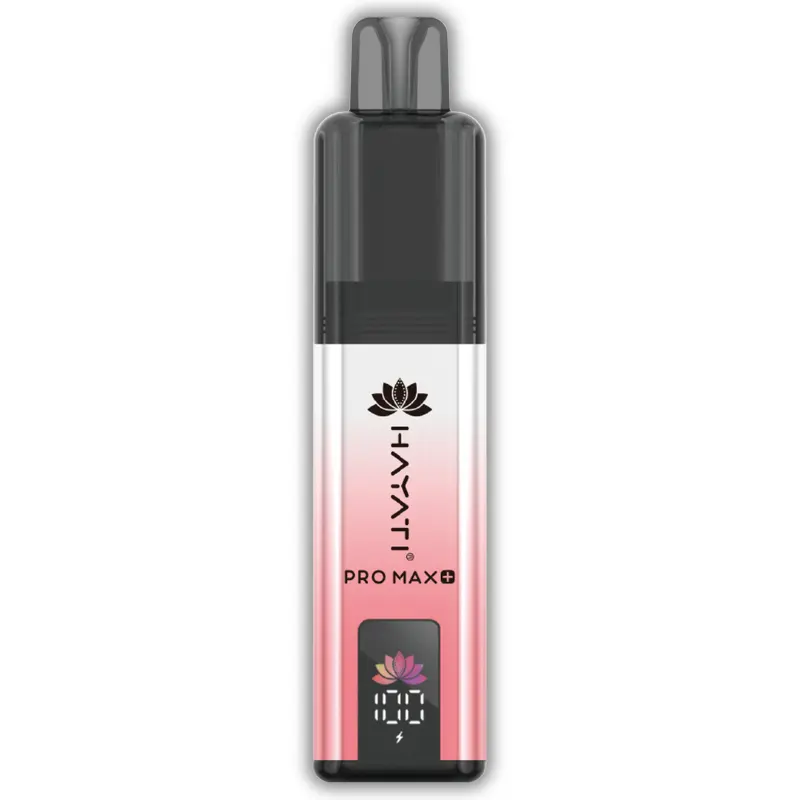
Hayati · Pro Max Plus
Peach Aura Hayati Pro Max Plus 6000 Pod Kit
£7.99
✔ In stock — ready to ship
Genuine Hayati
Free over £20
Same-day dispatch
Secure checkout
Seven pounds ninety-nine buys a rechargeable Hayati Pro Max Plus body and a prefilled pod of Peach Aura holding 12ml of liquid at 20mg, with the maker quoting a ceiling of 6,000 puffs for the pod. The hardware half of that sentence is shared with roughly ninety other listings and has been explained to death. The liquid half is not shared with anything, and it is the reason to read further, because Hayati have described this peach in a way that quietly commits them to a specific piece of flavour engineering.
Here is the commitment. Their text calls the fruit fragrant, velvety and ripe, and then rules out tang. In the next breath it suggests the blend should suit somebody who finds other peach vapes too sugary. Those are three claims, and the third one is in tension with the second in a way that is not obvious until you think about what acid actually does in a piece of fruit. Removing the sharp note from a sweet liquid does not make it read as less sweet. It makes it read as more. So if this blend genuinely lands on the restrained side of the peach category while also having nothing sharp in it, the sweetener load has to have been cut rather than balanced, and a peach with less sweetener and no acid is resting almost its entire weight on its perfume.
That is the argument of this page, and it has a consequence that matters over 12ml: perfume is the part of a liquid that does not last. Everything below works through the reasoning. What the acid was doing in a peach in the first place. What a stone fruit becomes when you take it out. Why the result reads sweeter, heavier and shorter than the tangier alternative sitting beside it on the same shelf at the same money. Whether that is the better buy at this volume. And, at the end of the pod rather than the start, what a Peach Aura with a tired coil is likely to taste like, which on a blend built this way is a different question from what a tired coil does to a busier one.
The name is settled, the one difference on the record is thinner than it looks
The naming question belongs to another page and is not reopened here. Peach Aura Hayati Pro Max Plus Pods, the bare pod at £5.49, takes the suffix apart at length and reaches three conclusions this page accepts and builds on. Across all six Aura listings the word has generated no shelf assignment of any kind, so nobody inside Hayati's own merchandising has ever treated it as meaning anything. The reading where Aura marks a softer handling defeats itself, because Hayati reach for the same soft vocabulary when describing a peach that carries no suffix at all. And the most likely function of the word is simple disambiguation: a second solo peach arrived on a shelf that already had one, and it needed a distinguishing word before it needed a meaning.
What that page also did, and did carefully, was isolate the single point where the published record distinguishes this liquid from the plainly named peach beside it. Hayati's copy for Juicy Peach mentions a small fresh sharpness at the close. Both Peach Aura texts deny anything of the kind. On paper that is the entire difference between two solo peaches on one shelf at one price, and it is the hinge the rest of this page turns on.
Before turning on it, it is worth weighing, because the hinge is lighter than it appears from inside a single shelf.
Juicy Peach is not one listing. It is ten, counting only the ones where the flavour stands alone rather than sharing a pod with something sour. Those ten run across six different hardware families and two bottle formats. If the closing sharpness were a property of the recipe, it ought to appear in the copy wherever the recipe appears. It does not. Exactly two of the ten mention it, and both of those two are the Pro Max Plus versions: the kit at £7.99 and the pod at £5.49. The other eight go the other way, and not by omission. Every one of them states the absence explicitly. The Pro Ultra Plus versions call sharpness low and rule out a sour note outright. The Rubik pair say there is no sharpness worth mentioning. The Mini Ultra pod, the 10ml salt, the 70/30 bottle and the 50/50 shortfill all say some version of nothing sharp or sour competing with the fruit. Eight denials, two affirmations, one flavour name.
Two readings of that, and the page needs both because the record does not choose between them.
The first is that the Pro Max Plus Juicy Peach is a genuinely different mix from the Juicy Peach in a 120ml bottle, and that the copy is tracking a real formulation difference confined to this platform. That is entirely plausible. A 12ml prefilled pod and a shortfill destined for a sub-ohm tank are not obliged to share a recipe just because they share a name, the carrier ratios almost certainly differ, and a flavour house routinely retunes a profile for a different power band. On this reading the differential the pod page found is real and it lands precisely where it counts, because Peach Aura exists only on the Pro Max Plus and so does the one tangy Juicy Peach.
The second is that the sentence is a copywriting variant rather than a formulation note. Ten descriptions of one flavour, written at different times by people with a house style and a word count, will not agree on every clause. Eight of them settled on one account of the finish and two settled on another. On this reading the record contains no differential at all between the two solo peaches on this shelf, and the only honest description of the difference between Peach Aura and Juicy Peach is that they have different titles.
Marking this as inference, because it matters. Hayati publish no acid figure, no sweetness figure, no ingredient proportions and no flavour-house documentation for any product in this range. Nothing in the paragraphs above is a specification. It is a count of published sentences, which is a fact about the copy, plus two accounts of why the copy says what it says, neither of which can be settled from outside. What the count does establish is that the one published difference between these two listings is carried by two sentences out of twelve, and that a buyer treating it as a hard fact is leaning on less than it looks like.
The useful move from here is not to keep interrogating the sentence. It is to take the claim at face value, since Hayati made it twice for this product and never contradicted it, and ask the question the claim opens up. If this peach really does close without a sharp note, what kind of peach is that?
What the acid was doing, and what leaves with it
A peach, as a thing you eat, is three separate systems that arrive together and get read as one.
The first is sugar. Sucrose mostly, with fructose and glucose behind it, and it is the least interesting of the three because it is the one every sweet fruit has. Sugar tells you the fruit is ripe. It does not tell you which fruit.
The second is acid, and in stone fruit that means malic acid principally, with citric behind it. There is much less of it by mass than there is sugar, and at the concentrations involved it is not really a flavour in its own right. A ripe peach does not taste sour. What the acid does is structural, and it does four separate jobs that are easy to run together and worth pulling apart.
The third is the aromatic fraction, which is minute by weight and does nearly all of the identification. Peach owes its recognisability to a family of lactones, the gamma and delta decalactones above all, which read as creamy, faintly waxy and warm. Around them sit esters, a small green note from six-carbon aldehydes that is strongest in slightly underripe fruit, and in some cultivars a benzaldehyde presence that pushes towards almond and cherry. That is the part of a peach that makes it a peach rather than a generic sweet thing, and it is the part that exists in vanishing quantities and evaporates readily.
Now the four jobs.
Acid holds sweetness down. Sweet and sour are mutually suppressive in mixture, which is a well-established property of how the two are processed together rather than anything exotic. Two liquids with identical sweetener loads will not taste equally sweet if one of them carries acid and the other does not. Take the acid out and perceived sweetness rises with no change to the recipe's sugar or sweetener at all. This is the single most important thing to understand about a peach advertised as not tangy, and it is why the phrase reads as reassuring while describing something that will land heavier on the palate than its tangier neighbour, not lighter.
Acid creates a time axis. Sourness has a different onset and a different decay from sweetness. It arrives slightly later, it registers on the sides of the tongue rather than the centre, and it persists after sweetness has begun to fade. That mismatch is what produces the sensation of a finish that is distinct from the middle of a mouthful. A liquid with sugar and aroma but no acid has an attack and a peak and then a fade, with nothing arriving late and nothing handing over to anything else. The flavour is not shorter in seconds. It is shorter in events, and the palate reports that as brevity.
Acid is the freshness cue. This is the one with the most consequence for how a peach specifically is read. The mental model of fresh fruit includes acid, and its absence is the defining sensory signature of fruit that has been cooked or canned. A tinned peach half in syrup has sugar and it has a good deal of the lactone character, and it is unmistakably not a fresh peach, and what has gone is the acid. A peach flavour built with the sharpness removed therefore does not read as a gentler fresh peach. It drifts towards the preserved end of the category: peach in syrup, peach jam, peach yoghurt, the peach in a dessert rather than the peach in a bowl. Whether that is a problem depends entirely on which of those a person wanted.
Acid clears the mouth. Sourness is a strong salivary stimulus, and saliva physically rinses residue off the tongue between one mouthful and the next. A liquid with no acid produces less of that rinse, so sweeteners and the heavier aromatic compounds accumulate across a session instead of being cleared. The effect is cumulative and invisible on draw one. It is very visible on draw four hundred.
One complication belongs here rather than in a footnote, because a reader who knows the format will already have thought of it. Nicotine salt, which is what a 20mg prefilled pod contains, is made by pairing nicotine with an acid. That is the whole mechanism of the preparation, and it is why salts exist as a category separate from freebase. Which acid Hayati use is not published, and it is not published for anything else in the range either. So a liquid described as having no tang is not chemically acid-free, and nobody claims it is. The claim is about the flavour house's decision, not about the pH of the bottle. The acid in a salt preparation is there to do something other than flavour, and a well-made one is meant to be sensorially quiet. Noting it matters only because it means a Peach Aura draw is not a sugar-and-perfume experiment with nothing acidic in it anywhere. It is a peach flavouring built without a flavour acid, sitting on top of a preparation that contains one for unrelated reasons.
Sweeter, heavier, shorter: what that actually feels like
Put the four jobs together and the shape of the liquid follows. Three consequences, each with a mechanism behind it rather than an adjective.
It reads sweeter than its recipe
Covered above as a mechanism, and worth stating as an experience. The sweetness does not spike. It broadens. Without acid pushing back against it, sweetness occupies the whole draw rather than the front of it, and it does not recede on the exhale the way it does on a blend with something sharp behind it. People describe this as syrupy, and the word is doing two jobs at once: it describes the level of sweetness and it describes the lack of anything cutting it.
There is a second contributor that is easy to overlook, which is the carrier. Vegetable glycerine is faintly sweet in its own right. On a blend with an acid, or a coolant, or a citrus component, that background sweetness is inaudible under the things competing with it. On a solo peach with the sharp note taken out, it is one of the louder voices left in the room. Hayati publish no carrier ratio for this listing and none is estimated here, but whatever the ratio is, its contribution is more exposed on this liquid than on almost anything else on the shelf.
It sits heavier
The lactones that carry peach identity are not light compounds in character. They are creamy and slightly fatty in the way they present, which is why peach and apricot aromas end up in dessert formulations so often and why a peach note works so comfortably against cream and custard. In a fresh fruit the acid is what stops that creaminess from dominating. Strip the acid and the lactones are the loudest thing in the profile, so the fruit moves from the bright end of stone fruit towards the rich end.
Perceived thickness follows. Sweetness and creamy aromatics both push the mouthfeel estimate upwards, which is a cross-modal effect rather than anything physically happening to the vapour, but it is what a person reports. Peach Aura will feel like a fuller vapour than a sharp fruit at the same volume, and nothing about the device has changed to make that true.
It finishes early
The draw peaks and then goes quiet. There is no late-arriving component to extend it, no sharpness on the sides of the tongue holding the flavour in place for a few seconds after the exhale, and no salivary rinse to mark the end of one draw and the start of the next. A person used to a two-component blend will find this reads as an abbreviated flavour even when the intensity at the peak is perfectly high, and the instinct will be to draw again sooner, which is precisely the wrong response because it compounds the accumulation problem.
None of the three is a fault. A round, sweet, quick, cooked-fruit peach is a legitimate thing to want and there is a decent argument that it is the more comfortable companion over a long day than something that keeps demanding attention. The point is that it is a specific thing, and the word gentle in a product description does not convey any of it.
The contradiction in Hayati's own paragraph
Return to the third claim, which is the one nobody notices on a first read. The kit text suggests this suits somebody who finds other peach vapes too sugary.
Set that beside the denial of tang and the claim becomes structurally awkward, because the two standard routes to a less sugary fruit are to use less sweetener or to add acid, and Hayati have ruled the second one out in the same paragraph. There is no third route. Coolants can disguise sweetness, and there is no cooling word in this title. Astringency can cut it, which is what the tea does in Peach Green Tea, and nothing astringent is named here either. Bitterness can, and nothing bitter is named. So the only way both statements hold is if the sweetener load in this liquid is genuinely lower than the peach category average.
Suppose it is. That is the version of Peach Aura most flattering to the copy, and it is also the version with the most exposure. A peach with restrained sweetener and no flavour acid has removed both of the things that give a fruit body. What is left holding the liquid up is the aromatic fraction on its own: the lactones, the esters, whatever green or almond edge the flavour house put in. It is a peach that depends on its perfume in a way that a sweeter or sharper peach does not, because the sweeter one can coast on sugar and the sharper one can coast on structure.
Suppose it is not, and the sweetener is ordinary. Then the copy's suggestion about sugary peaches is doing what product copy does, and the liquid is the first version described above: broad, sweet, creamy, short. That is the less interesting outcome and probably the more common one.
Inference, marked. There is no published number for sweetener in this product or in any product Hayati sell, so which of those two liquids is in the pod cannot be determined from the listing. Both are consistent with everything on the record. What can be said is that the copy commits to a combination that is difficult to deliver, and that the version where the copy is fully true is also the version most vulnerable to what happens next.
Twelve millilitres against a fragile top end
This is where a low-acid blend stops being a matter of taste and becomes a matter of arithmetic, and it is the part of the analysis that a buyer choosing between two peaches at the same price should weigh hardest.
Three things happen inside a prefilled pod over its life, and they happen to every pod regardless of what is in it.
Residue builds on the coil. Sweeteners are the main culprit, because they do not evaporate cleanly at coil temperatures and instead leave a darkened deposit that thickens over time. That deposit sits between the heat and the liquid, so it changes what gets volatilised and how evenly.
Wick supply degrades. The rate at which liquid reaches the heated zone falls as the wick fouls, so each draw gets slightly less liquid, and what it does get has spent longer against a hot surface.
And the liquid itself changes, because the most volatile components are preferentially lost over the pod's life, particularly anywhere the pod has been warm.
Now apply the differential, which is the whole point. Those three processes do not treat every part of a recipe equally.
The aromatic fraction is the fragile part. Aroma compounds are volatile by definition, they are present in the smallest quantities, they are the first casualties of a fouled coil, and they are what heat degrades. Within the fraction, the lifted top end goes first: the esters and the faint green note that make a flavour read as fresh fruit rather than as fruit flavouring. The heavier lactones hang on longer but they too thin out.
Sweetener is durable. Sucralose and the compounds used alongside it are not volatile in the same way. They do not evaporate away and they do not thin. If anything the perceived sweetness of an ageing pod rises, not because there is more of it but because everything competing with it has fallen away. The sweetener is simultaneously the most persistent component and the principal cause of the fouling that kills the others, which is an unkind arrangement.
Flavour acid is durable too. The organic acids used in fruit flavourings are comparatively stable, non-volatile at the relevant temperatures, and considerably more robust than the perfume they sit under. An acid that was present at the first millilitre is substantially still present at the eleventh.
The consequence for the two peaches on this shelf is direct and it goes one way.
On a peach with a sharp close, the late pod still has a structure. The perfume has narrowed, so the fruit is less specific than it was, but the acid is still doing three of its four jobs: holding sweetness down, creating a late event on the exhale, and keeping the mouth clearing between draws. The liquid gets simpler and it stays legible. It still reads as a fruit with a shape.
On a peach with no flavour acid, the late pod has nothing underneath the perfume when the perfume goes. What remains is sweetness, carrier and a soft warm impression that could belong to several fruits. The failure mode is not harshness. It is anonymity. The liquid stops being identifiable as peach well before it stops being pleasant, and pleasant-but-unidentifiable is a much harder thing to notice than a burnt note, because nothing about it feels wrong. A person will keep going, mildly less satisfied each day, and attribute it to having got used to the flavour.
So the honest answer to what a late Peach Aura pod is likely to taste like: sweet, warm, slightly thick, soft on the exhale, with the fruit present as a general direction rather than as a named thing. Somewhere between a generic sweet fruit and a faint dessert note. Not unpleasant, and not what was bought.
Two practical consequences follow, and they are worth more than the diagnosis.
The first is that the standard test for a spent pod fails on this liquid twice over. The usual advice is to wait for a harsh or scorched taste, and a sweet low-contrast blend both masks that note longer and reaches its own point of diminishing return before the note arrives. The test that works here is identification rather than unpleasantness. Take a draw and ask whether somebody who had not been told what was in the pod could name the fruit from it. When the answer is no, the aromatic fraction has gone, and the pod is finished as a peach even if there is liquid left in it and nothing tastes wrong.
The second is that this argues against 12ml as the right format for this particular recipe, which is an awkward thing for a product page to conclude and is nevertheless what the reasoning gives. Twelve millilitres is a long run to ask of a blend whose entire distinguishing character lives in its least durable component. A busier blend spends that volume better because it has more than one thing to lose. That is a reason to prefer a peach with something else in it if the fruit is going to be a daily flavour, and it is not a reason to avoid this one if it is going to be an occasional one.
Marked as inference throughout: Hayati publish no coil resistance, no proportions, no acid figure and nothing at all about how their liquids behave at the end of a pod. The mechanisms above are general properties of flavoured liquid in a heated wick system, and the application of them to this specific recipe rests on the recipe being what the copy describes.
The kit, kept short
Eighty-eight listings sit on the Hayati Pro Max Plus Prefilled Pod Kit shelf and they all ship the same body, so the hardware writing has been done many times over and there is no reason to do it again at length.
Two items arrive. A rechargeable device built around an 850mAh cell, and one pod already filled with 12ml of liquid at 20mg, seated or ready to seat. Nothing needs filling, no coil is fitted by hand, and no bottle is involved at any stage. When the liquid has gone the pod is done, coil included, and a replacement pod restores the device to use. Before ordering anything for it, match the range name printed on your device to the range name on the pod listing, and treat that as the whole of the compatibility question rather than reasoning from a model number.
The specification that earns a mention on this particular page is the 12ml fill, and it earns it for a flavour reason rather than a convenience one. Everywhere else on the shelf, a large fill is straightforwardly good news: more liquid for the same body, fewer changeovers. On a recipe whose distinguishing feature lives entirely in its most perishable component, a large fill is a mixed blessing, because the pod will still be dispensing liquid after the part of the liquid that made it worth choosing has begun to fade. That is not an argument against the volume. It is an argument for knowing what the last third of it will be, which the section above sets out.
Hayati put a ceiling of 6,000 puffs on the pod. It is a bench figure from test equipment drawing at a fixed length and interval, it is a laboratory estimate rather than a forecast, and the only sensible use of it is comparing products measured the same way.
The numbers, and what each one does to this liquid
The table below runs the flavour-relevant rows first, the commercial rows next and the unpublished rows last, because on this product the blank rows carry as much weight as the filled ones. Everything in the left column is either on the listing or explicitly marked as absent from it.
| Field | Value on this listing |
|---|---|
| Fruit declared in the title | Peach, with no second component named |
| Closing sharpness | Denied by Hayati in both Peach Aura texts |
| Cooling word in the title | None |
| Liquid supplied | 12ml, prefilled before despatch |
| Nicotine | 20mg, nicotine salt |
| Alternative strengths of this flavour | None offered |
| Device included | Yes, rechargeable, 850mAh cell |
| Manufacturer puff ceiling | 6,000, a laboratory estimate |
| Price | £7.99 |
| Pod alone, no device | £5.49 |
| Other formats carrying this flavour | None in the catalogue |
| Flavour shelf it is filed on | Peach Vapes, 32 listings |
| Brand | Hayati |
| Sweetener loading | Not published, here or anywhere in the range |
| Acid content of the flavouring | Not published |
| Peach variety or flesh colour | Not published |
| Vegetable glycerine to propylene glycol | Not published for this listing |
| Coil resistance | Not published for this listing |
Four of those rows change how the liquid behaves rather than merely describing it.
The 20mg entry is a concentration, nothing more. Twenty milligrams per millilitre is the highest concentration that may be sold in the United Kingdom, nicotine is addictive, and the number is stated here as a property of the product and not as a recommendation to anybody. Its relevance to the flavour discussion is the one noted earlier: the salt preparation involves an acid whose purpose is not flavour, which is why a liquid can be described as having no tang without being chemically acid-free.
The absence of a cooling word is worth a sentence because of what a coolant would have done to this specific problem. A cooling agent is the one component that partially substitutes for acid: it creates a late event on the exhale, it suppresses perceived sweetness, and it survives coil ageing far better than perfume does. Fifteen of the eighty-eight kits on this shelf carry a cooling word in the title and this is not one of them, so the profile has neither of the two components that would have given it a structured close.
The three unpublished mechanical rows are the ones most often filled in wrongly by somebody working from a sibling listing. A carrier ratio governs vapour density and how readily liquid moves through a wick. A resistance figure governs how tight the draw is and how warm the vapour runs. A sweetener figure would settle the argument in the section above outright. None of the three appears in this product's data, so none is estimated here, and any number for them found elsewhere has been carried across from a different listing or invented.
Against the other peaches, and against the sharp end of the shelf
Six peach listings sit on this kit shelf, which is a large enough family to make real choices within. Ranked by what they do about the problem this page has been describing, they line up neatly, and the ranking is more useful than the usual flavour-by-flavour tour.
Juicy Peach is the direct comparison and the only other solo peach at this price on this body. On the published record it does the same thing as Peach Aura with a sharp note added at the close, and the whole of the analysis above says that the sharp note is worth more than it sounds: it holds the sweetness down, it gives the exhale somewhere to go, and it is the component still standing when the perfume has thinned at nine or ten millilitres. Against that, the count earlier in this page found that eight of the ten solo Juicy Peach listings across the catalogue deny sharpness in as many words, so a buyer choosing it for the tang is betting on two sentences. Juicy Peach also has a far wider footprint, which means the flavour can be found on cheaper hardware and in bottles, and Peach Aura cannot be found anywhere except these two Pro Max Plus listings. If the two liquids turn out to be near-identical, the one with the wider distribution is the more practical habit to form.
White Peach Raspberry solves the structural problem by naming a partner that supplies what the acid would have. Raspberry brings its own sharpness and its own distinct aromatic signature, so there are two things in the pod that can be identified separately and two things that would have to fade before the liquid goes anonymous. It also names a flesh colour, which is a genuine horticultural distinction with consequences for how the fruit eats, and the fact that this range can specify a peach precisely when it wants to is what makes the silence on the Peach Aura listing a choice. Anyone attracted to Peach Aura's softness but worried by the twelve-millilitre argument should look here first.
Cherry Peach Lemon is the same solution taken further, with the citrus doing the acid job explicitly and the cherry sitting on the other side of the peach. The peach becomes a middle rather than a subject, which is the opposite purchase to this one rather than an improved version of it, but it is the listing on the shelf with the most obvious late structure.
Peach Green Tea is the interesting one, because it pursues restraint by the only route left once acid is off the table. Tea contributes astringency and a faint bitterness, both of which cut sweetness without adding sourness. If what appeals about Peach Aura is the idea of a peach that is not cloying, that listing delivers the same intention by a declared mechanism instead of an implied one, and astringency is considerably more durable across a pod than perfume is.
Mango Peach Pineapple buries the peach in a warm tropical stack where it functions as the soft element between two louder ones, with the pineapple supplying the acid. It is the busiest peach on the shelf and the one least likely to go anonymous late in the pod, for exactly the reason that it has the most components to lose.
The pattern across those five is worth naming. Of the six peach listings on this shelf, four pair the fruit with something acidic or astringent, one claims an acid of its own, and one denies acid entirely. That is a range which, in most of its own decisions, treats peach as a fruit that needs a counterweight. Peach Aura is the listing that declines the counterweight, and the whole Peach Vapes shelf of 32 products across every Hayati format tells the same story when you read the titles.
Off this shelf and on smaller hardware, Cherry Ice / Peach Mango Hayati Mini Ultra Pod Kit at £3.99 takes a third route, pairing peach with mango on one side and setting a cooled cherry on the other, with a rotating mouthpiece choosing between them. It is a far smaller pod and a different device family, and it is the cheapest way in the catalogue to find out whether an uncounterweighted peach holds your attention, since the peach side is short enough to finish before adaptation becomes the dominant experience.
For anyone whose conclusion from this page is that they want the opposite, the kit shelf has plenty of it at the same £7.99. Berry Lemonade and Blackcurrant Lemonade build a fruit around a carbonated citrus frame, which is acid used as architecture rather than as a finishing note, and Blue Razz Lemonade does the same on the confection side. Blackcurrant Juice leads with one of the few fruits in the range whose acid is part of its identity rather than a correction to it. Blackcurrant Mango sets that dark acid against a soft tropical base and tells you both halves in two words.
The berry group is the natural rotation partner for a quiet peach rather than a rival to it. Blackberry Raspberry and Blueberry Raspberry are the plainest recipe names on the grid, two fruits each with nothing withheld, and both carry enough natural sharpness to reset a palate that has spent a week on stone fruit. Blueberry Pomegranate adds a drier, more tannic close than either. Mixed Berries and Dragon Berries go broader, the second of the two naming an unusual member of the family rather than the family alone.
Cooled options answer the structural problem a different way. Blackberry Ice and Blue Frozen both put a coolant where an acid would be, which produces a late event on the exhale that survives a tiring coil far better than a perfume does. Banana Ice is the closest thing on the shelf to a controlled experiment on this page's argument, because banana is another soft, low-acid, aroma-led fruit, and the difference between how it is built and how Peach Aura is built is precisely one coolant. Cola Ice leaves fruit behind altogether for a spiced soft-drink profile with its own acidity built in.
Two more for completeness, because they represent naming styles rather than flavour families. Blue Razz Fruit Twist and Blue Razz Pineapple both run on the confection accord that dominates this shelf, which is a sweet profile with a synthetic sharpness engineered into it rather than a fruit acid, and that sharpness is durable in the way a flavour acid is. Midnight Dream is the other coined name on the shelf and names no ingredient at all, which is the situation Peach Aura would be in without its first word.
Summarised for somebody deciding at the checkout. Buy this if a round, sweet, aromatic peach with no sharp edge is specifically the thing wanted, if it will be one flavour among several rather than the only one, and if the prospect of the last third going vague is acceptable. Buy Juicy Peach instead if the tang matters and the two sentences claiming it are enough to act on, remembering that the flavour is also available on cheaper hardware. Buy White Peach Raspberry or Peach Green Tea if the attraction was restraint rather than softness, because both reach restraint by a stated mechanism. Buy something from the Hayati Pod Kits shelf or browse the full Hayati range if this analysis has convinced you that a single soft fruit is the wrong shape for twelve millilitres, which is a defensible conclusion to draw from it.
Living with a quiet liquid
General pod handling applies to this kit as to every other on the shelf. What follows is the part that is specific to a low-contrast, aroma-led fruit, where several pieces of standard advice are either useless or actively backwards.
Do not draw harder when the fruit starts to fade. The instinct is sound on most liquids and wrong on this one. A longer, harder pull pushes more liquid through a hotter coil, which favours the sweet and heavy end of the profile and suppresses exactly the light aromatic top that has gone missing. Drawing harder on a fading Peach Aura produces more of the thing that is already too prominent. If the fruit has thinned, a shorter and gentler pull recovers more of it than a longer one will.
Space the draws out further than you would on a busy blend. Sensory adaptation is fastest when the stimulus does not vary, and this is about as unvarying a stimulus as the shelf sells. A two-component blend gives attention somewhere to move and therefore feels fresh for longer within a session. A solo soft fruit does not, so the gap between draws is doing more work here than it does elsewhere, and chain-vaping this liquid flattens it inside twenty minutes.
Clear the palate with water rather than with another flavour. The deficit on this profile is contrast, not intensity, and reaching for something sharp immediately after tends to make the peach seem weaker rather than reviving it. Plain water and a couple of minutes restores more than a competing flavour does, because what has been lost is the ability to notice the fruit, not the fruit itself.
The device is a heat source, and this liquid minds heat more than most. The aromatic fraction is the volatile part, which means it is the part that leaves when a filled pod spends hours warm. A body that has been in a trouser pocket all day, or left in a car, or sat in sun on a windowsill, has been warming its own pod the whole time. This is not a safety point and it is not a claim about the hardware. It is simply that a liquid carrying its distinguishing character in its lightest compounds pays a higher price for that exposure than a sweet, heavy or cooled blend does, and the cost is paid in the last third of the pod rather than immediately.
Buy one pod at a time until the question is answered. Twelve millilitres of a single uncounterweighted fruit is a long enough run that the verdict at the end differs from the verdict on the first evening, and the argument on this page predicts a specific decline that is worth confirming or refuting before committing to a stack of them. One, then a second only after the halfway mark of the first has gone by with the flavour intact.
Judge a spent pod by identification, not by unpleasantness. Repeating the test because it is the single most useful habit for this profile: take a draw and ask whether the fruit would be nameable by somebody who had not been told what was in it. A yes means the pod is still doing its job. A no means the aromatic fraction has gone and what is left is sweetness and warmth, regardless of how much liquid remains.
Storage for spares. Cool, dark, upright, away from radiators and out of sunlight, for the reason given above rather than for any general reason. And anything holding nicotine belongs where children and pets cannot reach it, which includes a spare pod left on a kitchen surface rather than put away.
Disposal. A finished pod holds a heating element and a film of residual liquid, so it is electrical waste rather than household rubbish. Retailers selling vaping hardware generally take spent units back over the counter, and household waste recycling centres list them separately. The device itself, when it eventually reaches the end of its life, goes the same route for the same reason.
Questions a peach buyer actually asks
Is Peach Aura sweeter or less sweet than Juicy Peach?
On the published record it should read as sweeter, and that is a consequence of the tang rather than of the sugar. Acid suppresses perceived sweetness, so removing it raises how sweet a liquid tastes without changing the recipe. Hayati publish no sweetener figures for either, so this is reasoning from what they say about the finish rather than from a number.
What does Aura mean on the label?
Nothing about the ingredients. The bare pod page examines it in detail and finds that the word has produced no shelf assignment anywhere across the six Aura listings, that the soft-handling reading collapses because Hayati use the same vocabulary for a peach with no suffix, and that the likeliest function is distinguishing a second solo peach from the one already on the shelf. This page takes that as settled and spends its length on the liquid instead.
Is there any ice or menthol in this one?
No cooling word appears in the title, and Hayati mark cooling in the title whenever it is present, which is why fifteen of the eighty-eight kits on this shelf announce it. The caveat is that no cooling strength is published for anything in the range, so an absent marker means no headline coolant rather than a guarantee of a completely warm liquid.
Which variety of peach is it?
Not specified. The range can specify when it chooses to, since White Peach Raspberry names a flesh colour and that is a real distinction, so the silence here is a decision rather than a gap somebody forgot to fill. There is no answer waiting to be found.
Will it still taste of peach at the end of the pod?
Less so, and that is the central prediction of this page. Aroma compounds are the fragile part of a recipe and the first casualty of a fouled coil, while sweeteners persist and flavour acids persist. A peach with no acid loses its identifying component and keeps its sweetness, so the late pod tends towards generically sweet rather than towards harsh.
How will I know when to change the pod?
Use identification rather than taste quality. If a draw would not let somebody name the fruit without being told, the aromatic fraction has gone and the pod is finished as a peach even though the liquid may not be. Waiting for a scorched note is the wrong test on a sweet soft blend, because the sweetness conceals it for longer than it does on a sharp one.
Is this a good choice for an all-day flavour?
It is a reasonable one for somebody who wants a background flavour and a poor one for somebody who wants an event. A single low-contrast fruit adapts out faster than a blend does, so it holds up better when spread across a day alongside other things than when it is the only thing in use for a fortnight.
What exactly comes in the box?
A rechargeable device built on an 850mAh cell, and one pod prefilled with 12ml at 20mg. Nothing needs filling and no coil is fitted by hand. Once the liquid is gone the pod is finished as a unit and a replacement pod puts the device back into service.
How reliable is the 6,000 figure?
It is Hayati's ceiling, produced on bench equipment drawing at a fixed length and a fixed interval, and it is a laboratory estimate rather than a prediction about anybody's use. The honest use of a number like that is comparing products measured the same way.
Can I buy this flavour without the device?
Yes, the same 12ml pod is sold on its own at £5.49 for anybody who already has a Pro Max Plus body. Those two listings are the only places Peach Aura exists in the catalogue. There is no bottle, no smaller pod and no version on other hardware.
Is a lower nicotine strength available?
Not for this flavour. One concentration is listed against Peach Aura and it is 20mg, which is the maximum permitted for sale in the United Kingdom. Nicotine is addictive and the figure states what the liquid contains.
What should I put beside it in a rotation?
Something with its own acid or its own coolant, since the deficit is structural rather than one of intensity. A sharp berry or a cooled dark fruit gives the palate the contrast this liquid does not supply for itself, and it makes the peach legible again when you come back to it.
The verdict, without the adjectives
Peach Aura in kit form is £7.99 for a rechargeable 850mAh body and 12ml of 20mg liquid, with a maker's bench ceiling of 6,000 puffs and one flavour shelf to its name. The peach in the title is real and the catalogue backs it. The word after it names nothing, which the bare pod page established and this page has not re-argued.
What this page has argued is about the liquid. Hayati describe a peach that is fragrant and ripe and sweet, that has no tang at the close, and that should suit somebody who finds the category too sugary. The second and third of those pull against each other, because acid is the standard tool for keeping sweetness in check and it has been ruled out. If the copy is fully true, the sweetener has been reduced instead, and what remains holding the liquid up is its aromatic fraction almost alone. That produces a peach that reads sweeter than its recipe, heavier than a sharp fruit, and shorter in structure because nothing arrives after the peak. It also produces a peach that is unusually exposed over a twelve-millilitre pod, since perfume is the component that fades and sweetness is the component that does not, so the predictable end state is sweet, warm and no longer specifically peach.
Whether that is a good buy depends on one question, and it is not whether the flavour is nice. It is whether this will be one flavour among several or the only one for a fortnight. As a comfortable, undemanding fruit that sits in a rotation without competing, it is well made for the job and the absence of an edge is the point of it. As a sole flavour across the whole pod, the same absence is what will make the last third forgettable, and five other peaches on this shelf supply the counterweight it declines to.
Strictly for adults aged 18 and over. Nicotine is an addictive substance.
You might also like


