
Home / Hayati Pro Max Plus Pods / Blue Razz Blackcurrant Hayati Pro Max Plus Pods
Hayati · Pro Max Plus
Blue Razz Blackcurrant Hayati Pro Max Plus Pods
£5.49
✔ In stock — ready to ship
Genuine Hayati
Free over £20
Same-day dispatch
Secure checkout
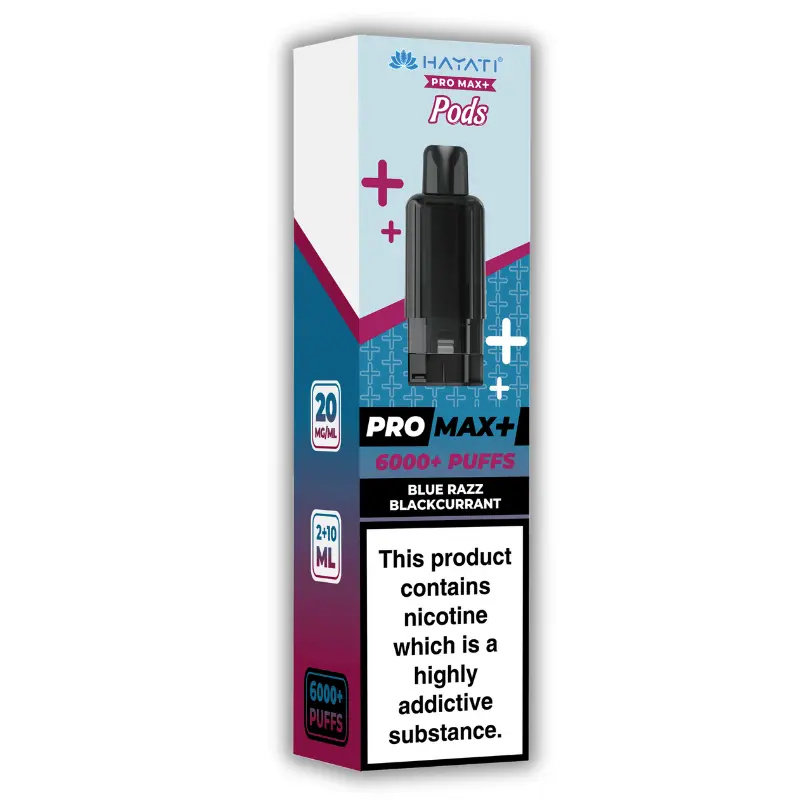
Twelve millilitres of Blue Razz Blackcurrant, closed at the factory into a single Hayati Pro Max Plus pod, £5.49, with no body in the packet. The liquid is 20mg nicotine salt. Hayati rate the pod at up to 6,000 puffs, a figure produced by machine under laboratory conditions rather than a forecast about anyone's week. Nobody buys a pod with nothing to seat it in, so the person reading this owns the device already and is deciding whether the next £5.49 goes here or somewhere else on a shelf of eighty-nine listings.
There is one sentence in Hayati's own text for this listing that the rest of this page is built around. They write that the liquid tastes deeper than most blue razz blends, and that the blackcurrant is why. It looks like ordinary product copy. It is not, and the reason it is not is countable: across all 492 listings in this catalogue, the words "deeper than" appear exactly once, and this is the listing they appear on. Hayati describe hundreds of liquids without ever once ranking one of them inside its own flavour family. Here they do.
A ranking is a different kind of claim from a description, and it fails in a different way. If a listing says a liquid is tart, one pod settles it. You draw on the thing and either the acid is there or it is not. If a listing says a liquid is deeper than most of the others wearing the same name, no single pod can settle anything, because the claim is not about the liquid in your hand. It is about the gap between that liquid and a group of products you may never have tasted. Depth in this sense is not a property you can find by concentrating harder. It is a position, and a position needs at least two other points before it means anything.
Which makes this a strange listing to meet for the first time and an unusually rewarding one to come back to. A first pod hands you an impression and no way to grade it. A second pod hands you the same impression with the surprise removed. By a third, if the two in between were chosen with any care, the sentence Hayati printed becomes something you can actually agree or disagree with. That is the argument here, and the rest of the page works out what it costs, because on this particular flavour the cost is higher than it looks.
One sentence, and how unusual that kind of sentence is
Before building anything on a claim it is worth knowing whether the claim is house vocabulary or a real signal. This catalogue has form on that. The word "jammy" turns up on 27 listings, so a jammy berry tells you nothing beyond the fact that somebody had to write 492 descriptions. "Candied" is on 28. Volume like that is a tell: a word used that often has stopped carrying information and is simply filling a slot.
Run the same test on depth and the result splits in an interesting way. Some form of "deep" or "depth" appears on 108 of the 492 listings, which puts it firmly in the jammy category. If this listing had said the blackcurrant brings depth, that would have been the 109th time Hayati reached for the same word and would have meant nothing at all. What it says instead is that the blend tastes deeper than something, and the comparative is where the sentence stops being boilerplate. One listing in 492.
Widen the net and the picture holds. Searching every description for an outward comparison against unnamed peers, in any of its usual shapes, turns up 18 listings out of 492. That is under four per cent of the catalogue, and most of those eighteen are comparing against a broad category rather than a family: lighter than most tropical blends, sweeter than a standard fruit mix, that sort of thing. Narrow it further, to listings that rank themselves against other blends of the same named type, and the count falls to two. One of them is a lychee liquid claiming to be lighter than most tropical blends. The other is this pod.
So Hayati have done something here that they otherwise almost never do, which is to place one of their own products against the rest of a family they also sell. Blue razz is a family they sell a great deal of. Forty-eight listings in this catalogue carry the words Blue Razz in the title, covering eight distinct single-flavour recipes across five hardware formats. When the copy says most blue razz blends, a comparison class exists, it is large, and a good deal of it is sitting on the same website.
Two further pieces of vocabulary from the same paragraph are worth pricing before they are trusted. The listing calls the blend full-bodied, which seven listings in 492 also say, so that is a real minority usage rather than a slot-filler. And it invites anyone who likes blackcurrant cordial to feel at home, which puts it in a group of ten listings using the word cordial, a group made up almost entirely of blackcurrant liquids and the Vimto-adjacent ones. That second reference is the more useful of the two, because cordial is a specific thing: sweetened, concentrated, diluted, and tasting of fruit that has been cooked and sugared rather than picked. It is a claim about treatment, not just intensity.
None of this makes the sentence true. Counting tells you that Hayati thought the comparison worth printing on one listing out of 492, and that they did not think it worth printing on Blue Razz Cherry Hayati Pro Max Plus Pods or on Blue Razz GB Hayati Pro Max Plus Pods or on any of the other blue razz pods at this price. That is a signal about the copy. Whether it is also a signal about the liquid is exactly what a repeat buyer is in a position to test, and a first-time buyer is not.
Why a first pod cannot read the sentence
Put a new pod in a body you already own and take the first draw. What arrives is a sweet blue top note with something dark sitting underneath it and a tart lift on the way out. That is a real observation and it is worth having. It is also silent on the only question the listing raised, and the reason is structural rather than a failure of attention.
Consider what you would need in order to say that this pod is deeper than most blue razz blends. You would need a sense of where the middle of the family sits. Not a memory of one other blue razz, because one other point gives you a difference rather than a distribution, and a difference between two liquids could be explained by either of them being unusual. You would need several, tasted closely enough together that your palate has not drifted between them, and taken on hardware similar enough that the device is not doing the work. Only then does a phrase like "most blue razz blends" have a referent in your head rather than on the page.
A first pod supplies none of that. Worse, it supplies something that feels like it. The first few draws of any new liquid are the loudest reading you will ever take of it, because novelty is doing half the work. Dark fruit against a sweet blue is a contrast, and contrast registers as depth almost automatically on first encounter. A buyer who has never met a blackcurrant-led blue razz will find this one deep on day one whether or not it is deeper than the alternatives, because on day one the comparison being made is not against other blue razzes. It is against the last thing that was in the device.
This is the part a repeat buyer can see and a first-time one cannot. On the second pod, the surprise is gone. The blend arrives as a known quantity, and whatever is still legible once the novelty has been subtracted is the part that belongs to the recipe. That subtraction is the entire value of the second purchase, and it is available to nobody else.
There is a second confound sitting behind the first, and it belongs to another page. Blue Razz Fruit Twist Hayati Pro Max Plus Pods works through the problem of telling a tiring coil apart from a palate that has adapted, and sets out how fitting a fresh pod isolates one variable while leaving the rest alone. That reasoning is done, it applies to this liquid as much as to that one, and it is not repeated here. What matters for present purposes is the boundary between the two arguments. That page asks what one liquid does to itself across a pod's life. This page asks where one liquid sits among its neighbours at a single point. Those are different measurements with different failure modes, and running them at the same time is how people end up with an opinion they cannot account for.
The cheap route to a reference set, counted, and then narrowed
The obvious way to build a comparison class is to buy some of it, and the obvious objection is the money. On this shelf every pod is £5.49, so three comparison purchases is £16.47 and you have spent more on calibration than on the product. That objection has an equally obvious answer, which is that most Hayati flavours are sold several times over in cheaper formats, so you can often sample a liquid for £2.49 or £3.49 rather than £5.49. That is the answer this page was handed, in the form of a claim: every other blue razz on the shelf has a cheap format you can calibrate against, and this one has none.
Counted against the catalogue, the claim is overstated in one direction and understated in another, and the corrected version is more useful than the one it replaces.
Take the shelf first. Eighty-nine listings sit on Hayati Pro Max Plus Pods, of which four are strength variants carrying no flavour name, leaving eighty-five flavour listings. Seven of those eighty-five begin with the words Blue Razz. This pod is one of them, and the other six are Cherry, GB, Pineapple, Lemonade, Mojito and Fruit Twist.
Now count what each of the seven can be sampled for. Blue Razz Cherry exists in eleven listings, the cheapest a £2.49 bottle, with a £3.49 Mini Ultra pod and a £3.99 Blue Razz Cherry Hayati Rubik Pods in between. Blue Razz GB runs to eight listings, cheapest £3.49. Blue Razz Pineapple Hayati Pro Max Plus Pods has three listings, cheapest £3.49. Blue Razz Lemonade Hayati Pro Max Plus Pods and Blue Razz Mojito Hayati Pro Max Plus Pods have three each, both with a £2.49 bottle at the bottom.
Then the last two. Blue Razz Blackcurrant exists in exactly two listings: this pod, and the Blue Razz Blackcurrant Hayati Pro Max Plus Pod Kit at £7.99, which is this same pod with a rechargeable body beside it. And Blue Razz Fruit Twist exists in exactly two listings, on precisely the same pattern, pod and kit, with nothing below £5.49.
So the claim needed narrowing on the page, and here it is narrowed. This is not the only blue razz on the shelf without a cheaper format of itself. It is one of two, and the other one is Fruit Twist. Five of the seven can be sampled below £5.49; two cannot. Stating it as a solitary case would have been wrong, and the pair is more interesting than the singleton, because the two flavours with no cheap format are also the two whose names promise something the blue razz convention does not supply on its own. One borrows an abstract noun, the other borrows a fruit with a reputation for weight.
The narrowing also exposes a hole in the original reasoning, and this is the part that actually matters. A cheap listing of your own liquid does not help you evaluate a comparative claim at all. A £2.49 bottle of Blue Razz Cherry tells a Cherry buyer about Cherry. It tells them nothing about where Cherry sits among blue razzes, because the comparison class is the other flavours, not the other formats. What a cheap format buys you is a cheap reading of somebody else's liquid, which means the cost of calibration depends on the rivals rather than on the product in front of you.
Recount it on that basis and the shelf looks generous. To place this pod among blue razzes you need readings of two or three of the others, and several of those are available well under £5.49: Blue Razz Pineapple Hayati Mini Ultra Pods at £3.49, Blue Razz GB Hayati Rubik Pods at £3.99, the Cherry Rubik pod at the same price, and three separate 10ml bottles at £2.49. A full reference set for under a tenner.
Except that it is not a reference set, and the reason is the one thing the cheap listings all have in common. Every one of them runs on hardware that is not the hardware this pod runs on. A Mini Ultra pod holds a fraction of the liquid and has its own coil. A Rubik pod is a different object again. A 10ml bottle has to be poured into whatever refillable device you happen to own, at whatever airflow and whatever power that device runs. Depth is not a property that survives a change of coil intact. It is an impression assembled from the weight of the vapour, how long the flavour hangs about after the exhale, and how much of the top note is still audible at the end of the draw, and every one of those moves when the hardware moves.
Which leaves the honest position. The cheap samples are worth buying and they are not worth treating as measurements. A £3.49 Mini Ultra pod will tell you roughly what a flavour is: whether GB is confectionery rather than fruit, whether Pineapple has real acid in it. It will not tell you whether this pod is deeper than GB, because the two readings were taken through different equipment. For the comparative claim specifically, the step size is £5.49 and stays £5.49, and there is no discount available anywhere in the catalogue for the only test that would settle the sentence.
That is a slower and more expensive calibration than the one the original claim described, and it is slow for a reason the claim had inverted. Not because this liquid lacks cheap formats of itself, which would be irrelevant, but because a like-for-like comparison has to hold the device constant, and this shelf is the only place the device is constant.
What a third pod is actually able to settle
Assume the two purchases have been made. Three pods have gone through one body: this one, and two other blue razzes from the same shelf, each taken for long enough to stop being new. Two specific questions come within reach that the first pod could not touch, and both of them are questions the listing raises without answering.
Is the blackcurrant carrying the blend, or only darkening it
Hayati's text puts the blackcurrant underneath and the blue raspberry on top, and both of this flavour's two listings agree about that ordering. What neither says is how much of the finished blend the blackcurrant accounts for. There are two quite different products consistent with the same description. In one, the blackcurrant is the subject and the blue raspberry is a sweet lid on it, in which case the liquid belongs with the dark fruit listings and a buyer who wanted a blue razz will find it heavy. In the other, the blue razz is the subject and the blackcurrant is a shading agent, present to supply a floor the convention does not have, in which case the liquid belongs with the blue razzes and a buyer who came for blackcurrant will find it thin.
You cannot separate those two readings by concentrating on one pod, because both produce the same first impression. You can separate them by where the pod sits relative to two liquids with known positions. Blackcurrant Juice Hayati Pro Max Plus Pods is blackcurrant with nothing in front of it, and that page has already done the work of establishing what the fruit does on this hardware when it is unaccompanied. Blue Razz GB is the other pole, blue confectionery taken as far in that direction as the shelf goes. Run all three and this pod lands somewhere on the line between them. Nearer the Juice end and the blackcurrant is carrying it. Nearer GB, with a shadow, and the blackcurrant is doing a structural job and the name has the emphasis the wrong way round.
That is a placement question and it is answerable, which is more than can be said for most flavour questions. It also explains why the answer is worth having. The two readings point at different second purchases. If the blackcurrant is carrying it, the useful neighbours are on Blackcurrant Vapes, a narrow shelf of sixteen listings where Blackcurrant Lemonade Hayati Pro Max Plus Pods lengthens the fruit with a soft drink and Blackcurrant Mango Hayati Pro Max Plus Pods puts a second fruit beside it. If it is only darkening a blue, the useful neighbours are the rest of the blue corner and the blackcurrant shelf is a detour.
Is the tart edge structural, or the shape of a first impression
The listing promises a juicy, tart finish, one that keeps each draw lively. Tartness is the property most likely to be reported on a first pod and least likely to survive scrutiny, because two completely different things produce it.
The first is acid in the recipe. Acid is structural. It is still there on the twelfth millilitre, it is still there on the second pod, and it is still there when you are bored of the flavour, because it is a component rather than a reaction. The second is contrast. A sweet top note arriving before a darker, heavier body produces a sensation of sharpness at the join that has nothing to do with acid at all, and it is strongest when the sequence is unfamiliar. Once your palate knows the shape of the draw in advance, the contrast effect fades and takes the perceived tartness with it. The liquid has not changed. The novelty has.
Telling them apart is the sort of thing a third pod does well. Structural acid holds its position across pods and shows up as a consistent bite in the same place in the draw each time. Contrast tartness declines steeply between the first pod and the second and then stays low. If you want to force the answer rather than wait for it, the sharpest instrument on this shelf is Blue Sour Raspberry Hayati Pro Max Plus Pods, which is built with acid as the subject rather than as a finishing touch. Taken within a day of each other, a blend whose tartness is structural will read as a milder version of the same thing, while a blend whose tartness was contrast will read as a different category of liquid entirely. Red Sour Raspberry Hayati Pro Max Plus Pods runs the same test without the blue framing, which is useful if you suspect the blue accord itself is what you are responding to.
This matters commercially and not only as an exercise. A liquid whose lift is structural stays good as a daily pod, because the thing keeping it interesting is in the bottle. A liquid whose lift is contrast gets progressively duller through a run of identical pods, and the correct response is not to stop buying it but to stop buying it consecutively. Those are opposite conclusions drawn from the same experience, and a first pod gives you no way to choose between them.
Where the two listings of this liquid disagree with each other
Hayati write fresh copy for every listing, so a flavour sold twice is described twice, and the two descriptions can be lined up against each other. This liquid has only the pod and the kit, which is a short list, but even two texts produce something.
Both agree the blackcurrant is dark and slightly sharp, both put the blue raspberry above it as the sweeter and more candied half, both call the finish tart, and both recommend it to people who want dark fruit with sweetness attached. Four agreements across two independently written paragraphs is the closest thing to a fact this catalogue will give you about the liquid, and the layering order is the firmest of the four.
Where they part is instructive, because the two texts compare in opposite directions. The kit description says the result is fuller and more intense than either fruit would be alone, which is a comparison inward, against the components. The pod description calls it deeper than most blue razz blends, which is a comparison outward, against other products. Same liquid, same range, two writers reaching for the same idea of intensity and pointing it at different reference classes. The kit text also produces the only instance of the phrase "wine-dark" in 492 listings, which is either an unusually precise observation about a tannic quality in the blackcurrant or simply a nicer sentence, and there is no way to tell from the copy which.
The honest reading of a disagreement like that is that it is evidence about how the descriptions were written and not about two different recipes. It is the same twelve millilitres in both packets. What it does tell you is that the comparative sentence was a choice made for this listing specifically, which is consistent with the count: one listing in 492, and it is this one rather than the kit sitting beside it.
The packet, and the one number the argument runs on
Little needs saying about the format, since ninety listings share it and there is only so much that can honestly be said about a device Hayati publish four numbers for. What arrives is one prefilled pod holding 12ml at 20mg, and nothing else. No body, no accessories, no spares, and this page will not list any, because the specification for this listing does not record any. The £2.50 between this and the kit is the device, bought once and then never again, which is the whole reason a refill listing exists as a separate line.
Make sure the range name on the body you own matches the range name in this title before ordering, because Hayati sell several pod formats that are not interchangeable and a retail page is not where a fitment decision should be settled.
The specification that carries the argument above is the 12ml, and specifically that it arrives as one closed unit. Twelve millilitres is a long commitment to a single recipe, which is a nuisance if you want to sample widely and an advantage if you want a reading that is not contaminated by whatever else you have been drawing on. There is no way to change the liquid halfway, so each pod is one clean exposure to one blend, which is precisely the condition a placement comparison needs. It also sets the pace of the exercise. Three pods is three commitments of twelve millilitres each, so a proper calibration is a project measured in weeks rather than an afternoon of tasting. The rest of the refill range, across every format Hayati make, is on Hayati Prefilled Pods & Refills.
The numbers, and what each one does to the test
| Price | £5.49 |
| Flavour as listed | Blue Razz Blackcurrant |
| What you receive | One prefilled pod, no device |
| Body required | Hayati Pro Max Plus |
| Liquid volume | 12ml |
| Nicotine | 20mg nicotine salt |
| Cooling | None named anywhere in the listing |
| Manufacturer puff figure | Up to 6,000, a laboratory estimate |
| Other listings of this liquid | One, the £7.99 kit |
| Coil resistance | Not published |
| VG and PG split | Not published |
Two of those rows are the ones that bear on everything above, and they are both absences.
The cooling row first. Nothing in the title and nothing in the description names a coolant. That is not a guess from silence, because this range signposts cold in the product name when it is present, and a census of the cooling vocabulary across the whole catalogue has already been done on Blue Frozen Hayati Pro Max Plus Pods, which counted the terms and found them ungraded rather than arranged on a scale. Take that finding as read. What matters here is the consequence for the comparison: an uncooled blend is a much easier thing to place, because menthol suppresses perceived sweetness and shortens the finish, and a cooled rival would be showing you the coolant rather than the fruit. When you are choosing comparison purchases, an Ice listing is a poor choice regardless of how good it is.
The coil resistance row next. It is not published for this pod, for the kit, or for any sibling, and printing an absence in a table is a deliberate choice rather than an oversight. Resistance is one of the few figures that would let you reason about whether two pods on different hardware are comparable, and without it there is no route from the specification to that judgement. It is also a standing reason to distrust any page that quotes a resistance for this pod: the number is not in the product data, so wherever it came from, it did not come from Hayati.
On the puff figure. It is generated by a machine taking uniform draws, which makes it a rough way of ranking one product against another and a poor way of predicting your own fortnight. On the strength: 20mg is the ceiling permitted in the United Kingdom, and it is the only strength this listing is sold at, with lower strengths existing as separate listings rather than as options on this one. Nicotine is addictive, and what strength to run is nobody's decision but yours. It matters to the exercise only in that changing strength mid-comparison invalidates it, since nicotine contributes to the sensation in the throat and altering it alters the thing being judged.
Assembling a reference set worth the money
The comparison section on most product pages is a shopping list. Here it is the apparatus, so the pods are chosen for what they hold constant rather than for how pleasant they are.
The two purchases that do most of the work
If there is budget for two, spend it on the extremes of the blue family rather than on anything adjacent. Blue Razz GB is the confectionery pole: the same blue reference pushed towards chew and sugar with the fruit resemblance abandoned. Blue Sour Raspberry is the acid pole. Between them they bracket the range the convention tolerates, and this pod has to land somewhere inside the bracket. A liquid that sits outside a bracket that wide is not a blue razz at all, which would itself be a finding.
Tasting two near neighbours instead is the standard mistake and it produces nothing, because two liquids from the middle of a distribution differ by less than the noise in your own attention from one day to the next. The edges are cheap information; the middle is expensive information.
The third purchase, if the first two leave it open
Blue Fusion Hayati Pro Max Plus Pods is the useful third, and for a slightly indirect reason. It is a blue with an undeclared composition, so it cannot be predicted from its name, which makes it the test of whether your reference set has actually become a reference set. If three pods in you can hear where Blue Fusion sits without being told, the distribution exists in your head. If you cannot, you have three memories rather than a scale. That page also works through why a convention like blue has to be sampled rather than looked up, and there is no point restating the argument here when it is already made properly there.
Blueberry B'Gum Hayati Pro Max Plus Pods is the alternative third if what you actually want to know is how much sugar this shelf is capable of. It swaps the blue reference for a bubblegum one and sits at the sweet extreme of the neighbourhood, which puts a hard ceiling on the sweetness axis and makes everything below it easier to place.
The blackcurrant half of the question
Everything above places the pod among blue razzes. Placing it among blackcurrants is the other half, and it needs different neighbours. Blackcurrant Juice is the unaccompanied reference and the first call. Blackcurrant Lemonade is the same fruit lengthened and sharpened by a soft drink frame, which shows you what happens when something is placed in front of the berry rather than on top of it. Blackcurrant Mango takes the pairing in the opposite direction, softening the fruit with something tropical; that page is written for somebody planning a supply rather than choosing a flavour, which is worth knowing before you read it.
One listing in the catalogue does something none of these can. Blackcurrant Cotton K / Blue Raspberry Hayati Pro Ultra Plus Pods puts blackcurrant and blue raspberry in the same pod without blending them. Its own listing states that the two are held apart and that a rotating mouthpiece moves you from one to the other, so you can taste each half on its own terms in a single session. That is a genuinely unusual instrument for the question this page is asking, because it lets you hear the two components separately before deciding what they do together. Two caveats, both real. The blackcurrant half there is a candy-floss reading rather than the darker one described for this pod, so it is a relative rather than a twin. And it runs on the Pro Ultra Plus, which is different hardware at £7.99, so what it gives you is the shape of each fruit, not a measurement you can carry back.
Where the reading stops transferring
A judgement about depth made on one pod format does not survive being moved to another, and this is the most tempting mistake available because the cheap listings are exactly the ones that tempt you. Blue Razz GB Hayati Pro Ultra Plus Pods is the same nominal liquid as the GB pod on this shelf and is a different experience of it, holding far more liquid on other hardware. The Rubik and Mini Ultra pods mentioned earlier are cheaper still and further away again. Buy them to learn what a flavour is. Do not put them in the same column of your head as the £5.49 pods, and do not let a cheap reading of GB stand in for the real one when you are deciding whether this pod is deeper than it.
Outside the blue corner, three same-shelf pods are worth knowing about as controls on the depth question specifically. Blueberry Raspberry Hayati Pro Max Plus Pods names both its components, so nothing is hidden and you can check your own ability to hear two things at once before trusting your reading of a blend that hides one. Mixed Berries Hayati Pro Max Plus Pods names none of them and is an accord rather than a list, which is the opposite exercise. And Blackberry Raspberry Hayati Pro Max Plus Pods is a dark berry against a bright one with no blue convention involved at all, which is the cleanest way to find out whether what you are calling depth is actually just the dark fruit and would be there with or without the blue. The wider set is on Raspberry Vapes, at 119 listings, and the whole catalogue of 492 is on the full Hayati range.
Running the comparison without ruining it
Practical handling, aimed at the exercise rather than at the pod in general, because the general advice is on every other page on this site and repeating it helps nobody.
Leave a fitted pod alone for a few minutes before the first draw. On a heavy blend this matters more than on a light one, because a dry wick taken hard produces a harsh first impression that a buyer will remember as the character of the liquid, and on a pod whose whole claim is depth, a scorched opening is exactly the wrong reading to file away.
Take the reading on a single unhurried draw rather than in the middle of a run of them. Consecutive pulls raise the coil temperature, and warmth flatters weight. A liquid tasted four draws into a session will read as deeper than the same liquid tasted cold, which means a careless comparison can find a difference between two pods that is entirely an artefact of when you happened to pick each one up.
Do not take it after anything sweet. Sugar in the mouth suppresses perceived sweetness in whatever follows and leaves the darker, more savoury parts of a blend standing out, which on this particular pod would exaggerate the blackcurrant and give you a false reading on the exact axis under test.
Leave a gap between comparison pods rather than alternating them within a day. Carryover is real and it runs in one direction: a heavy blend leaves more behind than a light one, so a light pod tasted straight after this one will be measured against a residue of this one. A day is plenty. An hour is not.
Store spare pods upright, somewhere dark and at a stable temperature. T-Misu Hayati Pro Max Plus Pods sets out why orientation matters for a pod sitting in a drawer, and there is no reason to argue with it or to rewrite it. The point worth adding is specific to a calibration: heat and light do more damage to a dark fruit than to a confectionery note, so a pod bought for comparison and then left in a warm car for a fortnight is no longer the same instrument it was when you bought it.
Retire a pod when the top note has gone and the blend reads as flat sweetness with no shape, whether or not liquid remains. Drawing harder on a tired pod recovers nothing and heats the coil further, and a pod that has reached that point is no longer producing readings you can use. The pod is a closed unit, so it cannot be refilled; when it is finished it is electronic waste and belongs at a shop that takes such things back rather than in a household bin. Keep unused pods where nobody who should not have them can reach them.
Questions a second-time buyer asks
Is it actually deeper than other blue razz liquids?
Hayati say so, and they say it on this listing alone out of 492. Nobody can answer it for you, because depth in this sense is a position rather than a property, and your position depends on which other blue razzes you have met. What this page argues is that the question becomes answerable on a third pod and is not answerable on a first.
Which blue razz should I buy alongside it to judge that?
Blue Razz GB for the confectionery extreme and Blue Sour Raspberry for the acid extreme. Both are £5.49 on this shelf, which keeps the hardware constant. Two pods from the middle of the family would cost the same and tell you considerably less.
Can I use a cheap bottle or a Mini Ultra pod instead to save money?
For finding out what a flavour is, yes, and it is a sensible way to spend £3.49. For judging whether this pod is deeper than that one, no, because the reading was taken through a different coil in a different pod, and weight and finish are precisely the properties that change with hardware.
Is this the only blue razz with no cheaper version of itself?
No, and the claim was narrowed on this page after counting. It is one of two. Blue Razz Fruit Twist is in the identical position, with a £5.49 pod and a £7.99 kit and nothing below. The other five on the shelf all have something cheaper, from £2.49 upwards.
What is the difference between this and the £7.99 kit?
A rechargeable device. The pod is the same twelve millilitres of the same liquid in both, and the kit description is a second piece of copy about the same recipe rather than a description of a different one. If you already own the body, the £2.50 buys you nothing.
Is there any ice or menthol in this pod?
Nothing in the title or the description names a coolant, and in this range cold is signalled in the product name when it is present. Read it as an uncooled blend. That is also why it works as a reference point, since a coolant would be interfering with the finish you are trying to judge.
Which is stronger in the blend, the blackcurrant or the blue raspberry?
Both of Hayati's descriptions put the blackcurrant underneath and the blue raspberry above it, and that ordering is the firmest thing the two texts agree on. Neither says which one dominates, and the difference between a blend the blackcurrant is carrying and one it is merely shading is the thing this page suggests testing against Blackcurrant Juice at one end and Blue Razz GB at the other.
Will the tart finish still be there on the second pod?
If it comes from acid in the recipe, yes, and it will sit in the same place in the draw every time. If it came from the contrast between a sweet opening and a dark body, it will be noticeably reduced once the sequence stops being new. Those are the two candidates and a second pod separates them, which is not something a first pod can do.
Does it work as an everyday pod or is it too heavy?
That depends on which of the two readings above turns out to be true for you. A blend held up by structural acid tends to survive continuous use; one held up by contrast dulls across consecutive identical pods. The second case is an argument for alternating it with something lighter rather than for abandoning it.
How long should I leave between comparison pods?
At least a day, and preferably take each reading in the same conditions: one unhurried draw, not after food, not at the very end of a charge. Alternating two pods within an hour measures the carryover between them rather than either of them.
Where does this sit if I came for the blackcurrant rather than the blue?
Sixteen listings carry blackcurrant in this catalogue, and this is the only one that pairs it with a blue razz. If the berry is the point, Blackcurrant Juice gives it to you without a partner, and Blackcurrant Lemonade and Blackcurrant Mango are the two obvious modifications of it. This pod is a blue razz with a dark floor, and the name is written in that order for a reason.
Is there anything unusual about this listing itself?
One thing, and it is why this page exists. Of 492 Hayati listings, this is the only one whose text ranks the liquid against other blends of the same named type using the words "deeper than". Eighteen listings make any outward comparison at all, and two of those compare within a flavour family. It is a small piece of copy doing something Hayati otherwise do not do.
The short version
A £5.49 refill for a Pro Max Plus you already own: 12ml, 20mg, dark blackcurrant under a candied blue raspberry, tart at the finish, with no cooling named anywhere. On first acquaintance it is a rich, sweet blue with something heavier underneath, and most people will like it or not like it within a pod.
The claim worth paying attention to is the comparative one, and comparatives are slow. Hayati say this is deeper than most blue razz blends, a sentence they print on no other listing in the catalogue, and it cannot be evaluated by anybody holding their first pod, because it is a statement about a distribution rather than about a liquid. The cheap way of building that distribution turns out not to exist here: the two blue razzes with no sub-£5.49 listing of their own are this one and Fruit Twist, and in any case a cheap format of a rival is measured through the wrong hardware. Every honest step in the comparison costs £5.49 and twelve millilitres of commitment.
Which is a reason to buy it again rather than a reason not to. The second pod subtracts the novelty; the third places the result against something. By then you will know whether the blackcurrant is the subject or the shading, and whether the lift at the end of the draw is in the recipe or in your surprise. Neither answer is available on day one, and both of them decide what the next order should be.
Strictly for adults aged 18 and over. Nicotine is an addictive substance.
You might also like


