
Home / Hayati Pods / Blueberry Raspberry Hayati Rubik Pods
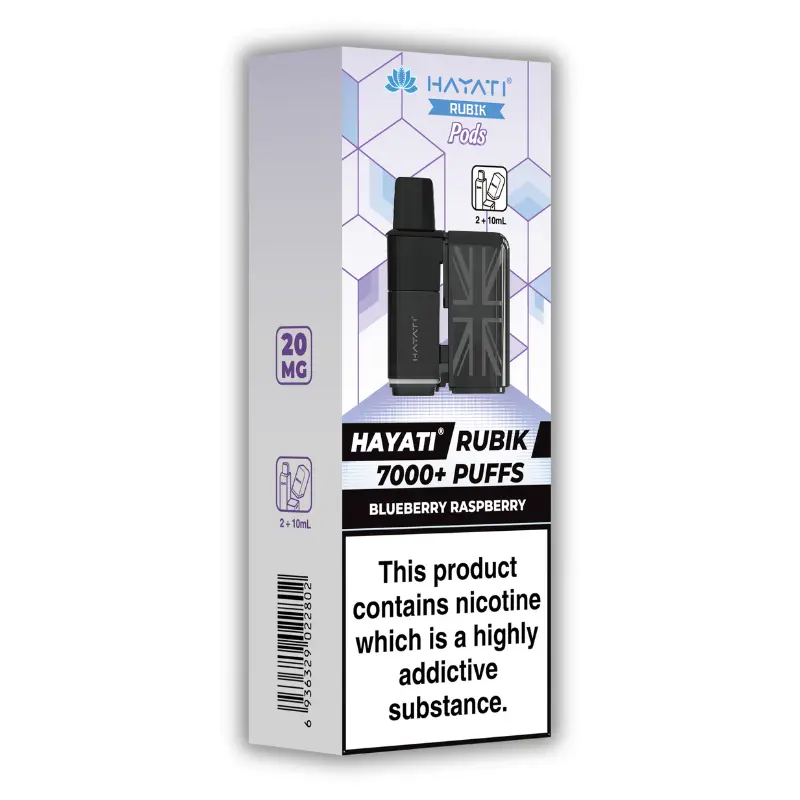
Hayati · Rubik
Blueberry Raspberry Hayati Rubik Pods
£3.99
✔ In stock — ready to ship
Genuine Hayati
Free over £20
Same-day dispatch
Secure checkout
Three pounds ninety-nine, twelve millilitres, 20mg nicotine salt, and no device in the box. This is the refill, not the kit. It seats in a Hayati Rubik body you already own, it holds one liquid with nothing to select between, and Hayati rate a full pod at up to 7,000 puffs, which is a laboratory estimate arrived at on test equipment rather than a description of anybody's fortnight. The Rubik is one of Hayati's compact, lower-priced lines, and at this volume and this ticket the pod works out at 33.25p a millilitre.
Everything worth knowing about what is inside it has already been written down. The Blueberry Raspberry Rubik kit is the complete version of this product and it carries the argument: what the liquid is, what it tastes like, who should buy it and what it costs per millilitre on four different platforms. Repeating any of that here would be a waste of your time, so this page cites it and goes somewhere the kit page could not.
The question it goes to is when to throw this pod away. That sounds like housekeeping and on most products it is. Here it turns out to be the whole purchase decision, because the property the kit page identified as this liquid's defining feature has a consequence for a refill buyer that nobody drew. A liquid with nothing happening in it also has nothing to watch. The ordinary way anyone decides a pod is finished is that the thing they bought it for stops arriving, and on this pod there is no such thing. So the usual method has no input, and something has to take its place.
What follows is the count that tests whether that is actually unusual, the reason the instrument other quiet pods use will not fit this one, and then the arithmetic, stated openly, of retiring a twelve-millilitre pod before it is empty when you have no way of knowing whether you needed to.
What the kit page settled, taken as settled
Five things belong to the complete-kit listing and are cited rather than rebuilt. Each gets a sentence, which is all they need, and anyone who wants the reasoning should read it there.
What kind of object this is. Blueberry Raspberry is not a recipe but a base, a liquid Hayati build other liquids on top of, established on the kit page by a count of eleven listings carrying the bare two-fruit name against eleven more carrying the pairing plus something, the second group splitting into six recipe extensions and five hardware pairings.
What the liquid does. The kit page works through the draw in full and concludes that there is no event in it: no sour snap, no cold, no confectionery hook, a bright raspberry arrival and then a warm, matt blueberry sweetness carrying the rest of the way out.
Who should buy it. Its verdict is that this is the range's quiet member, worth having if you want a berry that will not ask anything of you, and worth avoiding if what you enjoy is a moment when something happens, in which case it nominates Blue Sour Raspberry, Blueberry Cherry Cranberry, Blue Razz Cherry and Banana Ice as the four places to go instead.
What the liquid costs across the range. The kit page sets out the per-millilitre ordering for this flavour on four hardware families, kits and refills both, and it is the page that names this pod at 33.25p a millilitre and calls it the cheapest sealed millilitre of Blueberry Raspberry available anywhere in the range. That table is not reproduced here.
The point about the cheap platform. Its narrower argument, borrowed in turn from the Juicy Peach Rubik page, is that the least expensive platform is a poor place to make a flavour's acquaintance and a good place to keep one, with the condition attached that the point only bites when the liquid is new to you, which for a base it usually is not.
Two figures from that page were worth re-counting before building anything on them, and both survive. Eleven is the solo figure: eleven separate Hayati listings carry Blueberry Raspberry with no third word. And four further listings put the pairing in as one half of a divided Pro Ultra Plus pod, which is the Blueberry Raspberry / Blueberry Raspberry Cherry kit with its bare pod, and the Mr Blue pairing with its own bare pod. That is a difference of method rather than a contradiction of the kit page's tally, which counted the Mini Ultra pairing alongside these and reached five. Divided pods and mixed recipes are two ways of extending one liquid and the kit page says so. Nothing here disturbs it.
The claim I was handed, and what counting did to it
The proposition given to me was that this is the one pod on the nineteen-name Rubik refill shelf where replacement has to be scheduled rather than judged, because it is the one with no component whose disappearance would tell you the element underneath it is tiring. That is a rarity claim and this catalogue has a habit of overstating those, so it needed testing before anything was built on it. It did not survive as written. It survives after two narrowings, and the narrowed version turns out to be a better argument than the one I was given, because it explains why the absence matters here and not on the pods it shares the property with.
The test, stated before it is run
A retirement signal is a component you can ask a yes-or-no question about. Either it turns up in the draw or it does not, and a half-strength version of it still reads as the same component, quieter. Coolants qualify, because cold is unmistakable and nobody confuses a chilled exhale with a warm one. Dosed sour layers qualify. An astringent edge qualifies. Sweetness does not, because sweetness rides in the liquid rather than depending on the element to lift a heavy aromatic out of a wick, so it is still reporting normally long after everything around it has gone.
Applied to the Hayati Rubik Pods shelf, which is nineteen listings at one price, one volume and one strength, the question is how many of the nineteen name such a component in their own description.
Eight of the nineteen are cooled
Watermelon Ice, Vim Ice, Strawberry Raspberry Ice, Red Apple Ice, Pineapple Ice, Lemon Cola Ice and Banana Ice carry an ice word, and Fresh Mint carries a mint one. That is seven plus one, which matches the shelf page's own family table, and it means eight of the nineteen have the most durable and least ambiguous marker there is. On any of those eight the cold flattening is the signal. It arrives on its own, it does not need to be looked for, and nobody who has run a chilled pod into the ground has failed to notice the chill going.
Four more name something sharp
Strawberry Kiwi's listing puts the kiwi forward as sharp, green and slightly sour. Lemon Lime's names a clean acidity in front and a faintly bitter close behind it. Blueberry Cherry Cranberry's says the cranberry is the sharp one and gives it a dry, tangy bite whose job is to stop the blend going sweet. Blue Sour Raspberry's says outright that the sour twist is the point of the product. All four are yes-or-no components. Twelve of nineteen now have a signal.
Two are confectionery builds, and only one of them really counts
Blue Razz Cherry moves from a tangy front to a rich cherry close, which is two audible positions rather than one, and the tang at the front is the volatile half, so there is something to lose and notice. Blue Razz GB is the awkward case and it is worth being honest about it rather than rounding it into the count. Its distinguishing feature by its own description is a sugary confectionery body with the tang taking a back seat, and a sugary body is exactly the component that does not fade. So Blue Razz GB has a hook and does not obviously have a signal, and it belongs in a category of its own. Call it twelve clear, one partial.
Five have nothing
That leaves Triple Mango, Summer Dream, Mr Blue, Juicy Peach and this one. Triple Mango's listing says plainly that no ice and no citrus are named and the fruit carries the whole thing. Juicy Peach's says there is no sharpness to speak of and nothing icy or sour competing for attention. Mr Blue and Summer Dream name no contents at all, so they cannot name a signal either.
So the first narrowing is straightforward and it costs the claim most of its force. This is not the one pod on the shelf without a taste-based retirement signal. It is one of five, which is more than a quarter of the shelf, and anyone who reads the original claim and reaches for Juicy Peach or Triple Mango instead will find the same problem waiting.
Narrowing it twice more, until it is true
The second narrowing is small. Summer Dream and Mr Blue do not publish what is in them, and a pod whose contents are unstated is in a different position from one whose contents are stated and uneventful. You cannot ask whether a component has gone when you were never told which components there are. Their problem is upstream of this one and the Mr Blue listing's own page is about that gap rather than about this. Set them aside and three remain: Triple Mango, Juicy Peach and this pod.
The third narrowing is where the argument actually lives, and it is the reason a corrected claim beats the one I was handed.
Triple Mango and Juicy Peach are single-fruit liquids. One identity, carried by one family of aromatic material, so when the element starts refusing to lift it the whole flavour dims together. A tired Juicy Peach is a fainter peach. A tired Triple Mango is a fainter mango. That is a change of degree, it is continuous, and the Juicy Peach Rubik page has already set out at length why a continuous change is close to undetectable from inside: your reference updates itself, the daily increment sits below what a palate can register, and there is no point on the slope at which the pod stops being a plausible version of itself. All of that is theirs, it is right, and it applies to those two pods.
This pod is not built that way. It has two named components and they do not go at the same rate. The raspberry is a front-loaded acid with a perfumed aromatic sitting over it, both of them light and volatile. The blueberry is a slow, heavy, low-acid sweetness that builds through the middle and stays into the exhale. When an element starts rationing what it can carry, it rations the light material first, and the light material here is the whole of the raspberry. The heavy material is the whole of the blueberry, and it survives.
So this pod does not dim. It substitutes. The total intensity barely moves, because the blueberry was doing the larger share of the perceived volume from the start, and what changes is the proportion. You do not end up with a quieter Blueberry Raspberry. You end up with a warm sweet dark berry, and that is a different liquid.
The state it lands in, counted
Here is the part that makes the third narrowing worth having rather than merely true, and it is a straight comparison with the one other pod on this shelf that changes composition rather than intensity.
Lemon Lime does the same thing. Its lime is the light component and goes first, and its own page argues the consequence properly: what you are left with is a plain lemon, the gap where the lime used to close the draw does not fill because there is no sugar underneath to fill it, and a plain lemon is a profile Hayati decline to sell in any of their 492 listings. An absence at the point where you expected a full stop is loud. The degraded pod does not resemble anything on the shelf, so you cannot mistake it for a working product.
This pod is the exact inverse on both counts, and I checked the second one.
The gap fills instantly, because the component that leaves and the component that stays occupy overlapping ground. Blueberry sweetness is already sitting under the raspberry through the middle of the draw, so when the top goes there is no hole, only more of what was underneath it. And the profile you arrive at is not a gap in the catalogue. Take every distinct flavour name in the 492 that contains blueberry, blackberry, blackcurrant, cherry, cranberry or the word berry, and drop any that carry a cooling word, a sour word, a citrus word or a confectionery word. Fifteen names remain. One of them is this pairing, on eleven listings. The other fourteen account for forty listings between them, and if you further drop the four names carrying cranberry or pomegranate, on the grounds that both bring a dry edge you would notice losing, ten names and twenty-seven listings are left that are straightforwardly warm, sweet and dark with nothing pointed in them at all.
That is the finding. A worn Blueberry Raspberry pod tastes like a perfectly ordinary product that Hayati sell about forty times over. It does not taste broken, it does not taste thin, and it does not taste like anything is missing, because in this corner of the catalogue nothing pointed is expected to be there in the first place. You could hand it to somebody and they would describe it as a berry vape and be entirely correct.
So the claim I was given, narrowed until it holds: among the nineteen Rubik refills, five have no retirement signal, three of those five state what is in them, and this is the only one of the three whose components decay at different rates, which means it is the only one on the shelf that fails by turning into a different liquid the catalogue already sells rather than by becoming a fainter version of itself. That is a smaller claim than the one I started with and it carries more weight, because it says what kind of failure to expect rather than merely that failure is hard to see.
Why the instrument the other quiet pods use will not fit this one
There is an obvious objection and it deserves a proper answer rather than a dismissal. The problem of a pod that declines without announcing it has been solved on this shelf already. The Juicy Peach Rubik page does not merely diagnose it, it builds a measurement to replace the missing signal, and if that measurement transfers then this page has nothing to add.
Its method, cited and not rebuilt, is a timed count. Take one slow draw on the first day, on a rested palate, and count the seconds from the end of the exhale until what is left in the mouth stops being specifically peach and becomes generic sweetness. Write the number down with the date. Repeat it later. When the count has roughly halved, the pod has given most of what it has. The insight underneath it is that memory holds categories well and magnitudes badly, so you convert an unrememberable quantity into a number you can write on paper and compare honestly weeks apart.
That is a good method and it is the right one for a peach. It does not work here, for three reasons that are specific rather than general.
The component at risk lasts less than a second. The peach count works because the peach's identity lives in the tail, which is a stretch of time you can put a number on: three seconds, five, eight. The identity here lives in the opening. The raspberry's tang and its perfumed lift arrive inside the first moment of the inhale and are thinning before the draw is over. There is no duration to time, because the whole of the thing you would be timing is shorter than the resolution of counting. Asking how many seconds the raspberry lasts produces the same answer on a fresh pod and on a tired one, which is not very many.
The place the instrument points is occupied by the survivor. The peach method works by attending to what is still in the mouth after the vapour has cleared, on the grounds that the front of the draw is sweetness and sweetness is the last thing to fail. Point the same attention at the finish of this liquid and you are attending to warm blueberry sweetness, which is precisely the component that will still be arriving at full strength in week five. The instrument would report a healthy pod all the way to the end. Same procedure, wrong target, and the wrongness is not obvious, which is what makes it worth spelling out.
There is no drop in loudness to notice. Every intensity-based check assumes the pod gets quieter. This one does not, or not by much, because the bulk of what you perceive was always the sweetness and the weight and neither of those is going anywhere. A liquid that loses volume tells you something is wrong even if you cannot say what. A liquid that keeps its volume and changes its composition tells you nothing at all.
One piece of the peach method does transfer, and it is worth saying so, because the parts of this catalogue that contradict each other do more damage than the parts that repeat. Carrying a pod with a hard edge in it and taking a draw on that when something seems off is a check on your own palate rather than on the liquid, and that logic holds on any flavour. Fresh Mint on this shelf does the job, and so does anything with a genuine sour layer. But notice what it is for. It tells you whether today's reading is trustworthy. On this pod there is no reading for it to validate, so it answers a question you were not able to ask.
Which leaves the position plainly. There is no signal in the liquid, there is no measurement that substitutes for one, and there is no drop in intensity to fall back on. A decision that cannot be triggered by observation has to be made in advance, and a decision made in advance is a schedule with a number in it.
Setting the cadence before you need it, and pricing it honestly
The general arithmetic of retiring a prefilled pod early has been done properly on the Lemon Lime Rubik kit page, which works out the cost per millilitre actually drawn rather than per millilitre bought, runs the division across every platform that sells the same flavour, and finds the thresholds at which an early-retirement policy on a Rubik pod is still cheaper than buying a dearer pod and emptying it. Those figures are platform arithmetic rather than flavour arithmetic, so they hold here unchanged and there is no reason to reproduce them.
What does not transfer is the shape of the decision, and the difference is the whole of this section. That page prices acting on information. Its rule is conditional on where the signal arrives, and it has three branches depending on whether the lime goes early, in the middle or late. Every branch assumes a moment at which you know. Here there is no such moment, so a rule with branches has nothing to branch on. What is being priced instead is a policy adopted blind, and a policy adopted blind has a property the other kind does not: you will never find out whether it was worth it.
The ladder, in pods rather than in pence
Pence per millilitre is the right unit for comparing platforms and the wrong unit for deciding a personal rule, because nobody buys millilitres. People buy pods, and the useful form of the arithmetic is what a policy does to the number of pods you buy.
Divide twelve by the volume you actually draw and you have the multiplier on your pod bill. It comes out as a series of small whole-number ratios, which is convenient.
- Retire at eleven millilitres and you buy twelve pods where eleven would have done. The liquid you bin is one millilitre, which is 33p, a twelfth of the pod.
- Retire at ten and you buy six where five would have done. Two millilitres binned, 66p, a sixth of the pod.
- Retire at nine and you buy four where three would have done. Three millilitres, just under £1, a quarter.
- Retire at eight and you buy three where two would have done. Four millilitres, £1.33, a third.
Read the right-hand column and the left-hand one together, because they are the same fact stated twice and people react differently to the two statements. Sixty-six pence sounds like nothing. Buying six pods a year where five would have done sounds like something. Both describe a policy of retiring this pod at ten millilitres, and the second is the one that will actually show up on a bank statement.
Why ten, and what the sixth buys
Ten of twelve is the figure I would set, and the reasoning is about where the curve bends rather than about any published property of the coil.
Going from twelve to eleven costs a twelfth and buys very little, because an element that has processed eleven millilitres is not meaningfully fresher than one that has processed twelve. Going from ten to nine costs a further third of a pound per pod and raises the multiplier from a fifth to a third, which is a real increase in running cost for a further millilitre of protection. Ten sits at the point where the policy is cheap enough not to think about and long enough to matter, and it has the practical advantage of being a fraction anybody can hold in their head: five-sixths.
What the sixth buys is a guarantee that the last two millilitres of every pod are never the ones you drink. That is a modest thing to buy and the honest way to describe it is as insurance rather than as an improvement. You are not making any pod better. You are removing the tail of every pod from your experience, and the tail is the only part where the substitution described above is likely to have got far enough to matter.
It should also be said what the policy does not buy, since the alternative is not free either. Running a pod to the bottom costs the same 66p, spent differently. You paid for those two millilitres in both cases. The difference is whether you consume them, and on a liquid with a signal that is an easy trade, because you can hear what you are consuming and decide. Here you cannot, so the two options are 66p for nothing and 66p for two millilitres of something you have no way of assessing. Pick whichever of those descriptions you find less irritating, because the money is identical and the information is absent either way.
Converting five-sixths into a date
A fraction of a pod is not directly usable, because there is nothing in the specification about whether a Rubik pod shows how much liquid is left in it. Hayati publish no such detail, and taking a hardware property from a retail page is worth nothing anyway. So the fraction has to be converted into something you can actually observe, and the only quantity available without instruments is time.
The conversion is one pod long. Run the first one to the bottom and write down the date you seated it and the date it stopped producing. That interval is your denominator, and it already accounts for how long your draws are and how often they come, which is exactly what a laboratory puff rating cannot do. Call the interval D. From the second pod onwards, retire at five-sixths of D, rounded to whole days in whichever direction you prefer. Eighteen days becomes fifteen. Twenty-four becomes twenty. Thirty becomes twenty-five.
One unusual feature of this liquid makes the calibration pod cheaper than it would be elsewhere, and it is worth pointing out because it is the one place where having no signal helps. On a flavour with a marker, running a calibration pod to exhaustion means knowingly drinking a stretch of degraded liquid while listening to it get worse, which is unpleasant in a way people avoid. Here you cannot detect the degradation, so the calibration pod costs you nothing you will notice. The thing that makes the policy necessary also makes establishing it painless.
The limitation, which is real
A calendar tracks volume only if consumption is steady, and there is one common habit that breaks it completely. If you run two pods in rotation, alternating between this and something else, elapsed days stop bearing any relation to millilitres drawn. A pod that has been in the drawer for a fortnight has aged in date and not in use, and retiring it on the calendar would throw away liquid for no reason at all.
So the policy is only available to somebody running this as their sole daily pod. That sounds like a serious restriction and in practice it is not much of one, because it selects almost exactly the buyer this liquid is for. The kit page's verdict is that this is the range's quiet member, the flavour you keep when you want something that does not demand attention across a long day, and a quiet all-day liquid is the one most likely to be somebody's only pod. If you are rotating this against something louder, you are using it as the neutral half of a pair, and in that case the honest answer is that no schedule works, no signal exists, and you should run each pod to the bottom and accept that the last stretch of each will be anonymous.
The audit you get free at every changeover
One thing does become available at the moment you act on the schedule, and it is not the same as the reference-pod comparison the Juicy Peach page recommends, although it uses the same underlying fact that a palate is good at same-minute comparisons and bad at remembered ones.
That method asks you to buy a spare refill early, keep it sealed, and use it as a fresh standard to test the pod you are running, so that the comparison triggers the retirement. Here the comparison cannot trigger anything, because the schedule has already triggered it. What you have instead, at no extra cost and with no extra purchase, is both pods in your hand at the same minute: the one you have just retired and the one you have just seated. Take a draw on the new one and attend to the first half-second only. Reseat the old one and do the same. Then put the old one in the bin regardless of the answer, because the schedule has already decided that.
The answer is not a decision, it is a correction to D. If the two openings are indistinguishable, your schedule is early and D can be stretched. If the difference is obvious, you cut it too fine and D should come down. Three or four changeovers of that and the number is tuned to your own draw rather than to a fraction somebody printed on a page, and the whole exercise costs thirty seconds you were already spending on the swap.
Two warnings about the comparison, both of which matter more here than they would on a louder liquid. A newly seated pod runs wet for the first few draws, so give the fresh one four or five pulls before the one that counts. And attend to the opening and nothing else. The exhale will feel identical on both, because the exhale is the component that does not change, and a reader who compares finishes will conclude every time that the retired pod was fine.
The figures, ordered by what the policy runs on
The table below is arranged around the decision rather than around the specification, so the rows that feed the schedule come first and the rows that are simply facts about the object come last. Two rows carry nothing, and their blankness is the reason the schedule has to exist.
| Signal that the pod is spent | None available. No cooling to flatten, no sour layer to soften, no astringency to lose |
| How wear presents instead | The raspberry front thins and the blueberry sweetness stays, so the profile changes rather than quietening |
| Where to point attention at a changeover | The first half-second of the inhale. Nowhere else reports anything |
| Level visible through the pod | Not stated by Hayati, so the schedule runs on days rather than on volume |
| Suggested retirement point | Ten millilitres of twelve, which is five-sixths of your own measured interval |
| Liquid discarded at that point | 2ml, 66p, a sixth of the pod |
| Effect on the pod bill | Six pods bought where five would have been |
| Ticket price | £3.99, refill only |
| Rate when the pod is emptied | 33.25p a millilitre |
| Volume | 12ml, filled and closed at the factory |
| Strength | 20mg nicotine salt, the only figure this platform offers |
| Maker's rating | Up to 7,000 puffs for a full pod, a laboratory estimate rather than a forecast |
| Cooling | None named in the title or against the liquid |
| Flavour arrangement | One liquid throughout, nothing to select between |
| Element | Built into the pod, not reachable and not replaceable, retired with it |
| Device | Not included. A Hayati Rubik body is required and is sold separately |
| Coil resistance, wicking material, carrier ratio, fill date | Not published against this listing or any other on the range |
| Brand and code | Hayati, blueberry-raspberry-hayati-rubik-pods |
The blank rows are load-bearing rather than decorative. A published coil resistance would let somebody reason about how hard the element is working per millilitre, and a published fill date would let somebody separate a pod that has aged in a warehouse from one that has aged in use. Neither exists, for this listing or for any other Hayati sell in this format, so a buyer who wants to manage the thing has only two inputs: how much liquid the pod holds, which is printed, and how long their own consumption takes to get through it, which they have to measure. The schedule is built from those two numbers because there are no others.
The strength row is fixed and worth reading as a fact rather than as a recommendation. Twenty milligrams is the maximum concentration permitted for sale in the United Kingdom, this platform lists nothing else, and nicotine is addictive. The salt preparation is how the rest of this catalogue describes the range and is standard for a low-power sealed pod, although the listing text itself does not spell the preparation out.
On the puff rating: read it as a statement of how much work one sealed element has been given rather than as a quantity you have bought. It is produced by a machine drawing to a fixed pattern, and the useful thing it tells a buyer here is structural rather than numerical. One element is expected to process the entire twelve millilitres and cannot be serviced at any point, which is the fact the whole of this page rests on.
If you would rather have a signal than a schedule
Everything above is what to do if you want this liquid. There is a legitimate alternative, which is to decide that a pod you have to manage on a calendar is not worth the trouble and to buy one that manages itself. That is not a lesser choice and this section sets out where to go.
The four on this shelf that report their own condition
Blue Sour Raspberry is the nearest swap and the most direct answer, because it keeps a raspberry and doses a sour layer over it. That layer is the loudest yes-or-no component on the shelf: when the sourness stops cutting through the sugar you have your answer in one draw and no calendar is required. Blueberry Cherry Cranberry keeps the blueberry and hands the sharp job to cranberry, which is a dry astringency rather than an acid, and astringency is a texture you notice the absence of even when you would struggle to describe its presence. Lemon Lime has no sugar underneath it at all, so the disappearance of its closing note leaves a hole rather than a substitution, which is what makes it the clearest reporter of the nineteen. And Pineapple Ice puts a tang under a coolant, which is two independent signals on one pod.
The cooled entries generally are the low-effort option, and it is worth being explicit about why, because the usual reason given for buying a cold pod is preference and this is a different reason. A coolant is a receptor effect rather than an aroma. It does not depend on the element lifting a heavy volatile out of a wick and it does not fade gracefully, it just becomes less cold, and less cold is the single easiest change for a human to detect. Strawberry Raspberry Ice is the closest cooled relative to this liquid, being two berries with the same division of labour and a chill across the finish, and anybody who likes this pairing but wants it to tell them when it is finished should look there first.
The same liquid, if the platform is the problem rather than the flavour
A shorter pod solves the detection problem by making it small. An element that processes four millilitres never gets old enough for the question to arise, which is the reason the Blueberry Raspberry Mini Ultra pod is worth considering by anyone who dislikes the idea of a schedule. It is much dearer per millilitre and the kit page's table sets out by how much, but what you are buying with the difference is that every millilitre in it qualifies as fresh.
Going the other way, the Blueberry Raspberry Pro Ultra Plus pod puts twenty-two millilitres through one element, which is nearly twice the run and makes the problem correspondingly worse. If a policy is hard to justify at twelve millilitres it is harder at twenty-two, and the discarded sixth costs proportionally more. The Blueberry Raspberry Pro Max Plus pod is the same twelve millilitres at a higher ticket, so it presents the identical problem at a worse rate, and the only reason to prefer it is that you already own that body.
Putting something else into the empty position
The kit page establishes that every extension Hayati have built on this base adds a register the base does not use, which is another way of saying that every extension puts a signal into a liquid that lacks one. That is a coincidence worth exploiting. Blueberry Raspberry Cherry adds depth rather than an edge and so helps least, because a deeper sweetness is still a sweetness and still durable. The lemon version adds acid into exactly the position this page identifies as the place nothing survives, and acid is detectable, so of the three recipe extensions it is the one that most improves the monitoring problem as well as the flavour.
The divided pods do something different again and they are worth understanding correctly. Putting the base beside Mr Blue in a single Pro Ultra Plus pod, or beside its own cherry version in the pairing with Blueberry Raspberry Cherry, does not give you two elements. One coil and one airflow path serve both reserves, so both sides age together and neither side reports on the other. A pairing gives you somewhere to go when you are bored. It does not give you a diagnostic, and anybody buying one expecting the second flavour to act as a check on the first has misread the hardware.
Elsewhere in the range, for the same pairing and its neighbours
Off the Rubik shelf the pairing has a large footprint, and the Blueberry Raspberry Vapes shelf collects it, filing forty-six tiles against the twenty-two titles that actually print the two words, a discrepancy the kit page explains. For the broader neighbourhood, Berry Vapes is the widest view at two hundred and twenty-five tiles, and it is the fastest way to see for yourself how populated the warm sweet dark berry register is, which is the count this page turns on.
Three near neighbours on other platforms are worth naming for people who like this profile and want a version with something in it. Blueberry Pomegranate keeps the blueberry and swaps the raspberry for a sharper partner, which is the cleanest test of how much of what you like is the raspberry specifically. Blue Sour Raspberry on the Pro Max Plus and the same flavour on the Pro Ultra Plus carry the dosed sour version onto larger pods, where a self-reporting flavour is worth more because the run is longer. And the Mini Ultra version is the short-run option for anyone who wants both the signal and a small pod.
Two more for contrast rather than for substitution. Blue Razz GB and Blue Razz Fruit Twist are confectionery constructions rather than fruit ones, sweeter and heavier, and they sit in the same colour as this liquid without being in the same register at all. Blue Razz Cherry on the Pro Ultra Plus and the Blueberry Cotton K Mini Ultra pod go further into that territory. Anyone who has not tasted how far a sugared blue profile sits from a fruit one should run one against this pod before assuming the two are interchangeable, because the colour suggests they are and the mouth says otherwise.
The refill tier as a whole, every format included, sits under Hayati Prefilled Pods and Refills, and both Rubik tiers together are on the Hayati Rubik shelf. Hayati publish no fitment statement covering pods from one range in a body from another, so check the range name printed on your device against the range name in this title before ordering.
Running a pod you have already decided to bin early
General advice about prefilled pods is on the shelf pages. What follows is narrowed to a liquid whose identity is a short front note and whose body is a durable sweetness, on a platform where you have committed to a schedule.
Write the date on the pod, not in your head. This is the one item on the list that the entire argument depends on, and it is also the one people skip. A schedule you are keeping mentally has the same failure mode as a taste judgement, which is that your reference drifts. A date written where you will see it does not drift. The wrapper works, a phone reminder works, anything works except intending to remember.
Judge nothing on the first few draws. A factory-filled wick sits dry until liquid has properly soaked into it, and the opening draws on any sealed pod run thin. On this liquid that thinness lands specifically on the raspberry, because the perfumed top is the lightest material in the recipe and the first thing a partly wetted wick fails to carry, so a fresh pod can briefly impersonate a worn one. Stand it upright for a few minutes, take three or four short pulls, and start the assessment after that.
Draw length moves the balance, and it moves it towards the durable half. There is no airflow control and no wattage setting, so the length of the pull is the only adjustment available. A longer, slower draw pulls more heavy aromatic material and pushes the balance towards the blueberry. A shorter, sharper one keeps the raspberry proportionally louder. That matters practically at the changeover comparison: use the same length of pull on both pods or the comparison is worthless, and use a short one, because a short one favours the component you are trying to measure.
Back-to-back draws cost you the half you are monitoring. Pulls stacked one on another leave the wick behind the element and the vapour thins, and what thins first is the volatile top rather than the sweetness underneath. So a hard-run pod reads rounder and duller rather than weaker, which is the same direction as genuine wear and will make you retire a pod that had weeks in it. Half a minute between draws prevents it, and if the raspberry has gone quiet on a pod that is only a week old, suspect the pace before the element.
Heat in storage attacks exactly the component you cannot afford to lose. Aroma is the most volatile material in the recipe and a warm car or a sunny windowsill will take it faster than use will. Acid does not evaporate and sugar does not evaporate, so a badly stored pod arrives at the anonymous state by a completely different route and much faster, and your calendar will not have caught it. Keep spares somewhere ordinary and indoors, out of direct sun, and where children and pets cannot reach them.
A spare that has been in the drawer for months is not a fresh reference. This follows from the point above and it undermines the changeover audit if you ignore it. If you buy pods in quantity and one has been sitting for a long time, the comparison at the swap is between a used pod and an aged one, and both have lost the same component by different mechanisms. Buy in small numbers on this flavour, or use the newest spare for the comparison draw.
Disposal. A finished pod contains an element and a film of liquid, so it does not go in a household bin. Take it to a retailer that runs a take-back scheme, or to a household waste site that accepts electrical items. This applies to every pod you retire early as well as to the ones you empty, and on a policy that generates a sixth more pods it applies a sixth more often, which is a genuine if small cost of the approach and worth acknowledging.
Questions a refill buyer asks
Do I need the kit as well, or will this work on its own?
You need a Hayati Rubik body, which this listing does not include. A pod on its own is a sealed unit with nothing to power it, so it is not a cheaper route in, it is a purchase you cannot use until the hardware is already yours. The complete version is the Rubik kit, which arrives with a body and a filled pod of this same flavour.
Is the liquid the same as the one in the kit?
Same flavour name, same twelve millilitres, same twenty milligrams, same shelf. The kit is this pod with a body attached, so the sensible pattern is one kit followed by refills, and the refill is where the running cost of the platform actually sits.
How do I know when this pod is finished?
By the calendar rather than by taste, which is the unusual thing about this particular flavour and the reason this page exists. There is no cooling to flatten and no sour layer to soften, and the component that fades is a front note lasting under a second, so there is nothing to listen for. Run your first pod to the bottom, note how many days it took, and retire the ones after it at five-sixths of that interval.
Why not just run it until it stops producing vapour?
You can, and plenty of people should, particularly if you rotate this against another pod so a calendar would not track your usage anyway. What you are accepting is that the last stretch of every pod will have quietly turned into a generic sweet dark berry without announcing it. Whether that matters depends on how much you care about the raspberry, which is the half that goes.
What does retiring early actually cost?
At ten millilitres of twelve you bin two millilitres, which is 66p at this pod's rate, a sixth of the pod. Expressed the way it will show up over a year, you buy six pods where five would have done. Retiring at nine costs just under a pound a pod and takes you to four pods for every three.
Is this really the only pod on the shelf with this problem?
No, and the claim is worth narrowing rather than repeating. Five of the nineteen refills have no signal in them: this one, Triple Mango, Juicy Peach, Summer Dream and Mr Blue. What is specific to this pod is the way it fails. The other four either dim uniformly or do not publish what is in them, whereas this one has two components that go at different rates, so it changes into something else rather than becoming a fainter version of itself.
What does a worn pod of this actually taste like?
Warm, sweet, dark and unremarkable, which is a perfectly normal description of a berry vape rather than a description of a fault. That is the difficulty in one sentence. Strip the cooling, sour, citrus and confectionery words out of the catalogue's berry names and fifteen remain, so the state this pod decays into is a profile Hayati sell about forty times over under other names.
Is there any ice or menthol in it?
None. No cold word appears in the title and none is listed against the liquid, so the fruit runs warm from the first draw to the last and the sweetness decays on the exhale rather than being cut off. That absence is also why the pod has no wear signal, since a coolant is the easiest thing in a recipe to notice the loss of.
Can I refill the pod myself when it runs out?
No. It is closed at the factory with the element built in and no route to the liquid, so when it is done the whole pod is replaced. Anyone who wants to choose what goes into a Hayati device is looking at a different range entirely.
Should I buy several at once?
Two is sensible and a large stack is not, for a reason particular to this liquid. The component that distinguishes it is the most volatile material in the recipe, and a pod stored for months loses it to time in the same way a tired pod loses it to a fouled element. A spare in the drawer is useful for the comparison draw at a changeover, but only if it is recent enough to count as fresh.
Is the 7,000 figure a guide to how long a pod lasts?
Not really, and it is not offered as one. It is a laboratory estimate produced on test equipment drawing to a fixed pattern, so it moves with draw length, frequency and how warm the device runs. Read as workload it says something more useful: one element that cannot be serviced is expected to handle the whole twelve millilitres, which is the fact the retirement argument turns on.
Where this lands
This is the refill for a liquid the range treats as a base, at the lowest rate any sealed Hayati pod is sold for, and the reason it needs a page of its own rather than a paragraph is a consequence of the kit page's own finding rather than a new claim about the flavour. Nothing happens in this liquid, and a liquid in which nothing happens has nothing to stop happening. The usual rule for retiring a pod, which is to replace it when the thing you bought it for stops arriving, has no referent here.
The claim that this is unique on the shelf does not hold: five of the nineteen refills are in the same position, and two more are worse off because their listings never say what is inside them. What is specific to this pod is the shape of the failure. Its raspberry is light and its blueberry is heavy, so a tiring element takes the half that identifies it and leaves the half that fills the mouth, and the result is not a faint version of what you bought but a warm sweet dark berry of the sort the catalogue sells about forty more times. That is why no measurement substitutes for the missing signal: the pod does not get quieter, and the place you would point an instrument is occupied by the component that never fails.
So the cadence is a schedule. Run one pod out, take the interval, retire the rest at five-sixths of it, and check your own arithmetic at each changeover by comparing the first half-second of the old pod against the new one while both are in your hand. It costs 66p a pod and six pods where five would have done, you will never be able to confirm that it bought you anything, and that is the honest description of the trade rather than a reason to avoid it. If you would rather not run a calendar, the shelf sells four flavours that report their own condition and eight more with a coolant that does the same job, and choosing one of those is a perfectly good answer to everything above.
Strictly for adults aged 18 and over. Nicotine is an addictive substance.
You might also like


