Home / Hayati Rubik Prefilled Pod Kit / Blueberry Cherry Cranberry Hayati Rubik Prefilled Pod Kit
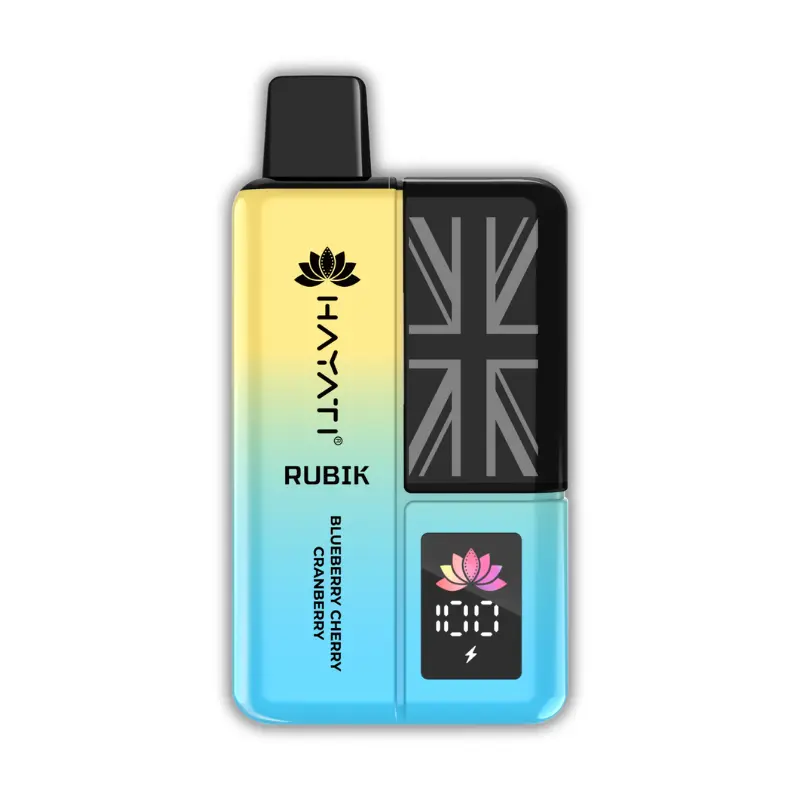
Hayati · Rubik
Blueberry Cherry Cranberry Hayati Rubik Prefilled Pod Kit
£5.99
✔ In stock — ready to ship
Genuine Hayati
Free over £20
Same-day dispatch
Secure checkout
Blueberry Cherry Cranberry is sold here as a complete Rubik purchase at £5.99: the body, and one factory-filled pod holding 12ml of liquid at 20mg in salt form. The cell is 850mAh. Hayati's own figure for a full pod is up to 7,000 puffs, which came off test equipment drawing to a timer and is useful for lining one listing up against another rather than for planning a fortnight. Three fruits are named and nothing else is. No cooling word, no sour treatment, no confectionery framing, no drink.
The third of those fruits is the reason this page exists. Cranberry is doing something in this recipe that neither of the other two can do, it is the component every one of Hayati's own descriptions credits with making the blend work, and it is also the only fruit in this entire catalogue that never once gets to be what a product is about. Sixteen listings contain it. Not one of them is called Cranberry, or Cranberry Ice, or Cranberry anything. It is always third or second in a list of three, always behind a sweeter fruit, always in support.
That looks at first like a verdict on how well cranberry sells. It is not, and the point of the next several thousand words is that the real reason is more interesting and has a practical consequence for anybody putting £5.99 down on this box. Cranberry cannot be the subject of a flavour, in the way blueberry or cherry or mango can be the subject of one, because it has almost nothing for you to recognise it by. What it contributes is an acid and a physical drying sensation, and a drying sensation is not something the nose can identify. It is something the inside of your mouth reports. A component like that can modify anything and can be the point of nothing.
Take that seriously and two things follow that a buyer would actually use. The first is what cranberry is for in this specific blend, which is to be the brake on two fruits that have no brakes of their own. The second is how this pod should age, which is unusual, and which the range currently disagrees with itself about. Both are below. The hardware section is short, because the Hayati Rubik Prefilled Pod Kit shelf has already worked out what the platform costs per millilitre and there is no value in rebuilding that here.
The ingredient that never gets its name on the front
The Strawberry Raspberry Cherry Pro Max Plus kit page reached this observation first and stated it cleanly: cranberry appears in exactly three flavour names across all 492 listings, all three are three-fruit names, sixteen listings in total, and not one of them lets cranberry lead. That page used the finding as a supporting point on the way to a different argument. This page makes it the argument, which means the first job is to check it rather than inherit it.
Counting it, because a rarity claim you were handed is a hypothesis
I counted it by a different route: reading the flavour field off every listing in the catalogue, splitting any name that carries an oblique into its two halves, and deduplicating what is left. That produces a different total number of distinct flavour names than the title-stripping method that page used, which is a note about methods rather than a disagreement. On cranberry the two routes land on exactly the same answer, which is the useful outcome.
Three flavour names contain cranberry. Blueberry Cherry Cranberry, which is this one. Strawberry Cherry Cranberry, which swaps the lead fruit. And Straw' Cranberry Cherry, which is the same three fruits as the second one printed in a different order. All three carry three fruits. None carries two. None carries one.
Those three names cover sixteen of the 492 listings, which is one product in every thirty-one. Seven of the sixteen are this exact recipe: the Rubik refill pod at £3.99, this kit, the Pro Max Plus kit at £7.99 and its bare pod, a 10ml nicotine salt, and two 120ml bottles at 0mg in different carrier ratios. Three are the strawberry-led version, headed by the Strawberry Cherry Cranberry Pro Max Plus kit. Six are Straw' Cranberry Cherry, and five of those six are divided pods where the other reserve is something cooled.
Now the position test, which is the part the earlier page did not run. Cranberry does not lead a name. That much is established. But plenty of things fail to lead a name and are still perfectly capable of being a subject, so leading is the wrong test on its own. The sharper question is whether a component ever stands as the whole name, or as half of a pair, because those are the two shapes a name takes when the thing named is what you are buying rather than what has been added to what you are buying.
Cranberry never does either. It has never been the whole of a name. It has never been one of two. Every appearance it makes is as one of three, positioned behind at least one fruit that is unambiguously sweeter, and that has now held sixteen times without an exception.
Who else never leads, and why none of them count
The claim only means something if cranberry is unusual in this, so I ran the same test across every word that appears in two or more flavour names. Seven words never head a name. Cranberry, lime, melon, passion fruit, mint, berries and frozen.
Five of the seven fall away immediately on the second half of the test. Lime appears in Lemon Lime and in Cola Lime, so it is half of a pair and a co-subject. Melon appears in Triple Melon, where it is plainly what you are buying. Mint appears in Fresh Mint, Black Mint and Frosted Mint, all of which are a modifier plus mint, which makes mint the subject and the modifier the qualification. Berries appears in Mixed Berries and Dragon Berries on the same pattern. Frozen is a temperature word rather than an ingredient and does not belong in the comparison at all. The Fresh Mint Rubik kit on this very shelf is the cleanest counter-example: a component that never leads a name and is nonetheless the entire point of eleven listings.
That leaves passion fruit, which does pass both halves. It occurs in Guava Kiwi Passion Fruit and in Lemon Peach Passionfruit, spelled two different ways, and both are three-fruit names with something sweeter in front. So the shape is not unique to cranberry, and it would be overstating things to say otherwise. What separates them is sample size. Passion fruit has two names and three listings behind it, which is not enough to distinguish a rule from a coincidence. Cranberry has three names and sixteen listings, and it is the only single fruit in the range with that many appearances and no appearance as a subject.
For scale, set that beside the fruits that do get to be subjects. Cherry heads five flavour names and appears in sixty-two listings. Blueberry heads twelve and appears in forty-six, and is sold on its own in a pouch. Strawberry in its various spellings heads eighteen and appears in eighty. Those three fruits are the other two-thirds of this pod and the whole of its nearest neighbours, and every one of them is something Hayati are willing to sell as the headline. Cranberry, at sixteen listings, is not far behind mint at sixteen and comfortably ahead of passion fruit at three, so it is not a fringe ingredient being quietly tolerated. It is used regularly, and it is used one way only.
Seven descriptions of one liquid, and the verb every one of them reaches for
Counting names tells you what Hayati are willing to print on a box. Reading what they write underneath tells you what they think the ingredient does, and this recipe is sold seven times with fresh copy each time, which is an unusually good sample to read.
Line up all seven and the consistency is the striking part. In this catalogue the several listings of one flavour routinely contradict each other, and a sibling page found seven descriptions of one blackcurrant recipe splitting over whether the berry was tart or merely sweet. Here there is no split at all. Every one of the seven gives blueberry a softness word: soft, mellow, rounded, gentle, smooth. Every one of the seven gives cherry a weight word: depth, richness, body, a dark or juicy centre. Seven from seven on both, with no listing dissenting.
Cranberry gets described seven times as well, and this is where the pattern breaks in a way that is worth the attention. Every one of the seven describes cranberry by what it does to the other two fruits, using a transitive verb whose object is the blend. It stops, it keeps, it cuts, it sharpens, it holds in check, it ties. Six of the seven pick a verb of restraint specifically. Nowhere across all seven descriptions is cranberry given a flavour of its own, a fruit character, an aroma, or a comparison to anything you might recognise from eating one.
The adjectives confirm it. Cranberry in these seven is tart, dry, sharp, sour, tangy, a snap, a bite. Every one of those is either an acid or a texture. Not one is an aroma. Blueberry gets softness, which is a weight. Cherry gets depth, which is a duration and a weight. Cranberry gets a sensation and an acid, and that is the whole account.
Widen it to the full sixteen cranberry listings and the same holds, with a vocabulary signature you can measure. The word dry appears in twenty-one of the 492 product descriptions in the catalogue. Eight of those twenty-one are cranberry listings, which is to say that three per cent of the range supplies thirty-eight per cent of the dryness language. The word snap appears twenty-one times and five of those are cranberry. Bite appears thirty-five times and seven are cranberry. Fifteen of the sixteen cranberry listings use the word tart, against about one listing in five across the range as a whole. The vocabulary Hayati reach for when they write about this fruit is not the vocabulary of flavour. It is the vocabulary of texture and of an edge.
Three of the seven descriptions of this recipe go further and credit cranberry with being the thing that makes the liquid what it is, in one case saying outright that it is doing the heavy work. So the copy's position, stated across seven independent attempts, is that cranberry is decisive and that there is nothing to say about how it tastes. Those two things together are the whole subject of this page.
One small outlier is worth flagging because it is this listing's own. Of the seven, six frame cranberry as restraint, holding the sweetness back. This Rubik kit's description is the only one that frames it as cohesion, saying it binds the three together. That is a different claim, and I think it is the weaker of the two readings. Cranberry does not join blueberry to cherry, which are already joined by sharing a register. It interrupts them both. The other six listings have it right and this one has reached for a nicer-sounding verb.
Why a fruit can be indispensable and never be the subject
So the pattern is real and it is consistent from two directions at once, the names and the copy. The question is what causes it, and there is a real answer that is better than the obvious one.
The mechanism, which belongs to another page
What cranberry does physically has already been set out properly on the Straw' Cranberry Cherry / Strawberry Raspberry Ice Pro Ultra Plus pods page, at length and with the right hedges, and repeating it here would waste your time and mine. The short version, cited rather than re-derived: cranberry carries acid and astringency, these are two separate mechanisms that arrive together, and astringency is not a taste. There is no receptor for it. It is protein binding, a thinning of the lubricating film in your mouth, registered by touch in the same category as texture or temperature. That page also marks the honest limit, which is that no cranberry-flavoured liquid contains cranberries and a flavour house can approximate the impression by more than one route, so the mechanism is a well-supported reading rather than a specification. Hayati publish no tannin figure, no acidity figure and no sweetness scale for this pod or any other.
Everything below takes that as established and asks a question that page did not: given a component that works by touch, what follows about where it can sit in a recipe and on a label.
The explanation that does not survive the count
The intuitive answer is commercial. Cranberry never leads because cranberry does not sell. Nobody walks into a shop wanting austerity, so you put the strawberry on the front and hide the sharp thing behind it. That reading has been offered in this range before and it is not stupid, but it does not hold up against what else is on the shelf.
If Hayati were shy of putting an unwelcome sensation on the front of a box, the catalogue would look very different from how it looks. Twenty-one listings carry the word sour in the title, and Blue Sour Raspberry sits on this exact shelf at this exact price with the treatment announced in the name. Sixteen listings name mint, which is a divisive, non-sweet, aggressively non-fruit thing, and eleven of them are Fresh Mint with no fruit anywhere in the name at all. Lemon Cola Ice puts a faintly bitter spiced drink note in the title. Lemon Lime is two acids and no sweet fruit whatsoever. This is not a range that flinches from a sharp label.
So unpopularity does not explain it. Hayati are perfectly willing to head a product with sourness, with bitterness, with herbal cold and with pure citrus. The one thing they will not head a product with is cranberry, and the difference between cranberry and every item on that list has to be something other than how many people like it.
The explanation that does: there is nothing there to recognise
Here is the answer, and it is a claim about perception rather than about marketing.
For something to be the subject of a flavour, the person using it has to be able to identify it. That is what a subject is. You buy a mango pod because you expect to recognise mango, and the recognition is what you are paying for. Recognition of a fruit is almost entirely a matter of aroma, delivered retronasally as you exhale, because that is where the information that distinguishes one fruit from another lives. Sweetness does not distinguish fruits from each other; nearly all of them are sweet. Acid does not either; a great many of them are sour, and sourness carries no identity of its own. What tells you a raspberry is a raspberry rather than a strawberry is a set of volatile compounds reaching the back of your nose.
Cranberry's distinguishing properties are astringency and a hard, low-sugar acidity. Neither of those is an aroma. Astringency is tactile, and acidity is a taste with no identity in it. What is left of cranberry once you take those away is a thin, faintly sour red note that nobody would name confidently in a blind test. Ask somebody to describe the smell of a cranberry as distinct from the feel of eating one and most people cannot, which is not a failure of their palate. There is not much there.
The consequence is structural rather than commercial. A liquid called Cranberry would have to deliver something the drinker could identify as cranberry, and the only reliable signal it could send is a drying mouth. But a drying mouth is not specific. Strong black tea does it. Red wine does it. An underripe pear does it. The kernel note behind a cherry flavouring reads as dry by a completely unrelated route, which a sibling page on the divided cherry pods works through in detail. Served a liquid whose only distinguishing feature is dryness, a buyer would register that the liquid is dry and would have no way to conclude that the dryness is cranberry rather than tannin from anywhere else. There would be nothing to recognise, which means there would be nothing to buy.
Put positively, this is exactly what makes cranberry so useful, and it is why it appears sixteen times rather than twice. A component with no aroma identity cannot compete for the identity of the liquid it is in. Add a second fruit to a blend and the two fruits argue about which one you are tasting. Add cranberry and nothing argues, because cranberry is not making a claim on the aroma channel at all. It is working somewhere nothing else in the recipe is working. That is a formulator's ideal corrective: it changes the shape of the experience and leaves the label honest.
Mark the whole of this section as reasoning. It is an explanation of a pattern in the catalogue, built from what cranberry is as a fruit and from what Hayati's own copy consistently credits it with. Hayati publish nothing about why they name products the way they do, and nobody outside the flavour house can tell you what is in the bottle.
What the three fruits do here, in the order you meet them
The general argument lands on this specific pod in a specific way, because of which two fruits cranberry has been asked to correct. They are, as it happens, the two least corrective fruits Hayati work with.
Blueberry sets the floor and leads only on the label
Blueberry is printed first and it is not what arrives first. The Blueberry Vapes shelf sets out at length why blueberry almost never leads a liquid in practice, and the reasoning is cited here rather than rebuilt: it carries very little acid, so anything sharper in the recipe takes the front of the mouth while the blueberry settles underneath as body. Ninety listings on that shelf and the pattern holds across nearly all of them.
What blueberry gives this pod is a floor. It is a broad, low, syrup-like sweetness with a faintly jammy cast to it, arriving without an edge and going nowhere in particular. It sets a colour and a sugar level and then holds still. Hayati's own seven descriptions of this recipe agree on that unanimously, which is the strongest sort of evidence available on a catalogue where the copy usually disagrees with itself.
The important property for this page is a negative one. Blueberry does not cut. There is no event in it, nothing that interrupts, no acid worth the name. Whatever else this blend was going to need, it was going to need something blueberry cannot provide.
Cherry takes the length and does not cut either
Cherry is the second fruit and the one carrying depth, which all seven descriptions also agree on. The mechanics of cherry as a flavouring, and specifically the narrow window between too little kernel character and too much, have been worked through properly on the Blueberry Raspberry Cherry Pro Max Plus 6000 kit and its pod sibling. That analysis is theirs and it is not being redone.
What it means here is that cherry occupies the middle and the tail. It is darker than the blueberry, heavier, and it extends the draw past the point where the blueberry would have faded out. Set at a sensible level it reads as fruit rather than as marzipan, and it is the component that gives the liquid its length.
And it does not cut either. Cherry is rich, and richness is the opposite of an interruption. Two fruits in, this recipe has a broad sweet floor and a long dark middle, both of them round, both of them sitting in the same part of the experience, and nothing anywhere in it that stops. That is a liquid heading directly for syrup, and it is the problem the third fruit was chosen to solve.
Cranberry arrives last, and what arrives is not a flavour
Cranberry lands at the end of the exhale and in the seconds after it, which is later than most people expect and later than either of the other two fruits reach.
Two things happen in that window and it is worth keeping them apart, because they behave differently and one of them is the reason this pod is worth writing about. The first is acid: a genuine sourness registering along the sides of the tongue, short, clean, done in a second or two. The second is the grip: a narrowing, a slight roughness where the tongue meets the palate, the sense that your mouth has become less slippery than it was. That second one is not a taste and it does not clear in seconds.
The practical effect on this particular recipe is precise. The blueberry has coated your palate with a broad sweetness and the cherry has extended it. The astringency strips the film that sweetness was sitting on, so the next draw starts from something much closer to neutral than it otherwise would. That is the brake. It is the whole reason a blend of two round fruits does not become tiring by the fourth pull, and it is delivered by touch rather than by anything you can taste, which is why the fruit responsible for it never competes with either of the others for your attention.
Note what the brake is not. It is not cooling, and there is no cooling word anywhere in this name. A coolant would also cut through a sweet mass and it would do so by numbing, which shortens the tail and takes the length out of the cherry. Astringency does not numb. It removes lubrication and leaves every aroma in the recipe fully audible. Those are two different solutions to the same problem and this pod uses the second one exclusively.
Where the sweetness sits, and what this pod is not
On a scale running from an unsweetened tobacco profile at one end to a sweet-counter build at the other, this lands above the middle and short of confectionery. It is clearly a sweet liquid. It is not a sugary one, and the difference is the cranberry rather than any restraint in how the other two are dosed. Take the third fruit out and this would sit near the top of the scale.
Several things it is not, for anybody scanning rather than reading. Not cooled, at any point, in any amount. Not a sour build: cranberry brings acid but nothing has been dosed to make your jaw ache, and Blue Sour Raspberry on the same shelf is what a declared sour treatment actually feels like. Not fizzy, so it is a different proposition from Fizzy Cherry, which puts an effervescent prickle where this puts a dry grip. Not a sweet-shop liquid, unlike Blue Razz GB and Blue Razz Cherry on the same twenty listings. And not a mood name: everything in the title is an ingredient, which puts it in a different category from Mr Blue, where the information gap is the subject of its own page.
Who it suits: somebody who likes dark red fruit and has found that dark red fruit gets heavy on them after twenty minutes. Who should avoid it: anybody for whom over-brewed tea is unpleasant rather than merely strong. That puckering roughness at the back of a stewed cup is the same signal this pod sends at the end of every draw, and no amount of blueberry in front of it will hide it, because it arrives after the blueberry has gone.
Three fruits from one colour, and no cold anywhere near them
The Strawberry Raspberry Cherry kit page established something about three-fruit names that bears directly on this one, and it did the counting properly. Across all 492 listings, not one flavour name carrying three fruits also carries a cooling word. No Ice, no Frozen, no Cooler, no Mint, no Menthol. Cooling is otherwise everywhere in this range, on roughly one listing in four. On a three it has never once happened. That page also found what Hayati reach for instead: when they want contrast in a three, they put an acid in it, usually a citrus, and four or five of the fourteen three-fruit names do exactly that.
This listing is the interesting case for that finding, because the acid here is not an addition. It is one of the three fruits. Blueberry Raspberry Lemon and Cherry Peach Lemon bolt a citrus onto a fruit pairing, and the citrus is legible as an extra ingredient. Blueberry Cherry Cranberry spends its third slot on the contrast itself, which has three consequences worth stating.
The first is that the contrast cannot be dialled. On a name where the acid is a citrus, the citrus is also a fruit with an aroma, so it contributes flavour as well as sharpness and the two arrive together. Here the corrective contributes almost no aroma at all, which means the liquid is, in aromatic terms, a two-fruit blend that has been given a third fruit's worth of edge. You are getting less flavour variety than the name suggests and more structure than a two-fruit name would have promised.
The second is that this is one of only three flavour names in the catalogue where all three fruits come from the same colour family, a narrowing that page also ran. The other two are the strawberry-led version of this trio and Strawberry Raspberry Cherry itself. A same-colour three has a particular risk attached to it, which is that the fruits converge into a single anonymous red, and the thing that saves this one from that is precisely that its third component is not competing on colour or on aroma. It is competing on nothing. It occupies a channel the other two have left completely empty.
The third is about escape. Five of the six Straw' Cranberry Cherry listings are divided pods with a cooled reserve on the other side of a collar, which means a buyer who finds the drying finish too much can turn away from it mid-session. This is a single-flavour pod with no collar on it, and what that costs has been set out on the Juicy Peach Rubik pods page and is not rebuilt here. The relevant point for this listing is narrow: of the sixteen cranberry products Hayati sell, the ones with a built-in way out are the divided pods, and this is not one of them. Twelve millilitres of a drying liquid is a longer commitment to a tactile sensation than most buyers think about when they are comparing thumbnails.
How this pod should age, and a disagreement in the range about it
This is the part with the most practical value in it, and it is also the part where two pages on this site currently predict opposite things. Both readings are set out here so you can judge, rather than the disagreement being quietly resolved in favour of whichever one I prefer.
The reading this page takes
A sealed pod ages because residue accumulates on the coil, and a fouling coil stops lifting the lightest material first. That is not contentious and several pages in this range have described it. What matters is which components in a given recipe are light.
In this pod the light material is the fruit. Blueberry's jammy sweetness and cherry's depth are both carried by volatile aromatic compounds, and those are exactly what a tired coil gives up. Cranberry's contribution is not volatile. Acid rides into the aerosol in the liquid fraction rather than being lifted off the wick as vapour, and whatever produces a drying grip is heavier still and largely indifferent to how well the coil is heating. Those components arrive on your tongue whether the coil is new or filthy.
So this pod should not fade evenly. The prediction is that the fruit thins while the edge does not, and because the edge holds its absolute level while everything around it drops, its share of the experience climbs steadily through the second half of the pod. A late pod on this flavour should read drier and harder rather than merely weaker. The last two millilitres should be the astringency close to full strength with a much quieter fruit behind it, which is a specific and slightly unpleasant direction rather than the gentle fading most pods do.
Two pages in this range have already said as much and should be credited. The Blackcurrant Juice Pro Max Plus kit page set out the general principle, that whatever produces a drying grip is heavy, non-volatile and unbothered by heat, so it is among the last things to go rather than among the first. And the Cherry Sour Raspberry Pro Max Plus pods page, which is about a non-volatile acid outliving the aroma it was meant to balance, named this exact liquid in passing and predicted a comparable late-pod imbalance for it, drying rather than sharp. So the claim on this page is a development of theirs rather than a discovery, and it is marked as a prediction from how the components behave rather than as anything with a specification behind it.
The reading that disagrees, and why the two can both be defensible
The Strawberry Cherry Cranberry nicotine salt page, covering the strawberry-led version of this trio, says the opposite. It says the astringency is the first thing to fade, and that a bottle starting to taste sweeter is a coil telling you it is tired.
Two pages confidently contradicting each other is worse than one being wrong, so this is worth settling as far as it can be settled. Part of the difference is genuine and structural. That page is about a 10ml bottle going into a refillable device where the user changes the cotton and where the same coil sees successive different liquids. Residue there includes whatever was in the pod before, and a wick carrying sweetener from a previous fill will blunt an edge directly. This is a sealed pod that runs one liquid from the first millilitre to the twelfth and is then thrown away, so that particular route to a softened finish is not available to it.
Part of it, though, looks like a conflation. That page treats cranberry's sourness and cranberry's astringency as one property and predicts they fade together. They are two mechanisms, as the Pro Ultra Plus pods page established, and neither of them is volatile. I do not think the prediction on that page is well supported on the astringency, and the disagreement is flagged here rather than papered over. If you own both, you are in a better position to judge than either page is.
What to actually watch for
The useful version for a buyer is short. On most pods the signal that a coil is finished is that everything goes quiet. On this one, expect the signal to be that the fruit goes quiet while the finish does not, so the liquid reads as having got harder rather than fainter. If the last part of a pod is drying your mouth as much as the first part did but the blueberry and cherry have gone flat and indistinct, that is the coil rather than a bad pod, and there is nothing left in it worth chasing. Nobody has published measurements on this liquid, so treat it as a well-reasoned expectation.
The Rubik box, kept to what it changes
The box holds the body and one pod already filled at the factory. The pod is sealed, with the coil built into it, and the pod is replaced rather than refilled when it is finished. The cell is 850mAh and rechargeable, and it outlives many pods, so the second purchase for this flavour is the Rubik pod at £3.99 rather than another kit.
One specification matters more than the rest for this liquid, and it is the sealed coil. Because the pod cannot be opened, refilled or rewicked, the ageing pattern described above is not something you can intervene in. On a refillable device you could drop the power, change the cotton and get the fruit back. Here the coil and the liquid are a single disposable unit and they finish together, so the drying-out is a property of the purchase rather than a maintenance problem.
The per-millilitre case for buying Hayati liquid on this platform rather than on the larger ones has been worked out on the Hayati Rubik Prefilled Pod Kit shelf and on the pod listings, where it belongs, and it is not repeated here beyond one observation about choice. All twenty Rubik kits are £5.99 and all nineteen Rubik pods are £3.99, so a three-fruit recipe costs exactly what a one-fruit recipe costs and nobody is charging you for the extra ingredient. The complete shelf, kits and refills together, is under Hayati Rubik. On fitment, check the range name printed on your device against the range name in this title, since Hayati publish no cross-fitment chart for any of their systems.
The numbers, and what each one decides
The table runs from the rows that determine whether you want this pod, through the published figures that change nothing, to the things nobody publishes. The last group is larger than most buyers expect.
| What the name promises | Three fruits, all from the same colour family. No coolant, no sour dosing, no confectionery or drink treatment. |
| How many of the three you will identify | Two. A soft sweet floor and a dark middle. The third is a sensation rather than a flavour. |
| Where the contrast comes from | Astringency and acid at the end of the exhale, not from cooling and not from a dosed sour |
| Sweetness | Above the middle of the range, held back by the finish rather than by restraint in the dosing |
| Cooling | None, and no cooling word appears in the title, which is how this range marks a cooled listing |
| Liquid | 12ml, filled and sealed at the factory |
| Nicotine | 20mg nicotine salt, the UK ceiling for a consumer e-liquid, and the only strength on this listing |
| Cell | 850mAh, rechargeable, outlives the pod |
| Manufacturer's puff figure | Up to 7,000, a laboratory estimate from test equipment rather than a measurement of anybody's use |
| Price with the body | £5.99 |
| Price of a refill afterwards | £3.99 |
| How strong the drying finish is | Not published. No tannin figure, no acidity figure, no scale of any kind |
| Proportions of the three fruits | Not published for this or any pod in the range |
| VG/PG ratio, coil resistance, wattage | Not published against this listing |
Three of those want a sentence. The 20mg figure is the legal maximum in this country rather than a decision anybody made about this recipe, so it says nothing about the liquid and it is the same on every prefilled pod Hayati sell; nicotine is addictive whatever the preparation and whatever number sits beside it. If 20mg is more than you want, the range does carry a lower-strength prefilled option in the Pro Max Plus 6000 kit at 10mg, though that is different hardware and a different shelf. The 7,000 figure comes off a machine drawing to a timer, so read it as the budget allotted to one sealed coil rather than as a duration, and treat the four rows at the bottom as the honest part of the table: if another page quotes you a fruit ratio, a resistance or a number for how drying this is, it has invented them.
What to buy instead, sorted by what you want the cranberry replaced with
Almost everything worth comparing this to is the same price or close to it, so arranging the alternatives by price would tell you nothing. The useful axis is what each neighbour puts in the third position, because that is the variable this page has been about.
The same liquid, differently packaged
Seven listings carry this recipe and only the hardware changes. The Rubik pod at £3.99 is the correct repeat purchase once the body in this box is yours, and buying it first is not a cheaper way in, because a sealed pod with nothing to power it is not usable. The Pro Max Plus kit at £7.99 holds the same 12ml at the same strength on a larger and dearer platform with a lower manufacturer's rating, so the case for it is the hardware rather than the liquid. Beyond those, the recipe exists as a 10ml nicotine salt and as two 120ml bottles at 0mg, for anyone running a refillable device instead of a prefilled one.
The corrective kept, the lead fruit changed
Strawberry Cherry Cranberry is the closest thing in the range to a controlled comparison: two fruits held constant, one swapped, cranberry left in place. The difference between the two leads has already been worked out properly on the nicotine salt page for that flavour, which found that strawberry gives the bigger swing between a soft opening and a sharp close, while blueberry carries a mild tartness of its own and so keeps the whole thing in one darker register. That analysis is theirs and the conclusion is worth taking: choose the strawberry version for contrast, this one for consistency.
Three fruits with nothing correcting them
Strawberry Raspberry Blueberry is the instructive opposite. Three red and blue fruits again, but the third one is doing weight rather than restraint, so nothing in it interrupts. If the description of the drying finish above sounded like a warning rather than a feature, that is the pod built the way you want. Mixed Berries takes the same idea further and stops itemising the fruit at all, which on a blend of this kind is arguably the more honest label.
Cold instead of dry
Cooling is the other way to stop a sweet red accumulating, and it works by a completely different route. Strawberry Raspberry Ice is the nearest cooled option on this shelf at the same £5.99, and Blue Frozen is the one built around the cold rather than around a berry. Worth knowing before you swap: cold numbs the middle and shortens the tail, so it takes something away as well as adding something, whereas the dry finish here leaves every aroma in the pod fully present. Twelve of the twenty Rubik kits carry no cooling word and eight do, so the shelf covers both.
Acid instead of astringency
If what appeals is the edge rather than the dryness specifically, the acid route is cleaner and it ages better. Blue Sour Raspberry on this shelf points the sharpness forward instead of back. Lemon Lime is two citrus fruits and no sweet floor at all, which is about as far from this pod's architecture as the shelf travels. Blue Razz Lemonade is worth a mention for the ageing reason set out above: citrus brightness is aromatic, so it fades at the same rate as everything around it and the balance stays intact right down to the point where the pod simply goes quiet. That is the opposite failure mode to this one.
Something else entirely in the third position
Lemon Cola Ice uses a spiced, faintly bitter drink note to break up the sweetness, which is a third solution to the problem this pod solves with dryness. Strawberry Kiwi uses a green note, which is genuinely a second aromatic axis rather than a textural one. Blue Razz Cherry is the useful one for anybody who came here wanting to taste the cherry: putting cherry next to a confectionery blue rather than next to a congener is what makes it audible, and the same fruit does a completely different job depending on what sits beside it.
The rest of the berry field
Blueberry Raspberry is the two-fruit parent of the blue half of this recipe and the obvious control if you want to hear what the cherry and cranberry are adding, since it is on the same shelf at the same price. Banana Ice is the softest and lowest-acid thing on the Rubik shelf and the natural partner if you want a rotation that alternates between an edge and none. For the bigger format, Blueberry Raspberry / Mr Blue on the Pro Ultra Plus at £11.99 puts two blue treatments behind a collar, which is a different kind of purchase entirely. Browsing by fruit is usually quicker than browsing by platform: Cherry Vapes runs to seventy-two listings, Blueberry Vapes to ninety, and Berry Vapes collects two hundred and twenty-five in one place. Everything Hayati make, across all the systems, is in the full product list.
Living with a pod that dries your mouth
Generic handling advice is on most pages in this range and is kept to a minimum here. What follows is the part that only applies because of the third fruit.
Pace matters more on this pod than on a sweet one. Astringency accumulates in a way sweetness and sourness do not, because the sensation comes from something being stripped out of your mouth rather than something being added to it, and replacing it takes minutes. Six draws in two minutes is a noticeably drier experience than the same six over half an hour, from the identical pod. If the finish feels harsher than you remember, check how fast you have been going before deciding the pod has turned.
Water does real work here. On most liquids, having a drink alongside is marginal. On this one it is the single habit that changes the experience, because what you are replacing is the lubricating film the finish removes. This is not advice about hydration in general and no claim is being made about anything other than how the liquid tastes.
Judge the first pod after a day, not after three draws. A factory-filled pod arrives with the wick fully saturated and the first few draws off a cold device tend to read sweeter and heavier than the pod does later, which on this recipe means the drying finish is the last thing to show up properly. Somebody who forms a view in the first ten minutes will have judged a liquid with its defining feature still warming up.
Rotate against something that does not share a channel. The obvious mistake is to buy two dark reds at once, which leaves you with two pods competing for the same position and neither of them providing relief. The useful second pod is one that works somewhere else entirely, which on this shelf means Fresh Mint or one of the cooled options rather than another berry. There is a wrinkle worth knowing: moving from this pod to a cold one straight after a drying draw tends to make the cold read thin and harsh, because a dry mouth flatters nothing. Give it a minute.
Heat takes the half you like and leaves the half you were tolerating. Aroma is the most volatile thing in the pod and a warm car or a sunny sill removes it faster than use does. The acid and whatever is producing the grip are heavier and are largely unaffected. A pod stored badly for a month therefore does not taste stale, it tastes like a harder version of itself with the fruit quietly subtracted, which is the same direction a worn coil takes it. Keep spares somewhere ordinary and indoors, away from children and pets.
Know what a finished pod looks like on this flavour specifically. There is no window and no gauge. The usual signals are a thinner vapour and a flatter taste. Here, expect the fruit to go before anything else while the finish holds, so the pod that has reached the end reads as dry and blank rather than as faint. Once the blueberry and cherry have gone indistinct there is nothing left in it that you bought it for.
At the end of it. The spent pod is a sealed plastic shell holding a coil, a wick and a little liquid, and the body holds a lithium cell. Neither is household rubbish. UK vape retailers are obliged to accept small electricals back, and council recycling sites take them as well. The body is the part worth keeping, since it will run many pods before it stops holding charge.
Questions this pod tends to raise
Can I taste the cranberry?
Not in the way you taste the blueberry and the cherry, and that is the honest answer rather than a criticism. What cranberry delivers here is a short acid and a drying, slightly rough sensation at the end of the exhale. You will notice it every time. You will not be able to point at it and say cranberry on the strength of its flavour, because it barely has one.
Is it sour?
Lightly, and briefly, and the sourness is not the main event. The bigger effect is astringency, which is a physical drying rather than a taste and which builds across draws instead of clearing between them. Expect a grip along the sides of the tongue after the exhale rather than a pucker on the inhale, and note that a declared sour build such as Blue Sour Raspberry feels quite different.
Is there any ice or menthol in it?
None. No cooling word appears in the name, and in this range that is how a cooled version announces itself. The finish is dry, which is a different sensation from cold and comes from a different mechanism. It is also worth knowing that no three-fruit flavour name in the whole Hayati catalogue carries a cooling word, so there is no cooled version of this recipe to go looking for.
How does it differ from the strawberry version?
The two share cherry and cranberry and differ only in the lead fruit. Strawberry opens softer and sweeter, so the swing to the dry finish is bigger. Blueberry brings a little tartness of its own, so this version sits in one darker register from start to finish. Pick this one for consistency and that one for contrast.
Is this the same liquid as the £3.99 Rubik pod?
Same flavour, same 12ml, same 20mg, same shelf. The only difference is that this listing includes the body. Once you own a Rubik, the pod is the right purchase and buying another kit charges you twice for hardware you already have.
Why is there no Cranberry on its own in the range?
Because there would be almost nothing in it to recognise. Cranberry's distinguishing properties are an acid and a drying sensation, and neither carries an aroma identity, so a liquid built on it alone would read as dry without reading as any particular fruit. That is a reading of the catalogue rather than a statement from Hayati, who publish nothing about how they choose names.
Will the three fruits stay distinct over a whole pod?
Two of them are distinct to begin with and the third was never a separate flavour. What changes with use is the balance rather than the separation: the expectation is that the blueberry and cherry thin out while the dry finish holds, because the fruit is volatile and the finish is not. So an old pod should read harder rather than quieter.
Does it gunk a coil quickly?
Nothing published lets anyone answer that with a number, and the coil is sealed into the pod so there is nothing to inspect. What can be said is that this is a fruit blend rather than a heavily sweetened dessert profile, and the acid in it is not especially hard on cotton. The failure you should expect is the balance tipping rather than the pod turning burnt.
Is it too drying for all-day use?
That depends almost entirely on pace rather than on hours. Spread through a day it holds up well, because the finish resets the palate and stops the sweetness building. Taken in rapid bursts it compounds, since the mouth cannot rebuild what it strips out that fast. Anybody who dislikes the grip of over-steeped tea should treat that as the deciding test.
What is the puff figure worth?
It is a comparison tool and not much else. Up to 7,000 is a laboratory estimate produced by equipment taking identical draws on a timer, so it describes the budget given to one sealed coil rather than a number of days. Draw length and how often you reach for the device change the real answer by a wide margin.
Can I refill the pod?
No. It arrives filled and sealed with the coil fixed inside, and there is no opening designed to be used. When it is finished the replacement is the £3.99 pod rather than a bottle, and the body stays with you.
I want the cherry in front. What should I buy?
Not this. Cherry here is doing depth underneath a blueberry floor and it is not the headline. Fizzy Cherry puts cherry forward with a prickle around it, and Blue Razz Cherry makes it audible by pairing it with a confectionery blue rather than with another round dark fruit. Both are on the same shelf at the same price.
The short version
£5.99 buys a Rubik body and one sealed 12ml pod of 20mg nicotine salt, uncooled, rated by Hayati at up to 7,000 laboratory puffs, and the refill afterwards is £3.99. The liquid is a soft blueberry floor, a dark cherry middle and a short drying finish, and it is the only three-fruit flavour name among the twenty kits on this shelf.
The argument of this page is that the third fruit is the reason to buy it and is also the reason the fruit itself is never sold as a headline. Cranberry appears in sixteen of Hayati's 492 listings, in three flavour names, all three of them three-fruit names, never leading, never in a pair, never alone. Every one of the seven descriptions of this recipe credits it with what it does to the other fruits and none of them says what it tastes like, because there is very little to say. Its properties are an acid and a tactile drying, and a component with no aroma of its own cannot be something you recognise, which means it can only ever be something that changes what you recognise.
Here the job it does is precise. Blueberry and cherry are both sweet and both round, and neither of them cuts. Cranberry is the brake, and it applies that brake by touch rather than by flavour, which is why it never competes with either of them for the identity of the pod. The consequence worth planning for is that a brake made of texture does not fade the way an aroma does, so the back half of a pod should read drier and harder rather than simply fainter. That is a prediction rather than a measurement, it is contradicted by one other page in this range and supported by two, and it is set out above in enough detail for you to judge it yourself.
Take it if you like dark red fruit and have found that dark red fruit gets heavy on you. Leave it if the dryness of strong tea is something you dislike rather than something you enjoy, because it arrives at the end of every single draw and nothing in front of it will hide it.
Strictly for adults aged 18 and over. Nicotine is an addictive substance.
You might also like