
Home / Hayati Pods / Blueberry Cherry Cranberry Hayati Rubik Pods
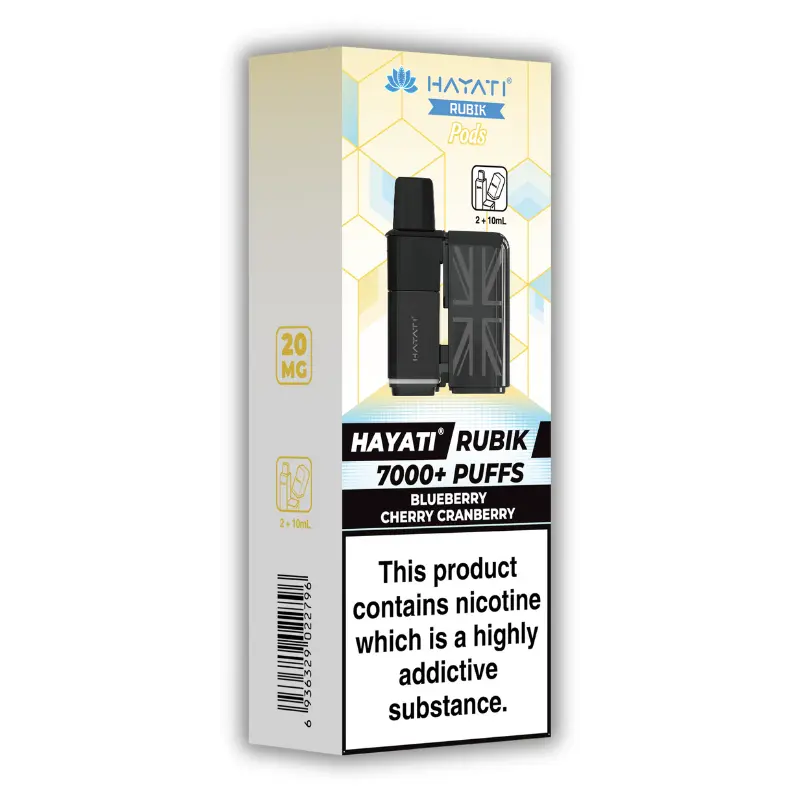
Hayati · Rubik
Blueberry Cherry Cranberry Hayati Rubik Pods
£3.99
✔ In stock — ready to ship
Genuine Hayati
Free over £20
Same-day dispatch
Secure checkout
Three pounds ninety-nine buys one Blueberry Cherry Cranberry pod for the Hayati Rubik and nothing else. No body, no lead, nothing to run it on. The pod holds 12ml of liquid at 20mg in salt form, Hayati put a full one at up to 7,000 puffs and that figure comes off laboratory equipment rather than anybody's use, and the name lists three fruits with no cooling word, no sour treatment and nothing borrowed from a drink or a sweet counter.
Nearly everybody who reaches this listing has already met the liquid. That is what a bare refill is: a second purchase, made by somebody who owns the device, has settled the flavour question, and now wants the same thing again. The flavour case for this recipe is made in full on the Blueberry Cherry Cranberry Rubik kit page, which is where a first-time buyer should be, and none of it is repeated below beyond what is needed to carry the argument.
That page ends on a prediction it could not test. It argues that this pod ought to age in an unusual direction, with the fruit thinning while the dry finish holds its level, so the back end of a pod reads harder rather than fainter. It then does something useful and uncomfortable: it flags that another page in this range predicts the exact opposite, and it sets both readings out instead of picking one. The disagreement is still open.
It is open because nobody in a position to close it had written yet. A claim about how one pod changes from its first millilitre to its twelfth is a claim about an arc, and an arc needs two observations at different points. A buyer opening a kit has one pod and one point. The person who can take the second observation is the person buying this listing, because the changeover between an old pod and a new one is the only moment in this product's life when both states exist in the same hand on the same day.
So this page is not another account of what three fruits taste like. It is about what the second, third and fourth pod can tell you that the first could not, why the two candidate explanations for a changing cranberry come apart across pod changes and stay welded together inside a single pod, and what to actually do at the changeover to get an answer worth having.
What the kit page has already settled
Five things belong to the kit page and are cited here rather than rebuilt, because rebuilding them would waste your reading and would be worse work than the originals.
The census. Cranberry appears in three flavour names across Hayati's 492 listings, those three names cover sixteen listings, roughly one product in every thirty-one, all three names carry three fruits and none carries two or one, and seven of the sixteen are this exact recipe. I re-ran the count off data/catalog.json before building anything on it and it holds exactly as stated.
The position test. Cranberry never leads a name, never stands as a whole name and never forms half of a pair. The kit page ran that test properly, including against the other components that never lead, and found cranberry is the only one with sixteen listings behind it and no appearance as a subject.
The anatomy. Blueberry sets a low broad floor and leads only on the label, cherry supplies the weight and the length, and cranberry arrives last with an acid and a drying grip rather than a flavour. Sweetness lands above the middle without reaching confectionery, and there is no cold in it anywhere.
The ageing prediction and its chemistry. The fruit in this pod is carried by volatile aromatic compounds and those are the first thing a fouling coil gives up, while cranberry's acid and its drying grip are heavy and are not lifted as vapour, so they hold their absolute level while everything around them drops and their share of the experience climbs. The mechanism belongs to the Straw' Cranberry Cherry / Cherry Ice Pro Ultra Plus pods page, and the kit page credits the Blackcurrant Juice Pro Max Plus kit and the Cherry Sour Raspberry Pro Max Plus pods pages for the general principle and for naming this liquid as a likely case of it.
The disagreement. The Strawberry Cherry Cranberry nicotine salt page, covering the strawberry-led version of the same trio, says the astringency is the first thing to fade and that a liquid turning sweeter is a coil telling you it is tired. The kit page sets that reading out beside its own and declines to resolve it, partly because one is about a sealed pod and one is about a bottle going into a device whose coil sees several different liquids in succession.
Everything above is taken as established. What follows is the question none of those pages was in a position to ask.
An arc is a repeat buyer's question, and here is why
Set the two predictions side by side and notice what they have in common. Both describe a change over the life of a pod. Both are therefore untestable by anyone holding a single pod at a single moment, because a change is a difference between two readings and one pod in use gives you one reading at a time. Memory does not fill the gap. Nobody can hold the taste of a draw taken eleven days ago accurately enough to compare it against a draw taken now, least of all on a property as slippery as how dry your mouth feels.
What the test needs is both states available together: a pod near the end of its liquid and a pod at the start of its own, sampled close enough in time that your palate, the weather, what you last ate and how much you have already vaped that day are held roughly constant. That pairing exists exactly once per pod, at the changeover, and only for the buyer who has the replacement in the drawer before the old one is finished.
Narrowing the claim, because the strong version is not true
The version of this I was handed said that no first-time buyer ever holds both. That is too strong and it is worth correcting rather than repeating, because the corrected version explains more.
A first-time buyer can obviously hold two pods. Nothing stops somebody adding this refill to the same basket as the kit, and plenty do. What they cannot hold is two states. Both pods in that basket are new. The old-pod reading does not exist yet and cannot be manufactured, because it is made of elapsed use, and elapsed use is not something you can buy alongside the hardware. So the accurate claim is narrower and sharper: the comparison requires a pod that has been worked through, which by definition only exists after a first pod has been worked through, which is the same as saying the test belongs to the second purchase onwards. The barrier is time, not the number of objects.
That narrowing also sets the earliest date for an answer. The manufacturer's figure for a full pod is up to 7,000 puffs, laboratory-derived and not a schedule, but it establishes that a pod is a unit of weeks rather than days for most people. Two changeovers, which is the minimum for a usable reading, is therefore a month or more of actual vaping. There is no shortcut.
Two things the catalogue will not do for you
Two structural facts, both checked against the catalogue file rather than taken from another page, make this harder than it needs to be.
The first is that nothing in the range is sold as a multiple. I searched all 492 descriptions for any quantity language, any pack, any pair, any figure attached to a pod count, and found none. Seventeen listings use the phrase "each pod" and not one of them says how many pods "each" is drawn from. The kit listing for this flavour says the device and the prefilled pod system come in the box and puts no number on it. So if you want two pods in the house, that is two purchases, and if you want them from the same production run you have to buy them at the same time and then deliberately not open the second.
The second is that for one flavour on this shelf the second pod does not exist at all. There are twenty Rubik kits and nineteen Rubik refill pods. Every kit flavour has a matching refill except Fizzy Cherry, which is sold as a kit and has no pod listing behind it. Anybody who settles on that flavour has bought into a dead end, and the fact that this is invisible from the kit page is a small argument for looking at the refill shelf before you commit to a flavour rather than after. The full refill shelf is Hayati Rubik Pods, nineteen listings, and kits and refills together are Hayati Rubik, thirty-nine.
Hayati's own copy treats this listing as the recurring one
One small piece of evidence that this SKU is understood as the repeat purchase comes from the feed text, and it is this listing's own word. The description on this page calls the blend an inexpensive refill to keep in rotation. Four descriptions in the whole catalogue use that phrase, and nineteen use the word rotation at all. Of the seven listings carrying the Blueberry Cherry Cranberry recipe, this is the only one that frames the purchase as something recurring rather than as something you try. The kit description talks about what the blend is. The nicotine salt bottle and the two large shortfills talk about what the blend is. This one talks about what you do with it repeatedly.
That is copywriting rather than evidence about the liquid, and it should not be leaned on hard. It does tell you the listing knows who is reading it.
Less helpfully, the shelf is inconsistent about saying that no device comes with a refill. Eight of the nineteen Rubik pod listings state it outright, this one among them, and eleven say nothing. Across the whole catalogue, 108 of the 492 descriptions carry some form of that warning. If you are buying a refill for somebody else, or buying a flavour you have not bought before, the absence of the warning on a listing means nothing: assume a listing whose title ends in Pods is liquid only.
Two explanations that look identical inside one pod
Here is the part that makes three pods worth more than one, and it is a point about experimental design rather than about fruit.
Suppose you are six weeks and three pods into this flavour and the cranberry does not feel the way it did at the start. That observation is real and common, and it has two completely different candidate causes.
Explanation one: the coil
Residue builds on a heating element as liquid passes over it, and a fouled element stops lifting the lightest material first. In this recipe the light material is the fruit, so the prediction from the kit page follows: the blueberry and cherry thin, the acid and the drying grip do not, and the ratio tips towards the edge. Under this explanation the change happens inside a pod, gradually, and it is at its worst in the last couple of millilitres.
One caution on this that the kit page does not make and that I am putting in because the catalogue forced it on me. Not one of the thirty-nine Rubik listings mentions a coil. Across all 492 descriptions, fifty-five mention one, and none of those fifty-five is a Rubik product. Hayati publish no resistance, no wattage and no description of what is inside a Rubik pod at all. The heating-element story is a reasonable reading of how a sealed prefilled pod works and it is how every page in this range talks, but on this particular hardware it is inference rather than a specification, and a page that asserted it flatly would be doing the thing this site keeps having to correct. Treat it as the most likely mechanism, not as a published one.
Explanation two: you
Astringency is not a taste. It is a physical event in your mouth, a binding that thins the lubricating film, reported by touch rather than by the nose. Sensations of that kind adapt. Repeated exposure to a tactile stimulus over days and weeks tends to reduce how much of it you notice, in a way that repeated exposure to a colour or a sound does not neatly parallel but that anybody who has worked their way into strong tea, unripe fruit or a tannic drink recognises. The signal has not got smaller. Your reading of it has.
Under this explanation the cranberry has not changed at all. You have. And crucially, the change is in you and travels with you, so it does not care which pod is fitted.
Why one pod cannot tell them apart
Inside a single pod both explanations predict the same thing: the cranberry seems different at the end than it did at the beginning. Coil fouling would do that. Adaptation over the same three or four weeks would do that. You cannot distinguish them from one pod because the two processes run on the same clock and in the same direction over that window, and you have no way to freeze one while observing the other.
This is exactly why the single-pod prediction on the kit page is honest about being a prediction, and it is also, I think, part of why the nicotine salt page reached the opposite conclusion in good faith. If your reading is taken across one bottle or one pod, whichever of the two processes is stronger for you personally will be the only one you see, and it will look like a property of the liquid.
Why three pods do tell them apart
Now change one thing. Fit a new pod.
If the mechanism is fouling, it resets. A fresh prefilled pod brings its own heating element with it, unused, and whatever residue had accumulated leaves in the bin with the old shell. Under that explanation the first millilitre of pod two should read like the first millilitre of pod one: fruit loud, edge in proportion. The cycle then repeats. You would see a sawtooth, the same drift happening inside each pod and snapping back at every changeover.
If the mechanism is adaptation, nothing resets. Your palate does not know a pod has been swapped. Under that explanation the first millilitre of pod three reads softer on the cranberry than the first millilitre of pod one did, and the drift continues straight through the changeover without a break. You would see a slope, not a sawtooth.
Those two shapes are distinguishable, and they are distinguishable using nothing more than attention at the moments when a pod is replaced. That is the whole argument of this page. The disagreement the kit page left open is not resolvable by tasting harder. It is resolvable by sampling at the right times, and the right times only exist for somebody buying their third pod.
The four outcomes, and what each one means
- Sawtooth. The fruit thins as each pod empties and comes back at every changeover, while the dry finish sits at much the same level throughout. That is the kit page's reading confirmed, and it means the last two millilitres of every pod will always read harder than the first two.
- Slope. The cranberry softens steadily across pods and the changeover does nothing to interrupt it. That is adaptation, and it means the liquid you are describing to a friend after two months is not the liquid they will meet on their first pod.
- Both. A sawtooth riding on a downward slope, which is the outcome I would actually expect and which neither existing page allows for. Each pod stiffens towards its end, and each new pod starts from a slightly lower baseline of perceived dryness than the last one did.
- Neither. The changeover reads the same as the middle of a pod and the third pod reads like the first. That would be a result worth having, because it would mean the volatile-versus-heavy prediction does not produce an effect large enough to notice on a 12ml pod, which is a real and reportable finding rather than a failure.
Notice that the fourth outcome is available. A test you cannot fail is not a test, and a page that only listed the outcomes confirming its own prediction would be running one.
What this cannot settle, and why the bottles cannot run it
The reset argument depends entirely on the heating element being part of the disposable pod, and the paragraph above sets out how far that is published on this range, which is not far. If it turned out that some part of the vapour path stayed with the body rather than leaving with the pod, the reset would be partial and the sawtooth would be shallower than described. That is a real limitation and I would rather state it than let the design look tidier than it is.
It also explains why this test belongs to a pod and not to a bottle. The kit page already notes that the disagreeing page is about a 10ml bottle in a refillable device where the same cotton meets several liquids in succession. The point I would add is narrower and is about instruments rather than about liquids: a refillable coil does not reset when you top it up, so a bottle user has no changeover at all, only a long continuous drift with both explanations superimposed and no moment at which one of them is forced back to zero. The three bottled versions of this recipe are the same liquid and they are the worse instrument for this particular question. A sealed pod is a crude thing in most respects and here its crudeness is the feature.
The protocol, in the order you would actually do it
None of this needs equipment. It needs one purchase made a little early and about ten minutes of attention twice.
Buy the replacement before you need it
The single thing that makes the test possible is having the new pod in the house while the old one is still running. Ordering after the old pod dies leaves a gap of days, and a gap of days destroys the comparison, because everything else about you moves in that time. Buy the next one when the current one feels roughly two thirds gone.
If you can, buy two at once and hold the second unopened. That gives you a changeover where both pods came from the same shipment, which removes batch variation from the list of things that could be causing what you see. It does introduce a different problem, since the held-back pod will have spent a month somewhere, and that matters, which the housekeeping section deals with.
Pick one time of day and keep it
Both readings, old pod and new pod, go in the same session, and that session sits at the same point in the day for every changeover you run. This is not fussiness. Your mouth is a different instrument in the morning than it is after a meal, and astringency in particular is sensitive to what else has been through recently. Tea is the obvious trap, since strong tea produces the same drying grip by its own route, and a cup half an hour before a reading will flatten your ability to detect the one in the pod. Coffee, anything acidic and anything oily all move the baseline as well.
Mid-morning, an hour after anything, is the easiest slot for most people to reproduce. The exact slot does not matter. Repeating it does.
Three draws old, two minutes, three draws new
Take three unhurried draws from the pod that is nearly finished. Then swap in the new pod, wait two minutes for the sensation from the first three to clear, and take three from that. Three is enough to get past the first-draw oddity and few enough that the drying does not start accumulating and contaminating the second half of the comparison. The order matters: old first, new second, every time, because the astringency from the old pod would otherwise be sitting in your mouth while you read the new one.
Record two numbers, never one
This is the step people skip and it is the step that carries the whole result. Do not write down "weaker" or "harsher". Write down two separate things on any scale you like, out of ten is fine, and keep them apart:
- Fruit volume. How loud are the blueberry and the cherry? This is an aroma judgement, made on the exhale and just after it.
- Dry grip. How much has your mouth tightened by four or five seconds after the exhale? This is a touch judgement and it is a different question.
The prediction under test is about a ratio between those two, not about the level of either. A single impression collapses them into one number and throws away exactly the information you sat down to collect. Somebody who records only "the old pod tasted worse" has done the work and kept none of the result.
Repeat at the next changeover, and only then look
One changeover gives you one pair of readings and cannot show you a shape. Two changeovers, which is the third pod, gives you old-new, old-new, and that is the minimum from which a sawtooth and a slope look different. Resist reading anything into the first pair. If the numbers from changeover two put the new-pod fruit volume back where the new-pod fruit volume sat at changeover one, that is your reset. If the new-pod dry grip at changeover two is lower than the new-pod dry grip at changeover one, that is you adapting.
What this is not
It is one person, with no instrument, who knows what result the page they read was expecting. Expectation shapes perception more than anybody likes to admit, and knowing that the kit page predicts a sawtooth makes a sawtooth easier to see. The honest mitigations are small: write the numbers down before you interpret them, do not reread the prediction on the day, and treat a weak result as weak. Nobody has published measurements on this liquid, Hayati publish no tannin figure, no acidity figure and no scale of any kind, and this protocol produces an impression rather than data. It is still better than the alternative, which is two pages contradicting each other and nobody checking.
What pods two, three and four tell you beyond the test
The changeover is the sharp question, but repeat buying answers several duller ones that a first pod cannot touch.
Whether it survives as a daily liquid. A flavour that is interesting on day one and a flavour you can live with in week five are different properties, and the second one is the one worth paying for. Three fruits in the same colour register is a narrower experience than the name implies, and the thing most likely to wear on you here is not sweetness but the finish, because a tactile corrective is harder to tune out than a sweet note is. Pod two is where you find out whether that finish reads as structure or as a nuisance.
Where your tolerance actually sits. The kit page warns that anybody who dislikes the grip of over-steeped tea should treat that as the deciding test, and it is good advice for a first purchase. By pod three you have a better version of the same information, which is your own record rather than an analogy, and you may find you have moved. Moving in the direction of finding it milder is the adaptation result above and it has a practical consequence: the thing that was holding back the sweetness is now doing less of that job for you, so the liquid will start reading sweeter and rounder than it did, which is the opposite of what the coil predicts and is why keeping the two numbers separate matters.
When to stop rebuying something you still quite like. The signal is not that a pod turned bad. It is that you keep reaching for the other thing in the drawer. Count the changeovers rather than the weeks: if the second pod took noticeably longer to get through than the first, and the third longer still, you have your answer regardless of what you would say about the taste.
What to put beside it. The obvious error is buying two dark reds at once, which leaves both competing for the same position. Eight of the nineteen Rubik refills are berry listings and eleven are not, so the shelf gives you plenty of room to rotate away from the register rather than within it. Banana Ice is the softest and least acidic thing on it. Lemon Lime is two citrus fruits with no sweet floor underneath, which is about as far from this architecture as the shelf travels. Strawberry Kiwi puts a green note in the second position instead of a textural one. For the test's sake, note that a rotation partner does not invalidate anything as long as the changeover readings themselves are taken on a day you have not been swapping about all morning.
The numbers a second purchase turns on
The table below is ordered by what a repeat buyer is actually deciding, which is not the same order a first-time buyer needs. The hardware rows that dominate a kit listing are absent here because none of them is part of this purchase.
| What you receive | One prefilled pod and no device. The Rubik body is bought separately or already owned |
| Price of this refill | £3.99 |
| Liquid per pod | 12ml, filled and sealed before it reaches you |
| Nicotine | 20mg in salt form, which is the UK ceiling for a consumer e-liquid and the only strength this listing offers |
| Manufacturer's puff figure | Up to 7,000 for a full pod, a laboratory estimate useful for comparing listings rather than for planning a month |
| Cooling | None. No cooling word is in the title, which is how this range marks a cooled listing |
| What resets when you fit a new pod | Everything that leaves with the old shell, on the standard reading of how a sealed prefilled pod works |
| What does not reset | Your own sensitivity to the drying finish, which travels with you across every pod you fit |
| Flavour arc across a pod | Predicted, disputed between two pages on this site, and the subject of the protocol above |
| Heating element detail | Not published for any Rubik listing. No resistance, no wattage, no description of the pod's internals |
| Fruit proportions | Not published for this or any pod in the range |
| Strength of the dry finish | Not published. No tannin figure, no acidity figure, no scale |
| Carrier ratio | Not stated against this listing |
Three rows want a sentence. The 20mg figure is a legal ceiling rather than a formulation decision, so it tells you nothing about this recipe and is identical on every prefilled pod Hayati sell; nicotine is addictive at any strength and in any preparation. The 7,000 figure comes from equipment drawing to a timer, so read it as the budget allotted to one sealed pod and not as a duration, and note that the same recipe on the Pro Max Plus carries a lower manufacturer's figure for the same 12ml, which tells you something about how the two ratings were produced rather than about the liquid. The last four rows are the honest part of the table: if you find a page quoting you a resistance, a fruit ratio or a number for how drying this is, it has invented them, and that includes any page on this site.
On fitment, the only check worth making is that the range word on your device matches the range word in this title, since Hayati publish no cross-fitment chart.
Which refill to put in the basket next
Everything here is a refill rather than a kit, because that is what this page is about. The comparisons are arranged by what a repeat buyer is usually trying to change.
The same recipe on other hardware
The Blueberry Cherry Cranberry Pro Max Plus pods hold the same 12ml at the same 20mg on a bigger platform at £5.49, with a manufacturer's figure of around 6,000 rather than 7,000. Same liquid, different budget, dearer per pod. If you own both devices, that pairing is the closest thing available to a controlled comparison of two sealed pods running one recipe, and it would be an interesting second experiment for anybody who finishes the one above. Beyond the pods, the recipe also exists as a 10ml nicotine salt and as two 120ml bottles, all three of which put it into a refillable device and, for the reason given earlier, remove the changeover the protocol depends on.
The same corrective with a different lead fruit
The Strawberry Cherry Cranberry Pro Max Plus pods hold cherry and cranberry constant and swap the lead. That is the version whose nicotine salt sibling predicts the opposite ageing behaviour, so if you want to run the protocol on two liquids at once, this is the pair that would tell you whether the disagreement is about the lead fruit or about the format. Do not run them simultaneously in one device, since alternating within a day makes both readings worthless.
Three fruits with nothing holding them back
The Blueberry Raspberry Cherry Pro Max Plus pods are the instructive opposite: three fruits again, all of them sweet and round, with nothing in the third slot doing restraint. If the drying finish is what you have grown tired of rather than what you came for, that is the shape you want. Mixed Berries takes the same idea further and stops naming the fruit at all, which on a blend of this kind is arguably the more honest label.
Cold instead of dry
Cooling is the other way to stop a sweet red from accumulating and it works by numbing rather than by stripping, which shortens the tail as well as cutting the sweetness. Strawberry Raspberry Ice is the nearest cooled refill on this shelf at the same price. Blue Frozen is built around the cold rather than around a berry. Worth knowing before you swap: a cooled pod fitted straight after a drying draw tends to read thin and harsh, so give it a few minutes if you are alternating.
Acid instead of astringency
Blue Sour Raspberry is the shelf's declared sour build and it points the sharpness at the front of the draw rather than the back, which is a different sensation entirely and, on the volatility argument, one that should age in step with the fruit rather than outliving it. That makes it a useful control if you want to know whether the odd ageing you are chasing is specific to a tactile corrective or happens on any sharp liquid.
The two-fruit parent, and the blue field
Blueberry Raspberry is the obvious control for anybody who wants to hear what the cherry and the cranberry are adding, since it is the same shelf, the same price and two of the same colour family with neither the weight nor the brake. Blue Razz Cherry is the one to buy if you came here wanting the cherry audible, because a confectionery blue in front of it does what a second dark round fruit cannot. Blue Razz GB is the sweet-counter end of the shelf. Mr Blue is the shelf's mood name, where the information gap is the subject of its own page rather than something this one can fill in.
Other formats of the same berry idea
If you run more than one device, the same territory is covered at other volumes. Blueberry Raspberry Mini Ultra pods at £3.49 are the smaller format, and Blueberry Raspberry Menthol is the cooled version of the same pairing on that platform. Blueberry Raspberry / Mr Blue Pro Ultra Plus pods at £7.99 put two blue treatments behind a collar, which changes the arithmetic of everything above because the two halves share one pod and therefore one changeover. Blueberry Pomegranate is the nearest thing in the range to another fruit chosen for an edge rather than for sweetness, and Blue Razz Fruit Twist sits at the opposite end for anybody whose rotation needs something uncomplicated in it.
Browsing by fruit is usually faster than browsing by platform. Cherry Vapes runs to seventy-two listings, Blueberry Vapes to ninety, and Berry Vapes gathers two hundred and twenty-five. Every refill Hayati sell across all their systems sits under Hayati Prefilled Pods & Refills, two hundred and one listings, and the whole catalogue is the full product list.
Housekeeping the test needs
General handling for this liquid is on the kit page, including why pace changes the finish more than it changes anything else, why a glass of water alongside makes a real difference to how the pod reads, and why the first day of a pod is a poor moment to form a view. All of that stands and none of it is repeated. What follows applies only because you are holding two pods instead of one.
A pod that waits is not the pod you bought. The kit page makes the point that heat removes aroma faster than use does, and that the acid and the grip are largely unaffected, so a badly stored pod reads as a harder version of itself. That has a specific consequence for a spare bought a month early: it has quietly moved in the same direction the coil is supposed to move it, which means it is no longer a clean baseline. Keep the unopened one somewhere cool and dark and out of sunlight, and if it has sat in a warm car or on a windowsill, say so in your notes and downgrade the reading rather than pretending it is valid.
Do not part-use the spare. The temptation at a changeover is to try the new pod early, decide it is fine, and go back to finishing the old one. That is understandable and it ruins the comparison, because the new pod is then neither fresh nor comparable to how fresh the previous new pod was. If you want to sample it early, count that as the changeover reading and finish the old pod afterwards, but pick one approach and use it at every changeover.
Keep the old pod until the reading is done. A pod with two millilitres left is the entire old-state half of the experiment. Finishing it the night before and binning it leaves you with half a comparison. In practice this means noticing at around ten millilitres used rather than at the point the vapour goes thin.
Label them if you buy two together. Two identical pods from one order are indistinguishable once both are out of the packaging, and at a changeover you genuinely do need to know which is which. A pen mark on the packaging is enough.
Two shells instead of one. Repeat buying means a spent pod every few weeks, each one a sealed plastic body holding a little liquid and the vapour path, and none of that belongs in household rubbish. UK vape retailers are obliged to take small electricals back and council sites accept them, so the sensible habit for a rebuyer is to keep the spent ones together and hand them over in a batch rather than dealing with each one separately. The device itself is the part that stays with you across all of them.
Questions a second or third purchase raises
Does this listing include the Rubik device?
No. This is liquid in a sealed pod and nothing else, and the description says so, although eleven of the nineteen refills on this shelf do not say it. If you do not already own the body, the kit listing at £5.99 is the one you want, and buying a refill first gives you something with nothing to run it on.
How many pods before the test says anything?
Three, which gives two changeovers. One changeover gives you a single old-new pair and no way to tell whether a reset happened or whether you simply caught the fruit on a good day. Two pairs let you compare one new-pod reading against another new-pod reading, and that comparison is the whole discriminator.
My third pod feels less dry than the first did. Has the recipe changed?
Almost certainly not, and that observation is the second of the two explanations above rather than a fault. A softening that carries across a changeover points at your own sensitivity adapting, because a new pod brings a fresh vapour path with it and nothing about the liquid has moved. The way to check is whether the softening survived the moment you fitted the new pod, which is why the readings are taken at that moment.
Should I buy two at once?
It helps, because two pods from one order remove batch variation as an explanation for anything you observe, and it guarantees the replacement is in the house before the old pod dies. The cost is that the second one will have been stored for several weeks by the time you open it, which introduces the storage effect described above. Buying them together and keeping the spare somewhere cool is the better of the two trade-offs.
Does a spare pod deteriorate while it waits?
Aroma is the most fragile thing in it and heat takes that first, so a pod left somewhere warm loses fruit while the acid and the drying grip sit unchanged. Nothing is published about how fast that happens or about shelf life for these pods. For the purposes of the test, treat a spare stored somewhere cool and dark for a month as usable and a spare that has been in a warm room all summer as a poor baseline.
Is this the same liquid as the £5.49 Pro Max Plus refill?
Same recipe, same 12ml, same 20mg, different platform and a different manufacturer's puff figure, with this one rated higher. The two are not interchangeable in a device: match the range word in the title to the range word on your body. Nothing published tells you whether the two pods deliver the liquid identically, so if you run both, treat them as two separate tests rather than one.
What if I get the opposite result to the one this page expects?
Then the prediction on the kit page is weaker than it looks and the nicotine salt page's reading gains ground, which is a useful outcome and the reason the fourth possibility is listed alongside the other three. Two pages on this site already disagree about this, so a third data point from somebody who actually ran two changeovers is worth more than either page's reasoning. The result that would be worthless is one where only a single overall impression was recorded.
Can I run the same test with one of the bottles?
Not properly. A refillable device keeps the same wick and element across many fills, so there is no moment at which residue is forced back to zero, and the two explanations stay superimposed for as long as you use it. Changing the cotton is the nearest equivalent and it is a much messier reset, since you also change how the device wicks. The sealed pod is the better instrument here precisely because it is disposable.
Is there a refill for every Rubik flavour?
Almost. There are twenty kits on the Rubik shelf and nineteen refills, and the one flavour sold as a kit with no matching pod is Fizzy Cherry. That is worth knowing before you settle on a flavour, because the refill shelf is where a flavour decision has consequences and the kit shelf does not show you the gap.
What exactly should I write down?
Two separate numbers per set of three draws: how loud the blueberry and cherry are, and how much your mouth has tightened a few seconds after the exhale. Keeping them apart is the point, because the prediction under test concerns the ratio between them rather than the level of either. Add the date, the time of day and anything you ate or drank in the previous hour.
Does swapping to another flavour mid-pod spoil the test?
Rotating between pods over the weeks is fine and most people do it. What spoils a reading is swapping about on the morning you take one, because the drying finish accumulates and a cooled or sour liquid taken shortly before will shift both of your numbers. Keep the changeover session clean and do what you like on the other days.
Is the 7,000 figure a useful planning number for restocking?
Only loosely. It is a laboratory estimate taken on equipment drawing to a timer, so it describes the budget given to one sealed pod rather than a period of days, and draw length alone moves the real answer a long way. For restocking, your own record of how long pod one and pod two lasted is a far better predictor than the rating, and it is a number you will have by the time you need it.
The short version
£3.99 buys one sealed 12ml pod of Blueberry Cherry Cranberry at 20mg for a Hayati Rubik you already own, uncooled, rated by the manufacturer at up to 7,000 laboratory puffs. The flavour argument for the recipe, the cranberry census behind it and the chemistry of why a drying finish behaves differently from a fruit note all belong to the kit page and to the pages it credits, and they are cited above rather than repeated.
What this page adds is the question those pages could not reach. Both of the competing predictions about how this liquid ages are predictions about an arc, and an arc needs two readings taken close together, which only exists at a pod changeover, which only exists for somebody buying their second pod. Across three pods the two candidate explanations separate cleanly, because a new pod brings a fresh vapour path and resets whatever the old one had accumulated, while your own sensitivity to a drying sensation carries straight across the changeover and resets nothing. A buyer who finds the cranberry softer by the third pod is reporting something about themselves. A buyer who finds the fruit thinning inside each pod and coming back at every changeover is reporting the hardware. The first millilitre of a new pod, read against the last two of the old one at the same hour of the same day, is what tells the two apart.
The claim I was handed said no first-time buyer could hold both. Narrowed to what is actually true, they can hold two pods but not two states, and the missing state is made of elapsed use, which is the part you cannot buy. That is the whole reason this is a refill page's argument and not a kit page's.
Run it if you are three pods in and curious. Ignore it and simply rebuy if you are not, because the liquid does not require anybody to study it. But if you do run it, the answer settles a disagreement that two pages on this site have so far only been able to state.
Strictly for adults aged 18 and over. Nicotine is an addictive substance.
You might also like


