
Home / Hayati Pro Max Plus Pods / Blueberry Cherry Cranberry Hayati Pro Max Plus Pods
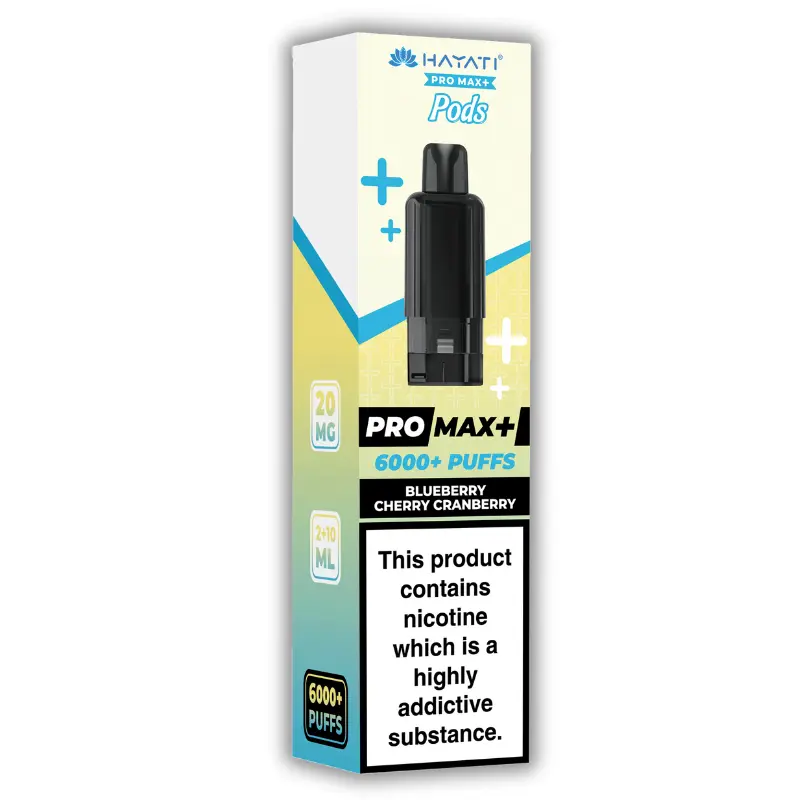
Hayati · Pro Max Plus
Blueberry Cherry Cranberry Hayati Pro Max Plus Pods
£5.49
✔ In stock — ready to ship
Genuine Hayati
Free over £20
Same-day dispatch
Secure checkout
Blueberry Cherry Cranberry Hayati Pro Max Plus Pods is one sealed refill: twelve millilitres of liquid at 20mg nicotine salt, filled at the factory, with the heating element built into the base of the pod and no device in the packet. The ticket is £5.49. Hayati rate a full pod by laboratory estimate at up to 6,000 puffs, a number generated by test equipment drawing to a timer rather than by anybody using one, which makes it a way of lining two listings up against each other and not a forecast for your fortnight.
Almost everyone who opens this listing owns the body already and wants another pod of something they have settled on. That is the ordinary shape of a refill page, and the ordinary refill page goes on to explain that £5.49 is the floor for its liquid and that the only premium was the one paid once, at the kit. This page cannot say that, because on this flavour it is not true. The identical volume of the identical recipe at the identical strength is sold as Blueberry Cherry Cranberry Hayati Rubik Pods for £3.99.
That much has already been written up, three times, on three other flavours, and written up well. Repeating it would be a waste of your reading. So the first job here is to say who established what and to recount the figures rather than inherit them, and the second job is to go where those pages did not. What none of them asked is a question about the shop rather than about the arithmetic: given that a cheaper twin exists, when does a buyer ever get to see it. The answer turns out to depend entirely on which door you came through, and on this particular liquid the doors are unusual, because the component that Hayati's own copy credits with making the blend work is the one component the shop has no shelf for.
Three things follow from that, and they are the page. Where the £1.50 is visible and where it is structurally invisible. Why this recipe has no browsing route of its own and what that does to the comparison. And a sentence in this listing's own description which, on a small and countable set of listings that includes this one, points a reader without a device at the dearer of two boxes holding the same twelve millilitres.
The money argument is finished, and three other pages finished it
Four pages and two shelf pages hold pieces of this between them. Setting out who owns what means everything below can move quickly and nothing below is a second telling.
- The cheapest sealed millilitre in this shop is 33.25p, and it is a Rubik refill. The Hayati Rubik Pods shelf page established that, built the comparison table across every prefilled format Hayati list, and then corrected itself in public: cheapest prefilled is not cheapest overall, because bottled liquid undercuts every pod.
- The Pineapple Ice refill page did the census of how often a cheaper identical twin exists, narrowed it to the flavours whose price picture has only two sealed entries in it, and named this recipe as one of them. It also priced the crossover for an owner defecting to the cheaper platform, and found it is fifty pence down on the first pod and ahead from the second. I do not run that sum again.
- The Strawberry Kiwi refill page built the full rung-by-rung ladder for one flavour, showed that the per-millilitre floor is a bottle rather than a pod, and then divided by milligrams of nicotine instead of by millilitres and found the order reverses. That is the sharpest piece of unit work in the corpus and it is not rebuilt here.
- The Fresh Mint refill page settled which denominators are honest. Any unit both listings measure the same way leaves the proportional gap exactly where it was; only a unit the two shelves do not share can move it, and there is exactly one such unit in the published data. Its instruction is to divide by millilitres and never by the rated puff.
- The flavour belongs to two pages, both about this recipe on the other platform. The Rubik refill listing's page owns what a second and third pod can tell you that a first cannot. Its kit page owns the rest: the anatomy of the blend, the census showing that cranberry never heads a product name anywhere in the range, the reading of all seven descriptions of this liquid against each other, and a prediction about how the pod ages that it honestly leaves unresolved.
Read any of those for the general case. What follows is narrower and, I think, more useful to somebody standing on this listing with a card in their hand.
Recounting it, because a number you are handed is a hypothesis
The version of this argument that arrived with me carried figures in it. Three writers on this site have now checked a handed figure and found it overstated, so the figures are re-derived below from the catalogue file as it stands today, and one of them comes out differently from the way it was given to me.
Take the two shelves first. The Rubik refill shelf carries nineteen listings. Every one of them is £3.99, every one holds twelve millilitres, every one is filled at 20mg. There is no rarer-fruit surcharge and no volume rung. Now the shelf this pod sits on: eighty-nine listings, every one £5.49, every one twelve millilitres, with the same total absence of variation. Divide and the two rates are 33.25p and 45.75p a millilitre, a gap of 12.5p on every millilitre and £1.50 on every pod.
Now the overlap, which is where the handed number needed adjusting. I was told this flavour is one of eighteen out of eighty-five. The eighteen is right and I confirm it by direct name matching: eighteen of the nineteen Rubik refill flavours also appear on this shelf, the single exception being Lemon Cola Ice, which exists as a sealed pod nowhere else. The denominator is the arguable part. Four of the eighty-nine listings here are not flavour names at all but nicotine-strength listings, and in the catalogue data all four carry Banana Ice as their flavour, so they are neither quite a flavour nor quite not one. Count them out and it is eighteen of eighty-five with sixty-seven having no cheaper twin. Count them in, as the Pineapple Ice page did, and it is eighteen of eighty-nine with seventy-one. Both are correct and they are the same eighteen liquids. The honest form is to give the denominator with the number, which is what both figures do above.
One more figure worth recounting, because it runs against intuition and because I would not repeat it without checking. The two shelves publish different manufacturer estimates for the same twelve millilitres at the same strength. Eighty-five of the eighty-nine descriptions on this shelf print an up-to figure of 6,000 puffs. Seventeen of the nineteen Rubik refill descriptions print 7,000. Both are laboratory estimates, both are attached to a platform rather than to a recipe, and neither changes when the liquid inside changes. So the dearer pod carries the lower published estimate, which is the opposite of what a price difference would lead you to expect and is a good reason not to treat that figure as a unit of value. The Fresh Mint page works out exactly why in detail and I take its conclusion as given.
One hedge on cross-range fitment, said once and then dropped. This pod is listed for the Hayati Pro Max Plus and the £3.99 pod is listed for the Hayati Rubik, nothing Hayati publish presents either as seating in the other, and a compatibility decision from a retail page, this one included, is not a specification.
Where the two prices are visible, and to whom
Here is the part nobody has looked at. A price comparison is only worth anything to a buyer who encounters it, and the shop's own structure decides who encounters this one. It is not random and it is not neutral.
Start with the platform shelves, because they are where an existing owner naturally browses. Somebody who owns a Pro Max Plus has one hard constraint, which is the body in their pocket, so they filter by it. That takes them to a grid of eighty-nine tiles, all at £5.49. There is no price signal on that grid at all, by construction, because the only thing that varies between the tiles is what is sealed inside them. The cheaper pod holding this exact liquid is not on that grid and cannot be, because it belongs to a different platform and therefore to a different shelf. A buyer who browses by hardware, which is the rational thing for an owner to do, will never see the £1.50 in their life.
Now the flavour shelves, and this is where it becomes interesting. This pod is filed on three of them: Berry Vapes, which is the largest flavour shelf in the shop at 225 tiles, Blueberry Vapes at 90, and Cherry Vapes at 72. The Rubik twin is filed on all three as well. So on each of those three grids, two tiles sit side by side carrying the same flavour name, holding the same twelve millilitres at the same strength, at £5.49 and £3.99, with nothing on either tile saying that they are the same liquid or why one costs more.
I checked whether that is peculiar to this flavour and it is not. All eighteen of the twinned pairs co-appear on at least one flavour shelf. So the general rule holds across the pattern: the comparison is invisible from the platform shelves and visible from the flavour shelves, on every flavour where it exists.
The consequence is worth saying plainly because it inverts who benefits. The buyer for whom the £1.50 is most consequential is the one who will pay it repeatedly, which is an existing owner restocking, and that buyer's natural browsing path hides it from them completely. The buyer who most easily sees it is the one browsing by fruit, who is typically choosing rather than restocking, and who is also the buyer for whom acting on it is cheapest, since they have not yet bought a body and so have no sunk cost pulling them one way. The information is delivered to the person who needs it least urgently and withheld from the person it costs the most.
None of that is a criticism of anybody's motives. Shelves are built by range and by ingredient because those are the two things a catalogue can file on, and a shelf that grouped listings by "same liquid, different platform" would be an odd thing to build. It is a structural fact rather than a decision, and the practical upshot is simply this: if you want to know whether your liquid has a cheaper twin, the flavour shelf is where to look and the platform shelf will never tell you.
Thirty shelves, and the one fruit that has none
That sends you to the flavour shelves, and on this liquid the flavour shelves have a hole in them.
The shop runs thirty flavour shelves. Some are ingredients, such as Blueberry, Cherry and Mango. Some are families, such as Berry, Sweet and Exotic. Some are properties, such as Ice, Mint and Menthol. Between them they are the entire browse-by-taste apparatus of the site.
There is no cranberry shelf.
The obvious explanation is that cranberry is too small to warrant one, and counting kills it. Sixteen listings in the catalogue of 492 carry cranberry in the title. Eight of the thirty flavour shelves are smaller than that: Fresh Mint has eleven tiles, Banana, Kiwi, Menthol and Orange have twelve each, and Juicy Peach, Mr Blue and Summer Dream have thirteen. Two of those three at thirteen are not ingredients at all, they are opaque product names that tell a buyer nothing about what is in the liquid, and both have been given a shelf. Cranberry, at sixteen, has not.
The control case makes it cleaner still. Blackcurrant also appears in exactly sixteen listings, and Blackcurrant Vapes exists. The difference between the two fruits is not how often they appear. It is where they appear in a name. Blackcurrant heads several product titles: Blackcurrant Juice, Blackcurrant Lemonade, Blackcurrant Mango, Blackcurrant Cotton K. Cranberry heads none, anywhere, ever, across all sixteen of its appearances and all three of the flavour names that contain it. That finding belongs to the Rubik kit page for this recipe, which proved it properly and tested it against the other components that never lead a title. I re-ran the count off the catalogue before building on it and it holds exactly.
What I can add is the consequence, which that page did not follow up. The shop's flavour shelves are built out of words that head titles. An ingredient that never heads a title therefore never earns a shelf, however often it occurs, and the filing system quietly inherits the blind spot in the naming convention. Sixteen listings contain cranberry and there is no route into any of them by that name. All sixteen are filed under Berry Vapes and all sixteen under Cherry Vapes, and seven of them, this one included, under Blueberry Vapes as well.
Put that next to the previous section and the two halves lock together. The only grids in the shop where you can see both prices for this liquid are Berry, Blueberry and Cherry. Those are also, necessarily, the only grids on which you can reach this liquid at all. And every one of them is named for a component that the descriptions of this recipe treat as support rather than as the point. You cannot arrive here by looking for the thing that makes it what it is. You arrive by looking for one of the two fruits that the copy repeatedly describes as being held in check by the third.
So the buyer who ends up on this page has almost certainly come in through blueberry or through cherry, or through the very broad berry shelf, or through the platform shelf, which shows no price at all. Three of those four doors show the £1.50. The fourth, which is the one an owner uses, does not.
The sentence on this listing that points at the dearer box
There is one more structural thing here, and unlike the two above it is specific to a small and countable group of listings rather than to a shelf. It is also the only point on this page where the shop's own copy actively works against a reader.
This listing's description ends by telling a reader who has no device that the matching kit includes one. That is a helpful thing to say and most of the shelf says something like it. I counted: fifty-four of the eighty-nine descriptions on this shelf address a reader without hardware and send them to a kit. Fifty-one of those fifty-four do it by naming the flavour's own kit with a definite article, as this one does. Three do it by naming the platform instead, and Blackberry Ice Hayati Pro Max Plus Pods is the clearest of those three, because it says a Pro Max Plus kit of any flavour will include a device and that this refill will fit it. That version cannot be misread.
The definite article can be, on a specific set of flavours. Seventeen of the fifty-one name a flavour for which two complete kits exist at two different prices, and this is one of the seventeen. There is a complete Blueberry Cherry Cranberry box on this platform, the Blueberry Cherry Cranberry Hayati Pro Max Plus Pod Kit, and it costs £7.99. There is also a complete Blueberry Cherry Cranberry box on the Rubik, holding the same twelve millilitres of the same recipe at the same strength, and it costs £5.99. The phrase "the kit" picks out one of them and the reader has no way of knowing which, or that a choice exists.
For a reader who already owns a Pro Max Plus this is harmless, because the ambiguity resolves itself: they want a refill, not a box. For a reader who owns nothing yet it is £2.00 on the day, and then £1.50 on every refill afterwards, and the second of those two numbers is the one that never stops.
That distinction matters more than it looks, and it is where this page departs from the ones cited above. Every one of them priced the exit for somebody who already owns the expensive body, and correctly concluded that it is a fifty pence decision with a two-pod payback, because the £5.99 box is not empty and so costs only fifty pence more than the £5.49 pod they were buying anyway. For a reader who has not bought a body, none of that arithmetic applies. There is no sunk hardware, no payback period and no crossover point. The cheaper box is cheaper on day one, by £2.00, and cheaper on every day after, by £1.50 a pod. The case is not close and there is nothing to amortise.
What the £2.00 buys, honestly, is a library. There are eighty-nine listings on this platform's refill shelf and nineteen on the other one, and eighteen of those nineteen are duplicates of flavours available here, so the cheaper shelf is very nearly a subset of the dearer one. If the liquid you want is among the sixty-seven named flavours that exist only here, the premium is buying you something concrete and this whole argument is academic. If it is among the eighteen, the premium is buying you access to the other sixty-seven, which is worth real money to anybody who rotates and nothing at all to anybody who does not. Nobody but you can price that.
Two small cautions before leaving this. The first is that Hayati nowhere state what distinguishes the two platforms, in any listing on either of them, so what the money buys is a question the catalogue does not answer and this page declines to invent an answer to. The second is a genuine trap on the neighbouring flavour: Fizzy Cherry is sold as a Rubik kit and has no Rubik refill behind it, so the cheaper entry exists there and the cheaper restock does not. That was spotted on the Rubik refill page for this recipe and is worth knowing before anyone generalises from the pattern.
What the liquid is, and where the analysis of it lives
Two pages already cover this recipe properly and a third would be padding, so this section is a summary with pointers and one observation of its own.
Plainly, for a reader who wants the short account: three dark fruits, no cooling agent anywhere in it, no sour treatment, nothing borrowed from a drink or a sweet counter. Blueberry sits underneath and supplies the rounded part. Cherry carries the weight and most of the length, which is why the draw reads dark rather than bright. Cranberry arrives at the back and does something the other two cannot, which is to put an acid and a drying grip on the finish so the sweetness has a stopping point. Sweetness sits above the middle of the range without reaching confectionery. If you like berry blends that end dry rather than syrupy, this is built for that; if you want something rounded and soft the whole way through, it is not.
Everything behind that sentence is somebody else's work. The Rubik kit page for this flavour takes the draw apart in order, establishes why an astringent component can be decisive in a recipe and still never be the subject of one, and cites a Pro Ultra Plus page for the underlying account of why a drying sensation is registered by touch rather than by taste. It also compares all seven descriptions Hayati have written of this liquid and finds unusual agreement across them, which is worth knowing because the same exercise on other flavours in this catalogue has turned up outright contradictions. The Rubik refill page then takes the one question the kit page could not settle, which is how the balance shifts from the first millilitre to the twelfth, and sets out how a repeat buyer can actually test it across a changeover. Neither argument is repeated here and both are better than anything I would produce by going over the same ground.
The observation that is mine belongs to the money rather than to the fruit, and it is a small one. Two listings in this catalogue sell twelve millilitres of this recipe at 20mg with no device attached, at £5.49 and at £3.99, and both carry their own freshly written description. If the price difference reflected anything about the contents, you would expect the dearer listing's copy to promise more. It does not. Both make a comparative claim of about the same weight, and both aim it at the same target, which is the plain single-berry liquid a buyer might otherwise choose. Neither mentions the other's existence and neither offers any account of the price. The only listing of the seven that mentions cost at all is the cheapest pod, which describes itself as an inexpensive thing to keep in rotation, a point the Rubik refill page counted across the catalogue and which I take from there. So the copy does not track the price in either direction, and a buyer looking for a written justification for the £1.50 will not find one on either tile.
The pod itself, briefly
The hardware section on a Pro Max Plus page has been written about ninety times and there is nothing left in it, so this is short on purpose.
What arrives is one pod, prefilled and sealed, with the heating element already inside it. There is nothing to assemble, nothing to measure and nothing to fill, which is the entire proposition of the format and also its limitation: the twelve millilitres it comes with is all of it, and when that is gone the pod is finished rather than empty. Hayati publish no resistance figure and no carrier ratio for this pod, and no parts breakdown of any kind, so anything you read anywhere about what is inside the shell, including on this site, is inference rather than specification.
The one number on the listing that actually matters for this particular liquid is the twelve millilitres, and it matters for a reason peculiar to an astringent blend. Everything the previous section points you towards suggests that the acid and the drying grip in this recipe hold their level while the aromatic fruit above them thins, which means a large single pod commits you to a longer run at whatever the late-stage balance turns out to be than a smaller one would. On a liquid whose defining component is the one predicted to survive, pod size is not a neutral convenience. Twelve millilitres is the standard across the whole prefilled refill range on this platform, so it is not a choice you get to make here, but it is worth knowing which way it cuts.
For anything else about the device family, the Hayati Pods shelf gathers all 202 pod listings and the platform shelf linked above carries the rest.
The published numbers, and the rows that are our own arithmetic
Three things are printed on the listing, three are published elsewhere in the catalogue, and three are sums we have done. They are separated below because a reader deciding on price should know which is which, and because two of the sums are the whole argument of this page.
| Row | Value | Where it comes from |
|---|---|---|
| Ticket price | £5.49 | This listing |
| Liquid in the pod | 12ml | This listing |
| Nicotine strength | 20mg, as a salt | This listing |
| Manufacturer's puff estimate | Up to 6,000, laboratory | This listing |
| Device supplied | None | This listing |
| Cheapest sealed pod of this recipe | £3.99 for 12ml at 20mg | The Rubik refill listing |
| Cheapest complete box of this recipe | £5.99 | The Rubik kit listing |
| Same recipe, bottled with nicotine | £2.49 for 10ml at 10mg | The Pro Max nic salt listing |
| Cost per millilitre here | 45.75p | Our sum |
| Cost per millilitre on the twin | 33.25p | Our sum |
| Recurring difference | £1.50 a pod, 12.5p a millilitre | Our sum |
| Carrier ratio, resistance, cell | Not published for this pod | Absent from the data |
Two of those rows need a sentence each. The 20mg is the maximum a prefilled pod may carry in the United Kingdom, so it is a ceiling rather than a selection, and every sealed pod discussed on this page sits at it except the bottled version, which is filled at half that. The empty row at the bottom is not an oversight on my part. Hayati publish no carrier ratio and no resistance for any listing on either of the two pod shelves compared here, which is exactly why the price difference cannot be attributed to anything specific: there is no published property of either pod that differs, other than the puff estimate, which describes the shelf rather than the pod.
One further listing on this shelf is worth a row of its own in your head rather than in the table. Hayati Pro Max Plus Prefilled Pods 10mg is twelve millilitres at half the strength, and it is £5.49, exactly like everything else here. Nicotine content is not a priced variable on this shelf. That is a fact about the shelf and not a suggestion about what strength anyone should buy, and the arithmetic of it has been worked through properly on the Strawberry Kiwi refill page rather than here.
Neighbours, and what changing to each one would actually change
The useful comparison for somebody on this listing is not "what else is dark and fruity", because the shelf is full of that. It is "what would I be changing if I moved", so the neighbours below are grouped by which variable they move.
Same three-fruit idea, one fruit swapped. Blueberry Raspberry Cherry Hayati Pro Max Plus Pods is the closest thing on the shelf structurally: three berries, two of them shared with this pod, with raspberry standing where the cranberry stands. The swap is instructive because raspberry brings a sharpness that is an acid without the drying grip, so you keep the tartness and lose the dry finish. If what you want from this liquid is the tang and the dryness is the part you tolerate, that is the pod to try. If the dry finish is the reason you are here, it is not. Strawberry Raspberry Blueberry Hayati Pro Max Plus Pods makes the same move in a lighter register, trading the dark cherry weight for strawberry's brighter, shorter one.
Two fruits instead of three. Blueberry Raspberry Hayati Pro Max Plus Pods is the anchor pairing of the entire berry section and the simplest point of comparison, and it is also one of the eighteen with a £3.99 twin, so everything above applies to it too. Blueberry Pomegranate Hayati Pro Max Plus Pods is the nearest thing the shelf has to another astringent partner for blueberry, since pomegranate carries a comparable grip, and it has no cheaper twin anywhere, so on that listing £5.49 genuinely is the floor. Blue Razz Cherry Hayati Pro Max Plus Pods keeps the cherry and replaces the natural berries with the candied blue raspberry register, which is a much sweeter proposition and also one of the eighteen.
Sharper, by a different route. Blue Sour Raspberry Hayati Pro Max Plus Pods announces its treatment in the title and delivers a manufactured sourness rather than an astringency, which is a different sensation doing a similar job. Blue Razz Blackcurrant Hayati Pro Max Plus Pods puts a genuinely tart dark berry underneath the sweet one, and blackcurrant is the fruit that most nearly does what cranberry does here while still being allowed to head a product name.
Names that will not tell you. Mad Blue Hayati Pro Max Plus Pods and Blue Fusion Hayati Pro Max Plus Pods are filed alongside this pod on the blue and berry shelves and neither title identifies an ingredient, which is a real cost at £5.49 a guess. Blueberry B’Gum Hayati Pro Max Plus Pods is explicit about being a confectionery treatment of the same base fruit, which is the opposite direction of travel from the one this pod takes.
Cold, if that is the axis. There is no cooling agent in this liquid at all. Blue Frozen Hayati Pro Max Plus Pods is the pod whose page established, by counting the whole catalogue, that Hayati's cooling words are not graded against each other, so a cooling word in a title marks a category rather than a setting. If you want the berry register with cold on it, start there rather than assuming the word tells you how much.
Different volumes, different rates. Blueberry Cotton K Hayati Mini Ultra Pods and Blueberry Raspberry Hayati Mini Ultra Pods are four millilitres at £3.49, which is the lowest ticket in the prefilled range and by some distance the highest cost per millilitre, a trap worth understanding before sorting anything by price. In the other direction, Blueberry Raspberry Lemon Hayati Pro Ultra Plus 25K Pods is twenty-two millilitres at £7.99, a higher ticket at a lower rate, and Blueberry Raspberry / Blueberry Raspberry Cherry Hayati Pro Ultra Plus 25K Pods is one divided pod carrying two related blends. This recipe does not exist on that platform in any form, so that route is closed for Blueberry Cherry Cranberry specifically.
Beyond the immediate neighbours, the full listing of all 492 products and the complete Hayati range are the places to go if nothing above is close enough.
Living with a pod you did not choose on price
Most practical advice on pages like this is generic. The parts below that are generic are kept short; the parts that are specific to an astringent liquid are the ones worth your attention.
Give a new pod a minute seated in the body before the first draw. The reason to bother on this liquid rather than as a general rule is that the component a hot, under-wicked first pull destroys is the volatile fruit sitting above the acid, and on this recipe that is the part carrying the blueberry and the cherry. Lose it on the first draw and what you get is the dry finish arriving on its own, with nothing in front of it, which reads as harsh rather than as this blend is meant to read.
Draw length is the one variable you control and on a three-fruit blend it moves the balance. A longer pull gives the heavier material more time to build and gives the aromatic part no extra time at all, because that arrives early and leaves. So if the fruit is what you want and the dryness is what you tolerate, shorter draws spaced further apart will serve you better than long ones. That is the opposite of the instinct most people have when a pod starts to read thin.
Store it at ordinary room temperature, upright, out of direct sunlight, and where children and pets cannot reach it. Heat is the specific problem rather than a generic one: warmth takes the lightest molecules first, and on this liquid those are exactly the ones carrying the fruit's identity while the acid sits there unbothered. A pod left in a warm car for a weekend will not taste weaker, it will taste drier and less identifiable, which is a different failure and easy to misread as a fault in the pod.
On part-used pods, the same reasoning applies over a longer clock. Rotating this flavour out for three weeks and coming back to it does not give you a fainter version, it gives you a version with more of the finish and less of the front. If you rotate, rotate quickly. If you are going to leave it standing a long time, finishing it and buying fresh is usually the better call, and at £5.49 that is a decision small enough not to agonise over, though on this flavour it is worth remembering that the same decision on the cheaper platform would be a £3.99 one.
Knowing when a pod is spent is harder on this liquid than on most, and the reason is the same one that runs through the whole page. The usual signal is that the flavour goes quiet. Here the component predicted to survive longest is the one you notice with your mouth rather than your nose, so a tiring pod may read as sharper and more anonymous rather than as fainter. The practical test, which the Rubik refill page sets out properly across a pod changeover, is whether the fruit still arrives ahead of the dryness on the first draw of the day. When it stops doing that, the useful part of the pod is behind you.
Disposal is different for a bare refill than for a complete kit and people who have only ever thrown away whole devices get this wrong. There is no cell in this pod. What there is is a heating element and whatever liquid the wick is still holding, which contains nicotine, so it does not belong in household waste. A retailer with an electricals take-back arrangement or a council facility that handles small electricals is the right destination, and the pod should go there whole rather than being opened.
Questions a buyer of this pod actually asks
Is the £3.99 Rubik pod genuinely the same liquid?
The two listings agree on every published property: the same flavour name, twelve millilitres, 20mg, prefilled and sealed, no device. Neither publishes a carrier ratio or a resistance, so there is nothing left on which they could be shown to differ. Hayati never state that the two are the same recipe and never state that they are different, so the honest answer is that everything printed matches and nobody outside the factory can go further than that.
Why does this pod cost £1.50 more, then?
Because the price is attached to the shelf rather than to the contents. All eighty-nine listings on this shelf are £5.49 whatever is inside them, and all nineteen Rubik refills are £3.99 on the same basis, so no flavour is dearer than any other in either place. Hayati publish no explanation of what separates the two platforms, in any listing on either shelf, and this page will not guess at one.
I do not own a device yet. Which box should I buy?
Two complete boxes carry this recipe: one on this platform at £7.99 and one on the Rubik at £5.99, both holding twelve millilitres at 20mg. If the only thing you care about is this flavour, the cheaper box is cheaper on the day by £2.00 and cheaper on every refill afterwards by £1.50, and there is no crossover point to wait for. The reason to pay the £2.00 anyway is the flavour library: this platform's refill shelf has eighty-nine listings and the other has nineteen.
I already own a Pro Max Plus. Is it worth buying a second device?
That sum was worked out on the Pineapple Ice refill page and comes out at fifty pence down on the first pod and ahead from the second, because the cheaper box is not empty. Whether it is worth it depends on how much of your rotation lives on the cheap shelf, since only eighteen of these eighty-nine flavours exist there at all. If Blueberry Cherry Cranberry is most of what you buy, the case is straightforward. If it is one of four liquids you rotate, you would be running two devices to save money on one of them.
How many other flavours on this shelf have a cheaper twin?
Eighteen, counted today against the catalogue file. Depending on whether you count the four nicotine-strength listings as flavours, that leaves either sixty-seven or seventy-one with no cheaper sealed version anywhere, so for roughly four listings in five this shelf really is the floor and the ordinary refill logic applies without qualification.
The other listing says 7,000 puffs and this one says 6,000. Does that mean it goes further?
No, and it should not be read in either direction. Both are manufacturer laboratory estimates, each shelf prints one figure for every listing on it regardless of what is inside, and the same twelve millilitres at the same strength carries 6,000 on one shelf and 7,000 on the other. A number that changes when the platform changes and never changes when the liquid changes is describing the platform.
Is there any cooling in this pod?
None. The title carries no cooling word, the description mentions no menthol or coolant, and the finish people sometimes read as cool is the drying effect of the cranberry rather than a cooling agent. If you want the berry profile with actual cold on it, look for a title with a cooling word in it and read the Blue Frozen page first, since it established that those words are not graded against each other.
Why can I not find this by searching for cranberry?
Because the shop has no cranberry shelf, and it has none because its flavour shelves are built from words that lead product titles. Cranberry appears in sixteen listings and heads none of them. Eight of the thirty flavour shelves that do exist are smaller than sixteen tiles, so the absence is about naming rather than about volume. The routes in are Berry Vapes, Cherry Vapes and Blueberry Vapes.
Can I refill this pod when it is empty?
No. It is sealed, with the heating element built in and no fill port, so the twelve millilitres it arrives with is the whole of it. That is the bargain the format makes: nothing to spill, nothing to measure and no way to put anything else in. When it is done the pod is replaced rather than topped up.
What about the 120ml bottles of this flavour at £6.99?
They are zero-nicotine liquid in a bottle, so they need a device you can open and fill, and one of the two is written for higher-powered hardware rather than for a pod. No nicotine shot is listed anywhere among the 492 products here, so that route cannot even be costed from this shop's own inventory. The per-millilitre figure looks dramatic because it is the price of liquid with the nicotine and the hardware both taken out of it.
Does a lower nicotine strength cost less on this shelf?
No. Four of the eighty-nine listings here carry strengths other than 20mg and all four are £5.49, the same as everything else. On this shelf the price follows the volume of liquid and nothing else. Nicotine is addictive at every strength sold, and choosing one is not something a price table can help with, because the prices do not move.
What does a tiring pod taste like on this particular liquid?
Probably drier and less identifiable rather than fainter, because the fragile aromatic fruit is predicted to go first while the acid and the drying grip hold their level. That prediction belongs to the Rubik kit page for this recipe, which flags honestly that another page in the range argues the opposite, and the refill page for the same flavour sets out how a buyer on their third pod can actually distinguish the two. It is not settled and nobody should pretend it is.
The short version
This is a sealed twelve millilitre refill at 20mg for a Pro Max Plus you already own, £5.49, with a manufacturer's laboratory figure of up to 6,000 puffs and a three-fruit profile whose full analysis lives on two other pages about the same recipe. It is not the cheapest way to buy its own liquid: the same twelve millilitres at the same strength is £3.99 on the Rubik shelf, and that £1.50 recurs on every pod rather than being paid once.
Three pages on this site established that pattern before this one and their conclusions are cited above rather than rebuilt. What this page adds is about the shop rather than the sum. The comparison is invisible from the platform shelf that an existing owner naturally browses and visible only from the flavour shelves, which means it reaches the buyer who can act on it most cheaply and hides from the buyer it costs the most. This liquid has no shelf of its own, because the shop files by leading word and cranberry never leads one, so the only doors in are named for the two fruits the copy treats as support. And this is one of seventeen listings on the shelf whose own description points a reader with no device at a box called "the kit" when two boxes of that name exist £2.00 apart.
If you own the body and this flavour is one of several you rotate, buying this pod at £5.49 is a perfectly reasonable thing to do and the premium is buying you a library you actually use. If you own nothing yet, the arithmetic points the other way and there is no payback period to wait out. Either way the number should be visible before you decide, which is the one thing a page can do about it.
Strictly for adults aged 18 and over. Nicotine is an addictive substance.
You might also like


