
Home / Hayati Pods / Blue Razz Cherry Hayati Rubik Pods
Hayati · Rubik
Blue Razz Cherry Hayati Rubik Pods
£3.99
✔ In stock — ready to ship
Genuine Hayati
Free over £20
Same-day dispatch
Secure checkout
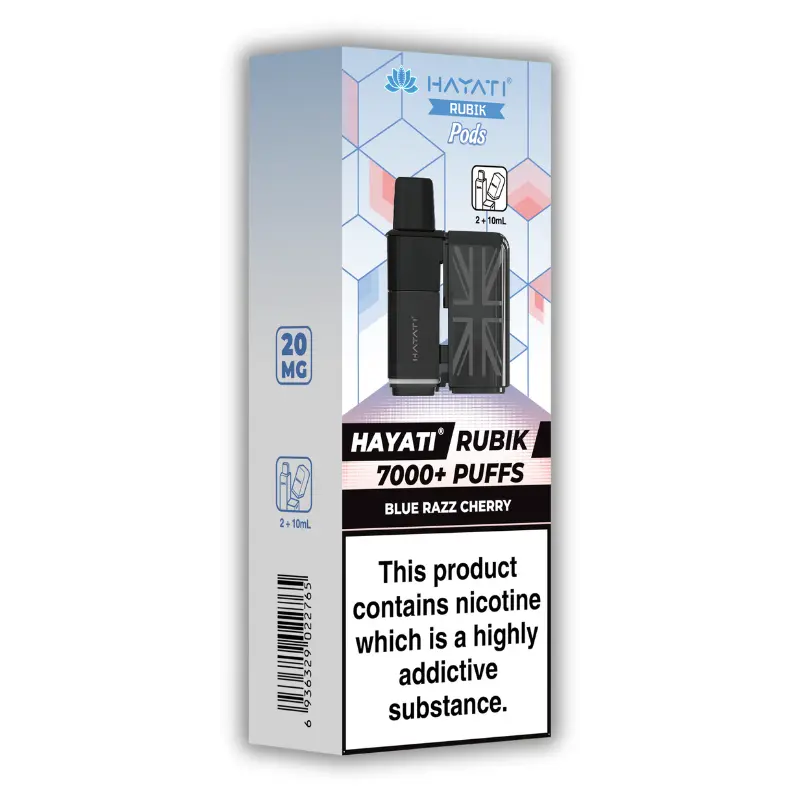
A Rubik pod of Blue Razz Cherry costs £3.99 and arrives as one sealed unit holding twelve millilitres of 20mg nicotine salt, coil already inside, nothing else in the packet. No body, no cable, nothing to assemble. The purchase does nothing whatsoever for anybody who does not already have a Hayati Rubik in a pocket or a drawer to seat it in, which is the first and most important thing this listing is. Hayati rate a filled pod at up to 7,000 puffs, a figure produced on laboratory test apparatus rather than a forecast of anybody's month. Nicotine is an addictive substance. At 20mg the pod sits on the UK legal maximum for a sealed prefilled format, which means strength is not among the things this listing lets you decide.
Everything in that paragraph is ordinary. What is worth a page is that you have already made every decision this product involves. You own the device, you have finished at least one pod of this liquid, and you are here to replace it. That puts you in a different position from every other reader the rest of this flavour's listings are written for, and it means most of what has been argued about Blue Razz Cherry elsewhere on this shop, at considerable length and rather well, is not addressed to you.
This page was commissioned on the premise that nobody had yet read this liquid outside a divided pod, and that a solo twelve millilitres would therefore be the first clean look at it. That premise is wrong, and saying so is more useful than writing around it. The Blue Razz Cherry Hayati Rubik Prefilled Pod Kit page already exists, runs to over eight thousand words, and contains a full reading of this exact liquid in this exact twelve millilitre pod with no collar anywhere near it. There is no clean-read gap to fill. What there is instead is a disagreement sitting on the public record between the description printed on this listing and the description printed on almost every other listing of the same recipe, including the one on the box your device came in. The kit page found that disagreement, flagged it honestly, and reached a verdict on it from the inside. Nobody has yet counted the thing that decides it. That count is below, it took the catalogue rather than an opinion to settle, and it changes what you should expect when this pod arrives.
Who buys a bare pod, and what they have already stopped deciding
Refill buyers get written for badly because pages are written as though every reader were arriving cold. A page that opens by explaining what blue raspberry is, or by weighing four cartons against each other, is speaking to somebody standing in front of a choice. You are not standing in front of a choice. You are standing in front of an empty pod.
Count what has already collapsed. The platform question is closed, because a Rubik pod is bought for a Rubik and the body in your hand settled that months ago. The flavour question is closed, or you would not be back. The strength question never existed, because every prefilled pod in this range is 20mg and there is no second option to compare it with. The volume question is closed, because a Rubik pod holds twelve millilitres and there is no eight and no eighteen. And the price question is closed to an unusual degree, because every one of the nineteen pods on the Hayati Rubik Pods shelf costs exactly £3.99 and every one of the twenty kits on the same range costs exactly £5.99. The whole Hayati Rubik shelf, thirty-nine listings, has two prices on it. Nothing you can do at the point of reorder makes this liquid cost less or more.
What remains is smaller and more interesting: whether to buy this one again, when to press the button, and what to listen for when it arrives so that a second pod teaches you something a first could not. Those are the questions this page is about, and a page about a purchase decision is worth more to you than a fifth account of what a cherry tastes like.
There is one structural fact about restocking on this shelf worth knowing, because it does not apply to you but it explains the shape of the range. Twenty flavours are sold as Rubik kits and nineteen of them are sold as bare pods. The nineteen map one to one onto nineteen of the kits. The odd one out is Fizzy Cherry, which exists as a boxed kit and has no refill listing at all, so somebody who committed to that flavour and liked it has nowhere on this shelf to go. You are not in that position. Blue Razz Cherry has a refill, it is this one, and the restocking route is intact. It is worth appreciating how easily it might not have been, and it is worth knowing before you recommend a Rubik flavour to somebody else.
The other thing that has collapsed is the running cost calculation, and it can be stated in a line rather than argued. Twelve millilitres for £3.99 works out at just over three millilitres per pound, which is the best figure among the ten Blue Razz Cherry listings that publish a capacity at all. The next best is the twenty-two millilitre Blue Razz Cherry Hayati Pro Ultra Plus Pods at £7.99, which comes out lower, and the Blue Razz Cherry Hayati Pro Max Plus Pods at £5.49 for the same twelve millilitres you are buying comes out lower still. Whatever else is true, the device you already own is attached to the cheapest way this shop sells this liquid by volume. The arithmetic behind the wider comparison, including why the puff figures printed on the four boxed kits cannot be divided by each other, is worked through properly on the kit page and there is nothing to add to it.
What is already on the record about this liquid, and who put it there
Three pages on this shop have argued about Blue Razz Cherry at length, and between them they have taken most of the ground. Naming what each owns is the fastest way to establish what is left.
The Blue Razz Cherry/Blue Razz GB Hayati Pro Ultra Plus 25K Pods page reads the liquid through a rotating collar, with Blue Razz GB on the other setting. It owns the comparison protocol entirely: what a shared coil and a shared wick do to a taste test, why the draws immediately after a switch are not a clean read of the new side, why one side of any pairing is always met by a palate the other has just prepared, and how to cancel that out. It owns the finding that the separation between the two settings is at its widest early and narrows as the mesh loads up. None of that reasoning is being rebuilt here, and it should not be: it belongs to that page and it is done properly there. Its central claim about this liquid is that the cherry functions as backbone rather than topping, arriving from the middle of the draw onwards as weight underneath a bright front, quiet enough that a hurried draw goes straight over it.
The Rubik kit page owns the evidence base. Hayati sell this recipe thirteen times over, across four device ranges and three bottle formats, and wrote fresh copy for each one. That page lined all thirteen up against each other and found the role assignment fixed across the whole set, bright for the berry and dark for the cherry, with no listing anywhere reversing it, and that eleven of the thirteen describe the arrangement in vertical terms: cherry underneath, blue raspberry over the top. It owns the account of what a draw does across twelve millilitres, the account of what residue takes first, and the verdict that eleven to two is decisive. It also owns the point that both halves of the name are confectionery references rather than fruits.
The single-flavour twenty-two millilitre kit page and the divided kit page cover the Pro Ultra Plus hardware and its absences. Between them, that is the flavour argument, the evidence argument and the hardware argument all spoken for.
So the honest position is that Blue Razz Cherry is on its fourth page and the taste of it is a finished subject. What is not finished is the two out of thirteen. The kit page identified them, noted that both are Rubik listings, observed that they do not even agree with each other, and concluded that the dissent is most likely a copywriting variant rather than evidence about a recipe. That is probably right. It was also reached from inside a set of thirteen, which is too small a sample to tell a recipe from a habit, and the obvious test was never run.
The two dissenting listings, and a count that tells you which kind of thing they are
Start with what is actually printed. Your listing, the one you are reading, describes the blend as a sequence. It puts tangy blue razz at the front of a draw, ripe cherry at the end of it, and says the profile travels from bright to rich across each draw. It is a claim about time. The eleven vertical listings make a claim about position: the Blue Razz Cherry Hayati Mini Ultra Pods listing gives the cherry the backbone and sits the blue raspberry on top of it, and the Pro Max Plus pod has the cherry filling in underneath. The Rubik kit, the second dissenter, does something different again and levels them, saying the two fruits meet in the middle with neither above the other and both stay audible from the first draw to the last.
Three descriptions, one recipe, three geometries. A buyer who reads two of them is entitled to wonder whether they are being sold the same thing twice.
How often Hayati's copy describes a draw as travelling at all
The question nobody asked is whether a temporal description is a rare thing on this shop or a common one. If it is common, its appearance here says nothing, in exactly the way a word that turns up on a quarter of the catalogue says nothing. If it is rare, then somebody chose it, and a choice is worth reading. I counted, across all 492 product descriptions.
Thirty-five listings use the word inhale. One hundred and thirty-seven use the word exhale. Only twenty-four use both. That asymmetry is the first finding and it is a useful one on its own: the house habit is to name the end of a draw and not the beginning, because exhale is doing duty as a synonym for finish rather than as one half of a structure. Naming both ends is a deliberate act and roughly one listing in twenty does it.
Of those twenty-four, eight are not describing a journey at all. They use the formula running from inhale to exhale precisely in order to say that nothing changes: a mango that holds steady, a bubblegum that stays centre stage, a mint that runs the same throughout. Ten more attribute the change to temperature rather than to a second flavour, which is a different kind of claim, because a coolant genuinely does arrive late and every one of those listings is an ice or a menthol. Three pair two adjectives across the draw without naming which component is doing what, which is decorative rather than structural.
That leaves three listings out of 492 in which two differently named, non-cooling components are assigned to opposite ends of a draw. One is a nicotine salt bottle where fruit sits on the inhale and bubblegum comes forward on the way out. The other two are on the Rubik shelf, and one of them is this listing.
Widening the net, because the words are not the only way to say it
Three in 492 looks conclusive and it is not, because a count of vocabulary is a floor rather than a total. Plenty of listings describe a draw travelling without reaching for either word. Blue Sour Raspberry Hayati Rubik Pods, on this very shelf, has the sour landing on the tip of the tongue and giving way to sweetness a moment later, and calls that a sequence outright, without an inhale anywhere in it. Blueberry Raspberry Hayati Rubik Pods opens on a tart snap and settles into jammy sweetness. Blue Razz GB Hayati Mini Ultra Pods has one component starting things off and another taking over towards the finish. All three are temporal claims and none of them would appear in the first count.
So I ran a second pass on transition verbs instead of on anatomy, looking for gives way to, takes over, settles into, comes forward, opens on, follows with and their relatives. Twenty-eight listings use one. Combine the two nets and remove the duplicates and the answer is 48 listings out of 492, which is 9.8 per cent. Roughly one description in ten on this shop treats a draw as something that develops. The other nine treat it as a thing with parts.
Now restrict the same test to the Rubik shelf. Eight of its thirty-nine listings describe a draw as developing, which is 20.5 per cent, a little over twice the catalogue rate. The eight are Fresh Mint in both formats, Lemon Lime Hayati Rubik Pods, Blue Sour Raspberry, Blueberry Raspberry in both formats, the Blue Razz GB kit, and this pod.
That is the finding. The temporal description on your listing is not a minority report about a recipe. It is the house style of the shelf the listing sits on, running at double the rate of the catalogue that surrounds it. Whoever wrote the Rubik descriptions reaches for time more readily than whoever wrote the rest, and this pod is one of the eight places that habit surfaced.
The control, which settles it beyond argument
A rate is suggestive and not proof, because it is still possible that the Rubik shelf simply happens to hold more liquids that genuinely develop. What kills that objection is a case where no development is possible and the copy describes one anyway.
Fresh Mint is sold on this shelf as a kit and as a bare pod. It is a single-note mint with no second component, nothing sequenced, nothing to arrive late. The kit listing says the mint feels clear on the inhale and leaves a fresh exhale, which is a description of a draw that changes. The pod listing says the coolness runs from inhale to exhale, which is the formula this catalogue uses specifically to say that a draw does not change. Same liquid, same shelf, same range, two listings, opposite positions on the one question, and no recipe difference is physically available to explain it.
That is as clean a control as this kind of evidence gets, and it is worth being precise about why it works. I measured the wording overlap between every Rubik kit and its matching pod description, all nineteen pairs. The highest is 4.5 per cent on an eight-word basis and most sit below four. Hayati did not write one description and trim it; they wrote thirty-nine separate ones for twenty flavours. Every kit and pod pair on this shelf is therefore two independent attempts at describing one liquid, which makes the shelf an accidental experiment in how much a description varies when the thing described does not vary at all. The answer, from Fresh Mint, is: enough to reverse the claim about whether a draw travels.
What the count licenses, and the part of the angle it destroys
Set out plainly, because a page that counts and then hedges has wasted the count.
The kit page's verdict stands, and the count strengthens it rather than overturning it. The two Rubik descriptions do not constitute evidence that the Rubik pod holds a different recipe from the other twelve listings. They are shelf habit, demonstrated by a control in which habit is the only possible explanation.
The claim I was handed, that this pod would give the first uncollared reading of the liquid and could be set against a collar-measured one, does not survive either. The kit page already read it uncollared in this exact twelve millilitre format, and did so before this page existed. There is no second reading to place beside the first, and manufacturing one would have meant writing a tasting note nobody has taken.
But the third thing the count shows is new, and it is the part worth carrying away. Vertical and temporal are not rival accounts of this liquid. They are the same account in two registers, and Hayati's own copy proves it in one sentence. Read the Mini Ultra pod listing again: it gives the cherry the backbone, sits the blue raspberry on top, and then says that the first impression is zingy and the finish is deep. The word joining those two clauses is so. One description, both vocabularies, and the writer treating the second as a consequence of the first rather than as an alternative to it.
There is a physical reason that inference is sound, and it is the reason the eleven and the two were never actually in conflict. Most of what registers as fruit character is smelled from the back of the throat rather than tasted on the tongue, and that happens on the way out. A component described as sitting underneath is a component whose contribution is read late, because depth and lateness are the same observation taken from two angles. The divided pod's page arrives at the same place from a completely different direction, saying that the front of the draw is identical on both of its settings and that the cherry only announces itself from the middle of the inhale onwards. Three independent routes, one answer.
Which means your listing and the kit's listing were never telling you different things about what is in the pod. They were telling you the same thing in the two vocabularies available, and the apparent contradiction is an artefact of a shelf that likes verbs.
Where to listen, and why it is late
The practical content of all that is short, and it is the only part you need at the moment the pod arrives.
The front of the draw is the part you already know and the part that will not surprise you. Blue raspberry is not a fruit and never was; it is a confectionery accord, and few things in vaping are reproduced as consistently, which is precisely why whatever you remember of it from any other blue pod will serve as a workable yardstick. It is tangy rather than sour, it sits broad across the tongue, and it arrives immediately. Nothing on this page or any other is going to tell you something new about it, and the two prior pages between them have already said what there is to say about where the accord came from and why it is coloured the way it is.
Everything that makes this pod different from a plain blue raspberry pod happens later. The weight underneath, the longer and rounder finish, and the faint dry edge right at the back of it are all late-draw material, and that is where your attention should go. Both prior pages agree on this and reached it separately, so it is about as well established as anything can be on a shop rather than in a laboratory. The consequences for a restocker are three, and they are the ones worth planning around.
A hurried draw misses the part you are paying for. If the whole of the difference between this and Blue Razz GB Hayati Rubik Pods, which is the same accord at the same price on the same shelf with sugar instead of depth underneath it, lives in the second half of a draw, then a run of quick draws taken while doing something else returns the plain version of the flavour and you have bought the cherry for nothing. This is not advice about technique. It is an observation that the two pods on this shelf are only distinguishable under a certain kind of attention, and that on a distracted day they converge.
A loaded coil removes the same material in the same order. Residue buries quiet components before loud ones, and in this blend the quiet component is the thing that gives it its name. The kit page works through what that means across twelve millilitres and I am not going to restate it; the short form is that this liquid does not fade evenly and the last third is the part of your purchase most at risk. Knowing that is worth more to a second-time buyer than to a first-time one, because you now have a baseline to notice the change against.
Chain draws do the same thing temporarily. When the wick has not kept pace, vapour thins, and thin vapour carries the quiet material worse than the loud material. A session in which this pod seems to have gone flat is frequently a pod that is fine an hour later, and telling that apart from a genuinely spent pod is a judgement a first pod cannot teach you and a second one can.
There is no cooling in any of it. I checked all thirteen listings of this recipe: not one names ice, menthol or a coolant, and two of them say so explicitly, denying both ice and gum. Across twelve millilitres that absence carries weight, since a cold note is the ordinary means of clearing the palate midway through a sugary blend, and nothing here performs that job. The acid in the blue raspberry is the only brake it carries, and it is the same acid throughout. Anybody who wants a cold berry on this shelf at the same money should be looking at Strawberry Raspberry Ice Hayati Rubik Pods instead, and eight of the nineteen Rubik pods carry a cooling word in the title, so the shelf is well supplied.
The one instrument a repeat buyer owns
Here is the thing you have that nobody who has written about this liquid has had, and it is a direct consequence of buying the refill rather than the kit.
Every account of Blue Razz Cherry on this shop, including the good ones, is built out of Hayati's own copy. The kit page says so explicitly and tags its confidence accordingly. The divided pod's page reads the liquid through a shared coil and is honest that carryover is the price of the arrangement. Neither is a measurement. You, on the other hand, have drawn twelve millilitres of this exact liquid through a Rubik and are about to draw twelve more.
That is not merely more experience. It is a specific kind of comparison that no other buyer on this shelf can run, and it is worth setting out because it is the one genuinely new piece of method this page has to offer.
The problem with judging a single sealed pod is that the only comparison available inside it is early against late, and early against late confounds two things that move together. A liquid tasted in week three differs from the same liquid tasted in week one for two reasons at once: a fortnight has passed and a coil has loaded up. You cannot separate them from within one pod. The divided pod solves this by putting two liquids behind one collar so they can be compared at the same coil age, and pays for the solution in carryover at every switch, which is the trade that page documents.
A restocker has the mirror image of that instrument, and it has no carryover in it. Order the next pod before the current one is finished and you can arrange an overlap: the last days of a loaded pod and the first days of a fresh one, the same liquid, the same device, the same mouth, a day or two apart. That holds the liquid constant and moves only the coil, which is exactly the variable a single pod cannot isolate. What you learn from it is how much of the flattening you noticed in the last third was the coil rather than your palate getting used to the flavour, and that is a genuinely useful thing to know, because the two feel identical from the inside and they call for opposite responses. If it was the coil, the flavour is fine and the timing of your reorders is the thing to adjust. If it was adaptation, the flavour has done its work and the honest move is to stop rebuying something you only quite like.
Two cautions, both of which make the method more honest rather than less useful. Storage is a confound, so a spare that has spent a month somewhere warm and bright is not a fair fresh reference, and the fix is to keep the spare somewhere dark and cool and not to run the comparison on a pod that has sat in a car. And a single pairing is one observation; the picture only firms up over two or three changeovers, by which point you will have a settled view of this liquid that no page on this shop can give you.
What this method will not tell you is anything about batch variation, and it is worth saying so rather than letting the reader over-read it. Two pods bought weeks apart differ in more than coil age, and attributing a difference to the filling rather than to the hardware needs a different design than this one. The comparison above is clean for one variable and one only.
The figures on this listing
| What is in the packet | One sealed pod, prefilled. No device, no cable, nothing to assemble |
| Liquid on board | 12ml |
| Ticket price | £3.99, which is every pod on this shelf |
| Volume per pound | Just over 3ml, the best of the ten Blue Razz Cherry listings that publish a capacity |
| Nicotine | 20mg salt, the UK ceiling for a sealed pod |
| Flavour as filed | Blue Razz Cherry |
| Cooling | None named, on this listing or on any of the twelve others |
| Hayati's rating | Up to 7,000 puffs, their laboratory estimate |
| Range it belongs to | Hayati Rubik, one of the compact and lower priced lines |
| Not on the record for this pod | Carrier ratio, coil resistance, airflow, wick material |
The volume-per-pound row is the one that earns its place, and it earns it by being the single number on this page that survives a move between packets with its meaning intact. Puffs do not travel between cartons. Millilitres do. On that basis your device is attached to the cheapest route to this liquid on the shop, which is a pleasant thing to discover after the fact rather than a reason to have chosen it.
That closing row is there on purpose. Print only the knowns and a table quietly suggests there is nothing else to know, when in fact several properties a person might reasonably ask about before pulling twelve millilitres through a pod are absent from the published record for this range. None of that is a complaint about the product; it is a limit on what a shop listing can honestly assert. Never lift a hardware figure for this device off a retail page, including this one.
On compatibility, one sentence and then nothing more, because saying it three times helps nobody: match the range name printed on your device against the range name in this title before ordering.
The 20mg gets the same treatment. It is a measure of concentration rather than a suggestion, it sits at the legal maximum for this format in the UK, nicotine is addictive, and it appears here purely so you can set it beside whatever you currently run.
Where this pod sits among its neighbours
The comparisons that matter to a restocker are different from the ones that matter to a chooser. You are not deciding whether to enter this flavour. You are deciding whether to stay in it, and the useful neighbours are the ones you might move to rather than the ones you might have picked instead.
The nearest thing to it is on the same shelf at the same money. Blue Razz GB Hayati Rubik Pods takes the identical blue raspberry base and, instead of putting weight under it, wraps it in confectionery sugar so the tang takes a back seat to a mellow body. That is the single cleanest comparison available to you, because only one thing moves between the two pods: what was done to the same starting material. If you have found this pod's late-draw depth is the part you value, the GB version will read as a loss. If you have found the depth is the part you keep missing on a quick draw, the GB version gives you something that does not require attention to register. The divided twenty-two millilitre pod puts both of these behind one collar for people who want to run the comparison rather than commit to an answer, and its page explains why that comparison is unusually well controlled.
Going the other way from the same base, Blue Sour Raspberry Hayati Rubik Pods adds acid rather than depth, and across twelve millilitres that is arguably the more sustainable construction for the reason given above: a sour layer keeps resetting a palate and this pod has nothing that does. Its own listing describes the sharpness landing first and the sweetness following, which is a second temporal description on this shelf and, by the count above, shelf habit rather than a recipe claim. Mr Blue Hayati Rubik Pods is the shelf's unnamed blue and commits to nothing on the label, which is a different sort of purchase and a riskier one for somebody who has already found a blue they like.
If the cherry rather than the berry is what has kept you here, the options split by what sits beside it. Blueberry Cherry Cranberry Hayati Rubik Pods keeps a cherry in the middle and puts a dry cranberry edge against it, which tackles by dryness the same structural problem this pod tackles by sugar, and that dry edge supplies the mid-pod reset Blue Razz Cherry has no way to provide. On other platforms, Blueberry Raspberry Cherry Hayati Pro Max Plus Pods puts a cherry under two real berries rather than under an invented one, which is the cleanest way to hear what the confectionery accord in your pod is actually contributing. Cherry Vapes runs to seventy-two listings if you want to browse the whole family, though be aware that shelf is sorting on the word in the name rather than on what the cherry is doing in the blend.
For a genuine change of direction while staying on this shelf, three do different jobs. Strawberry Kiwi Hayati Rubik Pods is the shelf's clearest example of two fruits from actually different families set against each other, which is a useful control if you have started to suspect that Blue Razz Cherry is one idea rather than two. Lemon Cola Ice Hayati Rubik Pods leaves fruit behind for a soft drink profile with cooling on the finish. Juicy Peach Hayati Rubik Pods goes the other way into something mellow with no sharpness anywhere, which is either restful or monotonous depending on what you want from twelve millilitres.
Off the Rubik shelf, the same flavour logic repeats at other volumes and other prices, and it is worth knowing where the recipe lives even if you have no intention of changing device. The Pro Max Plus pod holds the same twelve millilitres at £5.49 and its listing puts the cherry underneath in the standard vertical language. The Mini Ultra pod holds four millilitres at £3.49 and is the listing that uses both vocabularies in one sentence, which is why it did the most work on this page. The single-flavour Pro Ultra Plus pod holds twenty-two at £7.99 and denies both ice and gum outright.
For neighbouring profiles on the Pro Max Plus platform, Blackberry Raspberry Hayati Pro Max Plus Pods is a dark-and-bright berry pairing built from two real fruits, Blue Sour Raspberry Hayati Pro Max Plus Pods is the acid route on that hardware, and Blue Razz Mojito Hayati Pro Max Plus Pods keeps the blue base and adds mint and lime over it, which is the cooled answer to the no-reset problem. On the Mini Ultra, Blueberry Raspberry Hayati Mini Ultra Pods is the plain two-berry option at four millilitres, which is the least expensive way to test any berry idea before committing twelve.
Among the divided twenty-two millilitre pods, three are relevant to somebody in this flavour. Red Razz GB/Blue Razz GB Hayati Pro Ultra Plus 25K Pods puts the red and blue versions of the same confectionery idea against each other. Blueberry Raspberry / Blueberry Raspberry Cherry Hayati Pro Ultra Plus 25K Pods holds a two-berry base still and adds cherry to one side, which isolates the cherry itself rather than the treatment. Straw' Cranberry Cherry/Strawberry Raspberry Ice Hayati Pro Ultra Plus 25K Pods is the high-contrast option where the halves differ in several respects at once, and Fresh Mint / Blue Razz Mint Hayati Pro Ultra Plus 25000 Prefilled Pod Kit puts cold on both sides for anybody who has concluded that the missing reset is the real problem with a sweet twelve millilitres.
For browsing rather than comparing, Raspberry Vapes runs to 119 listings, and it is worth knowing that this pod is filed there alongside genuine red raspberry blends despite blue raspberry not being a fruit. The Hayati Rubik Pods shelf is the complete set of nineteen refills if you want the whole restocking menu on one screen.
Restocking this pod well
Priming advice on a sealed pod is usually generic and usually skipped. Here it has a specific payoff, so it is worth one line: two or three unhurried draws before anything else, because the late-draw material this liquid is named for is at its most audible on a clean coil, and a careless first session on a fresh pod throws away the clearest reading of the flavour you are going to get. If you intend to run the overlap comparison described above, this is the moment it depends on.
Ordering rhythm is the thing most worth changing between a first pod and a second. Most people reorder when a pod dies, which guarantees a gap and guarantees that the comparison above is impossible. Order when you open, not when you finish. A pod this size lasts long enough that the moment it runs out lands well outside anything you have planned for, and infrequent events are the ones that catch people unready. There is a second reason on this liquid specifically: if the last third goes flat on you and there is nothing fresh in the drawer, the tempting conclusion is that the flavour has worn out its welcome, when frequently it is the coil that has finished rather than the liquid. Having a spare to hand turns that from a guess into an answer.
Storing a spare is a different question from storing a pod in use, and a restocker does it routinely where a kit buyer never does. An unopened pod wants somewhere dark, cool and dry, standing upright, and away from a warm surface or a sunny sill. Warmth strips volatile material from a sugary confectionery blend more readily than from an acidic one, and what goes first is the same quiet late-draw material that a loading coil removes first. A spare that has spent six weeks in a window is a duller pod than one that has spent six weeks in a drawer, which matters more here than it would on a citrus.
Swapping out partway through leaves you with a half-used pod, which is better parked on its base than on its side, and it will taste marginally duller on the day it returns to service. That is ordinary and it is not the same thing as a pod that is finished. The distinction is easier to make once you have a fresh one to check against, which is the whole argument of this page in one practical form.
Knowing when to stop is the last piece, and it deserves saying plainly on a page written for somebody who has already committed once. The signal on this liquid is not that it tastes bad. It is that it stops separating: the late weight goes, the finish shortens, and what is left is a sweeter and flatter version of the same thing. If that happens in the last third of a pod, it is almost certainly the coil. If it happens in the first week of a fresh pod, the liquid has done its work for you and the honest response is to move to one of the neighbours above rather than to buy a fourth out of habit. A flavour you only quite like at £3.99 a pod is a slow, quiet expense.
The pod is a sealed unit, not designed to be opened or topped up, and when it is finished it still contains its heating element and a little liquid that cannot be recovered. That puts it outside the ordinary household bin. A retailer running a take back scheme will accept it, and so will a council site that handles small electrical items. Until then, keep spares and spent pods alike somewhere dry and out of reach of children and pets.
Questions a second purchase raises
Is the liquid in this pod the same as the one in the Rubik kit?
The name matches, the volume matches, the strength matches and the range matches. No recipe is published for either one, so a guarantee of identity is not available from anybody. The useful observation is narrower: the two descriptions differ in geometry alone, that difference tracks which shelf produced the copy, and across thirteen separate listings of this recipe not one describes a different set of ingredients.
Why does this listing describe the flavour differently from the box my device came in?
Because Hayati wrote the two descriptions independently, as they did for all nineteen kit and pod pairs on this shelf, where the wording overlap between a kit and its matching pod never exceeds five per cent. Independent writing produces variation, and on this shelf that variation runs to the shape of a draw. The clearest demonstration is Fresh Mint, whose kit and pod listings take opposite positions on whether a draw develops, for a single-note mint where development is not possible.
So is the cherry a second flavour beside the blue raspberry, or something underneath it?
Underneath, on the weight of the evidence, and the two descriptions are not really in conflict. A component read as depth is a component read late in a draw, because most fruit character is smelled on the way out rather than tasted on the way in. The Mini Ultra listing of this same recipe uses both vocabularies in one sentence and joins them with the word so, which is Hayati's own copy treating the vertical and the temporal reading as the same fact.
Does the pod need anything doing to it before use?
Nothing beyond seating it and taking the first few draws gently. It arrives filled and sealed with the coil already inside, so there is no filling, no wicking and nothing to soak. The only reason to be unhurried at the start is that this liquid's distinguishing material is clearest on a clean coil, so the first session is worth paying attention to.
Is there any cooling in it?
None. No ice, menthol or coolant is named on this listing or on any of the twelve other listings of this recipe, and two of those twelve deny ice explicitly. That counts for more than it reads on a pod of this size, since coolants are what normally clear the palate midway through sugar, and none is present. Eight of the nineteen pods on this shelf do carry a cooling word if that is what you want.
Why does the flavour seem to fade before the pod is empty?
Residue accumulates on a coil over twelve millilitres and it buries quiet material before loud material. In this blend the quiet material is the late weight and the dry edge on the finish, so the pod does not fade evenly and the last portion reads sweeter and flatter rather than weaker. The kit page for this flavour works that through in detail. A thinning that happens during a run of rapid draws is a different thing and usually recovers within the hour.
Should I buy this or the kit?
The pod, assuming a Rubik is already in your possession. Without a body it is an inert object, and the boxed version charges you £2.00 for hardware you are holding. Only go for the kit if you own no Rubik at all, or you specifically want a spare body. The kit listing works that amortisation through.
Is £3.99 good value for twelve millilitres?
By volume it is the best of the ten Blue Razz Cherry listings that publish a capacity, at just over three millilitres per pound. That comparison holds because millilitres and pounds are measured the same way in every packet. Comparing the puff figures printed on the various boxes does not work, for reasons set out at length on the kit page, and the two methods produce different rankings.
What does a second pod tell me that the first could not?
Whether the flattening you noticed towards the end of the first pod was the coil loading up or your own palate settling into the flavour. Those feel identical from the inside and they call for opposite responses. Overlap the two pods by ordering before the first is finished, and the comparison holds the liquid constant while moving only the coil, which is the one variable a single sealed pod can never isolate.
Can I run this pod in a different Hayati body?
Work on the assumption that you cannot. Nothing published by the manufacturer addresses interchange between their ranges, and sealed-pod systems are generally engineered so that one range's consumable will not seat in another's bay. Read the range wording on your own body and buy to match it, and do not take a compatibility decision from a retail page.
How sweet is it, honestly?
Upper band, with both components contributing to that rather than one balancing the other, and no cooling and no genuinely sour layer to break it up. Twelve millilitres is a long run at that level. Blue Sour Raspberry on this shelf is the more restrained option at the same price if you have found you tire of it.
Is it worth rebuying if I like it but do not love it?
That is a real question at £3.99 a pod and the answer is frequently no. A flavour you only quite like is a slow expense and there are eighteen other refills on this shelf at the same price. The useful test is whether you still notice the cherry, because if the late weight has stopped registering on a fresh pod rather than a tired one, the liquid has finished doing what it does for you.
The short version
Twelve millilitres of Blue Razz Cherry for a Hayati Rubik you already own, £3.99, 20mg, no cooling, rated by Hayati at up to 7,000 puffs on laboratory apparatus. Every pod on this shelf is the same price, so nothing about the reorder is a negotiation.
This listing describes the blend as travelling from a tangy front to a rich finish, while eleven of the thirteen listings of the same recipe describe it as a bright layer with depth underneath. That looked like a disagreement and it is not one. Roughly one description in ten across the catalogue treats a draw as something that develops, but one in five does on this shelf, and Fresh Mint is sold here as both a kit and a pod with the two listings taking opposite positions on a single-note mint that cannot develop at all. The vocabulary belongs to the shelf, not to the liquid, and depth and lateness turn out to be the same observation anyway, which is why one listing of this recipe states both in a single sentence.
What follows for you is simple. Expect the same liquid the kit gave you. Listen late, because that is where the cherry lives and where a hurried draw and a loading coil both take it from. Order the next pod before this one is finished, so the changeover gives you the one comparison a sealed pod cannot provide on its own. And if the late weight stops registering on a fresh pod rather than a tired one, the flavour has run its course and there are eighteen others on this shelf at the same money.
Strictly for adults aged 18 and over. Nicotine is an addictive substance.
You might also like


