
Home / Hayati Rubik Prefilled Pod Kit / Strawberry Kiwi Hayati Rubik Prefilled Pod Kit
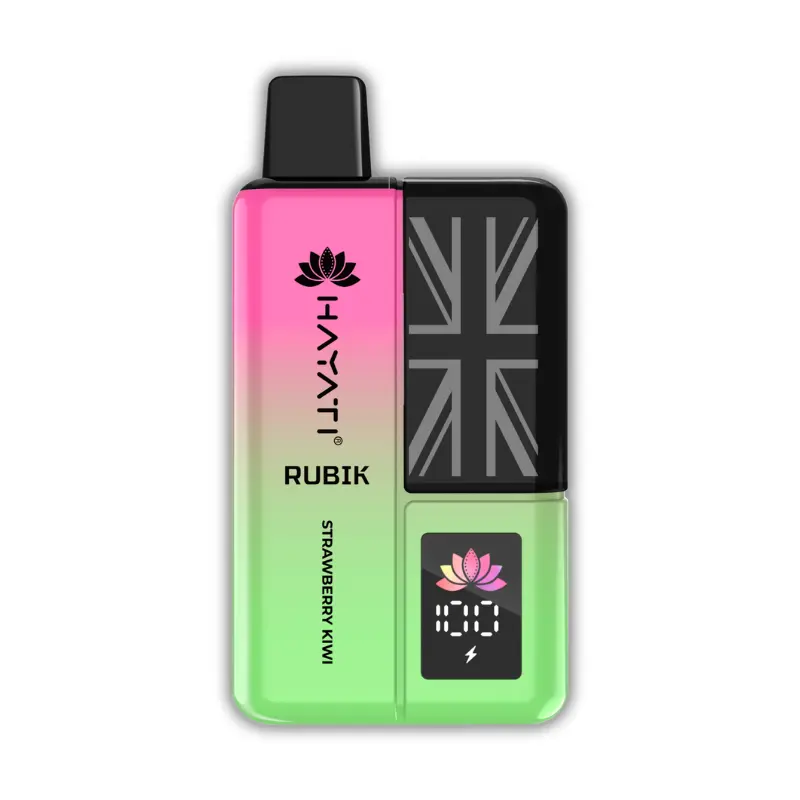
Hayati · Rubik
Strawberry Kiwi Hayati Rubik Prefilled Pod Kit
£5.99
✔ In stock — ready to ship
Genuine Hayati
Free over £20
Same-day dispatch
Secure checkout
Strawberry Kiwi arrives here as a complete Rubik purchase: the body and one pod that left the factory already holding 12ml of liquid, boxed together at £5.99. Nicotine is supplied at 20mg in salt form, the cell is 850mAh, and the manufacturer's figure for a full pod is up to 7,000 puffs. That figure came off test equipment taking identical draws on a timer, so it is a way of lining one listing up against another and a poor basis for planning a fortnight. No cooling word appears anywhere in the name, and nothing in the draw turns cold.
The reason to spend time on this listing rather than adding it to a basket is not the hardware, which twenty other Rubik kits share at the same price. It is the fruit on the left of the name. Kiwi is one of the least-worked ingredients Hayati sell: twelve listings out of four hundred and ninety-two, five recipes, one short shelf. Strawberry is at the other extreme, present in more distinct recipes than any other fruit in the catalogue. So the blend puts the range's rarest structural fruit with its commonest one, and it does so in the single most-replicated kiwi recipe Hayati have, five listings across three formats, more than twice as many as any other kiwi blend.
That combination is either the obvious right answer or the least imaginative thing anybody could do with a scarce ingredient, and the page exists to work out which. The question underneath it is narrow and answerable. Kiwi is being used here for its acid. Lemon, raspberry and cranberry all supply acid, and the range has far more of all three. If sourness is the whole of kiwi's job, this liquid is strawberry with a sharp partner and the choice of partner is arbitrary. If kiwi brings something none of those three could, it is doing work no substitute would do. The evidence for deciding is sitting in the catalogue, and the confirmation is available on your own first pod within a few days. Both are set out below.
Counting the kiwi before claiming anything about it
A page that calls an ingredient rare should say how rare, because the vague version is almost always wrong and the exact version is almost always more interesting. Here are the numbers, taken from the catalogue rather than from an impression.
Kiwi appears in twelve of Hayati's four hundred and ninety-two listings, which is a fraction under two and a half per cent. Those twelve resolve into six titles and five actual recipes, because one blend is catalogued under two spellings of the same thing. Kiwi Cooler puts the fruit on its own under a declared coolant. Guava Kiwi Passion Fruit sets it against two assertive tropicals. Kiwi Banana and its partner side pair it with something soft and dense. Kiwi Grape Raspberry buries it in a three-fruit nic salt. And Strawberry Kiwi, this one, is the fifth. Hayati file the lot under Kiwi Vapes, a shelf of twelve that can be read end to end in one sitting, which is not something you can say about most fruit categories here.
The rarity claim, corrected
It is tempting to call kiwi the least-used acid source in the range. Counted properly, that is not true, and the true version is better. Rank every acid-bearing fruit by how many distinct recipes contain it and the order runs: raspberry twenty-five, lemon twenty-four, cherry twenty, apple twelve, lime ten, pineapple seven, then cranberry, blackcurrant and kiwi tied at six, then orange four, dragon fruit three, lychee and passion fruit two apiece, and grapefruit and pomegranate on one each. Kiwi sits joint-seventh of fifteen. Five acid sources are scarcer than it, and two of them barely exist.
So scarcity is not the distinguishing fact. Concentration is. Grapefruit has one recipe because Hayati have used it once. Kiwi has five recipes and twelve listings, which means somebody at the flavour house keeps coming back to it, and then five of those twelve listings turn out to be the same blend. No other kiwi recipe reaches three. Strawberry Kiwi is also the only kiwi that exists in more than two formats, appearing as a bottled salt, as a Pro Max Plus kit, as a Pro Max Plus pod, and as this Rubik kit and its matching Strawberry Kiwi Hayati Rubik Pods refill. Every other kiwi blend exists twice or once.
There is a second consequence that matters more to a buyer than any of the above. This is the only kiwi anywhere on the Rubik platform. Thirty-nine Rubik listings, twenty of them kits, and exactly two contain kiwi: this one and its own refill pod. If you own a Rubik body and you want green fruit, the shelf offers you one answer. Compare that with raspberry, where Hayati's own Hayati Rubik range gives you Blueberry Raspberry, Blue Sour Raspberry, Strawberry Raspberry Ice and more besides. Liking this fruit is a narrow preference to hold on this platform, and that is worth knowing before rather than after.
And the partner, counted too
The other half of the claim is that strawberry is the most-used fruit in the range, and that one survives checking with a caveat attached. Strawberry appears in thirty-six of the one hundred and seventy-four distinct recipes and in eighty of the four hundred and ninety-two listings, ahead of raspberry at twenty-five recipes and seventy-four listings, cherry at twenty and sixty-two, and everything else by a wider margin. By both measures it leads. The caveat is that Hayati's own Strawberry Vapes shelf holds eighty-two products while their raspberry shelf holds a hundred and nineteen, because the raspberry shelf absorbs the whole Blue Razz family whose titles never say raspberry. So which fruit is biggest depends on whether you count names or shelf memberships. On names, which is what a flavourist chooses, strawberry wins.
Strawberry is also, by the range's own account, close to the least acidic thing in it. Of the eighty listings that name strawberry, fifty-eight attach a sweetness word to it directly, and six attach a sharpness word, of which most are describing the partner fruit rather than the strawberry. Not one listing in the catalogue presents strawberry as the sharp element in a blend. It is always the floor.
Put those two counts together and the shape of the pairing is clear before anybody tastes it. The softest widely used fruit has been given a corrective, and the corrective chosen is a fruit the range hardly touches. Which is exactly the setup that makes the substitution question worth asking rather than assuming.
What a scarce ingredient is supposed to buy you
Start with the version of the argument that says kiwi is doing nothing special. It goes like this. Strawberry is soft, sweet and low in acid, so it needs something sharp beside it or twelve millilitres of it becomes wearying. Plenty of fruits are sharp. The catalogue is full of them. Raspberry is the range's most common acid and it works: Strawberry Raspberry Ice Hayati Rubik Prefilled Pod Kit sits on this exact shelf at this exact price doing this exact job. Cranberry does it on Strawberry Cherry Cranberry Hayati Pro Max Plus Pod Kit. Lemon does it across nearly sixty listings. If sourness is all that is needed, kiwi is an unusual way to obtain an ordinary thing, and the resulting liquid should be hard to tell from any of its neighbours once you take the cooling out of the comparison.
One part of that argument needs correcting straight away, because it is frequently stated in money and the money is not there. Kiwi costs you nothing extra. Every one of the twenty Rubik kits is £5.99 and every Rubik pod is £3.99, whatever fruit is inside. Triple Mango, Juicy Peach and Fresh Mint are all the same price as this. Choosing a rare fruit here is not a premium purchase and nobody is charging you for scarcity. The per-millilitre argument for the Rubik platform as a whole belongs on the Hayati Rubik Prefilled Pod Kit shelf and on the bare pod listing, where it is worked out properly, and it is not repeated here.
What scarcity does cost you is optionality, and that is a real price even though it has no pound sign. Settle on raspberry and you have a hundred and sixteen listings to move between when you get bored. Settle on kiwi and you have twelve, of which five are the liquid you are already holding. If this pod turns out to be the thing you want, the range's ability to give you more of it is close to exhausted at the point of purchase. That is the honest cost of the choice, and it argues for testing the liquid carefully rather than committing to the fruit.
Why the question has a checkable answer
The substitution argument makes a prediction. If kiwi is here purely as an acid, then whatever kiwi contributes is a single dimension, and a single dimension can be swapped out. The blend would then differ from a strawberry and raspberry blend only in the shape of the sourness, which is a small thing, and both would present as sweet fruit with a sharp edge.
The opposing case makes a different prediction. Kiwi carries a green, faintly leafy, faintly starchy character that has no counterpart anywhere among the red and yellow fruits. If that survives the coil, the liquid has a second axis in it, and no amount of raspberry produces a second axis. It produces more of the first one.
Those two predictions disagree about something observable, which is the useful property of a good question. The rest of this page is about the two places you can go looking: Hayati's own copy across every listing of this fruit, which is free to examine right now, and the first days of your own pod, which is the only test that settles it.
The word the range uses for this fruit and almost nothing else
Here is a count nobody has any reason to fake, because it was produced by copywriters describing products one at a time rather than by anyone building an argument.
Across the four hundred and ninety-two listings in the catalogue, the word green appears in twenty-eight product descriptions. That is under six per cent, which already tells you it is not house vocabulary sprayed at everything. For comparison, tart appears in one hundred and ninety-eight descriptions and sharp in two hundred and sixty-eight, so the sourness vocabulary is genuinely generic and this one is not.
Twelve of those twenty-eight are the twelve kiwi listings. Every single kiwi listing in the catalogue uses the word, without exception, across five separate recipes, five formats and what must have been several unconnected writing passes. Not one kiwi product is described without it.
The other sixteen break down in a way that sharpens the point rather than blunting it. Five belong to the mints, where green means leafy and herbal rather than fruit. Two are Peach Green Tea, where the word is part of the ingredient's name. Two are Sour Apple listings, where a green apple is genuinely the fruit in the pod. The remaining seven use green to describe something that is deliberately absent: five Red Apple Ice listings explain that red apple is the mellow one rather than the sharp green sort, a Double Apple listing does the same, and a Banana Ice listing describes fruit that has just left green behind. In those seven the green is a foil, not an ingredient.
So the real tally for green as a positive description of what is in the liquid is kiwi twelve, mint five, sour apple two. Kiwi is the only fruit in the catalogue that gets the word every time it appears, and the only fruit for which it is never a comparison to something else.
The substitutes never get it
Run the same search over the candidate replacements and the result is a flat zero. No raspberry listing describes a green note. No cranberry listing does. No lemon listing does. Across a hundred and fifty-odd listings involving those three fruits, the vocabulary is tart, sharp, tangy, zesty, zippy and sour, and it stops there. Those words describe an intensity. Green describes a direction.
That is the strongest available piece of evidence that kiwi is not interchangeable here, and it is worth being precise about what sort of evidence it is. It is not a measurement of the liquid. It is a record of what the people writing about the liquid consistently reached for, which is a weaker thing. But it was reached for five times for this one recipe alone, on listings written at different times for different platforms, and it survived every pass. A vocabulary choice that recurs that reliably is usually tracking something.
The obvious objection, and what answers it
The objection is that a kiwi is green to look at, so the copy may be describing the colour and not the taste. Colour words do circulate in this catalogue: red turns up in seventy-one descriptions, blue in ninety-four, pink in eighteen, purple in sixteen. Nobody should pretend that is not happening.
Two things answer it. The first is that most of those colour words are pulled in by the product name. Blue is in ninety-four descriptions largely because Blue Razz, Mr Blue and Blue Razz Cherry put it there. No kiwi product has green in its title, including this one, so nothing on the label is prompting the word. It is being added.
The second is the apple evidence, which cuts the right way. Apple appears in thirty-five listings and only seven use green, and those seven use it exactly where a green apple is either the fruit itself or the explicit contrast. When the apple is red, the copy says so and names green as the thing it is not. Writers are evidently capable of using the word precisely, which makes its universal application to kiwi harder to dismiss as decoration.
None of this proves the green is audible in vapour. Coils are unkind to delicate material and a flavour house can fail to render anything it likes. What the count establishes is that the green note is the property the range consistently attributes to this fruit, which makes it the property to test, and which means the substitution question is at least being asked about something real.
What the two prior kiwi pages settled
Two arguments about kiwi are already made properly elsewhere in this catalogue and are not rebuilt here. The Guava Kiwi Passion Fruit Hayati Pro Max Plus 6000 Pod Kit page works out why kiwi functions as a referee when it is put among louder fruits: its acid and its green note occupy ground that perfumed and sulphurous material does not, so it holds two similar-smelling fruits apart instead of blurring into them. The Kiwi Cooler pages establish the more basic point that kiwi's tartness is structural rather than applied, present even in ripe fruit, so that sweetening a kiwi does not mellow it, it erases it. They also record the order in which a tiring pod loses a kiwi, which matters a great deal further down this page.
Both are worth reading if the fruit interests you. What neither page addresses is the question this one is for, because neither is about a pairing with a soft partner. Kiwi against two loud fruits is a structural problem. Kiwi on its own under a coolant is a solo. Kiwi against strawberry is a substitution problem, and it is the only one of the three where a cheaper ingredient could plausibly have done the same job.
Five listings of one liquid, lined up against each other
Strawberry Kiwi is sold five times over, and Hayati wrote fresh copy for each. Reading the five together is the closest thing to independent testimony available without opening a pod, because a property all five assert is much harder to dismiss than a property one of them mentions.
What all five agree on
Three things, and they are the three that should shape your expectations.
Strawberry is the sweet, round, ripe element. Every listing says so in some form, and none of them qualifies it. Kiwi is the sharp element and every listing says that too. And in the three listings that commit to an order, the sweetness is described as arriving before the sharpness. That is the only sequence claim in the set and it is unanimous among the listings that make one.
All five also name a green note, which is the finding from the section above narrowed to this one recipe. Green is not a word the range uses casually, and it is used here five times out of five.
One more shared habit is easy to miss and is worth as much as any of the above. Every one of the five hedges the acid. The kiwi is slightly sour, or slightly sharp, or slightly tart, on listing after listing. Nothing in the set describes the blend as sour outright. Compare that with Blue Sour Raspberry, which puts the word in the title and then in the copy describes a layer that makes the mouth water. Twenty-one listings in the catalogue declare sourness in their titles. This is not one of them, and the copy backs that up consistently. Expect a fruit with an edge, not a sour product.
Where the five disagree
The interesting divergence is that the two Rubik listings, this kit and its pod, are the only two of the five that reach for the word sour at all. The three others use tart, tangy or sharp. That looks meaningful until you check whether Rubik copy is generally more sour-minded than the rest, and the answer is barely: seven of thirty-nine Rubik listings use the word against fifty-eight of the other four hundred and fifty-three, which is a small lean off a very small base.
The right reading is the one this catalogue has arrived at before, on a blackcurrant blend whose seven listings also split along platform lines. A disagreement between two listings of one liquid is evidence about how the copy was commissioned, not evidence that two recipes exist. The Rubik pair were almost certainly written together, by one person, in one sitting, and sour was that person's word. Do not read it as a claim that the Rubik version is sharper than the Pro Max Plus version. Nothing published supports that and the liquid is described identically in every other respect.
The two things only one listing says
One listing in the five, and only one, makes a claim about duration rather than about a draw: it says the kiwi keeps the strawberry from turning jammy across a long session. That is the single most useful sentence in the whole set, because it is the only functional claim anybody makes. It is also the claim this page is best placed to test, since it is precisely the claim a substitute acid would also be able to make.
Worth noting that the word jammy itself carries nothing here. It appears in twenty-seven listings across the catalogue and is plainly part of the house vocabulary. The claim is what matters, not the adjective.
The other singular observation belongs to the bare pod listing, which is the only one of the five to make kiwi the subject of its first flavour sentence rather than a modifier hanging off the strawberry. On four listings out of five, the grammar puts strawberry in charge. On one, kiwi is the interesting part. Nothing follows from that about the liquid, but it is a small sign that somebody writing about this blend arrived at the same conclusion this page did.
The draw, taken apart
No other page in this catalogue has done the flavour analysis for this blend, so it is done properly here.
Entry
The first thing to say is that the listings' sweet-then-sharp description and the physical order of a draw are not quite the same thing, and reconciling them tells you where to look.
Acid is a tongue event and it registers almost instantly. Aroma has to reach the back of the nose, which takes a beat longer. So on the actual mechanics, the tartness is present from the very start of the inhale. What arrives later is the recognisable fruit, and the first recognisable fruit here is strawberry, because strawberry flavourings are aromatic and forward and there is a lot of the stuff in this liquid.
What that means in practice is that the opening of the draw is sweet in character but not soft in texture. There is a faint tightening at the sides of the tongue before anything has a name, and then the strawberry lands on top of it. If you draw quickly you will miss the first part entirely and the listings' description will seem exactly right. Draw slowly and short and you can catch the acid arriving first. Neither reading is wrong, they are answers to different questions, and the slow one is the more informative if you are trying to work out what the kiwi is doing.
The middle, and what kind of strawberry this is
The strawberry in this pod is the sweet-shop sort rather than the fresh fruit, which is true of most strawberry vapes and worth saying plainly rather than pretending otherwise. It is rounded, slightly jam-adjacent, with the faintly artificial high note that any strawberry flavouring carries. That is not a criticism. Fresh strawberry does not survive a coil and never has, and every strawberry liquid in this range is working with the same constraint.
For calibration against listings you may have run: this is considerably less confected than Strawberry GB, which is a bubblegum treatment and lays down a flat even sweetness, and less dense than the smoothie style of Straw' Guava / Dragon Berries. It sits between a fresh reading and a confectionery one, closer to fresh, which is roughly where a strawberry goes when it has been given something acidic to answer to.
Through the middle of the draw the strawberry is doing almost all of the work and the acid has receded into the background as a sensation rather than a flavour. This is the stretch that would be identical with any sharp partner, and if you are running the substitution test, this is not the part to attend to.
The exhale, where the question is settled
The green note, if it has survived, arrives on the exhale and mostly through the nose rather than on the tongue. That is the route to pay attention to. Breathe the vapour out through the nose on a fresh pod and there is something behind the strawberry that is not sweetness and not sourness: a faint leafy, slightly starchy impression, a little like the pale flesh close to the core of the fruit. The Kiwi Cooler pages describe that character in detail on a pod where it has nothing sitting on top of it, and that is the reference to use if you want to know what you are listening for.
What is specific to this blend, and what no other page can tell you, is how badly the partner obscures it. Sweetness is very good at masking bitterness and green notes and comparatively poor at masking acid. So a soft sweet partner suppresses exactly the half of kiwi's contribution that makes it unsubstitutable, while leaving the half that any other fruit could have supplied fully audible. That is an awkward result for the blend. The pairing keeps the replaceable part and hides the irreplaceable one.
On a fresh pod the green is still findable, in my reading of it, but it is quieter than it is in any other kiwi listing in the range and it needs looking for. Somebody who draws hard, exhales through the mouth and forms a view in the first two minutes will get sweet fruit with a tang and will be entirely justified in concluding that the kiwi is decorative.
The finish, the sweetness, and what it is not
The finish is medium and slightly drying, which is a more useful description than short or long. The strawberry leaves a light film and the acid takes most of it off again within a few seconds. There is no coating on the teeth of the sort a bubblegum profile leaves, and no lingering cold, because there is nothing cold in it.
On sweetness, place it in the upper middle of the shelf. It is sweeter than any kiwi-led listing, obviously, and sweeter than a cranberry blend. It is less sweet than the bubblegum family and less sweet than Fruit Bomb / Straw' Watermelon B'Gum. It is in the same region as most fruit pods with a declared sharp element, and notably drier than a single sweet fruit like Juicy Peach, which has nothing pulling against it at all.
Four things it is not, each of which somebody arrives expecting.
- Not cooled. Hayati mark cooling in a title when it is present, and there is no temperature word in this one. The cooling-vocabulary census on the Blue Frozen pods page established that the range's cooling words are not a graded scale, so the absence of one is a yes or no rather than a reading on a dial. There is no menthol here and no chill on the exhale. Any freshness you register is the acid.
- Not a sour product. Real fruit acid, hedged by every listing, and no confectionery sour layer dosed on top. The difference is that a sour layer spikes on the first draw and fades; a fruit acid stays even and is far less tiring over twelve millilitres.
- Not tropical. Kiwi turns up constantly in tropical blends and its presence here does not make this one. There is no perfumed or musky material in this liquid at all, which is most of what separates it from the guava blend named earlier.
- Not two flavours you switch between. There is no collar on this device and nothing to turn. Every millilitre in the pod is the same recipe, which distinguishes it from the dual-reserve listings on the larger platform such as Kiwi Banana / Strawberry Banana, where a rotating mouthpiece selects between two sides of one pod.
Twelve millilitres is long enough to answer the question by itself
This is the part that makes the whole enquiry practical rather than academic, and it comes out of an observation the Kiwi Cooler kit page already made and did not extend.
That page records the order in which a tiring pod gives up a kiwi. The green vegetal note goes first, because it is the most delicate material in the recipe. The acid softens second. On a cooled pod the coolant then outlasts both, which is the trap it describes, since cold is easy to mistake for a working pod.
There is no coolant in this one, so the sequence runs differently and the consequence is sharper. Green goes, acid softens, and what is left is strawberry. Which is to say that this pod runs the substitution experiment on itself, on a schedule, without asking you.
Days one to four, you have strawberry plus a green fruit, and the kiwi is contributing something a raspberry could not. Somewhere in the middle the green thins out and you have strawberry plus a fruit acid, which is what a raspberry or a cranberry would have given you at the same price. By the last stretch of the pod you have a sweet strawberry liquid with a fading edge, which is what a strawberry pod with no partner at all becomes. The liquid passes through all three answers to the question this page asked.
Two things follow, and both are worth more than a tasting note.
The first is that a verdict formed at the end of a pod is a verdict on a different liquid from the one you bought. People routinely decide what they think of a flavour in its final days, because that is when they are thinking about what to order next. On this blend that is the worst possible moment, because the distinguishing element has already gone. If you want to know whether kiwi is worth it to you, the window is the first few days.
The second is more useful still. Because the green disappears before the acid does, the green is the diagnostic. When you can no longer find anything behind the strawberry that is neither sweet nor sour, the pod has moved past its interesting phase. It has not stopped working and there may be a week of pleasant strawberry left in it. But whatever you paid the scarcity premium in optionality for is finished, and if that was the point of buying this rather than Strawberry Raspberry Ice, you should know when it happened.
The check, as a procedure
Four steps, none of which needs a trained palate, only attention at the right moment.
- Do it on the second or third day, not the first. A brand new coil can carry a faint manufacturing note that muddles a delicate green, and by the second day it has gone.
- Come to it on a rested palate, at least ten minutes since the last draw and preferably after water. Acid fatigues fast, and an hour into a session you have lost the ability to hear the part you are trying to assess.
- Take a short, slow draw and exhale through the nose rather than the mouth. The green is a retro-nasal event and a mouth exhale loses most of it.
- Ask one question only: is there anything present that is neither sweetness nor sourness. Not whether it tastes like a kiwi, which is a harder question and one memory answers badly. Just whether there is a third thing.
If the answer is yes, kiwi is earning its place and no substitute would have done. If the answer is no on a fresh pod on a rested palate, then this liquid is strawberry with an acid, the acid happens to be kiwi, and you can buy the same structure more cheaply in terms of future choice from a fruit with a hundred listings behind it. Either answer is worth having, and the second one is not a failure of the pod. It is information about what you are actually buying.
The kit, in short
Twenty Rubik kits share this body and there is a limit to how many times anybody needs the same device explained. The box holds the Rubik body and one pod supplied already filled with this blend. Nothing else is listed in the product data: no cable, no spare pod, no accessories. There is no assembly, no liquid to pour, and no coil to fit, because the coil is inside the pod and arrives wet.
Hayati name no charging connector anywhere in this product's data, so none is named here. If you read a specific cable type on another page for this range, a writer put it there.
The one specification that changes how you should read everything above is that the pod is sealed at a ratio somebody else chose. Whatever balance of strawberry to kiwi is in there was fixed before it was boxed, and no retailer can move it. On a blend whose entire interest rests on whether the smaller component is audible under the larger one, that is not a trivial detail. You are not choosing a ratio, you are judging one.
Pods are swapped rather than refilled, and the body stays with you. The correct repeat purchase once the device is yours is the £3.99 pod rather than a second kit, and the arithmetic on that, including what the price gap between the two listings actually buys, is set out on the pod listing and on the Rubik shelf rather than here. On compatibility: match the range name on the pod to the range name on the body you own, and treat a compatibility decision from a retail page as unverified, since Hayati publish no cross-fitment chart for any of their systems.
The numbers Hayati publish, and the ones they leave blank
| Named fruits | Strawberry, kiwi |
| Cooling declared | None, no temperature word in the title |
| Liquid supplied | 12ml, filled at the factory |
| Nicotine as filled | 20mg, salt form, no other strength on this listing |
| Sold as | Complete kit, body plus one filled pod |
| Price | £5.99 |
| Cell | 850mAh, rechargeable |
| Manufacturer's puff figure | Up to 7,000, a laboratory estimate |
| Coil | Inside the pod, not serviceable |
| Platform | Hayati Rubik |
| Maker | Hayati |
| Shelved under | Rubik prefilled pod kits, berry, exotic, kiwi, strawberry, new products |
| Not published | Coil resistance, wattage, carrier ratio, charge time, flavour concentrations |
The bottom row is the one that constrains this page. No concentration is published for any pod in this catalogue, so nothing above about the balance between the two fruits is a reading of a recipe. It is a description of how the liquid presents and of what the range's own copy consistently claims. A page that discusses ratios for two thousand words and then quotes you a percentage has invented the percentage.
The puff figure deserves a note because it differs from the Pro Max Plus number in a way people notice. A Rubik pod is rated at up to 7,000 and a Pro Max Plus pod at up to 6,000, and both hold 12ml with an 850mAh cell behind them. Hayati publish no explanation for the gap and this page will not guess at one. What can be said is that two figures are only comparable if they came off the same test protocol, which is not stated for either, and that neither is a forecast. Note the date you fit a pod and the date you finish it, and after two pods you have a figure for your own use that is worth more than both of theirs.
The strength row is fixed rather than chosen. Twenty milligrams in salt form is what this listing supplies and no alternative is offered against it, which is the maximum permitted in a pod sold in the UK. Nicotine is addictive and the figure is there to be read rather than interpreted, particularly on a reorder, where it is the easiest number on the page to stop noticing.
What sits next to it, and who should take which
If this exact pairing is what you want
Three other ways to buy it exist and they differ in hardware rather than in liquid. Strawberry Kiwi Hayati Rubik Pods at £3.99 is the right purchase the second time, once the body in this box is yours. Strawberry Kiwi Hayati Pro Max Plus Pod Kit at £7.99 is the same pairing on the larger, dearer platform, with the same 12ml and the lower puff rating discussed above. And the bottled nic salt version exists for anybody running a refillable device instead, at a different strength and in a different format entirely.
If you want to run the substitution test yourself
This is the interesting shopping route and the range supports it well. Strawberry Raspberry Ice Hayati Rubik Prefilled Pod Kit is the nearest control available: same platform, same price, same 12ml, strawberry with a sharper red partner instead of a green one. The confound is the declared ice, which adds a sensation this pod does not have, so allow for it. Strawberry Cherry Cranberry Hayati Pro Max Plus Pod Kit runs the same experiment with cranberry doing the correcting, on different hardware. Blueberry Cherry Cranberry stays on this platform and swaps the sweet base as well, which makes it a looser comparison but a cheaper one to try.
Running one of those alongside this pod for a fortnight is the only way to settle the question properly, and it costs less than most people spend working it out by reading.
If the kiwi is the part you came for
You have twelve listings and this page has named most of them. Guava Kiwi Passion Fruit Hayati Pro Max Plus 6000 Pod Kit is where kiwi holds two louder fruits apart, which is a completely different use of the same ingredient and the best demonstration of what its green note is structurally for. Kiwi Cooler is kiwi undiluted with a coolant over it, and is the listing to run if you want to hear the fruit with nothing sweet masking it. Kiwi Banana / Strawberry Banana Hayati Pro Ultra Plus 25000 Prefilled Pod Kit at £11.99 puts kiwi against something genuinely dense, which is the one experiment the rest of the range does not run, and it sits on a larger system that this body has nothing to do with. The full set is on the Kiwi Vapes shelf, and the Exotic Vapes shelf collects the wider category if green and sharp is a direction rather than a specific fruit.
If the strawberry is the part you came for
Then the acid is a tax you are paying and you should stop paying it. Strawberry GB Hayati Pro Max Plus 6000 Pod Kit is strawberry as confectionery with nothing cutting it. Grape GB / Strawberry GB Hayati Mini Ultra Pod Kit at £3.99 puts two sweet treatments in one pod on the smallest and cheapest format Hayati sell. Straw' Guava / Dragon Berries takes strawberry towards the perfumed end instead of the sharp one. All thirty-six strawberry recipes are on the Strawberry Vapes shelf, which is a long read but the most productive one if strawberry is what you actually buy.
If you are staying on this platform and just want something else
The Rubik shelf is twenty kits and all of them are £5.99, so changing your mind is cheap. Triple Mango is the heaviest and simplest thing on it, one fruit with no contrast at all, which makes it a good control for working out how much of your preference is about structure rather than about fruit. Red Apple Ice is the shelf's other listing that discusses a green note, though it does so to say the apple is not the green sort. Banana Ice is the softest and lowest-acid option there. Fresh Mint leaves fruit behind entirely and is the usual choice for somebody who wants a second pod that resets the palate rather than competing with the first. Blueberry Raspberry and Blue Razz Cherry cover the berry middle of the shelf.
Two listings on the wider range are worth naming for the opposite reason. Mr Blue and Midnight Dream are named for an impression rather than an ingredient, so they publish nothing you could compare against this. They may be excellent. What they cannot be is a reference point, and a page that has spent this long counting fruit names should say plainly that those two cannot be counted at all. If you would rather browse than decide, the Hayati Rubik range and the whole Hayati catalogue are there to be filtered.
Handling, and getting an honest reading
Most of what follows applies to any prefilled pod. What is specific to this one is that the element you are paying attention to is the most fragile thing in the recipe, so the usual advice has sharper consequences here than it does on a heavy sweet liquid.
Let it stand before the first draw. Two or three minutes upright, then start with short gentle pulls. A wick pulled dry on the first draw produces a scorched note, and on this blend that note lands in exactly the register you are trying to listen to. A burnt edge and a green edge are both faint, both dry, and both arrive behind the fruit, which makes them easy to confuse for days.
Pace matters more than it does on a sweeter pod. Consecutive draws run a coil hot, and heat costs you the lightest material in a liquid first. On a strawberry-dominant blend the strawberry survives that treatment comfortably and the kiwi does not, so chain-drawing this pod converts it into the substitutable version faster than ordinary use would. Ten or fifteen seconds between draws is not fussiness on this recipe, it is the difference between the two products it can be.
Do not judge it late in a session. Acid stops registering long before aromatic material does, so an hour of continuous use leaves you with the strawberry at full strength and both halves of the kiwi's contribution flattened. Anyone who decides this pod is too sweet at the end of an evening has reached a conclusion about their palate rather than about the liquid.
Store it out of heat and light. A drawer is fine. A dashboard on a sunny day, a pocket against a radiator or a bag left in the sun are not, and the reason is the same as every other reason on this page. Sustained warmth drives off the lightest components first, and here the lightest component is the one that justifies the fruit. A badly stored pod does not spoil, it goes quiet, and it goes quiet in the one direction this blend cannot afford. The body and any spare pods belong somewhere children and pets have no access to them.
Resist drawing harder as it fades. The instinct to pull longer on a tiring pod moves more liquid across a coil that is already struggling, which bakes residue on faster. The predictable result on this recipe is that the green and then the acid go while the strawberry hangs on, so pulling harder accelerates you towards the flattest version of the liquid.
Know when it is finished. The pod is spent when the liquid is gone, and the signal is thinner vapour with a flat, faintly burnt edge that a rest does not fix. There is no fill port and no replaceable coil, so nothing can be done at that point. What comes out is a plastic body with a coil and a little residual liquid in it, which makes it electrical waste rather than household rubbish: a vape shop take-back bin or a council recycling point is where it belongs.
Questions worth asking before ordering
Is there any ice, menthol or cooling in this?
No. Hayati put a temperature word in a title when a liquid contains cooling and there is none in this one. Nothing in the draw turns cold at any point. What some people read as freshness is the kiwi's acidity, which is a different sensation once you know to separate them.
How sour is it, really?
Moderately, and consistently rather than in a spike. All five listings of this flavour hedge the acid with a qualifier and none of them calls the blend sour outright. If you want a declared sour product, the range puts the word in the title when it means it, as Blue Sour Raspberry does. This is a sweet fruit with a real edge, not a sour one.
Would strawberry and raspberry taste the same?
Not on a fresh pod, if the green note in the kiwi is rendering, because raspberry supplies sharpness and nothing else. Later in a pod the difference narrows considerably, since the green is the first thing a tiring coil drops. That is the whole argument of this page and it is checkable on your own device within a few days.
What does a green note actually mean here?
A leafy, faintly starchy character underneath the fruit, closer to the pale flesh near a kiwi's core than to anything grassy. It reaches you through the nose on the exhale rather than on the tongue. Every one of Hayati's twelve kiwi listings names it, which is unusual: the word appears in only twenty-eight product descriptions out of four hundred and ninety-two.
How sweet is it against the rest of the Rubik shelf?
Upper middle. Sweeter than anything with mint in it, sweeter than a cranberry blend, drier than a single sweet fruit such as Juicy Peach, which has nothing pulling against it. Roughly level with the other listings on the shelf that declare a sharp element.
Why does the Rubik say 7,000 puffs when the Pro Max Plus says 6,000?
Hayati publish the two figures and no explanation for the difference, and both pods hold 12ml behind an 850mAh cell. Two laboratory estimates are only comparable when they came off the same protocol, which is not stated for either. Treat both as rankings rather than forecasts, and generate your own figure by noting the dates you fit and finish a pod.
What is in the box?
The Rubik body and one pod that arrives already filled with 12ml of this blend. That is the entire published contents. No charging connector is named in this product's data, so this page does not name one either.
I already own a Rubik. Should I buy this or the pod?
The pod, at £3.99, unless you specifically want a second body. Buying a kit charges you again for hardware you already have. The case for occasionally buying a kit anyway, and how to tell when a body is due for replacement, is set out on the pod listing rather than duplicated here.
Can I refill it or change the coil?
Neither. The coil sits inside the pod and no fill port appears in the published specification. When the liquid has gone the pod is replaced and the body carries on. That is the trade for something that works out of the wrapper with no preparation beyond letting it stand.
Is a lower nicotine strength available for this flavour?
Not on this listing. It is supplied at 20mg in salt form with nothing else offered against it, which is the UK maximum for a pod of this kind. Nicotine is addictive, and that is a figure to read consciously rather than skip past.
Does the flavour change over the life of the pod?
Yes, and in a predictable order on this recipe. The green note thins first, the acid softens next, and the strawberry outlasts both. That is a normal consequence of a coil accumulating residue rather than a defect, but it matters more here than on most pods, because the first thing to go is the thing that distinguishes the blend.
How much kiwi is actually in it?
Nobody outside the flavour house knows. No concentration is published for this pod or any other in the catalogue. What can be said is that every listing of this flavour describes strawberry as the base and kiwi as the element working against it, which is a statement about roles rather than proportions.
The short version
£5.99 buys a Rubik body and one sealed pod holding 12ml of 20mg nicotine salt, uncooled, rated by the manufacturer at up to 7,000 laboratory puffs. The liquid is a sweet strawberry with a kiwi acid running under it and a green note behind that, and it is the most-repeated kiwi recipe Hayati sell: five listings of twelve, and the only kiwi on this platform.
The reason to think about it rather than simply buy it is that the pairing is the conventional answer to a scarce ingredient. Strawberry appears in more recipes than any other fruit in the range and is never the sharp one, so pairing it with an acid is the obvious correction, and several cheaper and commoner acids were available. What justifies kiwi specifically is the green note, which the range's own copy attributes to this fruit on every one of its twelve listings and to none of its substitutes. Whether that note reaches you through a soft sweet partner is the one thing worth checking, and the honest answer is that it does on a fresh pod, quietly, and that it fades before the acid does. So the blend spends its first days being something no substitute could be and its last days being something several substitutes could match.
Take it if you want a sweet fruit with a genuine second dimension and you are willing to notice the second dimension in the first few days. Leave it if you want sharpness alone, in which case the raspberry and cranberry listings named above deliver it more cheaply in terms of future choice. Once the body is yours the repeat purchase is the £3.99 pod, not another kit.
Strictly for adults aged 18 and over. Nicotine is an addictive substance.
You might also like


