
Home / Hayati Pro Max Plus Prefilled Pod Kit / Blueberry B’Gum Hayati Pro Max Plus 6000 Pod Kit
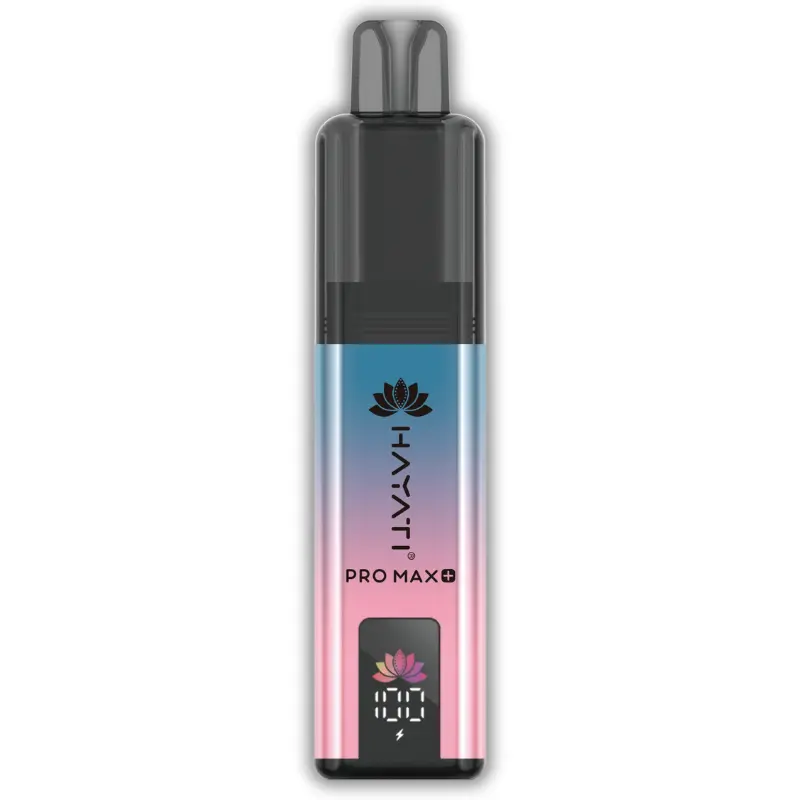
Hayati · Pro Max Plus
Blueberry B’Gum Hayati Pro Max Plus 6000 Pod Kit
£7.99
✔ In stock — ready to ship
Genuine Hayati
Free over £20
Same-day dispatch
Secure checkout
Blueberry B’Gum arrives as a complete Hayati Pro Max Plus setup at £7.99: a rechargeable 850mAh body, and a sealed pod carrying 12ml of nicotine salt liquid at 20mg per millilitre, with nothing to assemble and nothing to fill. Hayati place an upper bound of 6,000 puffs on that pod, which is a bench number taken off a draw machine and not a forecast of anybody’s week. It is one of 88 listings on the Hayati Pro Max Plus Prefilled Pod Kit shelf, and on the numbers alone it is indistinguishable from most of them.
Look at the label rather than the numbers and something unusual is going on. There is a punctuation mark in the middle of the flavour name. Across the entire Hayati range, 492 listings, the apostrophe appears in exactly 35 titles, and on the Pro Max Plus platform, which carries 179 of those 492 listings, it appears on four. All four are a chewing gum flavour. Not most of them. All of them, with no exceptions in 179 listings, which makes the mark a perfect predictor of one flavour family on the shelf this kit sits on, and a very unreliable one everywhere else.
That is worth knowing, but it is not the interesting part, and the interesting part is what this page is about. The clipped word is the steadiest thing printed on this listing. It commits to a register, it does not drift, and it says the same thing on both of the two occasions Hayati sell this liquid. Almost nothing else in the copy behaves that way. The prose around the name shifts between the pod listing and the kit listing, and it shifts again when the same fruit turns up under a differently spelled confection two shelves over, in ways that cannot all be true at once.
So the page does three things. It settles what the apostrophe is and is not doing, briefly, because most of that work has already been done elsewhere and only needs the new counts added. It then shows how much the descriptive copy moves, with the figures, because a buyer who takes the tasting notes at face value is trusting the least stable material on the listing. And then it does the part that actually decides whether you want this, which is working out what a blueberry can get past a bubblegum accord, from mechanism rather than from prose, and reaching a verdict on it.
What the apostrophe is doing, and what it is not
The census has been run and there is no sense running it again. Our Blueberry B’Gum replacement pod page counted the gum family across all four of its spellings and established that twenty listings out of 492 carry an unambiguous gum word, roughly four in every hundred. The Strawberry H’Bubba pods page went wider and counted every shortened element in every title: nine distinct markers, 77 listings with a truncation somewhere in the name, 35 of them carrying a literal apostrophe. Both of those are settled and cited rather than rebuilt.
What that second page established, and what matters most here, is the verdict on which clippings conceal something and which merely shorten it. Three of the nine markers point at a name that belongs to somebody else. H’Bubba clips a branded chewing gum. H’Berg and P’Man, which share two listings between them, clip two flagship liquid names owned by another house in this trade, and our H’Berg / P’Man kit page works through the identification carefully and marks the weaker half as inference. The other six markers point at ordinary words with no owner: a gelatine sweet, spun sugar, an Italian dessert, a fruit, and a compound noun that has been in general English for a century.
B’Gum is in the second group. It shortens bubblegum, which nobody owns, which Hayati print out in full in four of their own titles, and which appears unclipped in 24 of the 492 descriptions including the one attached to this very listing. There is no trade mark behind the apostrophe on this product and no legal reason for it to be there. Anyone reading the mark as a coded reference to a specific branded gum is reading something into it that is not there, and the same catalogue offers a listing that does make that reference, under a different spelling, at the same price.
Three counts the earlier pages did not run
Three things fall out of the title data that have not been reported, and each sharpens the reading.
The mark is distributed by hardware, not by meaning. Of the 35 apostrophe titles, 21 sit on the Pro Ultra Plus, nine on the Mini Ultra, four on the Pro Max Plus and one on a bottle. Straw’, which is far and away the commonest clipping at 22 listings, never appears on the Pro Max Plus at all. Not once in 179 listings. So a buyer who learned this convention on the larger hardware learned that an apostrophe usually means strawberry, and that reading is exactly wrong on the shelf this kit sits on, where it always means gum. The mark carries opposite implications on two shelves in one shop, which is a decent working definition of a signal that is not carrying information.
The catalogue clips and spells the same word inside a single title. Two listings in the range are called Straw’ Cranberry Cherry / Strawberry Raspberry Ice. One title, one word, clipped on the left of the oblique and written out on the right. Whatever the apostrophe is for, it cannot be for anything that would apply on one side of a slash and not the other four words later.
The same liquid is clipped on one SKU and spelled out on the other. Kiwi Banana / Straw’ Banana is sold as a Pro Ultra Plus pod. The matching complete kit, the same pairing on the same hardware, is titled Kiwi Banana / Strawberry Banana. Two listings, one recipe, and the clipping present on one and absent on the other. That is as close to a controlled test as a product catalogue is ever going to give you, and it says the mark is typography rather than content.
Three names for one confection, and nothing connecting them
Here is the count I find most useful, and it is a count of an absence.
Hayati sell the same confection under three names. B’Gum on seven listings. H’Bubba on seven. The branded name written out in full on two, both of them a Pro Max Plus kit and its matching pod, sitting a few rows from this one. Nowhere in 492 descriptions does Hayati say that any of these three refers to the same thing. The first word of that brand appears in exactly two descriptions in the entire catalogue, and both are the two listings that already carry it in their own titles. Not one H’Bubba listing glosses itself against the unclipped brand. Not one B’Gum listing mentions either of the others.
What the descriptions do instead is expand everything downward to the generic. Every B’Gum listing says bubblegum in its body text. Every H’Bubba listing says bubblegum too, including the bottled one, which describes itself as a bubblegum-inspired liquid. Even the two listings that print the brand in their titles describe the flavour as classic pink bubblegum rather than as itself. So the range has a ladder of reference with three rungs on it, and the copy quietly flattens all three to the bottom rung the moment you open a listing.
That ladder is worth spelling out, because it is the one piece of the naming system that actually helps a buyer decide something:
- The bottom rung, and the one this kit is on. B’Gum names the category. It tells you the liquid targets the pink gum accord and nothing more specific than that. Any competent bubblegum flavouring would satisfy the name.
- The middle rung. H’Bubba names a particular branded gum without printing it. That is a narrower promise. A buyer who recognises the reference is being pointed at one manufacturer's soft pink chew rather than at the generic, which is a meaningfully different target even though both are the same family.
- The top rung. Two listings print the brand outright and leave nothing to be decoded.
The practical consequence is short. If what you want is the specific gum you remember, the listing that names it is a surer purchase than the one that abbreviates the category, and Blueberry B’Gum abbreviates the category. If what you want is a gum register with a dark berry in it, the category name is all you need and the rung does not matter.
What none of these names imply
Worth being plain about this, because a clipped name invites a reader to fill the gap with more than is there. No licence, endorsement, approval or ingredient relationship is implied by any of these names, including the two that print the brand in full. Hayati are not making anybody's gum and nobody else's recipe is in this pod. What a flavour name of this kind describes is a target, which is to say the impression the formulator was aiming at, and the liquid is Hayati's own interpretation of that target, mixed from their own flavour concentrates. A reader who takes the name as a claim about who made the flavouring has read a claim nobody made.
That said, the reference is still doing real work, and dismissing it as marketing would be the wrong lesson. A name that points at a widely known confection hands a buyer a far more specific expectation than a generic sweetness word could. Told that something is sweet, you know almost nothing. Told that it is a bubblegum, you know the sugar level, you know there will be a floral lift that no fruit has, you know there will be no acid and no cooling, and you know roughly what the finish will do. That is four properties for one word, recovered from a memory rather than from a specification, and recovered without the seller having to stand behind any of it. That is precisely why the convention exists across this whole trade, and it works. The honest position is that it is informative and non-binding at the same time, and a buyer who understands both halves is better off than one who believes either alone.
The name holds still and the copy does not
Now the part that changes how you should read the rest of this listing.
Hayati write fresh copy for every SKU, so a flavour sold twice has two independent descriptions of one recipe. Lining them up is the technique that has produced the best evidence in this corpus, and on this liquid it produces a disagreement rather than a confirmation.
The kit listing, the one attached to the product you are looking at, is unambiguous that the gum is the base and the berry is folded into it. It leads with the gum, describes the gum's character first, and treats the blueberry as something added afterwards to stop the base tasting flat. The pod listing describes the same liquid and ends its flavour paragraph by saying the berry gives it enough depth that it tastes fruit-led rather than purely sugary. Fruit-led. That is not a smaller version of the kit's claim, it is the opposite ordering of the same two components, written by the same company about the same twelve millilitres.
Our pod page read those two descriptions as agreeing, on the basis that both open by putting the gum first, and it is right that both open that way. It missed the second half of its own listing's sentence, which reverses the order after the comma. The standing instruction on these pages is that a claim gets checked before it is echoed and checked again before it is challenged, so this comes with its evidence attached rather than as a flat contradiction: the two listings of this liquid do not agree about which component leads, and any page that says they do has stopped reading one of them a clause too early.
The disagreement is structural, and it shows up where you would predict
One pair of listings falling out is an anecdote. Four pairs is a pattern, so here are all four fruit-and-gum flavours in the range that exist as both a pod and a matching complete kit.
- Blueberry B’Gum. Kit says gum base with berry folded in. Pod says fruit-led. They disagree.
- Strawberry H’Bubba. The Strawberry H’Bubba Pro Max Plus 6000 Pod Kit says the gum sets the tone and the strawberry comes through on top. Its pod listing says a sugary strawberry is wrapped in bubblegum sweetness, which puts the fruit in the middle and the gum around it. They disagree.
- Watermelon B’Gum / Strawberry B’Gum. Both listings say the gum is the base on both sides. They agree.
- Blueberry H’Bubba / Watermelon H’Bubba. Both listings say bubblegum is the constant and the fruit gives each side its character. The Blueberry H’Bubba / Watermelon H’Bubba Pro Ultra Plus kit says it in almost the same words as its pod. They agree.
Two disagree and two agree, and the split is not random. The two that agree are the dual-flavour listings, and the two that disagree are the single-flavour ones. There is a mechanical reason for that. On a pod divided between two fruits under one treatment, the copywriter has no choice but to describe the gum as the fixed background, because that is the only way to explain what the mouthpiece is switching between. The architecture of the product dictates the sentence. On a single-flavour pod nothing dictates anything, the writer is free to lead with whichever component struck them, and what you see is two people, or one person on two days, reaching opposite conclusions about the same liquid.
That is not a criticism of the copy desk. It is a measurement of how confidently anybody can tell, and the answer it gives is: not very. Which is itself evidence about the liquid, arriving by the back door. If the gum and the berry were arranged as two identifiable layers, two writers tasting them would agree on the order, because the order would be a fact about the draw. They do not agree. The most economical explanation is that there is no order to report, which is what the pod page predicted on entirely separate grounds when it argued that a low-acid floral berry has nothing to push against a wall of esters.
The same fruit gets opposite adjectives under different confections
One more comparison, and this is the one that should change how you read any tasting note on a confectionery listing.
Blueberry is the most heavily treated fruit in this catalogue's sweet-shop corner. It appears under three different confectionery markers across eight listings: twice under B’Gum, twice under H’Bubba, and four times under Cotton K, which is the candy floss treatment. Same fruit, same company, three treatments. If the descriptions were reporting on liquid, the blueberry's contribution should read broadly the same in all three, because a blueberry flavouring is a blueberry flavouring.
It does not. Under the candy floss marker, on listings including the Blueberry Cotton K / Raspberry Cotton K Mini Ultra kit, the blueberry is mellow, soft, gentle and rounded, every time, across all four listings. Under the H’Bubba marker it is soft, sweet and gentle again, a berry-tinted gum. Under B’Gum, on this listing and its pod, the identical fruit becomes deep, jammy and dark, adding depth to something that would otherwise be flat. Soft and gentle on one shelf, deep and dark on another, for one fruit.
Both readings of blueberry are defensible in the abstract. The fruit genuinely does have a mellow side and a jammy side. What is not defensible is treating either set of adjectives as a report on this particular liquid, because the same company reached for the opposite set two rows away with no recipe change to justify it. And the specific words are house vocabulary rather than observations: jammy appears in 27 of the 492 descriptions, depth in 51, sugary in 109. A word that turns up on one description in five is furniture.
Which leaves the page with a problem and, fortunately, a solution. If the copy cannot be trusted on the fruit, the only honest route to a prediction is mechanism: what a blueberry is made of, what a gum accord is made of, and which parts of the first can still be heard over the second. That is the rest of this page, and it is where the money question lives.
What a blueberry can get past a bubblegum accord
Two pieces of groundwork are already laid and are taken as read here rather than rebuilt.
The first is what the treatment is. Our pod page sets out what a bubblegum accord is assembled from and why it transfers into an aerosol with unusually little loss, the short version being a stack of loud fruit esters arranged so that none of them can win outright, lifted by a rose-like note no actual fruit carries, over a wide sweet foundation. It was built to be tough and heat-stable because it had to survive extrusion into a rubbery base, and it has no original in nature to be measured against.
The second is the model for working out what survives it. The Watermelon B’Gum / Strawberry B’Gum pods page proposes that perceived flavour is not one quantity but roughly eight semi-independent channels reporting at once, and that a loud treatment flattens only the channels it occupies. Its count is that a gum accord saturates about five of them: sweetness pushed to its ceiling, fruit-ester aroma crowded by design, the floral lift supplied by the accord itself, the vanilla-ish rounding underneath, and finish length, which is mostly a function of sweetener load. That leaves acid, cooling, and body or water open. Its finding, which it reached against expectation, is that the fruit which survives a gum treatment is the quiet one rather than the loud one, because survival depends on occupying a channel the treatment has left alone rather than on being audible in general.
That model was built to answer a question about two fruits behind a collar. Nobody has run it on blueberry, and blueberry turns out to be the most awkward case in the range.
Channel by channel
Acid: empty, and blueberry cannot fill it. This is the widest gap the accord leaves and the one a sharp fruit would walk straight through. Blueberry is close to the bottom of the range for perceived acidity among the berries Hayati sell. Raspberry is sharper. Cherry is sharper. Cranberry, blackcurrant and every citrus are far sharper. Whatever blueberry is bringing, it is not bringing the thing that would cut a confectionery base, and the absence of any sour or citrus word in the title confirms nothing was added to compensate.
Cooling: empty, and nothing fills it. The title carries no cooling term, and the pod page's tally of the gum family turned up a single cooled entry among the twenty, sold as a 10ml bottle. Warmth is the family default here rather than a choice anybody made about this flavour. The channel stays open and goes unused.
Body and water: open, and this is where blueberry moves in the wrong direction. This is the channel that saved the watermelon side of the dual pod, because melon's thin, watery, faintly green quality lies well outside anything a gum accord contains, so even a small amount of it registers as a difference. Blueberry's contribution on this channel is the opposite. It is dense rather than thin, and its texture impression is cooked and jammy rather than watery. A gum accord already has weight, supplied by the vanilla rounding and the sweetener load. Blueberry pushes further in the direction the treatment was already going. It is not contrast, it is reinforcement, and reinforcement on an occupied channel is inaudible by definition.
The floral channel, which is where it gets genuinely awkward. Here is the observation this page contributes, and it goes a step beyond the masking rule rather than restating it. The masking rule says a fruit is absorbed when its distinguishing material lies inside the accord's region of flavour space. Blueberry does something worse than lie inside that region. The property that most reliably marks blueberry as blueberry rather than as generic dark berry is a soft floral quality, and the property that stops a gum accord collapsing into a generic mixed-fruit impression is its rose-like lift. Those are the same channel. Blueberry's signature does not merely go unheard under the treatment. It lands precisely on the treatment's own signature, and whatever it adds there will be read as more gum rather than as fruit, because the listener has already learned to attribute a floral note over a sweet ester stack to bubblegum.
The green edge: real, weak, and first to go. Blueberry does carry a faint green, stalky note from the short-chain aldehydes common to most berries, and that is the one element of the fruit sitting in the same unoccupied territory melon exploits so effectively. It is much quieter than melon's, it is pitched lower and darker, and it is among the most volatile material in the recipe, which makes it the first casualty when a coil starts crusting. Call it a genuine but fragile claim on the only channel that was going to work.
Astringency: probably absent, and worth saying so. The drying grip of a fresh blueberry skin is a real part of eating the fruit, and it is carried by non-volatile polyphenols that do not travel into an aerosol. Nothing in a flavour concentrate reproduces it. If you are expecting the tannic tug that gives fresh berries their structure, expect it not to arrive, and note that the same is true of every berry pod on the shelf rather than of this one in particular.
Tagged by confidence
Reasonably confident: blueberry does not survive this treatment as an identifiable fruit. Every property it brings either lands on a channel the accord has already saturated or pushes in the direction the accord was already pushing. Its one asset on an open channel, the faint green top, is both weaker than the comparable case that worked and the first thing a warm coil takes. If you could taste this pod blind alongside the plain gum listing and were asked to name the fruit, arriving at blueberry would be luck rather than perception.
Reasonably confident: something does change, and it is directional rather than nameable. Absorbed is not the same as absent. A fruit whose material is added to channels the accord already occupies still shifts where those channels sit. The prediction is a gum that reads lower and heavier than a plain one, with the pink pulled towards something duskier, and with more going on underneath the sweetness even though none of it resolves into a berry you could point at.
Reasonably confident: the sugar runs high. A confectionery register arrives with no counterweight built into it, and this title names nothing sour, nothing citrus and nothing cold to supply one from outside. Neither of the two components brings acid either. Read that as description rather than complaint: for a reader who already knows they want sweet ahead of sharp, it is the one line here that settles the purchase.
Probable: it will read as one thing rather than two. The pod page predicted this from the pairing, the mechanism above predicts it from the channels, and the fact that two Hayati copywriters could not agree on which component leads is weak independent support for there being no order to agree about.
Unknown: the ratio. Nothing published tells you how much blueberry concentrate is in the mix. A pod with twice the fruit load would behave differently from one that is lightly tinted, and both are consistent with everything Hayati state. This page infers a direction and declines to give you a magnitude, and anyone who gives you one is guessing.
The verdict, which inverts the sign on the sibling's finding
Everything above reads as a case against the blend, and on the larger hardware it would be. It is not, here, and the reason is worth following because it is the point of the page.
The asymmetric-masking finding is a finding about discriminability. It answers the question "can you tell these two sides apart", and that question only exists because the product it was written about has a collar, two reserves and a reason to care whether turning the mouthpiece changes anything. On that product, a fruit absorbed into the treatment is a fruit you paid for and cannot hear, and the pod is two labels on one flavour.
This kit has no collar. There is no second side, nothing has to be distinguishable from anything, and discriminability is not a property you are buying. What you are buying is one flavour, and the question that matters for one flavour is whether it is coherent, which is very nearly the opposite question.
Put those together and the conclusion flips. The fruit that masks worst is the fruit that blends best. A fruit sitting outside the accord's region, like melon, gives you gum plus a detectable second thing, which is exactly what you want when you are comparing two sides and exactly what reads as a seam when there is only one. A fruit sitting inside the accord's region, like blueberry, cannot give you a second thing at all. What it gives you instead is one accord with its centre of gravity moved, which on a single-flavour pod is not a compromise but the entire achievable goal.
So the verdict is this. Blueberry is the wrong fruit for the two-sided gum pod and the right fruit for this one, and the same mechanism explains both. Judged as a fruit flavour it fails, because you will not taste a blueberry. Judged as what it actually is, which is a modified bubblegum, it should work well, because the modification is applied through the accord rather than laid on top of it and there is no join for the ear to catch. Buy it if you want the gum register a shade darker and heavier than plain. Do not buy it if the word blueberry in the title was the reason you stopped, because on that reading you will be disappointed and the disappointment is predictable from the ingredients rather than from anything going wrong.
Where this sits in the range, structurally
One count to place it. Of the twenty gum listings across the catalogue, most are either plain gum with no fruit named or a divided pod offering two fruits behind a collar. Exactly four are a single named fruit under a gum with no second side: Blueberry B’Gum as a pod and as this kit, and Strawberry H’Bubba as a pod and as its kit. Four listings out of 492, and only two fruits in the whole range get the treatment. If the thing you want is one fruit, one gum, and no switching, there are two flavours to choose between and this is the darker of them.
What it is not
Stated plainly, because a confectionery name invites assumptions. It is not a fresh blueberry and nothing about the format would let it be. It is not tart, and there is no acid anywhere in it. It is not iced, chilled or mentholated. It is not a two-stage flavour that gives you fruit and then gum, or gum and then fruit, and no pod on this shelf develops across a draw. It is not a subtle flavour. And the famous collapse that a stick of gum performs between the molars is not something the format can offer, which the pod page works through at length and which is worth reading if that collapse was the half of gum you were buying.
The kit, in brief
There is very little left to say about this hardware that the shelf has not said ninety times over, so this section is deliberately short and the words go to the liquid instead.
The box holds a rechargeable 850mAh body and one prefilled pod carrying the twelve millilitres, arranged as a 2ml chamber at the coil with a 10ml reserve behind it. Hayati state the two volumes and do not publish how liquid moves between them, so this page describes the arrangement and stops there. The coil and wick are built into the pod and are replaced with it. Nothing needs filling or assembling, and no accessories are listed beyond the two items already named. Every remaining property of the platform belongs to all 174 listings on the Hayati Pod Kits shelf rather than to this one in particular.
The one number that bears on this particular liquid is not on the box, which is the sweetener load. A confectionery register carries more of it than a fruit or a citrus one, and sweetener is what determines how quickly a coil builds residue and therefore how long the pod goes on tasting like itself. Since it is not published, treat the flavour family as the stand-in: plan on a shorter working life here than a lean flavour on identical hardware would give you, and take your reference point from how it tasted on the day you opened it.
On fitment, check the range name printed on your device against the range name in this title before ordering a replacement, because Hayati run several pod formats that look similar in a photograph.
Specifications, with the unusual rows first
| Name, as printed | Blueberry B’Gum, with the clipping marking bubblegum rather than a brand |
| Flavour register | Confectionery gum accord, tinted with dark berry |
| Fruit audibility | Low. Inferred, not published |
| Acid | None named and none expected from either component |
| Cooling | No cooling term in the title |
| Sweetness | Top of the range, with no counterweight |
| Nicotine | 20mg per ml, nicotine salt |
| Liquid volume | 12ml in total: a 2ml working chamber at the coil, behind it a reserve of 10ml |
| Body | Rechargeable, 850mAh, supplied in the box |
| Pod | Prefilled, coil integrated, not designed to be refilled |
| Manufacturer puff figure | An upper bound of 6,000, measured on a bench |
| Price | £7.99 complete |
| Restock route | Blueberry B’Gum replacement pods, £5.49 |
The first three rows are the ones a spec sheet would normally omit, and they are at the top because they are the rows this page has spent its whole length establishing. A specification table that lists volume and strength and stops has told a buyer nothing that distinguishes this from eighty-seven neighbours. Putting the name's reference level and the expected fruit audibility in the table, tagged as inference where they are inference, is at least reporting on the thing that differs.
Two of the conventional rows deserve a sentence. One strength is offered, 20mg per millilitre, and that number marks where UK law stops rather than a suggestion aimed at any particular person. Nicotine is addictive. A salt preparation is what allows a figure that high to function at low power through a narrow, restricted draw, and while this listing does not name the preparation, nothing else would work in the format.
The puff figure warrants more scepticism on a confectionery liquid than on a lean one, and not because the number is wrong. A bench rating measures throughput: fresh hardware, a machine pulling at a fixed cadence, no view whatever on whether the flavour has held up. The figure that matters to a person is the point at which the accord stops resembling itself, and on a sugar-heavy recipe that lands while there is still plenty in the reservoir. Those two numbers diverge further here than they would on a lean citrus pod off the same rack.
On the kit-versus-pod arithmetic, there is nothing new to add and two pages already own it. The Blueberry B’Gum pod at £5.49 is the same liquid without a body, so the hardware costs £2.50 once and nothing thereafter, and the refill economics of stranded liquid and spare rotation are worked through on the Grape GB and Blue Razz GB pod pages rather than here.
Where it sits among the neighbours
The useful comparisons divide by what you actually wanted out of the two words in the title, and the division is unusually clean on this product because the two words pull in different directions.
If the gum was the point
Then the question is only which fruit you want tinting it, and the honest answer is that there are two. Strawberry H’Bubba at £7.99 is the other single-fruit gum kit on this platform, the same price, the same hardware, the same twelve millilitres. Its differences from this one are worth stating precisely. Strawberry is louder and pitched higher than blueberry, and it tends to perch on a gum base instead of sinking through it, so that kit has the better chance of arriving as two identifiable components where this one should arrive fused. Its name is also on the middle rung of the reference ladder, pointing at a specific branded gum rather than at the category, so if the particular remembered chew matters to you that listing promises more than this one does. Choose this one for a single fused darker flavour and that one for a brighter one where the fruit is a bit more audible.
Going wider, the Blueberry H’Bubba / Watermelon H’Bubba kit at £11.99 sets almost this exact idea against a melon version of it inside one 22ml pod, two reserves feeding a single coil with a rotating mouthpiece choosing which. Treat that as a separate category of product rather than a bigger edition of this one. The choice gets made dozens of times in a session, both reserves draw down one liquid budget so anything left in the half you use less ends up in the bin with the pod, and one coil means the two sides wear out in step. Different hardware, as well.
If the confectionery register was the point but not gum specifically
Blue Razz GB works the sugared-sweet territory without committing to a gum accord, and the letters in its name are glossed two incompatible ways across the listings that carry them, so it makes a vaguer promise than either of the gum spellings does. The Grape GB / Strawberry GB Pro Ultra Plus kit puts two of those against each other on the larger hardware. Blueberry Cotton K / Raspberry Cotton K at £3.99 is the cheapest way to find out what a different confectionery treatment does to the same fruit, and the candy floss register is lighter and less syrupy than gum. Galaxy Aura and Black Mamba are filed as sweet as well, and neither name tells you what is inside it, which is a different problem from the one this page is about.
If the blueberry was the point
Buy something else, and buy it without hesitation, because the analysis above says the fruit is a tint here rather than a flavour. The shelf is well stocked with the alternative. Blueberry Raspberry is the straightforward version, with raspberry supplying the acid and the definition a gum accord suppresses. Blueberry Raspberry Cherry stacks a third berry on top for more weight. Blueberry Pomegranate comes out driest of the four, the pomegranate lending a faint grip that passes for structure. Blueberry Cherry Cranberry is the most tart of them, because cranberry does not do sweet. On other hardware, Blueberry Raspberry Lemon adds citrus to the pairing at 22ml, Blueberry Raspberry Rubik puts the same berries on smaller, cheaper hardware at £5.99, and the Blueberry Raspberry / Mr Blue Pro Ultra Plus kit pairs a named berry blend against a name that tells you nothing.
If the problem is the sweetness
Both components here sit near the top of the range with nothing pulling against them, which is why the listing is filed under Sweet Vapes alongside 60 others. The opposite direction is easy to find on the same shelf. Blue Sour Raspberry leads with acid. Blue Razz Lemonade hangs a blue fruit on a citrus frame that gives it something to push against. Blue Razz Mojito works a herbal angle over the same fruit. For cold rather than sharp, Blue Frozen is the obvious option and its page also owns the census on how this range uses its cooling vocabulary.
The blue names that commit to nothing
Blue Fusion and Mad Blue sit on this shelf at this money and neither puts an ingredient in its title. Blueberry B’Gum, punctuation and all, tells you two substantive things: a fruit that is genuinely in the mix, and a flavour register that is genuinely in the mix. All the apostrophe holds back is five letters of a word any reader could supply. Against a name that commits to nothing at all, a clipped name that commits to a register is a considerable step up, which is the closing argument for the naming convention and not against it.
Two more worth naming for specific reasons. The Blue Razz Fruit Twist page owns the sugar-and-acid argument for this platform and is worth the read if you want to know why a sweet liquid carrying no acid behaves as it does. And Strawberry Kiwi stands in for the large unremarkable middle of this shelf, which is where you go on the days when a confectionery register is the last thing you want.
For browsing rather than deciding, Blueberry Vapes runs to 90 listings, Berry Vapes to 225, the Hayati Prefilled Pod Kits shelf to 171, and the full Hayati range holds all 492 for anyone who would sooner scan the lot.
Getting the best out of a single-note confectionery kit
Most handling advice is the same on every pod and you have read it before, so each item here is anchored to the thing that actually makes this one behave the way it does, which is a heavy sweetener load with no acid or coolant anywhere in the mix.
Let a fresh pod stand upright for a few minutes before you draw on it. Wicking material has to saturate before any heat arrives, and skipping that wait is charged at a higher rate on a sugary recipe than on a lean one. Whatever bakes on during a brief dry moment stays baked on, so a single hot first pull is paid for across the whole pod rather than across the next minute. Nothing else in this list shifts the needle as far on how long the gum keeps sounding like gum.
Space your draws. A coil that gets no time to re-wet runs hotter and dry-spots, and every dry spot on a sweetened liquid becomes a new patch of crust. Crust takes the esters before it takes anything else, and the esters are what makes this read as gum at all, so chaining draws here means spending flavour you have already paid for in exchange for slightly quicker delivery. A few seconds between pulls costs nothing.
Listen for the floral lift rather than for volume. A crusting coil on a sweet liquid does not produce something that tastes of less. It produces something that tastes of sweetness with the top gone, which registers as generic rather than as faint, and it is easy to keep using without noticing. On this blend the marker to watch is the floral quality on the exhale, which is what makes an ester stack read as gum rather than as sugar water. When that has gone, what is left is sweetened dark something with nothing gum-shaped in it, and the kit has finished being the product you bought. This blend is harder to monitor than most because it has no internal contrast to lose: a liquid built on tension announces its ageing loudly when the two halves stop being distinguishable, and this one has no two halves. It will get duller as a single unit, which is a slower and quieter change.
Give it a break rather than concluding it has gone off. A constant, sweet, single-note aroma flattens perceptually over a long uninterrupted run, which is a fact about how a receptor system reports change rather than steady state, and it is the commonest reason somebody decides a confectionery pod has died when nothing whatever has happened to it. Put it down for twenty minutes and check again before deciding anything.
Store spares cool and dark, and away from children and animals. Warmth damages an ester-led recipe in a drawer much as it does on a wire, since whatever leaves a liquid readily under heat also creeps out of it slowly at room temperature and faster above it. An accord that has spent a summer in a hot car has already shed part of its top before any coil touches it, and the symptom is indistinguishable from an ageing coil, which makes it undiagnosable once it has happened.
If you rotate flavours, expect carryover. A sweet confectionery liquid leaves more residue in the airway than a light fruit does, so give anything you fit after this one three or four draws before you judge it. Running something drier alongside this kit is a sensible habit rather than an admission of anything, since a sweet flavour with no contrast in it benefits from a reset more than a sharp one does.
At the end of its life it is electronic waste. The body holds a cell and the spent pod holds a coil and a residue of nicotine liquid, so neither belongs in a household bin. Vape retailers take them back, and local authority recycling centres accept small electricals. The sentence earns its place on a confectionery listing in particular, since a pod that has gone characterless with liquid still in it is exactly the one somebody bins in a hurry without pausing to consider where it should go.
Questions this listing actually raises
What does the apostrophe in B’Gum stand for?
Bubblegum, shortened. There is no brand behind it and nothing is being concealed: the unclipped word heads four other titles in this catalogue and appears in this listing's own description. Hayati do use a clipped name elsewhere that does point at a branded gum, spelled H’Bubba, and they also print that brand out in full on two listings, so the range carries the same confection under three names at three levels of specificity.
Is this endorsed by, or made with, any confectionery manufacturer?
No, and nothing in the name implies it. A flavour name of this kind describes the impression the formulator was aiming at, not a licence, an approval or a supply relationship. The liquid is Hayati's own mix. That is equally true of the listings in this range that print a confectionery brand out in full.
Will I taste the blueberry?
Probably not as blueberry. Everything the fruit contributes lands on channels a gum accord already occupies, and its most distinctive quality, a soft floral character, sits on the exact channel that makes a gum accord recognisable as gum. Expect the accord to read lower and heavier than a plain bubblegum rather than to taste of berry, and treat that as inference from the components rather than as anything published.
Which comes first, the gum or the fruit?
Hayati's two descriptions of this liquid do not agree. The kit listing says the gum is the base with the berry folded in, and the pod listing ends by calling it fruit-led. That disagreement is between two pieces of copy rather than between two recipes, and the most economical reading of it is that there is no clear order to report because the two components fuse.
Is anything cooled or mentholated in it?
Nothing in the title says so, and Hayati mark cooled liquids by name. Counted across all twenty gum entries in the range, a single one is cooled, and that one is a 10ml bottle. Warm gum is the family standard rather than something decided about this blend. Treat naming as evidence rather than as a declaration, though, because coolant content is published nowhere on any listing.
How does it compare to the Strawberry H’Bubba kit?
Same platform, same £7.99, same volume and strength, and they are the only two single-fruit gum kits in the range. Strawberry is a brighter, higher-pitched fruit that tends to sit on top of a gum base, so that one is more likely to read as fruit plus confection, where this one should read as one fused darker flavour. Its name also points at a specific branded gum rather than at the category.
Is it too sweet for all-day use?
It sits near the top of the sweetness range with no acid, no citrus and no cooling to counterweight it, so for many people yes. There is an additional wrinkle specific to a single-note sweet flavour, which is that a constant sugary aroma flattens perceptually over a long run without anything changing in the liquid. Many people run a confectionery flavour alongside something drier for that reason.
Should I buy the kit or just the pod?
The kit if you do not already own a Pro Max Plus body, since £7.99 covers the device and the first twelve millilitres against £5.49 for the liquid alone. After that the pod is the repeat purchase and the £2.50 hardware premium is spent once. If you are buying purely to sample the flavour and you already own the body, there is no reason to take the kit.
Why does the flavour go flat before the liquid runs out?
Sweetener does not leave a hot wire cleanly. Some fraction of it darkens and polymerises into an insulating layer over the coil and through the wicking, and the lightest aromatic material is what that layer costs you first. Since the light aromatics are what makes this read as gum, sweetness outlives character. Sugary recipes reach that point sooner than lean ones, which is why the bench rating and the moment you lose interest sit so far apart on a flavour like this.
When has the pod had enough?
Set the comparison against how it tasted on the day you opened it rather than against some other pod, because a palate follows a slow decline downward without ever flagging that it has. The specific marker on this blend is the floral quality on the exhale. Once that has gone, the accord has lost the thing that identified it and there is nothing to be gained from persisting, however much liquid is left.
Can the pod be refilled?
No. The coil and wick are built into the pod and there is no accessible fill point, so the liquid and the coil finish together and the whole pod is replaced. The body is the part that carries on, and replacement pods in this flavour are listed separately at £5.49.
The short version
Blueberry B’Gum is a £7.99 complete kit: an 850mAh rechargeable body plus one sealed pod carrying 12ml at 20mg per millilitre, with a manufacturer’s ceiling of 6,000 puffs measured on a bench, no cooling anywhere in it, and a sugar level near the top of the range with nothing at all pulling against it.
On the name, the finding is deflationary and useful. The apostrophe marks an ordinary word cut short rather than a brand being sidestepped, which is provable three ways: the unclipped word heads four titles, it appears in this listing's own first sentence, and the range uses a different spelling entirely when it does mean a particular branded gum. The clipping still buys you something, because bubblegum as a word hands you four properties at once, the sugar level, the floral lift, the absence of acid and the shape of the finish, in a way no generic sweetness word could. It implies no licence, no endorsement and no relationship with anybody, and the liquid is Hayati's own reading of the target.
On the liquid, the clipped word turns out to be more reliable than the prose around it. The two Hayati descriptions of this recipe disagree about which component leads, the same fruit collects opposite adjectives under three different confectionery markers in this catalogue, and the specific words used are house vocabulary rather than observations. Working it out from mechanism instead: blueberry brings no acid, no cooling and no watery thinness, it adds weight in the direction the accord already leans, and its defining floral quality lands on the accord's own signature. Almost nothing of it survives as fruit.
That is a verdict against the blend only if you were buying a difference, and on a pod with no second side you are not. A fruit absorbed into the accord cannot produce a seam, which is why the property that would sink this pairing behind a collar is the property that makes it work here. Expect a bubblegum pulled darker and heavier, not a blueberry. Watch the floral lift on the exhale, because that is what tells you the pod is finished long before the liquid is.
Strictly for adults aged 18 and over. Nicotine is an addictive substance.
You might also like


