
Home / Hayati Pro Max Plus Prefilled Pod Kit / Hayati Pro Max Plus 6000 Prefilled Pod Kit
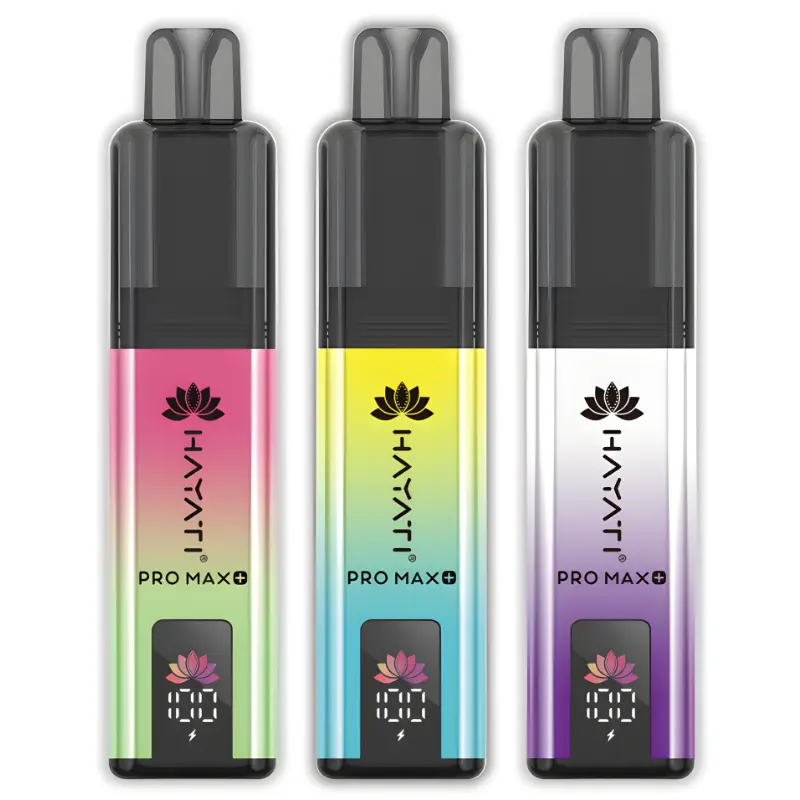
Hayati · Pro Max Plus
Hayati Pro Max Plus 6000 Prefilled Pod Kit
£7.99
✔ In stock — ready to ship
Genuine Hayati
Free over £20
Same-day dispatch
Secure checkout
Seven pounds ninety-nine buys a complete Hayati Pro Max Plus setup: a rechargeable body with a sealed twelve millilitre pod already seated in it, filled at 20mg nicotine salt, and Banana Ice recorded as the flavour value against this particular entry. Hayati put a ceiling of up to 6,000 puffs against a full pod. That figure is a laboratory estimate, produced by bench equipment repeating one draw to a fixed pattern, and it ranks listings against one another rather than forecasting anybody's fortnight. There is nothing else in the commercial description, and the liquid itself has already been taken apart at length by the strength-titled pages on this platform, so this page will not do it a fifth time.
What deserves the room instead is the name. This kit is called the Pro Max Plus 6000. Sitting next to it on the same shelf, at the same money, are thirty-five other kits called nothing more than the Pro Max Plus, with no numeral in the title at all. Scroll the shelf and you get two product names in an unsorted grid. Nobody tells you whether you are looking at one device written down two different ways, or at two devices that share three words and differ in something the title is trying to signal.
That is a fair question to have and it has never been answered anywhere on this site, so it gets answered here, with the counts in front of you rather than tucked behind a conclusion. It matters more than it sounds, because the answer you assume changes what you buy. A buyer who reads the numeral as a specification will avoid the unnumbered kits on the suspicion that they are an older or lesser version. A buyer who reads it as decoration will ignore it, and if they are wrong about that they will end up with a device that does not match the pods in their drawer. Both readings are reasonable from the grid. Only one of them survives the evidence.
The second half of the page is the more general lesson and it outlives this one shelf. A number in a product name and a number in a specification look identical on the screen and do completely different jobs. Puff ratings in particular start life as measurements and end up as model names, and once a measurement is doing duty as a name it stops behaving like a measurement. Pro Max Plus 4000, Pro Max Plus 6000, Pro Ultra Plus 25000: those read as a ladder and they are not one. Understanding why is the most useful thing on this page, because it tells you which numbers on a listing you may compare and which you may not.
Two ways of writing one platform, counted
Assertion is cheap here and counting is not, so everything below comes from the 492 listings in this shop's own product data rather than from an impression of the grid.
Start with the population. One hundred and seventy-nine titles in the catalogue contain the words Pro Max Plus. Of those, fifty-three also contain 6000, two contain 4000, and one hundred and twenty-four contain no numeral whatsoever. Split them by format and a clean pattern falls out immediately: every single one of the fifty-three titles carrying 6000 is a kit. Not one bare replacement pod anywhere in the catalogue has a numeral in its name. The Hayati Pro Max Plus Prefilled Pod Kit shelf holds eighty-eight listings, fifty-three of them numbered and thirty-five of them not. The matching pod shelf holds eighty-nine, and all eighty-nine are spelled the same way as each other.
So the ambiguity is not a property of the range. It is a property of one shelf. Buy pods and the naming is uniform and gives you nothing to worry about. Buy kits and you are choosing between two title conventions with no published explanation of either.
The split is a partition, not two versions of the same thing
The obvious first test is whether any flavour appears under both spellings, because if one did, the two forms would have to be two products. Normalise all eighty-eight kit titles down to the flavour name, dropping the brand, the platform words and the format words, then compare the two sets. The overlap is zero. Not small, zero. No flavour on that shelf exists both as a Pro Max Plus 6000 Pod Kit and as a Pro Max Plus Pod Kit, and there are no duplicates inside either set either.
Fifty of the fifty-three numbered listings carry a flavour name, the remaining three being this listing and its two strength-titled relatives. Thirty-five unnumbered listings carry a flavour name. Fifty and thirty-five make eighty-five, and eighty-five is exactly the number of distinct flavour names the bare-pod side of this platform is documented as carrying on our Pro Max Plus pods shelf page. The two spellings between them account for the whole flavour library once, and once only.
That is the first piece of evidence and it is a strong one. If the numbered and unnumbered kits were different hardware, the flavour library would have to exist twice over, once for each device, or else be divided so arbitrarily that owners of one device could never buy half the range. What the data shows instead is a single library with two ways of writing the label on it.
What the two sets publish about themselves
The second test is the specification, and here the result is blunter still. Pull the published description text for all eighty-eight kits and line the numbers up.
| Published figure | Fifty-three numbered kits | Thirty-five unnumbered kits |
|---|---|---|
| Shelf price | £7.99, every one | £7.99, every one |
| Sealed liquid | 12ml, every one | 12ml on thirty-four, one listing silent |
| Nicotine | 20mg on fifty-one, 10mg on one, 0mg on one | 20mg, every one |
| Manufacturer's laboratory ceiling | Up to 6,000 puffs on fifty-two, one listing silent | Up to 6,000 puffs, every one |
| What the box contains | Body plus one filled pod | Body plus one filled pod |
| Where the shop files it | Pro Max Plus Prefilled Pod Kit | Pro Max Plus Prefilled Pod Kit |
Read the fourth row twice, because it is the finding that settles the argument. Every one of the thirty-five kits whose title omits the number states the six thousand figure in its own description text. The number is not absent from those listings. It has simply been left out of the title and printed in the body instead. Pipeline Punch is the one unnumbered listing that never states a volume, and Blackcurrant Lemonade is the one numbered listing that never states a puff figure, and both of those look like ordinary copywriting gaps rather than evidence of anything. On every other row, across all eighty-eight listings, the two sets are the same.
There is a third corroboration and it comes from the shop's filing rather than from Hayati. All eighty-eight sit on one shelf. There is no separate shelf for numbered kits and no separate shelf for unnumbered ones. Filing can be careless, so that is not proof on its own, but it is consistent with everything else, and the contrast a few paragraphs below with how the seven millilitre line is filed makes it worth more than it first looks.
What the evidence supports, stated at its actual strength
Three independent lines converge. The flavour library partitions cleanly across the two spellings and appears exactly once. The published specifications match on both, including the puff rating, which sits in the title on one set and in the body copy on the other. The shop files all eighty-eight together. Taken as a whole, the reading the evidence best supports is that the Pro Max Plus 6000 and the Pro Max Plus, on the kit shelf, are one platform written down two different ways, and that the numeral is a difference in how the title was typed rather than a difference you can buy.
Now the qualification, because the gap between a strong inference and a published fact is exactly the thing this site has got wrong before. Hayati do not state anywhere that the two title forms name the same product. There is no compatibility chart, no model list, no line in any description saying the unnumbered kit is the 6000 under another name. Everything above is a reading of published specifications and filing. It is not a manufacturer's statement, and if you own a device and are matching a pod to it, check the range name printed on your device against the range name in the listing title and take that decision from the hardware rather than from a retail page, ours included.
Two things follow for the shopper immediately. Do not pay extra attention to a numbered kit on the assumption that it is the newer or larger one, because the price is the same and so is everything published. And do not skip the unnumbered kits on the assumption that they are a smaller or superseded version, because a third of the shelf is spelled that way and a good deal of it is not duplicated anywhere. Mr Blue, Blue Sour Raspberry and Blue Razz Pineapple are all unnumbered, and a buyer filtering the shelf on the numeral would never see any of them.
The one pattern in the split, and how far to trust it
Having established that the two sets do not differ in what they contain, the natural next question is whether they differ in anything at all. One thing does show up, and it is worth reporting with its uncertainty attached rather than dressed up as a finding.
Take each kit's flavour name and ask whether that flavour also exists somewhere in the catalogue away from the Pro Max Plus platform, as a Mini Ultra pod, a Rubik pod, a Pro Ultra Plus reserve or a bottle of nicotine salt. Among the fifty numbered flavour kits, twenty do. Among the thirty-five unnumbered ones, twenty-nine do. Forty per cent against eighty-three per cent is a wide gap and unlikely to be chance. Incidentally, twenty plus twenty-nine is forty-nine, which leaves thirty-six flavours exclusive to this platform, and thirty-six is precisely the figure our Pro Max Plus pods shelf page reached by a different route. Two counts arriving independently at the same number is the best corroboration available here.
What the gap probably means is dull and probably true: the two sets were written and loaded at different times, and the unnumbered batch happens to be weighted towards flavours Hayati also run elsewhere. That is a fact about this catalogue's history, not about the hardware. What it is emphatically not is a reason to prefer one spelling to the other, and anybody who reads a correlation like that as a product difference has made the exact error this page exists to correct.
A number in a name is not a number in a specification
The naming question above is local. The reason it confuses people is not, and the general version deserves setting out properly, because it applies to every vape listing you will ever read rather than to one shelf.
A puff rating begins life as a measurement. A manufacturer runs a filled pod on bench apparatus that draws on it repeatedly, to a set duration and a set interval, until the liquid or the coil gives out, and counts the draws. That is a real procedure producing a real number. It is also a number with conditions attached, and the conditions are where the trouble lives: draw length, interval, ambient temperature, the power the device delivers on each draw, and what counts as the end of a pod's usable life. Hayati publish the figure. They do not publish the protocol. Nobody in this trade does.
Under those circumstances the honest description of a rating is the one this site uses on every page: a manufacturer's laboratory estimate rather than a quantity you have bought. It stays useful as an internal marker, a rough index of how much work a pod is designed to do before it is finished. That is genuinely worth something.
Then the number migrates into the model name, and at that point it stops being a measurement and starts working as a badge. Once a figure is part of what the thing is called, it is no longer reporting anything. It is doing the job a letter or a word would do on another product, and it does that job well, because numbers feel precise in a way adjectives do not. Nobody who calls a device the 6000 is lying. They are naming it, and a name that sounds like a measurement is a good name from a seller's point of view. But a buyer who reads the badge as though it were still the measurement has been misled by the format rather than by the seller, and the effect on what ends up in the basket is the same.
How often this happens here, counted
One hundred and thirty-nine of the 492 listings in this catalogue carry a puff numeral in the title, and every one belongs to one of two platforms. The Pro Max Plus contributes fifty-five, being the fifty-three 6000 kits and two 4000 listings. The Pro Ultra Plus contributes eighty-four and manages three spellings for what is broadly one family: fifty-two titles ending 25000, thirty ending 25K, and two Shisha listings carrying 30000. Twenty more Pro Ultra Plus titles carry no number at all.
The remaining three hundred and fifty-three listings never name a figure. The Mini Ultra, across fifty listings, never does. The Rubik, across thirty-nine, never does. Neither does the Quokka, and neither does any of the sixty-four bottles in the Pro Max nicotine salt line. All of those products have ratings or capacities that could perfectly well have been printed into a name. They simply were not.
That distribution is the clearest available evidence about what the numerals are for. If a puff figure in a title were carrying a specification, you would expect it where the specification is most useful and absent where it is not. Instead it turns up on two platforms and nowhere else, and on one of those two it appears in three different spellings and is dropped from twenty titles outright. Our H'Berg / P'Man pods page counted that mess on the Pro Ultra Plus shelf and reached the same verdict from the other direction: a title ending in 25K and a title ending in Pods describe the same format at the same price, and the wording is a difference in typing. This shelf is the smaller, tidier version of the same disease.
One flavour, four boxes, and only one number
The cleanest demonstration available uses a single flavour that Hayati sell on four platforms at four prices. Blue Razz Cherry exists as a boxed kit four times over, and the four listings make the whole argument without any commentary needed.
| Listing | Sealed liquid | Price | Manufacturer's laboratory ceiling | Number in the title |
|---|---|---|---|---|
| Blue Razz Cherry Hayati Mini Ultra Pod Kit | 4ml | £3.99 | Up to 1,500 puffs | None |
| Blue Razz Cherry Hayati Rubik Prefilled Pod Kit | 12ml | £5.99 | Up to 7,000 puffs | None |
| Blue Razz Cherry Hayati Pro Max Plus Pod Kit | 12ml | £7.99 | Up to 6,000 puffs | None |
| Blue Razz Cherry Hayati Pro Ultra Plus 25000 Prefilled Pod Kit | 22ml | £11.99 | Up to 25,000 puffs, stated only in the title | 25000 |
Four boxes of what the listings call one flavour, and exactly one of the four titles names a figure. The three that do not are not hiding anything: their ratings are printed in the body copy, just as the unnumbered Pro Max Plus kits print theirs. So whether a number appears in a Hayati product name is independent of whether the number exists.
The middle two rows are the ones to sit with. Both hold twelve millilitres of the same flavour at the same 20mg. The Rubik is two pounds cheaper and carries a published figure a thousand puffs higher. If the ratings were a common currency, the cheaper box would be the better buy on both axes at once, which is a conclusion nobody should draw from two numbers produced on two different benches. And on the fourth row the 25,000 exists only as part of the name, because that listing's description text never repeats it. A figure that lives exclusively in a title has stopped being a specification by any reasonable definition.
Why the numbers do not form a ladder
Here is the move a buyer makes without noticing. They see 4000, 6000 and 25000 across three Hayati boxes, read them as one scale, and conclude the 25000 does roughly four times the work of the 6000, which in turn does half as much again as the 4000. That reasoning is intuitive, it is what the numbers invite, and it does not hold.
The reason has already been established on this site and does not need re-deriving. Our Red Razz GB / Blue Razz GB Pro Ultra Plus kit page divided each platform's published rating by the volume of liquid it applies to, and our Vim Ice Rubik kit page tabulated the result. Across four prefilled formats, sold by one brand at one nicotine strength, the rated puffs per millilitre run from 375 at the bottom to 1,136 at the top. That is a threefold spread. One millilitre of 20mg salt does not turn into three times as much vapour in one plastic shell as in another, so either those four ratings were produced under conditions that differ enormously, or the numbers are doing commercial work alongside their measurement work. Hayati publish nothing that lets anybody choose between those explanations.
The consequence is precise. Two ratings produced under unstated conditions, on different hardware, applied to different volumes of liquid, are not two values of one quantity. They cannot be divided into each other and the answer cannot be read as a ratio of anything. A 6000 against a 25000 is not four times the device. It is two numbers from two test runs nobody has described to you.
The Shisha kit makes the same point without any arithmetic at all. It holds twenty-two millilitres and costs £11.99, which is the same volume for the same money as Cherry Berry Hayati Pro Ultra Plus 25000 Prefilled Pod Kit, and the badge on its title is twenty per cent higher. Whatever accounts for that, it is not five thousand extra puffs sitting inside a pod of identical size.
The one place on this platform where the numeral does mean something
Now the complication, and it is the reason the whole thing is confusing rather than merely sloppy. The numeral in a Pro Max Plus title is not always empty. Sometimes it marks a real difference, and nothing in the title tells you which case you are in.
Hayati publish two listings carrying 4000: Hayati Pro Max Plus 4000 Pod Kit at £7.99 and Hayati Pro Max Plus 4000 Prefilled Pods at £5.49. That kit holds seven millilitres against this one's twelve, at an identical price, with a manufacturer's laboratory figure of up to 4,000 rather than up to 6,000. The shop gives each of the two listings a shelf of its own rather than filing them among the eighty-eight. So here the numeral is doing real work: it separates a seven millilitre fill from a twelve millilitre fill, and the gap is worth five millilitres of liquid for the same money.
Line the three comparisons up and the trap is obvious.
- Pro Max Plus 4000 against Pro Max Plus 6000. The numeral marks a genuine difference in volume and in the published rating, and the shop files the two on separate shelves. Worth reading.
- Pro Max Plus 6000 against Pro Max Plus with no numeral. The numeral marks nothing. Same volume, same strength, same published ceiling, same price, one shelf. Worth ignoring.
- Pro Max Plus 6000 against Pro Ultra Plus 25000. The numerals mark two genuinely different platforms, but the size of the gap between them cannot be read off the numbers, because the two figures are not on a common scale.
One numeral, three completely different jobs, on one brand's shelf, with nothing in any title to tell them apart. That is why a buyer cannot resolve this by looking harder at the name. The name does not contain the information required to interpret the name.
A word on the seven millilitre line while it is in view, because the temptation to fill this gap is strong and two pages on this site have already filled it in opposite directions. Whether a 4000 pod has anything mechanically in common with the twelve millilitre pods is not published by Hayati in any form, and it is not something to work out from a shared range name. If that question bears on a purchase, the answer has to come from the device in front of you.
What you can actually compare, and how to read a title
The negative half of this argument is easy to state and not much use alone, so here is the positive half. Two things on a Hayati listing are comparable across every platform in the catalogue, and they are the two that attract least attention.
Volume is a physical quantity. Millilitres are millilitres. They are published for every prefilled listing here, they mean the same thing on every shelf, and they divide cleanly into a price. Twelve millilitres in this box against twenty-two in a Pro Ultra Plus box against four in a Mini Ultra box is a real comparison of real quantities, and no question about test protocols enters into it.
Price is price. Every kit on this shelf is £7.99. A Rubik kit is £5.99 for the same twelve millilitres, a Mini Ultra kit is £3.99 for four, a Pro Ultra Plus kit is £11.99 for twenty-two. Divide the second figure by the first and you have something you can act on. Our Pro Ultra Plus 25000 kit page has already run that census across all ten prefilled prices in the catalogue and there is no reason to run it again; the point here is narrower, which is that the arithmetic works because both of its inputs are trustworthy.
Rated puffs are not in that category and should not be used as though they were. Use them for what they can do, which is to sit alongside a volume as a rough indication of how long a manufacturer expects one pod to do useful work. Do not convert them, do not divide one into another, and above all do not let a number in a model name stand in for the volume figure printed a few lines below it.
Applied to reading a title on this shelf, that reduces to four habits.
- Take the volume and the price out of the listing body, never out of the name.
- Treat the presence or absence of 6000 in a kit title as carrying no information, and do not use it to narrow a search.
- Treat a change of platform word, Pro Max Plus against Pro Ultra Plus against Mini Ultra against Rubik, as the thing that actually changes what arrives in the box.
- When you reorder, match the listing rather than the remembered name, because the name is the least reliable part of this.
Finding your way around eighty-eight kits
The umbrella job proper. This listing heads a shelf of eighty-eight boxed kits, all at £7.99, all holding twelve millilitres, all pairing one rechargeable body with one sealed pod. Eighty-five carry a flavour name and three carry a nicotine strength. Eighty-six of the eighty-eight titles end in the words Pod Kit, and only three contain the word Prefilled, which is mildly comic given the shelf is called the Prefilled Pod Kit shelf. Those three are the strength-titled ones, so on this shelf the word Prefilled in a title is a reliable signal that the title will not tell you the flavour.
How this shelf relates to the pod shelf
The flavour library question is settled elsewhere and should not be answered twice. Our Pro Max Plus pods shelf page did that work: it clustered all eighty-five flavour names by shared ingredients, found forty-three groups of which twenty-six are legible from their titles, and established that the kit shelf and the pod shelf mirror each other almost exactly, with a single asymmetry. That page is where to go if your question is which flavour, and everything it says applies here unchanged, because the eighty-five names on this shelf are the same eighty-five.
What is worth adding is the practical bridge between the two shelves, which follows directly from the naming finding above. The pod shelf is uniformly titled and the kit shelf is not. So the efficient route through the range is to settle the flavour question on the pod side, where every title is spelled the same way and the grid is at least internally consistent, then come back to the kit shelf for the matching box. When you do, expect the kit's title to be spelled either way and do not be thrown by it. Blueberry Raspberry Cherry comes as a numbered kit and Blueberry Cherry Cranberry comes as an unnumbered one. Both are £7.99, both hold twelve millilitres, both are three-berry blends, and the difference between the titles is nothing but the typing.
The other direction is worth knowing too. If you already own a Pro Max Plus body, the kit shelf is the wrong shelf for you and the pods are the cheaper route, because the gap between the two prices is the body and you only need to buy that once.
Four ways in, depending on what you already know
If you have no device and no fixed preference, the flavour is the only decision. Every box on this shelf costs the same and holds the same, so nothing but the liquid separates them. Start from the grouped map on the pods shelf page rather than from the grid, then find the kit with your chosen name on it. Something unambiguous is a sensible first purchase: Mixed Berries, Fizzy Cherry and Cherry Peach Lemon all say roughly what is in them, and two of those three carry the numeral while the third does not, which tells you how little it is worth as a sorting key.
If you know the family but not the version, pick the difference deliberately. Within a family the listings differ by one component at a time, so buying two adjacent ones teaches you far more than buying two distant ones. Blue Razz Lemonade against Blue Razz GB holds the blue raspberry base fixed and swaps a sharp fizzy carrier for a confectionery treatment. Blue Sour Raspberry against Blue Frozen keeps the colour and changes the structural device from acid to cold. Note in passing that Blue Frozen is the only one of those four whose title carries the numeral, and that all four are the same price on the same shelf.
If the name tells you nothing, treat that as the information. Several kits here are named for a mood or an invented word rather than an ingredient. Blue Fusion, Blueberry B'Gum, Blue Razz Fruit Twist and Mr Blue all withhold something, in different amounts. Twelve millilitres is a long commitment to a liquid whose description you cannot reconstruct from its name, so if the axis that decides a purchase for you is one the title never addresses, buy a named one first. Blackcurrant Juice and Double Apple are at the opposite end of that scale, naming a single fruit apiece, although the second borrows a shisha term and reads mint-led rather than as a straight apple.
If the strength is what you are choosing, the shelf is far smaller than it looks. Eighty-six of the eighty-eight kits are filled at 20mg. The other two are Hayati Pro Max Plus 6000 Prefilled Pod Kit 10mg and Hayati Pro Max Plus 6000 Prefilled Pod Kit Zero Nicotine (0mg), and both hold the same Banana Ice recipe as this one. Choosing anything other than 20mg on this platform means accepting the liquid that comes with it rather than choosing a liquid at all. Those two listings have pages of their own and both go into what the strength change does to the recipe in more detail than belongs here.
If the platform itself is the question
Twelve millilitres at £7.99 is the middle of Hayati's boxed range rather than either end of it. Below it, a four millilitre Mini Ultra kit at £3.99 is a much shorter commitment to a flavour and a much cheaper way to be wrong, which is why that format works well for meeting a profile before you hand twelve millilitres to it. Above it, a twenty-two millilitre Pro Ultra Plus kit at £11.99 is nearly double the liquid, and many listings on that platform divide the pod between two reserves behind a rotating mouthpiece, which is a structural option this platform does not offer at any price. The wider Hayati Pod Kits and Hayati Prefilled Pod Kits shelves gather every boxed format together for a side-by-side look, and the full Hayati catalogue is there if you would rather check the counts in this page than take them from me, which is the better instinct.
The published figures, ordered by how much they vary
The rows below are arranged by how much each value differs across the eighty-eight listings on this shelf, most variable at the top. On a range this uniform that ordering is more useful than the conventional one, because it puts the things you might actually need to check above the things that are identical everywhere and can be stopped worrying about.
| Row | This listing | Across the other eighty-seven |
|---|---|---|
| Flavour recorded in the product data | Banana Ice | Eighty-five distinct names, plus two strength-titled entries holding this same recipe |
| Title convention | Numbered, and one of only three on the shelf using the word Prefilled | Fifty-two others numbered, thirty-five unnumbered, no flavour appearing under both |
| Nicotine | 20mg, as a nicotine salt | 20mg on eighty-five others, 10mg on one, 0mg on one |
| Sealed liquid | 12ml, filled and closed at the factory | 12ml wherever a volume is stated at all |
| What the box holds | One rechargeable body, one filled pod | Identical |
| Price | £7.99 | £7.99, without exception |
| Manufacturer's laboratory ceiling | Up to 6,000 puffs, a bench estimate | The same figure, carried in the title on fifty-two and in the description text on thirty-five |
| Refillable | No. The pod arrives closed and is replaced whole | Identical |
| Not published anywhere on this shelf | Coil resistance, wick material, VG/PG ratio, charge time, power delivery, the test protocol behind the puff figure | The same silence on all eighty-eight |
Two rows deserve a sentence. The 20mg is the highest strength a nicotine-containing liquid may legally be sold at in the United Kingdom, so there is no stronger fill of this to go looking for, and nicotine is an addictive substance at every strength on the label. The final row is the one people most often assume must be knowable somewhere. It is not, and on this platform the silence is total and uniform, which at least means it cannot be a reason to prefer one listing over another.
On the hardware itself there is little left to say that eighty-seven other pages have not said better. The box holds a rechargeable body and one filled pod. Nothing is assembled, nothing is measured, nothing is set. When the pod is spent it comes out and a replacement goes in, and the replacements are the eighty-nine listings on the pod shelf at £5.49 rather than £7.99. The two pounds fifty between those numbers is the body, bought once.
Buying and reordering something whose name is unstable
The handling advice below is deliberately narrow. Most of what there is to say about looking after a sealed twelve millilitre pod applies to every listing on the shelf and is already on those pages. What follows is the part that exists specifically because the titles here are spelled two ways.
Record the listing, not the name you remember. A fortnight after finishing a pod most people can recall roughly what it tasted like and have lost the exact wording of the title. On a shelf where three fifths of the titles carry a numeral and two fifths do not, that is a real problem, because searching for the version you half remember may return nothing while the product sits there under the other spelling. The order confirmation solves it. It records exactly which listing you bought, with the wording as it stood on the day, and it does not degrade the way a memory does.
Do not use the numeral as a filter when you search. Typing the flavour plus 6000 hides thirty-five of the eighty-eight kits from you. Type the flavour word on its own and read the results.
Check the price before you check the name. This is the most reliable single guard on the whole range, and it works precisely because the naming does not. Every kit on this shelf is £7.99 and every replacement pod is £5.49. If you meant to reorder a refill and the basket says £7.99, you are about to buy a second body whether or not the title looked familiar. If you meant to buy your first kit and it says £5.49, no device is coming.
Buy one at a time until you know the flavour. Twelve millilitres is a longer commitment than it feels in a basket, and a kit you dislike cannot be returned once opened, decanted or refilled. Stocking up only starts to make sense once you know what you are stocking up on, and on a shelf where every listing costs the same there is no discount for guessing early.
Keep an unopened pod cool and dark, and finish one before opening the next. A factory-sealed pod in a drawer at room temperature is stable for a long time. One that has been seated in a device and taken out again is a different object, because the wick is wet and has been through heat cycles, and it reads flatter when you come back to it. Rotating half-used pods is what damages them, not the passage of time.
Judge a spent pod by the fruit, not by the liquid you can still see. Flavour drops away before the pod empties and it does not drop evenly. Sweetener and any coolant outlast the fruit, so the closing stretch tends to taste sweet, cold and vague rather than tasting of nothing at all. When that happens the pod is finished regardless of what is left in the window.
Dispose of the pod, and eventually the body, through the right route. A finished pod still contains a coil and a residue of liquid, and the body contains a cell, so neither belongs in an ordinary bin. Most vape retailers run a take-back point and local recycling centres accept small electrical items. Keep spares where children and pets cannot get at them in the meantime.
Questions this listing raises
Is the Pro Max Plus 6000 a different device from the Pro Max Plus?
Everything published points to one platform written two ways. The eighty-eight kits on the shelf split fifty-three numbered and thirty-five unnumbered, no flavour appears under both spellings, and both sets state twelve millilitres, 20mg, £7.99 and the same laboratory ceiling. Hayati never state that the two names are one product, so this is a reading of the specifications rather than a manufacturer's statement.
Why do only some kits have the number in the title?
Nothing published explains it. The best available guess is that the two sets were written at different times, weakly supported by the finding that twenty-nine of thirty-five unnumbered flavours also exist on other platforms against twenty of fifty numbered ones. That is a fact about catalogue history rather than hardware, and it is not a reason to prefer either.
Do the unnumbered kits still have a puff rating?
Yes, and it is the same one. All thirty-five state a manufacturer's figure of up to 6,000 in their own description text. The number has been left out of the title and printed in the body instead, which is the clearest single piece of evidence that a title numeral is not carrying a specification.
Is a 25000 device roughly four times a 6000 one?
No, and the ratio cannot be computed at all. Rated puffs per millilitre across four Hayati prefilled formats run from 375 to 1,136, a threefold spread on liquids sold at one strength by one brand, which our Vim Ice Rubik kit page tabulated and our Red Razz GB kit page derived. Ratings produced under unstated conditions on different hardware are not two values of one quantity.
What should I compare between platforms instead?
Volume and price. Millilitres mean the same thing on every shelf and divide cleanly into a price, so twelve millilitres at £7.99 against twenty-two at £11.99 against four at £3.99 is a real comparison. Leave the puff numerals out of the arithmetic entirely, because they are not on a common scale.
Does the 4000 in the other kit's name mean nothing either?
That one does mean something. The seven millilitre 4000 kit holds five millilitres less than this one at the same £7.99, carries a lower published figure, and is filed on a shelf of its own rather than among the eighty-eight. So on this platform the numeral is load-bearing in one comparison and empty in another, which is exactly why a title cannot be read at face value.
Will a 4000 pod work in the device that comes in this box?
Hayati do not publish an answer and this page will not invent one. Two pages elsewhere on this site once stated opposite answers to that question, both confidently, and both were reasoning from a shared range name rather than from anything published. Take a fitment decision from the device you are holding.
What flavour is in this box, given the title does not say?
The product data records Banana Ice, a soft sweet banana with a cooling finish. Three listings on this kit shelf are titled by strength rather than flavour and all three hold that recipe, as do the four strength-titled entries on the pod shelf. Our zero-nicotine and 10mg pages take the liquid apart properly; this one does not.
How many kits are on this shelf, and do they all cost the same?
Eighty-eight, and yes, every one is £7.99 holding twelve millilitres. Eighty-five carry a flavour name and three carry a strength. Since price, volume and strength barely move across the whole shelf, the flavour is effectively the only variable you are choosing between.
Should I buy the kit or just the pod?
If you already own a Pro Max Plus body, buy the pod. The pods hold the same twelve millilitres at £5.49 against the kit's £7.99, and the difference is a body you only need once. The kit is the right purchase on a first order, or when you genuinely want a second body.
How do I make sure I reorder the same thing?
Work from the order confirmation rather than from memory, because the title is the least stable part of this and the numeral may or may not be in it. Then check the price before the name: £7.99 is always a box with a body in it and £5.49 is always a pod on its own.
Is a number in a name ever worth paying attention to?
Only when it arrives with a change of platform word or a change of volume. Moving from Pro Max Plus to Pro Ultra Plus or Mini Ultra changes what turns up. Moving from 6000 to no number on this shelf does not, and across the wider catalogue only 139 of 492 titles carry a numeral at all, spread over two platforms and three spellings.
The short version
This box is £7.99 for a rechargeable Pro Max Plus body and one sealed twelve millilitre pod at 20mg nicotine salt, with Banana Ice on the record and a manufacturer's laboratory ceiling of up to 6,000 puffs attached to the pod. It heads a shelf of eighty-eight boxed kits, every one at the same price and the same volume, so the flavour is very nearly the only thing you are choosing.
On the naming question the evidence is consistent and points one way. Fifty-three of those eighty-eight kits carry 6000 in the title and thirty-five carry no number. The two sets share no flavour between them, they account for the eighty-five names on the platform exactly once, they publish identical volume, strength, price and puff figures, and the shop files them on a single shelf. All thirty-five unnumbered listings state the six thousand figure in their body text. The reasonable conclusion is one platform under two title conventions, with the numeral a difference in typing rather than a difference you can buy. Hayati do not say so themselves, so treat that as the best reading of the published data and settle any fitment question against the device in your hand.
The larger lesson is the one to carry off this page. A puff rating is a laboratory estimate with unpublished conditions attached, and when it climbs into a model name it stops describing performance and starts working as a badge. That is why 4000, 6000 and 25000 do not form a ladder anybody can climb, and why a threefold spread in rated puffs per millilitre sits underneath those numbers unmentioned. One flavour, Blue Razz Cherry, is sold in four boxes at four volumes and four prices, and exactly one of the four titles names a figure. Volume and price are published, consistent and comparable across every shelf here. Rated puffs are not. Buy on the two that are.
Strictly for adults aged 18 and over. Nicotine is an addictive substance.
You might also like


