
Home / Hayati Pro Max Plus Prefilled Pod Kit / Cherry Peach Lemon Hayati Pro Max Plus 6000 Pod Kit
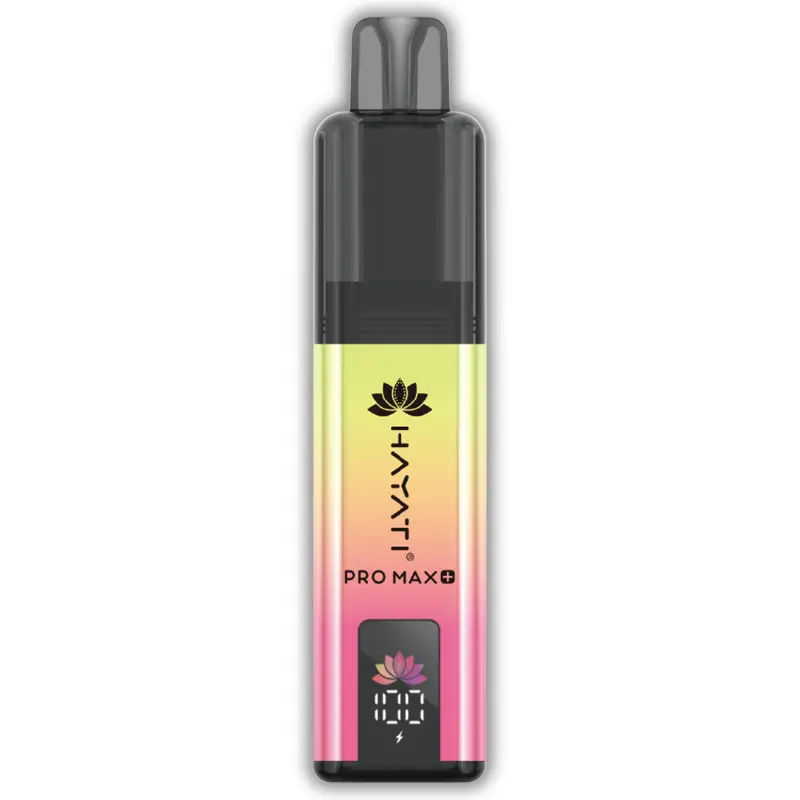
Hayati · Pro Max Plus
Cherry Peach Lemon Hayati Pro Max Plus 6000 Pod Kit
£7.99
✔ In stock — ready to ship
Genuine Hayati
Free over £20
Same-day dispatch
Secure checkout
Cherry Peach Lemon in kit form is £7.99 for a rechargeable body with an 850mAh cell and one filled 12ml pod of 20mg nicotine salt, closed at the factory with its mesh element already inside it. Hayati put a ceiling of 6,000 puffs on a full pod. That number came off bench apparatus taking identical pulls to a clock, and since this page is about to spend several thousand words on why identical pulls are the one thing this particular liquid does not reward, read the figure as a device for placing listings side by side, not as a forecast of your fortnight.
The specification is the same specification as the other eighty-seven listings on the Pro Max Plus kit shelf, so it is not why you are here. What is different about this one is not in the box at all. It is in the order the liquid arrives in.
The Cherry Peach Lemon pod listing, which is the same recipe at £5.49 for people who already own a body, did the chemistry on this blend and did it thoroughly. It established that the three fruits do not separate for the reason everyone assumes, and it established the order in which they reach you. What it did not do, because it had already spent its length elsewhere, is ask what a blend built that way is actually like to drink over a fortnight.
That question turns out to have a longer answer than it looks. A liquid that arrives in stages is not a more detailed version of a liquid that arrives all at once. It is a different kind of object, with a different relationship to your attention, a different decay curve, and one control surface that most pods on this shelf simply do not offer. It also has a specific way of letting you down that produces no complaint at all, which is the part worth knowing before you spend £7.99.
What the pod page settled, and what it handed on
Three findings from that page are load bearing here. I am citing them rather than rebuilding them, because rebuilding them would waste the space this page needs and would produce a worse version of an argument already made properly.
The first is taxonomic. The premise that this blend works because its three fruits come from widely separated parts of the plant kingdom does not survive a count. Cherry and peach are congeners, both of them Prunus, both of them single-stone drupes, and on family spread this listing ranks in the middle of the eight three-fruit titles on its shelf rather than at the top. Ancestry is not the mechanism and the pod page shows why in detail.
The second is the one everything below depends on. What separates the three components is not how they are classified but what chemical class carries each of them, and those classes sit in different volatility bands. The light citrus material comes off the coil first and reaches you first. The marker that makes a cherry note recognisable is mid-weight and occupies the middle. The stone-fruit lactones that carry peach are the heaviest aromatic material in the recipe, they volatilise slowest, and they are still arriving after the vapour has gone. Citrus at the front, cherry through the middle, peach at the back and beyond. That is the sequence, it is the pod page's finding, and I am taking it as read.
The third is a contrast the pod page drew and I want to keep in view, because it frames the whole purchase. Hayati sell the same pair of stone fruits in a product built on the opposite principle. Cherry Ice / Peach Mango on the Pro Ultra Plus keeps cherry and peach in separate internal reserves of one pod, with a rotating collar choosing which one feeds the shared coil. The same company, looking at the same two fruits, has shipped one product that blends them into a sequence and another that walls them off and lets you switch. Both cannot be the right answer, and holding them side by side is the clearest way to see what you are actually buying here.
Everything from this point is mine, and it is about consequences rather than causes.
Three moments, and only two of them happen while you are inhaling
The word sequence suggests three evenly spaced events, like beats. That is not the shape of it, and getting the shape right changes the advice that follows.
The draw is short, and the sequence is not inside it
A pull on a restricted device of this sort runs somewhere around two seconds. Two of the three arrivals are crowded into that window and they are close together: the acid rides in with the liquid fraction and lands almost immediately, the light citrus material is right behind it, and the cherry marker follows closely enough that most people will hear the two as a single event with a dark centre. Calling that two distinct moments is generous. It is more honest to call it a chord.
The third arrival is not in the window at all. The stone-fruit compounds are slow and weighty, and what defines them is persistence rather than impact. The peach in this blend is something that happens to you after you have stopped inhaling, in the two or three seconds when your mouth is empty and you have already decided what you think.
So the real structure is a chord and an echo. Not three beats in a row. One compound event that you hear while you are drawing, and one quiet event that you hear only if you are still listening afterwards. That distinction is not pedantry, because the two parts of the structure have completely different requirements. The chord arrives whether or not you are paying attention. The echo is conditional on you.
The gap between draws is part of the flavour
Follow the consequence. If the third component lands in the silence after a draw, then the length of that silence is a flavour variable. Nobody thinks of the interval between pulls as something that changes what a liquid tastes like, because on almost every other pod it does not. On a liquid whose character is front-loaded, the gap is dead time. Here it is where a third of the recipe lives.
Take a draw and then take another two seconds later and you have covered the peach with fresh vapour before it finished arriving. Do that all day and you will drink 12ml of a three-fruit liquid and meet two fruits, and you will not have done anything wrong in any obvious sense. The pod will not have failed. You will simply have used a cadence that is incompatible with the way the liquid is built.
This is the first of two controls the blend hands you, and it is the one nobody mentions because it is not a control on the device. It is a control over your own rhythm. Ten to fifteen seconds between pulls is enough for the tail to land and clear. Anything much shorter and the structure is functionally two-band regardless of how well the recipe was made.
What it reduces to when you are not paying attention
Now be realistic about how vaping actually happens. Most draws are taken while doing something else. Walking somewhere, waiting for a kettle, halfway through a sentence in your head. Under those conditions the echo is not perceived at all, and what you get is the chord: a bright, sharp, sweet red impression with a dark centre. It is perfectly pleasant. It is also, and this is the uncomfortable part, indistinguishable from a version of this recipe where the peach was dosed too lightly to hear in the first place.
That equivalence deserves stating plainly, because it is the most practically important thing on this page. The failure mode of the product and the failure mode of the user produce the same result. A distracted vaper cannot tell a well-built Cherry Peach Lemon from a badly built one. Both taste like cherry and lemon. The only way to tell them apart is to stop and listen to the gap, and the only people who will do that are the people who already know there is something to listen for.
Which means the money you spend on the third fruit is spent on a component you have to actively collect. That is not a criticism of the blend. It is a description of what sort of purchase it is, and it separates the people who will get value from it from the people who will not far more reliably than any question about whether they like peach.
Legible on the first pod, tiring by the fifth
There is a second thing attention does here, and it runs on a longer clock.
The first pod of a sequenced blend is genuinely interesting, because the shape is new information. You notice the order. You notice that something is left behind. You form opinions about proportion. That is real value and it is why a blend like this reads better than a flat one in the first few days.
The problem is that the shape is finite. Once you have learned it, and a pod is more than long enough to learn it, the sequence stops carrying information. The liquid has not changed at all. What has changed is that the structure is now predicted rather than discovered, and a structure you predict is just a texture. At that point you are drinking a liquid that still asks for attention and no longer pays for it, which is a worse position than a straightforward blend puts you in, because the straightforward blend never asked.
Palate adaptation to the taste itself is slower and is not the issue. What wears out is the novelty of the arrangement. That is why the fifth pod of this can feel like work in a way that the fifth pod of a single-fruit liquid does not, even for someone who still likes the taste perfectly well. The pod page reached the edge of this observation from the chemistry side. Coming at it from the buyer's side, the finding is sharper than it first looks, because it has a remedy that a taste-based tiredness does not.
The remedy is rotation. If what has worn out is your familiarity with a shape, then a fortnight away from the shape restores it, and restores it fairly completely. That is not true of a flavour you have simply had too much of, where the aversion tends to stick. So this liquid behaves unusually well as one of three pods in circulation and unusually badly as the only pod you own. The conclusion is not obvious and it is worth acting on: buy this if you rotate, and if you do not rotate, buy something rounder.
The sweetness and the absence of cold, in one paragraph each
Sweetness sits a little above the middle of the shelf, and the pod page explains the mechanism properly, including why a blend with a soft tail can register as sweet while carrying less added sweetener than a tart citrus recipe would need. The only thing worth adding from the sequence angle is where the sweetness sits: it is not distributed evenly across the draw, it is concentrated in the middle and the tail, so a short pull tastes drier than the recipe is and a long one tastes sweeter. Sweetness here is partly a function of how you drink it, which is unusual.
There is no coolant here. The Blue Frozen pages went through the whole catalogue counting how this range uses its temperature vocabulary, and found both that a cooled listing always announces itself in its own title and that the several words in use are not ranked against each other. A title made of three fruit names and nothing else is trustworthy on this point. For this blend the absence is structurally helpful rather than neutral. A coolant would occupy the front of the draw and the airway, ground already occupied by the quickest and most assertive part of this profile, and it would push the faintest part further into the background. If you want the three-part shape audible, you want it uncooled.
Draw length is a contrast control, and it only works one way
The second control is draw length, and on this liquid it does more than it does on most. The body has no button, no airflow collar and no wattage setting, a point the Blue Razz Fruit Twist pages made for this platform generally, so length is the only thing about the draw that can vary. What makes it interesting here is not that it is the only variable. It is that this particular liquid is unusually responsive to it, for a reason you can reason out from the sequence.
What a short pull gives you
A brisk pull of roughly a second moves less air across the coil, keeps the element at temperature for less time, and vaporises less liquid. The material that needs the least help is unaffected. Citric acid does not need to volatilise at all, since it rides in the liquid fraction, so the sharpness arrives in full. The light citrus aromatics come off almost immediately and they arrive in full too. The cherry marker, being mid-weight, arrives but quieter. The lactones barely get started, because they are the part of the recipe that most needs time and heat, and a short pull gives them neither.
The result is a lean, sharp, bright reading of the blend with a dark middle and almost no tail. It is quick, it is dry by this liquid's standards, and it is what most people will get most of the time without ever deciding to. If you have taken a couple of hurried pulls out of a window and concluded this is a lemon liquid with something red in it, that is not a misperception. That is what short pulls make.
What a long pull gives you
A slow pull of around three seconds moves considerably more liquid over a coil that has been held at temperature longer, and the extra output is not distributed evenly across the recipe. The light material was already fully present, so it does not get proportionally louder. The heavy material was the part being left behind, so it is the part that gains. Lactones come off in greater quantity, the tail lengthens, and the whole profile tips towards the stone-fruit end.
Perceptually the change is larger than the mechanism sounds, because you are not just adding peach. You are lowering the ratio of front to back, which makes the citrus read as a lift on top of something soft rather than as the main event. The same 12ml can taste like a sharp fruit liquid with a shadow or like a rounded stone-fruit liquid with a citrus edge, and the difference is how you breathe.
The asymmetry nobody mentions
Here is the part that matters and that I have not seen stated anywhere. The control is not symmetrical, and understanding why tells you exactly what it can and cannot do for you.
The light end of this recipe is unconditional. It arrives first, in full, on every draw, regardless of length, because nothing about it depends on how long you pull. You cannot turn the lemon down. The heavy end is conditional. It arrives in proportion to how much liquid you move and how long the coil stays hot, so it is the only part of the recipe you have any purchase on.
Which means draw length does not balance the blend. It only ever adds to one side. The floor of the adjustable range is the recipe with its tail missing, which is roughly a two-fruit liquid. The ceiling is the recipe complete, as the formulator intended it. There is nothing above the ceiling: you cannot make a peach-led liquid out of this by pulling harder, because a long draw delivers the whole recipe rather than a re-weighted one, and the citrus is still at the front of it.
So it is a contrast control rather than a balance control. You are choosing how much of the blend to collect, not which parts. Someone who bought this because they wanted the peach can get all the peach that is in it and no more, and if the answer turns out to be not much, no technique will help. That is the honest limit, and it is the reason the diagnostic below matters more than the technique does.
What using it costs
Three costs, all small, all real.
The first is liquid. A long pull vaporises more of the pod than a short one, which is arithmetic rather than opinion, and Hayati's 6,000 figure was produced by a machine drawing at a fixed length that is not yours. Deliberately lengthening your pulls to collect the tail moves your real number away from the published one in the direction of fewer draws from the same 12ml. That is not a reason to avoid doing it. It is a reason not to be surprised.
The second is that the control has no memory. A wattage dial stays where you put it. Draw length is re-decided every single time you lift the device, which makes it a habit rather than a setting, and habits drift. Ten minutes into a session you are drawing however you normally draw, and the deliberate long pull you took at the start is not a state the device is holding for you.
The third is repeatability. Human draws vary a great deal, which means you cannot reliably compare the blend against itself. If you take a short pull and then a long one and the long one tastes rounder, you have learned something. If you take two nominally identical pulls and they differ, that could be the liquid or it could be you, and there is no instrumentation on this device to tell you which. Any conclusion you draw about proportions should be held loosely for that reason.
Match the length to the interval, not to the mood
The two controls interact and the interaction is the useful bit. A long pull collects the tail, and the gap afterwards is where the tail is heard. Doing one without the other is wasted effort in both directions: a long pull followed immediately by another draw buries the material you just went to the trouble of lifting, and a long gap after a short pull leaves you listening to a silence with nothing in it.
So the practical pattern is paired. When you have the attention to spare, pull long and leave the gap. When you do not, pull short and accept that you are drinking the two-fruit version, which is a perfectly reasonable thing to do and costs you nothing except the part of the recipe you cannot hear anyway. What does not work is treating the blend as one thing and expecting it to deliver the same experience through both modes. It will not, and that is not a fault in the pod.
How the sequence collapses, and why the warning light is at the bottom
Every prefilled pod gets worse as residue builds on its mesh, and every page on this shelf says so. What is specific here is the order in which this liquid loses things, and the pod page made a prediction about it that inverts the standard advice.
The standard advice, which holds on most liquids, is that the top note is the canary. Delicate volatile material is the first thing a tiring coil stops lifting, so when the bright edge goes flat you know where you are. The pod page argues the opposite applies to this recipe: as residue accumulates, heavy aromatic material is the first casualty, not the last, so the part of this blend that fails first is the base. I am taking that prediction as given rather than re-deriving it, and what interests me is what it implies for a liquid whose base note is also its third act.
The shape of the decline
Run it forward and the collapse has stages, and they are not the stages a buyer expects.
Early on you have the full structure: chord, then echo. The pod tastes like the product description promises, assuming the recipe was built well in the first place.
The first thing to go is the echo. The draw itself does not change. The sharpness is intact, the cherry is intact, the vapour looks the same and there is no flatness to notice. What changes is that the silence afterwards goes quiet. This is the single most important thing to understand about living with this pod, because the loss happens entirely in the part of the experience that most people were not attending to. You can lose a third of the recipe without noticing anything at all.
Next the middle loses ground. The cherry marker is mid-weight, which puts it second in the queue behind the lactones and ahead of the citrus, so as the coil worsens the cherry stops holding its own position and crowds forward into the opening. The chord tightens. What was a bright attack over a dark centre becomes a single bright sweet event with a suggestion of red in it.
By the last stretch you have one impression: sharp, sweet, fruity, over quickly. It is not unpleasant and there is nothing obviously wrong with it. It is simply not a three-part liquid any more, and it has not been for some time.
The finding, which is not what you would guess
Put those stages together and the conclusion is that this pod does not lose intensity first. It loses order first. Volume holds up better than structure does, and structure is the thing you paid the premium of your attention for.
That gives a sequenced blend a shorter useful life than its 12ml implies, if the sequence is what you bought it for. There is a stretch in the middle of the pod, and I cannot tell you how long because nobody can, where the liquid is perfectly serviceable and no longer the product. Most people will keep vaping through it quite happily, which is the right thing to do with a pod you cannot refill, and will simply be drinking something less interesting than what they chose.
It also means the usual signal is useless here. Waiting for the flavour to go flat will not tell you that the sequence has gone, because the sequence goes first and the flavour goes later. The signal you want is a missing tail: the day a draw stops dead, with the mouth empty five seconds later, is the day the coil has passed the point where it can lift the heavy end. The pod page proposes the same gap as a one-off diagnostic for whether the two stone fruits were ever built as separate notes. The longitudinal use is different and just as valuable: check the gap once a day, and the day it goes quiet is the day the recipe stopped being what you bought.
Three roads to the same destination
Something uncomfortable falls out of all this. The pod page identified several ways the recipe itself can fail, and observed that they converge on the same outcome: a two-fruit liquid wearing a three-fruit name. Add the two mechanisms this page has described and there are now more roads than that, and they all end in the same place.
Dose the peach conservatively and you get cherry and lemon. Vape it at speed and you get cherry and lemon. Run the coil down and you get cherry and lemon. Three unrelated causes, one identical result, and no way to distinguish between them from inside the experience. If your pod is not delivering a third fruit, you genuinely cannot tell whether the liquid is at fault, the coil is at fault, or you are.
The pod page put its finger on why that matters commercially: this sort of failure produces indifference rather than complaint. Nobody returns a pod because it was pleasant. I want to take that seriously as a buying risk rather than as an observation, and I will come back to it when the question is whether to spend the £7.99.
The kit itself, briefly
Ninety-odd listings share this device and its hardware has been documented past the point of usefulness, so the wider Hayati kit shelf is the place to go for that. Only three things about it bear on this liquid.
The box holds a rechargeable device with an 850mAh cell and one prefilled 12ml pod at 20mg in salt form, together at £7.99. The same liquid without hardware is £5.49, so the arithmetic is straightforward: if there is already a Pro Max Plus in a drawer, the kit listing is the wrong one.
One line on the sheet actually matters for this liquid, and it is the coil. A single mesh element is enclosed in the pod, it processes the whole 12ml, and it cannot be reached, rewicked or swapped. Whatever condition it is in is the condition you are vaping in, permanently. On most blends that is a slow fade you can shrug at. Because this recipe spreads its components across three different volatility bands, the collapse described above is something other than a maintenance problem with a fix. It is the pod's life story, and the only intervention available is to buy another pod.
Beyond that there is very little to say that has not been said better elsewhere on this site. Hayati publish no coil resistance for this listing, no carrier ratio, and no charging specification, so this page states none of those. One fitment note and no more: match the range name printed on your device to the range name in this title before ordering refills, because a hardware fitting is not something to take off a retail page, including this one.
The sheet, ordered by how much each line changes the taste
Most spec tables run hardware first and liquid second. That ordering is useless on this product, because the lines that decide what it tastes like are mostly not hardware and two of them are not on the sheet at all. The table below runs from most influential to least, which puts the published figures surprisingly far down.
| Decides what you taste, and is yours | |
| Length of each pull | Not published, not settable, decided by you on every draw |
| Interval between pulls | Also yours, and unusually consequential on this recipe |
| Condition of the coil | Changes continuously across the 12ml, cannot be restored |
| Decides what you taste, and was fixed at the factory | |
| Named components | Cherry, peach and lemon, blended into one recipe |
| Ratio between them | Never published, in any form, on either listing |
| Cooling | None named, none implied by the title |
| Nicotine | 20mg, salt form, the only strength on this listing |
| Decides the transaction | |
| Price of the kit | £7.99 |
| Price of the same liquid alone | £5.49 as a pod, for a body you already have |
| Liquid supplied | 12ml, filled and sealed before packing |
| Device cell | 850mAh, rechargeable |
| Maker's puff figure | Up to 6,000 per full pod, from laboratory apparatus |
| Coil | Mesh, enclosed, not serviceable |
| Not on the sheet anywhere | |
| Ohm rating of the coil | Nowhere in this listing's data |
| VG and PG split | Not given |
| Flavouring percentages | Not given, as on every sealed pod this brand lists |
| Date of filling | Neither published nor printed on the packet |
| Brand | Hayati |
The first group is the argument of this page in table form. Two of the three lines that most affect what this liquid tastes like are behaviours rather than specifications, they appear on no product page anywhere, and they are free. That is an odd thing to find at the top of a spec table and it is accurate.
The ratio row is the one that governs every inference about proportion, here and on the pod page. Hayati have never published how much of each fruit is in the recipe and are under no obligation to. Any page that reasons from compound classes, as both of these do, and then reports the result in the same voice it uses for the price has told you something it does not know.
Twenty milligrams is where United Kingdom law stops, and it is what nearly every sealed pod of this shape arrives filled to. Nicotine is addictive. The figure sits on the sheet as information, and nothing on this page is guidance about which number anybody ought to be holding. Separate range-level kit listings do exist at 10mg and with no nicotine at all, next to the unnamed range listing, but nothing in this listing's data confirms that Cherry Peach Lemon is one of the flavours they cover, so do not plan around it.
How it compares, sorted by how the blend arrives
The usual way to compare fruit pods is by fruit. On this shelf that produces a long list of red things and does not help anyone. The more useful sort here is by arrival shape, because the decision you are actually making is whether you want a liquid that unfolds or a liquid that lands.
Blends that arrive all at once
The berry stacks are the clearest contrast and the shelf is thick with them. Blueberry Raspberry Cherry and Blueberry Cherry Cranberry both name three components, exactly as this one does, and both behave completely differently in the mouth. Their components sit in the same aromatic register and the same weight band, so they reinforce rather than sequence, and what you get is one composite berry impression that is denser than any of its parts and does not change across a draw.
That is not a worse product. For a great many people it is the better one. A composite asks nothing of you, it tastes the same whether you are concentrating or not, it does not decay in a way you have to interpret, and it never becomes work. If everything above has made a sequenced blend sound like effort, these are the honest alternative and they cost the same.
Cherry Berry is the two-component version of the same idea, simpler still, and the Rubik edition of Blueberry Cherry Cranberry at £5.99 puts the same composite on different hardware while still holding 12ml.
Blends that arrive in two parts
A two-band construction is the middle position and there are several worth naming. Cherry Cola leans into the aromatic marker that carries cherry rather than trying to hold it in check, and the result is unambiguously confectionery with no citrus in the way. Fizzy Cherry puts a prickle over the red fruit, which is a sensation layered on a taste rather than two tastes in order.
Cherry Sour Raspberry is the useful comparison for anyone whose interest in this pod is the sharpness. A dosed sour treatment behaves quite differently from fruit acid: it makes the mouth water and it hangs around, so it occupies the tail position that peach occupies here. Same three-part instinct, opposite casting.
White Peach Raspberry is the closest thing on the shelf to this blend with the citrus removed and a berry put in its place. Without a fast top note at the front, the lactone tail is no longer the quietest thing in the recipe, which is the cleanest demonstration available that peach's problem here is position rather than volume.
On the lemonade side, Blackcurrant Lemonade and Blue Razz Lemonade both use citrus as a base rather than as a component, which flattens the sequence deliberately. If the thing you liked in this pod was the brightness but you found the structure tiring, that is the direction to go.
Separated by construction rather than by chemistry
The dual-reservoir products are the real philosophical alternative and they deserve more than a mention. The Pro Ultra Plus Cherry Ice / Peach Mango kit at £11.99 is one 22ml pod with the red fruit held in one internal reserve and the stone fruit in the other, and a collar that chooses which reserve feeds the shared coil. Hayati publish that the collar selects a side and nothing about how the division works, so that is as far as any description should go.
Compare the two mechanisms directly and they are opposites. Switching is a discrete control: you get one fruit or the other, the choice is explicit, and you make it dozens of times a session. Draw length is continuous: you get more or less of the same recipe, the choice is implicit, and most of the time you are making it without realising. Discrete controls are easier to operate and produce less interesting results. Continuous controls are harder to operate and produce results you may not be able to reproduce. Which of those suits you is a genuine question about temperament rather than about fruit.
There is also a cheaper way to find out whether you enjoy operating a flavour at all. The Mini Ultra version of the same pairing is £3.99 for a 4ml pod with the same rotating selection, which is a third of the liquid at half the price. It answers a different question from the one this page is about, but it answers it for a lot less money, and for anyone unsure whether they want a flavour that needs attention it is the sensible place to find out. Blue Razz GB / Lemon Lime is the same construction with a citrus on one side, if the sharp half of this blend is the half you would keep.
One thing, no structure
The opposite pole is a single component with nothing to track, and the peach route is well served. Juicy Peach hands the stone-fruit material the entire draw instead of its last few seconds, which abolishes the position problem outright. What you lose is the acid, and a soft round liquid with nothing cutting it can become wearing over 12ml in a different way.
Peach Green Tea is the more interesting recommendation for anyone whose complaint here turns out to be a peach they could not hear. Its partner is not a fruit at all, so nothing in that recipe is in a position to bury the stone fruit, and what it contributes is dryness and a faint tannic grip rather than further sweetness. Peach Aura sets an ingredient beside an abstract noun, so one half of the title is verifiable and the other half is published nowhere. Only the peach part of that name carries information.
Blackcurrant Juice is the plainest one-idea listing on the shelf: a single fruit, no arrangement to follow, and an opinion that turns straight into a repeat order with nothing lost on the way. On the red side, Blue Razz Cherry puts cherry against the sweetest and most synthetic partner available, which is about as far from this construction as you can get while keeping the same lead fruit, and the Rubik version offers the same pairing at £5.99 on different hardware.
Browsing by fruit instead
If you would rather work from the ingredient than the structure, the three shelves this listing sits on are all short enough to read through properly. Cherry Vapes runs to seventy-two listings and is the thickest of the three, which tells you where the range's attention is. Peach Vapes holds thirty-two across every format Hayati make. Lemon Vapes holds fifty-four, and scanning it makes a point no paragraph can: lemon in this range is almost always carrying a lemonade or paired with lime, and a stone fruit is not the company it usually keeps.
Who should buy 12ml of this, and who should not
The commitment is worth counting properly, because it is larger than it looks and there is no smaller version of it.
Across the 492 listings Hayati sell, the published pod capacities come in five sizes: three listings at 2ml, fifty at 4ml, two at 7ml, two hundred and sixteen at 12ml and a hundred and four at 22ml, with the remainder not stating a figure. So 12ml is not a large pod by the standards of this catalogue. It is the standard one, and the range genuinely does offer smaller.
It just does not offer smaller for this recipe. Cherry Peach Lemon exists in exactly two listings in the whole catalogue, this kit and the pod, and both hold 12ml of identical liquid. There is no 4ml version, no sample, no way to buy a third of it. Whatever you conclude about this blend, you will conclude it while holding a fortnight of it.
The case for
Buy it if you rotate. This is the single strongest predictor, for the reason set out earlier: what wears out on a sequenced blend is your familiarity with its shape, and that recovers over a break in a way that genuine flavour fatigue does not. Two or three pods in circulation and this one stays interesting for a long time.
Buy it if at least some of your vaping is unhurried. Not all of it. Some. The blend does not require constant attention, it requires occasional attention, and a person who takes ten considered draws a day will get the whole product even if the other forty are hurried.
Buy it if you like having something to notice, and if the idea of a liquid with a technique appeals rather than irritates. Some people find that a pod they can operate is more engaging than a pod they simply consume. That is a real preference and this is one of the few listings on the shelf that rewards it.
Buy it if you want sharp and soft in the same liquid without a coolant doing the work. There are not many places in this range where a citrus meets a stone fruit, and the combination is genuinely less common than the size of the catalogue suggests.
The case against
Do not buy it if this will be the only pod you own. The fifth-pod problem is real and it is worse for a structured liquid than for a flat one.
Do not buy it if you vape fast. A short cadence deletes the tail and there is no way around that except changing the cadence, which is not a reasonable thing to ask of someone's day.
Do not buy it if you want the same experience every time. This liquid varies with how you drink it and with how far through the pod you are, and those two sources of variation compound. Consistency is available elsewhere on the shelf for the same £7.99.
Do not buy it expecting your preferences to be actionable. If you decide the peach is the best part, there is no version of this recipe with more peach in it. The pod page makes this point in full and it carries over unchanged: on a sealed blend, working out what you like sends you to other listings rather than to an improved edition of this one.
Indifference is the risk, and it is a strange one to price
The pod page identified the likeliest disappointment as one that produces no complaint, and I think that deserves treating as a purchasing consideration rather than a curiosity.
Think about what different bad outcomes teach you. A pod you dislike is useful: you learn something definite and you do not buy it again. A pod that is broken is useful for the same reason. A pod that is fine teaches you nothing. You cannot act on fine. And the specific danger with this blend is that every route to failure, whether the recipe was built cautiously, or the coil aged, or you were simply busy, lands on exactly the same fine: a pleasant bright cherry-and-lemon liquid with no obvious fault.
The practical consequence is that indifference here is ambiguous in a way that indifference about a single-fruit pod is not. If Juicy Peach leaves you cold, you do not like that peach. If this leaves you cold, you do not know whether you dislike the blend, missed a third of it, or bought it at the wrong point in a coil's life. That ambiguity has a cost, because it makes the reorder decision unresolvable, and people faced with an unresolvable decision tend to repeat it.
Two things reduce the exposure. Test the tail deliberately in the first day or two, while the coil is new, so that you at least know what the full recipe sounds like before anything degrades. And buy one, not three. The device survives whatever you decide, so the £7.99 is not all at risk; the part at risk is the 12ml, and that is exactly the part you cannot buy in a smaller quantity.
Living with a liquid whose quietest part is the point
The usual advice for any prefilled pod holds for this one and is not worth repeating. Below is only the part that changes because of the way this particular liquid is arranged.
Stand it upright for a minute or two before the first pull. A wick drawn on before it has loaded gives a scorched edge, and on this recipe that edge lands on the heavy end specifically, which is the part you need intact to calibrate everything else. A poor first impression on a blend you were planning to assess is worth avoiding for reasons beyond the taste of one draw.
Give the gap its ten to fifteen seconds when you want the whole thing. This is the handling note with the largest effect and the smallest cost. The tail is not a lingering afterthought on this liquid, it is a third of what you bought, and it happens in silence.
Decide draw length per session, not per draw. Fiddling pull by pull produces no useful information, because your own variability is larger than the difference you are trying to detect. Pick a mode for the next twenty minutes and stick to it, and the contrast between one session and the next will be legible where the contrast between one pull and the next is not.
Leave it alone between pulls. Back-to-back draws keep the element hot, and a hot element sheds the light material before it can reach you while cooking the heavy material on its way out. Both ends of this profile take damage at the same time, which is unusual. Elsewhere, chaining costs you one end of a flavour. Here it costs you the arrangement.
Form your opinion early and on a fresh palate. Fatigue removes the softest signals from a profile long before it touches the loud ones, and the softest signal in this recipe happens to be its entire third act. An assessment made at the end of a long evening will short-change the stone fruit and flatter the citrus, which is the wrong version of the blend to carry into a reorder.
Use the gap as a running check, not just a one-off test. Once a day, take a draw and count five seconds without taking another. What you are listening for is whether anything soft is still there. While it is, the coil is carrying the whole recipe. The morning it is not, the pod has moved into its late phase, and no adjustment to how you draw will bring it back.
Keep spares somewhere cool and dark, and expect the loss to run the unusual way. Sustained warmth strips the lightest material first, which on this blend means the citrus rather than the fruit that distinguishes it. An aged spare of this shifts towards the stone fruits rather than away from them, so it loses brightness rather than identity. That is the less damaging of the two failures and it is not a reason to leave one on a sunny windowsill.
Pair it with something that finishes abruptly. Keeping a second soft-tailed liquid in the same rotation dulls your ear for this one, since a sustained gentle finish is exactly what a palate learns to stop registering. An alternate that is sharp, cold or simply flat does the job far better than another stone fruit.
Store the kit and any spare pods where children and pets cannot reach them. Factory-sealed is not the same as secured, and a spare rattling around in a coat pocket needs the same care as the one currently fitted.
Know when it is done and where it goes. Vapour that has thinned out and picked up a burnt edge, and does not recover after the pod has been left standing for an hour, has run out of liquid. Nothing can be added to it and nothing inside it can be changed. What you are holding still contains a mesh element and a film of residue, and the body contains a cell, so the pod goes to a vape retailer's take-back bin and the device to the electricals bay of a household waste centre at the end of its own life. Neither belongs in a kitchen bin.
Questions worth asking before you order
What does it actually taste like?
Bright and sharp at the front, a dark sweet cherry through the middle, and a soft stone-fruit note that arrives after you have stopped inhaling. The first two are close enough together to read as one event with a dark centre. The third is separate and happens in the gap between draws, which is why it is the part most people never meet.
Why does it taste different depending on how I pull?
Because the heaviest material in the recipe needs time and heat to come off the coil and the lightest does not. A short brisk pull delivers the sharp front in full and leaves most of the soft tail behind. A longer slower pull moves more liquid and collects the tail, which tips the whole balance towards the stone fruit. The sharp part is always fully present, so the control only ever adds to one side.
Can I make it taste more of peach?
Up to a point, and the point is the recipe. Drawing longer and leaving a proper gap afterwards collects everything the blend contains, but there is no technique that produces more peach than was put in. If the full version still reads as mostly cherry and lemon, that is the liquid and not your method, and a peach-led listing is the answer rather than a different draw.
How long should I leave between draws?
Ten to fifteen seconds is enough for the tail to land and clear. This matters more here than on most pods because the last part of the profile arrives after the vapour has gone, so a fast cadence covers it with the next draw before you have heard it. If you habitually vape in quick bursts you will experience this as a two-fruit liquid.
Is there any menthol or ice in it?
No, and the title is good evidence for that. Counting the catalogue is how the Blue Frozen pages established that a cooled listing in this range always carries a temperature word of its own, and this one carries three fruit names instead. What reads as freshness at the start of a draw is acid and a light citrus top, not a substance working on a cold receptor.
How will I know when the pod is past its best?
Not by the flavour going flat, which is the usual signal and is misleading here. The first thing to fail is the soft note that lingers after a draw, because weightier aromatic material is what a residue-loaded mesh gives up on first. Once a draw simply ends, leaving nothing behind it, the recipe has lost its last act while the sharp and sweet parts are still going strong.
Is the three-part structure worth paying attention to?
On the first pod, yes, because the shape is new and noticing it is most of the pleasure. By the fourth or fifth it has become predictable, and a liquid that still asks for attention while no longer repaying it is more tiring than one that never asked. Rotating it against other pods resets that fairly completely, which is why this suits a rotation better than it suits exclusive use.
What is in the box?
A rechargeable device with an 850mAh cell and one prefilled 12ml pod at 20mg in salt form, for £7.99. The listing itemises nothing else, so this page will not promise accessories the facts do not record and will not name a charging specification the facts do not contain. Check the packaging when it arrives.
Should I buy the kit or just the pod?
If a Pro Max Plus body is already in the house, the £5.49 listing gives you this liquid without hardware you do not need. The £7.99 kit is for people who genuinely do not have the device. Where two listings share a flavour name on this shelf, the figure beside them is the quickest way to tell them apart.
What does the 6,000 figure mean in practice?
It is a manufacturer rating produced by laboratory apparatus taking fixed pulls at fixed intervals until the pod is empty. Since the argument of this page is that pull length is worth varying deliberately on this liquid, use the number to place one listing beside another, and expect your own total to land some way off it, lower if you favour the long draws that collect the tail.
Can I refill it when the liquid runs out?
No. The pod arrives filled and closed with its coil enclosed, and there is no fill port and no serviceable part. The route the product is built around is fitting a fresh matching pod to the same body, which is why the pod-only listing exists at a lower price than the kit.
Is it available in a lower strength?
This listing carries 20mg in salt form and offers nothing else beside it. Two range-level kit listings do exist, one at 10mg and one with no nicotine at all, but the data here stops short of confirming that Cherry Peach Lemon is among the flavours they cover, so treat that as unresolved rather than probable. Nicotine is addictive, and the strength appears here as information only.
How much am I committing to?
Twelve millilitres, with no smaller option. Both listings that carry this flavour hold exactly that, so a sample does not exist and neither does a partial purchase. Smaller pods are real elsewhere in the catalogue, down to 4ml, just never filled with this.
The short version
£7.99 puts a rechargeable 850mAh body and one factory-filled 12ml pod in the same box. The liquid is a three-fruit blend at 20mg in salt form with no coolant in it, and the bench figure for a full pod stops at 6,000 puffs. Without the hardware, the identical liquid is £5.49.
The pod listing settled what this blend is made of and the order it reaches you in: a sharp bright front, a dark cherry middle, and a soft stone-fruit note carried by the heaviest material in the recipe. This page is about what that structure is like to own. Two of the three arrivals happen inside the draw and read as one event. The third happens after it, in the silence, which makes the interval between your pulls a flavour variable and makes your attention a component of the product.
Two consequences follow and both are worth weighing. Draw length becomes a real control, because the heavy end is the only part of the recipe that depends on how long you pull, but it is a contrast control rather than a balance control: you can collect less of the blend or all of it, never a different version of it. And the pod does not decay the way pods usually do. It loses its order before it loses its flavour, so the sequence you paid for goes quiet while the liquid is still perfectly serviceable, and the warning sign is an absence in the gap rather than a flatness in the draw.
Buy it if you rotate pods, vape unhurriedly at least some of the time, and like a liquid you can operate. Buy something composite from the berry side of the shelf if you want a flavour that lands whole and asks nothing. And be clear-eyed about the way this one disappoints, which is not badly but blandly: a busy fortnight, a tiring coil and a cautiously built recipe all produce the same pleasant cherry-and-lemon result, and none of them gives you anything to act on.
Strictly for adults aged 18 and over. Nicotine is an addictive substance.
You might also like


