
Home / Hayati Pro Ultra Plus Prefilled Pod Kit / Hayati Pro Ultra Plus 25000 Prefilled Pod Kit
Hayati · Pro Ultra Plus
Hayati Pro Ultra Plus 25000 Prefilled Pod Kit
£11.99
✔ In stock — ready to ship
Genuine Hayati
Free over £20
Same-day dispatch
Secure checkout
Hayati seal liquid into prefilled pods at four volumes and no more. Four millilitres on the Mini Ultra, seven on the short Pro Max Plus 4000 line, twelve on both the Rubik and the standard Pro Max Plus, and twenty-two here. Twenty-two is the ceiling. Of the 492 products in this catalogue, 372 are prefilled in some form, and 104 of those hold 22ml, which is more liquid than any other sealed pod Hayati make. This listing is one of them.
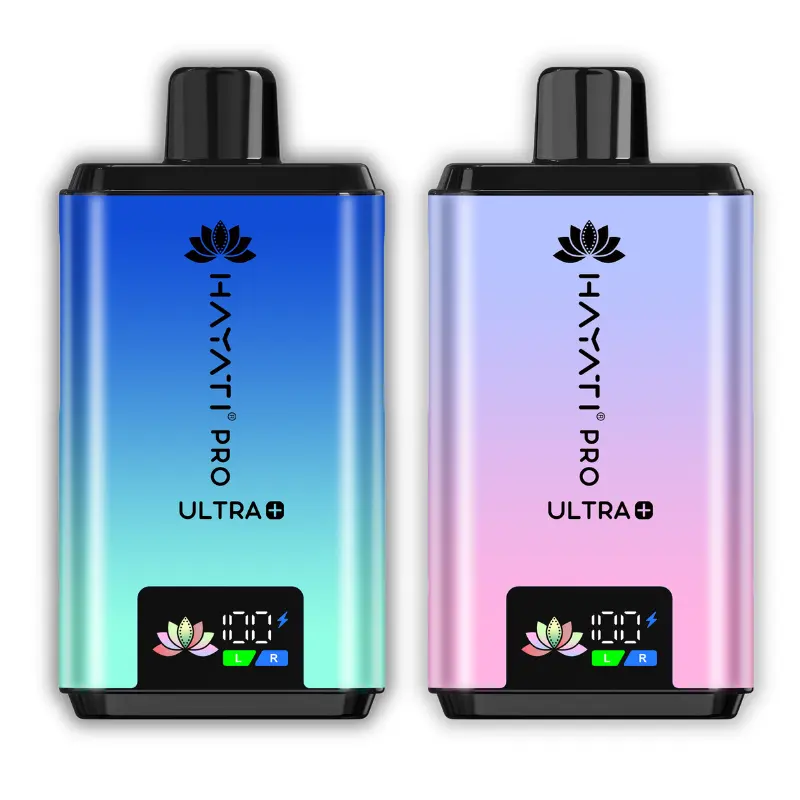
The box is £11.99 and holds an 850mAh Pro Ultra Plus body together with a filled 22ml pod at 20mg nicotine salt. Hayati's own laboratory figure for the pod is up to 25,000 puffs, produced by bench apparatus drawing to a set pattern, so it ranks listings against each other and forecasts nobody's fortnight. The flavour value on the record reads Blackcurrant Cotton K with Blue Raspberry: two liquids kept apart inside the single pod, with a rotating mouthpiece deciding which one reaches the coil. None of that appears in the title, which names only the brand, the platform and the puff ceiling.
Why the title withholds it, and what the liquid inside actually tastes like, are both settled on Hayati Pro Ultra Plus 25000 Pods, the £7.99 bare-pod version of this same slot. That page establishes two things worth carrying across before anything else. The pairing is a sugared dark berry against a sharp blue raspberry, built as a deliberate contrast rather than two shades of one idea. And the identical pairing is also sold under a descriptive title at the identical price, as Blackcurrant Cotton K / Blue Raspberry Hayati Pro Ultra Plus 25000 Prefilled Pod Kit, which is the listing to order if you want the flavour written on the thing you are ordering. Neither argument is rebuilt here.
What is left is the platform, and that is what this page is for. A title that names hardware and a number is, whatever else it is, an invitation to think about the format rather than the fruit. So this page treats the listing as the range's front door and argues the format question properly, which nobody has done from the direction of volume. Twenty-two millilitres is the largest prefilled quantity on sale here, and volume is the variable buyers on this site get wrong more often than any other. Not because they misunderstand it, but because it hides a second cost behind the first one. A large pod is the cheapest liquid you can buy in this format and it is also the most expensive mistake you can make in it. Those are not two competing facts that need balancing. They are one fact looked at from either side of a correct flavour choice, and every section below is arranged around getting you to the right side of it.
Every prefilled fill Hayati sell, counted and divided by its price
Arguments about value on this shelf are usually made with adjectives. Bigger, better value, more liquid for your money. The arithmetic is available and takes ten minutes, so here it is instead, with the working shown.
What is in the census and what is not
A prefilled format, for this purpose, is a pod that arrives sealed with liquid already in it, sold either on its own or in a box with a body. That takes in five lines. The Mini Ultra at 4ml, the Rubik at 12ml, the Pro Max Plus at 12ml, the single-listing Pro Max Plus 4000 refill and its kit at 7ml, and the Pro Ultra Plus at 22ml. Each of the five is sold both ways, as a bare pod and as a complete box, which gives ten separate prices to divide.
Two things are excluded and the reasons matter. The Quokka range holds 2ml, but Quokka pods arrive empty and you fill them from a bottle, so there is no liquid price attached to the pod at all. And the bottles themselves, 65 listings of 10ml nicotine salt and 40 of 120ml at zero nicotine, are not prefilled anything. They belong in the argument later, because their prices are instructive, but they do not belong in a table of sealed pods.
One earlier page on this site has run part of this exercise. The Red Razz GB / Blue Razz GB kit page set out four ranges with their pod volumes, pod prices and pence per millilitre, and it is the right piece of work. It leaves out the 7ml line, which exists as exactly two listings and is easy to miss, and it does not price the kits per millilitre. Both omissions change the shape of the table, so the version below is the full census rather than a correction. Rows are ordered by the last column, cheapest liquid first, which is not how anybody displays these products and is the only order that answers the question.
| What you are buying | Sealed liquid | Shelf price | Cost of one millilitre |
|---|---|---|---|
| Rubik replacement pod | 12ml | £3.99 | 33.3p |
| Pro Ultra Plus replacement pod | 22ml | £7.99 | 36.3p |
| Pro Max Plus replacement pod | 12ml | £5.49 | 45.8p |
| Rubik boxed kit | 12ml | £5.99 | 49.9p |
| Pro Ultra Plus boxed kit, this listing | 22ml | £11.99 | 54.5p |
| Pro Max Plus boxed kit | 12ml | £7.99 | 66.6p |
| Pro Max Plus 4000 replacement pod | 7ml | £5.49 | 78.4p |
| Mini Ultra replacement pod | 4ml | £3.49 | 87.3p |
| Mini Ultra boxed kit | 4ml | £3.99 | 99.8p |
| Pro Max Plus 4000 boxed kit | 7ml | £7.99 | 114.1p |
Reading the last column
Top to bottom the spread is 33.3p against 114.1p, which is a factor of three and a half for what is, in every case, 20mg nicotine salt sealed in a plastic shell with a coil in it. That is a very wide range for a single manufacturer selling a single category of consumable, and it is the first thing worth absorbing.
The second thing is that the column does not follow volume. If it did, the 22ml rows would occupy the top of the table and the 4ml rows the bottom, in strict order. They do not. A 12ml Rubik pod is the cheapest sealed millilitre in the catalogue, undercutting the largest pod Hayati sell by three pence on every one. Meanwhile the 7ml pod costs more per millilitre than the 12ml pod at the identical £5.49, which is exactly what you would expect, and the 7ml boxed kit costs more per millilitre than any other prefilled product by a margin of fifteen pence. Volume helps, and it helps a great deal, but it is not what sets the rate.
What does set the rate is a pair of things, and separating them is the useful part. Within any one line, more volume is always cheaper per millilitre and buying the pod without a body is always cheaper than buying the box. Both of those hold in every case, with no exceptions in ten rows. Across lines, neither holds, because each line is priced as its own commercial decision and the volumes were not chosen to make a ladder. So the honest rule for anybody sizing a purchase is narrow: compare within a platform by volume, compare across platforms by the arithmetic, and never assume the bigger pod is the cheaper millilitre until you have divided.
Applied to this listing, the position is good but not the best on offer. The bare 22ml pod at 36.3p is the second-cheapest liquid Hayati sell in any sealed format. This box, at 54.5p, is fifth of ten, and the difference between the two rows is entirely the body, which you buy once. The Blue Razz GB / Lemon & Lime kit page ran the body premium across every platform that lets you check it and found £4.00 here, which is the largest cash premium of the five, and the Straw' Lemonade kit page worked out what that £4.00 is worth once you spread it across a life on the platform. Both conclusions stand and there is nothing to add to them, so the figure is quoted here and left alone.
The comparison that makes the point cleanly
Abstract pence are hard to feel. Two concrete swaps make the same argument in a way you can act on.
Two Rubik pods cost £7.98 and hold 24ml between them. One Pro Ultra Plus pod costs £7.99 and holds 22ml. For one penny less you get two millilitres more liquid and, far more importantly, two separate flavour decisions instead of one. Whatever you think about the hardware, that swap is the whole thesis of this page compressed into two lines: the large pod is not buying you liquid cheaply, it is buying you fewer opportunities to be right.
And at the boxed level, £11.99 here is within £1.52 of three Mini Ultra pods at £3.49. Those three pods hold 12ml against this pod's 22ml, so on liquid alone the box wins comfortably. On decisions it loses three to one. Which of those two currencies matters more depends entirely on whether you already know what you want, and that is the axis this page keeps returning to because it is the axis the listings never mention.
The bottles deserve a mention here even though they are outside the table, because they set the floor. A 10ml nicotine salt is £2.49, which is 24.9p a millilitre, a quarter cheaper again than the cheapest sealed pod and a third cheaper than the bare pod on this platform. The 120ml at £6.99 comes out at 5.8p, though that is zero nicotine and built for a different kind of device entirely. What the bottle price tells you is that none of the ten rows above is a bargain in absolute terms. You are paying for the pod, the coil and the convenience of not filling anything, and on this platform that convenience costs about eleven and a half pence per millilitre against the bottled salt. That is a reasonable price for it and it is worth knowing it is being charged.
Twenty-two millilitres, measured in days rather than pounds
Money is the easy half. The harder half is time, because a pod is not a quantity you own, it is a period you have committed to.
Take three rates of consumption and convert. At a millilitre a day, a full pod runs about three weeks. At two millilitres a day, about eleven days. At four, roughly five and a half. Those are not predictions about you, they are arithmetic, and the point of writing them down is that all three answers are measured in weeks rather than days, which is not true of any other prefilled format Hayati sell. A 4ml Mini Ultra pod at two millilitres a day is a two-day object. You can be wrong about it on Monday and right about it by Wednesday.
Halve everything again if the pod is divided, which this one is. Twenty-two millilitres split between two reserves is roughly eleven a side, so at two millilitres a day one side is a five or six-day supply. That sounds like it shortens the commitment, and in a sense it does, but the pod does not end when a side empties. It ends when the coil is finished, and the coil is shared. The practical effect is that the reserve you like less is not a smaller purchase, it is a portion of a single purchase that you may simply throw away.
Which is the thing to hold on to about this format. A 22ml pod is one coil, one wick and one airflow path serving the whole 22ml, and none of those is replaceable. You cannot rest it, you cannot clean it, and you cannot transfer the liquid. When the coil tires, whatever is left goes with it. The pods page on this listing covers what that means for judging a switch between the two sides, and the arithmetic that follows from it is simple enough to state once: the money is spent at the moment of purchase and cannot be partially recovered at any later point.
The same fact from the other side: what a miss costs here
Everything above argues for the large pod. This section argues against it, using the same numbers, and both arguments are correct.
Suppose the flavour does not land. Not a disaster, just a liquid you find dull, or too sweet, or cold in a way you did not want. Price the outcome honestly and it is not £11.99.
It is £11.99, plus the two to five weeks of supply you now do not want, plus whatever you spend on a replacement while the unwanted pod sits in a drawer, plus the thing nobody puts a number on, which is that most people do not throw away a pod they have paid for. They finish it. Somewhere between the second and the tenth millilitre the purchase stops being a choice and becomes a chore, and the chore runs for another fortnight. On a 4ml pod that outcome costs £3.49 and two days and barely registers. Here it costs an order of magnitude more in both currencies.
Now run the same failure on the divided version. If one half of a pairing misses, roughly eleven millilitres of the 22 is liquid you will not choose to use, which at the bare-pod rate is about £4.00 of the £7.99 and about £6.00 of the £11.99. The Blueberry Raspberry / Blueberry Raspberry Cherry kit page made the mirror-image case and made it well: a pairing whose two halves share a base carries almost no exposure to this, because liking one very nearly guarantees liking the other. The corollary, which that page states plainly, is that a pairing built on genuine opposites carries the most exposure of anything on the shelf. Blue Razz Pineapple / Strawberry Ice is the sharpest example, putting an uncooled fruit against a cooled one, and Cherry Ice / Peach Mango does something similar with a chilled red fruit against a warm tropical blend. Both are good pods. Both put half your money on a proposition you may not want.
So the two halves of the thesis are now on the table together. Per millilitre, this is among the cheapest liquid on sale. Per mistake, it is the dearest exposure available in a prefilled format, by a factor of five against a Mini Ultra and by roughly two against a 12ml pod. Both statements come from the same number. The way to collect the first without incurring the second is not to buy smaller. It is to know more before you buy, and the rest of the page is about how.
Five things worth settling before you commit at this volume
These are not general buying advice. Each one is here because the cost of getting it wrong scales with the size of the pod, and at 22ml all five are worth deliberate thought rather than a glance at the title.
Whether you want cooling, and how much. This is the single most consequential axis on the shelf and the one that divides buyers most cleanly. Cooling is either in a liquid or it is not, there is no dial, and the presence or absence of it changes the whole character of a profile rather than adding a top note. The Blue Frozen pods page counted how this range uses its cooling vocabulary and established that the terms are not graded, so the useful signal is whether a cooling word appears at all rather than which one appears. On a 4ml pod, guessing wrong about this is a two-day annoyance. Across 22ml it is the defining property of a month.
Where you sit on sweetness, stated as a register rather than a preference. Most people know they like sweet things. Far fewer have worked out whether they like confectionery sweetness, which is what the GB and Cotton K and B'Gum modifiers deliver, or fruit sweetness, which is a different sensation carried by different compounds. Grape GB / Strawberry GB and Blueberry Cotton K / Raspberry Cotton K are both squarely in the confectionery register on both sides. Blueberry Raspberry is the plain fruit version of roughly the same colour. If you cannot say which of those two families you are in, that is the thing to find out first, because it is worth more than any individual flavour name.
Whether there is an acid line in it. Acidity is the most underrated property on a large pod and it is the one least often named in a title. A liquid with acid in it resets your palate on every draw; a liquid without acid does not, and relies on sweetness alone to stay interesting. Over a week that difference is minor. Over 22ml it is the difference between a pod that still tastes of something in its third week and one that has flattened into general sweetness. Blue Sour Raspberry sits at the acid end of this shelf, Lemon Lime carries citrus acid as its whole structure, and the lemonade builds such as Blackcurrant Lemonade and Straw' Lemonade add acid to a fruit rather than sugar.
Whether you want one liquid or two. Of the 52 kits on this platform, 27 carry two flavour names divided by an oblique and 25 carry one. That is a genuine fork rather than a variant, and it is covered properly below. What belongs in a pre-purchase list is only this: the divided pods do not give you two purchases, they give you one purchase with an internal choice, and they cost the same as the single ones.
Whether you have actually lived with the profile, as opposed to tasted it. This is the one people skip and it is the most important of the five at this volume. A flavour you enjoyed for an afternoon in somebody else's device, or for a 4ml pod two summers ago, is a flavour you have sampled. A flavour you have run for a fortnight is a flavour you know. The gap between those two states is where almost every disappointing 22ml purchase comes from, and the next section is about closing it cheaply.
The cheap instruments, and how far they actually reach
The smaller formats in this catalogue are usually described as lesser versions of the big one. They are better understood as measuring devices. A 4ml pod is the worst value per millilitre in the whole census and simultaneously the cheapest unit of information Hayati sell, and those two things are not in conflict because information and liquid are different purchases.
Counted: what you can try before you buy it big
Whether this strategy works at all depends on a fact nobody has counted, so it has been counted here. Breaking every Pro Ultra Plus listing into its flavour components, splitting the divided ones at the oblique, gives 54 distinct named profiles across the platform. The question is how many of those 54 you can meet somewhere cheaper.
- On the 4ml Mini Ultra at £3.49: 28 of the 54. That is the single best instrument in the catalogue, covering slightly over half the platform's flavour vocabulary at a fifth of the boxed price.
- On the 12ml Pro Max Plus pod at £5.49: 23 of the 54. Dearer as a unit, but 12ml is a fortnight rather than an afternoon, which makes it the closest thing to a real trial rather than a taste.
- As a 10ml nicotine salt bottle at £2.49: 22 of the 54. The cheapest of all in cash and in pence per millilitre, and useless unless you already own something refillable to put it in.
- On the 12ml Rubik pod at £3.99: 11 of the 54. The shallowest library of the four and therefore the weakest instrument, though it is the cheapest sealed millilitre if the profile you want happens to be among the eleven.
- Across all four routes combined: 37 of the 54. So roughly two thirds of what this platform offers can be met in some cheaper form first, and one third cannot.
That last figure is the honest limit of the method and it should be stated before the method is recommended. Seventeen of the 54 profiles exist only at 22ml. They include most of the abbreviated and invented names, which are exactly the ones a buyer would most want to test: the H'Berg and P'Man contractions, the banana pairings in Kiwi Banana / Strawberry Banana, the two H'Bubba builds in Blueberry H'Bubba / Watermelon H'Bubba, the grapefruit and dragonfruit strawberries, Raspberry Cola, and, with a certain irony, both halves of the pairing in this very box. Blackcurrant Cotton K is sold nowhere else in the catalogue at any volume, and neither is Blue Raspberry under that exact name.
There is a partial way round it, and it is worth knowing because it generalises. You cannot buy Blackcurrant Cotton K small, but you can buy the modifier small: Blueberry Cotton K and Raspberry Cotton K both exist as 4ml Mini Ultra pods at £3.49. What that £3.49 answers is not "do I like this pod" but "does a candy-floss layer over a dark berry work for me", which is the question that actually decides it. Test the component you are unsure of rather than the product, and a great deal more of the platform becomes reachable than the raw count of 37 suggests.
What a small trial proves and what it does not
Two limits, both real.
The first is formulation. A flavour name repeated on two platforms is not published as the same recipe, and the Pro Max Plus 4000 refill page set this out at length under the heading that the same name on three listings is not the same guarantee. Hayati publish no formulations, no comparison between ranges and no statement that a Mini Ultra liquid and a Pro Ultra Plus liquid of the same name share anything but a label. So a small pod tells you about a profile family with reasonable confidence and about an exact liquid with none. Treat a good result as permission to proceed rather than as proof.
The second is duration, and it is the more serious of the two. Four millilitres cannot tell you what a liquid is like in week three, because four millilitres does not last until week three. A trial tells you whether you like something. It cannot tell you whether you will still like it, and on a 22ml pod that second question is at least as important as the first. Which is the subject of the next section, and the reason it exists.
One pod lasts long enough for you to change
The assumption buried in every flavour description ever written, here included, is that the liquid and the person meet once and the result is stable. Over a 4ml pod that assumption is harmless. Over 22ml it is wrong, and wrong in a direction that is predictable enough to plan around.
What this site has already established
Four pages in this corpus have worked out separate pieces of the mechanism, and the sensible thing is to cite them rather than derive it all again.
The Fruit Bomb / Straw' Watermelon B'Gum pods page established the central effect. Sensory systems track change rather than steady levels, so a strong unvarying input stops reading as strong within days while its actual level has not moved at all. That page draws the consequence for anything sold on magnitude: the margin of loudness is exactly the margin adaptation removes. It also established the second, independent effect pushing the same way, which is that the fine aromatic top of a profile degrades on a loading coil before the sugar does, so a liquid does not fade evenly. It converges on sweetness, because sweetness is what survives.
The H'Berg / P'Man kit page established the cooling case at session length: twenty minutes into a heavily cooled pod the palate has acclimatised to the cold while the fruit has not grown any louder, so the balance appears to shift towards the menthol although nothing in the liquid has changed. That page also notes the fix, which is that putting it down for half an hour resets the impression.
The Strawberry Raspberry Ice pods page established the same thing at the scale of successive purchases: a flavour run four times in a row stops reading as a flavour and starts reading as a default, and the remedy is a fortnight of something structurally unlike it rather than a different version of the same fruit.
And the Blueberry Raspberry / Blueberry Raspberry Cherry kit page established the limit of the hardware answer. A divided pod offers somewhere to go when a profile stops registering, but only if the two sides are genuinely unlike. Turning a collar between two sweet berries provides no relief, because the thing you have tired of is present on both sides of it.
What that argues for at this volume
Put those four findings together and apply them specifically to a pod that will be in your hand for weeks rather than days, and a clear preference falls out. It is not the preference the shelf advertises.
Profiles carrying their own acid do best. Acidity is a sensation with an edge to it, it does not accumulate the way sweetness does, and it keeps producing contrast draw after draw rather than settling into a background level. A lemonade build such as Blueberry Raspberry Lemon, which adds citrus to a berry base rather than sugar, is structurally better suited to 22ml than a sweeter version of the same berries would be, and the same reasoning covers the sour builds and the citrus singles.
Cooled profiles do better than their sweetness figure suggests, with one qualification. Cooling suppresses perceived sweetness, so a heavily cooled pod reads as more moderate than its description, and moderate profiles have less height to fall from. The qualification is the H'Berg finding: the cold itself adapts, and on a pod where cooling is the structure rather than a finish, what you have in week three is a less cold version of something that was mostly cold. So cooling helps when it sits over a profile with content underneath it and helps much less when it is the content.
Genuine contrast pairings do best of all, and this is the strongest practical argument for the divided format at this volume specifically. Two liquids that differ on a real axis, sweet against sharp or cooled against warm, give you a second reference point inside one purchase, and a reference point is precisely what adaptation destroys. Blue Razz GB / Lemon & Lime runs a confectionery berry against a citrus, which is about as far apart as this shelf goes without changing temperature. Straw' Cranberry Cherry / Strawberry Raspberry Ice puts a dry cranberry-anchored blend opposite a cooled one. The pairing in this box, a sugared blackcurrant against a sharp blue raspberry, belongs in the same group and that is its real merit.
And what it argues against
Three categories are poorly matched to 22ml, and saying so is more useful than pretending the platform suits everything equally.
Profiles sold on intensity are the clearest case, because the Fruit Bomb page already proved the mechanism and the conclusion transfers without modification. If the proposition is loudness, and loudness is the property adaptation removes fastest, then the thing you are paying a premium for is the thing with the shortest life in the pod. Nothing has failed when it happens. It is simply a poor match between what the name promises and what the format delivers.
Undiluted confectionery pairings are the second case, and the count makes the point. Both halves of Blueberry Cotton K / Raspberry Cotton K carry the same candy-floss modifier. Both halves of Blue Razz Cherry / Blue Razz GB sit on the same blue accord with a confectionery treatment over each. These are well-made pairings and there is nothing wrong with either, but sweetened liquids load a coil fastest and sweetness is also what survives longest on a tiring one, so a pod sweet on both sides is being asked to run its whole length with no structural relief available anywhere inside it. At 12ml that is fine. At 22ml the third week is a long way from the first.
And narrow variations are the third, for the reason the Blueberry Raspberry page set out. A collar that moves you from a berry to the same berry with one addition gives you a smaller change than the format is capable of, and a smaller change is worth less over a long pod than over a short one. That is a comment about format fit, not about quality, and somebody who already knows a profile suits them may well want exactly that and be right to buy it.
The general rule, stated once: at 4ml, buy what sounds most appealing. At 22ml, buy what has somewhere to go.
The published figures for this box
The specification below is short because Hayati publish a short specification, and the blanks are listed alongside the entries rather than left out, since on a platform this uniform the absences are the only thing that varies.
| Item | What the listing states |
|---|---|
| Price of the complete box | £11.99 |
| Same pod without a body | £7.99 |
| Sealed liquid in the pod | 22ml |
| Cost of the liquid, boxed | 54.5p per millilitre |
| Nicotine | 20mg per millilitre, as a salt |
| Cell capacity | 850mAh |
| Flavour value on the record | Blackcurrant Cotton K with Blue Raspberry |
| Pod structure | Two reserves, one coil, rotating mouthpiece |
| Manufacturer's laboratory ceiling | Up to 25,000 puffs, a bench figure |
| Refillable | No, the pod arrives sealed and is replaced whole |
| Not published | Coil resistance, wick material, VG/PG ratio, charge time, pod dimensions, coolant level, how the two reserves are divided |
Three rows repay a sentence each, chosen because they are the ones this page has actually used.
The 54.5p is the figure that places this box in the ten-row census above, fifth of ten, and the 36.3p attached to the bare pod is the figure that matters from your second purchase onwards. Those two numbers together are the whole financial case for the platform and they are more useful than the puff ceiling, which the Red Razz GB kit page showed cannot be converted between ranges in any meaningful way. The Shisha 30000 listing makes the same point from the other direction, carrying a higher rating on an identical 22ml fill.
The 20mg is the legal maximum in the United Kingdom for a liquid containing nicotine, so nothing on this shelf or any other is filled higher and there is no stronger version of this pod to look for. Nicotine is addictive at any strength stated.
The last row is longer than the ones above it, which is the honest state of affairs for a £11.99 device. Nothing here should be read as a description of parts Hayati have not described, and in particular this page says nothing about how the pod is held in the bay or how liquid reaches the coil from either reserve, because none of that is published. On compatibility, match the range name printed on your device to the range name in this listing's title, and do not take a fitment decision from a retail page, ours included. Whether the 7ml Pro Max Plus 4000 pod and the 12ml pod share a fitting is likewise not published, and the table above places the 4000 by price alone.
How the library is actually arranged
Having spent the page arguing about format, the last practical question is what is in the format. The Hayati Pro Ultra Plus Prefilled Pod Kit shelf runs to 52 boxed listings, every one at £11.99. Alongside it sits a matching set of 52 bare pods at £7.99, and the combined Hayati Pro Ultra Plus Prefilled Pod Kits & Pods shelf gathers all 104 in one place. That is the second-largest prefilled library Hayati run, behind the 12ml platform and well ahead of the rest.
The 52 divide 27 to 25 between divided pods and single ones. That is close enough to an even split that neither can be called the default, and the split is the first thing to resolve because it is a structural decision rather than a flavour one.
What the divided pods change
A title with two names separated by an oblique means one 22ml pod holding two liquids apart from each other, with a collar on the mouthpiece selecting which one feeds the coil. It does not mean two pods in the box. That convention is set out fully on the bare pod page for this listing and on several others, so three consequences will do here.
Switching is instant and available whenever you like, so the choice is made repeatedly through a session rather than once at purchase. One coil, one wick and one airflow path serve both sides, so the first draws after a turn carry the previous side with them and are not a clean read of the new one. And the two halves share a single 22ml budget and a single coil, so they age together and neither can be bought, replaced or finished separately.
Set against that, the 25 single listings do one thing the divided ones cannot: every millilitre is the flavour you chose. Lemon Lime, Mr Blue, Cherry Berry and Blueberry Raspberry each commit the full volume to one profile, which is the right structure if you already know the profile and the wrong one if you are still finding out.
Where to start
Four routes in, depending on which of the five pre-purchase questions you cannot yet answer.
If you do not know whether you want cooling, buy a pod that has it on one side only. Blue Razz Pineapple / Strawberry Ice and Cherry Ice / Peach Mango both put a cooled side against an uncooled one, which turns a guess into a comparison you run yourself over several weeks. That is the most informative single purchase available on the shelf and it costs the same as every other box.
If you do not know whether you want confectionery or fruit, the same trick applies on a different axis. Blueberry Raspberry / Mr Blue sets a plain berry against an invented blue accord, and this listing's own pairing sets a sugared berry against a sharp one. Either answers the register question from the inside.
If you already know your register and simply want a long supply of it, take a single. There is no reason to pay for a second reserve you will not turn to, and the 25 single listings cover most of the common profiles. Fruit Twist is the exception to recommend cautiously, since it is named for a mood rather than an ingredient and the listing does not break it down, which makes it a poor first 22ml by the standards of this page.
And if you already own a Pro Ultra Plus, do not buy a kit at all. The £4.00 difference buys a second body, which is a real purchase with real uses but is not what most people reordering a flavour intend to buy. The bare pods carry the same 52 flavours at £7.99, and the wider Hayati Prefilled Pod Kits and Hayati Pod Kits shelves will show you every other boxed format if you are weighing the platform against the 12ml alternatives such as Blue Fusion Hayati Pro Max Plus 6000 Pod Kit. The complete range sits on the full Hayati catalogue if you would rather check the arithmetic in this page than take it on trust, and checking it is the better habit.
Living with a pod that outlasts the mood you bought it in
Handling advice is much the same everywhere, so what follows is restricted to the parts that behave differently because the pod is large.
Let it stand upright for a few minutes on arrival, and again after any long gap. A 22ml pod is likely to have travelled and to have sat somewhere before you opened it. The wick wants to be properly wet before the coil does any work, and the penalty for skipping it is a scorched first impression of a liquid you are then committed to for weeks. It is the cheapest insurance on the whole purchase.
Do not form your opinion in the first millilitre, and do not form it in the last one either. The opening of a new pod is novelty, and the closing stretch is a coil past its best. The fair sample is the long middle, which on this format is most of the pod, and that is one genuine advantage of the volume: there is enough of it that a bad first evening is not representative of anything.
Rotate rather than persist. This is the direct practical consequence of the adaptation section and the single most useful habit on a large pod. If a liquid has flattened, a fortnight of something structurally unlike it restores more than pushing through ever will, and a divided pod does part of that job for you provided the two sides genuinely differ. What does not work is switching to a near neighbour of the thing you have tired of.
Watch the sharp half, not the sweet one, for wear. On any pod with an acid or bright element, that element thins first as the coil loads. Sweetness persists and is therefore a poor indicator. If the sharper side of a pairing has gone dull while the sweeter side still seems acceptable, the pod is further through its life than the sweeter side is admitting.
Store it upright, cool and out of direct light, for longer than you would a small pod. Twenty-two millilitres means the last of it is opened weeks after the first, so storage conditions have time to matter here in a way they do not on a two-day pod. A drawer indoors is fine. A warm car in July is not, and heat flattens the contrast in a divided pod before it flattens anything else. Store it where children and pets cannot get to it.
Buy the spare late rather than early. With a pod this size the temptation is to stock up, and the case against is the same case this page has been making throughout. Each additional pod bought in advance is another decision locked in before you have finished learning from the current one. One spare is prudent. Six is a commitment made with less information than you will have next month.
At end of life, the pod holds a coil, a residue of liquid and electronics. None of that belongs in a household bin. A retailer take-back scheme or a local recycling point that accepts electrical waste is the right route, and the device itself, which will outlast many pods, should follow the same path whenever it finally stops working.
Questions this listing actually raises
Is 22ml really the largest pod Hayati sell?
Yes. Sealed prefilled pods in this catalogue come at 4ml, 7ml, 12ml and 22ml, and nothing holds more than 22ml. A total of 104 listings hold that much, split evenly between boxed kits and bare pods. The only 2ml pods on the site are the Quokka ones, which arrive empty.
Does the biggest pod give the cheapest liquid?
Not quite, and the arithmetic is worth having. The bare 22ml pod works out at 36.3p per millilitre, which is second of ten prefilled prices. A 12ml Rubik pod at £3.99 comes out at 33.3p and takes first place. Within any one range a larger pod is always the cheaper millilitre, but across ranges that does not hold.
What flavour is actually in this box?
The record gives Blackcurrant Cotton K with Blue Raspberry: a dark berry under a candy-floss sweetness on one side, a sharp blue raspberry on the other, selected by turning the mouthpiece. The title omits it. The bare pod listing analyses the liquid in full and this page does not duplicate that work.
Should I buy this listing or the one that names the flavour?
The one that names it. Blackcurrant Cotton K / Blue Raspberry is sold as a separate kit listing at the identical £11.99 with the identical volume, strength and rating, and a title you can recognise in your own order history six weeks later is worth having for free.
Is there a cheap way to try a Pro Ultra Plus flavour first?
For about two thirds of them, yes. Of the 54 distinct profiles on this platform, 28 also exist as 4ml Mini Ultra pods at £3.49, 23 as 12ml Pro Max Plus pods, 22 as 10ml bottles and 11 on the Rubik, with 37 covered by at least one of those routes. The remaining 17, including both halves of this pairing, exist only at 22ml.
If the small version tastes right, is the big one guaranteed to?
No. Hayati publish no formulations and never state that a shared flavour name means a shared recipe across ranges, so a small pod is evidence about the profile family rather than proof about the exact liquid. It also cannot tell you how something behaves in week three, because it does not last that long.
Why would a flavour I like start seeming duller?
Because sensory systems respond to change rather than to steady levels, so a constant input stops reading as strong within days while its actual level has not moved. A loading coil pushes the same way by thinning the fine aromatic top before the sugar. Both effects have more time to act on a pod this size than on a small one.
Does the rotating mouthpiece solve that?
Partly, and only when the two sides genuinely differ. A collar between a sweet side and a sharp one gives you somewhere to go. A collar between two versions of the same sweet berry does not, because what has tired you is present on both settings.
How long should a pod this size last me?
That depends entirely on how much you draw and how long each draw is, so the only honest answer is arithmetic rather than a promise. At a millilitre a day it is about three weeks, at two millilitres a day about eleven days. On a divided pod each side holds roughly eleven millilitres, so halve those figures per side.
What does the 25,000 figure actually mean?
It is Hayati's own laboratory ceiling, produced by equipment drawing to a fixed pattern rather than by anybody using the device. Treat it as a way of ranking listings and not as a quantity you have bought. The Shisha listing carries a higher number on the same 22ml fill, which shows how little the ratings can be compared.
What happens to liquid in the side I do not use?
It goes in the bin with the pod. Both reserves share one coil and one 22ml budget, the coil cannot be replaced, and the pod ends when the coil is finished rather than when either side runs dry. That is the specific reason a pairing where you only want one half is an expensive purchase at this volume.
Is 20mg the strongest fill available?
Yes. Twenty milligrams per millilitre is the United Kingdom maximum for a nicotine-containing liquid, so no listing on this shelf or any other is filled above it. Nicotine is an addictive substance whatever the strength on the label.
The short version
This box is £11.99 for an 850mAh Pro Ultra Plus body and a sealed 22ml pod at 20mg, divided between a candy-floss blackcurrant and a sharp blue raspberry and selected with a turn of the mouthpiece, with a laboratory ceiling of up to 25,000 puffs attached to the pod. The same pairing under a descriptive title costs exactly the same and is the better listing to order.
Twenty-two millilitres is the most liquid Hayati seal into a pod, and the full census of ten prefilled prices puts the bare version of it second cheapest per millilitre of anything in the catalogue at 36.3p, with this boxed version fifth at 54.5p. The spread across the ten runs from 33.3p to 114.1p, it does not track volume across ranges, and the only reliable rules are that within a line more volume is cheaper and a bare pod is always cheaper than a box.
That cheapness is real and it is half the story. The other half is that a pod this size is a commitment measured in weeks, that a flavour which misses costs the purchase plus the weeks plus the replacement, and that roughly eleven millilitres of a pairing you only half like is money already spent. Two thirds of the platform's flavour vocabulary can be met first in a 4ml pod, a 12ml pod or a 10ml bottle, and doing so is the cheapest thing on this page. One third cannot, and for those the honest advice is to test the component you are unsure of rather than the product.
The second thing a large pod changes is you. Adaptation and a loading coil both work against intensity from the first day, so the liquid you meet in week three is not the one you chose in week one. That argues for acid, for genuine contrast across the collar, and for moderate profiles with somewhere to go, and it argues against anything whose whole proposition is magnitude or unbroken sweetness. Choose on that basis and the largest pod on the site is also the cheapest. Choose on the front of the box and it is the dearest way to be wrong.
Strictly for adults aged 18 and over. Nicotine is an addictive substance.
You might also like


