
Home / Hayati Pro Ultra Plus Prefilled Pod Kit / Blackcurrant Lemonade Hayati Pro Ultra Plus 25000 Prefilled Pod Kit
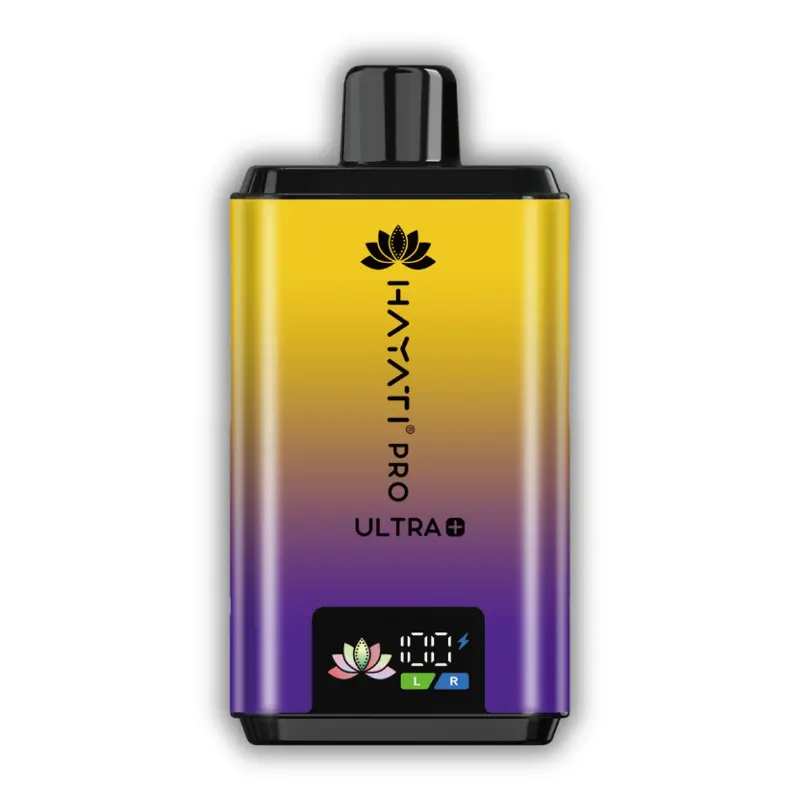
Hayati · Pro Ultra Plus
Blackcurrant Lemonade Hayati Pro Ultra Plus 25000 Prefilled Pod Kit
£11.99
✔ In stock — ready to ship
Genuine Hayati
Free over £20
Same-day dispatch
Secure checkout
Blackcurrant Lemonade in the Pro Ultra Plus box costs £11.99, and what arrives is an 850mAh device with a 22ml prefilled pod of 20mg nicotine salt already seated in it. Hayati rate that pod at up to 25,000 puffs. That number is produced on test equipment under fixed conditions, so treat it as a laboratory figure rather than a forecast of your month. Nothing needs filling, priming or assembling.
There is an awkwardness built into the listing you are reading, and it is worth naming before anything else. Almost every word on a kit page, here and on the fifty-one others like it, is organised around the two flavour words at the front of the title. Those two words describe the part of the purchase that will be gone soonest. The liquid runs out once. The device carries on through as many pods as you choose to feed it. So the listing puts a flavour decision in front of you at the exact moment flavour matters least, and files the hardware decision underneath it at the exact moment hardware matters most.
That is not a complaint about Hayati. It is how every prefilled platform on this site is merchandised, and there is a reason for it: a flavour name is legible in a fraction of a second and a pod library is not. But it means the question this page has to answer is not the one the title asks. The title asks whether you want blackcurrant and lemonade. The purchase asks whether you want to be a Pro Ultra Plus owner, because that is what £11.99 actually buys you and that is the decision you will still be living with in three months.
The flavour case for this particular liquid is made properly on the Blackcurrant Lemonade pod listing, which argues that a British buyer's reference point for blackcurrant is the cordial rather than the raw berry, because almost nobody here eats the fruit fresh. That argument is correct and this page will not restate it. What follows takes it as read, describes the liquid briefly enough to be useful, and then spends most of its length on the thing no listing on this site currently addresses: how to choose a kit, which is a different exercise from choosing a flavour and has a different answer.
What the label on the box actually decides
The flavour is reversible, and on this platform it is reversible for all of them
Start with the claim that sounds strongest and check it, because a claim like this is easy to assert and easy to get wrong. If the flavour in the box were hard to change, the flavour would deserve the top of the page. So: how hard is it to change?
The Pro Ultra Plus range on this site runs to 104 listings. Fifty-two of them include the device at £11.99, and fifty-two are the pod on its own at £7.99. Set the two groups side by side and match them up by flavour, and every single kit flavour has a matching pod. All fifty-two. There is nothing you can buy in a box here that you cannot then rebuy without the box. Hayati describe those £7.99 listings as replacement pods for a compatible Pro Ultra Plus device, and they publish no fitment list beyond that phrasing, so the shelf arrangement is the evidence rather than a compatibility chart.
That completeness is not automatic and it is worth knowing it was checked rather than assumed. On the Rubik system, for instance, there are twenty kit flavours and nineteen pod flavours, and one kit profile has no pod twin at all. So the correct statement is narrow: on the Pro Ultra Plus specifically, at the time of writing, every flavour sold in a kit is also sold as a pod. Change your mind about Blackcurrant Lemonade after two weeks and the fix costs £7.99 and no hardware.
Hayati sell this same kit twice, once with a flavour on the front and once without
The clearest evidence that the flavour name is packaging rather than product comes from Hayati's own catalogue. One pairing, Blackcurrant Cotton K with Blue Raspberry, appears twice on the kit shelf at the identical £11.99. Once it is titled for its flavours, as Blackcurrant Cotton K / Blue Raspberry. Once it is titled for the hardware and the puff rating, with no flavour in the name at all, and the flavour only turns up in the body text as a note about what the box happens to contain.
Fifty of the fifty-two kit listings put a flavour in the title. Two do not, and one of those two is the same product as a listing that does. Hayati are, in effect, running the experiment themselves: here is the device, described as a device, at the same price as the device described as a berry. The existence of that second listing tells you the flavour was never the load-bearing part of the title.
What changing your mind actually costs, and why that is the honest limit on all of this
None of the above makes the flavour free. The 22ml in the box is not returnable once opened, so abandoning it part way means writing off whatever is left. That is a real cost and it is the one genuine argument for taking the label seriously. The arithmetic of stranded liquid, and how the effective price of a millilitre climbs when you stop using a pod early, is worked out at length elsewhere on this site and there is no sense in doing it twice here. What matters for a kit decision is the shape of it: the penalty for a wrong flavour is bounded and one-off, while the penalty for a wrong platform recurs on every pod you buy afterwards.
Which is the whole point. A bounded, recoverable, £8-ish mistake is at the top of the page in 24-point type. An unbounded, compounding mistake is not mentioned anywhere.
The liquid, described quickly because it is the easy part
Where it sits, taking the cordial reading as settled
Hayati describe this as a tart, dark blackcurrant against a sharp and zesty lemonade, with the berry supplying weight and the citrus supplying lift. Read against the cordial reference that the pod page sets out, that is a coherent and fairly specific brief: not a berry with lemon squeezed on it, but the squash-and-fizz construction that most British palates already hold a template for. The useful consequence, for a kit buyer specifically, is that you are unlikely to be surprised. Almost nobody arrives at this flavour without a prior.
On the draw itself the order is legible. The citrus registers first because acid always does, arriving as a bright edge in the first fraction of a second. The blackcurrant comes in underneath it and stays, and it is the berry that you are still tasting on the exhale after the lemonade has thinned out. The two are not fighting; the berry is the floor and the citrus is the ceiling, and the pod is at its best when both are audible.
Sweetness sits above the middle of the range but well short of the confectionery listings. Hayati's own framing is sweet without being cloying, and the tang is what keeps that true: acid cuts perceived sugar, which is why a lemonade construction can carry more sweetener than a plain berry and still read as drinkable. Put it against something like Grape GB / Strawberry GB, where both halves are built on the chewy sugared register the GB suffix signals, and this one is noticeably drier. Put it against a straight citrus such as Lemon Lime and it is the sweeter of the two by some distance.
No cooling is stated anywhere in the specification for this listing, and nothing in the flavour description implies any. Take that at face value: this is a room-temperature profile, with no menthol lift and no chill on the finish. If you want the cold version of a citrus idea on this platform, the listing built for it is Lemon Mint, which puts mint where the berry sits here.
What it is not, briefly
- Not a sour listing. Tang is not the same as sour. There is acid for lift, not acid as the headline. A genuinely sour construction on this shelf is the apple half of Sour Apple / Juicy Peach, and it is a different sensation entirely.
- Not a berry blend. One berry, not three. If you want blackcurrant as one voice among several, the pairings are where to look rather than this.
- Not a dual. There is no second reserve and no collar to turn. Both halves of the pod hold the same liquid, so the one choice a dual listing gives you mid-session is not available here.
- Not a lemon-forward liquid. The lemonade is the treatment, the blackcurrant is the subject. On Blueberry Raspberry Lemon the citrus is a garnish on a berry base; here it is more structural than that, but it still is not the thing you are buying.
How it ages, which matters more on 22ml than on a small pod
The two components do not decay at the same rate, and the direction of travel is predictable. Volatile citrus top notes are the first casualty of a coil that has been working for several weeks, so the lemonade thins before the blackcurrant does. The late pod reads darker and rounder than the early pod: more berry, less fizz, and a shorter finish. Whether that is a problem depends entirely on which of the two brought you here. If you came for the cordial-and-fizz balance, you will notice the balance shift. If you came for the blackcurrant, you will barely register it.
The other side of the same coin is that the berry is the durable half, and a berry-dominant end state is a more comfortable place to finish 22ml than, say, a blend that collapses into undifferentiated sweetness. This is a reasonably good profile for a large pod, for reasons that have nothing to do with how nice it is.
The hardware, and the four numbers Hayati publish about it
What is in the box
Device plus prefilled pod, in one carton, ready at the point of unwrapping. There is no bottle, no fill port, no soak time and no decision to make before the first draw. The pod is a sealed unit with its own coil inside it, which is why there is nothing to service and nothing to clean: when the liquid is finished the coil is finished with it, and the replacement is a whole new pod rather than a part.
The draw is restricted and mouth-to-lung, which is what the 20mg salt concentration is formulated around. Pulling hard and fast on a narrow airway does not extract more flavour from it; it raises coil temperature and outruns the wick. This is a device you sip.
Four numbers, and the state of the other rows
Hayati publish, for this listing, an 850mAh battery, a 22ml capacity, a 20mg nicotine strength and a 25,000 puff rating. That is the complete set. Now consider what happens when you try to use those four numbers to choose between kits, which is what a buyer comparing the shelf is trying to do.
Three of the four are constant across the shelf. Every one of the fifty-two kit listings states 22ml. Fifty-one of the fifty-two state 20mg. The rating is 25,000 on all but one. So three of the four published numbers carry no information at all for a choice between kits, because every option gives the same answer.
That leaves the battery, and the battery is where the published record gets untidy. Of the fifty-two kit listings, forty-one carry the 850mAh figure this one carries, ten carry no battery figure whatsoever, and one carries a different figure. Before treating that as a contradiction it is worth looking at which one: the odd figure belongs to the Pro Ultra Plus Shisha 30000 kit, which is also the single listing with a different puff rating and a different nicotine strength, so the likeliest reading is different hardware rather than an error. The honest summary is therefore: on the fifty-one kits that are the 25,000-rated 20mg device, the battery is either 850mAh or not stated, and roughly one listing in five does not state it.
What is not published anywhere on this shelf
This is the part that determines the recommendation later on, so it is worth being exact rather than gestural. Across all fifty-two Pro Ultra Plus kit listings, none states a coil resistance. None states a mesh type. None mentions airflow, wattage, device weight or dimensions. None says anything at all about how the device is charged: not the method, not the time, not the connector, and this page will not name one either, because inventing that detail is precisely how four pages elsewhere on this site ended up asserting a charging standard that no Hayati specification contains.
Nothing is published about how the pod is retained in the bay, so do not assume any particular fitting, and treat any page that tells you otherwise, ours included, as unverified. Nothing is published about whether pods from other Hayati ranges seat in this device. The pod listings say compatible Pro Ultra Plus device and stop there, and that is the extent of what can honestly be said.
Put plainly: you cannot choose between Pro Ultra Plus kits on hardware specification, because there is essentially no hardware specification to choose on. That sounds like a dead end. It is actually the beginning of the answer, because it tells you the right criteria have to come from somewhere other than the spec sheet.
The sheet itself, and the rows that are missing from it
| What you pay | £11.99 |
| What the box holds | The device and one prefilled pod |
| Liquid volume | 22ml |
| Nicotine | 20mg nicotine salt |
| Battery | 850mAh, as stated on this listing |
| Manufacturer puff rating | Up to 25,000, a laboratory estimate |
| Flavour sides | One, Blackcurrant Lemonade throughout |
| Cooling | Not stated in the specification |
| Coil | Inside the pod, not serviceable, retires with it |
| Replacement pod | £7.99, listed on its own |
| Sold by | Hayati |
Two of those rows deserve a note. The 20mg is the highest nicotine concentration permitted for sale in the United Kingdom, and salt rather than freebase is the usual formulation at that concentration for a narrow-airway device, because of how the two behave on a slow draw rather than because one is stronger. Nicotine is addictive, and what concentration suits you is your own business rather than something a product page should be steering.
The puff rating is the row most often misread. It is generated by machine, drawing at a fixed length and a fixed interval until the pod stops producing, which makes it a reasonable basis for ranking two products against each other and a poor basis for predicting a fortnight. The more useful way to read it is as a statement of workload: one coil, unserviceable, is being asked to process the entire 22ml. That is the number's real content.
The rows that are not on the sheet are the ones listed in the previous section, and their absence is not an oversight on our part. Where Hayati are silent we are silent, and the alternative, filling a blank with a plausible-sounding figure copied from a competitor, is how bad specifications propagate.
How to choose a kit, which is a different question from how to choose a flavour
Nothing else on this site answers this, so here is an attempt at it, built only from what is published. The exercise has four steps and the flavour is not one of them.
Step one: hold the flavour still and watch what happens to the price
The cleanest way to see that the flavour is not the variable is to fix it and see what else moves. Lemon Lime is sold as a complete kit on four different Hayati systems. Lemon Lime Mini Ultra is £3.99. Lemon Lime Rubik is £5.99. Lemon Lime Pro Max Plus is £7.99. Lemon Lime on this platform is £11.99. Same two words on the front of four boxes, and an £8 spread between the cheapest and the dearest.
Whatever that £8 is buying, it is not flavour, because the flavour is identical in name and broadly the same in intent. It is buying a different device, a different pod size and a different set of pods you will be able to buy afterwards. Those are the variables. The title of every one of those four listings leads with the constant and buries the variables.
One caution, because this is exactly the place where a reasonable person starts guessing. Four platforms carrying the same flavour tells you nothing whatsoever about whether their pods interchange. Hayati publish no fitment between any of these ranges, and reasoning from a shared flavour name, or a shared brand, to a shared fitting is how buyers end up with a drawer of pods that do not seat. Assume nothing crosses.
Step two: count the library behind the device
Since the hardware cannot be judged on specification, judge it on the catalogue it gives you access to. Once you own a prefilled device, the flavours available to you are the flavours sold for it, and that number varies a great deal between Hayati's systems.
- Pro Max Plus has the largest library on this site by some way, at around ninety pod listings, with replacement pods at £5.49 and kits at £7.99.
- Pro Ultra Plus, this platform, is second with fifty-two pod listings at £7.99 and fifty-two kits at £11.99.
- Mini Ultra has thirty-one pod listings, and an unusual shape: its kits are nearly all dual-flavour pairings while its pods are mostly the single flavours split back out.
- Rubik is the smallest of the prefilled systems at nineteen pod listings.
Library size is not automatically decisive. A person who has settled on one profile and intends to rebuy it forever does not care whether there are nineteen alternatives or ninety. But a person who rotates, or who expects to get bored, is buying optionality, and optionality is exactly what the number measures. This is a real and countable difference between two kits that the listings will never put in front of you, because it is a property of the shelf rather than of the product.
It also reframes the £4 difference between this kit and the pod on its own, which is the arithmetic every page on this platform recites. That £4 is a one-off entry fee, and the number of pods you subsequently buy through the device is what determines whether it was money well spent. Four pounds spread across one pod is an expensive way to buy 22ml. Four pounds spread across a year of them is a rounding error. The fee is not the question. The commitment is.
Step three: check the strength you will be able to buy later, not the one in the box
This is the step nobody takes, and it is the one with the sharpest consequence, because it is the only genuinely irreversible thing about adopting a prefilled platform.
Across every prefilled pod listing on this site, on all four systems, there are 192 products. 188 of them are 20mg. The exceptions number four: three on Pro Max Plus, at 0mg, 5mg and 10mg, and one on Pro Ultra Plus, the 5mg Shisha pod. Kits tell the same story, with 177 of 180 at 20mg.
Read that against the platform you are considering. If you buy into Pro Ultra Plus, fifty-one of the fifty-two pods available to you afterwards are 20mg, and the single alternative is a 5mg listing that also differs in rating and battery figure and may not be the same device at all. If you buy into Pro Max Plus instead, there are three non-20mg pod listings and two non-20mg kits, which is not a wide choice but is three times the choice. No kit page, on either platform, mentions this. The strength in the box is printed everywhere; the strength range behind the box is printed nowhere.
If 20mg is what you want, none of this affects you and you can ignore the paragraph. If you might want something else later, it is the single most consequential fact on this page, and it is the kind of thing that should be settled before the £11.99 rather than after it.
Step four: decide whether you want a flavour attached to your hardware at all
On this site, 183 listings are sold as kits. Of those, 180 are prefilled systems where the hardware comes wearing a flavour. Three are not: the refillable Quokka kits, which ship with no factory flavour because you fill them from a bottle. Those three are the only listings in a 492-product catalogue where the hardware is sold as the hardware.
That comparison is not a recommendation to buy one over the other, and the two things are not equivalent purchases: a refillable device is a different amount of work, a different running cost and a different set of decisions on a Tuesday evening. The point is narrower. The existence of those three listings shows that a flavourless kit is a thing Hayati can and do sell, which means the flavour on the front of the other 180 is a merchandising choice rather than a technical necessity. Knowing that makes it easier to discount it when you are comparing.
The recommendation, in order
Choose the platform first, on the size of its pod library and on the strengths sold for it. Check second that the specific flavour you like is available as a pod on that platform and not only as a kit, because that is not guaranteed everywhere. Third, and only third, pick which flavour you want in the box, and pick the one you already know rather than the one that sounds most interesting. Then buy exactly one kit and never buy a second one, because every kit after the first is a device you already own.
If you would rather browse the decision than read about it, the fifty-two complete kits sit together on the Pro Ultra Plus kit shelf, the kits and pods together on the combined Pro Ultra Plus shelf, and every Hayati kit on every system on the Hayati pod kits shelf. Prefilled kits specifically, as opposed to refillable ones, are gathered on the prefilled kit shelf.
The one case where the flavour on the box does matter
Everything above assumes a buyer who can tolerate a liquid they are lukewarm about for as long as it takes to form a view of the device. Not everyone can, and for the buyer who cannot, the argument inverts.
Here is the mechanism. A first kit is doing two jobs at once. It is a flavour and it is an evaluation of hardware you have never used, and you have no way to run those two assessments separately. If the liquid is unfamiliar and you do not get on with it, you will not know whether the device is disappointing you or the blend is. Twenty-two millilitres is a long time to sit with that confusion, and the usual outcome is that the platform takes the blame for something the pod did.
This is why buying an unread flavour name as your first kit is a worse idea than it looks. The listings where a name tells you very little are easy to find on this shelf: Lemon Lime / Summer Dream pairs a legible citrus with a mood word, and Blueberry H'Bubba / Watermelon H'Bubba puts an elided shorthand on both halves. Those are perfectly good pods and both listings deal honestly with what their names do and do not disclose, including what sampling an undescribed blend costs you when the smallest unit you can buy is 22ml. They are simply the wrong thing to attach to a hardware evaluation, because they add an unknown to an experiment that already has one.
Judged on that criterion, Blackcurrant Lemonade is a good first kit and that is the strongest thing this page will say in its favour. Cordial and lemonade is a reference nearly every British adult already holds, the pod page makes the case for why, and it is one of only nineteen single-name profiles out of 134 in this catalogue that Hayati carry on four or more different formats, which is its own kind of evidence that the profile travels. You are unlikely to be startled by it. Being unstartled is the point: it keeps the variable you are actually testing down to one.
If you want an even smaller version of the same manoeuvre, meet the profile on cheaper hardware first. The Mini Ultra kit at £3.99 carries this profile alongside a strawberry lemonade, and the Pro Max Plus 6000 kit at £7.99 carries it on the larger-library platform. Both are separate devices with their own pods, and neither tells you anything about whether the pods interchange, because that is not published. What they do tell you is whether you like the flavour, for less money.
Against the other £11.99 boxes
Every kit on this shelf is the same price, so value plays no part and the comparison is purely one of fit. If you have accepted the argument above, you are now choosing a flavour with the pressure taken off, which is a much more pleasant decision.
Staying inside the lemonade idea, Straw' Lemonade is the nearest neighbour: same fizzy citrus treatment, a red summer fruit instead of a dark tart one. It is the sweeter and rounder of the two, with less of the bite that the blackcurrant contributes here. Anyone who finds this pod slightly austere should look there first. The whole lemonade group across every Hayati format sits on the lemonade shelf, which is the fastest way to see how many ways the same construction has been used.
If the citrus rather than the berry is what appeals, three listings take it further. Lemon Lime is the plain double-citrus with nothing sweet underneath. Orange Lemon Lime adds a third, softer citrus that takes some of the edge off. Blue Razz GB / Lemon Lime is the textbook sweet-against-sharp dual, with a confectionery blue raspberry on one side and the citrus on the other, and it is the listing to choose if you suspect you will want an escape route from sweetness mid-session rather than a single settled profile.
If the dark berry is the draw, Blue Razz Cherry is the other single-flavour listing in the deep red-and-purple register, though it swaps the cordial framing for a confectionery one. Blackcurrant Cotton K / Blue Raspberry, the twice-listed pairing mentioned earlier, puts blackcurrant against candyfloss sweetness rather than against acid, which is the opposite treatment to this one. Everything blackcurrant-flavoured across all formats is collected on the blackcurrant shelf, sixteen listings in total, which is a small enough group to read end to end.
Off this platform, the same profile appears on the Pro Max Plus 6000 kit already mentioned, and the lemonade family there is broader: Berry Lemonade takes a mixed-berry base rather than a single one, and Pink Lemonade is the lightest of the group. Both are £7.99 kits on their own hardware, which is the platform with the largest pod library, and if step two of the process above carried any weight with you then that is a point worth putting on the scales.
Living with it once the flavour has stopped being the interesting part
Give the lemonade a fair hearing early. A new pod runs slightly wetter than a settled one, and on an acid-led profile that presents as blunter than the liquid really is. The citrus edge sharpens up over the first twenty or thirty draws. Forming a view on draw three is a way of misreading the pod and, on a first kit, of misreading the device along with it.
Spacing matters more here than on a sweet profile. Consecutive draws raise coil temperature, and heat takes the volatile top off a liquid before it touches the base. On this pod that means the lemonade goes and the blackcurrant stays, so chain-drawing actively converts a balanced profile into a plain berry one. Ten or fifteen seconds between draws is enough to keep both halves in play.
Keep it cool and out of direct light. Warmth accelerates the same loss that heat from the coil causes, and a pod left on a dashboard for an afternoon comes back noticeably flatter at the top end. Somewhere stable and shaded is all that is required. Keep it somewhere children and animals cannot get to it, and treat that as non-negotiable rather than as advice.
Know what a tired pod feels like on this specific liquid. The signal is the ratio rather than the volume. When the berry is still there but the fizz has gone, and the finish has shortened, the coil is towards the end of its working life. A warmer, drier draw and a drop in vapour usually arrive at about the same time. That is the point to reorder rather than the point to persevere.
Do not turn the mouthpiece looking for a second flavour. This is a single-flavour pod and there is no second reserve behind it. Buyers arriving from a dual listing reach for the collar out of habit and then wonder whether something is broken. Nothing is.
Order the pod, not another kit. The correct repeat purchase is the £7.99 Blackcurrant Lemonade pod, and placing it while the current one still has several days in it removes the temptation to push a spent coil. Buying a second box means buying a second device, which is the mistake this entire page has been arguing against.
Questions this listing gets asked
If the flavour barely matters, why is it in the title?
Because it is the fastest thing to read and the easiest thing to have an opinion about. A flavour name is legible in a second; a pod library is not. That makes it good merchandising and a poor decision criterion, and the two are not the same thing.
What exactly am I committing to by buying this kit?
To a device whose only published hardware figure is an 850mAh battery, and to a pod catalogue of fifty-two listings at £7.99 each, of which fifty-one are 20mg. That is the commitment. The 22ml of Blackcurrant Lemonade is the part you are least committed to, because a different flavour costs £7.99 and no hardware.
I already own a Pro Ultra Plus device. Should I buy this?
No. Order the pod listing instead and keep the difference. The kit exists for a first purchase or a hardware replacement, and buying it a second time means paying again for something already in your pocket.
Is every kit flavour also sold as a pod?
On this platform, yes. All fifty-two kit flavours have a matching £7.99 pod listing. That is not universal across Hayati's systems, though: on the Rubik range one kit profile has no pod equivalent, so it is worth checking on whichever platform you pick rather than assuming.
Can I get this in a lower nicotine strength?
Not on this platform. Fifty-one of the fifty-two Pro Ultra Plus pods are 20mg, and the one exception is a 5mg Shisha listing that also differs in puff rating. Across all 192 prefilled pod listings on this site only four are anything other than 20mg, and three of those four are on the Pro Max Plus system.
How is the device charged?
Hayati do not state it. None of the fifty-two kit listings on this shelf mentions charging method, charging time or a connector, so this page will not name one. Ask us before ordering if that detail decides the purchase for you, rather than taking a figure from another retailer's listing.
Does it have any cooling in it?
None is stated. The specification names no menthol or coolant and the flavour description does not imply one, so treat it as a room-temperature profile. Lemon Mint is the listing on this shelf built around a cold finish if that is what you are after.
Does the mouthpiece collar select anything?
Not on this pod. Collar selection applies to the dual listings, the ones with two flavour names separated by an oblique, where it chooses which internal reserve feeds the coil. Both sides of this pod hold the same liquid.
Will 22ml of one flavour get boring?
It will narrow rather than stop working. The lemonade fades before the blackcurrant does, so the late pod is darker and rounder than the early one. Whether that reads as boring depends on which half you came for. Rotating a second pod of something structurally different is the usual answer if you suspect it will.
Is 25,000 puffs what I should expect?
No. It is a manufacturer's laboratory rating, generated by machine at a fixed draw length and interval, and it is a comparison figure rather than a prediction. Its useful meaning is workload: one unserviceable coil has to see out the whole 22ml.
Will pods from Hayati's other ranges fit this device?
Hayati publish no fitment between their ranges, so we cannot tell you. A shared brand or a shared flavour name is not evidence of a shared fitting, and a retail page is the wrong place to settle a hardware question. The pods sold as Pro Ultra Plus pods are what this device is listed with.
Which is the better first kit, this or a dual?
A dual gives you two profiles and an in-session switch, at the cost of splitting 22ml between them. For a first kit, the case for a single flavour you already recognise is that it keeps the number of unknowns down while you form a view of the device. After that, a dual is a perfectly reasonable second purchase.
The short version
£11.99 buys an 850mAh device and a 22ml prefilled pod of 20mg nicotine salt, rated by Hayati at up to 25,000 puffs in laboratory conditions. The liquid is a tart blackcurrant carried on a sharp lemonade, sweet above the midpoint but not confectionery-sweet, with no cooling stated and no second reserve. The citrus leads, the berry stays, and the berry is the half that survives to the end of the pod.
The flavour, though, is the least binding part of what you are buying. Every one of the fifty-two kit flavours on this platform is also sold as a £7.99 pod, Hayati list one of their own kits twice with and without a flavour in the title, and three of the four numbers they publish about the device are identical across the whole shelf. Change your mind about the blackcurrant and it costs £7.99. Change your mind about the platform and it costs everything you have bought for it.
So choose the kit on the platform. Count the pods behind the device, fifty-two here against roughly ninety on Pro Max Plus, check what strengths exist for it before you need one, confirm the flavour you like is sold as a pod and not only as a kit, and only then look at the label. The single honest exception is your first kit, where an unfamiliar liquid will contaminate your read of unfamiliar hardware, and on that test this listing does well: a cordial reference almost every British buyer already has, on a profile Hayati carry across four separate formats.
Buy one kit. Buy pods after that.
Strictly for adults aged 18 and over. Nicotine is an addictive substance.
You might also like


