
Home / Hayati Pro Ultra Plus Pods / Lemon & Lime/Summer Dream Hayati Pro Ultra Plus 25K Pods
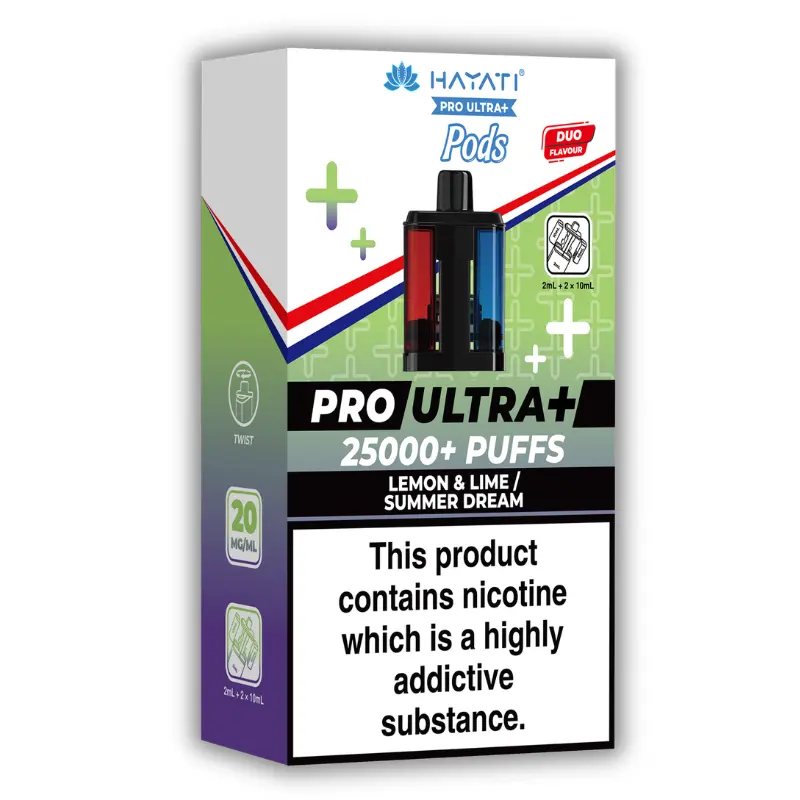
Hayati · Pro Ultra Plus
Lemon & Lime/Summer Dream Hayati Pro Ultra Plus 25K Pods
£7.99
✔ In stock — ready to ship
Genuine Hayati
Free over £20
Same-day dispatch
Secure checkout
£7.99 buys one prefilled Hayati Pro Ultra Plus pod holding 22ml of liquid at 20mg nicotine salt, carrying two flavours that are kept apart inside it and selected by turning the mouthpiece. Hayati attach a rating of up to 25,000 puffs, measured in a laboratory. Nothing else is in the pack. Without a Pro Ultra Plus body already in the house this is an object that cannot be made to work, and the Lemon Lime / Summer Dream kit at £11.99 is the listing that includes the device.
One correction first, because the title invites the wrong picture. This is not a pack of two pods. It is a single pod with two reserves, one mouthpiece and one coil, so the two names are two liquids sharing a sealed item rather than two items in a box. Hayati say the flavours stay separate and say nothing about how that is achieved, so nobody should be telling you what the arrangement inside looks like. What it means for you is clear without the detail: you cannot take one and leave the other, or keep the second for later. The two share one 22ml budget and one coil that finishes when the pod does.
Now notice which two they are. Lemon & Lime is about as completely specified as a name gets on this catalogue: two ordinary fruits you have probably tasted in a vape and could describe from memory. Summer Dream specifies nothing. It gives a season and then a coined word Hayati reuse elsewhere, and between them they identify no fruit, no fruit family and no sweetener. Half this pod is a known quantity. The other half is an abstraction with a short note wrapped round it.
That pairing is not a random draw. A labelled half puts a floor under the transaction, and it does more than that: it is one turn of the collar away at any moment, so you are never stuck with the unknown for so much as a session. The effect is to make an undescribed liquid easy to accept here when the same liquid, sold alone at the same price, would give most buyers pause. Whether that is a sensible way to find out what Summer Dream is, or a tidy way of moving something that would not sell by itself, is a real question with arguments both ways. This page takes both seriously, gives you a method for reading the unnamed half, and works out what the pod is worth if you finish it wanting only one of the two.
One pod, two liquids, a label on one of them
Set the published record out flat and the asymmetry stops being a matter of opinion.
Stated about the pod: 22ml prefilled; 20mg nicotine salt with no other strength listed; a laboratory rating of up to 25,000 puffs; two flavours held separately; a rotating mouthpiece to choose between them; no device supplied; a matching kit sold with one.
Stated about the first flavour: it is lemon and lime. That is a complete answer. Two fruits, named in order, from a family with no ambiguity in it, and one that appears elsewhere on this catalogue as a single liquid, as a smaller pod and as a partner in other pairings, so the record extends well past this listing and can be cross-checked.
Stated about the second flavour: that it is sweet, that it is a blend rather than one fruit, and that it leans light and seasonal. That is a genuine contribution, more than some unnamed listings get, and it deserves weighing rather than dismissing. It is also a description of a register rather than of a substance. Sweet narrows little, since most of the shelf is sweet. Blend gives a count, not contents. Light and summery is an atmosphere.
The second word contributes nothing at all
Dream is a series slot rather than a flavour term, and that is not a guess. Hayati run the same construction on Midnight Dream and a parallel one on the Aura names, where the decisive case is Peach Aura: a literal fruit sitting in front of the coined word. Nobody builds a name that way unless the coined word is empty. The Midnight Dream kit listing works the grammar out at length, and the conclusion transfers cleanly, so there is no point restating the derivation. Whatever information a name of this shape carries lives entirely in the first slot.
Which leaves Summer working alone, and it does slightly more than Midnight manages. Midnight fixes a level of darkness and stops. Summer fixes a level of brightness and carries a faint implication of ripeness, which nudges away from dessert, spice and dark berry. Both set a dial. Neither names a substance.
Claims, with the confidence attached
- Reasonably confident. One pod holds two distinct liquids; one is a lemon and lime blend; the other is sweeter and softer; neither side has ice, menthol or a coolant declared against it; the total is 22ml at 20mg through a single built-in coil.
- Probable. Summer Dream sits in the bright half of the range rather than the dark or dessert half. That is an inference from one word plus Hayati's note about a light character, and it produces a set rather than an identification. Melon, tropical fruit, red berry and stone fruit all satisfy it and taste nothing like each other.
- Probable. The halves contrast on register rather than on fruit family, one described as sharp and the other as sweet and soft. That is a different construction from Lemon Lime / Lemon Blueberry, where both sides open on the same fruit.
- Unknown. Which fruit or fruits are in the second half. How sweet it is on any comparable scale. Whether it carries acid of its own. Where the 22ml divides. How the two are kept apart inside, which Hayati do not describe anywhere.
If the unknown row holds the thing that decides purchases for you, and for many people fruit family is the only thing that does, a listing that prints its contents will serve you better at the same money. That is said here rather than buried, and the alternatives are further down.
The asymmetry is the product, not a quirk of the label
What makes this listing easy to reason about is that the controls exist, sit on the same shelf and cost the same. Lemon Lime Hayati Pro Ultra Plus Pods is the citrus alone, 22ml, £7.99. Summer Dream Hayati Pro Ultra Plus Pods is the unnamed blend alone, 22ml, £7.99. This pod is half of each, £7.99. Three listings, one price, one volume, one device.
Run the test that arrangement makes available. Would you put £7.99 on 22ml of a liquid whose entire published description is a season, a coined word and the word sweet? Most people hesitate, and the hesitation is rational: that is a week or more of daily use bought on an atmosphere. Would you put £7.99 on this pod? Usually an easier yes, for the same money, volume and device, with the only change being that half the liquid now has a label on it.
Nothing about Summer Dream improved between those two questions. Your worst outcome moved. On the solo pod the floor is 22ml of something you do not enjoy. Here the floor is a citrus you can predict, and it is not merely a fallback you reach at the end of a bad fortnight. It is available mid-session, by turning the collar, so a buyer who dislikes the first draw of the unknown is thirty seconds from the flavour they came for. That is a more comfortable proposition than any amount of reassurance in a description, and it is the commercial mechanism at the centre of this listing.
The case that this is a sensible hedge
The Straw' Lemonade listing makes the general point about the dual format: the same 22ml divided two ways halves your exposure to any one flavour at no change in price. Correct, and it applies here. What it does not cover is the case where the halves are not symmetric in information, which is this one. A hedge between two flavours you know equally well is a hedge about taste. A hedge between one you know and one you do not is a hedge about risk, and it is the better instrument, because you are not spreading a bet across two uncertainties. You are pairing a certainty with an uncertainty, which is the only version of the arrangement in which the second half is insurance rather than a second lottery ticket.
The case that it is a way of moving stock
Now the unflattering reading, put as strongly as it deserves. Bundling something nobody can evaluate with something dependable is the oldest packaging move there is, and it works through exactly the mechanism described above. Attach a hard-to-sell liquid to a reliable one and the buyer is no longer asked to want it. They are asked not to mind it, with an escape route built into the mouthpiece in case they do.
The construction is also uncommon in the range. Of the thirteen two-flavour pods shown alongside this one on its own listing, eleven name a fruit on both sides. One, H'Berg / P'Man, uses abbreviations, which is a different problem, since a shortened word can be reconstructed by somebody who knows the range and that page handles the reconstruction. One, Fruit Bomb / Straw' Watermelon B'Gum, has a vague half of its own. A fully specified flavour paired with one that names no substance does not repeat in that group.
What actually settles it, which is less than either side wants
Two things cut against the cynical reading. Summer Dream sells on its own, on this shelf, at this price, and a flavour that could not move alone would not be given its own listing beside the pairing. It also appears in more than one format, which the Summer Dream Vapes shelf collects in one place, and planners do not usually spread a dud across devices.
Against that, a solo listing existing is not evidence that it sells. Nothing published tells you how either version performs, and nobody outside Hayati can settle intent. What can be settled is effect, and effect does not depend on intent. However this pod came to be built, the structure prices risk: a flavour that is hard to sell on its own terms is attached to one that is not, at the same money for the combination. Read it that way and you will decide better than if you read it as a variety pack, because a variety pack implies two things you might want, and this is one thing you might want plus one question.
The flavour, one side described and one side deliberately not
The citrus half, which anybody can write about
Lemon and lime together is one of the more stable ideas in the format, and that stability is why it works as the anchor here. The draw opens on lemon, bright and peel-forward, arriving early and sitting high. Lime comes in behind and slightly later, and it contributes width rather than depth: a green, faintly resinous edge that broadens the sourness sideways instead of pushing it further down. The finish is short and dry. There is very little in the middle, which sounds like a criticism and is really a description of what two citrus fruits together are, since neither brings body.
Sweetness sits below the midpoint of the shelf. Sugar is present, and has to be, because unsweetened citrus on mesh is thin and unpleasant, but it is there to keep the acid civil rather than to be tasted. No cold element is declared on either side of this pod and none is apparent in the citrus, so what reads as lively is fruit acid working alone. Acid and a coolant behave differently over a long pod, and that matters later.
Why lemon, lime and orange are harder to tell apart than their names suggest, and where in the aroma the differences live, is worked out on the Orange Lemon & Lime listing. The part worth carrying across is the practical consequence: everything identifiable about this half is concentrated at the very front of the draw, and the front of the draw is the first thing a working coil stops delivering accurately. A tired citrus does not go quiet. It goes round and slightly sweeter, which is a more confusing failure than fading.
Ruling things out. There is no lemonade construction, no fizz and no diluted sugar base, which separates it from Blackcurrant Lemonade and from the Straw' Lemonade pod. It is not a sour-coated sweet, so the sharpness is dry rather than mouth-watering. And it is not cold, which distinguishes it at once from Lemon & Mint, where the second element is temperature rather than fruit.
The other half, and why there is no tasting note for it
There will not be a description of Summer Dream here, and the reason is worth stating rather than leaving as a gap. Nobody writing product copy has a basis for one. A page that turned a season and a series word into a confident paragraph about mango, or strawberry, or pineapple, would be manufacturing the exact thing you came to find out, in the same voice it uses for the price. Inventing a fruit here is not a small liberty. It is the one claim on the page a buyer would act on.
What can be said, with the reasoning visible, is this. Summer points at brightness and ripeness, which is an inference from ordinary usage rather than a statement by Hayati, and it narrows the field to something like melon, tropical fruit, red berry or stone fruit. Note what that leaves: a set whose members taste entirely unlike one another. Somebody who wants melon and gets tropical has not had their question answered, only narrowed.
Hayati's own note that it is sweeter and softer than the citrus is more useful than the name, because a relative statement is checkable. It places the second half above the first on sweetness and below it on sharpness, which says something real about how the pod is meant to work: a contrast of intensity rather than a pair of neighbours. That is the one structural fact about the pairing the record supports.
The word blend tells you to expect a composite, which usually means an overall impression rather than identifiable components. That is not a fault; plenty of liquids are built that way on purpose, because a composite is more forgiving across a long pod. It does mean that even after tasting it you may not be able to name what is in it, and that is not a failure of your palate.
Two readings of the name are available. The generous one is that the blend genuinely does not resolve into a fruit anybody could print on a label, so the naming department reached for an atmosphere. The less generous one is that a range this size runs out of unused fruit combinations long before it runs out of listings, and a mood name is what gets written when the next liquid is a variation on something already stocked. Both fit the facts, and this page does not know which is true.
How the two are likely to sit together
Working only from the record, the pairing looks like an intensity contrast: dry, acid-led and short-finishing on one side, sweeter and rounder on the other. If that is right it is a more useful pairing than one built from relatives, because the collar changes register rather than shading it. Compare Red Razz GB / Blue Razz GB, two versions of one sweet-shop idea where the switch is a nudge. The load-bearing word is likely, though. A pairing described as sharp against sweet could still land as two things separated by very little, if the second half turns out to be a soft fruit blend with citrus somewhere in it, and that is what the next section is designed to detect on your first pod.
Getting a usable reading on the half nobody described
There is one genuine advantage to meeting an unknown liquid inside this pod rather than on its own, and one genuine obstacle. Both come from the same fact, which is that the two liquids pass through a single coil and wick.
The obstacle: you get exactly one clean reading
A shared wick means a swap is not a clean break. Some of the previous flavour carries across for a while after the collar turns, so from the second switch onward every draw of the unnamed half arrives with a trace of lemon and lime on it. That is a real problem for the thing you are being asked to sample, and it lands harder on the unnamed side, because you have a memory of what lemon and lime should taste like and can subtract a stray note from it. You have no such reference for the other one, and a faint citrus lift inside an unfamiliar blend is indistinguishable from citrus being part of the recipe. Which direction the carry-over runs more strongly here cannot be predicted either, because that depends on the weight of a liquid nobody has published anything about. On the Lemon Lime / Lemon Blueberry pod the direction is documented, since both halves are known. Here it is not derivable.
The consequence is advice that runs against the obvious. The only uncontaminated reading of Summer Dream you will ever take is the first session on a new pod, before the collar has been turned at all. Start there. Do not take a citrus baseline from this pod first, however tidy that sounds, because it spends your one clean sample on a flavour you already know. Your reference for lemon and lime need not come out of this pod: it is among the most reproducible profiles on the shelf and is sold on its own if you want a controlled copy.
The advantage: a known flavour as a wear gauge
After that first session the citrus becomes useful for something a solo unknown pod cannot offer at any price. You know what it should taste like, so any change in it over the following weeks is a change in the hardware rather than in the liquid, and once you can see how far the coil has drifted you can subtract that drift from your reading of the unnamed half. Without a reference, a fortnight into an unfamiliar blend you are left with an unanswerable question: has the flavour dulled, or has the coil? People hit this constantly on solo pods of liquids they do not know, they usually blame the liquid, and they are frequently wrong. The trace carried over does not spoil this use, because you are watching for change over time and the contamination is roughly constant.
Score it, do not try to name it
The instinct on meeting an unnamed liquid is to hunt for the fruit, and it is the wrong first move. Identification is the hardest thing to do on a vape, the answer is often a composite with no correct name, and chasing it spends your freshest coil producing a result you cannot check.
Score it instead, on four axes: sweetness, acid, weight through the middle, and how long the finish runs. Take those in the first session, take the same four on the citrus once you switch, and keep the two sets side by side. Comparative readings are reliable in a way absolute ones are not, and they answer the question that matters, which is whether this liquid belongs in your rotation. The fruit guess can come second, held loosely and revisited after a week, since most people find their first guess was anchored on whatever the word Summer led them to expect. Whatever you do, do not leave the unknown until late in the pod, because a liquid read on tired mesh gives you an impression you cannot attribute to anything.
The figures, and the rows that carry the argument
| Listing | Lemon & Lime/Summer Dream Hayati Pro Ultra Plus 25K Pods |
| Price | £7.99 |
| Format | One sealed pod holding two liquids. Not two pods. |
| Labelled side | Lemon & Lime. Two named fruits, sharp and dry. |
| Unlabelled side | Summer Dream. Sweet and soft. No fruit named. |
| Choosing between them | Rotate the mouthpiece |
| Total liquid | 22ml, supplied full |
| Split | Not published. Around half each is the working assumption. |
| Cost across the full volume | Roughly 36p per millilitre |
| Cost if only one side is used | Roughly 73p per millilitre of usable liquid |
| Nicotine | 20mg nicotine salt. No alternative strength offered. |
| Cold element | None declared against either side |
| Coil | Built in, shared by both liquids, not serviceable |
| Hayati's rating | Up to 25,000 puffs, by laboratory measurement |
| Also supplied | Nothing. No device, no accessories. |
| Needs | A Hayati Pro Ultra Plus device you already own |
| Kit version | Same two flavours with a device, £11.99 |
| Reference | lemon-and-lime-summer-dream-hayati-pro-ultra-plus-pods |
| Brand | Hayati |
Two rows carry the argument. The split is the first, and the significant thing about it is that it is an assumption rather than a specification: Hayati publish a total and no division. Half each is the reasonable working figure and it is what the arithmetic below uses, but an uneven division would move the value calculation, and nobody outside the factory can say which way.
The pair of flavour rows is the second. One describes a liquid. The other describes a category of liquid. A sheet that can characterise half its contents and not the other half is telling you that this pod is two purchases with different risk profiles sold under one price.
The rest behave as they do across the range. 20mg is the only concentration offered against these flavours, so the product settles that rather than you; nicotine is addictive and the figure is a statement of content. The puff rating comes off bench equipment drawing to a fixed pattern, which makes it reasonable for lining products up against each other and close to useless as a forecast of your own month. Read it as an indication of how much liquid one non-replaceable coil is expected to process. Coil resistance, airflow, running power and the carrier ratio of either liquid are absent from this product's data and are therefore absent here. Figures for all of them circulate, they are inferences rather than manufacturer statements, and printing them is how a guess becomes a fact.
What it is worth if you only want one of the two
This is the outcome most likely to leave somebody feeling short-changed, so it deserves arithmetic rather than a shrug. Across the full 22ml the pod works out at about 36 pence a millilitre. The Grape GB / Blue Razz GB listing sets out the general economics of that headline rate, including why the figure you really pay sits above it, so take 36 pence as the optimistic case.
Now suppose you finish wanting only one of the two. The halves are not separable purchases: there is no arrangement for buying eleven millilitres, and liquid left on the side you did not want is thrown out with the pod when the side you did want runs dry. You paid £7.99 and used roughly eleven millilitres of it, which puts the liquid you actually wanted at about 73 pence a millilitre. That is a touch over twice the rate for a solo pod of the same flavour, and the solo pod of either flavour is on the shelf at the same £7.99.
A second loss sits on top, because the coil is shared as well and is built to process the whole 22ml. Retire the pod with eleven millilitres of unwanted flavour inside it and you are discarding a coil that has done about half the work it was made for. You are not only throwing liquid away; you are throwing away hardware life you paid for inside the same £7.99.
A poor supply purchase and a decent information purchase
Those two descriptions are not in tension, and separating them resolves most of the confusion around this listing. As a way of keeping a device fed, this pod is twice the price of the correct listing whenever you know which flavour you want. If lemon and lime is the answer, the solo citrus pod gives you 22ml of it, a full coil behind one flavour and no collar to manage. If the unnamed blend is the answer, its solo pod does the same. Buying the pairing again in either case is a premium paid for eleven millilitres you will not drink.
As a way of finding something out, £7.99 is a fair price for closing a question you could not otherwise close, and the alternatives are worse: the solo unknown is the same money with no protection, no instant escape and nothing to measure against, and the £11.99 kit is four pounds more for a device you may not need.
The conclusion is unusual for a replacement pod, since bare-pod listings are repeat purchases almost by definition. This pairing is structurally a one-off. In two of the three outcomes, answering the question tells you to buy something else next time. Only the third, where you like both halves and value having the switch, makes it a sensible standing order. That outcome is real and not rare, and if it is where you land the division stops being a cost and becomes the point of the thing.
When not to buy it at all
Three situations, flatly. If this would be the only pod in the house, an unknown half is the wrong thing to depend on. If you have a specific target in mind, a pod that cannot be aimed will not hit it. And if you already know the bright, sweet, soft end of the range is not for you, half of this purchase is written off before the wrapper comes off, with no way to avoid it except by not buying it.
What else £7.99 buys on this shelf
If you want the citrus and not the question
The solo Lemon Lime pod is the direct answer and the listing most people who enjoy this pod's first half should end up on. For a third citrus over the same two, the Orange Lemon & Lime pod fills the hollow middle that any two-citrus blend has, since orange brings weight where lemon and lime bring only lift. To keep the sharpness but change the second element from a fruit to a temperature, Lemon & Mint is the one. Both sit on the Lemon Lime Vapes shelf, and the wider Lemon Vapes shelf gathers every lemon-led liquid across the Hayati formats.
For lemon in a supporting role, Blueberry Raspberry Lemon inverts the hierarchy: two berries in front, citrus used as a cut at the end. One liquid, no collar, which suits anyone who has decided the dual format is more management than they want.
If you want the dual format without the unknown
Blue Razz GB / Lemon & Lime is the closest substitution available: identical citrus on one side, a chewy sugared blue raspberry on the other instead of an abstraction. Everything above about the value of a known reference applies, with two references and no experiment. The same pairing comes with hardware as the Blue Razz GB / Lemon Lime kit.
The Lemon Lime / Lemon Blueberry pod keeps the citrus and pairs it with a berry opening on the same lemon note, making it the least contrasting of the citrus pairings and the one where running order matters most. Its listing works through what a permanent running order does across successive pods, and it is worth reading before making any dual pod a standing purchase.
Away from citrus, Cherry Ice / Peach Mango sets a cold side against a warm one, Blue Razz Pineapple / Strawberry Ice does something similar inside a sweeter frame, and Blackcurrant Cotton K / Blue Raspberry moves the whole thing into confectionery. All three name both sides, which is the point.
If it is the unnamed half you are curious about
The Summer Dream Vapes shelf is the place to start, for a specific reason rather than as a browse. The flavour appears in more than one format, and formats differ in size and price, so that shelf is where you can see whether a smaller and cheaper route into the same liquid exists before committing 22ml to it. The difficulty with an undescribed flavour is rarely the flavour and usually the size of the smallest available unit.
The Midnight Dream replacement pod listing works that general problem out in full: what it means when the smallest thing a shop can sell is structurally larger than the question a shopper is holding, what the gamble is worth once the arithmetic is done, and how to make an indivisible pod behave as though it were smaller. It is written about the Pro Max Plus platform and transfers with the numbers changed. This page does not repeat it, because the interesting thing here is not the size of the unit. It is that the unit already contains its own hedge.
Smaller commitments, on hardware you may or may not own
Lemon Lime Hayati Mini Ultra Pods at £3.49 is the cheapest way into the same citrus idea, and Blackcurrant Lemonade Hayati Pro Max Plus Pods at £5.49 is a smaller commitment on the mid-sized system. Both are different hardware rather than refills for a Pro Ultra Plus, so check what is in your drawer first. The Hayati Prefilled Pods & Refills shelf lines every prefilled format up side by side, which is the quickest way to see what fits what.
Staying on this device, Hayati Pro Ultra Plus Pods is the shelf to browse, and Hayati Pro Ultra Plus Prefilled Pod Kits & Pods shows kits and bare pods together if you are replacing a body at the same time. Recent additions appear under New Products, and the full Hayati catalogue is there for anyone who would rather scan the lot.
Living with a pod where half of it is a question
General pod handling applies here as everywhere, so what follows is only the part specific to running one known liquid and one unknown one through a shared coil.
Mark which position is which before you fit it. No indicator tells you which side is live, and here that is worse in one direction: you can identify the citrus instantly and cannot confirm the other by taste, because you do not yet know what it is meant to be. A pen mark aligned with the citrus position removes the ambiguity both ways.
Do your comparing early, then stop. Frequent switching is right for the first few days and counterproductive afterwards, since every swap drags a little of each liquid into the other and a constantly switched pod gives you two blurred versions rather than two flavours.
Ease off on quick successive draws late in the pod. Mesh that has worked through most of 22ml re-saturates slowly, and outrunning it produces heat and a scorched top on the citrus. That is the commonest reason a reasonable liquid gets written off.
Keep it cool and out of direct light while one side waits. Under any running pattern, eleven millilitres sits untouched while you work through the rest, and citrus aromatics are the first casualty of warmth. A pod left on a dashboard or a sunny sill loses the top of the lemon before you reach it. Store it somewhere shaded, and out of reach of children and pets.
Give a new pod a minute. Liquid shifts in transit and the opening draws are not a fair sample. Stand it upright, take three or four slow pulls, then start paying attention. That matters more here, because one of your two first impressions is the only impression you will ever form of an unfamiliar liquid.
Nothing can be topped up, and a spent pod is not household waste. No filling arrangement is described in this product's specification and the coil is part of the sealed unit. Mesh and a film of liquid are left at the end, which puts a finished pod in the remit of a retailer's collection point or a local recycling facility.
Questions this listing raises
Is this two pods or one?
One. A single pod holds both liquids and you choose between them by rotating the mouthpiece. There is no second pod and no way to separate the flavours, which is the fact that shapes every other question here. How the two are kept apart inside is not something Hayati describe, so this page does not either.
Is a device included?
No. This is the pod alone and it will not produce anything without a Pro Ultra Plus body to fit it to. The same two flavours are sold with a device at £11.99, and the four pound difference is the hardware.
What flavour is Summer Dream?
No fruit is named for it in the title, the specification or the product data. Hayati state that it is sweet, that it is a blend rather than one fruit, and that it has a light seasonal character. Anything more specific is somebody's guess dressed as information. Dream itself is a series slot, reused on Midnight Dream, so the only word carrying anything is Summer.
How much liquid is on each side?
Hayati publish 22ml as a total and do not break it down, so roughly eleven millilitres a side is a working assumption rather than a specification. A little more or less either way is entirely possible, and the cost arithmetic on this page moves with it.
Is there any menthol or ice in it?
Neither side has ice, menthol or a coolant declared against it. The citrus relies on fruit acid for its lift, and acid softens as the coil works where a cooling agent tends to hold. If cold is what you want, the mint pairings on this shelf are where to look.
I only want the lemon and lime. Should I buy this?
Probably not. The solo Lemon Lime pod gives you the whole 22ml for the same £7.99, which is half the effective cost per millilitre and a full coil behind one flavour. Buying the pairing for one of its halves means paying for roughly eleven millilitres you will not use and binning a coil about halfway through the work it was built for.
Is this a good way to sample an unfamiliar flavour?
Better than the obvious alternative. The solo Summer Dream pod costs the same and exposes you to 22ml of an unknown with nothing to fall back on. Here you are one turn of the collar from a flavour you can predict, at any moment, which is the whole reason an undescribed liquid is easier to accept in this pod. The catch is that after the first session every draw of the unknown carries a trace of the citrus.
Which side should I start on?
The unnamed one. That first session is the only completely uncontaminated reading of it you will ever get, because the two liquids share a wick and a trace carries across after every swap afterwards. Taking a citrus baseline first sounds tidy and spends your one clean sample on a flavour you already know.
Will the two flavours mix?
They are held apart in the pod, but they share one wick, so some carry-over is normal for a while after each switch. Discount the first dozen draws following a swap. Which direction it runs more strongly here cannot be predicted, because that depends on the weight of a liquid nobody has published anything about.
Is a lower nicotine strength available?
Not on this listing. 20mg nicotine salt is the only concentration offered, so the product settles that decision rather than you. Nicotine is addictive, and anyone who wants a different figure is better served by a format that publishes the one they are after.
The position, plainly
£7.99 buys one sealed pod for a Pro Ultra Plus you already own: 22ml of 20mg nicotine salt divided between a dry, peel-forward lemon and lime and a second liquid described only as a sweet, soft, seasonal blend. Hayati rate it in the laboratory at up to 25,000 puffs. One pod, not two, both liquids running through a single coil.
What sets it apart is not the flavour on either side. It is a fully specified liquid paired with an unspecified one at the same price as the solo version of each, which prices risk whether or not anybody designed it to. The labelled half removes your worst outcome and keeps that removal one collar-turn away at all times, which is what makes an unnamed flavour buyable here when the same flavour alone gives people pause. A real service, and also, viewed less charitably, exactly how you sell something nobody can evaluate.
The practical answer does not need that argument settled. Buy it once, if the question is genuinely open, and use it properly: meet the unknown first while the pod is clean, score it on four axes rather than hunting for a fruit name, then bring the citrus in as a gauge of what the coil is doing. Act on the result, because the halves cannot be bought separately and whatever you leave behind goes in the bin with the coil. If the blend suits you, its solo pod is on the shelf at the same money. If it does not, the solo citrus is. What is not worth doing is buying this pairing repeatedly while drinking half of it.
Strictly for adults aged 18 and over. Nicotine is an addictive substance.
You might also like


