
Home / Hayati Pro Ultra Plus Pods / Straw’ Lemonade Hayati Pro Ultra Plus 25K Pods
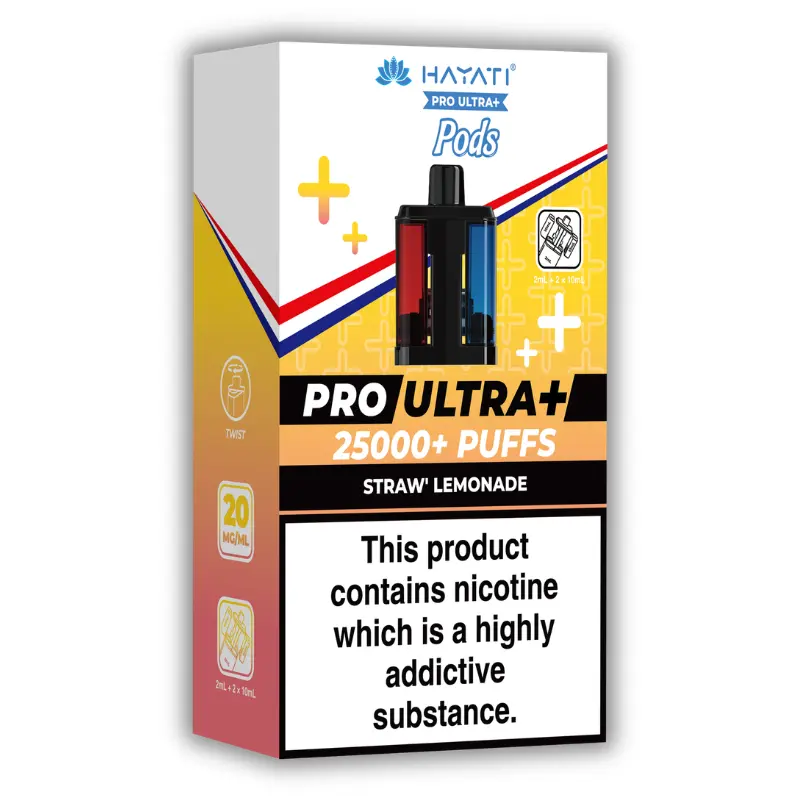
Hayati · Pro Ultra Plus
Straw’ Lemonade Hayati Pro Ultra Plus 25K Pods
£7.99
✔ In stock — ready to ship
Genuine Hayati
Free over £20
Same-day dispatch
Secure checkout
£7.99 buys one sealed Hayati Pro Ultra Plus pod holding 22ml of liquid at 20mg nicotine salt, carrying Straw’ Lemonade from the first draw to the last. Hayati put a figure of up to 25,000 puffs against it, arrived at on test equipment rather than by anyone using one, so treat it as a number for ranking products beside each other and not as a forecast of your fortnight. There is one item in the pack and it is the pod. No device, no charger, nothing else, which means anyone who does not already own a Pro Ultra Plus wants the Straw’ Lemonade kit at £11.99, where the same pod arrives with hardware attached to it.
The number on this listing that should govern the decision is not 25,000 and it is not 7.99. It is 22. Twenty-two millilitres is the largest quantity of e-liquid Hayati sell here inside a single sealed unit that cannot be opened, topped up, diluted or divided. It is roughly double what a 12ml Pro Max Plus pod holds. It is five and a half times what a 4ml Mini Ultra pod holds. Assembled out of Mini Ultra pods at £3.49 each, the same 22ml would cost a little over £19, so the saving is substantial and it is real.
That size is the whole subject here, because it converts the question in front of you. You are not deciding whether strawberry lemonade sounds pleasant. You are deciding whether you want several weeks of it, paid for in advance, drawn through one coil that has to survive the entire volume, with no way to change your mind partway without abandoning liquid you have bought. Those are different questions and the second is much harder.
Three things follow from the volume and each cuts in a different direction. One coil does all 22ml, so whatever a sweetened drink profile does to mesh, it does for roughly twice as long as the middle format asks. An untasted flavour at this size is a much larger bet, because there is no sampling arrangement and no way to stop at a third of a pod. And a pod this size occupies a rotation slot for weeks, which is right for one kind of buyer and wrong for another. The per-millilitre arithmetic and the suitability question give different answers, and this page works through both rather than pretending they are one.
Twenty-two millilitres, measured against the rest of the catalogue
The three sizes Hayati sell, and what each one costs by volume
Set the three prefilled pod formats side by side and the pattern is immediate. A Mini Ultra pod holds 4ml and lists at £3.49. A Pro Max Plus pod holds 12ml and lists at £5.49. This pod holds 22ml and lists at £7.99. Divide each price by its volume and the order reverses: 87.3p per millilitre for the smallest, 45.8p for the middle, and 36.3p for this one.
Read that gap properly, because it is wider than the shelf prices make it feel. Liquid in the 22ml format costs about a fifth less per millilitre than in the 12ml format, and well under half what the 4ml format charges. Nothing else about the three pods varies in a way that would explain it. All three are prefilled and sealed, all three carry 20mg nicotine salt, and none contains a serviceable part. You are paying for liquid and a coil, and this listing gives you more liquid per pound than anything else on the site that arrives ready to use.
The complete kit belongs on the same scale, since it is the other route to this exact pod. £11.99 across 22ml works out at 54.5p per millilitre, but only once. The £4 difference between the two listings is hardware, paid a single time, after which every subsequent pod drops back to 36.3p. That is the whole financial logic of owning the device, and why a bare pod listing exists at all.
Good value and good for you are not the same finding
Here is where the arithmetic stops being decisive. Cost per millilitre answers one question well: if you are certain to use all of it, which format wastes the least money? On that test this pod wins clearly.
What the figure cannot tell you is whether you will use all of it. A 4ml pod at 87.3p per millilitre that you finish, enjoy and repurchase is a better outcome than a 22ml pod at 36.3p abandoned at 15ml because the flavour stopped holding your interest. The cheap unit is only cheap if the unit fits your consumption. Bulk pricing behaves here as it does anywhere: the discount is real, the discount is conditional, and the condition is that you want the quantity.
The honest summary of the money is therefore short. Anybody confident about the flavour is getting a genuinely good deal. Anybody not confident about it is being offered a discount to take a bigger risk, which is a different proposition and should be judged as one.
Why the puff ratings are useless for comparing the three formats
There is an obvious temptation to compare the formats by their headline figures rather than by volume, and it produces nonsense. Hayati rate this pod at up to 25,000 puffs. Their published figure for the 12ml pods is up to 6,000, and for the 4ml pods it is up to 1,500. Work those out per millilitre of liquid and you get roughly 1,140, 500 and 375 laboratory puffs respectively.
Those three numbers should be much closer together than they are. The same volume of liquid cannot plausibly yield three times as many draws in one format as in another unless the draws are being defined differently, which is the likely explanation: each figure comes from a rig running its own conditions for its own device, and the results were never meant to be compared across hardware. Hayati publish the ratings without the test parameters behind them, so the discrepancy cannot be resolved from the outside and should not be argued away.
The practical instruction is simple. Compare formats by millilitres and pounds, which are defined the same way everywhere. Leave the puff figures for comparing pods within one format, the only place they behave consistently, and treat each of them as a laboratory estimate rather than a description of use.
Strawberry lemonade, taken apart
A drink flavour is two jobs, not one
Most fruit pods on this shelf are doing one thing: rendering a fruit, or several fruits, with sweetener underneath. A lemonade profile is structurally different because it has to build a beverage, and a beverage has two separable components. There is the fruit, which supplies body and identity, and there is the lemonade itself, which supplies acidity, brightness and the impression of something poured rather than picked.
Both have to be present and balanced against each other, which is harder than it sounds. Too much berry and the drink character disappears, leaving a sweet strawberry with a sour note in it. Too much acid and the strawberry becomes a garnish on a lemon pod. This one does land between the two, though it is worth being precise about what that balance means when you draw on it rather than when you read about it.
The draw, in the order it arrives
The front of the inhale is strawberry and it is the ripe, jammy kind rather than the green, slightly tart kind you occasionally find in a fresh berry. It arrives sweet and it arrives quickly, which is normal for a sugared fruit on a narrow restricted draw, and for the first portion of the inhale the pod reads as a straightforward strawberry.
The lemonade surfaces across the middle and it does two distinct things. It introduces citrus, which is the obvious part. Less obviously it thins the berry, cutting across the roundness with something sharper, so the texture of the draw changes as well as the taste. A strawberry on its own tends to sit heavily on the tongue. This one does not, and the reason is the acid running underneath it rather than any lightness in the fruit.
The exhale is where the drink identity actually lands. The citrus lingers longer than the berry does, so the finish is tangier than the opening, and what stays behind is closer to the last mouthful of a soft drink than to fruit. There is no cold on the end of it. Nothing in the specification lists menthol, ice or a coolant, and nothing in the flavour behaves like one, so the finish runs warm and the brightness you notice is entirely acid rather than chill. The distinction matters, because people describe an acidic profile as refreshing and then buy something cooled expecting the same sensation.
How sweet, honestly, against the rest of the shelf
Place the Pro Ultra Plus pods on a line from dry to sugared and the two ends are easy to identify. The pure citrus listings sit at the dry end: Lemon Lime is zest with very little sugar behind it, and Orange Lemon & Lime stacks three citrus fruits without adding a sweet counterweight. The confectionery listings hold the other end, the ones carrying GB for gummy or B’Gum for bubblegum in their names, where sugar is the primary construction material and the fruit is a flavouring on top of it.
This pod sits between them and closer to the middle than to either edge. It is distinctly sweeter than any of the plain citrus pods, because the strawberry is doing sweetening work as well as flavouring work. It is noticeably less sugared than something like Fruit Bomb / Straw’ Watermelon B’Gum, where the bubblegum treatment coats the tongue in a way this does not.
The kind of sweetness is as informative as the amount. Confectionery pods tend to leave a film that persists between draws and accumulates over a session, which is part of why they read as heavy by the evening. A drink construction behaves differently: the acid clears the palate on the finish, so the sweetness does not stack in the same way, and the pod stays legible for longer within a single day than its sugar level alone would predict. Anyone who has found a sugared pod exhausting by mid-afternoon should read that as the main practical difference on offer here.
What the lemonade is, and what it is not
Worth separating a lemonade from a lemon, since the catalogue contains both and they are not interchangeable. A lemon profile such as the citrus pods named above is built on zest and rind: sharp, aromatic, slightly bitter at the edges. A lemonade is built on juice and sugar together, which rounds the sharpness off and adds a faintly carbonated impression that has nothing to do with actual carbonation, since vapour cannot fizz. What produces it is the acid arriving quickly and then releasing, which the palate reads as liveliness.
Set against Lemon & Mint, which pairs citrus with a cooling element and stays deliberately dry, this pod is rounder, sweeter and warmer. Set against Blackcurrant Lemonade, which is the only other lemonade at this size, the construction is identical and the fruit is the variable: blackcurrant brings tartness of its own and reads drier overall, while strawberry brings sweetness and reads softer. Those two pods are the clearest like-for-like comparison available anywhere in the format, and which one suits you depends entirely on whether you want the fruit reinforcing the acid or balancing it.
Ruling things out
- Not cooled. No ice, no menthol and no coolant appears in the specification, and there is no chill anywhere in the draw.
- Not sour. There is acidity, which is not the same thing. Nothing here puckers, and anyone shopping for a genuine sour should look at the listings that say so in their names.
- Not a dual pod. One liquid fills the whole 22ml, so the mouthpiece selects nothing.
- Not a confectionery build. The sweetness comes from fruit and lemonade sugar rather than from a sweet-counter treatment.
- Not a realistic strawberry. It is recognisably strawberry, in the way a strawberry drink is recognisably strawberry, and it makes no attempt at the fruit itself.
- Not configurable. One strength, one flavour, one volume, no options published against the listing.
One coil, and the whole twenty-two millilitres
What is in the pack
A single sealed pod, filled at the factory, ready to seat in a device you already own. No bottle, no syringe, no waiting for a wick to take up liquid. One thing separates the £7.99 and £11.99 listings, namely whether hardware is included, and confusing the two is the usual reason a bare pod arrives and disappoints.
The pod fits a Hayati Pro Ultra Plus, and that is the extent of what the listing states. Hayati publish no compatibility chart against this product, no dimensions and no fitting description, so the working rule is to match the range name printed on your device against the range name in the title and go no further. Pods from other Hayati ranges are different pods for different hardware however alike two black rectangles look in a drawer, and a retail page is not the place to settle a question the manufacturer has not addressed.
Nothing to select, and nothing to service
A great many listings on the Pro Ultra Plus pods shelf carry two flavour names separated by an oblique and a collar under the mouthpiece to choose between them. This one does not. Both reserves hold the same strawberry lemonade, so turning the mouthpiece changes nothing, and nothing is broken if you try it and find that to be the case.
Inside is one mesh coil, fixed in place, processing every millilitre that passes through. It cannot be removed, rinsed, rewicked or replaced. Its condition at any moment is the condition you are vaping in, and it retires when the liquid does. That arrangement is standard across the prefilled pods and refills range, which groups every Hayati product that works this way regardless of flavour.
Why a sweetened drink profile makes the back half the interesting part
Now the consequence that the volume actually creates, and the reason this page spends more time on the end of the pod than on the beginning.
Residue accumulation on mesh tracks how much sweetener has passed over it. That is not a Hayati specification, since no coil detail is published against this product, but it is the ordinary behaviour of sweetened e-liquid on any coil and it is the mechanism behind every complaint about a pod tasting flat, darkened or slightly burnt towards the end. The relevant point for this listing is one of arithmetic rather than chemistry. A 12ml pod puts 12ml of sweetened liquid across one coil. This puts 22ml across one coil. Whatever the accumulation curve looks like, this format asks the mesh to travel further along it before the pod is finished.
The result is that the worn phase of a 22ml pod is a longer stretch of your life than the worn phase of a 12ml pod, in absolute terms. If a coil starts to change character after a given quantity of sweetened liquid has gone through it, and if the pod keeps drawing for another several millilitres after that, those several millilitres are the ones you spend in a degraded version of the flavour. No smaller format asks you to accept as long a tail, because no smaller format has as much liquid behind the coil.
Two qualifications, both genuine. A drink profile has a real advantage here, since the sweetness is moderate by the standards of this shelf and the load on the mesh is lighter than a confectionery pod of the same size would apply. Anyone weighing 22ml of something heavily sugared against 22ml of this should count that in this pod's favour. And nothing in the specification says when any of it begins, so anyone quoting a millilitre figure is guessing. The shape of the problem is defensible. Its coordinates are not.
What the late stage sounds like on this particular flavour
Different profiles signal wear differently, and knowing your own pod's tell is worth more than general advice about coils. On a cooled pod the chill goes first. On a heavy confectionery pod the sugar keeps arriving long after the fruit has left, so the draw turns sweet and anonymous. On a drink profile the order is more specific: the acid and the top of the citrus are the delicate components and they thin first, which leaves the strawberry body and the sugar under it. A late pod here does not taste burnt so much as it tastes like a strawberry pod that has misplaced its lemonade.
That is a useful signal precisely because it is distinctive. If the tang has gone quiet and the berry is doing all the work, you are in the last phase of the pod and you can plan accordingly. If the berry has gone quiet too and the draw has turned dry and warm, you are past the last phase and there is nothing further to be gained from the remaining liquid.
Stated as unpublished
Hayati document the capacity, the nicotine strength, the flavour and the puff rating. They do not document a coil resistance, a wick material, an airflow figure, a wattage or a set of pod dimensions, and none of those has been supplied for this page from any other source. Listings elsewhere will quote some of them with complete confidence. They are not quoting this product's specification, because this product's specification does not contain them, and a number invented once and copied twice does not become a fact.
The numbers, read as a commitment sheet
| Liquid volume | 22ml, prefilled and sealed |
| Cost by volume | 36.3p per millilitre at £7.99 |
| Price | £7.99 |
| Relative size | About double a 12ml pod, about five and a half times a 4ml pod |
| Flavour | Straw’ Lemonade, the same liquid throughout |
| Selectable sides | None. Nothing to turn. |
| Nicotine | 20mg nicotine salt, no other strength listed |
| Cooling | None specified and none present |
| Coil | One, sealed in, handling the full volume |
| Manufacturer rating | Up to 25,000 puffs, a laboratory measurement |
| Supplied | The pod alone, with no device and no accessories |
| Device required | A Hayati Pro Ultra Plus, bought separately |
| Brand and SKU | Hayati, straw-lemonade-hayati-pro-ultra-plus-pods |
Two rows on that table deserve more than a glance and the rest are there for completeness.
The volume row is the one that determines everything else on this page, which is why it is at the top rather than buried in the middle where a specification table normally puts it. Every other characteristic of the purchase follows from 22ml: the price, the value, the duration, the risk of buying a flavour you have not tasted, and the length of the worn phase at the end. A specification sheet that lists capacity as the ninth line is describing a component. On a pod this size, capacity is the product.
The relative size row exists because a volume in isolation means nothing. Twenty-two millilitres is an abstraction until you know the pods one shelf over hold twelve and the compact format holds four. Once you do, the decision becomes a question about quantity rather than about flavour, which is the reframing this listing needs and rarely gets.
The nicotine row is fixed at 20mg salt with no alternative offered against this listing, which is the maximum strength permitted in the United Kingdom and the standard across this entire format. Salt rather than freebase is the usual formulation at that concentration, given how it behaves on a narrow restricted draw. Nicotine is addictive, and the appropriate strength for any individual is not a matter a product page should offer an opinion about.
Choosing this over its neighbours
The same flavour with the hardware included
If you do not own a Pro Ultra Plus, this listing is not a purchase, it is a component. The complete Straw’ Lemonade kit at £11.99 holds the same 22ml at the same strength with a device attached, and the £4 difference is hardware you pay for once. Start there if you lack the device, and do not if you have one, since you would be buying a second.
The smaller lemonade commitment, and why it is the sensible first move
This recommendation follows directly from the size argument, and it points away from this listing for a significant group of buyers.
If you have not tasted this flavour, 22ml is a large amount to buy on a description. The same construction exists in the 12ml format, where Blackcurrant Lemonade in Pro Max Plus form sells at £5.49 for roughly half the commitment, though it is a different fruit and needs the other device. Hayati also list Straw’ Lemonade itself in the 4ml Mini Ultra format at £3.49, which is much the cheapest way to find out whether a strawberry lemonade suits you before spending £7.99 on five and a half times as much. The rate per millilitre on the small pod is poor and that is beside the point. You are buying information rather than liquid, and £3.49 is fair for information that prevents a £7.99 mistake.
The ordering matters more here than on any other format, because the smaller pods offer a cheap exit and this one does not. Once the seal is broken, the whole £7.99 is committed whether you draw on all of it or a third of it.
If the lemonade construction is the part you want
Blackcurrant Lemonade is the direct sibling at this size, and choosing between them is a choice of fruit rather than of style. Blackcurrant has tartness of its own, so that pod reads drier and sharper. Strawberry has none, so this one reads rounder. If the tang is your reason for wanting a lemonade, the blackcurrant serves it better. If you want fruit with a lift rather than fruit with an edge, this is the one.
Stepping into citrus without the sugar, Lemon Lime leaves zest and no fruit body, and Orange Lemon & Lime does the same across three citrus fruits. Both are considerably drier, and both suit anyone who liked the lemonade half of the idea and found the strawberry unnecessary. Blueberry Raspberry Lemon goes the other way, keeping citrus as a top note over a berry base, which makes it the nearest structural relative using different fruit. The Lemonade Vapes shelf runs to nineteen products across every format, and Lemon Vapes widens that to fifty-four.
If the strawberry is the part you want
Strawberry appears across this shelf in several treatments and they are genuinely different products. Grape GB / Strawberry GB gives it the gummy-sweet treatment, a long way from a drink profile and much heavier on sugar. Kiwi Banana / Straw’ Banana pairs it with soft fruit and removes the acidity altogether. Straw’ Grapefruit / Straw’ Dragonfruit keeps a sharp counterpart, with grapefruit supplying bitterness where this pod supplies lemon acidity.
For strawberry with cold rather than acid, Strawberry Ice / Strawberry Raspberry Ice arrives as a kit at £11.99, and Blue Razz Pineapple / Strawberry Ice puts a cooled strawberry opposite something warmer. Straw’ Cranberry Cherry / Strawberry Raspberry Ice and Straw’ Cranberry Cherry / Cherry Ice push the berry darker. The Strawberry Vapes shelf holds eighty-two listings across every Hayati format, for anyone to whom the fruit matters more than the hardware.
The dual pods, read as a way of halving the bet
This is the comparison the size argument makes unavoidable, and it has little to do with variety as the marketing frames it.
A two-flavour pod holds the same 22ml and divides it. Financially nothing changes, since you still pay £7.99. What changes is your exposure to any one flavour, which drops to roughly 11ml. For a buyer unsure about a profile, that halving is the nearest thing the format offers to a hedge: if one side turns out merely acceptable, the other is there, and you have committed about a 12ml pod's worth to each rather than a full 22ml to one.
Lemon & Lime / Summer Dream sets a sharp half against a rounder one. Blue Razz GB / Lemon & Lime runs sugared confectionery against straight citrus, which is one of the wider gaps on the shelf. Lemon Lime / Lemon Blueberry keeps citrus on both sides and varies what sits underneath it. Sour Apple / Juicy Peach puts a genuine tartness opposite a sweet fruit.
State the cost of that hedge plainly rather than skipping it. You get half as much of the flavour you wanted, one shared coil still handles all 22ml however the liquid is divided, so nothing in the wear argument improves, and you acquire a second way to waste money, since a pod often stops being worth drawing on while liquid remains in the side you visited less. That failure mode does not exist here. Every millilitre in this pod is the flavour you chose, which is the strongest argument for a single at this size and the reason confident buyers should ignore the hedge.
A third category is worth naming, because people confuse it with a pairing. Mango Peach Pineapple mixes three fruits into every draw, which is complexity you cannot switch off rather than a choice you can make. A narrowly drawn pairing has the opposite fault, offering a change you may struggle to notice. Neither reduces your exposure the way a genuinely contrasted pairing does, and buying one in the belief that it does is a common and expensive misreading of the oblique in a product name.
Where to browse from here
The Pro Ultra Plus pods shelf carries fifty-two listings, all at £7.99, so moving between flavours costs nothing at the till and loyalty to one pod buys no discount at all. Pro Ultra Plus kits and pods together runs to a hundred and four and is the shelf for anyone weighing a second device rather than a second pod. Recent additions land in New Products, and the full catalogue is there for browsing at length.
Living with a pod this size
General pod handling applies here as it does anywhere. What follows is the part that is specific to a large volume of a lightly sweetened drink profile, which is where the useful advice actually differs.
Do not buy a second one until the first is past halfway. This runs against the usual instinct and it is correct for this format specifically. A 22ml pod covers a long stretch, so a spare is worth less here than on a smaller pod and costs more, since it ages in a drawer throughout. Buy it when you can see the end of the one you are using.
Judge the flavour in the first week, not the third. Decide whether you genuinely like this before the pod is deep enough into its life for coil condition to start influencing what you taste. If you leave the verdict until 15ml, you will be judging a mixture of the liquid and the mesh and you will not be able to separate them, which is how people conclude that a flavour was disappointing when what actually disappointed them was the last third of it.
Watch the lemonade rather than the strawberry. The acid and the citrus top notes are the fragile components in this blend, so they move first and they move most. Take a deliberate reading in the first couple of days, note how prominent the tang is relative to the berry, and use that as your reference. When the ratio has visibly shifted towards the fruit, the pod has entered its late phase, and that tells you more than counting days does.
Draw slowly and do not chase it when it thins. The draw is restricted and narrow, and pulling harder does not extract more lemonade. It raises coil temperature and moves liquid through the wick faster than it is replaced, and on an acid-led profile the first casualty is the bright top end, which is the part you bought the pod for. Chain-drawing a pod that has started to fade reliably makes the fade worse rather than better.
Give a rested pod a few draws before forming a view. Any pod left standing part-used for a week has liquid sitting against an idle wick, and the first pulls come through thick and slightly stewed. On this profile that reads as syrup, which is the least appealing version of it. Three or four unhurried draws and the lemonade returns.
Store spares away from heat and daylight. A drawer or a cupboard is adequate. What degrades a citrus-led liquid over weeks is sustained warmth and light, so the windowsill, the car and anywhere near a radiator are the places to avoid, and the top notes are what you lose rather than the sugar. Anything containing nicotine belongs where children and pets cannot reach it, spares included, and a closed box is not a barrier.
Decide in advance what you will do with the last two millilitres. On a pod this size there is a genuine decision at the end, because the tail is long enough to matter. Either commit to finishing it and accept a diminished version of the flavour for that stretch, or retire it when the lemonade goes and accept the waste. Both are defensible. Drifting between them, which is what most people do, produces the worst of each.
Dispose of it properly. A spent pod still holds a coil and a residue of liquid, so it does not belong in household waste. Most vape retailers and local recycling points accept them, and there is nothing recoverable inside to justify keeping it.
Questions this listing raises
Is a device included at £7.99?
No. This is the pod on its own, prefilled and sealed, with no hardware in the pack at all. The same flavour is sold as a complete kit at £11.99 on a separate listing, and that is the one to order if you do not already own a Pro Ultra Plus.
How much liquid is in it compared with the other Hayati pods?
Twenty-two millilitres, which is the largest sealed unit in the range. A Pro Max Plus pod holds twelve, and a Mini Ultra pod holds four. In other words this is about double the middle format and five and a half times the compact one, which is the single most important fact on the listing.
What does it work out at per millilitre?
36.3p, dividing £7.99 across the full 22ml. For comparison, the 12ml format at £5.49 comes to 45.8p and the 4ml format at £3.49 comes to 87.3p. This is the lowest rate of the three by a clear margin, provided you finish the pod.
Is there any ice or menthol in it?
None is specified and none is detectable. The freshness people notice in it comes from the citrus acidity rather than from any cooling agent, and the finish runs warm. If you want a cold strawberry, the iced pairings elsewhere on the shelf are the listings to look at instead.
How sweet is it really?
Above the middle of this shelf and well below the confectionery end. The strawberry supplies most of the sweetness and the lemonade acidity cuts across it, so it reads lighter than the sugar level alone would suggest. It is definitely sweeter than the plain citrus pods and definitely less sugared than anything named after a sweet.
Can I try the flavour without committing to 22ml?
Straw’ Lemonade is also listed in the 4ml Mini Ultra format at £3.49, which needs that device rather than this one but is the cheapest way to find out whether the profile suits you. The rate per millilitre is much worse and that does not matter for a trial. Spending £3.49 to avoid an unwanted £7.99 pod is sound arithmetic.
Does the mouthpiece turn on this pod?
There is nothing behind it to select, because the same liquid fills the whole pod. Buyers arriving from a two-flavour listing sometimes reach for a collar out of habit and find that nothing changes, which is the product working as described rather than a fault.
Will the flavour hold up across the whole pod?
No coil specification is published against this product, so nobody can give you a millilitre figure for when a change begins. What is reasonable to expect is that the delicate parts of a blend move before the robust parts, which on this one means the citrus lift thins ahead of the strawberry body. Taking a mental reading in the first few days gives you something to measure later draws against.
Does a larger pod wear the coil harder than a smaller one?
One coil here handles 22ml where the 12ml format's coil handles twelve, so it processes considerably more liquid over its life. Neither specification quantifies that and a figure would be invention. What is defensible is that the worn stretch at the end of a pod this size is longer in absolute terms than on a smaller one.
Can I refill the pod when it is empty?
Nothing in this product's description provides for refilling, and no filling arrangement is published, so treat it as one committed unit rather than a container you own. The coil is not a replaceable part either, which means even a successful top-up would be drawing through mesh that has already processed 22ml.
What does the 25,000 figure actually mean?
It is Hayati's own rating, produced on laboratory equipment drawing to a fixed pattern, and it is a comparison tool rather than a prediction about your use. It is most usefully read as a statement of the workload one non-serviceable coil is designed to handle. It should not be used to compare this format against the 12ml or 4ml pods, whose ratings clearly come from different test conditions.
Will it fit my device?
It fits a Hayati Pro Ultra Plus, and that is the whole of what the listing states. No compatibility chart is published against this product, so match the range name on your device to the range name in the title and do not assume that a similar-looking pod from another Hayati range will seat correctly.
The short version
A replacement pod for a Pro Ultra Plus you already own: £7.99 for 22ml of 20mg nicotine salt, sweet strawberry over a tangy lemonade base, no cooling, and Hayati's laboratory rating of up to 25,000 puffs. It sits between a fruit pod and a soft-drink pod, sweeter than the citrus listings and lighter than the confectionery ones.
On value the verdict is unambiguous. At 36.3p per millilitre this is the least expensive prefilled liquid in the range, a fifth cheaper by volume than the 12ml pods and well under half the rate of the 4ml ones. If you know you want strawberry lemonade, nowhere else on the site sells you more of it for less.
Suitability is narrower, and the two should not be confused. The 22ml format serves one buyer properly: a settled taste who runs one flavour as a default rather than as a choice, will not want a change in three weeks, and has met this liquid somewhere already. It serves three others poorly. Anyone untested on strawberry lemonade is buying a lot of an unknown, and the 4ml version exists for exactly that. Anyone who rotates will find 22ml occupies a slot for weeks. Anyone sensitive to a tiring coil should register that the tail of a pod this size is longer than any other format asks them to sit through.
Work out which of those you are before you order rather than at 15ml. The size is not a detail of this product. It is the product.
Strictly for adults aged 18 and over. Nicotine is an addictive substance.
You might also like


