
Home / Hayati Pods / Blue Sour Raspberry Hayati Rubik Pods
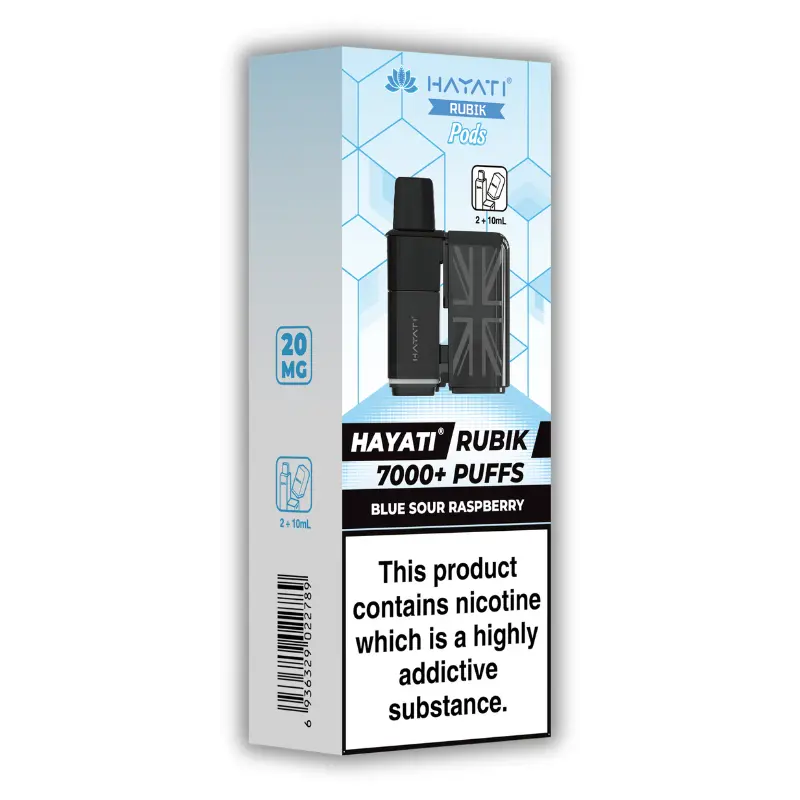
Hayati · Rubik
Blue Sour Raspberry Hayati Rubik Pods
£3.99
✔ In stock — ready to ship
Genuine Hayati
Free over £20
Same-day dispatch
Secure checkout
Three pounds ninety-nine buys one sealed replacement pod holding twelve millilitres of Blue Sour Raspberry at 20mg nicotine salt, built for the Hayati Rubik and supplied without a body. Hayati rate the pod at up to 7,000 puffs, a laboratory figure arrived at under a test protocol rather than a description of anybody's fortnight. Divide the ticket by the fill and the running cost is 33.25p a millilitre, the lowest figure on any sealed pod in the catalogue. The Hayati Rubik Pods shelf works that table out in full against every other prefilled format, and this page takes the arithmetic as settled rather than repeating it.
All of that is on the listing. The reason this page exists is a question no listing answers and no first-encounter page can: what this liquid is like the second time you buy it, and the third. A refill buyer is a different person from a kit buyer. The flavour decision is behind them, the hardware decision is behind them, and the only live question is whether to order the same thing again. That question has an answer, it is not the same answer for every liquid, and for a declared sour it turns out to be genuinely awkward.
Blue Sour Raspberry is the only declared sour on the nineteen-name Rubik pod shelf. It is also, across the whole Hayati Rubik range of thirty-nine tiles, one of exactly two listings with the word in the title, and the other one is this same flavour sold with a body attached. So the shelf gives you no second sour to compare against, no sourer version and no milder one, which matters more than it sounds and is most of what this page is about. The catalogue as a whole is not short of sour. The platform is.
What follows is organised around the pod boundary: what happens inside twelve millilitres, what resets when you open the next one, and which of the two readings you can trust. Some of it corrects instructions I was handed. The counts come from the catalogue data as it stands, not from any sibling page, because shelf figures on this site have gone stale before.
What another page already settled, and why this one does not start there
Blue Sour Raspberry has been analysed properly once already, on the complete kit page for the same liquid on the Mini Ultra, and that analysis is long, careful and mostly right. Rebuilding it would waste your time and mine. Here is what it owns, stated as citation so nothing below has to re-derive it.
It lined up all eleven catalogue listings of this one liquid and diffed their descriptions against each other. It found that four of them put the sourness before the sweetness, six make the berry the base with acid over or through it, and one calls the two equal, and it showed that matched kit-and-refill pairs of the identical liquid contradict each other on that point, which means the sequence claims in the copy are evidence about copywriters rather than about the recipe. It found that eight of the eleven reach for a salivation word, against nineteen listings in the whole catalogue that use that vocabulary at all, and treated that as the one property eleven independent writers agreed on. It established that a worn coil is where the format argument lives, worked the proportional case with an illustrative threshold volume, and refused to pretend the threshold was known. It ran the per-millilitre table across every format of this flavour. And it warned against comparing formats in puffs, because the four Hayati platforms imply 375, 583, 500 and roughly 1,136 puffs a millilitre on the same liquid, which cannot all be true.
Three other pages get cited below rather than re-argued. The Rubik pod shelf owns the cost table and the finding that bottled liquid undercuts every sealed pod, so the 33.25p figure is a running cost rather than a claim about value. The Cherry Sour Raspberry Pro Max Plus refill page owns the mechanics of a pod's final stretch and the observation that people summarise an experience by its most intense moment and its ending, so a pod that goes wrong at the end gets remembered as worse than it was. And the Juicy Peach Rubik kit page owns the general statement about this platform, which is that the cheapest hardware is the wrong place to meet a flavour and the right place to keep one, because twelve millilitres is a large commitment and a large commitment is a poor shape of experiment.
That last one is the sentence this page grew out of. If the Rubik is the right place to keep a flavour rather than to meet one, then every Rubik pod after the first is the platform doing the job it is actually for, and the interesting question is which liquids keep well on it. A sour is the hardest case.
The counts, including two I was handed wrong
I was told to build this page on the claim that Blue Sour Raspberry is the only sour on the Rubik pod shelf, and that twenty listings across the catalogue carry a sour word under five distinct names. One of those survives counting and one does not.
The shelf claim holds, with a qualification worth putting on the page. There are nineteen tiles on the Rubik pod shelf, all at £3.99, all 12ml, all 20mg, and exactly one of them names sour in its title. But three of the other eighteen use the word somewhere in their description, and reading what they do with it is more informative than the raw count. Red Apple Ice uses it to deny it, saying the blend avoids the sourness of green apple profiles. Juicy Peach uses it to deny it too, ruling out anything icy or sour competing for attention. Only Strawberry Kiwi credits a component with any of it, describing the kiwi as sharp, green and slightly sour against the strawberry. So the accurate version is that one shelf-mate has a partly sour component, two go out of their way to say they have none, and one listing has it as the headline. Narrowed that way the claim is stronger than the flat version, because two explicit denials on a nineteen-name shelf tell you the copy desk treats sourness as a thing buyers avoid unless they came looking for it.
The catalogue figure was wrong in both halves. Twenty-one listings out of 492 carry the word in a title, not twenty, and they run under six distinct names rather than five: Blue Sour Raspberry, Red Sour Raspberry, Cherry Sour Raspberry, Sour Apple, Sour Apple with Juicy Peach, and Tropical Sour Juice. The twenty-one figure is already published on the Mini Ultra kit page, which also records that eleven of the twenty-one are this flavour. The name count is new here, and it changes the shape of the thing. Fifteen of the twenty-one are a sour raspberry of some colour. Hayati's sour programme is not a spread of sour fruits, it is a raspberry programme with one apple and one tropical blend attached.
One more count is worth having, because it explains why the shelf feels the way it does. Across all 492 titles Hayati name a taste direction twice and only twice: sour on twenty-one listings and fizzy on six. There is no listing whose title says tart, none that says sweet, none that says zesty. Every other title names fruits, a colour, a mood or a temperature. On the Rubik specifically, three of the thirty-nine tiles carry either word, and one of those three, Fizzy Cherry, exists only as a complete kit with no standalone refill. On the pod tier, therefore, there is exactly one listing that tells you in its name what it will do to your tongue rather than what it is made of. That is the shelf's whole sensory vocabulary, and it is one word long.
Sour is ordinary in the catalogue at roughly one listing in twenty-three, and singular here. Both halves of that are needed. If sour were rare everywhere, a buyer could conclude Hayati do not make it. They do, at reasonable depth, on three other platforms. What the Rubik lacks is not the recipe, it is the range.
The liquid, described for the twelfth millilitre rather than the first
The draw-by-draw has been done. Rather than write a second one, here is the same liquid described along the axis that a refill buyer actually experiences, which is the length of a pod.
The base is a confectionery accord rather than a fruit. Blue raspberry does not exist as a berry and never has, and the kit page on the Mini Ultra tier borrows a census from the Red Sour Raspberry refill page establishing that sixteen names in this catalogue attach a colour that is counter-factual, invoking a sweet rather than describing a fruit. Blue Sour Raspberry sits in that group. What that means practically is that there is nothing underneath the accord. A raspberry blend has fruit character that persists when its brightness fades. This has a sugared confectionery impression and a dosed acid, and if either of those two things changes, the liquid changes into something else rather than into a quieter version of itself.
Fresh, the two arrive close enough together to be a single event. Hayati's own text for this listing commits to an order, putting the tart edge on the tip of the tongue with the familiar blue sweetness a beat behind, and says the sequence repeats on every draw. Take that as a description and not as data, because the same listing's own kit twin on this platform builds the flavour from sugar upwards and puts the acid on top, and both cannot be describing a different liquid. What is not in dispute across any of the eleven is that both things are present, that neither is subtle, and that the appeal is the interaction between them rather than either one alone.
Where the corpus contradicts itself, and why it lands here
Now the part that matters for a twelve millilitre pod, and the part where two shipped pages on this site say opposite things about the same physics.
The Mini Ultra kit page states that acid is the first thing a coil stops delivering as residue builds. Its whole format argument rests on that: a fresh pod arrives with its acid intact, the sharp window is a fixed number of millilitres wide, and a bigger pod therefore spends a larger fraction of its life past that window. The Cherry Sour Raspberry Pro Max Plus refill page states the reverse. It argues that the acids carrying sourness are non-volatile, that they ride into the aerosol in the liquid fraction instead of being lifted off the wick as vapour, and that they therefore reach your tongue whether the coil is immaculate or filthy, while the aromatic fruit around them does not. On that reading a tiring coil does not reduce the sour at all. It removes everything competing with it, so the acid's share of the draw rises and the pod finishes sharp and hollow rather than flat and sweet.
Those cannot both be right, and I am not going to pick one by deciding which page sounds more confident. What can be said is that there is a third data point and it is Hayati's own. The listing for this flavour as a 10ml bottled nicotine salt ends with a line of advice: if the sour note starts to taste muted, that usually means the coil needs changing. That is the manufacturer's copy describing the sour as the thing that goes first, which is the Mini Ultra page's direction rather than the Cherry page's. It is one sentence of retail copy and it is not a measurement, but it is the only published statement of direction anybody has, and it deserves to be on the record.
There is also a reason the two pages might both be describing something real. The Cherry page's mechanism needs aromatic fruit present to be lost. Cherry Sour Raspberry has actual fruit character in it, so removing the aromatics leaves acid standing alone and audible. This liquid does not have that. If the accord thins here, what is left is acid and sweetener rather than acid and nothing, and sweetener is not an aromatic either. So the two pages may be describing two different recipes correctly, and the general rule neither of them should have written is the one that says what sourness does on every pod.
What that leaves you able to hear
The practical consequence is narrower than either page's version and more useful. Late in a Rubik pod of this, one of two things will be true, and they sound different enough to tell apart on a rested palate.
If the acid delivery has dropped, the draw arrives sweet with the edge missing, and the sweetness reads earlier and broader because there is nothing suppressing it. That is a generic sugared blue, and it is the version Hayati's bottled listing warns you about. If instead the accord has thinned and the acid has not, the draw arrives sharp and thin, the sweetness is still there but reads flatter and less specific, and the whole thing loses the confectionery roundness that made it recognisable. One failure is too sweet. The other is too bare. On a fruit-true sour the two would both leave you with quieter fruit and you could not separate them. Here they diverge, which makes this liquid a poor thing to commit twelve millilitres to and an unusually clear one to observe.
What it is not
Nothing in it is cold. The Mini Ultra kit page checked all eleven listings for every cooling word Hayati use and found none of them, which is about as clear a signal as a catalogue of this kind produces, and all the sharpness here is chemical rather than thermal. It is not a fruit-forward blend, and anyone expecting raspberry rather than a sweet shop impression of one has misread the name. It is not a graded or layered acid either, because the Cherry Sour Raspberry kit page established that sourness is a single channel reporting a magnitude, so there is one acid arrival per draw and not a sequence of them. And it is not restrained. The sweetness is high and the acid is dosed on top of it, which is a combination that either works for you immediately or does not.
The second pod, and what it is actually for
Here is the argument this page was written to make. Four millilitres could not test it, because the Mini Ultra format puts you three pods into a month before anything slow has had room to happen. Twelve millilitres can.
The tell I was given, and the half of it that works
The proposal handed to me was that habituation to a sour would announce itself as the sweetness arriving sooner rather than as the sourness arriving weaker, and that this would distinguish a palate effect from a coil effect because the coil produces the opposite signature. Tested properly, that does not hold, and the reason is worth setting out because it is the sort of thing that sounds rigorous and is not.
Sweetness and acidity suppress each other. If the acid signal falls for any reason at all, the sweetness reads earlier and larger, because less of it is being masked. That means "the sweet arrived sooner" and "the sour arrived weaker" are not two findings. They are one observation with two descriptions, and no amount of attention while drawing will separate them. A palate that has adapted and a coil that has stopped delivering acid produce the identical percept. The tell cannot do the job it was given.
It does do a different job, and a genuinely useful one. The two coil hypotheses above predict opposite things, so the same observation discriminates between those. If the late pod reads sweeter and rounder, the acid delivery has dropped and the Mini Ultra page's direction is the one operating on this liquid. If it reads sharper and thinner, the accord has gone and the Cherry page's is. That is a real experiment, it costs nothing, and anybody running a second Rubik pod of this is in a position to settle for themselves a question two shipped pages disagree about.
The reading that separates palate from hardware
The discriminator is not inside a draw. It is the pod boundary.
Every coil effect, in either direction, resets when you fit a fresh pod, because a fresh pod brings a fresh coil with it. No palate effect resets when you fit a fresh pod, because your tongue does not know you have been shopping. So the comparison that answers the question is between two readings taken under identical hardware conditions and separated by twelve millilitres of use: the first draw of a morning on a fresh pod, against the same reading on the pod before it.
The instrument itself is not mine. The Mini Ultra kit page already names a morning draw early in a fresh pod as the reading that cuts through session adaptation, coil residue and memory drift simultaneously, and it is right. What that page could not do, and said so, was use the reading as a series. At four millilitres the readings come three times as often but each interval is short, and a slow effect measured over short intervals is measured as noise. What is new here is the spacing.
Why twelve millilitres is the right interval, and the Rubik the right hardware for it
A measurement series needs its readings far enough apart that anything slow has room to appear, close enough together that you remember the last one, and cheap enough that you take them. Twelve millilitres at £3.99 satisfies all three, and nothing else in the catalogue does.
The 4ml Mini Ultra refill gives you a boundary three times as often, which sounds better and is not, because consecutive readings a few days apart on a liquid that changes over weeks tell you nothing except how well you slept. It also costs 87.25p a millilitre, so the extra boundaries are paid for at two and a half times the rate. The 22ml Pro Ultra Plus refill goes the other way. Its boundaries are so far apart that by the time you reach the second one your memory of the first reading has been rewritten several times over, and each reading costs £7.99 to take. The Rubik kit at £5.99 is the same twelve millilitres with a body you already own.
So the pod in front of you is a poor container for a sour and a good instrument for measuring one. Those are not in tension. The container argument, which belongs to the Mini Ultra page, says a large fill wastes a larger proportion of a perishable property. The instrument argument says a large fill spaces your calibration points correctly. Both are true, and which one you care about depends on whether you are still deciding about this liquid or have decided.
What the series cannot tell you
Two things sit outside the reach of this or any other test you can run at home, and pretending otherwise would be the sort of confident invention this catalogue has already been caught doing.
Batch variation is one. No Hayati listing publishes a fill date, a batch code or anything else that would let you know whether pod two was made in the same month as pod one, so a genuine difference between two pods and a change in you are indistinguishable from a single comparison. Three readings help, because a one-off step is more likely to be a batch and a steady drift more likely to be you, but three readings is thirty-six millilitres and most of a season. Report it to yourself as uncertain and leave it there.
Storage is the other. A pod bought alongside the one you are using and left in a drawer for two months is not the same reference point as one bought fresh, and the Mini Ultra page's drawer section notes that an acid-carrying liquid tends to drift downwards over a long stay rather than upwards. If you are running a series, buy the next pod near the time you need it rather than stockpiling, which is the opposite of what the 33.25p figure encourages.
The rebuy decision arrives at the worst moment available
Now the part that makes all of this more than an intellectual exercise. You decide whether to buy another one when the current one runs out. That is the natural moment, it is the moment the empty pod prompts you to act, and it is the single worst reading in the entire cycle.
The Cherry Sour Raspberry refill page sets out the mechanism: experiences get summarised by their most intense moment and by how they ended, so a pod whose last stretch is its weakest gets filed in memory as the weak one regardless of how good the other four fifths were. That applies to any pod. What is specific to this one is the interval. A Pro Max Plus pod of the same volume behaves similarly, but on the Rubik there is nothing else on the shelf to interrupt the run, and twelve millilitres at £3.99 is the platform's whole proposition, so the buyer who chose it for the running cost is exactly the buyer least likely to break a pod up. You will run this one end to end. Your last impression of Blue Sour Raspberry will therefore be formed at the point where the coil has done the most work it will ever do, and your decision about whether to reorder will be made against that impression rather than against the liquid.
The correction is simple and costs nothing. Do not decide at the end of a pod. Decide on the first morning of the next one, or do not open the next one at all. If you have already bought the replacement, fit it, take one draw before anything else, and make the call then. If you have not bought it, the honest position is that you do not currently have a reading you can use, and the reading you are about to use is known to be the harshest one the pod produced.
So does twelve millilitres at a stretch stop you registering the sour?
The hypothesis I was given was that acid perception habituates over weeks while the recipe does not change, so a long run on a single sour turns it into something you stop hearing as sour. Tested against what the corpus has already established, that specific claim does not survive, and the thing that replaces it is more interesting.
Within-session adaptation is real and it is not the answer. Saliva arrives, buffers the acid and the sharpness stops registering, which is why a first draw of the morning reads sharper than the same draw at midday. The Mini Ultra kit page tested this as a format argument and found it volume-neutral, because the effect resolves overnight and therefore starts from the same place on session one and session forty regardless of what is behind the coil. Nothing about a twelve millilitre pod changes that.
Multi-week receptor habituation is the stronger-sounding version and it should not be claimed, because nothing in this corpus establishes it and upgrading a within-session mechanism into a multi-week one is precisely the reasoning that has produced errors on this site before. What the sibling pages do establish is a different effect with a similar outcome: acidity, unlike a fruit aroma, leaves behind no category you can file and retrieve, so there is no stable copy of the original to notice today's draw moving away from. The drift is real and it lives in the reference rather than in the receptor. Your palate has not changed. Your yardstick has gone missing.
That reframing is what makes the shelf structure matter, and it is where this page ends up somewhere the Mini Ultra page could not. If the problem is a missing reference, the fix is a contrast, and a contrast means something else to taste that is not this. The Rubik pod shelf has nineteen names and exactly one declared sour. There is no milder sour to step down to, no sourer one to check against, and no second liquid on the platform whose title even names a taste direction. Eight of the nineteen are cooled and eleven are not, so the available contrasts are temperature and fruit, neither of which is the axis you are trying to hold steady in your memory.
The conclusion follows and it is uncomfortable for the platform. The Rubik sells this liquid at the lowest running cost in the catalogue and simultaneously offers the worst conditions for keeping it legible, because keeping a sour legible requires periodically tasting something that is not sour in the same way, and the shelf has nothing to offer. A Pro Max Plus owner in the same position can reach for a second declared sour without leaving the platform. A Rubik owner cannot. So the fade a long-term buyer of this pod will report is real, it is not habituation, and it is a property of the range rather than of the recipe or of their tongue.
Testing the claim the Blueberry Raspberry kit page handed over
The Blueberry Raspberry Rubik kit page says, in passing and about this product, that Blue Sour Raspberry is the Rubik entry that holds up longest over twelve millilitres because the sour layer keeps resetting the palate. I was asked to test that before repeating it. It does not pass, and the failure is instructive rather than embarrassing, because the claim is half right in a way that is easy to state precisely.
The mechanism is wrong. A sour does not reset a palate. What restores acid perception after it has faded within a session is an interval without acid, which is to say a pause, and the Mini Ultra kit page documents that resolution as the thing that happens over ten minutes away from the device or across a night's sleep. Continuing to draw on the sour is the opposite of the pause that would restore it. Nothing in the liquid resets anything; the gaps between sessions do.
The direction is unproven and may be backwards. Under the reading where a worn coil reduces acid delivery, a declared sour is the flavour with the most to lose over twelve millilitres, because the thing you specifically paid for is the thing that goes, and there is no fruit underneath to fall back on. Under the reading where the acid survives and the accord thins, it does not fade so much as change shape into something narrower. Neither of those is holding up longest. On the first reading it holds up worst on the shelf, and on the second it holds up differently rather than better.
What is defensible, and what I think the kit page was reaching for, is a real property and a different one. Sweetness accumulates. A high-sugar liquid with nothing cutting it gets tiring across a long run, and the acid here does cut it, which is what Hayati's own copy for the Rubik kit means when it says the sourness keeps the sweetness from building up. That is a claim about palate fatigue from sugar, not about the sour resetting anything, and it holds for as long as the acid is still being delivered. So the correct sentence is that this liquid resists sweetness fatigue better than the sugar-forward entries on the shelf do, for the portion of the pod where its acid is intact, and that the portion in question is exactly what nobody can put a number on. Blue Razz GB is the shelf's most sugar-forward listing and the one that argument is really about.
One further correction, since it belongs in the same paragraph as the rest of the money. The Blue Razz Cherry and Blue Razz GB Pro Ultra Plus pod page calls the £3.49 Mini Ultra refill the cheapest way to hear what soured blue raspberry sounds like, which is true on ticket price and false per millilitre by a wide margin, since 87.25p against 33.25p here means three Mini Ultra pods cost £10.47 to deliver the twelve millilitres this one delivers for £3.99, so the sentence needs to say which measure it means.
The pod itself, kept short
One sealed prefilled pod arrives and nothing else. There is no body in the packet, no charging accessory and no spare, and the listing is explicit that a device is not included. Fitting it is the whole of the operation.
The one published figure that changes anything about how this behaves is the fill. Twelve millilitres is a long single block of one liquid, which is the basis of everything argued above, and it is the number to plan around rather than the puff rating. Hayati rate the pod at up to 7,000 puffs and that figure implies 583 puffs per millilitre, which sits oddly against the same manufacturer's figures for its other platforms on the same liquid. Treat all of them as laboratory estimates produced under a test protocol and use millilitres, which are a measured quantity of liquid.
Hayati publish nothing about the coil. No resistance, no wick material, no construction detail appears on this listing or anywhere else in the Rubik range, so any statement about how many millilitres pass before the delivery changes is an estimate rather than a specification, including the estimates on this page. No fill or refill route is described either, so treat the pod as a sealed consumable and replace it rather than attempting to open it. On buying pods for a device you own, the only sound rule is that cross-range fitment is not something to settle from a retail page, so match what is printed on the body in your hand. The whole range sits together on Hayati Rubik if you would rather see the pods and the kits in one grid, and the pods repeat on Hayati Prefilled Pods & Refills alongside every other sealed format Hayati make.
The sheet, with the blanks marked as blanks
The rows below are ordered by how much each one changes a repeat purchase, which puts the unit cost first and the puff rating well down. Half the table is empty, and the empty half is arguably more informative than the full one, because the specifications Hayati decline to publish are the specifications that would let you predict how a pod ages.
| Running cost | 33.25p per millilitre (£3.99 divided by 12ml) |
| Fill | 12ml |
| Ticket | £3.99 |
| What is in the packet | One prefilled replacement pod, no device |
| Body it is made for | Hayati Rubik |
| Nicotine | 20mg, salt preparation |
| Strength options | None; 20mg is the only figure on this platform |
| Manufacturer rating | Up to 7,000 puffs, a laboratory estimate |
| Implied puffs per millilitre | 583, and not comparable with other platforms |
| Cooling agent named | None |
| Flavour as filed | Blue Sour Raspberry |
| Shelves it appears on | Seven |
| Coil resistance | Not published |
| Wick material | Not published |
| VG and PG ratio | Not published |
| Refill route | Not published; treat as sealed |
| Fill date or batch code | Not published |
The strength row deserves a sentence because it removes a decision rather than offering one. Twenty milligrams per millilitre is the maximum permitted for retail sale of this kind of liquid in the United Kingdom, every listing on this platform carries it, and there is no lower figure to move to without leaving the range entirely. Nicotine is addictive. If a different milligram figure is what you want, the search starts on another shelf and probably with bottled liquid rather than sealed pods.
The blank rows are the ones that bear on this page's argument. Without a coil resistance or a wick description, nobody outside Hayati can say how many millilitres pass before the delivery changes, which is why the threshold on the Mini Ultra page is illustrative rather than measured and why the two contradictory accounts of what a worn coil does to acid have never been settled. Without a fill date, a difference between two pods cannot be attributed. Those are not oversights on my part. They are the shape of what Hayati publish, and a page that filled them in with plausible numbers would be making things up.
What else to buy, and what to buy alongside it
This section assumes you already own the body, which is what separates a refill buyer from everyone else. If that is wrong, the arithmetic changes and the £2 gap between this pod and the complete kit becomes the relevant number rather than the 33.25p.
The same liquid in a different quantity
Four formats carry it and the choice between them is a choice about interval rather than about taste. This pod is the cheapest per millilitre of the four. The 4ml Mini Ultra refill costs two and a half times as much for the same liquid and buys you a pod boundary three times as often, which is worth paying for only if you actively use boundaries as punctuation. The 22ml Pro Ultra Plus refill is a longer block and a slightly higher unit cost. And the divided Pro Ultra Plus pods are a different proposition again, since a listing with two flavour names behind a collar gives you a second thing to taste inside one purchase, which is exactly the contrast the Rubik shelf cannot supply.
Blue without the acid, on this shelf
Six of the nineteen Rubik pods are blue in one sense or another and none of the other five carries acid as a headline. Blue Razz Cherry is the closest neighbour in profile, bright on the inhale with a darker exhale and both fruits legible, and it is the one to take if what you liked about this pod was the blue rather than the edge. Blue Razz GB is the sugar-forward end and the direct opposite of what you bought. Mr Blue is a mood name rather than an ingredient list, which makes it a poor choice for anybody trying to hold a stable reference. Blueberry Raspberry opens on raspberry's tart snap and settles into blueberry, which is the nearest thing on the shelf to a fruit-true version of the same fruits, and is the sensible all-day partner. Blueberry Cherry Cranberry brings cranberry's own dryness rather than a dosed acid, which is a different mechanism reaching a vaguely similar place.
The rotation partner problem, which this platform has
If the argument above is right, the thing that keeps a sour legible over months is periodically tasting something that is not it. The Rubik shelf makes that expensive in a way the running cost hides. Running two pods in parallel means holding £7.98 of liquid open at once, and the 33.25p figure only pays off if you finish what you open. Alternating is the correct handling for this liquid and it is the handling that undermines the reason you chose the platform.
The partners that work best are the ones furthest from the profile rather than nearest to it. Fresh Mint is the strongest palate contrast on the shelf and has no fruit to confuse the comparison. Banana Ice is soft, creamy and cooled, which is about as far from a dosed acid as nineteen names allow. Strawberry Raspberry Ice keeps the raspberry but reaches for cold rather than acid to get its lift, which makes it an unusually direct comparison if you want to know how much of what you like here is the sharpness rather than the fruit. Strawberry Kiwi builds its own contrast internally from the kiwi, which makes it the shelf's closest thing to a second sour without being one.
If it is the sour you are committed to, look off the platform
Nineteen names is a fifth of what the Pro Max Plus pod shelf carries, and the sour register is where that shortfall bites hardest. On that platform Blue Razz Blackcurrant brings blackcurrant's own tartness rather than a dosed one, Blue Razz Mojito takes the lift from citrus and herb instead, and Blue Razz Pineapple uses a fruit that carries genuine acid of its own. Those are three distinct routes to a sharp blue and this shelf has none of them. Blue Razz Cherry on the Pro Max Plus and the same pairing on the Mini Ultra exist if you keep a second device, which plenty of people running a sour do.
If the acid was the problem rather than the point
Some buyers arrive at a declared sour because they wanted intensity and discover that acid was not the kind of intensity they meant. Blackberry Raspberry keeps the berry weight and drops the edge. Blueberry Raspberry on the Pro Max Plus is the same idea at the larger fill. Strawberry Raspberry Ice on the Mini Ultra is the four millilitre way to find out cheaply whether cold does for you what acid was supposed to. And the blackcurrant and blue raspberry divided pod puts a sweeter blue next to something darker inside one purchase. The wider shelf worth browsing is Raspberry Vapes, which collects everything built on the fruit across every platform, with the full catalogue behind it.
Running a twelve millilitre sour pod properly
Most handling advice is generic. These items are not, because each one only matters on a liquid whose defining property is perishable and whose shelf offers no substitute.
Take the reading before you do anything else. On the first morning of a fresh pod, draw once, pay attention, and write down in four or five words what arrived first and how sharp it was. That single note is the only calibration you will ever have, it takes ten seconds, and without it every later judgement about whether the flavour has faded is being made against a memory that has been quietly rewriting itself.
Commit to the pod rather than dipping into it. A pod opened and used occasionally over two months is losing its lighter aromatic material to time as well as to the coil, which mixes two effects that have different remedies. If you are going to run this liquid, run it as the main one for a continuous stretch. If you are going to alternate, alternate deliberately and accept that the pod will take longer to finish and will not taste the same at the end as a continuously run one would have.
Do not let the late pod open your sessions. The Cherry Sour Raspberry refill page makes this point about its own flavour and it transfers cleanly. A rested palate is where a weakening liquid shows worst, so once the first unmistakably changed draw appears, hand the cold starts to whatever else is in rotation and keep this one for mid-session. It buys real days and it stops your last impressions being formed at the point of maximum disappointment.
Resist the instinct to draw harder and shorter. A thinning flavour makes people pull sharply at it, which is precisely wrong. A longer, slower pull moves more liquid across the coil and brings forward whatever heavier material is still being lifted; a brisk one does the opposite. Draw length is essentially the only variable this hardware hands you, so use it in the right direction.
Know what stopping early costs, because it is less than you think. At 33.25p a millilitre, binning the last millilitre costs 33p and binning the last two costs 67p. Stopping at four fifths costs 80p. That is the entire price of never meeting the pod's worst phase again, and it is roughly a quarter of what the same decision costs on the Pro Max Plus refill at 45.75p. The cheapest pod in the catalogue is also the cheapest one to walk away from, which is the one respect in which the low running cost genuinely helps a sour.
Buy the next one near the time you need it. Nothing published tells you when a pod was filled, and an acid-carrying liquid does not improve in a drawer. The running cost invites stockpiling and the flavour argues against it, and on this one the flavour should win.
Store a spare somewhere stable and out of the light. Heat and sunlight are not kind to a liquid whose appeal is a fine balance between two components, and a warm windowsill will shift that balance before you have opened the packet. A drawer at room temperature is enough. When a pod is finished it contains a coil and a residue of liquid, so it belongs at a shop take-back point or a council electrical recycling collection and not in the bin.
Questions this listing gets asked on the second purchase
I liked the first pod but it went flat near the end. Is that normal, or did I get a bad one?
It is normal and it happens on every sealed pod to some degree. What is not settled is which direction it takes on this particular liquid, because two pages on this site describe opposite mechanisms and Hayati publish nothing about the coil that would decide it. Note whether the late draws read sweeter or sharper than the early ones, because that is the answer for your device and it is worth knowing before you buy the next one.
How do I tell whether the flavour has faded or I have just got used to it?
Fit a fresh pod and take the first draw of the next morning before anything else. A coil effect resets when the pod does, and an adaptation does not. If the fresh pod reads as sharp as the first one did, the change was in the hardware and you have nothing to worry about. If it reads flat on a fresh coil and a rested palate, the change is somewhere else.
Does running twelve millilitres straight through make a sour fade faster than a smaller pod would?
Not through your palate, no. Within-session adaptation resolves overnight and starts from the same place every morning regardless of pod size. What a long single block does remove is your reference point, because sourness leaves no stable category in memory to compare against, and the longer you go without tasting something different the less you can tell how much has moved. That is a shelf problem rather than a tongue problem.
Is this the only sour on the Rubik?
It is the only listing on the nineteen-pod shelf whose title names sour, and one of only two in the entire thirty-nine tile range, the other being the same flavour with a body attached. Three other pods mention the word in their descriptions, but two of those are denials and the third credits a kiwi with being slightly sour, so nothing on the shelf is a substitute.
Is it sourer than Red Sour Raspberry or Cherry Sour Raspberry?
Nothing published lets anyone answer that. None of the twenty-one sour-titled listings in the catalogue carries an intensity figure, so sour is effectively a yes or no in Hayati's naming with no scale behind it. What differs between them is the base underneath, and this one has a confectionery accord where the other two have more actual fruit.
Should I rebuy this or alternate it with something else?
Alternate it, and be clear-eyed about what that costs. A sour stays legible when it is periodically contrasted with something that is not sour, and this shelf offers no second sour to rotate within. The catch is that alternating means two pods open at once and the platform's low running cost assumes you finish what you open, so the correct handling works against the reason for choosing the Rubik in the first place.
Is there any ice, menthol or mint in this?
No. All eleven catalogue listings of this flavour were checked for every cooling word Hayati use and none of them appears on any of them, which for a catalogue that labels cooling freely is a clear enough signal. The sharpness is entirely chemical.
Can I refill the pod when the liquid runs out?
The listing describes a prefilled pod and gives no fill route, so treat it as a sealed consumable and fit a replacement instead of trying to open it. If controlling what goes into a pod is what you want, Hayati sell a line built for that and this is not it.
Is the kit worth the extra £2 if I already own a Rubik?
No. The kit holds the identical twelve millilitres of the identical liquid and the £2 gap is entirely the body, so buying it again means paying for hardware you already have. The kit is the right purchase once and the wrong purchase every time after that.
How many pods will I get through in a month?
That depends entirely on your own rate and the honest answer is a ratio rather than a number. Twelve millilitres is three times what a Mini Ultra pod holds and a little over half what a Pro Ultra Plus pod holds, and those proportions hold whatever your consumption is. The puff rating will not help, because the four platforms imply wildly different puffs per millilitre on the same liquid.
Why does this cost less per millilitre than every other pod in the range?
Because twelve millilitres at £3.99 divides better than any other combination Hayati sell in a sealed pod. The shelf page lays out the full comparison and also makes the honest correction that bottled liquid undercuts every sealed pod, this one included, so the claim is that it is the cheapest thing you clip on and use rather than the cheapest liquid outright.
Where that leaves the reorder
Blue Sour Raspberry is a high-sugar confectionery blue with a dosed acid over it, sold here at the lowest running cost of any sealed pod Hayati make, in the one format large enough for a slow change to be visible and cheap enough to repeat. It is the only declared sour on its shelf and one of two in its range, and while sour is ordinary enough across the catalogue at twenty-one titles under six names, none of that depth is available to somebody who bought a Rubik.
The claim that it holds up longest over twelve millilitres does not survive examination, because a sour does not reset a palate and a pause does, and because the corpus has not settled whether a tiring coil takes the acid first or leaves it standing while everything else goes. The claim that you will stop registering the sourness does not survive either, at least not as a fact about your receptors. What is left is smaller and more actionable: over a long single pod you lose the reference rather than the sensitivity, the shelf gives you nothing to restore it with, and the reorder decision arrives at the exact point in the cycle where your impression of the liquid is least like the liquid.
So buy it again if the first two thirds were what you enjoyed, decide on the first morning of the next pod rather than the last night of this one, keep something unlike it in rotation even though the platform makes that awkward, and stop a millilitre or two early for the sake of 33p. If none of that appeals and you simply want a blue that behaves the same way from the first draw to the last, the shelf has five of those and they are all £3.99.
Strictly for adults aged 18 and over. Nicotine is an addictive substance.
You might also like


