
Home / Hayati Pro Max Plus Pods / Blue Razz Mojito Hayati Pro Max Plus Pods
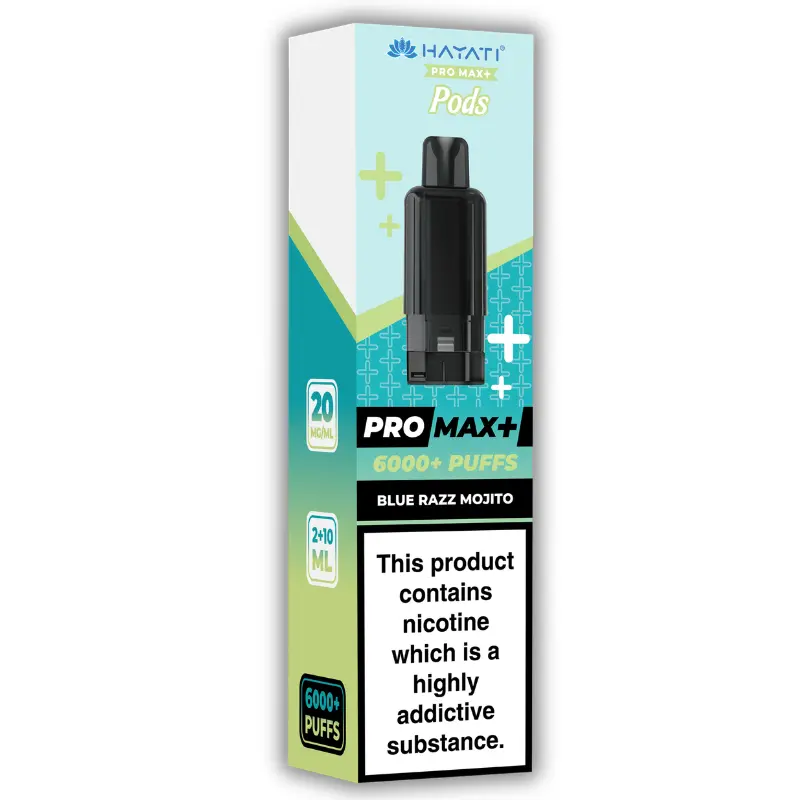
Hayati · Pro Max Plus
Blue Razz Mojito Hayati Pro Max Plus Pods
£5.49
✔ In stock — ready to ship
Genuine Hayati
Free over £20
Same-day dispatch
Secure checkout
What is on sale here is the refill by itself. One Blue Razz Mojito pod for the Hayati Pro Max Plus, £5.49, filled at the factory with 12ml of liquid at 20mg, sealed, and posted without any hardware around it. No body in the house means no use for the pod, and anybody in that position wants the Blue Razz Mojito Hayati Pro Max Plus 6000 Pod Kit at £7.99, where the device is included and the difference in price is the device. Hayati attach an upper figure of 6,000 puffs to a full pod. That number comes off bench apparatus drawing on a timer, so it ranks pod sizes against each other reasonably and tells you almost nothing about how long yours will last.
The commercial part of this listing takes one paragraph and the rest of the page is about the name, because the name is doing something unusual and almost nobody stops to notice it. Every other product on the Hayati Pro Max Plus Pods shelf is named after ingredients. Blackberry and raspberry. Mango, peach, pineapple. Those names list what is in the pod, and if the list is accurate the name has done its job. This one does something else entirely. A mojito is not an ingredient. It is a recipe with a fixed build and a fixed proportion, and a recipe can be reproduced, approximated or broken in a way that an ingredient cannot.
Which raises the question the page is here to answer. A mojito is rum, lime, sugar, mint and soda over ice. There is no alcohol in a vape liquid and there is not going to be, so one line of that recipe is not available to any formulator anywhere. A mojito-flavoured pod is therefore a mojito with the spirit deleted, which is to say lime, mint and sugar. Is what remains still coherent, or is it a lime and mint blend wearing a borrowed name? And then the harder half, because there is a second word on this label: blue raspberry belongs to a completely different tradition from anything served in a tall glass, and adding it either deepens the reference or destroys it. There is a verdict on both at the bottom, and on the second one it is not a flattering verdict, although it does end in a recommendation.
A recipe with one line missing
Set out the build properly, because the argument depends on the detail. A mojito is white rum, the juice of a lime, sugar, mint leaves bruised rather than shredded, soda water, and a quantity of ice, served long in a tall glass. Six components and a serving format, and the format is part of the identity in a way it is not for most drinks.
Five of those six have some route into a sealed pod. Lime can be rendered as an accord, and rendered well, because citrus is one of the things flavour chemistry does most convincingly. Mint can be rendered, and it is one of the few plant profiles where the vape version and the real version sit close together, since the compounds responsible are volatile and simple. Sugar is trivial. Cold can be gestured at with a coolant. The tall glass and the melting ice can be hinted at, not by any physical means but by keeping the blend thin and short-finishing so that it reads as dilute rather than as concentrate.
One component has no route at all. The rum is not an omission the formulator made on grounds of taste or cost or regulation. It was never on the table. That fact is shared by every mojito-named liquid ever produced, by every brand, in every market, which means the interesting question is never whether a particular one kept the spirit. None of them did. The question is what the deletion costs, and the answer is more interesting than the joke version of it suggests.
What the missing line was actually doing
White rum is, by design and by industry convention, among the most neutral spirits in the classic canon. Filtration strips out most of what would otherwise make it assertive, and the result is a base whose job in a mixed drink is structural rather than declarative. In a mojito specifically it supplies three things: weight on the tongue, a faint cane sweetness that is genuinely difficult to separate from the sugar already in the glass, and a solvent phase that holds the mint's volatile oils in suspension and lets them out gradually as the ice melts. What it does not supply is the thing anybody identifies the drink by. Nobody picks a mojito out of a line-up on the strength of its spirit.
Hold that against the rest of the canon and the mojito starts to look like a special case rather than a typical one. An old fashioned is whisky with two small adjustments made to it, and removing the whisky leaves sugar and a bitter tincture, which is not a drink. A negroni is three spirituous components in equal measure and no fourth thing, so subtracting any one of them produces something with no name. A martini is two components, both of them alcoholic. The mojito has the opposite construction: four non-spirit components doing all the identifying work, and one spirit doing the load-bearing work underneath them. Of the drinks a flavour house could borrow a name from, it is close to the only one that survives the subtraction with its recognisability intact.
The survivor is not a hypothetical construct either. Lime, mint, sugar and soda over ice is a drink sold in its own right, in bars, in bottles and in cans, and a good proportion of the people ordering one are ordering it because that is what they want. So a mojito-flavoured liquid is aiming at a target that exists, can be bought for very little, and can be tasted this afternoon by anyone who wants to check the pod against it. That is not a trivial property, and it is precisely the property the other half of this pod's name lacks. Our page for Blue Fusion works through the consequences of a flavour category whose only reference standard is other manufactured products, and the short version is that nothing outside the category can settle an argument about it. The mojito half of this blend is not in that position. The blue half is.
The two things a pod cannot borrow, even from the version with no spirit in it
Carbonation is the first and it is a bigger loss than the rum. Fizz is not a taste. It is carbonic acid registering on the trigeminal nerve, the same nerve that reports heat, cold and the burn of chilli, and it arrives as a percussive, granular prickle rather than as a flavour. A vape has exactly one trigeminal lever available to it and that lever is coolant. Coolant is continuous where fizz is intermittent, and cold where fizz is sharp. Reaching for a chill in order to signal a drink is the standard manoeuvre in this trade, and it is an approximation made with the nearest available sensation rather than a reproduction. Anyone who has worked through the lemonade-named liquids in this range has already met the substitution, whether or not they named it at the time.
Duration is the second. A glass takes twenty minutes and gets weaker while you hold it, so the drink you finish is not the drink you started. A draw takes two seconds and does not evolve. Whatever impression of length a liquid conveys has to be produced inside a single exhale, and the only levers for that are a short finish and a restrained sugar level, both of which make a blend read thinner and therefore longer. Whether this particular pod uses those levers is the subject of the section after next. The answer is that it half uses them, and the half it drops is the important half.
What the word is buying, once the subtraction is taken seriously
Here is the payoff of the audit. If the spirit was never available and the fizz cannot be copied, what does "mojito" tell a buyer that "lime and mint" would not? Four things, and they are all real.
- Lime rather than lemon. Not a cosmetic distinction. Lime peel is more aromatic and carries a bitter edge that lemon does not; lemon is rounder, sweeter and more purely sour. A liquid built on one is a noticeably different liquid from one built on the other, and the cocktail name fixes which.
- Leaf mint rather than confectionery mint. A mojito's mint is bruised green leaf, closer to spearmint than to peppermint, and nothing like the mint of a lozenge. The name rules out the lozenge reading without having to spell it out.
- Sugar present as syrup rather than as fruit. Sweetness with no flavour of its own attached to it is a different material from sweetness carried by a berry, and the cocktail reference specifies the first.
- A finish that is meant to read long and cold rather than dense. This is the proportion instruction, and it is the one the rest of this page is going to spend its time on, because it is the one this pod has the most trouble with.
Four pieces of information compressed into a single word, which is more than an ingredient list delivers in the same space. So the honest verdict on the first half of the question is that the name is neither a lie nor a joke. It is a shape reference rather than an ingredient reference, and a buyer who reads it as a proportion gets exactly what it says. A buyer who reads it as a promise of something heavier or more grown-up than a fruit pod is reading a meaning that is not in the word once the spirit comes out of it.
The count, because a claim like that should be testable
Assertions about what a range does and does not name are cheap, so this one was counted rather than assumed. Across the 492 listings in this catalogue, the word mojito appears seven times. No other cocktail appears at all: no colada, no daiquiri, no margarita, no sangria, no spritz, no julep, no mule. No listing anywhere in the range names a spirit of any kind. The only other drink-shaped name on the books is Pipeline Punch, and a punch is not definitionally alcoholic, so it does not have the problem this page is about.
Two readings of that, and they are probably both true. The generous one is that mojito has crossed the line into being a flavour word rather than a drink word, in the way that cola stopped referring to a specific product decades ago and became a taste. The less generous one is that it is the only cocktail whose identifying components are cheap, stable and already sitting in every flavour house's cupboard, so it is the only one worth the trouble. Lime and mint are common industrial accords. Whatever a negroni tastes like is not. Both readings are inferences drawn from a name count, and Hayati state neither.
Mint, lime, and a sweet that is not a fruit
Hayati name three components for this pod: mint, lime and blue raspberry. Naming the citrus that precisely is more than most of the range bothers with, and it matters here, because a mojito with an unspecified citrus in it is a weaker claim than one that says lime. Twenty-four of the 492 listings name a lime at all, so it is not a rare ingredient, but a listing that tells you which acid it is has told you something.
What follows is an account of how the three of them share a draw. It is a description rather than a guarantee; a blend is read differently by different palates and the same liquid in two devices is not the same experience, so use it to work out whether the balance is the balance you want rather than as a specification.
Order of arrival
Draw on it slowly and the blue leads. It is in front from the first instant and it stays in front through the inhale, broad and rounded and sweet before it is anything else. Tartness is in there but it is the soft, sherbet kind of tartness rather than an acid bite, and it functions as part of the sweetness rather than as a check on it.
The lime shows up a beat behind and it shows up as a smell before it shows up as a sour. That order is worth knowing, because it is the aromatic side of the citrus doing the work, the part that lives in the peel rather than the juice. Hold the vapour in the mouth for a second before exhaling and the lime opens considerably; take a short sharp draw and it barely registers at all. Of the three components it is the one most sensitive to how the pod is used, which is a practical observation rather than an aesthetic one and it recurs later on this page.
The mint takes the finish. It arrives last, sits underneath everything else rather than beside it, and its effect is felt more than tasted: a drying of the palate that pulls the mouth back towards neutral after the sugar has coated it. There is a cooling sensation attached and it is moderate. Nothing in the product name flags a chill, and this range does flag a chill when it means one, with Ice and Frozen and Cooler in the titles of the pods that carry it. Read the absence of those words as information, because it is.
How sweet, honestly
Sweet-led, and sweeter than the cocktail half of the name sets you up for. That is the single most useful sentence on this page for somebody deciding between pods, so it is going in plain language rather than being hedged into uselessness. The sugar is the largest single thing in the blend by volume of impression, the lime and the mint are both corrections applied to it, and the corrections are real but they are not equal to the thing they are correcting.
Practically, that shows up in two places. It shows up on the palate after a sustained stretch, when the mouth begins to feel coated in a way it did not at the start. And it shows up on the coil, because sweetened liquid leaves a residue behind that unsweetened liquid does not, which is dealt with further down. Neither of these is a defect. They are the predictable behaviour of a sugar-forward blend and they are worth knowing in advance rather than discovering in week three.
What is not in it
No alcohol, and nothing resembling it. The cocktail reference in the name describes the citrus and herb pairing and the proportion those two are mixed at, and nothing beyond that. No fizz, because a pod cannot produce one. No syrup weight, no dilution, no sensation of a long drink, all for the reasons set out above. And no realistic raspberry either: the fruit in this is a confectionery accord, which is the subject of the next section and the reason this page has a second half at all.
Blue raspberry on a mojito: addition, or replacement?
Two traditions meet on this label and they do not obviously belong together. A mojito comes out of the bar, where the organising principle is that acid and aroma keep sugar in check. Blue raspberry comes out of the sweet counter, where the organising principle is that sugar is the point and everything else is decoration on it. Putting one on top of the other is a real decision with a real consequence, and it is worth working out which way the consequence runs.
Two pages in this catalogue have already done the groundwork and there is no sense repeating either. The Blue Fusion pod listing argues that blue is a manufactured convention with no original anywhere in nature, so a blue liquid can be typical or atypical but never accurate, since accuracy requires a target that exists independently of the things being measured against it. The Blue Razz GB / Lemon & Lime listing argues what happens when a confectionery flavour and a real-fruit flavour are sold at one price under one heading, and how the two are graded with instruments that do not convert into each other. Take both as read. This page is asking a narrower question that neither of them raises: not what happens when the two logics sit side by side, but what happens when one is poured into the other.
The case that it deepens the reference
Start with the strongest version of the argument for, because it is stronger than it first looks.
A mojito already contains sugar. Sugar is in the build, in the original, in the bar's own recipe, and it is there because the drink needs it. So sweetness is not a foreign body being smuggled into a dry construction. The only live question is what kind of sweetness, and a cocktail that already tolerates syrup is not obviously going to be destroyed by tolerating something else.
More than that, fruit mojitos are an established form rather than an invention of the vape trade. Strawberry, passion fruit and raspberry versions are all standard bar variations and have been for years. Adding a berry to a mojito is a thing people actually do, and the resulting drink is still called a mojito by everyone involved, which suggests the name survives the addition in the same way it survives the subtraction of the spirit.
And blue razz is nominally a raspberry. On the face of the label this is a raspberry mojito, which is a coherent and long-established recipe rather than a marketing invention. If the argument stopped there the verdict would be that the fruit deepens the reference, brings the pod closer to a recognisable variation on the original, and gives the lime something to work against instead of working alone.
The case that it destroys it
Three arguments, and they compound rather than sitting in parallel.
First, it is not raspberry. This is the hinge and everything else follows from it. A raspberry muddled into a glass brings acid, a light astringency from the skin, and a slightly woody, dusty note from the pips. Every one of those points in the same direction as the lime, which is why a raspberry mojito works: the fruit reinforces the acid structure instead of fighting it. Blue razz brings none of the three. What it brings is a broad, rounded, ester-driven sweetness with a sherbet edge, which points in precisely the opposite direction. The substitution is therefore not fruit for fruit. It is a category swap performed under cover of a shared word, and the word is the only thing the two have in common.
Second, it attacks the one property the cocktail name promises. Go back to the four things the word buys. Three of them are ingredient specifications and the blue does not touch them: the lime is still lime, the mint is still leaf mint, the syrup is still there. The fourth is the proportion instruction, the one that says the finish should read long and cold rather than dense, and that instruction is the entire reason anyone would choose a drink-named liquid over a fruit-named one. A mojito's defining characteristic, the thing that distinguishes it from every other sweet drink, is that it is dry for its sugar content, because the lime and the dilution hold the sweetness in check and the finish clears quickly. Blue razz's defining behaviour is the exact inverse. It coats, it lingers, and the place it lingers is the finish. The addition is not neutral with respect to the name; it is targeted at the one part of the name that was carrying real information.
Third, volume decides it before anyone tastes anything. Blue razz is among the loudest accords in the whole of this range's vocabulary, built to be immediately legible through a mouthful of vapour. Lime aromatics and leaf mint are two of the quietest registers available. Put the three in one pod and the outcome is arithmetic rather than artistry. The lime is thinned, the mint is pushed into a supporting role, and the fruit occupies the ground the cocktail was supposed to occupy. Sampling is not required to predict the result, although sampling confirms it.
The verdict
It destroys the drink reference, and it produces a good pod anyway. Those two findings are not in tension and it is worth being clear about both.
Put precisely: the word order on the label is backwards relative to the contents. This is not a mojito with blue raspberry added to it. It is a blue razz with a mojito treatment applied on top. The fruit is the subject and the lime and mint are adjectives attached to it, which is the reverse of what a cocktail name implies, since in a cocktail name the drink is the subject and any fruit is the modifier. Anybody buying this because they want a drink flavour will find the drink has been demoted to a garnish. Anybody buying it as a blue razz will find the garnish is the best thing about it.
And that second reading is where the recommendation lives, because the treatment turns out to be more valuable than the reference it fails to honour. Seven of the bare-pod listings in this range lead with the words Blue Razz, and the corrections applied to the base fall into three groups. Some are corrected with a second fruit: Blue Razz Cherry adds depth and a darker sugar, Blue Razz Pineapple adds a tropical acid, and Blue Razz Blackcurrant adds genuine astringency, which of the three is the most effective correction. One is corrected with an acid and a fizz gesture, which is Blue Razz Lemonade. One is corrected with a broadening rather than a sharpening, which is Blue Razz Fruit Twist, and that listing is also where the naming history of the blue accord is argued out properly. And one is not corrected at all, which is Blue Razz GB, where the confectionery reading is the whole proposition and nothing is asked to hold it back.
This pod is the only one of the seven corrected with something that is not a fruit. That is the genuinely distinctive fact about it and it has a practical consequence, because a herb does a job no fruit does. A second fruit balances a blend in the middle of the draw, adding a flavour that competes with the first for the same space. A herb works on the finish, and it does not compete, it clears. The difference is audible on the fourth puff of a session rather than the first. A two-fruit blue tends to feel like one larger sweet thing by then. A blue with mint in it keeps handing the palate back.
So the fair summary, and the one this page will stand behind: as a mojito it does not work, because the component that was supposed to be the modifier has become the subject. As the best-behaved member of a family of sweet confectionery liquids, it works well, and for a reason nobody would guess from the name. Buy it for the second thing and it is a sound £5.49. Buy it for the first and you will spend the pod waiting for a drink that does not arrive.
One narrower case where the verdict flips
There is a group of buyers for whom the analysis above comes out the other way, and it is worth naming them rather than pretending the finding is universal. If what you want is the lime and mint pairing at low volume, as a seasoning rather than as a flavour, then a loud fruit underneath it is a feature. A pod built to put the herb in front would be a mint pod, and mint pods exist in this range in their own right for people who want them. This is not that, and it was never trying to be. It is a sweet pod with a herbal correction, and if you have previously found straight menthol profiles too austere to live with while still wanting something that clears, the ratio here is aimed squarely at you. The name oversells the cocktail. It does not oversell the blend.
The pod itself, briefly
Very little needs saying about the hardware, because it is shared with every other listing on the same shelf and none of it is specific to this liquid. One prefilled pod arrives in the packet. There is no device, no charger and no accessory of any kind, and the coil sits inside the pod as a non-serviceable part, so when the liquid is finished the coil is finished with it. That is the trade the sealed format makes: nothing to maintain, nothing to adjust, and nothing to rescue when it goes off. Match the range name printed on your device to the range name in the product title before ordering, because Hayati make several pod formats and a compatibility decision should not be taken from a retail page.
The specification that actually matters for this liquid is not a hardware figure at all. It is that the 12ml arrives as one sealed volume at a ratio somebody else set. On a single-fruit pod that is neither here nor there, since there is no ratio to argue about. On a three-register blend it is the whole story, because everything worth discussing above is a question of proportion, and the proportion is fixed at the factory and cannot be moved by anything you do. There is no dilution available, no second liquid to add, no setting to change. If the blue is louder than you want it, that is the pod for the next few weeks, and the only remedy is a different listing.
The rest of the platform is documented across the Hayati Pro Max Plus Pods shelf, and the wider set of replacements for every Hayati device sits on Hayati Prefilled Pods & Refills, which is the right page to browse when you are filling a gap rather than choosing a flavour. Nothing else about the hardware is published in this product's own data, and where a figure is absent this page leaves it absent rather than borrowing one from a neighbouring listing.
What is on the sheet
The published facts for this product are short. They are reproduced below in the order that matters for a buyer working out whether the blend suits them, which is not the order a spec sheet usually takes.
| Named in the blend | Mint, lime, blue raspberry |
| Chill flagged in the title | No such word appears |
| Liquid volume | 12ml, sealed at the factory |
| Nicotine | 20mg per millilitre |
| Price | £5.49 |
| What arrives | One prefilled pod and nothing else |
| Device required | A Hayati Pro Max Plus, supplied by you |
| Bench figure | Up to 6,000 puffs, laboratory conditions |
| Maker | Hayati |
| Shelves | Pro Max Plus Pods, Hayati Pods, Prefilled Pods & Refills, Berry Vapes, Raspberry Vapes, New Products |
The top two rows are the ones a buyer of this particular pod should read first, which is why they are at the top. The ingredient row is unusually specific by the standards of this range and the chill row is an absence rather than a value, but an absence with meaning, since the range is consistent about announcing a hard cooling in the product name and this name announces nothing.
On the economics, a 12ml pod at £5.49 works out at roughly forty-six pence per millilitre, and the interesting thing about that figure is what it buys on a blend like this one. A single-fruit pod at the same price is selling you a flavour. A three-register blend is selling you a ratio, and a ratio is a thing you cannot inspect before purchase and cannot adjust afterwards. That makes the first pod a genuine gamble in a way that a strawberry pod is not, and it is the reason this page has spent as long as it has on where the balance actually sits. Forty-six pence a millilitre is not much to be wrong by, but twelve millilitres is a long time to be wrong for.
The 20mg figure is the ceiling permitted in the United Kingdom and the listing records it without describing the formulation, so the number is all this page will state about it. One observation that is specific to this blend rather than generic: a cooled liquid occupies some of the same sensation at the back of the throat that nicotine does, so moving from this pod to an uncooled pod at an identical strength tends to make the uncooled one read as more present. Same number on both labels, different impression, and it regularly catches people out mid-rotation. Nicotine is addictive, and how much of it anyone uses is not this page's business.
Four things are absent from the sheet and their absence is worth naming so the silence is not mistaken for an oversight on this page. Hayati publish no carrier ratio for this pod, no coil resistance, no source for the cooling, and no nicotine formulation. Those gaps are in the source data rather than in this description, and none of them has been filled in by inference from a sibling listing.
Where it sits against the neighbours
Eighty-nine listings share this shelf, so the useful question is never whether this pod is any good in the abstract. It is which of its neighbours it displaces, and the answer depends entirely on which half of the name brought you here.
If you came for the mojito
The other mojito on this shelf is Strawberry Raspberry Mojito, and between the two it is the closer to the drink, for the reason the whole of this page has been about. Its fruit half is two real berries rather than a confectionery accord, which means the fruit brings acid of its own and reinforces the lime instead of smothering it. That listing is also where the argument about running a herbal pod alongside other pods is made, so anybody weighing how a mint-bearing liquid affects the rest of a drawer should read it there rather than here.
If the appeal is the sharpness rather than the herb, the acid-led route through this shelf is worth taking instead. Blue Sour Raspberry keeps the blue base and swaps the aromatic citrus for a flatter, harder sourness that sits on the sides of the tongue rather than spreading through the nose. Red Sour Raspberry does the same thing on a red base, which reads slightly more like fruit and slightly less like a sweet. Neither of them clears the palate the way a mint does, and both are considerably more aggressive about the acid.
If you came for the blue
Then the comparison set is the six other blue razz pods listed earlier, and the ordering principle is how hard the sugar is held down. Blue Razz GB holds it down not at all and is the reference point for what the accord does when nothing is asked of it. Blue Razz Lemonade holds it down with acid and is the nearest thing on the shelf to this pod's proposition, since it also reaches for a drink reference. The difference between the two is that a lemonade is a drink whose flavour is entirely sugar and acid, so nothing about it is lost in translation to a pod, whereas a cocktail loses its spirit and its fizz on the way in. That makes the lemonade the more faithful reference and this one the more interesting blend.
Blueberry B'Gum is worth naming for contrast rather than similarity. It is the listing on this shelf that says outright which confectionery register it belongs to, and comparing it against this pod is a quick way to hear how much work the mint is doing here, since the two share a manufactured sweetness and only one of them has anything holding it back.
If you want the berries real
Several pods on the same shelf take the opposite approach and build on fruit that exists. Blackberry Raspberry is the darkest and most structurally sound of them, tart through the middle with no cooling at all and no confectionery register anywhere in it. Blueberry Raspberry is the plainer blue pairing, rounder and sweeter, and it is the pod you would arrive at by removing everything this page has been discussing. Blueberry Raspberry Cherry adds a third berry and a little more weight, and Blueberry Cherry Cranberry brings the only genuine astringency in that group, which is a different kind of dryness from the one a mint produces and arrives earlier in the draw.
Across on the red side, Strawberry Raspberry Blueberry and Strawberry Raspberry Cherry are the uncomplicated three-berry options, sweet and soft and with nothing correcting them, and Mixed Berries spreads the fruit more evenly than either. White Peach Raspberry keeps a raspberry in the blend but replaces the confectionery register with a softer stone fruit, and is a considerably quieter pod than this one in every respect.
If it is the cold you want
This is not a cold pod and it should not be bought as one. Strawberry Raspberry Ice applies its chill by the direct route, with a coolant announced in the title and no herb involved, which is a different sensation from the one here and a much larger one. The distinction is worth holding on to: cooling applied through a mint is attached to a flavour and behaves like part of the blend, whereas cooling applied as a coolant is a sensation sitting on top of the blend. People who like one frequently do not like the other, and the titles tell you which you are getting.
The same idea in other formats
Blue razz runs right through the Hayati ranges and the larger formats change the arithmetic rather than the flavour. Blue Razz GB Hayati Pro Ultra Plus Pods at £7.99 puts the uncorrected confectionery reading into a much larger pod, which is a long commitment to a loud flavour. Blue Razz Cherry / Blue Razz GB is a single pod divided into two reserves with a rotating mouthpiece selecting which one feeds the coil, so it offers two readings of the same accord in one purchase. Blackcurrant Cotton K / Blue Raspberry pairs the blue with a spun-sugar profile, which is the confectionery direction taken as far as it goes.
Two more worth knowing about. Blueberry Raspberry Lemon treats its citrus as a third fruit with its own sweetness and body rather than as a corrective, which is a genuinely different construction from the one here and a good illustration of the difference. Raspberry Cola is the only other listing in the range that puts a manufactured drink accord next to a berry, and the comparison is instructive, because cola made the crossing from drink to flavour word successfully in a way this page has argued the mojito has not.
For a cheaper way to find out whether a blue base suits you at all, Blueberry Raspberry Hayati Rubik Pods at £3.99 hold considerably less liquid, so being wrong costs less. The full blue and berry population is on the Berry Vapes shelf, and Raspberry Vapes narrows it to the listings where a raspberry of some description is in charge, whether or not an actual raspberry was ever involved.
Running this one well
Generic advice about sealed pods applies to every product in the format and is on the shelf page. What follows is tied to the specific problem of a blend whose two quietest components are the ones you bought it for.
The lime is the first thing you will lose, and it will not be the pod's fault. Aromatic citrus is the most volatile material in this blend, and it is the first casualty of two separate processes: residue accumulating on a coil, which filters fine top notes before it affects anything else, and your own palate adapting to a sweetness it has been reading all week. The blue will still be there long after the lime has gone quiet, because a loud accord survives conditions a delicate one does not. When the pod starts tasting like a plain blue sweet, the mojito half has not been removed from the liquid. It has stopped reaching you.
Draw length is the one lever you have over the balance. Since the lime arrives as an aroma before it arrives as an acid, it needs a moment of warmth in the mouth to volatilise. A long, slow draw with a brief hold before the exhale gives it that moment and shifts the whole blend towards the cocktail half. A short sharp pull goes straight past it to the fruit. That is not a trick and it will not transform the pod, but it is the difference between the two readings of this liquid and it costs nothing to use.
Let the herb do its job by leaving gaps. Mint clears the palate between draws, and clearing takes a few seconds of not drawing. Puff continuously and the clearing never happens, the sugar accumulates, and by the twentieth draw you are vaping the blue on its own with a cold sensation you have stopped noticing. The blend is designed around an interval and it repays one. Ten to fifteen seconds is usually enough.
Judge the pod on the second half, not the first. A sugar-forward liquid is at its most flattering when everything is new, and the honest test of this one is whether the lime and mint are still audible at the eight millilitre mark. If they are, the balance is holding and the pod is doing what it was bought for. If the blend has collapsed into sweetness by then, you have your answer about whether the corrections in this recipe are strong enough for your palate, and the acid-led alternatives named above will serve you better next time.
Store it upright, somewhere cool and dark, and do not stockpile it. Warmth and light are what drive the loss of volatile top notes, and this is a blend where the volatile top notes are the reason to buy it. A spare pod sitting in a warm drawer for four months will have a quieter lime than the one you open today, and nothing about that is a fault in the product. Buy the pod you are about to open rather than a row of them. Keep it where children and pets cannot reach it.
When it is done, it is waste electronics. A spent pod contains a coil and a residue of liquid, so it does not belong in a household bin. Vape retailers and local authority recycling sites take them, and the pod is small enough that saving several and dealing with them together is the practical approach.
Questions this listing raises
Is there any alcohol in this?
No, and there could not be. Vape liquid does not contain alcohol as a flavouring component, so the spirit named in the cocktail is not a thing any manufacturer could put in a pod even if they wanted to. The mojito reference describes the lime and mint pairing and the proportion those two are mixed at, and that is the whole of what the word is doing on this label.
So does it actually taste like a mojito?
Not really, and the reason is the fruit rather than the missing spirit. A mojito without its spirit is still recognisably lime, mint and sugar, which a pod can render. What a pod cannot render is the fizz or the length of a long drink, and what this particular pod does on top of that is put a loud confectionery sweetness in front of the lime and the mint. Read the name as a description of two accents on a blue razz base and it is accurate.
How much cooling is in it?
Moderate, and it comes from the mint rather than from a coolant announced in the title. This range flags a hard chill in the product name with words like Ice and Frozen, and no such word appears here. The chill registers on the exhale, sits for a second or two and clears, and it functions as a counterweight to the sugar rather than as a sensation in its own right.
Which is louder, the blue or the mojito half?
The blue, by a clear margin, and it is not close. The fruit leads the inhale and holds most of the exhale, with the lime cutting across it and the mint taking the last part of the finish. Anybody weighing this pod should decide whether they want a sweet liquid with a herbal correction, because that is what it is, rather than a drink flavour with a berry in it.
Is this the same liquid as the kit version?
Yes. The Blue Razz Mojito Hayati Pro Max Plus 6000 Pod Kit at £7.99 contains the same 12ml pod with a device in the box, and this listing is the pod on its own for £5.49. The gap between the two prices is the hardware and nothing else.
How does it differ from Strawberry Raspberry Mojito?
Both take the same lime and mint treatment, so the difference is entirely in what sits underneath. Strawberry Raspberry Mojito puts two real berries under it, which bring their own acid and pull in the same direction as the lime. This one puts a confectionery accord under it, which pulls the other way. The red version is closer to the drink; this one is sweeter and louder.
If I like this, what should I try next?
It depends which part you liked. For the same clearing effect with more acid underneath it, Blue Razz Blackcurrant is the nearest thing on the shelf. For the confectionery sweetness without any correction applied, Blue Razz GB is the reference. For a drink reference that translates into a pod more completely, Blue Razz Lemonade is the one to take.
Is the mint strong enough to notice if I do not like mint?
Yes, it is clearly present, and anybody who actively dislikes a herbal note should not buy this one on the strength of the fruit in the title. It is mixed well below the blue and it never takes a solo, but it holds the finish and it is the last thing in the mouth after every exhale. A person who wants the same base without any herb in it is better served by one of the fruit-corrected blue razz pods named on this page.
What does the 6,000 figure actually tell me?
Less than it appears to. It is an upper bound produced on laboratory apparatus taking identical draws on a fixed cycle, so it compares pod sizes against one another sensibly and forecasts nobody's week. Draw length, frequency and how much of the day you spend on this pod rather than another one all move the real number a long way, in both directions.
Can I make the lime come through more?
To an extent, yes. The citrus in this blend is aromatic rather than purely sour, so it needs a moment of warmth to open up, and a long slow draw with a brief hold before the exhale will get noticeably more of it than a short sharp pull. Nothing else on the device is adjustable, so that is the only lever available, and it stops working once a coil has accumulated enough residue to filter the fine notes out.
Is it worth buying two at once?
Probably not. A 12ml pod is in service for a long stretch, so a spare sits unopened for weeks or months, and the part of this blend that fades in storage is the part you bought it for. The volatile citrus is the first thing to go quiet in a pod that has been waiting. One at a time keeps every pod you open close to the condition it left the factory in.
Does the sweetness affect how long the pod tastes right?
It does. Sweetened liquid leaves a residue on a coil that unsweetened liquid does not, and the residue muffles fine top notes before it affects anything else, so the lime will quieten well before the blue does. Expect the balance to shift towards the fruit over the life of the pod rather than the whole thing fading evenly, and judge the pod's condition by whether the citrus is still audible.
The short version
Blue Razz Mojito as a bare pod is £5.49 for 12ml at 20mg, a refill for a Pro Max Plus you already own, with no hardware in the packet. The blend is mint, lime and a confectionery blue raspberry, and the fruit leads comfortably.
The argument of this page has two halves. On the cocktail name, the subtraction is real but survivable: the spirit in a mojito is the component doing the least identifying work, the lime and mint and sugar that remain are a drink people order in their own right, and the word buys a buyer four pieces of information that an ingredient list would not. What a pod genuinely cannot borrow is the fizz and the length, and those are approximated with a coolant because a coolant is the only lever available.
On the blue razz, the verdict goes the other way. It is not a raspberry, it does not reinforce the lime the way a real berry would, and it attacks the one property the cocktail name was carrying, which is the short, dry finish. This is a blue razz with a mojito treatment on it rather than a mojito with a berry in it, and the label has the subject and the modifier the wrong way round.
Which still leaves a pod worth the money, for a reason the name does not advertise. Of the seven blue razz listings in this range, this is the only one corrected with something that is not a fruit, and a herb clears the palate where a second fruit merely competes with the first. That is a real advantage and it shows up from the fourth puff onwards. Buy it as the best-managed member of a family of loud sweet liquids and it delivers. Buy it as a drink and you will be waiting.
Strictly for adults aged 18 and over. Nicotine is an addictive substance.
You might also like


